Entity Set Expansion using Interactive Topic Information
Kugatsu Sadamitsu, Kuniko Saito, Kenji Imamura and Yoshihiro Matsuo NTT Media Intelligence Laboratories, NTT Corporation
1-1 Hikarinooka, Yokosuka-shi, Kanagawa, 239-0847, Japan
{sadamitsu.kugatsu, saito.kuniko, imamura.kenji, matsuo.yoshihiro}
@lab.ntt.co.jp
Abstract
We propose a new method for entity set expan-sion that achieves highly accurate extraction by suppressing the effect of semantic drift; it requires a small amount of interactive infor-mation. We supplement interactive informa-tion to re-train the topic models (based on in-teractive Unigram Mixtures) not only the con-textual information. Although the topic infor-mation extracted from an unsupervised corpus is effective for reducing the effect of seman-tic drift, the topic models and target entities sometimes suffer grain mismatch. Interactive Unigram Mixtures can, with very few interac-tive words, ease the mismatch between topic and target entities. We incorporate the inter-active topic information into a two-stage dis-criminative system for stable set expansion. Experiments confirm that the proposal raises the accuracy of the set expansion system from the baselines examined.
1 Introduction
The task of this paper is entity set expansion in which the lexicons are expanded from just a few seed entities (Pantel et al., 2009). For example, the user inputs the words “Apple”, “Google” and “IBM”, and the system outputs “Microsoft”, “Face-book” and “Intel”. Many set expansion and relation extraction algorithms are based on bootstrapping al-gorithms (Thelen and Riloff, 2002; Pantel and Pnacchiotti, 2006), which iteratively acquire new en-tities from corpora. These algorithms suffer from the general problem of “semantic drift”. Semantic
drift moves the extraction criteria away from the ini-tial criteria demanded by the user and so reduces the accuracy of extraction.
Recently, topic information is being used to alle-viate semantic drift. Topic information means the genre of each document as estimated by statistical topic models. Sadamitsu et al. (2011) proposed a bootstrapping method that uses unsupervised topic information estimated by Latent Dirichlet Alloca-tion (LDA) (Blei et al., 2003) to alleviate semantic drift. They use a discriminative method (Bellare et al., 2006) in order to incorporates topic information. They showed that the use of topic information im-proves the accuracy of the extracted entities.
Although unsupervised topic information has been confirmed to be effective, the topic models and target entity sometimes demonstrate grain mis-match. To avoid this mismatch, we refine the topic models to match the target entity grain. Deciding the entity grain from only positive seeds is diffi-cult (Vyas et al., 2009). For example, the positive seed words are “Prius” and “Civic”. In this situa-tion, whether “Cadillac” is positive or negative de-pends on the user’s definition. If the user thinks that “Japanese car” is positive grain, “Cadillac” should be placed into the negative class but if “car” is the positive grain it should be placed into the positive class. Note that we use the term “class” to refer to a set of entities denoted asCP.
We control the topic models using not only pos-itive seed entities but also a very small number of negative entities as distinguished from the output of the preliminary set expansion system. To implement this approach, we need topic models that offer
trollability through the addition of negative words and high response speed for re-training. We utilize a variation of interactive topic models: interactive Un-igram Mixtures (Sadamitsu et al., 2012). In a later section, we show that proposed method improves the accuracy of a set expansion system.
2 Set expansion using Topic information
2.1 Basic bootstrapping methods with discriminative models
In this section, we describe the basic method adopted from Bellare et al. (2006) since it offers easy handling of arbitrary features including topic information. At first,Nentpositive seed entities and
Nattr seed attributes are given. The set of posi-tive entity-attribute tuple,TP, is obtained by taking the cross product of seed entity lists and attribute lists. Tuples TP are used as queries for retrieving some documents, those that include a tuple present inTP. Document setDent,attr that includes the tu-ple{ent, attr}is merged as an example to alleviate the sparseness of features.
Candidate entities are restricted to just the named entities that lie in close proximity to the seed at-tributes. Discriminative models are used to calcu-late the discriminative positive score, s(ent, attr), of each candidate tuple, {ent, attr}. Their system
extractsNnew new entities with high scores at each iteration as defined by the summation ofs(ent, attr) for all seed attributes (AP); the condition is
∑
attr∈AP
s(ent, attr)>0. (1)
Note that we do not iteratively extract new attributes because our purpose is entity set expansion.
2.2 Bootstrapping with Topic information The discriminative approach is useful for handling arbitrary features. Although the context features and attributes partly reduce entity word sense am-biguity, some ambiguous entities remain. For ex-ample, consider the class “car” with the attribute of “new model”. A false example is shown here: “A new model of Android will be released soon. The attractive smartphone begins to target new users who are ordinary people.” The entity “Android” be-longs to the “cell-phone” class, not “car”, but ap-pears with seed attributes or contexts because many
“cell-phones” are introduced in “new model” as oc-curs with “car”. By using topic, i.e. the genre of the document, we can distinguish “Android” from “car” and remove such false examples even if the false entity appeared with positive context strings or attributes.
Sadamitsu et al. (2011), the most relevant work to our current study, can disambiguate entity word senses and alleviate semantic drift by extracting topic information from LDA and adding it as dis-criminative features. The topic models can calculate the posterior probability p(z|d)of topicz in
docu-ment d. For example, the topic models give high
probability to topic z =”cell-phone” in the above example sentences1. This posterior probability is
ef-fective for discrimination and is easily treated as a global feature of discriminative models. The topic feature value φt(z, ent, attr) is calculated as fol-lows,
φt(z, ent, attr)∝
∑
d∈Dent,attr
p(z|d). (2)
They also use topic information for selecting nega-tive examples which are chosen far from the posinega-tive examples according to the measure of topic similar-ity.
There are other similar works. Pas¸ca and Durme (2008) proposed clustering methods that are effec-tive in terms of extraction, even though their clus-tering target is only the surrounding context. Ritter and Etzioni (2010) proposed a generative approach to allow extended LDA to model selection prefer-ences. Although their approach is effective, we adopt the discriminative approach and so can treat arbitrary features including interactive information; moreover, it is applicable to bootstrapping methods.
3 Set expansion using Interactive Topic Information
3.1 Interactive Topic Information
Although topic information is effective for alleviat-ing semantic drift, unsupervised topic information raises several problems. For example, Sadamitsu et al. (2011) reported that their set expansion system reached only 50% in the fine grained class “car”;
1zis a random variable whose sample space is represented
an analysis showed that the nearest topic was mixed with “motorcycle”. These classes are hard to distin-guish even when both context and topic information are used simultaneously because they have similar context and topic information. One reason for the ineffectiveness of topic information is that the top-ics in topic models have grain sizes that are inap-propriate for the target class in set expansion. Even when we use seed entities for modeling the semi-supervised topic models, as in (Andrzejewski et al., 2009), estimating the appropriate grain size is dif-ficult because of a lack of information about other topics and contra-examples.
In order to control grain size in topic models, this section introduces interactive topic models that per-mit free control via human interaction. This interac-tion also includes some negative examples which are very effective in modifying the topic models. Topic model modification is now possible with the recent proposal of the Interactive Topic model (ITM) (Hu and Boyd-graber, 2011), which is based on LDA with the Dirichlet Forest prior (Andrzejewski et al., 2009). ITM makes it possible to accept the alter-ations input by users and to revise the topic model accordingly. Although ITM can modify a topic model, the calculation cost is high because it uses Gibbs sampling. The factor of processing overhead is very important because the user must wait for sys-tem feedback before interaction is possible. If user-interactivity is to be well accepted, we need to raise the response speed.
3.2 Interactive Unigram Mixtures
To obtain faster response, we utilize interactive Un-igram Mixtures (IUMs) (Sadamitsu et al., 2012). This section details IUMs. IUMs are based on the simplest topic model, Unigram Mixtures (UMs) (Nigam et al., 2000) which are defined as
p(D) =
D
∏
d=1
∑
z
p(z)∏
v
p(v|z)n(v,d), (3)
whereD is a set of documents,da document, za
hidden topic of a document,vis word type,n(v, d) is the word count of v in document d. p(z) and
p(v|z)are the model parameters of UMs. Their ap-proach is to use the standard EM algorithm to esti-mate UMs. The estimation is achieved by
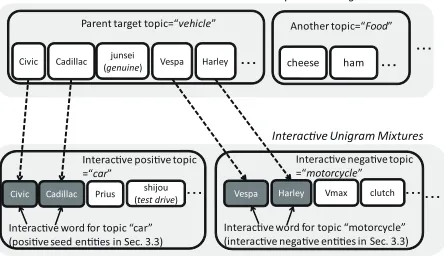
comput-Figure 1: The abstract of interactive Unigram Mixtures with their characteristic topic words. The words in col-ored boxes are supervised words and the words in white boxes are the characteristic words extracted automati-cally. Note that, some characteristic topic words are not entity words.
ing the following formulae,
p(v|z) =
∑
dn(v, d)p(z|d)
∑
v
∑
dn(v, d)p(z|d)
(4)
p(z) =
∑
dp(z|d)
|D| , (5)
where p(z|d) is called the posterior probability of topiczfor documentd. For UMs, posterior
proba-bilityp(z|d)is calculated in E-step by the following formula,
p(z|d) = p(z)
∏
vp(v|z)n(v,d)
∑
zp(z)
∏
vp(v|z)n(v,d)
. (6)
UMs are not only faster than Gibbs sampling be-cause only the standard EM algorithm is used, but they also make it easy to employ parallel processing (e.g. Map-Reduce).
puni(v) is a unigram model parameter for all doc-uments. Note that, some characteristic topic words are not entity words because topic models describe all of words not only entity words (e.g. “clutch”in the “motorcycle” class).
In IUMs, we can focus on just a single parent topic which includes a subset of all documents e.g. vehicle. After creating unsupervised UMs, each document is clustered in topiczif its posterior
prob-ability satisfiesp(z|d)≥0.5. Most documents meet this condition because UMs are uni-topic models un-like LDA, which offers multi-topic models. IUMs can be updated faster by this hard constraint because they process only the subset of documents.
In order to construct controlled topic models us-ing very few supervised words, IUMs use supervised posterior probabilityps(z|ds). ps(z|ds)is the prob-ability of topicz according to documentdsthat in-cludes supervised words and is calculated as
ps(z|ds) =
nds(z) Nds
, (7)
wherends(z)is the number of supervised words in
documentdsthat belong to topicz.Nds is the
num-ber of supervised words that belong to any topic,
Nds =
∑
znds(z). ps(z|ds) is used instead of the
E-step in estimating UMs (Eq. 6). For example, we consider two documents,{Civic, Cadillac} ∈ ds1 and{Civic, V espa} ∈ ds2. The supervised pos-terior probability of ds1 and ds2 is calculated as
ps(z = “Car00|ds1) = 1andps(z = “Car00|ds2) = 0.5,ps(z= “Motorcycle00|ds2) = 0.5, respectively. These hypotheses can expand the supervised infor-mation from the word level to the document level.
The supervised posterior probability,ps(z|ds), is too radical to be believed completely, so it is inter-polated from the calculated posterior probabilities by the standard E-step in later iterations in the EM algorithms. The interpolated posterior probability
pi(z|ds)is calculated as
pi(z|ds) =w·ps(z|ds) + (1−w)·pc(z|ds). (8)
In the initial EM iteration, the interpolation weight
wis set to1, which means that only the supervised posterior probability is used. Interpolation weight
w is decreased with each iteration. In early
itera-tions,wtakes a high value to permit model learning
Figure 2: The structure of our system.
to closely approach the supervised structure. In later iterations,wis given a low value to adjust the total balance of model parameters from the perspective of probabilistic adequacy.
We note that the initial parameters are very impor-tant for modeling interactive topics appropriately. If the initial parameters are given at random, the model might converge on an inadequate local minima. To avoid this, the initial parameters are set to the parent topic model parameters.
3.3 Applying interactive Unigram Mixtures to set expansion
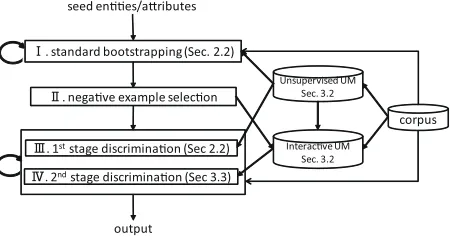
In this section we describe how to apply IUMs to set expansion in agreement with user’s intuition. Our system’s diagram is shown in Figure 2.
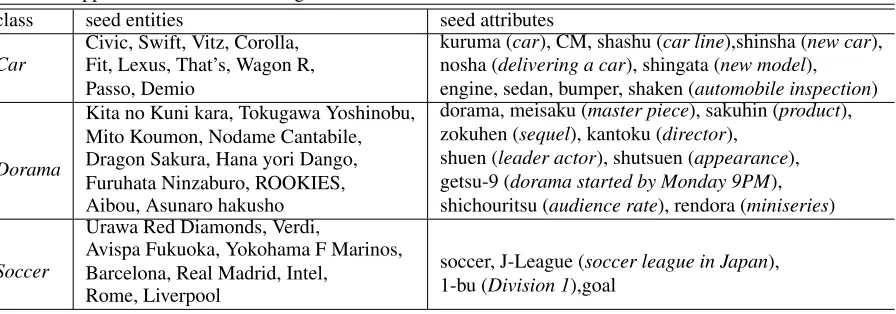
Table 1: Seed entities and seed attributes. The words surrounded by bracket are translation English. The words without brancket are appeared in Katakana or English itself.
class seed entities seed attributes
Car Civic, Swift, Vitz, Corolla,Fit, Lexus, That’s, Wagon R, Passo, Demio
kuruma (car), CM, shashu (car line),shinsha (new car), nosha (delivering a car), shingata (new model), engine, sedan, bumper, shaken (automobile inspection)
Dorama
Kita no Kuni kara, Tokugawa Yoshinobu, Mito Koumon, Nodame Cantabile, Dragon Sakura, Hana yori Dango, Furuhata Ninzaburo, ROOKIES, Aibou, Asunaro hakusho
dorama, meisaku (master piece), sakuhin (product), zokuhen (sequel), kantoku (director),
shuen (leader actor), shutsuen (appearance), getsu-9 (dorama started by Monday 9PM), shichouritsu (audience rate), rendora (miniseries)
Soccer
Urawa Red Diamonds, Verdi,
Avispa Fukuoka, Yokohama F Marinos, Barcelona, Real Madrid, Intel,
Rome, Liverpool
soccer, J-League (soccer league in Japan), 1-bu (Division 1),goal
gives the highestscore(z),
zp = arg max
z score(z), (9)
score(z) = ∑
v∈EP
p(z)p(v|z)
∑
z0p(z0)p(v|z0)
, (10)
wherep(z), p(v|z)are unsupervised UMs model pa-rameters. Finally, the posterior probability calcu-lated by IUMs is used as topic features as per the description in Sec 2.2.
Also we utilizes interactive negative entities not only for re-estimating the topic model but also for training the discriminative models as negative exam-ples. Since there are only few interactive negative entities, we expand them by assuming that an en-tity co-occurring with an interactive negative class (CIN) can be taken as negative entity “EIN0”. To
summarize, interactive negative entity-attribute tu-ples “TIN” are defined as in
TIN =EIN×(CIN +AP) +EIN0×CIN,
where×indicates cross product. TIN andTP (de-scribed in Sec.2.1) are used as training data for dis-criminative models, negative and positive examples, respectively.
For using interactive information effectively, we adapt two stage discrimination. The first stage is the same as the original set expansion system with unsupervised topic model (described in Sec. 2.2); it achieves coarse grain general selection (“III ” in Figure 2). In the second stage, the system trains a discriminative model using the same number of pos-itive and negative tuples selected fromTP andTIN
respectively with interactive topic information cal-culated by IUMs (“IV” in Figure 2). The system uses the trained discriminative model in the second stage to re-score the selected candidates from the first stage.
Although the single step discriminative approach can be utilized by usingTINin the first stage as the supervised data, this would degrade discrimination performance. The discriminative models could not train fine and coarse grain simultaneously as same as UMs. In preliminary experiments on the one stage method, we confirmed that the system outputs many inadequate entities belonging to wrong topics in the sense of coarse grain.
McIntosh (2010) proposed the method most sim-ilar to ours. In McIntosh (2010), only negative en-tities are clustered based on distributional similarity. We cluster not only the entities themselves but also their topic information.
Vyas and Pantel proposed an interactive method for entities refinement and improved accuracy of set expansion (Vyas and Pantel, 2009). They utilized the similarity method (SIM) and feature modifica-tion method (FMM) for refinement of entities and their local context features.
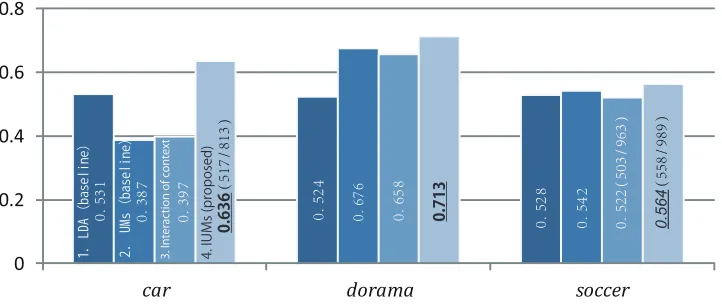
Figure 3: Results for the three classes “car”, “dorama” and “soccer team”. Bold font indicates that the difference in accuracy between proposal and best of baseline is significant by binomial test withP <0.05and italic font indicates
P <0.1.
4 Experiments
4.1 Experimental Settings
The experimental parameters follow those of the ex-periments in Sadamitsu et al. (2011). We used 30M Japanese blog articles crawled in May 2008. The documents were tokenized, chunked, and labeled with IREX 8 named entity types (Fuchi and Tak-agi, 1998; Suzuki et al., 2006), and transformed into context features. The context features were defined using the template “(head)ent. (mid.) attr. (tail)”. The words included in each part were used as sur-face, part-of-speech, and named entity label features with added position information. Maximum word number of each part was set at2. The features have to appear in both the positive and negative training data at least5times.
In the experiments, we used three classes, “car”, “dorama” and “soccer team” since they often suf-fer semantic drift. The adjustment numbers for the basic setting areNent = 10, Nattr = 10, Nnew =
100,|CIN| = 2. Note that, for confirmation in a more severe situation, we setNattr = 4,|CIN|= 1 in “soccer” class. After running 10 Bootstrapping iterations, we obtained 1000 entities in total. The seed entities and attributes for each class are shown in Table 1
SV Mlight (Joachims, 1999) with a second or-der polynomial kernel was used as the discrimina-tive model. Unsupervised UMs and unsupervised LDA were used for training100mixture topic
mod-els. Parallel LDA, which is LDA with MPI (Liu et al., 2011), was used for training and inference for LDA. For training IUMs, we set the mixture num-ber of child topics to5, that covers both interactive and other unsupervised topics about each class. The other unsupervised topics, (5− (|CIN|+|CP|)), catch the other structure in the parent topiczp, where |CP|always equal to1.
Four settings were examined.
• First is a baseline method using unsupervised topic information with LDA (without interac-tion); it is described in Sec. 2.2.
• Second is similar to first but the topic models, LDA, are replaced by unsupervised UMs.
• Third is the second setting with the addition of the set of interactive tuples,TIN, for re-training discriminative models using only context infor-mation. This setting allows confirmation of just the IUMs effect by comparison to fourth set-ting which also models interactive topic infor-mation.
• Fourth, proposed, is the third setting with the addition of the IUMs learned from the set of interactive tuples,TIN.
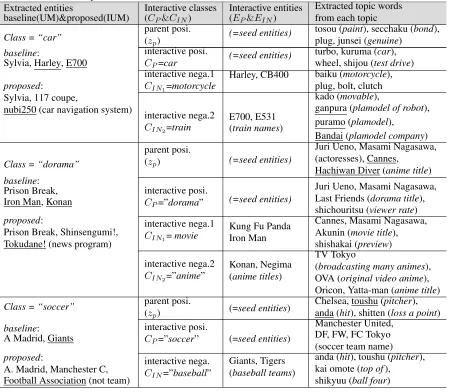
Table 2: Examples of extracted entities (first column) and characteristic topic words extracted from UMs and IUMs (fourth column). This table also shows interactive supervised positive and negative classes (second column) and their supervised entities (third column). The words with underline are incorrect extracted entity in the first column and incorrect characteristic topic words in the fourth column.
Extracted entities
baseline(UM)&proposed(IUM) Interactive classes(CP&CIN)
Interactive entities (EP&EIN)
Extracted topic words from each topic
Class = “car” parent posi.(zp) (=seed entities) tosou (plug, junsei (paint), secchaku (genuine) bond), baseline:
Sylvia, Harley, E700 interactive posi.CP=car
(=seed entities) turbo, kuruma (car),
wheel, shijou (test drive)
proposed: interactive nega.1CIN1=motorcycle
Harley, CB400 baiku (motorcycle), plug, bolt, clutch Sylvia, 117 coupe,
nubi250 (car navigation system) interactive nega.2
CIN2=train
E700, E531 (train names)
kado (movable),
ganpura (plamodel of robot), puramo (plamodel),
Bandai (plamodel company)
Class = “dorama”
parent posi.
(zp) (=seed entities)
Juri Ueno, Masami Nagasawa, (actoresses), Cannes,
Hachiwan Diver (anime title)
baseline: Prison Break,
Iron Man, Konan interactive posi.CP=”dorama” (=seed entities)
Juri Ueno, Masami Nagasawa, Last Friends (dorama title), shichouritsu (viewer rate)
proposed:
Prison Break, Shinsengumi!, Tokudane! (news program)
interactive nega.1
CIN1=movie
Kung Fu Panda Iron Man
Cannes, Masami Nagasawa, Akunin (movie title), shishakai (preview)
interactive nega.2
CIN2=”anime”
Konan, Negima (anime titles)
TV Tokyo
(broadcasting many animes), OVA (original video anime), Oricon, Yatta-man (anime title)
Class = “soccer” parent posi.
(zp) (=seed entities)
Chelsea, toushu (pitcher), anda (hit), shitten (loss a point)
baseline:
A Madrid, Giants interactive posi.CP=”soccer” (=seed entities)
Manchester United, DF, FW, FC Tokyo (soccer team name)
proposed:
A. Madrid, Manchester C, Football Association (not team)
interactive nega.
CIN=”baseball”
Giants, Tigers (baseball teams)
anda (hit), toushu (pitcher), kai omote (top of),
shikyuu (ball four)
(1231entities) were double checked and theκscore
for agreement between evaluators was0.843.
4.2 Results
Figure 3 compares the accuracy of the four methods. If the number of extracted examples is lower than 1000, i.e. Eq. 1 was unsatisfied, the figure shows the number of extracted examples and the correct num-ber in brackets. At first, we compare two baseline methods, first and second bar, that use different un-supervised topic models. The result is that “UMs” are superior to “LDA” in “dorama” but inferior in “car”. They yield more variability than “LDA”. One reason for this is that UMs are uni-topic models
which leads to over-fitting. Uni-topic models de-scribe most documents by one topic. For uni-topic models, setting a small number of topics (topic grain size is large) suits large topics rather than than small topics because the latter would have to be merged to match the grain size. Conversely, setting a large number of topics suits small topics rather than large topics because the latter would have to split. This restriction can degrade accuracy significantly. LDA smoothes the topics due to its multi-topic modeling. The third setting shows that the interactive tuples
indi-cates that context is not effective in terms of discrim-ination with fine grain, because at this grain posi-tive context is similar to negaposi-tive context. Proposed, on the other hand, offers improved accuracy in all classes significantly. These results show the effec-tiveness of the interactive method that uses topic in-formation. The interactive methods are more effec-tive than the selection of topic model type.
To confirm whether our proposal works properly, we show characteristic topic words extracted from IUMs with interactive classes (CP, CIN) and enti-ties (EP, EIN) in Table 2. Because each topic z is not explicitly understandable, we use the charac-teristic topic words which are representative words for each topicz. The characteristic topic words are
ranked by a score functionp(v|t)/puni(v).
• The first column shows target classes and the resulting entities yielded by using set expan-sion of baseline with UM and proposed method with IUM.
• The second column shows the parent positive topic (zp) selected by Eq.(9), seed class (CP) and the interactive supervised classes (CIN) as interactive topic information.
• The third column shows the seed entities (EP) and the interactive supervised negative entities (EIN).
• The fourth column shows the characteristic topic words of each topic. In this experiment, we extracted 4 topic words from the words listed in top10.
Table 2 shows that the characteristic topic words are strongly related to the interactive positive (neg-ative) classes and their entities. For example, in the parent positive topic of “dorama” class in Figure 2, there are some characteristic topic words, “Juri Ueno”, “Masami Nagasawa” (actresses), “Cannes” and “Hachiwan Diver (anime title)”. The words with underline are inadequate topic words for “dorama” class. After applying IUM, in the interactive pos-itive topic, the topic words are refined as adequate words, “shichouritsu (viewer rate)” and a dorama title. IUMs also model appropriately for the inter-active negative topic “movie” whose extracted topic words are “Cannes” and “shishakai (preview)”.
On the other hand, in the “motorcycle” class which is the first interactive negative class for “car” class, topic words include “plug”, “bolt” and “clutch”. Although these words are not uniquely “motorcycle” words, they tend to appear with “ mo-torcycle” class in the corpus used. There are many inadequate characteristic topic words extracted for the “train” class, which is the second negative class of the “car” class. The characteristic topic words are placed into the “plamodel” (plastic model) topic. We consider that the “train” words were extracted by the “plamodel” topic via semantic drift. This sit-uation is assumed as an example of human’s mis-predication for a negative topic. Even if IUMs model a class (plamodel) different from user pre-diction topic (train), interactive topic information is also effective for alleviating semantic drift. As a re-sult, “car” class as the interactive positive topic, its topic words are more pure like “turbo” and “shijou (test drive)” than in the parent positive topic.
A similar observation is confirmed from the “ soc-cer” class. Because the interactive negative infor-mation is smaller than other classes, the improve-ment of accuracy is smaller. We can expect that much more interactive information achieve further improvement for the accuracy.
5 Conclusion
We proposed an approach to set expansion that uses interactive information for refining the topic model and showed that it can improve expansion accuracy. In our set expansion system, 2 stage discriminations are applied to discriminate coarse from fine grain in each stage. Since we also applied interactive Uni-gram Mixtures for treating interactive information, our set expansion system makes interaction highly effective.
The remaining problem is how to automatically determine the most appropriate threshold in set ex-pansion. Also, we intend to compare the effective-ness of using manually detected negative examples (which were used in this paper) and automatically detected interactive negative examples.
References
Modeling via Dirichlet Forest Priors. InProceedings of the International Conference on Machine Learning., volume 382, pages 25–32.
Kedar Bellare, Partha P. Talukdar, Giridhar Kumaran, Fernando Pereira, Mark Liberman, Andrew McCal-lum, and Mark Dredze. 2006. Lightly-supervised at-tribute extraction. InProceedings of the Advances in Neural Information Processing Systems Workshop on Machine Learning for Web Search.
David M. Blei, Andrew Y. Ng, and Michael I. Jordan. 2003. Latent dirichlet allocation. The Journal of Ma-chine Learning Research, 3:993–1022.
Takeshi Fuchi and Shinichiro Takagi. 1998. Japanese Morphological Analyzer using Word Co-occurrence-JTAG. In Proceedings of the 36th Annual Meeting of the Association for Computational Linguistics and 17th International Conference on Computational Lin-guistics, pages 409–413.
Yuening Hu and Jordan Boyd-graber. 2011. Interactive Topic Modeling. InProceedings of the 49th Annual Meeting of the Association for Computational Linguis-tics: Human Language Technologies, pages 248–257. Thorsten Joachims. 1999. Making large-Scale SVM
Learning Practical. Advances in Kernel Methods -Support Vector Learning. Software available at
http://svmlight.joachims.org/.
Zhiyuan Liu, Yuzhou Zhang, Edward Y. Chang, and Maosong Sun. 2011. PLDA+: Parallel latent dirich-let allocation with data placement and pipeline pro-cessing. ACM Transactions on Intelligent Systems and Technology, special issue on Large Scale Machine Learning. Software available at http://code. google.com/p/plda.
Tara McIntosh and James R. Curran. 2009. Reducing semantic drift with bagging and distributional similar-ity. InProceedings of the Joint Conference of the 47th Annual Meeting of the Association for Computational Linguistics and the 4th International Joint Conference on Natural Language Processing of the Asian Federa-tion of Natural Language Processing, pages 396–404. Tara McIntosh. 2010. Unsupervised discovery of nega-tive categories in lexicon bootstrapping. In Proceed-ings of the 2010 Conference on Empirical Methods in Natural Language Processing, pages 356–365. Kamal Nigam, Andrew K Mccallum, Sebastian Thrun,
and Tom Mitchell. 2000. Text Classification from La-beled and UnlaLa-beled Documents using EM. Machine Learning, 39(2):103–134.
Marius Pas¸ca and Benjamin Van Durme. 2008. Weakly-supervised acquisition of open-domain classes and class attributes from web documents and query logs. InProceedings of the 46th Annual Meeting of the As-sociation for Computational Linguistics, pages 19–27.
Patrick Pantel and Marco Pennacchiotti. 2006. Espresso: Leveraging generic patterns for automatically harvest-ing semantic relations. InProceedings of the 21st In-ternational Conference on Computational Linguistics and the 44th annual meeting of the Association for Computational Linguistics, pages 113–120.
Patrick Pantel, Eric Crestan, Arkady Borkovsky, Ana-Maria Popescu, and Vishnu Vyas. 2009. Web-scale distributional similarity and entity set expansion. In
Proceedings of the 2009 Conference on Empirical Methods in Natural Language Processing, pages 938– 947.
Alan Ritter and Oren Etzioni. 2010. A Latent Dirich-let Allocation method for Selectional Preferences. In
Proceedings of the 48th Annual Meeting of the Associ-ation for ComputAssoci-ational Linguistics, pages 424–434. Kugatsu Sadamitsu, Kuniko Saito, Kenji Imamura, and
Genichiro Kikui. 2011. Entity Set Expansion using Topic information. InProceedings of the 49th Annual Meeting of the Association for Computational Linguis-tics: Human Language Technologies, pages 726–731. Kugatsu Sadamitsu, Kuniko Saito, Kenji Imamura, and
Yoshihiro Matsuo. 2012. Constructing a Class-Based Lexical Dictionary using Interactive Topic Models. In
Proceedings of the 8th International Language Re-sources and Evaluation, pages 2590–2595.
Jun Suzuki, Erik McDermott, and Hideki Isozaki. 2006. Training Conditional Random Fields with Multivari-ate Evaluation Measures. InProceedings of the 21st International Conference on Computational Linguis-tics and the 44th annual meeting of the Association for Computational Linguistics, pages 217–224.
Michael Thelen and Ellen Riloff. 2002. A bootstrap-ping method for learning semantic lexicons using ex-traction pattern contexts. InProceedings of the 2002 conference on Empirical methods in natural language processing, pages 214–221.
Vishnu Vyas and Patrick Pantel. 2009. Semi-automatic entity set refinement. InProceedings of Human Lan-guage Technologies: The 2009 Annual Conference of the North American Chapter of the Association for Computational Linguistics, pages 290–298.