Cognitive Radio Network as Wireless Sensor
Network (II): Security Consideration
Feng Lin
∗, Zhen Hu
∗, Shujie Hou
∗, Jingzhi Yu
∗, Changchun Zhang
∗,
Nan Guo
∗, Michael Wicks
†, Robert C. Qiu
∗, Kenneth Currie
‡ ∗Cognitive Radio Institute, Department of Electrical and Computer Engineering,Center for Manufacturing Research, Tennessee Technological University, Cookeville, Tennessee 38505, USA
†ISR group of sensor system, University of Dayton Research Institute Dayton, Ohio 45469, USA
‡Center for Manufacturing Research, Tennessee Technological University, Cookeville, Tennessee 38505, USA
Email:{flin43, zhu21, shou42, jyu42, czhang42}@students.tntech.edu,{nguo, rqiu, kcurrie}@tntech.edu
Abstract—This is the second paper in a series of using cognitive radio network as wireless sensor network. The motivation of the paper is to push the convergence of radar and communication systems into a unified cognitive network. This paper studies this vision from a secure point of view. We propose two methods for robust spectrum sensing in the same framework of cognitive radio network. The first method is based on robust principal component analysis (PCA), to separate spectrum sensing results into the low rank signal matrix and the sparse attack matrix. Using sparse attack cancellation in least squares, the second method iteratively estimates the relative transmitted power of primary user under the threats of attackers. Then the relative transmitted power of primary user can be calculated from the recovered signal matrix. Both two methods can detect the sparse compromised cognitive radio nodes and effectively obtain the relative transmitted power. Index Terms—cognitive radio network, security, attack cancel-lation, robust spectrum sensing
I. INTRODUCTION
As a limited nature resource, wireless spectrum becomes increasingly scarce due to more and more applications. Cog-nitive radio (CR) is a key technology to mitigate the over-crowding of spectrum space based on its capability of dy-namic spectrum access (DSA). Cooperative cognitive radio network (CRN) has recently received considerable attention in literature, which can enhance the detection performance by exploring the spatial diversity [1]. However, similar to traditional wireless networks, CRN also have security problem that will make the network vulnerable to be attacked.
It is of crucial importance to identify various types of security attacks and the related protection measures. One major threat in CRN is called masquerade attack [2], in which a mali-cious CR node can inject false information on the spectrum en-vironment into the other CR nodes. A malicious CR node may have two different motives for launching masquerade attack. One motivation is to gain an unfair advantage in accessing Contact author: Robert C. Qiu. Mailing Address: Campus Box 5077, Tennessee Technological University, Cookeville, TN 38505-0001. Telephone: (931) 372–3847. Fax: (931) 372–6345. Email: [email protected]
spectrum in the spectrum sharing paradigm of DSA. We refer to such an attack as a “selfish” masquerade attack. The second motivation is to deny spectrum resource to other legitimate secondaries, thereby causing denial of service, referred as “DoS” masquerade attack [3]. In [4], threat about disruption to MAC or the cognitive engine of the cognitive radio network was introduced, and security for CR network MAC protocols was analyzed. In [5], the authors look specifically at the use of unsupervised learning in signal classifiers, and attacks against self-organizing maps. By temporarily manipulating their signals, attackers can cause other secondary users (SUs) to permanently mis-classify them as primary users (PUs), giving them complete access to the spectrum. One result of the paper [6] is that distributed cooperative design seems more robust than non-cooperative CR.
The design of robust distributed cooperative sensing has recently received considerable attention. Most of the anomaly detection are statistics-based. The authors in [7] develops an attack detection framework called robust cooperatIve sensing via iteRatIve State estimation (IRIS), that safeguards the incumbent detection process by checking the consistency among sensing reports via the estimation of system states. Multi-objective programming is another method which makes system fluctuation small to against CR objective function attacks [8]. There is a trend that utilizing machine learning algorithms to detect and mitigate threat [9]. The authors in [10] develops countermeasures to the class manipulation attacks when using unsupervised learning classification. The authors in [11] presents a new geometric framework for unsupervised anomaly detection, which are algorithms that are designed to process unlabeled data. Besides, two feature maps, data-dependent normalization feature map and spectrum kernel map, for mapping data elements to a feature space. A universal sparsity-controlling outlier rejection framework is introduced in [12] for outlier mitigation and robust learning. Least square based method using soft-thresholding can effectively remove outlier from the dataset [13], [14].
system model of CRN with malicious attack is described. Sec-tion III will introduce the robust PCA based attack cancellaSec-tion method. Section IV presents a least square based iteration method to remove attack signals. Preliminary simulation re-sults are provided in Section V, followed by conclusion given in Section VI.
II. SYSTEMMODEL
We consider a cooperative CRN including one PU, several sensors and one fusion center. Sometimes we use SU instead of sensor. They have the same meaning in this paper. Each SU is sensing the signals transmitted by PU periodically, and report the measurement results to fusion center at the end of the sensing period. Based on the measurement results from all SU in the network, fusion center makes a decision that PU exists or not.
A. Signal Propagation Model
The received primary signal power of SUn∈N at sensing timet∈T can be expressed as [7]:
yn,t=Pt+α10 log10(d0/dn),(dB) (1) where Pt denotes the received signal power at reference distanced0at sensing timet. Power control may be applied at PU side, soPtvaries at different sensing time t.αis the path-loss exponent, which depends on the network environment.dn is the distance between PU and SUn, and it can be measured prior via geo-location database. The parametersPtandαare unknown, and needed to be estimated. After that, allPtcan be sent to fusion center, helping fusion center to make decision on PU present or absent.
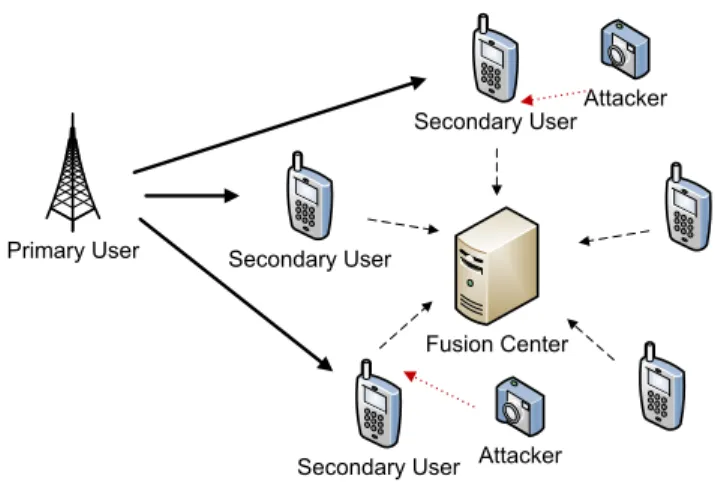
In the scenario of attacking, as shows in Fig. 1, the sensors may be compromised by the attacker, and their measurement results are manipulated by the attacker by injecting tampered data. The goal of the attacker is to mislead the fusion center to make a wrong spectrum sensing decision. For example, when the attacker injects positive offset data, the fusion center may make a decision that PU exists while actually PU is absent. In other word, it raise false alarm rate. When the attacker injects negative offset data, PU may not be detected, thus miss detection rate increases. The received signal strength of SU can be modified as:
yn,t =Pt+α10 log10(d0/dn) +on,t,(dB) (2) whereon,t represents the tampered data value, which take the value on,t 6= 0whenever attack exists at sensor n at sensing time t, and on,t = 0 otherwise. As a unified received signal strength model, Eq. (2) is adopted in both Section III and Section IV.
B. Robust Spectrum Sensing
Fusion center makes decision based on the estimatedPˆtat each sensing time using a threshold based spectrum sensing rule. If the Pˆt is above threshold TH, fusion center decides the PU is present and broadcasts the information to all the SUs in the cell. Then all the SUs must vacate the channel
Primary User Secondary User
Fusion Center
Secondary User
Secondary User
Attacker
Attacker
Fig. 1. Cooperative Cognitive Radio Network Structure.
immediately. If the transmit-power is below the thresholdTH, the SUs can utilize the channel without any limit.
III. ROBUSTPCA-BASEDAPPROACH
In this section, we describe the robust PCA based attack detection approach for spectrum sensing. Then the jammed nodes can be found at each sensing time. After removing the injected data,Ptcan be estimated more accurately.
Robust PCA [15], [16], [17] is a powerful method in solving the problem how to recover the low rank matrix from grossly corrupted observation matrix. The model can be expressed as:
R=L+I (3) in whichRis the observation matrix,Lis a low rank matrix, and matrix I is a sparse matrix with arbitrarily magnitude. Recovering matrix L can be solved by the relaxed convex optimization model
minimize
L,I kLk∗+λkIk1,subject toR=L+I, (4)
where k·k∗ represents the nuclear norm of a matrix, k·k1
denotes l1 norm, and λ is a tradeoff parameter. Once the assumption of low rank matrix L and sparse matrix I are satisfied, L and I can be exactly recovered with very large probability.
We are rewriting the Eq. (2) in matrix form.
Y=HX+O (5)
Y= [yn,1yn,2· · ·yn,T] (6)
O= [on,1on,2· · ·on,T] (7) Hereyn,t ∈CN×1,on,t∈CN×1, andyn,tis thet-th column of Y,on,t is the t-th column of Orespectively.
yn,t= [y1,ty2,t· · ·yN,t] T (8) on,t = [o1,to2,t· · ·oN,t] T (9) Let S=HX (10)
H= 1 β1 1 β2 .. . ... 1 βN N×2 (11) where, βn = 10 log10(d0/dn) (12) X= P1 P2 · · · PT α α · · · α 2×T (13) Hence, Y=S+O (14) We know from matrix theorem that
rank(AB)≤min(rank(A),rank(B)) (15) Similarly,
rank(S)≤min(rank(H),rank(X)) (16) And we noticed rank of both matrix HandX is 2, so
rank(S)≤2 (17) As a result,Sis a low rank matrix.
We consider the worst case that attack appears randomly, without following any distribution. Besides, in order to make itself not to be discovered easily, attack behavior is not continuous. In practice, it is reasonable to say the attack matrix
O is sparse. The percentage of on,t 6= 0in the whole matrix dictates the sparsity inO.
Robust PCA can be applied here to get the estimated low rank matrixSˆ and the estimated spare matrixOˆ. Then we can get the estimated Xˆ by applying
ˆ
X=H†Sˆ (18)
H† = (HHH)−1HH (19) Finally, we get the estimatedPˆfrom the first row ofXˆ, which is
ˆ
P =hPˆ1Pˆ2· · ·PˆT iT
(20) IV. LEASTSQUAREBASEDAPPROACH
In this section we describe the least square based attack signal cancellation method. Attack signals can be gradually mitigated by comparing with a threshold. After several times iteration, we get accurate estimated Pˆt.
We expand the elements represented in Eq. (2) into a vector form as z=Uv+w (21) z= [y1,1· · ·yN,1· · ·y1,T· · ·yN,T] T (22) w= [o1,1· · ·oN,1· · ·o1,T· · ·oN,T] T (23) v= P1 P2 · · · PT α T (24) U= Q1 Q2 · · · QT γ γ · · · γ T (25) γ= [β1β2· · ·βN] (26) Qt= 0 0 · · · 0 .. . ... . .. ... 1 1 · · · 1 .. . ... . .. ... 0 0 · · · 0 T×N (27)
The entries of t-th row in the matrix Qt are all 1, of other
rows are all 0. The sparsity is the percentage of on,t 6= 0 in the whole vector the same as which defined in Section III.
We are dealing with the Lagrangian version of problem below min v,w 1 2k(z−w)−Uvk 2 2+λkwkr (28) Where k·k2 represents l2 norm and k·kr representslr norm. The initial w is set to be 0, and we solve for v. Then we get a updated w from the v. Again we use this updated w
to solve forv. Iteratively, we can get both accuratev andw. This procedure is described in algorithm 1.
Algorithm 1 Least Square Based Estimation 1: Specify the robust norm k·kr.
2: Choose the parameter λ.
3: Initiate all entries of vectorw to be 0. 4: while vdoes not converge:do 5: Solve for v v= arg min v 1 2ka−Uvk 2 2,a=z−w (29) 6: Solve for w w= arg min w 1 2kb−wk 2 2+λkwkr,b=z−Uv (30) 7: end while
The above algorithm is divided into two parts solvingvand
w separately. Eq. (29) can be solved by least square
ˆ
v=U†ˆa (31)
U† = (UHU)−1UH (32) When we deal with Eq. (30), a nature choice of r is 0, thenk·krbecomesl0normk·k0, which counts the number of nonzero entries ofw. However, l0norm is in general difficult to optimize due to its non-convexity. So we relax thel0 norm to its tightest convex relaxation l1 norm, in which r equals to 1. l1 norm is a classic choice for robust measurement and regularization for sparsity. Then Eq. (30) becomes
w= arg min w 1 2kb−wk 2 2+λkwk1,b=z−Uv (33) The sof t − thresholding method makes the solution to Eq. (33) into sub-problems [14]
wj = arg min wj 1 2(bj−wj) 2 +λ|wj| (34)
Fig. 2. Estimated error on different attack sparsity.
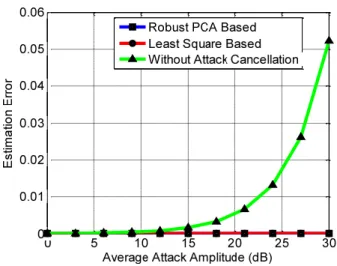
Fig. 3. Estimated error on different average attack amplitude.
= bj−λ ifbj> λ bj+λ ifbj <−λ ∀j 0 otherwise (35)
By tuning the parameter λ, we can control the threshold and the iteration time. After algorithm 1 converges, we get estimated ˆvandPˆ the same as Eq. (20).
V. SIMULATIONRESULTS
We now evaluate the performance of two attack cancellation methods. First we describe the simulation setting, then We compare the estimation error between with attack cancella-tion methods and without cancellacancella-tion, under different attack sparsity and average attack amplitude scenario.
We consider a CRN where PU and SUs coexist. The reference distance d0 is 20m. Path-loss component is set to α=4. Number of cooperative SUs is 40. Total number of sensing samples is 100. Transmission power of PU Pt is uniformly distributed between 1000W and 1100W. The distance between PU and n-th SU is uniformly distributed
Fig. 4. Comparison of Estimated Error on different average attack amplitude between two methods.
between 5km and 6km. Attack amplitude also follows uni-form distribution. Each simulation is run104 times and their average values are taken as the performance measures.
The estimation error of the transmit power of PU is defined as σ= ˆ P−P 2/kPk2 (36) Here, we identify the following two key factors that can affect the estimation error:
• Attack sparsity, ranges from 0 to 1 • Average attack amplitude (in dB)
In Fig. 2, we fixed average attack amplitude to be 20dB, but attack sparsity varies from 0 to 0.4 with step 0.05. When spar-sity is less than 0.2, robust PCA based method can get nearly 0 estimation error. As the attack becomes dense, the estimation error increases. This is because the goal of robust PCA method is to separate the mixture of a low rank matrix and a sparse matrix. The sparser of matrix O, the lower estimation error. On the other hand, least square based method is not affected by sparsity, which can get almost 10−6 estimation error. In Fig. 3, The attack sparsity is fixed at 0.1,λis set to 10, while average attack amplitude increases from 0dB to 30dB with step 3dB. Both two attack cancellation method get nearly no estimation error. Because them are overlapped, we may only see one line at the bottom of the figure. Apparently, without any attack cancellation method, estimation error in both Fig. 2 and Fig. 3 increase dramatically. Though the performance of robust PCA based method and least square based method looks similar in Fig. 3, they have some differences as show in Fig. 4. As average attack amplitude becomes large, estimation error of least square based method increases a little. The performance of robust PCA based method remains in the same level, since it is insensitive to value of the sparse matrix, which can deal with any amplitude sparse attacks. In summary, simulation results show that both two methods can get low estimation error of transmission power of PU when the SUs are under attack.
VI. CONCLUSION
This paper deals with attack cancellation in estimating transmission power in CRN. Two approaches, robust PCA based and least square based are introduced in this paper. Robust PCA can divide observation matrix into a low rank matrix and a sparse matrix, and this method doesn’t care about the amplitude of the attack. Least square based method can remove attack values at any attack sparsities. Hence, these two methods can deal with different kinds of attack scenarios effectively. Our future work includes how to unify these two methods into a same framework and combine them together to make system more secure and robust.
ACKNOWLEDGMENT
This work is funded by National Science Foundation through two grants (ECCS-0901420 and ECCS-0821658), and Office of Naval Research through two grants (N00010-10-1-0810 and N00014-11-1-0006).
REFERENCES
[1] A. W. Min, K. G. Shin, and X. Hu, “Attack-tolerant distributed sensing for dynamic spectrum access networks,”2009 17th IEEE International Conference on Network Protocols, pp. 294–303, Oct. 2009.
[2] G. Baldini, T. Sturman, and A. R. Biswas, “Security Aspects in Software Defined Radio and Cognitive Radio Networks : A Survey and A Way Ahead,”Spectrum, pp. 1–25, 2011.
[3] R. Chen, J.-M. Park, Y. T. Hou, and J. H. Reed, “Toward secure distributed spectrum sensing in cognitive radio networks,”IEEE Com-munications Magazine, vol. 46, no. 4, pp. 50–55, Apr. 2008.
[4] L. Zhu and Z. Huaibei, “Two Types of Attacks against Cognitive Radio Network MAC Protocols,” in2008 International Conference on Computer Science and Software Engineering (CSSE 2008), vol. 4, Dec. 2008, pp. 1110–1113.
[5] T. C. Clancy and A. Khawar, “Security Threats to Signal Classifiers Using Self-Organizing Maps,”Computer Engineering, no. 3, 2009. [6] A. Sethi and T. Brown, “Hammer Model Threat Assessment of Cognitive
Radio Denial of Service Attacks,” in3rd IEEE Symposium on New Frontiers in Dynamic Spectrum Access Networks (DySPAN08), Oct. 2008, pp. 1–12.
[7] A. Min, K. Kim, and K. Shin, “Robust Cooperative Sensing via State Estimation in Cognitive Radio Networks,” inThe International Dynamic Spectrum Access Networks (2011 DySPAN), 2011.
[8] Q. Pei, H. Li, J. Ma, and K. Fan, “Defense Against Objective Function Attacks in Cognitive Radio Networks,”Chinese Journal of Electronics, vol. 20, no. 4, 2011.
[9] Z. Chen, C. Zhang, F. Lin, J. Yu, X. Li, Y. Song, R. Ranganathan, N. Guo, and R. C. Qiu, “Towards a large-scale cognitive radio network: Testbed, intensive computing, frequency agility and security,” 2011. [10] T. C. Clancy, A. Khawar, and T. R. Newman, “Robust Signal
Clas-sification using Unsupervised Learning,” IEEE TRANSACTIONS ON
WIRELESS COMMUNICATIONS, 2011.
[11] E. Eskin, A. Arnold, M. Prerau, L. Portnoy, and S. Stolfo, “A geometric framework for unsupervised anomaly detection: Detecting intrusions in unlabeled data,” inApplications of Data Mining in Computer Security, 2002.
[12] G. B. Giannakis, G. Mateos, S. Farahmand, V. Kekatos, and H. Zhu, “USPACOR: Universial sparsity-controlling outlier rejection,” in 36th International Conference on Acoustics, Speech and Signal Processing (2011ICASSP), May 2011.
[13] G. Mateos and G. B. Giannakis, “Robust Nonparametric Regression via Sparsity Control with Application to Load Curve Data Cleansing,” April 2011.
[14] L. Xiong, B. Poczos, A. Connolly, and J. Schneider, “Anomaly Detection for Astronomical Data,” Dec. 2010, from Carnegie Mellon University. [15] E. Candes, X. Li, Y. Ma, and J. Wright, “Robust principal component
analysis?” 2009.
[16] J. Wright, A. Ganesh, S. Rao, and Y. Ma, “Robust Principal Component Analysis : Exact Recovery of Corrupted Low-Rank Matrices via Convex Optimization,”submitted to Journal of ACM, 2009.
[17] N. Guo, S. Hou, Z. Hu, and R. Qiu, “Robust PCA Based Extended Target Estimation with Interference Mitigation,” in2011 IEEE Radar Conference, 2011.