multiple temporal scales. PhD thesis, University of
Nottingham.
Access from the University of Nottingham repository: http://eprints.nottingham.ac.uk/33056/1/Thesis.pdf
Copyright and reuse:
The Nottingham ePrints service makes this work by researchers of the University of Nottingham available open access under the following conditions.
This article is made available under the University of Nottingham End User licence and may be reused according to the conditions of the licence. For more details see:
http://eprints.nottingham.ac.uk/end_user_agreement.pdf
Visual Tracking Over Multiple Temporal
Scales
by
Muhammad Haris Khan
A thesis submitted in partial fulfillment for the degree of Doctor of Philosophy
in the
Faculty of Science School of Computer Science
I, Muhammad Haris Khan, declare that this thesis titled, ‘Visual Tracking Over Multiple Temporal Scales’ and the work presented in it are my own. I confirm that:
This work was done wholly or mainly while in candidature for a research degree
at this University.
Where any part of this thesis has previously been submitted for a degree or any
other qualification at this University or any other institution, this has been clearly stated.
Where I have consulted the published work of others, this is always clearly
at-tributed.
Where I have quoted from the work of others, the source is always given. With
the exception of such quotations, this thesis is entirely my own work.
I have acknowledged all main sources of help.
Where the thesis is based on work done by myself jointly with others, I have made
clear exactly what was done by others and what I have contributed myself.
Signed:
Date:
Abstract
Faculty of Science School of Computer Science
Doctor of Philosophy
visually track targets in a broad range of settings. However, visual tracking algorithms struggle to robustly follow a target in unconstrained scenarios. Among the many chal-lenges faced by visual trackers, two important ones are occlusions and abrupt motion variations. Occlusions take place when (an)other object(s) obscures the camera’s view of the tracked target. A target may exhibit abrupt variations in apparent motion due to its own unexpected movement, camera movement, and low frame rate image acquisition. Each of these issues can cause a tracker to lose its target.
This thesis introduces the idea of learning and propagation of tracking information over multiple temporal scales to overcome occlusions and abrupt motion variations. A tem-poral scale is a specific sequence of moments in time e.g. [t−1;t] in an image sequence. Models (describing appearance and/or motion of the target) can be learned from the target tracking history over multiple temporal scales and applied over multiple temporal scales in the future. With the rise of multiple motion model tracking frameworks, there is a need for a broad range of search methods and ways of selecting between the available motion models.
The potential benefits of learning over multiple temporal scales are first assessed by studying both motion and appearance variations in the ground-truth data associated with several image sequences. A visual tracker operating over multiple temporal scales is then proposed that is capable of handling occlusions and abrupt motion variations. Experiments are performed to compare the performance of the tracker with competing methods, and to analyze the impact on performance of various elements of the proposed approach. Results reveal a simple, yet general framework for dealing with occlusions and abrupt motion variations. In refining the proposed framework, a search method is generalized for multiple competing hypotheses in visual tracking, and a new motion model selection criterion is proposed.
I would like to convey my sincerest gratitude to my supervisors Prof. Tony Pridmore and Dr. Michel Valstar for all the guidance and support they have provided throughout the development of this thesis with patience and knowledge. They were always available to listen my ideas, offer beneficial discussions, and provide useful feedback. They were always there to boost my confidence at the time of setbacks. Without their advice and unwavering support, this dissertation would not have been possible.
I am grateful to all my colleagues at Computer Vision Laboratory at Nottingham Uni-versity for providing a friendly and a nice working atmosphere.
Last but not least, I would like to thank my beloved parents and my dear wife for their love and support, which has given me the confidence to overcome difficulties through the years. You were simply phenomenal in understanding and supporting me for whatever I aspired to achieve in my life.
Declaration of Authorship i
Abstract iii
Acknowledgements v
List of Figures x
List of Tables xii
1 Introduction 1
1.1 Motivation for Study . . . 2
1.2 Contributions . . . 4
1.3 Thesis Organization . . . 5
1.3.1 Preliminary Background of the research related to this thesis . . . 5
1.3.2 Visual Tracking Over Multiple Temporal Scales . . . 5
1.3.3 Exploration of the proposed tracking framework . . . 6
1.4 Related Publications . . . 6
2 Related Work 8 2.1 The Visual Tracking Problem . . . 8
2.1.1 Online and Offline Tracking Methods. . . 9
2.1.2 General Framework for Visual Tracking . . . 9
2.1.3 Major Visual Tracking Problems . . . 11
2.2 Appearance Modelling . . . 15
2.2.1 Generative Models . . . 16
2.2.2 Discriminative Models . . . 19
2.2.3 Other Approaches . . . 21
2.3 Search Strategies . . . 22
2.3.1 Non-probabilistic Search Strategies . . . 23
2.3.2 Probabilistic Search Strategies . . . 23
2.3.2.1 Kalman Filter . . . 25
2.3.2.2 Particle Filters . . . 27
2.3.2.3 Markov Chain Monte Carlo . . . 28
The Metropolis Hastings (MH) Algorithm . . . 29
Adaptive MCMC algorithms . . . 29
Partition-based algorithms . . . 30
2.4 Tracking by detection and data association . . . 31
Local Linking-based Methods . . . 31
Global Linking-based Methods . . . 31
Hierarchal Methods . . . 32
2.5 Existing Approaches for Handling Occlusion . . . 32
Explicit Approaches . . . 32
Implicit Approaches . . . 33
Approaches Exploiting Detectors and Context . . . 34
Other Approaches . . . 35
2.6 Existing Approaches for Handling Motion Variations . . . 36
General-Purpose Motion Models . . . 36
Hybrid Approaches . . . 37
Improved Proposal Distributions . . . 37
Offline Learned Motion Models. . . 38
Approaches Without Motion Prior . . . 38
2.7 Observations . . . 40
2.7.1 Regarding Current Solutions to Occlusion . . . 40
2.7.2 Regarding Current Solutions to Motion Variations . . . 41
3 Potential Benefits of Multiple Temporal Scales 43 3.1 Importance of Multiple Scales . . . 44
3.2 Probing motion and appearance variations in the ground truth data . . . 46
3.2.1 Learning Motion Over Multiple Temporal Scales . . . 48
3.2.2 Learning Appearance Over Multiple Temporal Scales. . . 57
3.3 Conclusion . . . 66
4 A Visual Tracker Operating Over Multiple Temporal Scales 68 4.1 Introduction. . . 69
4.2 Bayesian Tracking Formulation . . . 72
4.3 A Multiple Temporal Scale Framework . . . 74
4.3.1 Evaluation . . . 74
4.3.1.1 Model Set Reduction . . . 75
4.3.1.2 Propagation of Particles. . . 75
4.3.1.3 Model (Prediction) Status . . . 77
4.3.2 Learning. . . 78
4.3.3 Prediction . . . 80
4.3.4 Model (Prediction) Status . . . 80
4.4 Applying the proposed framework to the two-stage motion model . . . 82
4.5 Experimental Details and Results . . . 83
4.5.1 Data . . . 83
4.5.2 Evaluation Protocol . . . 85
4.5.3 Experimental Settings . . . 86
4.5.4 Comparison with competing methods . . . 87
4.5.4.2 Qualitative Evaluation . . . 96
4.5.5 Analysis of the Proposed Framework . . . 105
4.5.5.1 Without Multiple Prediction-Scales . . . 105
4.5.5.2 Without Multiple Model-Scales. . . 106
4.5.5.3 Varying the Degrees of (Polynomial) Motion Models . . . 107
4.5.5.4 Fixed Number of Prediction-Scales. . . 108
4.5.5.5 Potential Drawbacks. . . 109
4.6 Conclusion . . . 109
5 A Generalized Search Method, and a New Model Selection Criterion111 5.1 A Generalized Search Method for Multiple Competing Hypotheses in Vi-sual Tracking . . . 112
5.1.1 Bayesian Tracking Formulation . . . 115
5.1.2 A Multiple Temporal Scale Framework. . . 116
5.1.3 A Generalized WLMCMC sampling . . . 118
5.1.3.1 Wang Landau Monte Carlo (WLMC) method. . . 120
5.1.3.2 Proposal Step . . . 121
5.1.3.3 Acceptance Step . . . 121
5.1.4 Experimental Details and Results. . . 123
5.1.4.1 Data . . . 123
5.1.4.2 Experimental Settings . . . 124
5.1.4.3 Experimental Results . . . 124
5.1.5 Discussion. . . 127
5.2 A New Model Selection Criterion . . . 129
5.2.1 Model Selection Problem . . . 129
5.2.2 A New Motion Model Selection Criterion . . . 131
5.2.2.1 Rejecting Low Visual Likelihood State Predictions . . . . 131
5.2.2.2 Spatial Clustering . . . 133
5.2.2.3 Formation of Search Regions . . . 134
5.2.3 Experiments and Results . . . 135
5.2.3.1 Image Sequences used for Evaluation . . . 135
5.2.3.2 Description of Trackers and Experimental Settings . . . . 135
5.2.3.3 Results . . . 136
5.2.4 Discussion. . . 139
5.3 Conclusion . . . 140
6 Conclusions and Future Work 142 6.1 Summary and Contributions. . . 142
6.2 Drawbacks, Unaddressed Topics and Future Work . . . 144
6.2.1 Distractors during Occlusion . . . 144
6.2.2 Revisiting Motion Model Selection . . . 145
6.2.3 Long-term Occlusions . . . 146
6.2.4 Capturing Appearance Variations. . . 146
6.2.5 Revisiting Poorly Tracked Frames . . . 147
2.1 Difference between online and offline tracking methods. . . 10
2.2 Appearance changes due to different illumination conditions. . . 11
2.3 Example of a rigid and a non-rigid target. . . 12
2.4 Changes in appearance due to out-of-plane rotations. . . 13
2.5 An example of distractors in the background while tracking a person’s face. 13 2.6 Various types of occlusions. . . 14
2.7 Two different kinds of motion variations.. . . 14
2.8 Typical target shape representations used in visual tracking.. . . 16
2.9 Steps involved in estimating the posterior PDF at time tfrom the given posterior PDF at time t−1 using RBE. . . 24
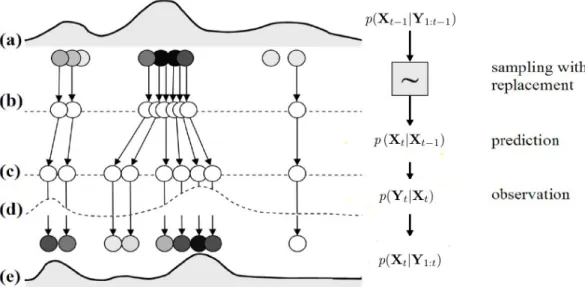
2.10 Steps involved in one iteration of a particle filter algorithm . . . 28
3.1 Learning and Predicting Motion Over Multiple Temporal Scales. . . 49
3.2 Performance comparison in case of motion prediction on ten challenging video sequences. . . 53
3.3 Position prediction performance under (nearly) smooth motion variations. 54 3.4 Position prediction performance under unpredictable motion variations. . 55
3.5 Selection percentage for each motion model in ten video sequences. . . 56
3.6 Appearance model over model-scale m.. . . 59
3.7 Performance comparison in case of appearance prediction on seven chal-lenging video sequences. . . 62
3.8 Performance comparison between appearance models derived from model-scale 5, and 9 under two different types of variations in bin values. . . 64
3.9 Selection percentage for each appearance model in seven video sequences. 65 4.1 Visual Tracking Over Multiple Temporal Scales. . . 70
4.2 Graphical illustration of events occurring at the evaluation stage. . . 76
4.3 Model Status at time-points ahead of time t (current time-point) in the evaluation stage. . . 78
4.4 Graphical illustration of the learning stage and the prediction stage. . . . 79
4.5 Model Status at time-points ahead of time t (current time-point) after the prediction stage. . . 80
4.6 Image sequences used for evaluation. . . 84
4.7 Tracking through multiple partial occlusions. . . 91
4.8 Performance comparison of MTS-L with a traditional Particle Filter with a number of particles requiring the same amount of resources as MTS-L. . 96
4.9 Tracking results when the time difference between two consecutive occlu-sion is small (17 frames).. . . 97
4.10 Tracking results with occlusions of different lengths in an outdoor envi-ronment.. . . 99 4.11 Tracking results in a surveillance environment. . . 100 4.12 Another example of occlusion in an outdoor environment. . . 101 4.13 Tracking results in case of abrupt motion variations and frequent occlusions.103 4.14 A comparison of tracking results between MTS-L(cyan), TNCV(blue),
TRW(magenta), and TTS(white) during rapid motion variation, and
oc-clusion. . . 104 4.15 Performance of the proposed framework with and without multiple
prediction-scales. . . 105 4.16 Performance of the proposed framework with and without multiple
model-scales. . . 106 4.17 Performance of the proposed framework with different degrees of
polyno-mial motion models. . . 107 4.18 Performance of the proposed framework with and without fixed number
of prediction-scales (T parameter). . . 108 5.1 Graphical Illustration of the search problem in the proposed framework. . 114 5.2 (Top row) There existsT (most suitable) state predictions at time t, and
it is required to search for the best target state around these predictions. (Bottom row) The search is modelled by allocating each state prediction a certain area (cell). . . 118 5.3 Graphical representation of the search pattern in the original instantiation
of MTS. . . 119 5.4 Division of a state space into a fixed grid of equal sized cells. . . 119 5.5 Graphical illustration of the steps involved in a single iteration of
gener-alized WLMCMC. . . 123 5.6 Comparison of tracking consistency over five runs between MTS-GWL
and MTS-PF with and without occlusions.. . . 126 5.7 Tracking results of MTS-PF(cyan) and MTS-GWL(magenta) in ball2,
TUD-Campus, andsquash sequences. . . 127
5.8 Graphical Illustration of three additional dimensions of model space in the model selection problem. . . 130 5.9 Kernel density estimate and histogram of a random variable which is a
mixture of three normal distributions. . . 132 5.10 Threshold point selected on capturing 50% of the total density of a
ran-dom variable, which is a mixture of three normal distributions. . . 132 5.11 Six different prediction classes identified by K-Harmonic Means (KHM)
inDt. . . 133
5.12 Performance comparison between MTS-MS and MTS-GWL in terms of percentage of correctly tracked frames based on Pascal score. . . 136 5.13 Performance comparison between MTS-MS and MTS-GWL in terms of
precision at a fixed threshold of 20 pixels. . . 137 5.14 Performance of MTS-MS upon varying e values in terms of CLE, CDR,
and Precision. . . 138 5.15 Performance summary of each e value in terms of CDR, CLE, and Precision.139 A.1 Precision and success plots for MTS-L, FragT, L1-APG, SemiBoost, VTD,
3.1 Challenging aspects of videos used for evaluating motion and appearance prediction. . . 47 4.1 Tracking accuracy in the presence of occlusion. . . 89 4.2 Accuracy through simultaneous motion variation and occlusion . 93 4.3 Accuracy through abrupt motion variations . . . 94 5.1 Tracking accuracy of 9 trackers on 11 video sequences . . . 125 A.1 Parameters of different trackers used in the experiments. . . 155
Introduction
Computer vision has been studied actively as a scientific field since the late 1960s, when computing power started to increase rapidly. Computer vision started with the goal of building a system that can process images in a similar way to the human visual system, however, it has evolved into a much broader field. For instance, applications like image database search in the world wide web, biometrics, and computational photography have arisen from developments in computer vision over the years. In addition, the proliferation of digital video cameras in daily life is generating large amounts of visual data. In response to large volumes of data, there is a growing demand for robust visual analytics algorithms to perform automatic analysis either in real-time or offline.
To be able to understand video content fully, it is important to know certain information about the target(s)/object(s) present in it. This information could be where each target is, what it is doing etc. The answer to the two questions mentioned lies in how it is moving i.e. in establishing its correspondence from one frame to the next, which is known as visual tracking, object tracking, or target tracking. Visual object tracking is a fundamental component in many computerized video applications such as intelligent traffic control [Hsieh et al.,2006,Morris and Trivedi, 2008, Zhou et al., 2007], security and surveillance [Chen et al.,2011,Hampapur et al.,2005] human-computer interaction [Poole and Ball,2006,Wang et al.,2006], event detection and recognition [Johnson and Hogg,1996,Saleemi et al.,2009,Smith et al.,2006], and many others. Due to its large potential impact, visual tracking has remained an active topic in computer vision for more than two decades.
Specifically, visual tracking has been researched actively since the mid 1980s, although many estimation tools and statistical methods used to solve this problem were developed long before that time [Smith,2007].
Out of the many routes to visual tracking, perhaps the most popular is the probabilistic approach. At a very basic level, a probabilistic approach makes use of the information available from the video, and prior knowledge about the target (object) to build a probability distribution, which can be conceived as the belief about the target’s state. The target state is typically a set of parameters such as position, orientation and scale of a bounding box used to represent the target. This probability distribution is updated as soon as information, in the form of a new video frame, arrives.
Probabilistic approaches have remained popular in the realm of visual tracking because of their ability to handle uncertainties in the measurements and models involved in a principled manner. While tracking under uncontrolled conditions, uncertainties may result from varying target appearance caused by factors such as illumination changes in the scene, and variations in apparent target motion caused by e.g. low frame-rate image acquisition.
The work presented in this thesis focuses on a widely celebrated probabilistic approach to tracking known as recursive Bayesian estimation (RBE). It maintains a (unknown) probability distribution, which encodes knowledge about the target state given infor-mation from the video. This probability distribution is estimated in a recursive fashion over time through extracting information from the incoming video frames.
Although many difficulties in visual tracking can be mitigated by a multi-camera setup, the work in this thesis is restricted to visual tracking through a single camera system, as most existing systems are equipped with a single camera.
1.1
Motivation for Study
Despite the fact that visual tracking is a well-defined computer vision problem, it is challenging. It remains unsolved due to the inevitable variations associated with the tracked target, and occlusions.
Appearance Variations: Tracking algorithms require some kind of model to detect
the presence of a target in each frame of an image sequence. The model describes the appearance of the target i.e. what it looks like. Usually, it is built prior to the start of tracking by utilizing information from the first frame. As it relies on limited information, this appearance description might not be adequate when the target’s appearance changes over time. Such change can be the result of variation in scene lighting, target pose, and target shape (due to non-rigid deformation). Under these circumstances, the model needs to adapt to these variations over time to remain an appropriate description of the target’s true appearance.
On the other hand, this adaptation risks the tracker losing its target due to the accumu-lation of imperfect tracking results over time, which leads to a gradual mis-representation of the target’s appearance. Although many methods have been presented to address this adaptivity versus stability problem, it is still an open problem. Most of the solutions presented so far are conservative in approach as they do not allow abrupt appearance variations to be captured.
Complex Motion Variations: In unconstrained environments, a target can display
complex motion variations, which can be smooth or abrupt. To achieve efficient tracking, it is typically assumed that the motion of the target varies smoothly over time. However, under realistic tracking scenarios, a target’s motion can change abruptly over a given time interval due to factors such as camera motion/switching, low frame rate image acquisition, etc.
A vital component of probabilistic trackers is a motion model, which describes the movement of a target over time. Assuming smooth motion variations, most of the existing tracking approaches employ motion models that exploit a single temporal scale, e.g. Random-Walk (RW). These models use the most recent state to predict the state at the current time. A temporal scale is a specific sequence of moments in time e.g. [t−1], [t−1;t], or [t−3;t]. When a target exhibits a range of motion patterns(smooth to abrupt), single scale models may find it difficult to handle this multi-modal variability in motion. Building motion models by exploiting multiple recent state histories could, however, provide a way to cover variable target motion better than single scale models.
Tracking frameworks use search methods to seek for the most likely hypothesis from the space of all available hypotheses. Here, the hypothesis is the state of a target. Tracking algorithms have typically deployed a single motion model (like RW), and so relied upon a few search methods (like Particle Filters). To cover different motion patterns, which single motion model might not be capable of, multiple motion model methods have attracted increased interest in the recent past. The existence of multiple hypotheses produced by these motion models necessitates that a broader range of search methods be used in visual tracking.
The presence of multiple motion models also raises an important question: how to pick the most suitable hypothesis, i.e. closest to the true target state, as the hypotheses generated by all the models are usually not equally accurate. Exploration of the space of possible motion model selection criteria is a prospective research direction.
Occlusions: Occlusions arise when the view of the camera that tracks the target is
obscured by another object or objects. Although it is a classic problem in visual tracking, it remains unsolved due to the difficult nature of the problem itself. This is because target
observation (image-based evidence) becomes very weak, or is fully unavailable, during occlusions. Furthermore, occlusions can take place over different periods of time.
Most of the existing probabilistic tracking algorithms predict a target’s state at time t
using only its state at time t−1. In other words, they all operate on a single temporal scale [t−1;t]. This is a reasonable approach to tracking at timetas long as the immediate previous state (at time t−1) is accurately estimated. However, in the presence of problems such as occlusion, it is quite possible that the estimated state at time t−1 might be completely different to the true underlying state. This inaccurate target state at timet−1 may make it difficult to estimate the true target state at timetsince a large tracking error will be propagated. As a result, the tracker can start to or completely lose the target.
Extending the tracker’s temporal scale alone might not be enough to adequately cover the variation in periods of occlusions. However, a tracker operating over multiple temporal scales may be able to solve this problem. Such a tracker will make use of several previous estimated states instead of only one at timet−1 to infer target state at timet.
1.2
Contributions
The work described in this thesis proposes to exploit multiple temporal scales to address two important and outstanding problems in visual tracking: occlusions and abrupt mo-tion variamo-tions. The central objective of the thesis is to investigate the usefulness of multiple temporal scales of model generation and application to deal with the problems related to occlusions and abrupt motion variations. In addition, work in this thesis generalizes a search method for multiple competing hypotheses in visual tracking, and proposes a new way of (motion) model selection. In brief, the work presented in this thesis makes the following contributions:
• The thesis assesses potential benefits of multiple temporal scales to visual tracking using ground truth data. Specifically, both motion and appearance variations are investigated by doing preliminary, but thorough experiments on the ground truth data of several image sequences.
• The thesis proposes a visual tracker operating over multiple temporal scales that is capable of handling occlusions and abrupt motion variations. This is accomplished by learning motion models from the target history at different temporal scales, and applying those over multiple temporal scales in the future. An extension of the bootstrap particle filter is presented to search around the predictions generated by motion models.
• The proposed tracking framework is compared to state-of-the-art tracking algo-rithms (both according to the CVPR’13 [Wu et al., 2013] benchmark, and their capability to handle occlusions and abrupt motion variations) on both publicly available benchmarks and some new data. Both quantitative and qualitative eval-uations reveal that the proposed framework shows favourable performance against competing methods. Experiments are also conducted to analyse the performance of the proposed framework by excluding vital components, keeping some parameters fixed, and varying the degrees of polynomial motion models.
• With the goal of exploring the proposed tracking framework, and as a first step towards improving its performance further, the thesis generalizes a search method for multiple competing hypotheses in visual tracking and proposes a new (motion) model selection criterion.
1.3
Thesis Organization
This dissertation proposes and evaluates the idea of visual tracking over multiple tem-poral scales, and then further explores the proposed tracking framework. In the four chapters that constitute the body of this thesis, the following topics are covered:
1.3.1 Preliminary Background of the research related to this thesis Chapter 2 begins by briefly describing the main challenges associated with visual track-ing. These include change in target appearance, abrupt motion variations, and occlusions (by other target objects and the environment). It then outlines the general framework for visual tracking, and recalls some of the important and popular estimation tools used, with a special focus on recursive Bayesian estimation. Next it features an overview of the state-of-the-art approaches which are in some sense connected to the work described in this thesis. It then provides an in-depth discussion of the existing work related to the problems addressed in this thesis. Finally, the chapter concludes by summarizing impor-tant trends in prior work, and highlighting the outstanding problems in visual tracking and drawbacks in the connected body of works that propelled the research described in this thesis.
1.3.2 Visual Tracking Over Multiple Temporal Scales
Chapter 3 defines the proposed approach of visual tracking over multiple temporal scales, and assesses the potential benefits of multiple temporal scales. In particular, it examines
whether, by using a set of models, learned over different temporal scales, it is possible to generate a better prediction performance than is possible when using a single model from this set. The chapter begins by emphasizing the importance of multiple scales in the spatial domain, which served as a motivation for utilizing multiple temporal scales in visual tracking. Next it investigates both motion and appearance variations in the ground truth data of several sequences to highlight the potential benefits of access to a set of models, derived from multiple temporal scales. This chapter concludes that prediction performance can be improved if a set of models, extracted from multiple temporal scales, is combined with an ability to pick the right model from the set.
After conducting a preliminary study on the potential benefits of learning over multiple temporal scales in Chapter 3, Chapter 4 proposes a visual tracker operating over multiple temporal scales that is capable of overcoming occlusions and abrupt motion variations. The proposed tracker is compared with competing methods on both publicly available benchmarks and some new data. Experiments have also been carried out to analyze the impact on the performance of the proposed tracking framework of excluding important components, varying the degrees of the polynomial motion models used, and keeping an important parameter fixed.
1.3.3 Exploration of the proposed tracking framework
Chapter 5 develops further insight into the proposed tracking framework and takes a first step towards further improving the performance of the method. In particular, it generalizes a search method to estimate the best hypothesis around multiple competing hypotheses, and proposes a new motion model selection criterion. A modified tracker based on the generalized search method is evaluated and its performance is reported. With the aim of further exploration, the chapter then defines the model selection prob-lem in the context of the proposed framework, and proposes a new motion model se-lection criterion. A further tracker based on this new sese-lection method is assessed and then discussed. Finally, the chapter concludes by describing important findings in this exploration study.
1.4
Related Publications
The research described in this thesis has been a collaborative effort with my supervisors, Tony Pridmore, and Michel Valstar, who have provided a guiding hand in all of the work presented in this thesis.
1. Haris Khan, Michel Valstar, and Tony Pridmore, “MTS: A Multiple Temporal Scale Tracker Handling Occlusion and Abrupt Motion Variation”, Proc. Asian Conference on Computer Vision (ACCV), 2014.
2. Haris Khan, Michel Valstar, and Tony Pridmore, “A Generalized Search Method for Multiple Competing Hypotheses in Visual Tracking”, Proc. International Con-ference on Pattern Recognition (ICPR), 2014.
Related Work
This chapter reviews important computational tools used in visual tracking, features an overview of recent state-of-the-art work in visual tracking, and provides an in-depth discussion of prior work relevant to this thesis.
It begins by describing the general visual tracking problem and highlighting major issues associated with it. It then outlines the main components of a tracking system, under-scores a few early and some recent state-of-the-art work in visual tracking related to this thesis, and recalls classic tools (search methods) used to infer solutions to the tracking problem with a special emphasis on the approximation methods for recursive Bayesian estimation (RBE). RBE is a popular probabilistic approach to visual tracking, and has been used throughout the work described in this thesis. Next, it provides a detailed discussion of prior work relevant to this dissertation. As there is an enormous amount of published work on visual tracking, this chapter is not aimed at providing an exhaustive literature review. Instead, the chapter highlights bodies of work that are either related to this thesis in some sense, or are considered seminal in the visual tracking field. The chapter concludes by summarizing important trends in prior work, and outlining the outstanding problems that motivated our research.
2.1
The Visual Tracking Problem
In computer vision, visual tracking refers to the task of estimating the state of a target of interest at each time instant in a given image sequence. The target state is usually comprised of parameters such as velocity, location, and scale of a bounding box used to represent the target. Although visual tracking extends to image sequences formed by fusing outputs from multiple cameras, the scope of this dissertation is limited to sequences captured from a single camera.
At this stage, it is worthwhile to distinguish the tasks of visual object detection and recognition from visual tracking. Object detection aims to find the locations and config-urations of objects of a certain class in a given image [Vedaldi et al.,2009],[Everingham et al.,2010]. A common example of this is face detection [Rowley et al.,1998],[Viola and Jones, 2004]. The detection task does not consider the temporal relationships among a sequence of images. Object recognition refers to categorizing a given object in an image as belonging to one of a set of object classes [Vedaldi et al., 2009],[Yang, 2009]. For instance, identifying the make and model of a car given different possible categories [Pearce and Pears,2011], [Chen et al.,2015].
Although a visual tracker detects and recognizes a certain object, it further establishes the object correspondence from one frame to the next frame by introducing a temporal factor. An example of this would be to consistently infer the position, pose and motion parameters of a moving car in some image sequence. A human equivalent of tracking is to follow something with the eyes over a certain time period [Smith,2007].
2.1.1 Online and Offline Tracking Methods
Tracking methods can be broadly classified as online or offline [Smith,2007],[Hong and Han,2014]. Online methods only have access to the present and past member of the im-age sequence, whereas offline methods can use all the information available in an imim-age sequence. Fig. 2.1 illustrates the difference between the two tracking methods [Smith, 2007]. Many tracking applications such as video surveillance and human-computer in-teraction require online processing. On the other hand, large amounts of archived video in local hard drives and video sharing websites can be accurately analyzed using offline methods[Hong et al.,2013].
Most of the tracking methods discussed in this and the following chapters are online. However, a few relevant offline methods are also reviewed in the subsequent sections.
2.1.2 General Framework for Visual Tracking
In simple terms, a tracking algorithm is composed of amatching and a search strategy [Yang et al., 2009b] applied at each moment in time to find the best possible target configuration (hypothesis) in a search space. For a given tracking problem, the set of all possible solutions make up its search space [Smith,2007]. The matching strategy quantifies how well a given hypothesis matches the available image data, while the search method seeks the optimal hypothesis through maximising or minimising an objective function, which itself is a function of the matching strategy.
t-3 t-2 t-1 t t+1 t+2 t+3
t-3 t-2 t-1 t t+1 t+2 t+3
Information available till this time-point
Available Information
Online
Offline
Figure 2.1: Difference between online and offline tracking methods. Lets
assume that the most recent frame available for processing belongs to time t. In
on-line methods, the information up to and including time t is available for processing,
and information after time t is not. Offline methods have no restriction in terms of
availability, and they can choose to track any frame from the whole image sequence regardless of temporal order.
The matching strategy, most commonly known as the observation model, is constructed based on an appearance model. Appearance modelling defines possible ways of describing a target to be tracked using information from an image sequence. This information is typically features extracted from an image sequence such as colour, texture, edges, and motion [Perez et al., 2004]. Section 2.2 introduces simple appearance models, one of which is used quite frequently in the proposed work, and later reviews some recent state-of-the-art work in adaptive appearance modelling.
Search strategies control the way these appearance models are used in tracking to find the optimal hypothesis [Smith,2007]. At a very primitive level, these search strategies can be classified as either probabilistic or non-probabilistic [Zhou et al.,2004]. Non-probabilistic approaches, typically known as deterministic approaches, formulate the tracking problem in terms of a cost function and use optimization techniques to minimise or maximise this function [Lucas et al.,1981],[Comaniciu et al.,2003],[Fan et al.,2010],[Sevilla-Lara and Learned-Miller,2012]. In contrast, probabilistic approaches use statistical methods to model the uncertainty associated with the motion and appearance of the target and represent belief about the target state by fusing these information sources [Isard and Blake,1998a],[Perez et al.,2004],[P´erez et al.,2002],[Ross et al.,2008],[Mei et al.,2011]. Section2.3.1reviews some of the popular non-probabilistic search methods in tracking. Section2.3.2discusses various probabilistic search methods in detail, as they are central to this thesis.
2.1.3 Major Visual Tracking Problems
Like object detection and object recognition, visual tracking has to deal with problems that trouble computer vision systems in general [Arvind Ganesh and Ma, 2011], such as appearance variations, background clutter and occlusions. In addition to these three challenges, a visual tracking method has to cope with variations in the apparent motion of the tracked target. In the context of visual tracking, appearance variations can be caused by changes in illumination, pose, and shape, occlusions can be partial or full, and motion can vary smoothly or abruptly in a given time interval.
Recent research in visual tracking has focussed on challenging real-world tracking prob-lems more than the experiments in purely laboratory settings [Yilmaz et al.,2006]. In these realistic conditions, it is quite possible for a target to display any combination of the aforementioned problems. As a result, robust tracking becomes a severely compli-cated task in such conditions. To be able to develop a tracker that can handle real-world challenges, first it is important to understand the nature and source of these challenges in detail.
Illumination changes are one of the most important sources of appearance variations. They can influence the appearance of the target in an image as the colour of the target may change due to the properties (intensity and colour) of the falling incident light [Smith, 2007]. For instance, a target may look different under light from flashing blue and red bulbs than under sunlight. This can introduce problems since the most common models of target appearance are simple, e.g. colour distributions. As an example, Fig. 2.2shows some images of a target captured under different illumination conditions.
(a) (b) (c)
Figure 2.2: Appearance changes due to different illumination conditions. This figure shows three different images of a lady captured under different illuminations.
These images are taken from [He et al.,2013].
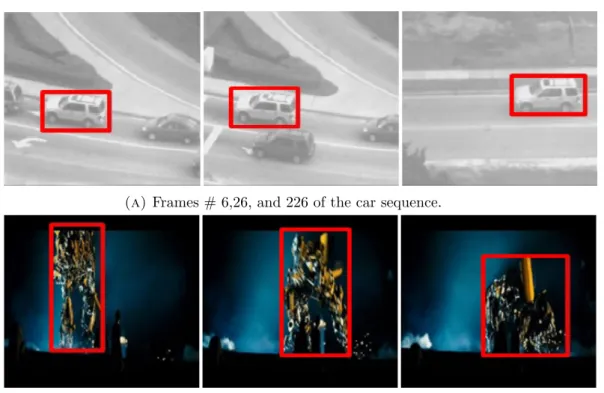
Target appearance can vary significantly if it changes shape on its own. Some targets, such as cars, are rigid, while others, like humans, are non-rigid. Rigid targets do not change their shape (Fig. 2.3(a)), while non-rigid can deform and take many complex
shapes (Fig. 2.3(b)). To accurately capture the variations shown by a non-rigid target, a high dimensional state representation is required, and searching for the best possi-ble configuration in this space can be a daunting task. For instance, the pose space in articulated human tracking has many degrees of freedom and, therefore, advanced optimization techniques are required to efficiently find the most likely configuration.
(a) Frames # 6,26, and 226 of the car sequence.
(b)Frames # 25,51, and 65 of the transformer sequence.
Figure 2.3: Example of a rigid and a non-rigid target. The target in all frames is represented by a red bounding box. (A) shows that a rigid target (car) does not change its shape during tracking, while (B) indicates that a non-rigid target (transformer)
takes complex shapes during tracking.
Another dimension of appearance change is pose variation, which can be divided into in-plane and out-of-plane rotations. In-plane rotations occur when a target changes its orientation in the image plane, while out-of-plane rotations result when a target rotates across the image plane. Out-of-plane rotations can be difficult to handle since some or all of target features becomes invisible, depending on the degree of rotation. An example of appearance variation caused by out-of-plane rotations is illustrated in Fig. 2.4. For robust tracking, it is necessary to learn these variations offline or adapt to them while tracking.
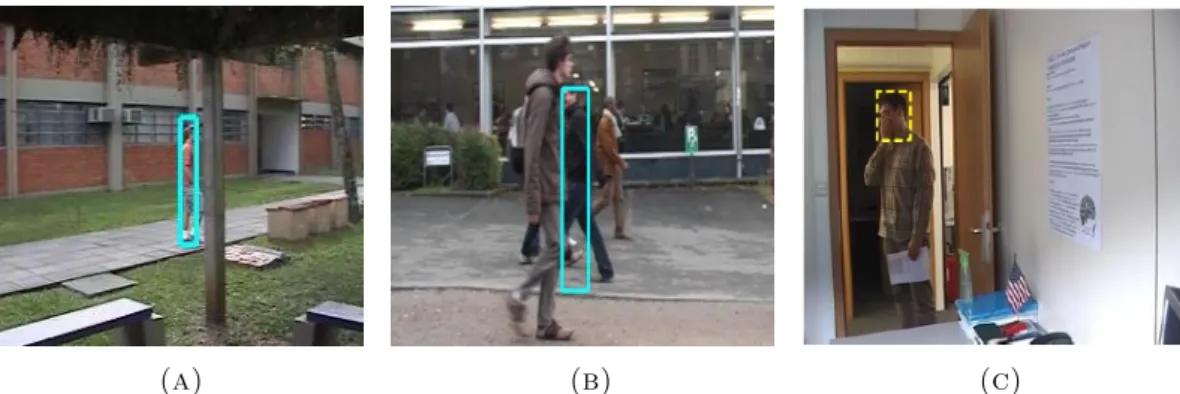
Background clutter can introduce problems for trackers as it contains elements that may bear similarity to some target features. In severe cases, some patches might appear very similar to the target. These are termed distractors. The appearance model used should bediscriminativei.e. able to confidently distinguish between the target and these
(a) (b) (c)
Figure 2.4: Changes in appearance due to out-of-plane rotations. An example of how a person’s face appears differently when undergoing out-of-plane rotation. These
images are taken from [Yang,2008].
visually similar objects. Fig. 2.5shows an example of distractors in the background while tracking a person’s face.
(a) (b) (c)
Figure 2.5: An example of distractors in the background while tracking a
person’s face. In all three images, the target(face of a person) is represented by a
yellow bounding box, while the distractors are two faces in the background.
Another difficult tracking problem is occlusion. Occlusions arise when the camera’s view of the tracked target is blocked by one or more stationary or moving object(s). In addition to this, targets can occlude themselves by undergoing out-of-plane rotation or articulated motion. Fig. 2.6illustrates three different kinds of occlusion. In real-world scenarios, a tracked target can stay partially or fully occluded for variable time periods. Because the target image evidence is partially or wholly unavailable, it becomes hard for a tracker to maintain contact with the target through occlusions. This is particularly problematic if a change in the appearance or direction of motion occurs while the target is occluded. Reliable recovery of the target after occlusions is essential to achieve accurate tracking.
Although a target can exhibit numerous types of motion, in general, its motion is cate-gorized as varying smoothly or abruptly over some time interval. Fig. 2.7demonstrates two typical motion variations. Abrupt variations can be due to motion of the target
(a) (b) (c)
Figure 2.6: Various types of occlusions. A tracked target is represented by a cyan bounding box in (a) and (b), and by a dashed yellow bounding box in (c). The target is occluded by a stationary object in (a), and by a moving object in (b). In (c), the
target is self-occluded. Image in (c) is taken from [Smith, 2007].
itself and/or camera movement. The search in state space can be constrained consider-ably when motion is smooth. However, to cover abrupt motions it is essential to search a relatively large area of or even the entire state space. The selected search method therefore directly determines the efficiency of the tracking method, and the robustness of the tracker to noise and local maxima.
(a) (Frame #551) (b) (Frame #554)
(c)(Frame #448) (d) (Frame #449)
Figure 2.7: Two different kinds of motion variations. This figure demonstrates smoothly and abruptly varying motion of a target, which is represented by a white bounding box in all four frames of a video sequence. From frame #551 to frame #554, the variation in motion is smooth, while from frame #448 to frame #449, it is abrupt.
These images are taken from [Kwon and Lee,2008].
Efficiency is an important requirement, particularly for online tracking methods. Be-cause these methods are used or expected to work in real-time applications, they have to process information upon its availability as quickly as possible. On the other hand, a high-dimensional target representation coupled with online learning may be required
to achieve robust tracking. Consequently, it becomes very hard for the search mech-anism to fulfill the efficiency requirement and at the same time find the best possible configuration.
2.2
Appearance Modelling
As mentioned earlier, appearance modelling characterizes possible ways of representing the target given information from a video sequence. An appearance model can be as simple as a colour histogram in some colour space, as proposed by [P´erez et al.,2002], or it can be complex, such as the hybrid generative discriminative model proposed by [Yu et al.,2008].
Before probing deeply into the literature on appearance modelling in visual tracking, it is important to briefly survey classic ways of representing target shape, as it is fundamental to appearance representation. Some typical shape representations used in visual tracking are illustrated in Fig. 2.8and are described below.
Pointsare often used to represent targets that cover a small region of an image [Yilmaz
et al.,2006]. Algorithms using this representation only estimate the translation of the target. This estimation can be achieved in three different ways: (1) by tracking on a frame-to-frame basis [Lucas et al., 1981], (2) through matching key-points [Veenman et al.,2001], and (3) by learning linear predictors [Zimmermann et al.,2009].
Geometric shapesare often used to describe rigid targets, and sometimes deformable
targets. Common geometric shapes are the bounding box and ellipse. Methods based on this representation estimate location, scale, and in-plane rotation of the target.
Contours are often utilized to represent non-rigid targets as they delineate the target
boundary. Parametric representations of contours have been applied to track human heads [Birchfield, 1998], while non-parametric representations have been used to track people [Yilmaz et al.,2004].
Articulated modelsare used to represent the motion of non-rigid targets which
them-selves are composed of rigid parts. These rigid parts are described by geometric shapes and their relative motion is governed by a model of their geometric relations [Kalal, 2011]. Articulated models have been used to track non-rigid targets such as humans [Wang et al.,2003],[Ramanan et al.,2007].
The work described in this thesis uses a bounding box to represent the target shape. This representation, though simple, has good expressive power. Typically, three parameters are used to describe the bounding box. In the subsequent sections, existing work on
(a) (b) (c) (d)
Figure 2.8: Typical target shape representations used in visual tracking. Four different shape representations shown in this figure are: (a) points, (b) geometric
shapes, (c) contours, and (d) articulated models. These images are taken from [Kalal,
2011].
appearance modelling, mostly related to this shape representation, will be discussed. The discussion of appearance models has been divided into two major categories: generative models and discriminative models.
2.2.1 Generative Models
Generative models encode the appearance of the target. The simplest and perhaps the most popular generative models used in visual tracking are colour histograms. Colour features have reasonable expressive ability and are readily available from an image se-quence. [Comaniciu et al., 2000] have shown that colour histograms can be used to track various targets in an efficient and robust manner. However, it is obvious that this representation cannot distinguish among targets having similar colour distributions. A remedy to this problem was proposed by [P´erez et al., 2002]. While modelling target appearance, they considered the spatial arrangement of colour features by dividing the target shape into different subregions and extracting a colour histogram from each.
Template based appearance models represent the target using a single exemplar e.g. an image patch [Schweitzer et al.,2002],[Reddy and Chatterji,1996]. As target appearance can vary significantly over time a fixed template, formed prior to the start of tracking, cannot stay valid over extended periods of time. To adapt to these variations, it is essential to update this template during tracking. On the other hand, the adaptation is prone to drift as incorrect estimates of the target state can gradually corrupt the evolving template with the introduction of the background information. Moreover, a single template obviously does not allow encoding of multiple possible appearances.
To handle the trade off between adaptive and non-adaptive tracking, it is important to update the template only if necessary and re-use previously learned templates otherwise. This idea was demonstrated successfully in the work of [Matthews et al.,2004].
To represent multiple appearances of a target, a single template can be decomposed into multiple bases using a dimensionality reduction technique such as Principal Component Analysis (PCA). [Black and Jepson, 1998] utilized eigenbasis to encode known target appearances in an offline trained target model and used it to track deformable targets. However, these models are limited to tracking applications for which the target appear-ances are known in advance. Ross et al.[Ross et al., 2008] learned a low-dimensional subspace (eigenbasis) in an incremental manner during tracking and demonstrated ro-bustness to moderate illumination and appearance variations. However, the appearance model can drift when presented with noisy updates, which are caused by imperfect track-ing results, because the algorithm does not include any mechanism to reduce the impact of these updates.
Another way of handling variations in target appearance is to construct multiple simple appearance models, with each model responsible for covering a certain type of varia-tion. The seminal work of Kwon and Lee [Kwon and Lee,2010] used Sparse Principal Component Analysis (SPCA) to form multiple basic target models to track robustly in challenging tracking environments. Each target model is a mixture of templates and its cardinality is determined by the number of non-zero entries in the principal compo-nent corresponding to this target model. By sampling these basic appearance models according to the state of the recent tracking environment, [Kwon and Lee,2011] showed improved accuracy and efficiency in real-world settings. To handle abrupt appearance variations, Park et al. [Park et al., 2012] modelled the probabilistic dependency be-tween sequential target appearances. They clustered formerly seen target appearances based on their visual similarity, learned cluster-specific classifiers as multiple appearance models, and then modelled the dependency between these learned appearance models. The algorithm is effective in tracking an abruptly varying target appearance, but is computationally expensive.
The success of sparse representations in face recognition motivated its application in vi-sual tracking. Mei and Ling [Mei and Ling,2009] modelled the target as a sparse linear combination of target and trivial templates using L1-minimization. A good target can-didate can be well approximated by the trivial templates leading to a sparse coefficient vector, whereas a bad candidate will often produce a dense coefficient vector. The re-sulting tracker shows robustness against clutter and illumination changes. However, the computational complexity of L1-minimization is high, which precludes its applicability in real-time scenarios. To improve the efficiency of sparse coding methods, [Li et al., 2011] used an orthogonal matching pursuit algorithm, and [Bao et al., 2012] proposed an accelerated proximal gradient approach to solve the costly optimization problem.
Recently, sparse representations have been further exploited, in different formulations, to enhance robustness to appearance variations. Zhang et al. [Zhang et al., 2012b] proposed a tracking framework based on multi-task sparse learning, in which the inter-dependencies among different particles were taken into account to improve the accuracy of [Mei and Ling, 2009]. In [Jia et al., 2012], a local sparse appearance model was proposed that utilizes partial as well as spatial information of the target to achieve bet-ter performance than methods based on holistic representations such as [Mei and Ling, 2009]. A dictionary, formed by sampling overlapped local image patches from a set of templates, was used to encode local patches in a candidate region. An alignment-pooling method was proposed to reduce the impact of outliers and retain structural information in this local representation.
Multi-region representations of the target are more robust to noise and other appear-ance variations compared to holistic, as mentioned earlier in this section. They were further used to good advantage by many approaches attempting to cover large geo-metric appearance changes. In [Shahed Nejhum et al., 2008], a constantly changing foreground shape was represented by a few rectangular blocks, whose positions within the tracking window were adaptively determined. To track a given frame, the algorithm finds a tracking window by scanning whole image, segments the precise boundary of the target in this window, and updates the configuration of rectangular blocks with this extracted boundary. Kwon and Lee [Kwon and Lee, 2009] proposed a more flexible patch-based appearance model, in which the patches are added, removed, and moved by affine transformation and transition to deal with large geometric and photometric appearance variations. However, the local appearance model can still drift because it does not have a mechanism to identify noisy samples during the appearance update process. Cehovin et al. [Cehovin et al.,2011] combined global appearance of the target with the local patch-based target representation using a novel coupled-layer visual model to reduce noisy samples while updating the local appearance. The aforementioned ap-proaches have shown good accuracy while tracking non-rigid targets, but at the cost of speed.
Despite the fact that these online generative models have demonstrated success, there are two major concerns that require attention. First, a large number of examples are required from some sequence of recently processed frames to capture the likely appear-ance variations. Since there are often only a few available, these models assume that the target appearance does not vary significantly in this period. However, if this assumption is violated, the appearance model may again drift. Second, these models do not take into account the available background information, which again might improve their tracking accuracy and robustness [Zhang et al.,2012a].
2.2.2 Discriminative Models
Discriminative models learn a decision boundary between foreground (target) and back-ground (non-target) examples. This decision boundary is also termed a binary classifier. The classifier can be trained offline by providing all possible target(positive) and non-target(negative) examples(patches), or can be adapted online by utilizing the weakly labeled data generated by a tracker.
For discriminative models to stay valid over extended periods of tracking, it is necessary to update the decision boundary as soon as new tracking data becomes available. Collins et al. [Collins et al., 2005] developed a framework to select the most discriminative features online and Avidan [Avidan, 2007] proposed a method to update an ensemble of weak classifiers to separate the target from the background. In [Collins et al.,2005], the set of candidate features is comprised of linear combinations of red, green, and blue pixel values. A likelihood image is produced for each candidate feature in which object pixels have positive values and background pixels have negative values. Then, a variance ratio is computed from histograms of these likelihood values to quantify the separability of object and background classes under this feature. Finally, top N most discriminative features are selected for tracking based on their ability to separate between object and background. In [Avidan, 2007], a weak classifier is a separating hyperplane learned from target and non-target examples. A strong classifier is learned using (offline)Adaboost algorithm from the ensemble of weak classifiers, which is then used to produce a confidence map in a given frame for tracking. In [Grabner and Bischof, 2006], Grabner & Bischof proposed an online version of Adaboost to select discriminative features. Again, features are weak classifiers, which perform better than a chance. However, contrary to offline boosting, where all examples are used to update one weak classifier, in online boosting, all weak classifiers get updated upon the arrival of a new example.
Although the aforementioned approaches adapt to target appearance variations, each time the classifier (model) is updated errors may be introduced into it by imperfect tracking results. The repeated inclusion of these errors over time will most likely lead to degradation of the classifier, also known as the drift problem. The degradation occurs since the classifier gradually loses the ability to distinguish between target and non-target examples. Furthermore, the above-mentioned approaches are online versions of supervised learning techniques; they are not good at tackling noisy labels.
The trade-off between non-adaptive and adaptive classifiers can be portrayed as the stability-plasticity dilemma [Grossberg, 1987]. If a classifier has been trained offline, and it is not updated online then it cannot drift. However, its non-adaptive nature
would not allow robust tracking of a target that is undergoing appearance variations. On the other hand, online classifiers being updated with their own tracking results can easily lead to tracking failure in the case of incorrect updates.
An intuitive way to reduce the drift problem is to bind an online appearance learner (tracking classifier) with a fixed (non-adaptive) initial appearance (auxiliary classifier). One of the first attempts in this direction was made by Grabner et al.[Grabner et al., 2008], in which they used an offline classifier in conjunction with an online classifier. The coupling of an adaptive classifier with a fixed classifier overcomes the drift problem to a certain extent, but does not allow the method to adapt to appearance changes beyond a certain range. The drift problem can also be alleviated by training a pair of independent classifiers. [Yu et al., 2008] adopted a co-training based approach to label the incoming data and train a hybrid generative discriminative model. The generative model encodes all the appearance variations of the target that have been seen while tracking, while the discriminative model focuses on the recent appearance variations of the target. The co-training approach requires the feature sets for the classifiers to be conditionally independent, which is a strict assumption for visual tracking.
Online classifiers (e.g. boosting) or learners being updated on their own tracking result can drift due to the label noise problem. The label noise problem emerges when the bounding boxes of the target do not perfectly overlap with the target [Santner et al., 2010]. If label noise persists over a tracking sequence, the tracker will most likely start to loose lock on the target. An online version of the Multiple Instance Learning (MIL) technique was introduced to tracking by Babenko et al.[Babenko et al.,2009] to overcome the label noise problem. Their central idea was to take patches most likely lying on the target as instances for the positive bag, and instances further away from the target as negatives. With this formulation, the ambiguity in tracking results caused by imperfect alignment of the target bounding box and target is passed onto the learning algorithm, which now has to decide which instance in each positive bag is the most correct. Most correct implies the instance whose bounding box aligns most closely with the target. Zhong et al. [Zhong et al.,2010] handled the label noise problem by framing tracking in a weakly supervised learning scenario where the labels (possibly noisy) for positive and negative examples were provided by multiple imperfect oracles (i.e. trackers). Recently, Hare et al. [Hare et al., 2011] proposed an online structured output support vector machine (SVM) to alleviate the effect of misaligned examples. Instead of learning a classifier, which predicts binary labels, the approach learns a predictor that directly predicts the target transformation between frames.
The drift problem can be explicitly addressed by combining trackers with different ap-pearance adapting capabilities or by integrating a tracker and a detector. Santner et
al.[Santner et al.,2010] heuristically combined an adaptive online learning method with two complementary tracking approaches. A template tracker and an optical-flow-based mean-shift tracker are the non-adaptive and adaptive approaches, respectively, while an online random-forest is a moderately adaptive method. Although the proposed method reduces drift to a reasonable extent, it requires certain thresholds to be adjusted prior to tracking to perform well. Kalal et al. [Kalal et al.,2012] trained a binary classifier by exploiting the structure of unlabeled data during tracking using positive and negative constraints. This binary classifier was used to correct the errors made by the tracker, thereby reducing the drift problem.
The discriminative learning paradigm has also been exploited through mid-level cues, compressed features, and the incorporation of spatial constraints to achieve robust visual tracking. Wang et al. [Wang et al., 2011] proposed a discriminative model based on superpixels to minimize the impact of drift. This appearance model is constructed by clustering segmented superpixels from training images. Rich image representations can be combined with simple discriminative models to build robust and efficient trackers. Based on this formulation, Zhang et al. [Zhang et al.,2012a] projected high-dimensional features, which represent the target and the background samples, to a low-dimensional space using a compressed sensing technique, and then trained a binary classifier on these low-dimensional features to counter appearance variations and achieve computationally efficient tracking. To cope with appearance changes, Zhang and Van der Maaten [Zhang and van der Maaten,2014] trained appearance models of target parts and the structural constraints between these parts jointly in an online structured SVM.
2.2.3 Other Approaches
Almost all the aforementioned approaches, in both the generative and discriminative learning paradigms, assume that a target model trained (updated) till the previous time-point is still valid for the current time-point. However, the appearance of the target might have changed significantly at the current time-point. As a result, the target model, trained till the previous time-point, would produce a sub-optimal target state at the current time-point, and the errors accumulated over time might cause tracking failure. To address the above problem, Bai and Tang [Bai and Tang, 2012] designed three sets of patches for training the online laplacian ranking SVM. The first and the second set contain patches corresponding to bounding boxes of the target in the initial and the latest frames, respectively, to adapt to the fluctuation in the target appearance. While the third set comprises patches corresponding to rough location of the target from the current time-point to adapt to the substantial appearance variations.
Most of the tracking approaches reviewed in the previous two sections assume that the best target state produces the highest likelihood score near the previously estimated state. This assumption is only valid if the target model, updated over time, is always correct. However, as mentioned in the previous two sections (2.2.1,2.2.2), it is not difficult to imagine that the target model might become contaminated with noise (i.e. background information) in real-world tracking scenarios. This noisy target model would not allow the search method to output the true target state even though it might have converged to the global optimum solution (the best state). The best state found in this case would not correspond to the true state. With this tracking error, the target model includes more background and might drift over time. Recently, Kwon and Lee [Kwon and Lee, 2013] proposed an indirect solution to this drift problem. They employed two Markov Chains in an interactive manner to find the best state as the one that maximizes the average of the lower and upper bounds of the likelihood and at the same time minimizes the gap between two bounds of the likelihood. This best state would produce the same likelihood, regardless of the target models used.
2.3
Search Strategies
Previous section discussed some different methods of modelling target appearance. This section reviews search strategies that use appearance models and image data to infer a solution to the tracking problem. In simple terms, the aim of the search strategy is to find the best hypothesis from the space of all possible hypotheses. The space of all possible hypotheses defines the search space of a search method. The dimensionality of this search space is determined by the number of variables included in the target state multiplied by states per variable.
As mentioned previously, search strategies can be either probabilistic or non-probabilistic. Probabilistic approaches, described in section2.3.2, use random variables and their corre-sponding probability distributions to model the uncertainty associated with the motion, observation, state and appearance of the target. These models are then fused to infer knowledge about the target state at each time-step. In contrast, the non-probabilistic approaches discussed in section 2.3.1 employ optimization methods to find the best target state.
2.3.1 Non-probabilistic Search Strategies
Non-probabilistic search strategies typically cast tracking as an optimization problem. With this formulation, the tracking problem is described by a cost function and the so-lution is achieved by maximizing or minimizing this cost function [Smith,2007]. These methods gained popularity as they exhibit good convergence properties and are compu-tationally efficient.
One early work in optimization-based tracking is known as EigenTracking [Black and Jepson,1998]. In this work, the target is represented by a small set of eigen bases and a tracking solution is found by minimizing an error function which defines similarity between the learned bases and the image data through least-squares approximation. Avidan [Avidan, 2004] argued that eigenbasis is not a general purpose classification technique, and proposed a fusion of SVM and an optic-flow based tracker to track vehicle rear-ends. An SVM based detection module was used to find candidate vehicle regions. These detected regions were then tracked by maximizing the SVM classification score using gradient descent.
Another early, but classic optimization technique for tracking is based on the Mean Shift algorithm. Mean Shift is a general non-parametric approach finding the mode of a density function which was introduced by Fukunaga and Hostetler [Fukunaga and Hostetler, 1975]. Later, it was adopted to solve the tracking problem by Commaniciu et al. [Comaniciu et al., 2000]. In [Comaniciu et al., 2000], mean shift iterations are utilized to find the target candidate that best matches the target model. The matching function is a similarity measure based on the Bhattacharyya coefficient.
2.3.2 Probabilistic Search Strategies
Probabilistic search strategies hold three clear advantages over the non-probabilistic methods described in the previous section [Smith,2007]. The first is flexibility, as one component can be exchanged for another (e.g. an edge based observation model can be replaced with a colour based observation model) without affecting the overall design. The second is their generality: an inference method used for single target tracking might also be applicable to a pose estimation problem. Third, but an important advantage of these methods, is the ability to systematically handle unpredictable target configurations and noise. This is possible because probabilistic methods can maintain multiple hypotheses, which makes them robust to the uncertainties present in real-world data. For instance, these methods are robust to situations in which a target may move unpredictably or, due to clutter, it appears that there may be more than one likely solution.
Recursive Bayesian estimation (RBE) is the most popular and celebrated technique in probabilistic tracking, although there are a few alternatives. RBE formulates tracking as the temporal propagation of conditional densities over time. Let Xt be the target state at time t, and Y1:t ={y1, ...,yt} be the observations up to time t. According to RBE, the posterior probabilityp(Xt|Y1:t) given the stateXtat time t and observations Y1:t up to tcan be computed as:
p(Xt|Y1:t) =Ctp(Yt|Xt)
Z
Xt−1
p(Xt|Xt−1)p(Xt−1|Y1:t−1)dXt−1, (2.1)
where the term p(Yt|Xt) expresses the observation model. It measures how well the observation Yt at time t supports the hypothesis that the target is in state Xt at time t. p(Xt|Xt−1) is called the motion model or the state evolution, and determines
the probability of transitioning to state Xt at time t given state Xt−1 at time t−1.
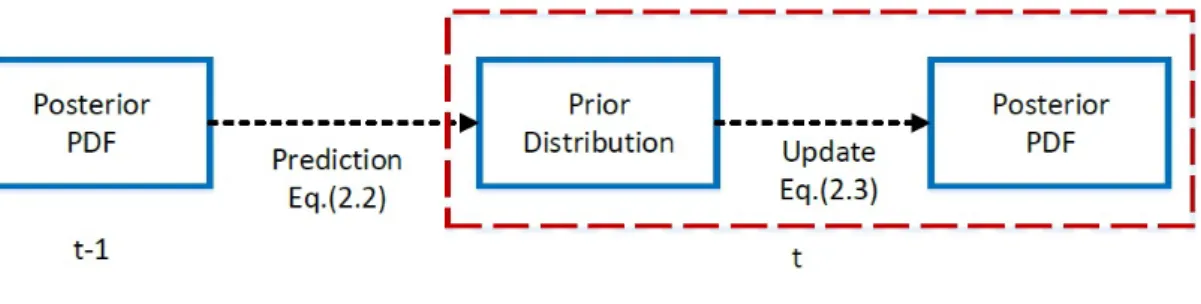
Ct= p(Yt|Y11:t−1) ensures that the posterior probability sums to one over the state space. Eq.2.1 is composed of two steps (See Fig. 2.9): prediction and update. During pre-diction, the posterior probability at timet−1,p(Xt−1|Y1:t−1), is propagated to time t
using the motion modelp(Xt|Xt−1) to form a prior distributionp(Xt|Y1:t−1),
p(Xt|Y1:t−1) =
Z
Xt−1
p(Xt|Xt−1)p(Xt−1|Y1:t−1)dXt−1, (2.2)
In the update step, this prior distribution is corrected using the observation model
p(Yt|Xt) to generate the posterior probabilityp(Xt|Y1:t) at timet.
p(Xt|Y1:t) =Ctp(Yt|Xt)p(Xt|Y1:t−1), (2.3)
The posterior probabilityp(Xt|Y1:t) encodes belief about the state of the target at time t using observations Y1:t up to time t. The next section reviews well-known methods for computing recursive Bayesian estimation.
Figure 2.9: Steps involved in estimating the posterior PDF at timet from the given
2.3.2.1 Kalman Filter
The Kalman Filter dates back to 1960, when it was formally presented by R. Kalman [Kalman, 1960]. In general, the Kalman filter provides an optimal way of estimating the hidden state of a system by analyzing observable measurements [Kalman,1960]. In other words, the Kalman filter solves the state estimation problem completely. It is important, however, to realize that the filter provides an optimal solution only if certain assumptions hold true.
In terms of Bayesian tracking, the first assumption is that the model governing the state evolution must be linear with additive Gaussian noise, and the second assumption is that the observation density must be Gaussian. If these assumptions are valid for a tracking situation then the Kalman Filter will provide an exact solution to the recursive Bayesian estimation.
Informally, the filter can be described as the composition of three stages: deterministic prediction, stochastic diffusion, and prediction correction through measurement. In the deterministic prediction stage, the mean value of the state distribution changes while the covariance remains fixed. To capture inaccuracies in the process of deterministic pre-diction and the unavoidable noise present in any real-world phenomenon, the stochastic diffusion process is incorporated, resulting in increased state covariance. Finally, this state prediction is corrected using observable measurements to produce a final state es-timate. This last step also results in the alteration of the state mean and covariance. In summary, this filtering process is a combination of a prediction step and a correction step. Both deterministic prediction and stochastic diffusion generate the predicted state that is refined using the measurement to estimate the final state.
Mathematically, the predictive component of the Kalman filter, which produces the a prioristate estimate and its covariance, respectively, can be written in terms of equations 2.4and 2.5. The a priori estimate depicts the predicted state before the arri