Book Chapter IN PRESS Citation Information:
"#$%&'!()!*#&&+,)!-./!0&%,,1!2#345'%&!6789+/:!7/;!'<%!=%8</+>5%,!#?!@%5'&7A+B7'+#/C!D/! E34+&+87A!D,,%,,3%/')!./!2#&4#&7'%!6789+/:!7/;!=%8</#A#:FGH&+I%/!2&+3%C!J#8+7A!HF/73+8,!7/;! .34A+87'+#/,!"#$%&#$"'(")*+,-."/0"1+2&"3"40"56*#22!"78"9:#..!"1#:.*#(!"9;<"7=7"=2+'-20
Computer Hacking and the Techniques of Neutralization: An Empirical Assessment
Robert G. Morris, Ph.D. University of Texas at Dallas
School of Economic, Political & Policy Sciences Program in Criminology, GR 31
800 West Campbell Rd. Richardson, TX 75080-3021
(972) 883-6728 [email protected]
Bio Statement: Robert G. Morris, Ph.D. is an Assistant Professor of Criminology at the
University of Texas at Dallas. He studies the etiology of crime with a specific interest in fraud and cybercrime as well as issues surrounding the social response to crime. His recent work has appeared in Criminal Justice Review, Journal of Criminal Justice, Journal of Crime and Justice, Deviant Behavior, Criminal Justice & Popular Culture, Criminal Justice Studies, and Criminal Justice Policy Review. Questions in reference to his chapter can be emailed to
Computer Hacking and the Techniques of Neutralization: An Empirical Assessment Introduction
The impact on daily life in westernized countries as a result of technological development is profound. Computer technology has been integrated into our very existence. It has changed the way that many people operate in the consumer world and in the social world. Today, it is not uncommon for people to spend more time in front of a screen than they do engaging in physical activities (Gordon-Larson, Nelson, & Popkin, 2005). In fact, too much participation in some sedentary behaviors (e.g., playing video/computer games; spending time online, etc.) has become a serious public health concern that researchers have only recently begun to explore. Research has shown that American youths spend an average of nine hours per week playing video games (Gentile et al., 2004)! Video gaming and other similar forms of sedentary behavior, among youth, may be linked with obesity (e.g., Wong & Leatherdale, 2009), aggression (stemming from violent video gaming—see Anderson, 2004 for a review), and may increase the probability of engaging in some risky behaviors (Nelson & Gordon-Larsen, 2006; Morris & Johnson, 2009). In all, it is difficult to say whether increased screen time as a result of technological development is good or bad in the grand scheme of things; the information age is still in its infancy and it is simply too early for anyone to have a full understanding of how humans will adapt to technology and mass information in the long-run. However, we do know that people are spending
considerable amounts of time participating in the digital environment and the popularity of technology has spawned a new breed of behaviors, some of which are in fact criminal. One such criminal act is that of malicious computer hacking.1
Scholarly attention to cyber related crimes has gained much popularity in recent years; however, much of this attention has been aimed at preventing such acts from occurring through information technology and information assurance/security developments. To a lesser extent, criminologists have focused on explaining the etiology of malicious cyber offending (e.g., malicious computer hacking) through existing theories of criminal behavior (e.g., Hollinger, 1993; Holt, 2007; Morris & Blackburn, 2009; Skinner & Fream, 1997; Yar, 2005a; 2005b; 2006). This reality is somewhat startling considering the fact that economic losses resulting from computer hacking have been conservatively estimated in the hundreds of millions of dollars per year (Hughes & DeLone, 2007) and media attention to the problem has been considerable (Skurodomova, 2004—see also Yar, 2005a). Hopefully, future research, this chapter included, will help to stimulate more scholarly attention to the issue. The goal of this chapter is to explore malicious hacking from a criminological perspective while focusing on the justifications, or neutralizations, that people might use when engaging in criminal computer hacking.
Caution must be used when using the term hacking to connote deviant or even criminal behavior. Originally, the term was associated with technological exploration and freedom of information; nowadays, the term is commonly associated with criminal conduct. In general, hacking refers to the act of gaining unauthorized/illegal access to a computer, electronic communications device, network, web page, data base or etc. and/or manipulating data associated with the hacked hardware (Chandler, 1996; Hafner and Markoff, 1993; Hannemyr, 1999; Hollinger, 1993; Levy, 1994; Roush, 1995; Yar, 2005a). For the purposes of this chapter, we will use the term hacking as a reference to illegal activities surrounding computer hacking. Such forms of hacking have been referred to has “black hat” hacking or “cracking” (Stallman, 2002). Again, the primary demarcation here is criminal and/or malicious intent. However, before
we fully engage understanding hacking from a criminological perspective, it is important to briefly discuss the history of computer hacking.
The meaning of computer hacking has evolved considerably since the term was first used in the 1960s and as many readers are surely aware, there still remains a considerable debate on the connotation of the word hacking. The original definition of hacking surrounded the issue of understanding technology and being able to manipulate it. Ultimately, the goal was to advance technology by making existing technology better; this was to be done through freely sharing information. The first definition was clearly a positive one and did not refer to criminal activity in any form. As time progressed and computer/software development became more common, the persona of a hacker began to evolve (Levy, 1984; Naughton, 2000; Yar, 2006). The second generation of hackers stemmed from advancements and opportunities such as relatively affordable computer hardware and increased networking capabilities (i.e., the internet)—see Clough & Mungo (1992). Many hackers of this generation participated in a tightly knit
community that followed the social outcry and protest movements from the late 1960s and early 1970s (Yar, 2006). In this sense, second generation hackers were anti-regulation as far as the exchange of information was concerned. As you might expect (or have witnessed), this view typically runs counter to the views of governmental and corporate stakeholders. These hackers believed that information can and should be free to anyone interested and that by doing so, technology would advance more efficiently and effectively since there would be less
“reinventing the wheel” and more progress (see Thomas, 2002). Clearly, there is some logic to their argument, that there is a “hacker ethic.” However, many hackers of this generation used this ethic to justify illegal (or illegitimate) access to closed systems and simultaneously argued such exploration for not for malicious purposes.
More recently, the term hacking has referred to a variety of illegitimate and illegal
behaviors. However, the definitional debate continues and many “old school” hackers contest the current negative label of what it is to be a hacker (see Yar, 2005). The reality is that malicious hacking causes much harm to society. The primary difference between classical hacking and modern hacking is that with the latter, being a skilled programmer is not a requirement in order to cause harm or to be able to do hacks. For example, any neophyte computer user can simply download malicious prewritten code (e.g., viruses, worms, botnet programs, etc.) and conduct simple internet searches to find literature on how to use the code for harmful or illegal purposes.2 Thus, it seems that the hacker ethic is a double-edged sword; the open sharing of information may very well stimulate technological progression but it also opens to door to harm committed by those with, presumably, a lack of respect and/or skill for the technology behind the code. This difference is critical to our understanding of why some users engage in malicious computer hacking—today, there are simply more hackers.
The Present Study
The primary goal of this chapter is to explore why some individuals engage in illegal computer hacking. Certainly, most moderately experienced computer users could develop some anecdote that might explain why some people hack. For example, some suggest that people hack because it is an adrenaline rush. In other words, hackers get a thrill out of hacking and enjoy solving problems or understanding how a program operates and how it can be manipulated (see Schell & Dodge, 2002). Anyone who enjoys computing technology and problem solving might be sensitive to this explanation and it may very well be the case some of the time. However, this does not explain why some people go beyond simply exploring computer code to actually manipulating code for some alternative purpose. Perhaps the purpose is simply for kicks, akin of !!!!!!!!!!!!!!!!!!!!!!!!!!!!!!!!!!!!!!!!!!!!!!!!!!!!!!!!!!!!!
juvenile vandalism, or perhaps the goal is financially motivated. Whatever the case, simple anecdotes developed from the hip are not very systematic and may not go too far in explaining the motivations behind hacking in general.
In understanding something more thoroughly, we need a strong theoretical foundation to develop our understanding of the issue. Established criminological theories provide us with a systematic basis to begin our evaluation of the etiology of hacking. However, as discussed below, the transition into the digital age has serious implications for crimes and the theories that best explain the onset, continuity, and desistance of participating in cyber related crimes. It is hoped that this chapter will shed some light (both theoretically and empirically) as to why some people engage in some types of malicious computer hacking.
For over a century, criminologists have been concerned with the question “why do people commit crimes?” Several theories of crime are suggestive of the idea that an individual’s
environment plays a large role in the development of individual beliefs and attitudes toward moral and immoral behavior and that such are likely to play a strong role in behavior. Some individuals may develop attitudes favorable to crime while others may not, depending on their particular situation. However, varying theories of crime present varying explanations with regard to the nature of such attitudes and beliefs (Agnew, 1994). One theory of crime that focuses explicitly on the nature of beliefs in the process of becoming delinquent/criminal is referred to as the techniques of neutralization (Sykes and Matza, 1957; Matza; 1964).
The Techniques of Neutralization
The techniques of neutralization theory (Sykes and Matza, 1957; Matza; 1964) attempts to explain part of the etiology of crime while assuming that most people are generally unopposed to conventional (i.e., non-criminal) beliefs, most of the time. Even so, they may engage in
criminal behavior from time to time (Sykes & Matza, 1957; Matza, 1964). Sykes and Matza, though focused only on juvenile delinquency, argued that people become criminal or deviant through developing rationalizations or neutralizations for their activities prior to engaging in the criminal act. In this sense, attitudes toward criminality may be contextually based. Specifically, Sykes and Matza developed five techniques of neutralization that were argued to capture the justifications that a person uses prior to engaging in a criminal/deviant act. This was argued to allow the individual to drift between criminality and conventionality (Matza, 1964). The techniques of neutralization include 1) the denial of responsibility, 2) the denial of an injury, 3) the denial of a victim, 4) the condemnation of the condemners, and 5) an appeal to higher loyalties. These five techniques are discussed in some detail below.
In using the denial of responsibility to justify engaging in a crime, the individual may direct any potential blame to an alternative source or circumstance. In other words, blame is shifted to a source other than the self. The individual may also conclude that no harm (to property or to other individuals) will result from the action (the denial of injury), thus
participation in the behavior is harmless. For example, Copes (2003) found that joyriding auto thieves regularly felt that since the car was eventually brought back, there was no harm in joyriding. The denial of a victim may be particularly apparent in cyber related crimes. This technique might be used when the victim is not physically visible or is unknown or abstract. This view suggests that if there is no victim, there can be no harm. As an example, Dabney (1995) found that employees tended to use this neutralization technique to justify taking items found on company property if there was no clear owner (i.e., another employee or the company). A condemnation of the condemners refers an expression of discontent with the perceptions of authority holders. For example, holding the view that those opposed to the action are hypocrites,
deviants in disguise, or impelled by personal spite (Skyes & Matza (1957, p. 668). In other words, the critics are in no position to judge my actions, thus my actions are not inappropriate. Sykes and Matza’s (1957) final technique of neutralization, an appeal to higher loyalties, refers to justifying actions as being a part of an obligation to something equal to or greater than one’s own self-interest. For traditional crimes, an example would be the rationalization of embezzling from a company in order to pay for a child’s college tuition or medical costs.
After reading the above passage, you may be thinking of types of justifications or
neutralizations that weren’t explicitly covered in the original five presented by Sykes and Matza (1957)—at least you should be doing so! The original five techniques do not account for every possible justification. Several criminologists have expanded the list through more recent research studies. An example developed by Minor (1981) was termed the defense of necessity. According to this technique, “if an act is perceived as necessary, then one need not feel guilty about its commission, even if it is considered morally wrong in the abstract” (Minor, 1981, p. 298). Morris and Higgins (2009) found modest support for this technique of neutralization, and others, in predicting self-reported and anticipated digital piracy (i.e., illegal downloading of media). Other extensions of the techniques of neutralization include, but are not limited to, the metaphor of ledgers (Klockers, 1974) and justification by comparison and postponement (Cromwell & Thurman, 2003)—for greater detail and a full review of neutralization theory see Maruna and Copes (2005).
To this point, the discussion on neutralization theory has surrounded the idea that neutralizations of criminal conduct precede the actual conduct, as argued by Sykes and Matza (1957). However, neutralizations may occur after the crime takes place and there is some research that is suggestive of this. For example, Hirschi (1969) argued that neutralizations may
begin after the initial criminal acts take place, but post-onset, may be used as a precursor to the act. Either way, continued research is needed to hash out whether neutralizations occur before or after a crime is committed (see Maruna & Copes, 2005). The fact is that several studies have found a significant link between neutralizations and crime, including digital crimes (e.g., Ingram & Hinduja, 2008; Hinduja, 2007; Morris & Higgins, 2009). However, no study to date has quantitatively assessed the relationship between techniques of neutralization and computer hacking.3 The remainder of this chapter is devoted to addressing this gap in the literature. Based on the extant neutralization literature, it is hypothesized here that neutralization will explain some variation in participation in computer hacking.
Methods
To address this issue, data were used from a larger project aimed at assessing computer activities among college student. During the fall of 2006, a total of 785 students participated in a self-report survey delivered to ten college courses at a university located in the southeastern United States. The students who participated were representative of the general university demographic with regard to individual characteristics (e.g., age, gender, and race) and their academic majors. Specifically, fifty-six percent of respondents were female; seventy-eight percent were White; and most (eighty percent) were between eighteen and twenty-one years old. Measures
!!!!!!!!!!!!!!!!!!!!!!!!!!!!!!!!!!!!!!!!!!!!!!!!!!!!!!!!!!!!!
3 One study sought to explain computer hacking through the lens of moral disengagement theory, which complements the techniques of neutralization and found that hackers possessed higher levels of moral
disengagement compared to non-hackers (see Young et al., 2007). However, the study was limited to data collected at a single hacker convention and the analysis did not control for potentially confounding influences from other explanatory variables.
Dependent variables. Several indicators of participation in computer hacking were used to tap into malicious hacking. Such included guessing passwords, gaining illegitimate access to a computer or network, and manipulating another’s files or data. Specifically, students were asked to report the number of times during the year prior to completing the questionnaire they had tried to guess a password in order to gain access to a system other than their own. Second, they were asked to report the number of times they had gained accessed another’s computer without his/her permission to look at files or information. Finally, students were asked to report the number of times they had had added, deleted, changed, or printed any information in another person’s computer without the owner’s knowledge or permission. For each type of hacking, students were asked to report the number of times they had engaged in the behavior using university owned hardware as well as the number of times they had done so using a non-university computer. Responses were recorded on a five point scale (Never, 1-2 times, 3-5 times, 6-9 times, and 10 or more times).
In order to provide the most complete analysis possible, each of the hacking indicators (i.e., password guessing, illegitimate access, and file manipulation) were explored individually and in an aggregated fashion (i.e., all types combined to represent general hacking). First, each of the three hacking types, as well as a fourth “any of the three” hacking variable, was explored as a prevalence measure. In other words, a binary indicator was created for each type that identified whether the student had engaged in the activity, or not. Next, a variable was created to represent the level of hacking frequency among all three hacking types together. This was done by
calculating factor scores based on each hacking variable where higher scores represented increased frequency of participation in hacking (alpha = .91). Finally, a measure of hacking diversity was created by counting the number of different forms of hacking reported (zero, one,
two, or all three forms reported). In all, analyzing reports of hacking in this manner provides a more complete analysis of the outcome measure, hacking, than has typically been done in the past. Here, whether they participated in a particular, or any, type of hacking, how much they participated (if at all), and how versatile they are in hacking types are each assessed while statistically controlling for several demographic and theoretical predictors of offending.
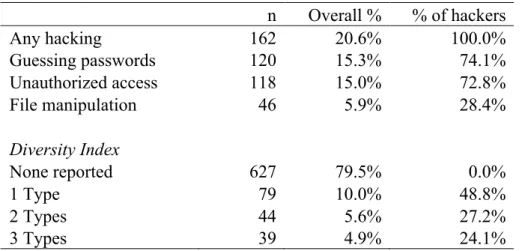
As shown in Table 1, twenty-one percent of respondents reported at least minimal participation in computer hacking within the year prior to the date of the survey. Fifteen percent of respondents reported gaining illegal access or guessing passwords, respectively. Of all
students reporting at least one type of hacking, seventy-four percent reported password guessing, seventy-three percent reported unauthorized access, and twenty-four percent reported file
manipulation. Clearly, there is some versatility in hacking, as defined here. With regard to hacking versatility, forty-nine percent of those reporting hacking reported only one type, twenty-seven percent reported two types and twenty-four percent reported all three types of hacking.
INSERT TABLE 1 ABOUT HERE
Independent variables. As discussed above, the main goal of this chapter is to explore participation in computer hacking from a techniques of neutralization perspective. Since the available data were secondary in nature, neutralization was limited to eight survey items each reflecting varying, but not all, techniques of neutralization. The items asked respondents to report their level of agreement with a series of statements on a four-port scale (strongly disagree=4; strongly agree=1) and all items were coded in a manner so that higher scores were representative of increased neutralizing attitudes. It is important to note that each of the neutralization items reflect neutralizations toward cybercrime. Unfortunately, no items appropriately reflected the denial of responsibility. However, three items captured the denial of injury: 1) Compared with
other illegal acts people do, gaining unauthorized access to a computer system or someone’s account is not very serious, 2) It is okay for me to pirate music because I only want one or two songs from most CDs, and 3) It is okay for me to pirate media because the creators are really not going to lose any money. The denial of a victim was assessed via two items: 1) If people do not want me to get access to their computer or computer systems, they should have better computer security, 2) It is okay for me to pirate commercial software because it costs too much; and 3) People who break into computer systems are actually helping society. Condemnation of the condemners was not directly represented but could be argued through the second indicator from the denial of a victim above. An appeal to higher loyalties was represented by the third statement above from the denial of a victim category and from one additional item, 1) I see nothing wrong in giving people copies of pirated media to foster friendships. Clearly, there is substantial overlap among the available neutralization items. For this reason, neutralization was assessed as a
singular construct by factor analyzing each of the eight items. A similar approach was taken by Morris and Higgins (2009). Factor scores were calculated to represent the techniques of
neutralization in general where higher scores represent increased neutralization (alpha = .80). However, the neutralization indicators were also explored as individualized variables as a secondary analysis, discussed below.
It was also important to control for other important theoretical constructs in order to insure that the impact from neutralization on hacking was not spurious. Differential association with deviant peers and cognitive self-control were each incorporated into the analysis.
Differential association refers socializing with people who engage in illegal activities and is one of the most robust predictors of criminal/deviant behavior (see Akers & Jensen, 2006). In theory, increased association with peers who are deviant increases the probability that the individual will
become deviant (i.e., engage in crime). Recent research has shown that increased association with deviant peers is significantly linked with participation on a variety of forms of computer hacking (see Morris & Blackburn, 2009). Differential association was operationalized via three items asking students to report how many times in the past year their friends had guessed passwords, had gained unauthorized access to someone’s computer, and modified someone’s files without their permission. Responses were recorded on a five-point scale (5 = all of my friends; 1 = none of my friends). Factor score were calculated based on the three indicators where higher scores represent increased differential association. The internal consistency of the differential association measure was strong (alpha = .88).
Self-control refers to one’s “tendency to avoid acts whose long-term costs exceed their momentary advantages” (Hirschi & Gottfredson, 1993, p. 3). Research has consistently found that low self-control has a significant positive link with a variety of criminal behaviors—see Pratt & Cullen (2000) for a review. Here, self-control was operationalized via the popular, but not perfect, twenty-three item self-control scale developed by Grasmick et al. (1993). Again, factor scores were calculated based on the self-control items. Items were coded so higher scores on the self-control scale reflect lower self-control. The internal consistency of the scale was also strong (alpha = .89).
Control variables. In staying consistent with the extant literature on the topic of computer hacking, several control variables were incorporated into the analysis. As for individual
demographics, the analysis controls for gender (female = 1), age (over 26 years old = 1), race (White = 1). Also controlled for were each individual’s computer skill and a variable
representing cyber victimization. Computer skill was operationalized through a variable
the level of being able to use a variety of software and being able to fix some computer problems, or greater. Cyber victimization was operationalized through four items asking respondents to report the number of times during the past year someone had accessed their computer illegally, modified files, received a virus or worm, and/or harried them in a chat room. Factor scores were calculated to represented the victimization construct where higher scores represent increased victimization. The factor analysis suggested a singular construct, however internal consistency was only modest (alpha = .54).
In all, six regression models were developed to address the goals of this chapter. Each model contains the same independent variables described above, however each dependent variable is different, also described above. Each outcome variable’s metric determined the type of regression model utilized. For the hacking frequency model, ordinary least squares regression (OLS) was employed as the outcome variable is continuous. For the hacking versatility model, the outcome is an over-dispersed count variable with a substantial proportion of cases reporting a zero count. To this end, zero-inflated negative binomial regression was used (ZINB). The
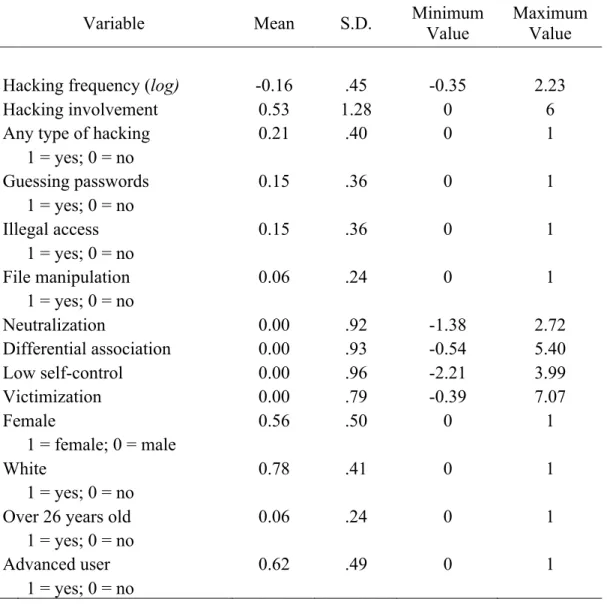
remainder of the models, all of which are based on varying binary dependent variables, logistic regression was utilized (Logit). It is important to note that collinearity among the independent variables was deemed non-problematic. This was assessed by examining bivariate correlation coefficients among independent variables (see Appendix A) and by calculating variance inflation factors. Further, residual analyses of each model suggested reasonable model fit and robust standard errors were calculated in order to determine coefficient significance levels. Table 2 provides the summary statistics for each variable used in the analysis.
Results
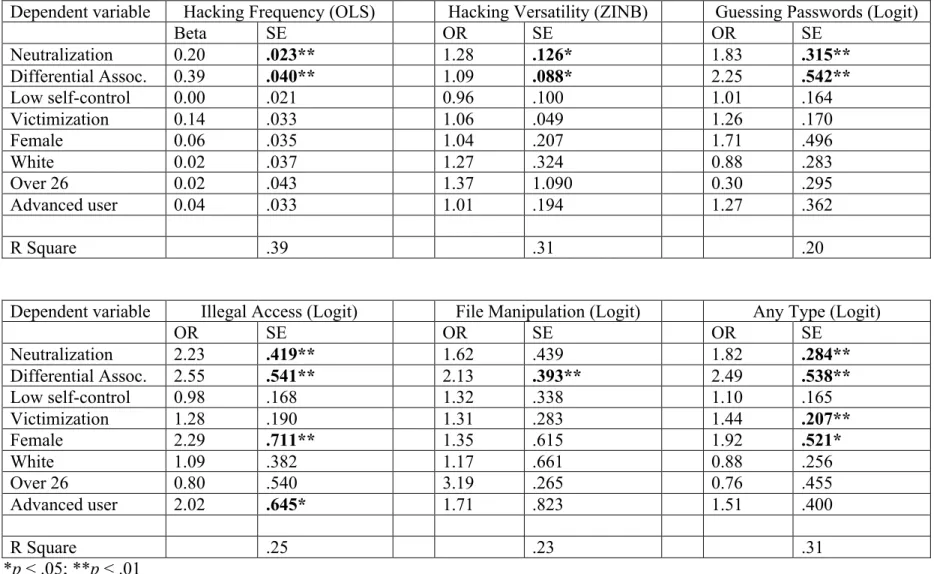
The regression model results are presented in Table 3. To start, note the model assessing the predictors of the “any type of hacking” model. The results suggest that both techniques of neutralization and association with hacking peers significantly predict whether someone reported some type of hacking, as defined here. It appears that in predicting hacking participation, in general, association with peers who hack plays a stronger role than neutralizing attitudes, but both have a uniquely substantive impact on hacking. Also, for hacking in general, being female and having been a victim of a cybercrime modestly increased the odds of reporting hacking.
For each of the specific hacking prevalence models (i.e., predicting password guessing, illegal access, and file manipulation individually), differential association was significant in predicting the outcome measure, as expected. However, neutralization was significant in
predicting only password guessing and illegal access, but not for file manipulation. In each case, the odds ratio (i.e., the change in the odds of reporting hacking) for differential association was greater than that of neutralization; however, the difference was modest. Like with the general prevalence model, the illegal access model suggested that being female increased the odds of reporting illegal access. Further, being an advanced computer used double the odds of reporting illegal access, as one might expect.
The hacking versatility model produced similar results to the binary models in that both neutralization and differential association were significant. However, for versatility, the impact from the techniques of neutralization was stronger than that of differential association. Similarly, for hacking frequency, both neutralization and differential association significantly predict increased participation in hacking, but the impact form differential association was stronger. For
each regression model, the amount of explained variance in the dependent variable was good, ranging between twenty and thirty-nine percent.
INSERT TABLE 3 HERE
As a secondary analysis, each model was re-run with each neutralization indicator as its own independent variable (output omitted) producing some noteworthy findings. Two
neutralization indicators stood out. Representing the denial of injury, the item worded “compared with other illegal acts people do, gaining unauthorized access to a computer system or someone’s account is not very serious” was significant in each binary model as well as the hacking
frequency model. Further, one indicator representing the denial of a victim (If people do not want me to get access…they should have better computer security) was significant in the general hacking model and in the file manipulation model. The impact from differential association remained unchanged here. Interestingly, when the neutralization variable was itemized, cyber-victimization was significant in four of the six models.
Discussion
Before we delve into discussing the relevance of the model results further it is important to recognize several methodological limitations of the above analysis. The primary limitation is that the data were cross-sectional, not longitudinal, and the hacking variables only account for twelve months worth of time for a limited number of types of hacking. Thus, causal inferences cannot be made from the above results. Second, the results cannot be used to determine whether the neutralizations occur before or after hacking takes place. That being said, it is more likely that the results are a better reflection of continuity in hacking. Third, the sample was not random; it was a convenience sample of college students attending one university. Fourth, as with any secondary data analysis, the theoretical constructs developed here are by no means complete;
however, they do offer a fair assessment of each of the three theories incorporated into the analysis.
Overall, the findings from the above analysis lend modest support to the notion that techniques of neutralization (i.e., neutralizing attitudes) are significantly related of some, but not all, types of malicious computer hacking, at least among the college students who participated in the survey. Clearly, constructs from other theories, particularly social learning theory, may play a role in explaining some computer hacking behaviors. However, the significant findings for neutralization held despite the inclusion of several relevant theoretical and demographic control variables (social learning and self-control). The results were not supportive of self-control, as defined by Hirschi and Gottfredson (1990), in predicting any type of computer hacking. Finding significant, but non-confounding, results for the neutralization variables supports Skyes and Matza’s (1957) theory in that the techniques of neutralization are more of a complement to other theories of crime rather than a general theory of crime (Maruna & Copes, 2005). Again, it is important to note again that the above analysis was not a causal modeling approach. Rather, the regression models used here were more for exploring the relationship of neutralizations with malicious hacking, while controlling for other relevant factors.
Focusing on the techniques of neutralization as a partial explanatory factor in malicious computer hacking is particularly salient considering the current state of social reliance on technology. The primary difference here, as compared to attempts at explaining more traditional crimes (e.g., street crimes), is that many factors that may be involved in a terrestrially based crime do not come into play when a crime is committed via a computer terminal (see Yar,
2005b). Unlike many other crimes, the victim in a malicious hacking incident is often ambiguous or abstract. There will likely be no direct interaction between the victim and the offender and
opportunities to engage in hacking are readily available at any given time. This removal of face-to-face interactions changes the dynamic of criminal offending and thus may require us to
rethink how existing theories of crime might explain digital crimes. We still only know very little about the dynamic behind what is involved in the onset and continuity in computer hacking. Certainly, more research with quality longitudinal data is warranted.
In considering the above results, Akers (1985; 1998) social learning theory provides plausible theoretical framework for explaining some of this process, however, the theory does not explicitly account for the importance of the digital environment for which the crimes take place. Social learning theory argues that crime and deviance occurs as a result of the process of learning, just as is non-criminal behavior and has been supported by many studies of crime (e.g., Akers et al., 1979; Krohn et al., 1985; Elliot et al., 1989—see Akers & Jensen (2006) for a review). The theory posits that crime and deviance occurs as a result of the learning process where increased exposure to deviant peers (i.e., differential association) is exaggerated. Through such exposure, a person may develop attitudes, or neutralizations/justifications, favorable to crime. Of course, all of this depends on the quality, duration, and frequency of exposure to such views and to a large extent on exposure to, or witness of, positive versus negative outcomes as a result of engaging in the act (i.e., the balance between rewards and punishments). This study, and others (e.g., Morris & Blackburn, 2009; Skinner & Fream, 1997) lend modest support to the social learning theory approach for explaining the etiology of computer hacking but leave many questions unanswered.4 For example, it is currently unknown if neutralizations play a different !!!!!!!!!!!!!!!!!!!!!!!!!!!!!!!!!!!!!!!!!!!!!!!!!!!!!!!!!!!!!
4 Beyond the dispositional theoretical explanations outlined above, situational theories should be considered when attempting to understand cybercrime in general (see Yar, 2005b). For example, Yar (2005b) makes a case for the applicability for routine activities theory (Cohen & Felson, 1979), albeit limited, in explaining cybercrime.
role in justifying, or neutralizing, computer crimes as compared to traditional crimes, most of the time. Certainly, much between-individual variation exists in why any given individual becomes involved in computer hacking, or any crime for that matter. Some of this variation is individual specific, but some may be a result of environmental, or contextual, factors. The problem is that elements of the digital environment are not fully understood and have yet to be explicitly incorporated into any general theory of crime and deviance.
Indeed, research has suggested that young hackers are commonly represented by a troubled or dysfunctional home life (Verton, 2002) which complements work by developmental criminologists (e.g., Loeber & Stouthamer-Loeber, 1986). However, research assessing this issue with regard to hacking is limited. Furthermore, we do not know if exposure to deviant virtual peers (i.e., cyber friends) has the same impact on one’s own cyber deviance as exposure to terrestrial peers might have on traditional deviance. Clearly, more research is needed with regard to virtual peer groups (see Warr, 2002) yet Holt’s (2007) research suggests that hacking may take place in some part through group communication within hacking subcultures and such
relationships may exist both terrestrially as well as digitally in some cases.
Sadly, the above results may provide us with more questions than answers. Indeed, future researchers have their work cut out for them. For one, we do not know if the impact from
neutralizing attitudes on cybercrime is stronger than neutralizing attitudes toward traditional crimes/delinquency. Much work remains in the quest for understanding the origins of computer hacking and on how to prevent future harms as a result. For example, the findings here modestly suggest that cyber-victimization and participation in computer hacking are positively correlated. It is possible that having been a victim of computer hacking, or other cybercrimes, may play some role in developing pro-hacking attitudes or may even stimulate retaliatory hacking. It is
clear, however, that the virtual environment provides abundant opportunities for training in hacking, and for networking with other hackers, which may ultimately promote malicious behavior (Denning, 1991; see also Yar, 2005). One need only do a quick internet search to find specific instructions on how to hack and on hacking discussion boards.
As scholars continue to develop research and attempt to explain the origins of computer hacking and related cybercrimes, action can still be taken in an attempt to reduce the occurrence of malicious computer hacking. Regarding practical solutions that should be considered,
administrators and policy makers should consider providing quality education/training to today’s youth in reference to ethical behavior while online. School administrators should consider providing in-person and online ethical training to parents as well as students, beginning at a very early age. Any proactive attempt to curb neutralizing attitudes toward hacking would be
beneficial. Universities can also contribute by providing, or even requiring, ethical training to students. In fact, at my home university, which is by and large an science and engineering university, all engineering and computer science majors are required to complete an upper-level course on social issues and ethics in computer science and engineering. I have taught this course for over two years (at the time of this writing) and each semester one of the more popular sections is on computer crime and hacking. I regularly get comments from students about how evaluating all sides of computer hacking got them to understand, or at least critically assess, the importance of ethical behavior in computing. Although most of my students end up voting in favor of offering a course specific to teaching hacking (as part of a formal debate we hold each term), they generally agree that there are ethical boundaries that all computer users should consider; hacking as defined in this chapter is unethical, but the knowledge behind true hacking can be a good thing and something that ethical computer experts should be familiar with—they
may even have an ethical responsibility to do so. Again, computer science majors are not the only potential malicious hackers out there; malicious hacking today does not require that level of skill. Ethical training and evaluation should be a requirement for all computer users.
The bottom line is that the digital environment should not be taken for granted and we have to be mindful of the fact that as time goes on, the more we rely on such technology for everyday activities. Victimization does occur online and we have a responsibility to understand and respond to it in an ethical manner. One way is to try and quash neutralizing attitudes that might make hacking justifiable for some users. People must understand that just because there is no face-to-face interaction and the risk of getting in trouble might be low, such behavior causes harm and is absolutely unethical. Simultaneously, people should not be discouraged from learning the skills that fall in line with what could be referred to as computer hacking. This is especially salient considering plausible threats of cyber-terrorism (see Furnell & Warren, 1999). We definitely need more good guys behind the screen!
Chapter Summary
This goal of this chapter was to assess participation in computer hacking from a criminological perspective, specifically though Sykes and Matza’s (1957) techniques of
neutralization theory. This was done in order to contribute to the debate surrounding the issue of why some individuals engage in malicious computer hacking. It is hoped that the findings presented here contribute to this debate. Relying on a series of regression modes stemming from self-reported survey data from 785 college students, the results suggest that rationalizing, or neutralizing, attitudes are significantly linked to participation in hacking even when controlling for other important predictors of criminal/deviant behavior. Hacking in general may be explained
in part through existing theories of crime, such as social learning theory, which directly incorporates neutralizing attitudes in explaining the process of engaging in deviant behavior.
Continued theoretical and empirical exploration is critical as we increasingly rely on technology, as a society, and spend more of our lives in front of a computer screen. For this reason, it is important that we strongly consider the ethics of online behavior and refrain from taking the digital environment for granted. It is plausible to assume that crimes committed behind a computer terminal are more readily justified than crimes committed in person; the findings presented in this chapter lend some support to this notion. Unfortunately, both terrestrial and digital crimes cause a variety of substantial social and individual harms and all computer users should be aware of this and should certainly take computing ethics very seriously. A good first step in any social response devoted to curtailing computer crimes would be to provide, or even require, ethical training for everyone who engages the digital environment, regardless of whether they are a computer scientist, an engineer, or a general computer user. Hopefully, the research presented here will help to stimulate such initiatives in addition to increased focus from scholars on this important topic.
References
Agnew, R. (1994). The techniques of neutralization and violence. Criminology, 32, 555-580. Akers, R. L., & Jensen, G. F. (2006). The empirical status of social learning theory of crime and
deviance: The past, present, and future. In F. R. Cullen, J. P. Wright, & K. Blevins (Eds.): Vol. 15. Advances in criminological theory. New Bruswick, N.J.: Transaction Publishers. Akers, R. L., Krohn, M. D., Lanza-Kaduce, L. & Radosevich, M. (1979). Social learning and
deviant behavior: A specific test of a general theory. American Sociological Review, 44, 636-655.
Anderson, C. A. (2004). An update on the effects of playing violent video games. Journal of Adolescence, 27, 113-122.
Chandler, A. (1996). The Changing Definition and Image of Hackers in Popular Discourse. International Journal of the Sociology of Law 24:229-251.
Clough, B. & Mungo, P. (1992). Approaching Zero: Data Crime and the Computer Underworld. London: Faber and Faber.
Cohen, L. & Felson, M. (1979). Social change and crime rate trends: A routine activity approach. American Sociological Review, 44, 588-608.
Copes, J. H. (2003). Societal attachments, offending frequency, and techniques of neutralization. Deviant Behavior, 24,101–27.
Cromwell, P., & Thruman, Q. (2003). The devil made me do it: Use of neutralizations by shoplifters. Deviant Behavior, 24, 535-550.
Dabney, D. A. (1995). Neutralization and deviance in the workplace: Theft of supplies and medicines by hospital nurses. Deviant Behavior, 16, 313-331.
Elliott, D. S., Huizinga, D., & Menard, S. (1989). Multiple problem youth. New York: Springer-Verlag.
Furnell, S. M., & Warren, M. J. (1999). Computer hacking and cyber terrorism: The real threats in the new millennium. Computers and Security, 18, 28-34.
Gentile, Douglas A., Paul. J. Lynch, Jennifer Ruh Linder, & David A. Walsh. 2004. The effects of violent video game habits on adolescent hostility, aggressive behaviors, and school performance. Journal of Adolescence 27:5-22.
Gordon-Larsen, P, Nelson, M. C., & Popkin, B. M. (2005). Meeting national activity and inactivity recommendations: Adolescence to adulthood. American Journal of Preventive Medicine, 28, 259-266.
Gottfredson, M. R., & Hirschi, T. (1990) A general theory of crime. Stanford, CA: Stanford University Press.
Grasmick, H. G., Tittle, C. R., Bursik, Jr., R. J., & Arneklev, B. J. (1993). Testing the core empirical implications of Gottfredson and Hirschi's general theory of crime. Journal of Research in Crime and Delinquency, 30, 5-29.
Hafner, K. & Markoff, J. (1993). Cyberpunk: Outlaws and Hackers on the Computer Frontier. London: Corgi Books.
Hannemyr, G. (1999). Technology and Pleasure: Considering Hacking Constructive. Firstmonday, Peer-Reviewed Journal on the Internet 4:n.p-n.p.
Hirschi, T. (1969). Causes of delinquency. Berkeley: University of California Press.
Hirschi, T. & Gottfredson, M. R. (1993). Commentary: Testing the general theory of crime. Journal of Research in Crime and Delinquency, 30, 47-54.
Hollinger, R. C. (1993). Crime by computer: Correlates of software piracy and unauthorized account access. Security Journal, 4, 2-12.
Holt, T. J. (2007). Subcultural evolution? Examining the influence of on- and off-line experiences on deviant subcultures. Deviant Behavior, 28, 171-198.
Hughes, L.A. & DeLone, G. J. (2007). Viruses, Worms, and Trojan Horses: Serious Crimes, Nuisance, or Both? Social Science Computer Review 25:79-98.
Ingram, J. R. & Hinduja, S. (2008). Neutralizing music piracy: An empirical examination. Deviant Behavior, 29, 334-366.
Jordan, T. & Taylor, P. (2008). A sociology of hackers. Sociological Review, 28, 757-780. Klockars, C. B. (1974). The professional fence. Free Press, New York.
Krohn, M. D., Skinner, W. F., Massey, J. L., & Akers, R. L. (1985). Social learning theory and adolescent cigarette smoking: A longitudinal study. Social Problems, 32, 455–473. Levy, S. (1994). Hackers: Heroes of the Computer Revolution. Harmondsworth, UK: Penguin. Loeber, R. & Stouthamer-Loeber, M. (1986) ‘Family factors as correlates and predictors of
juvenile conduct problems and delinquency’, in: M. Tonry and N. Morris (Eds.), Crime and Justice: An Annual Review of Research, vol. 7. Chicago, Ill.: University of Chicago Press.
Maruna, S., & Copes, J. H. (2005). What have we learned from five decades of neutralization research? Crime and Justice: An Annual Review of Research 32:221-320.
Matza, D. (1964). Delinquency and drift. John Wiley and Sons, Inc, New York.
Minor, W. W. (1981). Techniques of neutralization: A reconceptualization and empirical examination. Journal of Research in Crime and Delinquency, 18, 295-318.
Morris, R. G. & Blackburn, A. G. (2009). Cracking the code: An empirical exploration of social learning theory and computer crime. Journal of Crime and Justice, 32, 1-34.
Morris, R. G. & Higgins, G. E. (2009). Neutralizing potential and self-reported digital piracy: A multitheoretical exploration among college undergraduates. Criminal Justice Review, 34, 173-195.
Morris, R. G., & Johnson, M. C. (2009). Sedentary activities, peer behavior, and delinquency among American youth. University of Texas at Dallas. Working Paper.
Naughton, J. (2000). A brief history of the future: The origins’ of the internet. London: Phoenix. Nelson, M C., & Gordon-Larsen, P. (2006). Physical activity and sedentary behavior patterns are
associated with selected adolescent health risk behaviors. Pediatrics, 117, 1281-1290. Roush, W. (1995). Hackers: Taking a Byte Out of Computer Crime. Technology Review
98:32-40.
Schell, B.H. & Dodge, J.L. (2002). The Hacking of America: Who’s Doing It, Why, and How. Westport, CT: Quorum Books.
Skinner, W.F. & Fream, A.M. (1997). A social learning theory analysis of computer crime among college students. Journal of Research in Crime and Delinquency, 34, 495-518. Skorodumova, O. (2004). Hackers as information space phenomenon. Social Sciences, 35,
105-113.
Stallman, R. (2002). Free Software, Free Society: Selected Essays of Richard M. Stallman. Boston: Free Software Foundation.
Thomas, D. (2002). Notes from the underground: Hackers as watchdogs of industry. Retrieved on April 20, 2009 from Online Journalism Review
Warr, M. (2002). Companions in Crime: The Social Aspects of Criminal Conduct. Cambridge: Cambridge University Press.
Wong, S. L., & Leatherdale, S. T. (2009). Association between sedentary behavior, physical activity, and obesity: Inactivity among active kids. Preventing Chronic Disease, 6, 1-13. Yar, M. (2005a). Computer hacking: Just another case of juvenile delinquency? The Howard
Journal, 44, 387-399.
Yar, M. (2005b). The novelty of ‘cybercrime. European Journal of Criminology, 2, 407-427. Yar, M. (2006). Cybercrime and society. Thousand Oaks, CA: Sage.
Young, R., Zhang, L., & Prybutok, V. R. (2007). Hacking into the minds of hackers. Information Systems Management, 24, 271-28
Table 1: Self-report Computer Hacking Prevalence n Overall % % of hackers Any hacking 162 20.6% 100.0% Guessing passwords 120 15.3% 74.1% Unauthorized access 118 15.0% 72.8% File manipulation 46 5.9% 28.4% Diversity Index None reported 627 79.5% 0.0% 1 Type 79 10.0% 48.8% 2 Types 44 5.6% 27.2% 3 Types 39 4.9% 24.1%
Table 2: Summary Statistics of Model Variables
Variable Mean S.D. Minimum
Value
Maximum Value ! !
Hacking frequency (log) -0.16 .45 -0.35 2.23
Hacking involvement 0.53 1.28 0 6
Any type of hacking 0.21 .40 0 1
! 1 = yes; 0 = no Guessing passwords 0.15 .36 0 1 ! 1 = yes; 0 = no Illegal access 0.15 .36 0 1 ! 1 = yes; 0 = no File manipulation 0.06 .24 0 1 ! 1 = yes; 0 = no Neutralization 0.00 .92 -1.38 2.72 Differential association 0.00 .93 -0.54 5.40 Low self-control 0.00 .96 -2.21 3.99 Victimization 0.00 .79 -0.39 7.07 Female 0.56 .50 0 1 ! 1 = female; 0 = male White 0.78 .41 0 1 ! 1 = yes; 0 = no
Over 26 years old 0.06 .24 0 1
1 = yes; 0 = no
Advanced user 0.62 .49 0 1
Table 3: Model Results (robust standard errors)
Dependent variable Hacking Frequency (OLS) Hacking Versatility (ZINB) Guessing Passwords (Logit)
Beta SE OR SE OR SE Neutralization 0.20 .023** 1.28 .126* 1.83 .315** Differential Assoc. 0.39 .040** 1.09 .088* 2.25 .542** Low self-control 0.00 .021 0.96 .100 1.01 .164 Victimization 0.14 .033 1.06 .049 1.26 .170 Female 0.06 .035 1.04 .207 1.71 .496 White 0.02 .037 1.27 .324 0.88 .283 Over 26 0.02 .043 1.37 1.090 0.30 .295 Advanced user 0.04 .033 1.01 .194 1.27 .362 R Square .39 .31 .20
Dependent variable Illegal Access (Logit) File Manipulation (Logit) Any Type (Logit)
OR SE OR SE OR SE Neutralization 2.23 .419** 1.62 .439 1.82 .284** Differential Assoc. 2.55 .541** 2.13 .393** 2.49 .538** Low self-control 0.98 .168 1.32 .338 1.10 .165 Victimization 1.28 .190 1.31 .283 1.44 .207** Female 2.29 .711** 1.35 .615 1.92 .521* White 1.09 .382 1.17 .661 0.88 .256 Over 26 0.80 .540 3.19 .265 0.76 .455 Advanced user 2.02 .645* 1.71 .823 1.51 .400 R Square .25 .23 .31 *p < .05; **p < .01
Appendix A: Correlation Matrix
1. 2. 3. 4. 5. 6. 7. 8. 9. 10. 11. 12. 13. 14.
1. Hacking frequency 1
2. Hacking involvement .87 1
3. Any type of hacking .60 .82 1
4. Guessing passwords .64 .81 .83 1 5. Illegal access .65 .83 .82 .62 1 6. File manipulation .72 .73 .49 .48 .52 1 7. Neutralization .25 .29 .26 .24 .26 .17 1 8. Differential Assoc. .45 .50 .45 .41 .46 .37 .27 1 9. Low self-control .19 .19 .19 .14 .18 .15 .45 .25 1 10. Victimization .28 .25 .25 .21 .22 .19 .09 .36 .15 1 11. Female -.06 -.05 -.02 -.03 -.01 -.06 -.18 -.10 -.28 -.03 1 12. White .04 .02 .00 .00 .03 .02 .02 .04 .05 -.01 -.07 1
13. Over 26 years old -.05 -.07 -.07 -.09 -.06 -.01 -.09 -.11 -.17 -.05 -.07 -.12 1
14. Advanced user .07 .09 .07 .06 .09 .08 .07 .06 .13 .04 -.21 .07 .01 1