Papers
Wharton Pension Research Council
9-1-2010
Payouts in Switzerland: Explaining Developments in Annuitization
Payouts in Switzerland: Explaining Developments in Annuitization
Monika Bütler
University of St. GallenStefan Staubli
University of St. GallenFollow this and additional works at: https://repository.upenn.edu/prc_papers Part of the Economics Commons
Bütler, Monika and Staubli, Stefan, "Payouts in Switzerland: Explaining Developments in Annuitization" (2010). Wharton Pension Research Council Working Papers. 208.
https://repository.upenn.edu/prc_papers/208
The published version of this Working Paper may be found in the 2011 publication: Securing Lifelong Retirement Income.
This paper is posted at ScholarlyCommons. https://repository.upenn.edu/prc_papers/208 For more information, please contact [email protected].
age income, and examines the role of regulation in the payout phase. Recent developments in both market conditions and regulations are used to assess the impact of certain determinants of the annuitization decision, such as money’s worth ratios, means-tested benefits and behavioral factors.
Disciplines
Disciplines
EconomicsComments
Comments
The published version of this Working Paper may be found in the 2011 publication: Securing Lifelong Retirement Income.
Securing Lifelong
Retirement Income:
Global Annuity
Markets and Policy
EDITED BYOlivia S. Mitchell, John Piggott,
and Noriyuki Takayama
3
Great Clarendon Street, OxfordOX2 6DP
Oxford University Press is a department of the University of Oxford. It furthers the University’s objective of excellence in research, scholarship,
and education by publishing worldwide in Oxford New York
Auckland Cape Town Dar es Salaam Hong Kong Karachi Kuala Lumpur Madrid Melbourne Mexico City Nairobi
New Delhi Shanghai Taipei Toronto With offices in
Argentina Austria Brazil Chile Czech Republic France Greece Guatemala Hungary Italy Japan Poland Portugal Singapore South Korea Switzerland Thailand Turkey Ukraine Vietnam Oxford is a registered trade mark of Oxford University Press
in the UK and in certain other countries Published in the United States by Oxford University Press Inc., New York
#Pension Research Council, The Wharton School, University of Pennsylvania, 2011 The moral rights of the author have been asserted
Database right Oxford University Press (maker) First published 2011
All rights reserved. No part of this publication may be reproduced, stored in a retrieval system, or transmitted, in any form or by any means,
without the prior permission in writing of Oxford University Press, or as expressly permitted by law, or under terms agreed with the appropriate
reprographics rights organization. Enquiries concerning reproduction outside the scope of the above should be sent to the Rights Department,
Oxford University Press, at the address above You must not circulate this book in any other binding or cover
and you must impose the same condition on any acquirer British Library Cataloguing in Publication Data
Data available
Library of Congress Cataloging in Publication Data Data available
Typeset by SPI Publisher Services, Pondicherry, India Printed in Great Britain
on acid-free paper by
MPG Books Group, Bodmin and King’s Lynn ISBN 978–0–19–959484–9
Chapter 11
Payouts in Switzerland: Explaining
Developments in Annuitization
Monika Bu
¨tler and Stefan Staubli
Overview
Occupational pensions in Switzerland were widespread long before the first pillar of old-age security was introduced in 1948. Even before the second pillar was mandated in 1985 (based on a change in the constitution approved by the Swiss electorate in 1972), more than half of the Swiss workforce participated in occupational pension funds. For these employ-ees, participation in a fund was mandated; employees had to participate if they were employed by a company that offered a fully funded pension scheme. Although payouts were traditionally in the form of annuities, lump-sum payments were not uncommon.
Together with the Netherlands, the Swiss pension system is rather unique in an international context, since in both countries, a large fraction of retirement income stems from the mandatory fully funded second pillar. There are generous income guarantees, and there is no choice as to pension provider. In contrast to the Dutch system, however, Swiss retirees are given more withdrawal options and there is more diversity in pension plan provi-ders. Swiss annuitization rates are high, but they also vary greatly over time and between pension providers. Despite the mandate, there are very few legal restrictions regarding the size of the lump sum payout. Full annuitization is always possible (subject to the minimum requirements specified in pension law), but many providers also allow the total pension capital to be paid out as a lump sum. Since first-pillar benefits are below the level of subsistence, full cash-outs of occupational pension capital jeopardize the adequacy of retire-ment income and may in turn be costly for the governretire-ment.
This chapter sheds light on two interconnected aspects of the choice between the annuity and the lump sum within the Swiss pension system. First, we explore the annuitization decision from an individual perspective: what are the most important factors in the individual decision to cash out, and how do changes in policy effect individual payout decisions? Second, we describe the policymaker perspective: what intentions and goals define
pension policies? What are the most significant problems to be addressed: regulation, or interdependence with other social insurance schemes, nota-bly guaranteed income in old age? This chapter highlights the impact of recent changes in second-pillar legislation such as conversion rate reduc-tions, and we also examine additional factors that are important in the annuitization decision in Switzerland.
The idiosyncrasies of the Swiss pension system have attracted consider-able interest, and this study is not the first to focus on the Swiss second pillar. Queisser and Vittas (2000) provide a detailed analysis of the strengths and weaknesses of the Swiss pension system, but they do not include a discussion of second-pillar retirement payouts. Queisser and Whitehouse (2003) focus on participant withdrawal options in Swiss occu-pational pension schemes, but that analysis is based on aggregate data from the Pension Funds Statistics, which cannot be used to shed light on the determinants of individual retirement payouts. The World Bank report on annuity markets in Switzerland by Bu¨ tler and Ruesch (2007) is most closely related to this chapter, in that it examines the role of the second pillar in the provision of old-age benefits and calculates money’s worth ratios for different subgroups of the population. Yet, we go farther in the present chapter by exploring individual retirement decisions.
The structure of the chapter is as follows. In the next section, we present a brief history of the Swiss pension system, provide an overview of the institutional structure with a focus on the occupational pension pillar, and discuss the current demographic and economic situation in Switzer-land. Next, we analyze key determinants defining the high annuitization rates among middle- and high-income earners and the relatively low annui-tization rates for low-income earners in Switzerland. Finally, we discuss the future of the Swiss pension system and identify important areas calling for reform, and provide concluding remarks.
Institutional frame
Historical perspective
The first pension funds in Switzerland were established over a century ago, initially in the engineering industry. Unlike today, insurance then was optional and depended on employer goodwill. Persons not gainfully em-ployed had no insurance and no institutionalized means of making provi-sion for their old age, as the first-pillar welfare scheme (AVS) was established only much later (1948). In 1972, occupational pension plans were incorporated into the Constitution, where they represent the second pillar in the three-pillar system. They are designed to complement the first
pillar. Based on this provision in the Constitution, the Federal Law on Occupational Retirement, Survivors and Disability Pension Plans (LPP) was elaborated and enacted in 1985. The system design was largely based on the structure of existing pension funds. It kept the previous benefit schemes based on a single earner, but introduced the principle of a mini-mum provision guaranteed by law. With the introduction of mandatory participation, coverage rates jumped from around 50 percent in the 1970s to almost 90 percent. Currently, around 96 percent of working men and 83 percent of working women are covered by an occupational pension plan.
Due to the evolution of pension funds and the LPP allowance for different organizational structures within occupational pension plans, the second pillar has always been highly fragmented. Even though the number of pension funds was roughly cut in half over the period 1994–2007, there were still 2,543 pension funds active in 2007. This consolidation is mainly the result of small firms outsourcing the organization of the second pillar to insurance companies, instead of operating a completely autonomous pension fund.
The scheme’s long history is also reflected in the size of the accumulated capital stock. In 2007, assets of occupational pension funds amounted to approximately 120 percent of GDP. Initially, all schemes were set up as defined benefit (DB) plans. Over the last twenty years, a majority of pen-sion funds changed to a more flexible defined contribution (DC) struc-ture. But practically speaking, the difference between DB and DC schemes is negligible because the occupational pension scheme is strongly regu-lated with respect to minimum accrual and interest rates, as well as the conversion factor.
Pension plans have always been considered an important device in attracting skilled workers. For a long time, they were a disadvantage for mobile workers, given that the accumulated capital was not transferable across pension funds until 1995. The predominant payout option was, and still is, a lifetime annuity. Since 2005, Swiss pension funds are required by law to offer a partial lump sum option as well. While the LPP defines minimum requirements for various pension factors, the system was char-acterized by a lack of transparency: in many cases, individuals had no idea of how much accumulated capital they had. The fragmentation of the system added to this problem. Only recently, new transparency standards have been enacted, which are legally binding for all pension plan providers.
Structure of the Swiss pension system
Switzerland’s pension system is based on two pillars which are more or less of equal importance. The first pillar AHV/AVS is a pay-as-you-go (PAYG) system that seeks to provide a basic subsistence level of income to all retired
residents. The second pillar is an employer-based, fully funded occupation-al pension scheme and is mandatory for occupation-all employees whose annuoccupation-al income exceeds a certain threshold. When total income does not cover basic needs in old age, means-tested supplemental benefits may be claimed as part of the first pillar. The first and second pillars are complemented by a voluntary third pillar, which is an individual tax-deductible savings account for retirement.
Adding the first and second pillar together, an individual with an unin-terrupted working career has a replacement rate of approximately 50–60 percent of insured income. The net replacement rate after taxes often amounts to 70–80 percent, even for higher levels of income, and can reach 100 percent for beneficiaries with dependent children. In contrast to other countries, the structure of the second pillar leads to replacement rates that are similar for both lower and higher incomes. In addition to retirement income, the first and the second pillars also provide disability insurance.
First-pillar benefits in Switzerland vary depending on average earned income and the number of contribution years, including those granted for child care. Conditional on having contributed at least forty-five years to the system, a minimum pension of 13,680 CHF per year is guaranteed, which is equivalent to an annual 12,670 US$ (exchange rate as of February 12, 2010). A majority of retirees qualify for a pension close to the maximum benefit level, which is equal to twice the minimum pension (i.e., 27,360 CHF). The statutory retirement age is 64 for women and 65 for men. The earliest age at which first pillar benefits can be claimed is 62 for women and 63 for men, subject to an actuarially fair reduction in benefits of 6.8 percent per year. Working beyond age 64/65 is possible, but most work contracts specify a retirement age that coincides with the statutory age of retirement. If a spouse dies, first-pillar benefits of the surviving spouse are increased by 20 percent up to the maximum benefit level. In addition, retirees can claim child benefits equivalent to 40 percent of the base first-pillar pension for each dependent child. First-pillar contributions are proportional to earned income (without a cap), and they account for approximately 70 percent of AVS/AHV revenue. The remaining revenue comes from earmarked value-added taxes and additional funds paid from general government revenues. Participation in the second pillar is mandatory for all employees with annual earnings of approximately 20,000 CHF or more. The insured in-come above this threshold and below an upper threshold (at present 82,080 CHF) is called the mandatory part. The income above the upper threshold is called the super-mandatory part of the second pillar. The mandatory part is subject to stringent regulation with respect to minimum contribution rates, minimum interest rates, and the conversion rate at which the accumulated pension wealth is translated into an annuity. By
contrast, there are few restrictions on the contract conditions offered by the insurance companies in the super-mandatory part. By law, pension plan providers are required to insure the mandatory share. They are free to provide insurance for the super-mandatory part, and most do because the second pillar is important in attracting a well-educated workforce and both mandatory and super-mandatory pension components are treated favor-ably under tax law.
Contributions to the occupational pension plans correspond to a certain fraction of an employee’s salary, of which the employer has to pay at least half. When an employee moves to another company, all of the accumulated contributions (including the employer’s part) are transferred to the new fund. The total amount of assets at retirement has thus been accumulated over the entire working life and is a good proxy for lifetime income. The occupational pension wealth can be withdrawn either as a monthly lifelong annuity, a lump sum, or a combination of the two options. In some plans, the cash-out limit is equal to 50 or 25 percent (the legal minimum) of accumulated capital. To mitigate adverse selection effects, individuals must declare their choice between three months and three years prior to the effective withdrawal date, depending on the insurer’s regulations. Many pension insurers define a default option if the beneficiary does not make an active choice.
Occupational pension annuities are strictly proportional to the accumu-lated retirement assets (contributions made during the working lifetime plus accrued interest). The capital K is translated into a yearly nominal annuity Busing the conversion rate g:B= gK. The conversion rate is independent of marital status, income, or gender (at least in the mandato-ry part), but it depends on the retirement age. By law, the annuity option includes dependent children’s benefits of up to 20 percent of the main claimant’s benefit for each child younger than 18 (or below the age of 25 if still dependent). The annuity option’s regulation also specifies that survi-vor benefits must be equivalent to 60 percent of the deceased’s pension. As will be illustrated later, these additional benefits combined with the uniform conversion rate create a sizeable redistribution between married and non-married annuitants.
Until 2004, the minimum conversion rate in the mandatory part was fixed at 7.2 percent. With the aim of improving the stability of the second pillar, the Swiss government implemented a series of changes in 2004, 2005, and 2006. An integral part of these changes is that the minimum conversion rate in the mandatory part will be successively lowered to 6.8 percent by 2015. Pension funds are free to set the conversion rate for the less-regulated super-mandatory part of the second pillar, but until 2003, conversion rates in the mandatory and super-mandatory part were virtually identical. In 2004, several large pension funds started to reduce the
version rate in the super-mandatory part to 5.4 percent for women and 5.8 percent for men. Since then, many other pension funds have followed.
By law, pension providers are not allowed to differentiate payout rates according to gender or marital status. The difference in gender conversion rates in some super-mandatory plans stems from women’s younger retire-ment age and is not related to differences in life expectancy. Female longer life expectancy is compensated with survivor benefits. Many pension funds offer an early retirement option at an actuarially fair adjustment of the conversion rate. This option is very popular and in many pension plans, the observed retirement age is substantially lower than the statutory age of retirement. Pension funds are requested to index annuities to inflation, if the fund’s financial situation allows it to do so. At present, only a few funds are actually able to index pensions to inflation, mainly due to the great liabilities created by a very high conversion factor in the mandatory part.
The annuity is subject to normal income tax rates. Additional income from other sources, for example from the first pillar, increases the effective marginal tax rate under the annuity option. The lump sum, on the other hand, is taxed only once (at retirement). The tax rate applied to the capital option varies greatly across Swiss cantons. The present value of the tax bill is almost always smaller under the lump sum option compared to the annuity option, particularly for average and higher levels of second-pillar pension wealth. Therefore, the differential tax treatment is expected to reduce the demand for an annuity.
Introduced in 1966, means-tested supplemental benefits may be claimed as part of the first pillar when the retiree’s total income does not cover basic needs in old age. Eligibility for benefits is limited to individuals who receive an old-age or disability pension, live in Switzerland, and have Swiss or EU citizenship or have been living in Switzerland for at least ten years. These additional benefits usually result in an income that is above the poverty threshold. The guaranteed total income is approximately 36,000 CHF for singles and 51,000 CHF for legal couples (without children).
A voluntary third pillar of individual saving complements the first and second pillars for retirement. Given the already high replacement rate provided by the first and second pillar, the third pillar is primarily impor-tant for the self-employed (who are not covered by the second pillar) and individuals with contribution gaps. Since contributions are fully tax-deduct-ible up to a certain amount, the third pillar has also become a popular instrument for middle- and high-income earners to save on taxes. Due to the high degree of annuitization in the first and second pillars, the accu-mulated capital in the third pillar is usually paid out as a lump sum. Reliable data on the volume of the third pillar is very difficult to get, as third-pillar contracts are provided not only by insurance companies but also by most banks and other financial intermediaries.
There exists a very small market for annuities outside the second pillar, but the offered contract conditions are far less generous compared to the second-pillar annuities mainly for two reasons. First, occupational pension plans are less plagued by adverse selection problems. Second and far more important, since the introduction of mandatory participation in 1985, the regulated high conversion factors in the second pillar have dominated market conversion rates by far for most individuals.
The Swiss demographic and economic situation
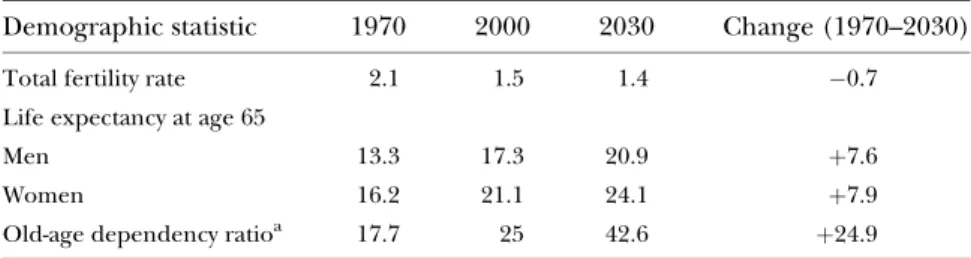
As in other industrialized countries, the demographic situation in Switzer-land is characterized by a substantial increase in life expectancy together with a low fertility rate. As shown in Table 11.1, the total fertility rate declined from 2.1 children per woman in 1970 to 1.5 children per woman in 2000. Over the same period, the remaining life expectancy at age 65 increased for men from 13.3 to 17.3 years and for women from 16.2 to 21.1 years. This trend in life expectancy is projected to continue at the same rate until 2030, if not beyond. This demographic transition will result in a substantial increase in the old-age dependency ratio. The ratio of individuals aged 65 and older to individuals aged 21–64 has grown from approximately 18 percent in 1970 to 25 percent in 2000 and will increase further to 43 percent in 2030. Due to the high rate of immigration, the Swiss population is aging at a slower rate compared to other industrialized nations. Nonetheless, the strong increase in the old-age dependency ratio has a direct impact on the financial stability of the first pillar. If the current levels of contributions and benefits are left unchanged, the scheme will start running a sustained deficit in 2012.
Despite these gloomy forecasts, and contrary to other European countries, the main structure of the first pillar as well as the contribution levels has remained essentially unchanged. Swiss policymakers face strong
Table 11.1 Demographic trends in Switzerland
Demographic statistic 1970 2000 2030 Change (1970–2030)
Total fertility rate 2.1 1.5 1.4 0.7 Life expectancy at age 65
Men 13.3 17.3 20.9 þ7.6
Women 16.2 21.1 24.1 þ7.9
Old-age dependency ratioa 17.7 25 42.6 þ24.9
aRatio of individuals aged 65 and over to number of individuals aged 20–64.
Source: Bundesamt fu¨r Statistik (2009a, 2009b).
political constraints for potential reforms as the public possesses a veto power (Bu¨ tler 2009). Any change in the law can be (and usually is) challenged by a national referendum. The last reform to the first pillar dates back to 1997. The most important element of the reform was an increase in the female retirement age in two steps from 62 to 64.
There have also been no fundamental changes in the second pillar of the pension system. Given the increase since 1985 in life expectancy at age 65 of about three years and the fall in capital market returns, the conversion factor should have been reduced by approximately 15–20 percent. Yet, the regulation of nominal interest rates and the conversion factor have remained constant for almost twenty years. The illusion of perpetual stabil-ity was only squashed after the stock market downturn at the beginning of 2000. As a consequence, market returns fell below the 4 percent minimum return requirement and many pension funds reported an underfunding. After an intense political debate, the Swiss Federal Council agreed to reduce the minimum return requirement to 3.25 percent as of January 2003. Since then, the interest rate has been adjusted several times to its current rate of 2 percent.
At the same time, the Swiss government enacted the first revision to the second pillar, which was implemented in three steps. In 2004, new regula-tions concerning transparency became effective. The changes implemen-ted in 2005 include an extension of the coverage of the second pillar to low-income and part-time workers and a stepwise reduction of the conversion rate in the mandatory part to 6.8 percent by 2015. Finally, in 2006, new tax law regulations concerning occupational pensions became effective. How-ever, the adjustments in the second pillar proved far too weak and further reductions in the conversion factor are planned.
The necessity for additional reforms in the second pillar was brought to light by the strong impact of the global financial crisis of 2008–10, which reduced the value of assets and uncovered structural deficiencies in the second pillar with respect to the funding ratio, regulation, and supervision. In 2008, private pension plan providers suffered from an average perfor-mance of 13 percent. In contrast, under the current regulatory frame-work, a return of roughly 5 percent is required to secure the liabilities in autonomous pension funds. As a consequence, the average funding ratio fell from 110 percent in 2007 to 96 percent in 2008. Insurance companies that mainly provide pension plans for small and medium companies were affected less due to their more stringent asset allocation rules. Retirees and individuals close to retirement were not directly affected by the crisis due to the many built-in guaranteed income benefits. However, most funds will be forced to undergo restructuring, and a reduction in benefits for present retirees is no longer off limits (though still difficult to implement by law).
Determinants of annuitization
Figure 11.1 presents the fraction of capital cashed out at retirement based on administrative records from several pension funds and large insurance companies. Compared to other industrialized countries, the Swiss annuiti-zation rate is very high: only between 10 and 30 percent of all individuals covered by an autonomous pension plan cash out their pension wealth. Annuitization rates in collective funds, that is, large insurance companies that provide occupational pension plans for small and medium-sized firms, are lower but still rather high compared to other countries.
There are at least two reasons for the difference in cash-out behavior between autonomous pension plans and insurance companies. The first is a composition effect. Individuals covered by collective funds tend to earn less and be poorer as measured by their accumulated pension wealth. The second reason relates to differences in the standard cash-out option. In most autonomous pension plans, the default option is the annuity. In most insurance companies, individuals do not face a default option. They are thus forced to make an active choice which might work to the disadvantage of the annuity option.
0 10 20 30 40 50 60 70 1996 1997 1998 1999 2000 2001 2002 2003 2004 2005 2006
Amount of capital cashed out (%)
Autonomous Pension Funds Collective Funds
Figure 11.1 Annual cash-out rates in autonomous pension funds and collective funds.Source: Authors’ calculations; see text.
We now discuss three factors that might explain the cash-out pattern in Switzerland: high money’s worth ratios, framing effects, and other behav-ioral factors, as well as generous means-tested supplemental benefits, which act as a supplementary longevity insurance. Each of these determinants will be analyzed in turn using individual retirement decisions from Swiss occu-pational pension plans.
Money’s worth ratio: the value of the annuity
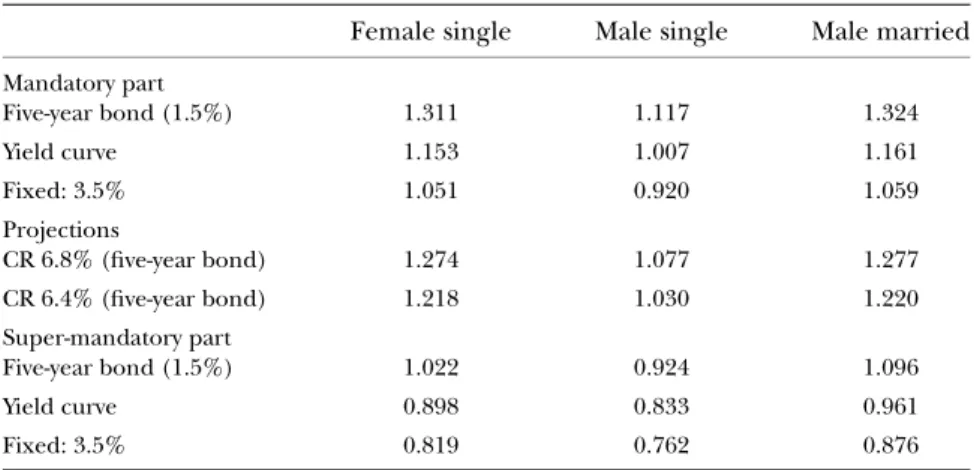
A commonly used measure for the value of an annuity is the money’s worth ratio (MWR), which relates the expected present discounted value of future payouts to the premium cost of the annuity. An MWR above 1 indicates that an individual will, on average, expect to get back more in annuity payments than what he or she paid in. On the other hand, when the MWR is less than 1, annuitants will expect to receive less in annuity payouts than they paid in premiums. Both administrative costs and adverse selection with respect to private health information about expected longev-ity may give rise to actuarially unfair MWRs. Annuities in the mandatory fully funded second pillar in Switzerland, which account for more than 99 percent of all (funded) pension payments in Switzerland, are extremely generous. Table 11.2 shows MWRs for the second pillar in 2009 using three different strategies to discount future annuity payments: (a) the nominal yield curve in 2009, (b) the return on a five-year bond (1.5 percent in 2009), and (c) the discount factor used by most pension providers, which is 3.5 percent. As shown in the first three rows of Table 11.2, MWRs in the mandatory part of the system are greater than 1 for single women and married men in 2009, even when future annuity payments are discounted with a (rather high) discount factor of 3.5 percent.
Only for single men, who do not benefit from survivor benefits and have a higher average mortality rate, are MWRs less than 1 (when a discount factor of 3.5 percent is applied). Thus, it is not surprising that many pension funds report difficulties in meeting their financial obligations. As is illustrated in Rows 4 and 5, the stepwise reduction in the conversion rate to 6.8 percent until 2014 and the further reduction to 6.4 percent, which is currently being debated, may not be sufficient to restore financial stability in the mandatory part of the second pillar.
Since 2004, many Swiss pension funds have reduced their conversion rates to 5.8 percent for men and 5.4 percent for women, in the less-regulated super-mandatory part of the second pillar. Therefore, as can be seen in Rows 6–8 of Table 11.2, MWRs are considerably lower in the super-mandatory part compared to the super-mandatory part of the scheme. Because the reduction was more pronounced for women relative to men, the adjustment in conversion rates also reduced the redistribution in the
super-mandatory part of the scheme, at least between single women and single men. Due to survivor benefits and lower average mortality, MWRs in the super-mandatory part are still substantially higher for married men.
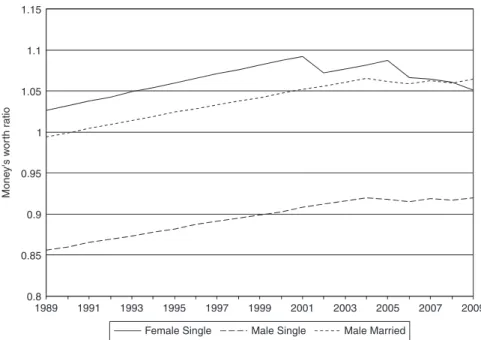
One reason for the high MWRs in the fully funded pillar is the generous income guarantees. Another reason is that since the introduction of the second pillar in 1985, the minimum conversion rate has hardly been adjusted to changes in life expectancy. To highlight the impact of the demographic transition on the financial well-being of the second pillar, Figure 11.2 shows trends in MWRs for different subpopulations over the last twenty years. The calculations are based on a fixed interest rate of 3.5 percent, but they do account for greater survival rates over time. For single men, the MWR increased from 0.85 in 1989 to 0.92 in 2004. It has remained relatively constant since 2005, due to the stepwise reduction in the minimum conversion rate. Similarly, the MWR for married men grew from 0.99 in 1989 to 1.07 in 2009. These numbers suggest that in order to hold the MWR constant, the annuitization factor should have been re-duced by approximately 10 percent over the last twenty years. Until 2001, the MWR for women increased at roughly the same rate as the MWRs for single and married men. In 2002, the women’s MWR declined by 2 percent, which is explained by the increase in the female retirement age from 62 to 63. A similar dip can be observed in 2005 when the female retirement age was increased further to 64. Together with the reduction in the conversion rate, these changes narrowed the gap between the MWRs for men and women.
Bu¨ tler et al. (2010) exploit a recent large and sudden cutback in the conversion rate in the super-mandatory part to examine how changes in
Table 11.2 Money’s worth ratios for the Swiss second pillar in 2009
Female single Male single Male married
Mandatory part Five-year bond (1.5%) 1.311 1.117 1.324 Yield curve 1.153 1.007 1.161 Fixed: 3.5% 1.051 0.920 1.059 Projections CR 6.8% (five-year bond) 1.274 1.077 1.277 CR 6.4% (five-year bond) 1.218 1.030 1.220 Super-mandatory part Five-year bond (1.5%) 1.022 0.924 1.096 Yield curve 0.898 0.833 0.961 Fixed: 3.5% 0.819 0.762 0.876
Source: Authors’ calculations; see text.
the annuity’s value impact the annuitization decision. The authors com-pare the annuitization behavior of individuals who were affected by the reduction in the conversion rate with observably similar individuals who were covered by an insurance company that did not reduce the conversion rate. They show that the 20 percent reduction in the annuity value led to an approximately 14 percentage point drop in the annuitization rate. Inter-estingly, the policy change also triggered substantial anticipatory behavior: individuals who had planned to retire after the policy change shifted their retirement date to take advantage of the favorable conditions prior to the change. In particular, there is a large spike in the number of retirees in the month before the lower conversion rates became effective. This pattern suggests that individuals were well aware of the large losses in the annuity value.
Calculation of MWRs implicitly assumes risk-neutrality. However, given that the annuity provides an insurance against the longevity risk, the utility value of an annuity may well exceed its money’s worth for a risk-averse individual. Consistent with this view, Mitchell et al. (1999) show that, as risk aversion increases, individuals are willing to forgo more wealth for actuari-ally fair annuities. Annuity equivalent wealth (AEW) is a utility-based
0.8 0.85 0.9 0.95 1 1.05 1.1 1.15 1989 1991 1993 1995 1997 1999 2001 2003 2005 2007 2009 Mone y's w o rth r a tio
Female Single Male Single Male Married
Figure 11.2 Evolution of money’s worth ratios over time.Source: Authors’ calcula-tions; see text.
measure that takes into account this insurance aspect. Using data from several autonomous pension funds in Switzerland, Bu¨tler and Teppa (2007) show that the AEW is indeed the most important determinant of the annuitization decision. Actually, a 1 percentage point increase in the AEW increases the annuitization rate by 1.5 percentage points for women and by 0.5 percentage points for men. This estimate of the responsiveness of the annuitization decision with respect to changes in the value of an annuity is thus close to the value in Bu¨ tler et al. (2010). Brown (2001) finds similar results using survey data from the United States.
Behavioral factors
Behavioral economics has been able to explain many aspects of retirement planning such as participation in employer-provided pension plans (Duflo and Saez 2003), saving rates (Beshears et al. 2008), and portfolio allocation decisions (Choi et al. 2009). Recent literature on the determinants of individual cash-out behavior suggests that behavioral biases play an impor-tant role in the annuitization decision as well. Brown et al. (2008), for example, show that framing matters for the annuitization decision. Under an ‘investment frame’ that focuses on risk and return, only 21 percent of individuals prefer a life annuity over a saving account. On the other hand, under the ‘consumption frame’ that highlights the consequences for life-long consumption, 72 percent choose the life annuity.
Research by Bu¨ tler and Teppa (2007) suggests that observed annuitiza-tion behavior in Swiss occupaannuitiza-tional pension plans is partially related to behavioral factors. For instance, the authors observe that individuals largely stick with the sponsor’s default option rather than making active decisions. In particular, the likelihood of cashing out pension wealth is significantly higher in companies that provide the (partial) lump sum as a default option. This finding is highly relevant for policymakers: the annuitization default is likely to decrease the propensity to cash out and increase longevi-ty insurance. Since the annuilongevi-ty is the default option in most pension plans, this finding also helps to explain the high overall annuitization rate in Switzerland. Interestingly, several small pension funds displayed almost no variation with respect to the annuitization decision: all retirees chose either the lump sum or the annuity. Pension fund managers usually explain the phenomenon with peer effects and an implicit standard option (‘it has always been done this way’).
The impact of the reduction in the super-mandatory conversion rate, analyzed by Bu¨ tler et al. (2010), provides further (informal) evidence that behavioral aspects might be important. They show that almost all benefici-aries chose a polar option and did not distinguish between the mandatory and super-mandatory part, although implicit annuity prices were
cally different after the reduction in the conversion rate in 2004. This result is consistent with the proposition that many retirees do not make properly informed choices.
The high degree of annuitization in Switzerland may also be attributed to the framing of the scheme. That is, Swiss occupational pension benefits were traditionally framed as annuities. Until very recently, many contribu-tors to the system were not even aware of the sum of money they had accumulated, but merely knew the approximate amount of the monthly payments. To improve transparency, starting in 2005, all pension funds are required to provide all insured participants with a yearly statement (many funds offered such statements already before the mandatory introduction). The statement declares the accumulated capital to date and contains information on the expected approximate annuity stream (based on an extrapolation of current earnings and interest rates). However, with re-spect to framing, the space given to annuity streams, which also includes survivor benefits and benefits in case of disability, is much larger compared to the space given to the accumulated capital. The statement on an indivi-dual’s occupational pension benefits thus comes close to what Brown et al. (2008) call a consumption frame, which is much more likely to induce beneficiaries to choose the annuity.
Means-tested benefits and annuitization
Approximately 12 percent of all retirees receive means-tested benefits as part of the first pillar, because their total income does not cover basic needs in old age. These very generous supplemental benefits have contributed to a low poverty rate among the elderly in Switzerland, but they may also have unintended consequences on the annuitization decision. In particular, because means-tested benefits provide an implicit insurance against the financial consequences of longevity, individuals have a strong incentive to cash out accumulated pension wealth even if full annuitization were opti-mal in the absence of a consumption floor.
The yearly amount of means-tested benefits is obtained by summing up all applicable expenditures and subtracting all pension income, investment income, and earnings, plus one-tenth of the wealth exceeding a threshold level of 25,000 CHF for singles and 40,000 CHF for married claimants. The applicable expenditures include a cost-of-living allowance, health insurance expenditures, and rent payments. Given that pension income is fully taken into account in the calculation of means-tested benefits, an annuity reduces the means-tested benefits proportionally. On the other hand, a lump sum payment has no effect on supplemental benefits as long as the total wealth (including the lump sum) is below the threshold level.
Even if the total wealth exceeds the threshold level, only one-tenth of the lump sum is credited against means-tested benefits. Moreover, since the eligibility age for benefits in pension plans is typically less than the statutory retirement age, the lump sum can be used to finance early retirement. Once the statutory age of retirement is reached, means-tested benefits can be claimed.
The incentive to cash out the accumulated wealth in order to apply for means-tested benefits later is particularly strong for individuals with less pension wealth. Middle-income individuals have to weigh the benefit of taking a lump sum and later receiving generous supplemental benefits, against the disadvantage of not receiving the wealth-enhancing mortality credit and not being able to smooth consumption optimally. Maximal first-pillar benefits amount to roughly 2,000 CHF per month; the means-tested benefits increase the total income to approximately 3,000 CHF a month. Thus, an individual with a monthly second-pillar benefit of less than 1,000 CHF a month (which corresponds to accumulated occupation-al pension weoccupation-alth of approximately 170,000 CHF) and little non-pension wealth is always better off withdrawing the accumulated capital upon retirement, spending it quickly, and then applying for means-tested benefits.
Informal evidence for this conjecture is provided in Figure 11.3, which plots the fraction of capital cashed out at retirement as a function of the accumulated old-age capital. Clearly, the probability of cashing out is very high for those with a capital stock and it decreases continuously for higher levels of second-pillar wealth. This pattern is in line with Bu¨ tler and Teppa (2007) who show that the probability of annuitizing increases with the accumulated wealth. Bu¨tler et al. (2009) analyze optimal annuity demand and consumption decisions in a realistic life-cycle model under a social security scheme in which means-tested benefits can be claimed if income falls below a certain subsistence level. A comparison of model results and real-world data from several Swiss pension funds suggests that means-tested benefits substantially decrease the annuity demand for individuals with low or medium levels of pension wealth. Moreover, the observed cash-out pattern is consistent with the predictions of the model.
Our findings do not preclude other explanations for the increase in annuitization rates with accumulated capital. Less wealthy individuals may prefer the lump sum because they tend to have a higher mortality risk. However, the likelihood of cashing out continues to decline even for relatively high levels of pension wealth where health is not an important factor. It is well known that financial literacy is positively correlated with income and wealth (see Lusardi and Mitchell 2007). Therefore, annuitiza-tion rates may increase with accumulated capital because wealthier indivi-duals make more informed choices.
Financial instability and future reforms
While the basic structure of Swiss old-age insurance based on the three pillars is generally undisputed, both the first and the second pillar will primarily have to tackle the problem of too generous benefits combined with insufficient contributions. For both systems, there are political con-straints to reforming the system because the political system in Switzerland leaves the population with a strong veto power. And indeed, the future of occupational pension plans continues to spark debate. Increasing life expectancy and lessening market returns jeopardize the financial sustain-ability of second-pillar pensions. In spite of this, attempts to stabilize the occupational pension system, as a whole, have failed thus far. Instead, individual parameters such as the conversion rate are being tweaked. Two directions of reform are outlined, both of which are likely to affect indivi-duals’ choice between a lump sum and an annuity.
The generous nominal income guarantees implicit in the high conver-sion rate limit the ability of penconver-sion funds to adjust penconver-sions to the rate of inflation. Without any significant inflation in many years, the Swiss may have forgotten just how important indexing annuities is. Just as an example of its importance, an annual inflation rate of 2 percent (which the Swiss National Bank still considers price stability) results in a real loss of one-third of benefits after twenty years of retirement. A change from nominal to real annuities would protect individuals against erosion of annuity value by inflation. But, it would also entail sizeable reductions in initial benefits, which are difficult to communicate. It might also lead to lower annuitiza-tion rates and thus to higher government expenditures in the form of means-tested benefits. Moreover, real annuities penalize individuals with a short life expectancy as a larger fraction of annuity income is paid out later in life. This might further reduce annuitization rates unless payout choices are restricted.
A second aspect that should be addressed is how risk is shared between different generations with respect to systemic risks (e.g., financial crises, life expectancy). Due to this intergenerational risk-sharing, in internation-al comparisons, those insured by Swiss pension funds have done relatively well in the current financial crisis. But, now there is a threat that risk-sharing between generations leads to a redistribution at the expense of those currently working. Reforming the occupational pension plan should put more emphasis on the risk-sharing agreements between generations. This would entail, for example, a clear definition of the ownership of pension fund surpluses and reserves. These definitions would have to be taken into consideration when either a job is changed or a lump sum is paid. Another important issue to conceptualize and regulate is the situa-tion in which a deficit emerges. The nature of (predefined) deficit recovery
plans – in particular, to what degree retirees participate – will most likely also influence annuitization decisions.
Conclusion
Switzerland has a very comprehensive mandatory occupational pension scheme with accumulated capital exceeding one year’s GDP. Consequently, a large part of retirement income comes from the second pillar. In international comparisons, Switzerland has markedly higher annuitiza-tion rates, in part due to the history of Swiss occupaannuitiza-tional pension schemes. Occupational plans, introduced well before the Swiss PAYG system, were traditionally set up as DB schemes. Even today, the political discussion focuses on the annuity stream and not on the size of capital stock at retirement. Furthermore, the high degree of regulation in the Swiss pen-sion scheme introduces yet another bias in favor of the annuity. The strong historical dimension and stringent regulation make it difficult to extract lessons for other countries regarding the level of annuitization.
This is not true, however, where the gradient of annuitization demand is concerned. A number of exogenous variations in annuities values as well as
0 10 20 30 40 50 60 70 80 90 100 0 100 200 300 400 500 600 700 800 900 1000
Amount of capital cashed out (%)
Accumulated capital second pillar (in 1,000 CHF)
Figure 11.3 Cash-out rates and accumulated pension wealth in the second pillar.
Source: Authors’ calculations; see text.
pension plan details allow conclusions to be drawn that seem more gener-ally applicable. While individuals in Swiss occupational pension plans do not have much choice during the accumulation phase, they have consider-able freedom in choosing how their capital will be paid out at retirement. By law, retirees can withdraw a certain fraction of their retirement balances in cash, and in most cases, there is no upper limit to cash withdrawals. While this feature is fortunate for the empirical researcher, it has the potential to undermine the adequacy of retirement income, especially for low- and middle-income earners, and it may lead to additional governmen-tal expenditures in the form of means-tested benefits.
Based on our empirical research with Swiss data, we argue that the demand for annuities entails both rational and behavioral factors. Obvi-ously, the value of the annuity is a good predictor for the decision to annuitize. The responsiveness of the annuitization decision with respect to the change in the annuity value is 0.7, as found in previous studies. It is also shown that reinsurance in the form of a means-tested consumption floor lowers the demand for an annuity for low- and middle-income earn-ers. Moreover, payout choices are significantly influenced by default op-tions and peer effects.
The Swiss three-pillar retirement system provides policymakers with a rich context to explore policy revisions. Our analysis shows that reducing overly optimistic income guarantees might reduce annuitization rates. Lower annuities in turn might decrease the desirability of an annuity, favoring instead an outside option of means-tested benefits. To prevent individuals from taking advantage of means-tested benefits, limits on cash-outs at retirement could be discussed. Last but not least, well-designed default options may indeed be central in achieving the goal of providing adequate retirement income, without putting too many restrictions on individual choice.
References
Beshears, John, James J. Choi, David Laibson, and Brigitte Madrian (2008). ‘The Importance of Default Options for Retirement Saving Outcomes: Evidence from the United States,’ in Stephen J. Kay and Tapen Sinha, eds.,Lessons from Pension Reform in the Americas. Oxford, UK: Oxford University Press, pp. 59–87.
Brown, Jeffrey (2001). ‘Private Pensions, Mortality Risk, and the Decision to Annui-tize,’Journal of Public Economics, 82: 29–62.
—— Jeffrey R. Kling, Sendhil Mullainathan, and Marian V. Wrobel (2008). ‘Why Don’t People Insure Late Life Consumption? A Framing Explanation of the Under-Annuitization Puzzle,’The American Economic Review: Papers and Proceedings, 98: 304–9.
Bundesamt fu¨ r Statistik (2009a). ‘Demographisches Portra¨t der Schweiz.’ Sektion Demographie und Migration, BFS. Neuenburg: Bundesamt fu¨r Statistik. —— (2009b). ‘Die Zukunft der Langlebigkeit in der Schweiz.’ Sektion
Demogra-phie und Migration, BFS. Neuenburg: Bundesamt fu¨ r Statistik.
Bu¨ tler, Monika (2009). ‘Switzerland: High Replacement Rates and Generous Sub-sistence as a Barrier to Work in Old Age,’The Geneva Papers, 34: 561–77. —— Martin Ruesch (2007). ‘Annuities in Switzerland.’ Policy Research Working
Paper No. 4438. Washington, DC: The World Bank.
—— Federica Teppa (2007). ‘The Choice Between an Annuity and a Lump Sum: Results from Swiss Pension Funds,’Journal of Public Economics, 91: 1944–66. —— Kim Peijnenburg, and Stefan Staubli (2009). ‘Do Means-Tested Benefits
Re-duce the Demand for Annuities? – Evidence from Switzerland.’ Department of Economics Discussion Paper. St.Gallen, Switzerland: University of St. Gallen. —— Stefan Staubli, and Maria Grazia Zito (2010). ‘The Role of the Annuity’s Value
on the Decision (Not) to Annuitize: Evidence from a Large Policy Change.’ Department of Economics Discussion Paper No. 2010-05. St.Gallen, Switzerland: University of St. Gallen.
Choi, James J., David Laibson, and Brigitte C. Madrian (2009). ‘Mental Accounting in Portfolio Choice: Evidence from a Flypaper Effect,’American Economic Review, 99(5): 2085–95.
Duflo, Esther and Emmanuel Saez (2003). ‘The Role of Information and Social Interactions in Retirement Plan Decisions: Evidence From a Randomized Exper-iment,’Quarterly Journal of Economics, 118: 815–42.
Lusardi, Annamaria and Olivia S. Mitchell (2007). ‘Baby Boomer Retirement Secu-rity: The Role of Planning, Financial Literacy, and Housing Wealth,’Journal of Monetary Economics, 54: 205–24.
Mitchell, Olivia S., James M. Poterba, Mark J. Warshawsky, and Jeffrey R. Brown (1999). ‘New Evidence on the Money’s Worth of Individual Annuities,’American Economic Review, 89(5): 1299–318.
Queisser, Monika and Dimitri Vittas (2000). ‘The Swiss Multi-Pillar Pension System: Triumph of Common Sense?’ World Bank Policy Reserach Working Paper No. 2416. Washington, DC: The World Bank.
—— Edward R. Whitehouse (2003). ‘Individual Choice in Social Protection: The Case of Swiss Pensions.’ OECD Social, Employment and Migration Working Papers No. 11. Paris, France: OECD.