183
The Various of Complete Feed Block for Dairy Cattle
Munasik1)*, Syaiful Anwar2) and Caribu Hadi Prayitno1)1)
Faculty of Animal Science, Jenderal Soedirman University, Jl. Dr. Soeparno 60, Purwokerto 53123, Central Java, Indonesia
2)
Faculty of Animal Agriculture, Diponegoro University, Tembalang Campus, Semarang 50275, Central Java, Indonesia *
Corresponding author email: [email protected]
Abstract. The effect of three forms of complete feed blocks (CFB) for dairy cattle was evaluated. The form of various CFB were cube, cylinder and ball. The CFB was prepared from napier grass specific tolerance acid soils and concentrate in 50:50 ratio. The research used experimental method with randomized block design. Sixteen dairy cattle were used in this experiment. There were four treatments and four replications used in this experiment. The treatments consisted of R0= control ration, R1= cube CFB, R2= cylinder CFB and R3= ball CFB. The treatment feeds were fed twice a day, at 6.00 am and 15.00 pm. The amount of morning ration 34 kg of fresh napier grass and 5 kg of concentrate for the control ration, and the same amount of ration was also given in the afternoon feeding, therefore, the daily total fresh forage was 68 kg and concentrate was 10 kg. Before feeding the forage was chopped in 5 cm length. The complete feed block for the dairy cows was 10 kg for the morning ration and 10 kg for the afternoon ration, therefore, the daily total complete feed block was 20 kg. The drinking water was available adlibitum. The preliminary period was conducted for 2 weeks and data collection were conducted for 5 day of the end of study. The variables measured were dry matter and organic matter intake, dry matter digestibility and milk production. These results showed that the control ration significantly affected with ration all CFB form on dry matter and organic matter intake but did not significantly affect the dry matter digestibility and milk production.
Key words : dairy cttle, complete feed block
Abstrak.Penelitian ini bertujuan mengevaluasi pengaruh tiga pakan komplit bentuk cetak yaitu bentuk kubus, silinder dan bola yang diberikan pada sapi perah. Pakan komplit bentuk cetak dibuat dari hijauan rumput gajah yang spesifik toleran tanah masam yang telah digiling dan bahan konsentrat dengan perbandingan 50:50. Rancangan percobaan yang digunakan adalah rancangan acak kelompok. Enam belas ekor sapi perah dikelompokkan menjadi 4 dengan 4 ulangan. Empat perlakuan yang dicobakan yaitu R0= ransum kontrol, R1= pakan komplit cetak bentuk kubus, R2= pakan komplit cetak bentuk silinder, dan R3= pakan komplit cetak bentuk bola. Pakan perlakuan diberikan dua kali sehari pagi pukul 06.00 dan sore 15.00. Jumlah pakan yang diberikan pada sapi perah kontrol pagi sebanyak 34 kg rumput gajah segar dan 5 kg konsentrat demikian juga pemberian yang sama pada sore hari sehingga jumlah hijauan segar yang diberikan kepada ternak 68 kg dan konsentrat 10 kg. Rumput gajah yang diberikan sudah dipotong-potong terlebih dahulu dengan panjang 5 cm. Jumlah pakan komplit cetak untuk sapi perah perlakuan yang diberikan pagi jumlahnya sama dengan pemberian sore masing-masing sebanyak 10 kg sehingga jumlah pakan komplit cetak yang diberikan 20 kg. Air minum diberikan adlibitum. Periode preliminary dilakukan selama 2 minggu dan koleksi data dilakukan selama 5 hari periode akhir percobaan. Variabel yang diamati adalah konsumsi bahan kering dan bahan organik pakan, kecernaan bahan kering pakan dan produksi susu. Hasil penelitian menunjukkan bahwa ransum kontrol beda nyata dengan semua bentuk pakan komplit cetak pada konsumsi bahan kering dan bahan organik, akan tetapi tidak berbeda nyata dengan kecernaan bahan kering dan produksi susu.
Kata kunci : sapi perah, pakan komplit bentuk cetak
Introduction
Feeds is the highest requirements in the management of animal breeding that is around 60-70% of the total cost of production. Considering the high cost component, so
attention is needed for the provision of feed in both quantity and quality side. The efforts to increase production and productivity of livestock is often done by providing additional forage and concentrate feed.
184 Generally in the complete feeding of livestock, forages are separated by the presence of concentrate or feed supplement or other present to total mixed ration (TMR), feeding in the form of mash (Zinger, 2004), crumble (Retnani et al., 2011) and pellets (Saenab et al., 2010). That way of providing feed were often caused forages were not consumed and so much wasted feed remains which need further treatment or waste handling. Not only forages were wasted, but also concentrates were wasted when granting fresh forage and concentrates are mixed together. Therefore, complete feed block form were expected to become easier and efficient in delivering dairy cattle rations complete feed block can be given simultaneously at the same time between forages and concentrates that is packaged in such a way to make a complete feed and more nutritive feed, higher quality and more practical for livestock, less workers and in the terms of time (Boediono et al., 2003). Feed block supplements that are commonly used are urea molasses block (UMB), urea molasses block multi nutrient and wafer.
According to Ensminger et al. (1990) the use of complete feed block will gain several
advantages: 1) improve the efficiency of feeding, 2) when forages were less palatable. Complete mixed ration will increase the consumption, and vice versa if the availability of concentrate were limited it can be used as a forage mixture, 3) mixed complete rations can facilitate livestock to get complete feed. Complete feed in block form is a solution to meet the availability of food. The use of complete feed block in the form of cubes, cylinders and ball shape is expected to simplify the presentation. The objective of this study were to evaluate the effect of three forms of complete feed blocks (CFB) for dairy cattle on dry matter and organic matter intake, dry matter and organic matter digestibility and milk production.
Material and Methods
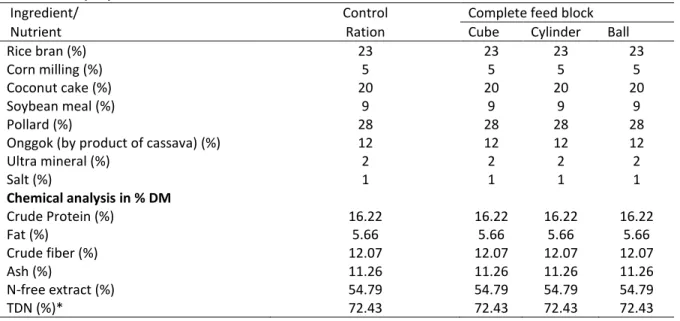
The research material that used were napier grass mutants specific location which was tolerant to acid soils, feedstuff, molasses and dairy concentrates. The proportion of feedstuff ingredient was listed in Table 1, the arrangement of ration control and complete feed block rations were listed in Table 2.
Table 1. The proportion of feedstuff of concentrate
Ingredient/ Control Complete feed block
Nutrient Ration Cube Cylinder Ball
Rice bran (%) 23 23 23 23
Corn milling (%) 5 5 5 5
Coconut cake (%) 20 20 20 20
Soybean meal (%) 9 9 9 9
Pollard (%) 28 28 28 28
Onggok (by product of cassava) (%) 12 12 12 12
Ultra mineral (%) 2 2 2 2 Salt (%) 1 1 1 1 Chemical analysis in % DM Crude Protein (%) 16.22 16.22 16.22 16.22 Fat (%) 5.66 5.66 5.66 5.66 Crude fiber (%) 12.07 12.07 12.07 12.07 Ash (%) 11.26 11.26 11.26 11.26 N-free extract (%) 54.79 54.79 54.79 54.79 TDN (%)* 72.43 72.43 72.43 72.43
185 Table2. Composition of control and complete feed rations
Material Control
ration
Complete feed block Cube Cylinder Ball
Napier grass control (%) 50
Napier grass mutant (%) 47.50 47.50 47.50
Concentrate (%) 50 47.50 47.50 47.50 Molasses (%) 5.00 5.00 5.00 Tota (%) 100 100 100 100 Chemical composition Crude Protein (% DM) 13.07 14.29 14.29 14.29 Crude fat (% DM) 4.19 0.44 0.44 0.44 Crude Fiber (% DM) 22.19 18.93 18.93 18.93 Ash (% DM) 11.63 9.82 9.82 9.82 N-free extract (% DM) 43.38 43.37 43.37 43.37 TDN (%)* 65.65 64.65 64.65 64.65
*Calculation according to Sutardi (2001) : TDN=2.79+1.17 CP + 1.74 Fat -0.295 CF + 0.810+ NFE
The observed variables included dry matter intake (DMI) and the organic matter intake (OMI), dry matter digestibility (DMD) and milk production. The experiments were conducted with experimental methods, the basic design of Randomized Block Design (RBD) with 4 groups and 4 replications. Lactation period was used as a group, namely G1 = fourth lactation, G2 = third lactation, G3 = second lactation and G4 = second lactation with different body weight for each individual cow. There were four treatments, namely R1 (control ration ) = 60 kg fresh napier grass mutant and 9 kg of concentrate, R2 = 20 kg cube complete feed block, R3 = 20 kg cylinder complete feed block and R4 = 20 kg ball complete feed block.
Manufacturing of complete feed block with a ratio off orage to concentrate is 50 : 50. Complete feed block manufacturing procedures: (a) preparation of the feed formulation, (b) napier grass mutant was cut manually with a knife, dried in the sun until dried and milled, (c) concentrates material that represented large particles such as coconut cake and onggok (by product of cassava) also were needed to be reduced in size by grinding, (d) mix the concentrate with an apportionment raw material which the smallest proportion evenly mixed first and then the larger proportion was to follow, (e) after the mixture
was apportionment as curtained and then mixed with ground grass. Inserted into the container and mix the molasses that had been diluted 6 times with water while stirring until evenly distributed, (f) and then mold by the molding press which had been prepared at a pressure of 70 kg/600cm2, (g) then the outcome was placed on the container (pan) made of aluminium and zinc for further action to drying by inserting into the oven at a temperature of 70-80 °C, (h) awaited until dry with moisture content of 13.15 %, (i) finally, it was packed with boxes that had been prepared.
Dairy cows which were used were 16 cows with body weight of 416-691 kg, the average body weight of 538 ± 73.4 kg and produce high milk productions according to the classification of BBPTU-SP (Balai Besar Pembibitan Ternak Unggul Sapi Perah) Baturraden Purwokerto in Central Java. Experimental dairy cows were placed in the individual pens.
Treatment feeds were given twice a day in the morning and afternoon. The feeds were given in the morning after milking (06.00 am) and in the afternoon at 15.00 pm. Milking were done twice a day at 03:00 am, and 14:00 pm. The amount of feed that was given to control cows in the morning were 30 kg of fresh grass and 4.5 kg of concentrate, and the same as in the evening feeding, so that the total feeds
186 were 60 kg of fresh forage and 9 kg of concentrates. Grass had been cut in advance with a length of 5 cm. The amount of feed given to treated cows was the same, both in the morning and in the afternoon was given each as much as 10 kg, so the total of complete feed block were 20 kg daily. Drinking water was given ad libitum. Performed during the preliminary period of 2 weeks refers to Osuji et al. (1993). Refusals, if any, were collected and weighed daily. Each experimental period comprised of 14 days for adaptation to the diet. Full treatment of complete feed block for the data collection carried out for 5 days (Fanchone et al., 2009; Korhonen et al., 2002).
All experimental cows chest circumference were measured to determine the weight by using a Nasco Holstein Dairy Tape. Given feed, residual feed and feces were weighed during the data collection. The formula for calculating dry matter digestibility (DMD) was as follows:
100% intake DM faeces DM -intake DM = DM D x
Formula of milk production was (kg 4% FCM/cow/day) = (0.4 x MP) + (0.15 x MP x F), where: MP = daily milk production (kg/head/day) and F = milk fat content (%) (Bakrie et al., 2005). Data were analyzed using analysis of variance followed by Duncan’s Multiple Range Test (Steel and Torrie, 1993).
Results and Discussion
Intake of dry matter and organic matter. The Average dry matter intake (DMI) for cattle was 3.37 % of body weight, it was still good because the standard of rationing in dry ingredients was
2-4 % of body weight (NRC, 2001). Dry matter intake (DMI) and the organic matter intake (OMI) in the experiment are listed in Table 3. The total dry matter intake of all shapes of complete feed block , i. e. cube, cylinder and ball had the similar values, i. e. 17.37 kg. Because all of the complete feed block that were fed finished to be consumed, therefore, this case had the same consequences the similar consumption of organic matter, 15.41 kg.
Dry matter intake of control ration was higher than those of complete feed block. This showed that the dry matter intake of cattle with complete feed block was more efficient than those cattle with control ration, and so the organic matter intake of complete feed block was higher than the intake of organic matter control ration. Therefore, the feeding using complete feed block had the greater effect i.e. more nutrients were used by the dairy cows for the maintenance and milk production. Dry matter intake in the low protein ration is higher rather than in high protein ration (Castillo et al., 2001). Aikman et al. (2008) stated that Holstein cows weighing 678±18kg with 42.6 kg milk yield/day, dry matter intake was 22.01 kg/day. Reducing the chop length of alfalfa did not affect DMI, but reducing the chop length of oats increased DMI from 19.4 to 21.2 kg/day across alfalfa chop length (Bhandari et al., 2008).
Dry matter digestibility (DMD) ration of dairy cows. Digestibility of dry matter rations given to cattle experiments were listed in Table 4. Dry matter digestibility (DMD) control ration did not show significant differences compared to the Table 3. Intake of dry matter and organic matter
Treatment Body weight (BW) DMI DMI OMI OMI
(kg) (kg) % BW (kg) % BW
Control ration 577.00±76.33 20.5028a 3.55 13.0136±0.20b 2.26
Cube CFB 514.50±35.93 17.3702b 3.38 15.4060±0.14a 2.99
Cylinder CFB 517.75±96.91 17.3702b 3.35 15.4060±0.14a 2.98
Ball CFB 543.00±84.21 17.3702b 3.20 15.4060±0.14a 2.84
187
Table 4. Dry matter digestibility (DMD) rations of dairy cows
Treatment DMD (%)
Control ration 82.02±2.17a
Cube CFB 82.99±1.17a
Cylinder CFB 82.75±0.88a
Ball CFB 83.76±1.24a
Values bearing different superscripts on the same column differ significantly (P<0.05)
Table 5. Daily milk production and milk production per lactation and 4% FCM in the provision of complete feed
Treatment Milk production /day 4% FCM (kg) Milk production /lactation and 4% FCM (kg)
Control ration 12.71±4.75 2829.60±1056.64
Cube CFB 15.98±2.35 3558.10± 524.11
Cylinder CFB 14.27±2.05 3175.90± 456.91
Ball CFB 13.95±1.71 3104.10± 380.47
DMD complete feed block treatment. This indicated that the DMD control ration had the same effect with all three kinds of complete feed block. DMD of control ration was lower than those of the three forms of complete feed block, because it was related to the ash content in the control ration that was higher in ash content compared to all three block forms that was consumed by livestock. There were many nutrients that can be digested and utilized for the needs of dairy cows. The study found that the cattle fed complete feed block with different forms did not show a different appearance and was almost equal to that reported by Mathius et al. (2005), further stated that the form of feed had no effect on digestibility of dry matter (Mathius et al., 2006). Dry matter digestibility ration of dairy cows were lower in the low protein content rather than in high protein content (Castillo et al., 2001).
Milk production. Dairy cow milk production of Holstein Frisian per day was 4% FCM and milk production was converted to age and 305 days in the control and the provision of complete feed block rations form a cube, cylinder and ball were listed in Table 5. Milk production of dairy cows fed a control ration showed no significant to the complete feed block ration either the form a cube, cylinder or ball. This was
presumably due to the material and the proportion of given concentrates the same for cattle fed control ration or a complete feed block in all three forms. This case was assumed because the feedstuff and the proportion of concentrate that was given to the animals were similar, better for the concentrate of the control ration as well as the concentrate that were made into complete feed block in the three kinds of shapes. Average daily milk production ranged from 12.71 kg to 15.98 kg. Milk production will be different with different rationing as the research by Herawati (2003) that milk production in dairy cows increased by substitution of portion forage in the ration with rejected pineapple, organic mineral supplementation on ration made from chicken feathers hydrolyzed and sorghum (Muktiani et al., 2005), macro mineral supplementation (Adriani and Mushawwir, 2009).
Conclusions
Intake of dry matter and organic matter in the form of complete feed block of cubes, cylinders and ball form are better than the control ration. Complete feed block in the form of a cube, cylinder and ball has better digestibility of organic matter than of control ration, however it has the similar effect as the control ration on milk production.
188
References
Adriani L and A Mushawwir. 2009. Level of blood glucose, lactose and dairy cattle milk yield at different level of macro mineral supplementation. J. Indon. Trop. Anim. Agric. 34(2):88-95.
Aikman P, CK Reynolds and DE Beever. 2008. Diet digestibility, rate of passage, and eating and rumination behavior of jersey and holstein cows. J. Dairy Sci. 91(3):1103–1114.
Bakrie B, Suwandi, A Saenabdan and BV Lotulung. 2005. Pemanfaatan silase jagung QPM sebagai hijauan untuk pakan ternak sapi perah di DKI Jakarta (The use of the QPM maize silage for dairy cattle forage in DKI Jakarta). Semiloka Nasional Prospek Industri Sapi Perah Menuju Perdagangan Bebas 2020. p. 99-106.
Bhandari SK, S Li, KH Ominski, KM Wittenberg and JC Plaizier. 2008. Effects of the chop lengths of alfalfa silage and oat silage on feed intake, milk production, feeding behavior, and rumen fermentation of dairy cows. J. Dairy Sci. 91(5):1942–1958.
Budiono RS, RS Wahyunidan dan R Bijanti. 2003. Kajian kualitas dan potensi formula pakan komplit vetunair terhadap pertumbuhan pedet. Proseding Seminar Nasional Aplikasi Biologi Molekuler di Bidang Veteriner dalam Menunjang Pembangunan Nasional. Surabaya, 1 Mei 2003. Castillo AR, E Kebreab, DE Beever, JH Barbi, JD
Sutton, HC Kirby and J France. 2001. The effect of protein supplementation on nitrogen utilization in lactating dairy cows fed grass silage diets.J. Anim. Sci. 79:247–253.
Ensminger, ME, JEO Field and WW Hineman. 1990. Feed and Nutrition (Formaly Feed and Nutrition Complete) 2nd Ed. The Esminger Publishing. California.
Fanchone A, H Archimède and M Boval. 2009. Comparison of fecal crude protein and fecal near-infrared reflectance spectroscopy to predict digestibility of fresh grass consumed by sheep. J. Anim. Sci. 87:236–243.
Herawati. 2003. The effect of forage feed subtitution with rejected pineapple on milk yield and quality in lactating dairy cows. J. Indon. Trop. Anim. Agric. 28(2):56-63.
Korhonen M, AVanhatalo and P Huhtanen. 2002.
Effect of protein source on amino acid supply, milk production, and metabolism of plasma nutrients in dairy cows fed grass silage. J. Dairy Sci. 85:3336–3351.
Mathius IW, AP Sinurat, DM Sitompul, BP Manurung and Azmi. 2006. Effect of shape and storage duration on quality and biological value of complete feed. Prosiding Seminar Nasional Teknologi Peternakan dan Veteriner. p. 57-66. Mathius IW, AP Sinurat, BP Manurung, DM Sitompul
and Azmi. 2005. Pemanfaatan produk fermentasi lumpur-bungkil sebagai bahan pakan sapi potong. Proseding. Seminar Nasional Teknologi Peternakan dan Veteriner. Bogor, 12 – 13 September 2005. Puslitbang Peternakan, Bogor. p. 153 – 161.
Muktiani A, T Sutardi, KG Wiryawan and W Manalu. 2005. Organic mineral supplementation in the diet containing hydrolyzed chicken feather and sorghum grain to promote milk production of dairy cows. J. Indon. Trop. Anim. Agric. 30(2):127-133.
NRC. 2001. Nutrient Requirement of Dairy Cattle. Seventh Revised Edition. National Academy Press, Wahington, D.C.
Osuji PO, IV Nsahlai and H Khalili. 1993. Feed evaluation. ILCA Manual 5. ILCA (International Livestock Centre for Africa), Addis Ababa, Ethiopia. 40 pp.
Retnani Y, L Herawati and S Khusniati. 2011. Physical characteristics on crumble ration of broiler starter using tapioca, bentonit dan onggok binders. J. Ilmu dan Teknologi Peternakan. 1(2):88-97.
Saenab A, EB Laconi, Y Retnani and MS Mas’ud. 2010. Quality evaluation of shrimp by-product complete ration pellets. J. Ilmu Ternak dan Veteriner. 15(1):31-39.
Steel RGD and JH Torrie. 1993. Prinsip dan Prosedur Statistika Suatu Pendekatan Biometrik. Edisi kedua. PT Gramedia Pustaka Utama, Jakarta. Sutardi T. 2001. Revitalisasi peternakan sapi perah
melalui penggunaan ransum berbasis limbah perkebunan dan suplementasi mineral organik. Laporan Akhir RUT VIII.I. Kantor Menteri Negara Riset dan Teknologi dan Lembaga Ilmu Pengetahuan Indonesia. Jakarta.
Zigger D. 2004. Cooling hot pellets critical to quality feed production. Feed Technology. 8:9-11.