U n i v e r s i t y o f H e i d e l b e r g
Discussion Paper Series No. 575
482482
Department of Economics
Geopolitics, Aid and Growth
Axel Dreher, Vera Eichenauer,
and Kai Gehring
Geopolitics, Aid and Growth
Axel Dreher* (Heidelberg University, University of Goettingen, KOF, CEPR, CESifo, IZA)
Vera Eichenauer (Heidelberg University)
Kai Gehring (University of Goettingen, Heidelberg University)
October 2014
Abstract: We investigate the effects of short-term political motivations on the effectiveness of foreign aid. Specifically, we test whether the effect of aid on economic growth is reduced by the share of years a country has served on the United Nations Security Council (UNSC) in the period the aid has been committed, which provides quasi-random variation in aid. Our results show that the relationship of aid with growth is significantly lower when aid has been committed during a country’s tenure on the UNSC. We derive two conclusions from this. First, short-term political favoritism reduces growth. Second, political interest variables are inadequate as instruments for overall aid, raising doubts about a large number of results in the aid effectiveness literature.
Keywords: aid effectiveness, economic growth, politics and aid, United Nations Security Council membership, political instruments
JEL codes: O19, O11, F35, F53
Acknowledgements: We thank Kurt Annen, Jean-Paul Azam, Sarah Bermeo, Simone Bertoli, Christian Conrad, Angus Deaton, Hristos Doucouliagos, Matthias Hartmann, Jude Hays, Richard Jong-A-Pin, Philip Keefer, Jamus Lim, Katharina Michaelowa, Daniel Nielson, Martin Paldam, James Snyder, Alois Stutzer, Byungwon Woo, Isleide Zissimos, participants at the 6th Annual Conference on The Political Economy of International Organizations (Mannheim/Heidelberg 2013), the Second Warwick Political Economy Workshop (2013), the Beyond Basic Questions Workshop (Lucerne 2013), the European Public Choice Society Meeting (Zurich 2013), the Conference on Research Frontiers in Foreign Aid (Princeton 2013), the Spring Meeting of Young Economists (Aarhus 2013), the Schliersee Workshop on "Public Finance and
2
Political Economy I,” the 2013 Silvaplana Workshop in Political Economy, the 2013 annual meeting of the International Political Economy Society at Claremont Graduate School, the Northeast Universities Development Consortium Conference 2013 at Harvard University, the EUDN Scientific Conference 2013, the Future of Political Economics (Freiburg 2014), the Verein für Socialpolitik (Hamburg 2014), and at seminars at the Instituto Universitário de Lisboa (ISCTE-IUL), University of Milano-Bicocca, University of Auvergne (CERDI), University of St. Gallen, and Heidelberg University for helpful comments. We thank Jamie Parsons for proofreading. Financial support from the German Research Foundation (DFG GZ: DR 640/2-2) is gratefully acknowledged.
* Corresponding author, Heidelberg University, Alfred-Weber-Institute for Economics,
Bergheimer Strasse 58, 69115 Heidelberg, Germany; Phone: +49 6221 54 2921; Fax: +49 6221 54 3649; Email: [email protected]
3
“UNSC membership offers a quasi-experiment to assess the impact of unconditional aid.” (Bueno de Mesquita and Smith 2010)
1. Introduction
For a new paper investigating the impact of aid on economic growth it may be good practice to begin with an apology for adding to such an immense literature. However, the debate on whether or not foreign aid is effective in promoting growth in recipient countries is ongoing and heated, arguably because the literature lacks an accepted identification strategy. While we do not offer recipes to estimate a causal effect of aid on growth, we propose a test to distinguish between the effects of aid granted while a country benefited from extraordinary political leverage and the effects of aid granted at other times. While the effect of favoritism on how aid promotes growth is interesting in its own right, our paper also offers important insights for those studies in the aid effectiveness literature that use political alignments to identify the effects of aid.
Most of the previous literature relies on three strategies to identify the effect of aid on growth (or other potential consequences of aid).1 First, researchers use instruments for aid that
mainly rely on the recipient country’s population size. Second, they employ internal instruments in the context of difference or system GMM estimations. Third, they base the analysis on instruments that proxy for the geopolitical importance of a recipient country to the donor, implicitly or explicitly generalizing the Local Average Treatment Effect (LATE) to be representative of all aid, rather than political aid exclusively.2 The first two estimation strategies
1 A number of recent contributions does not fit these groups. For example, Galiani et al. (2014) instrument
aid flows with the International Development Association’s (IDA) threshold for receiving highly concessional aid. Werker et al. (2009) make use of oil price fluctuations that substantially increase the aid budgets of oil-producing Arab donors, in particular to Muslim countries. While we are convinced of Werker et al.’s identification strategy, in particular, their results can hardly be generalized to represent the effects of aid more broadly. As they point out, their results show the LATE for oil-price-induced increases in aid to Muslim countries, which might be unrepresentative for aid by a broader set of donors to a broader set of recipients. The results in Galiani et al. (2014) refer to the small set of countries crossing the IDA-threshold.
2 The number of papers falling in this category is too large to cite them all. A number of recent papers use
4
violate the exclusion restriction. Clearly, population size and lagged aid can affect growth through channels other than contemporaneous aid.
The third strategy requires assuming that the effects of aid are independent of the donors’ motives for granting it. This might be reasonable. Donors who have already committed a certain amount of aid might be keen to achieve developmental outcomes, independent of the motive for granting aid in the first place (Rajan and Subramanian 2008). Kilby and Dreher (2010) raise doubts about this homogeneity assumption. Their results show that donor motives influence the effectiveness of development aid in promoting growth.3 Several reasons might
explain such a difference. Arguably, if donors are motivated by pure self-interest, their allocation decision does not depend on the way the recipient uses the aid. A politically motivated allocation of aid may result in the approval of lower-quality aid projects in favored countries instead of more promising projects elsewhere. Donors may fail to include growth-promoting policy conditions or wave them in case of non-compliance. Favoritism might thus allow projects to be pursued where important preconditions are not met or might reduce the time and resources devoted to the preparation of a project. The recipient might choose to use disbursed aid for purposes other than development if punishment for non-compliance is less likely,4 resulting in on average inferior outcomes.
(e.g., Creasey et al. 2011, Aurore and Maurel 2013, Bjørnskov 2013, Midtgaard et al. 2013). Others use temporary membership in the United Nations Security Council, which is in the focus of our paper (Christensen et al. 2011, Breitwieser and Wick 2013, Drometer 2013).
3 They do not propose exogenous instruments to identify causality, however, but rely on system GMM
estimations (with the exclusion restriction being unlikely to hold, see Bazzi and Clemens 2013). A handful of other studies consider the impact of donor characteristics on aid effectiveness (Bobba and Powell 2007, Headey 2008, Bearce and Tirone 2010, Minoiu and Reddy 2010, Bermeo 2011).
4 Focusing on the IMF and the World Bank, Stone (2008), Kilby (2009) and Nooruddin and Vreeland
(2010) suggest that political favoritism undermines the credibility of conditionality, rendering it ineffective. Nooruddin and Vreeland (2010) show that democratic countries under IMF programs increase public wages and salaries when they serve on the UNSC, while governments without UNSC-related political leverage have to reduce their wage bill. This suggests that politically important countries can avoid tough conditionality. Stone (2004) and Kilby (2009) show that IMF and World Bank conditions, respectively, are not rigorously enforced in politically important recipient countries (measured by UNGA voting patterns, among others). Kilby (2011, 2013) finds that political leverage reduces the time used to prepare World Bank projects, which in turn reduces the quality of these projects.
5
If geopolitical aid or aid given to recipients with political leverage more generally is less effective than other aid,5 the literature using political connections as instruments would not
provide evidence of the ineffectiveness of overall aid, but rather of aid given to politically important countries. Their estimates would represent a lower bound for the effects of overall aid. The lack of a convincing test for differential effects of these types of aid is thus an important gap in the literature. In this paper, we aim to fill this gap.
We investigate whether aid given to temporary members of the UNSC is less effective in promoting growth than aid given at other times. In measuring the amount of aid received by a country at times of extraordinary political importance, we connect to the recent literature investigating the effects of temporary membership on the UNSC. Bueno de Mesquita and Smith (2010) show that temporary members grow more slowly while serving on the UNSC. They attribute this to the adverse consequences of development aid, given that these temporary members receive substantial additional inflows of aid during their terms on the UNSC (Kuziemko and Werker 2006, Dreher et al. 2009a, 2009b). However, the results in Bueno de Mesquita and Smith reflect the effects of membership per se, and seem to be independent of the amount of aid received (Bashir and Lim 2013).6 It thus remains unanswered whether aid
granted during temporary UNSC membership results in different developmental outcomes than aid given at other times.
Dreher et al. (2013) investigate the effect of temporary UNSC membership on the evaluation of World Bank projects. Their results show that project evaluations are on average not inferior for projects granted to countries while being on the UNSC. It is only during times of macroeconomic crisis that politically motivated aid reduces the probability of a positive evaluation. In contrast to our paper, Dreher et al. focus on one (multilateral) donor and investigate the effect of geopolitics on self-assessed project outcomes rather than on economic growth. We take a broader approach and reconsider recent models of aid effectiveness to
5 Overall aid is composed of an (unknown) share of politically motivated aid and, arguably, some share
exclusively given for developmental purposes, among others. See Werker (2012) for more on the political economy of foreign aid.
6 As pointed out by Bueno de Mesquita and Smith (2013), the effects of “easy money” can take many
6
distinguish between aid given to countries of short-term geopolitical importance and aid granted at other times. In contrast to Bueno de Mesquita and Smith (2010), we do not relate UNSC membership per se to the variables of interest, but exploit the quasi-random variation in the amount and the implementation modality of aid at the time of temporary UNSC membership to investigate whether the effectiveness of these flows is different from aid granted at other times.
Augmenting Clemens et al.’s (2012) permutations of Burnside and Dollar (2000) and Rajan and Subramanian (2008), we find that the effect of aid on growth is reduced by donors’ geopolitical motives. This result holds for the model of Bueno de Mesquita and Smith (2010). It is more pronounced in autocratic recipient countries and holds if we restrict the sample to Africa, which follows the strictest norm of rotation on the UNSC and can thus most reliably be regarded as exogenous. Overall, we find that political favoritism reduces aid effectiveness. This renders political variables inadequate as instruments for overall aid.
The next section describes how we exploit temporary membership on the UNSC to identify the effects of political motives, outlines our data and method of estimation, and presents the main results. Section 3 extends the basic analysis, while the final section draws policy implications and concludes the paper.
2. Data, method, and main results
Our proxy variable for political importance is a measure that has been shown in previous research to induce political favoritism: temporary membership on the UN Security Council. Among the potential proxy variables for political influence, this measure poses the fewest problems.7 Membership positions are scarce, the nature of service is temporary and not
7 Other measures suggested in the literature include voting patterns in the UN General Assembly, formal
alliances or military support, colonial relationships, stronger geopolitical constraints during the Cold War period compared to more recent years, and ad hoc classifications of “good” versus “other” or “bad” donors. None of these measures is suitable to identify causal effects of politically motivated aid given that they vary little and slowly over time, so that most of the variation in these measures comes from the cross-sectional dimension.
7
immediately renewable, and the selection process is exogenous to aid (Bueno de Mesquita and Smith 2010, Dreher et al. 2014).8
While five members of the UNSC (China, France, Russia, the United Kingdom, and the United States) serve on a permanent basis, ten temporary members are elected by the UN General Assembly. These elected members serve two-year terms. While not random, membership appears to be largely idiosyncratic, with varying regional norms (Dreher et al. 2014): African nations typically rotate; Latin America and Asia hold competitive elections where regional hegemons win most often; Western Europe mixes rotation and competitive elections; and since the end of the Cold War, Eastern Europe shows no systematic pattern. The two-year, not immediately-renewable term reinforces the exogeneity of the selection process.
Our analysis closely follows the approach in Clemens et al. (2012), adding our variables of interest to their models. Clemens et al. show that the most prominent previous attempts to control for the potential endogeneity of aid rely on invalid instruments.9 Instead of suggesting
more valid ones, they address the potential endogeneity of aid by differencing the regression equation and lagging aid, so that it can reasonably be expected to cause growth rather than being its effect. Thus, they assume that the main (short-term) effects of aid on growth occur, on average, one period after its disbursement. We base our analysis on their permutations of Burnside and Dollar (2000) and Rajan and Subramanian (2008) – the two studies that arguably gained most attention in the recent literature on aid and growth. We also re-estimate the
8 For our work, the importance of previous research on what determines election to the UNSC cannot be
over-emphasized. If selection to the UNSC depends on those same variables that also affect aid and economic growth, our results would be biased. While countries become politically or economically more important over time, the amount of aid they receive and their rates of economic growth could simultaneously increase. For example, countries being temporary members of the UNSC might be able to draw the world’s attention to their legitimate developmental needs, giving them access to additional funds that are unrelated to political motives. Bueno de Mesquita and Smith (2010) and Dreher et al. (2014) test this possibility: They find that election to the UNSC is clearly not related to the variables that also affect the amount of development aid a country receives. Thus, conditional on the variables in our models, UNSC membership can be considered as providing exogenous variation that we can use to identify the temporary geopolitical importance of a country for exactly its two years of membership. See also Besley and Persson (2012).
9 Bazzi and Clemens (2013) show in more detail that previous papers in the aid effectiveness literature
rely on weak instruments – including those relying on internal instruments using “black box” GMM estimations.
8
specifications in Bueno de Mesquita and Smith (2010), which are closely related to the question we address here, and which gained considerable attention in the academic literature and the media alike.10 While we believe (as do Clemens et al. 2012) that OLS regressions are superior to
2SLS with questionable instruments, we stress that our estimate of whether aid affects growth could be biased in either direction,11 and we largely refrain from interpreting the aid-growth
relationship as causal. There is, however, no reason to expect a systematic bias for our coefficient of interest, the interaction of aid with UNSC membership for any given level of aid.12
We thus adopt the regression-based OLS approaches of these prominent previous analyses,13
and add development aid and its interaction with temporary membership on the UNSC to the equations of Bueno de Mesquita and Smith (2010), and temporary membership and its interaction with aid to those of Clemens et al. (2012).14
In terms of timing, we follow Clemens et al. (2012) and assume that disbursed aid takes one four-year-period to become effective to increase or decrease economic growth.15 We also
assume that bottlenecks in the donor and recipient administrations prevent aid from being disbursed immediately, so that the bulk of aid committed in one four-year-period is disbursed
10 E.g., Hosli et al. (2011), Bashir and Lim (2013).
11 For example, donors might grant more aid to a new reform-oriented government. Increased growth
resulting from these reforms could then spuriously be attributed to the increases in aid. On the other hand donors might give more aid to countries where they anticipate shocks to reduce future growth rates.
12 This interpretation relies on the formal analysis in Nizalova and Murtazashvili (2012). Also see Nunn
and Qian (2013). Nunn and Qian refer to section 2.3.4 of Angrist and Krueger (1999) for a technical discussion.
13 Unlike Clemens et al. and Bueno de Mesquita and Smith we cluster standard errors at the recipient
country level in all our specifications. Our results are not affected by this.
14 As an alternative approach, one could think of instrumenting for aid with temporary membership on
the UNSC. We do not pursue this route for two reasons. First, temporary membership is rare – the instrument thus has low power. More importantly, instrumenting aid with UNSC membership can only give us the LATE – in this case, the effect of aid given while a country was of short-term geopolitical importance. However, we are interested in the difference of the effectiveness of strategic aid compared to aid given at other times.
15 As summarized in Headey (2008), aid affects growth most substantially 5-9 years after it has been
disbursed, on average. If aid is disbursed evenly over time, the average positive distance between a dollar being disbursed and growth in the contemporaneous four-year-period is 16 months (Roodmann 2007, Headey 2008). Headey thus lags aid by one four-year period, so that the average positive distance between disbursements and their potential effects is 5 years and 4 months.
9
one period later, on average.16 Based on these assumptions about the lag structure of the growth
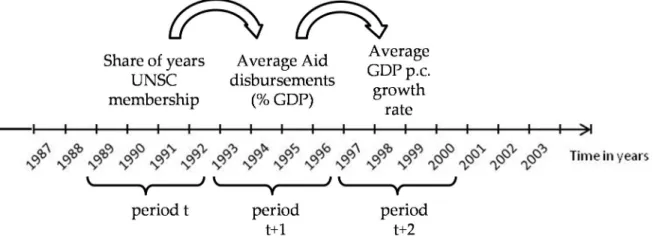
effects of aid we are interested in growth rates two periods after UNSC membership. Regarding the potentially harmful consequences of geopolitical motives, this would imply that aid committed in period (t), which is disbursed in period (t+1), is less effective in promoting growth in period (t+2) the more years a country has spent on the UNSC in period (t). Arguably, UNSC membership can also have more instant or contemporaneous effects on growth, depending on the exact channel that explain the reduced aid-growth correlation. We empirically test the possibility of different timings in a series of additional regressions.
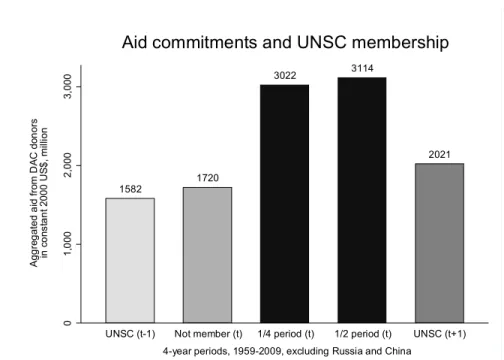
Figures 1-3 provide a first impression of the data. The patterns are in line with our assumptions about the most likely timing. Figure 1 shows that aid commitments (in constant 2000 million US dollars) from all DAC-donors in a specific four-year-period are substantially larger for countries that have served (one or two years) on the UNSC, compared to countries that did not serve. They are also larger compared to commitments received by temporary members in the period prior to serving on the UNSC, and compared to commitments one period after serving (these differences are statistically significant at the one-percent level). Figure 2 shows net aid disbursements (also in constant 2000 million US dollars) conditional on UNSC membership, but lags membership by one four-year-period. The data support the assumed pattern: Commitments increase in the contemporaneous four-year-period of membership; the accompanying disbursements increase in the period following UNSC membership. Thus, aid commitments during UNSC membership seem to be disbursed on average one period later. Both commitments and disbursements move back to their initial levels in periods (t+1) and (t+2) respectively. Overall, the effects coincide with UNSC membership, and disappear after the temporary member loses its extraordinary geopolitical importance.
16 For example, a 1999 report of the British House of Commons’ Select Committee on International
Development reports a delay between European Commission aid commitments and disbursements at the end of the 1990s of almost five years (cited in Odedokun 2003: 7). See OECD (2003) for an in-depth discussion of reasons for delayed disbursements.
10
Figure 1: Aid commitments and temporary UNSC membership (t)
Figure 2: Aid disbursements and temporary UNSC membership (t)
1582 1720 3022 3114 2021 0 1, 0 00 2,000 3,000 Agg re g ated a id fro m D A C do n ors in co ns ta n t 2000 US $ , mil lion
UNSC (t-1) Not member (t) 1/4 period (t) 1/2 period (t) UNSC (t+1) 4-year periods, 1959-2009, excluding Russia and China
Aid commitments and UNSC membership
1307 1579 2748 2770 1469 0 1,000 2, 0 0 0 3,000 Agg re g ated a id fro m D A C do n ors in co ns ta n t 2000 US $ , mil lion
UNSC (t) Not member (t+1) 1/4 period (t+1) 1/2 period (t+1) UNSC (t+2) 4-year periods, 1959-2009, excluding Russia and China
11
Figure 3: GDP per capita growth and temporary UNSC membership (t)
Figure 3 shows mean yearly growth rates of per capita GDP for different lags of UNSC membership. The first bar displays the growth rates for countries that have never been a member of the UNSC. The other bars show the growth rates for different lags of UNSC membership: Growth during UNSC membership, one period before, one period later, two periods later, and three periods later. The figure supports the notion that compared to countries that have never served on the UNSC, UNSC members subsequently experience lower growth rates. That is, in line with Bueno de Mesquita and Smith (2010), we find that UNSC membership correlates with lower growth rates. Still, as expected, the lowest growth rates are experienced two periods after UNSC membership. Also note that growth rates increase to almost the level of the pre-UNSC period in the period after UNSC membership. It thus seems that the commitments made while being on the UNSC are not disbursed in sufficient amounts in the next period, on average, to substantially decrease growth in that period.
This pattern supports our hypothesis that the increased aid committed in period (t) during
temporary
UNSC membership [figure 1], which is disbursed in large parts in period (t+1) [figure 2], has an adverse effect on growth in period (t+2) [figure 3].17 While these descriptive17 When we directly test the effect of aid commitments rather than disbursements in our models below,
we find no significant effect on growth. Commitments are not usually used in the aid effectiveness
1.80 1.25 1.06 1.16 0.99 1.23 0.5% 1% 1.5% 2% G DP pe r capit a gro w th ra te
Never UNSC (t-1) UNSC (t) UNSC (t+1) UNSC (t+2) UNSC (t+3)
12
statistics imply no causality, their pattern lends support to our story. We illustrate the timeline derived from our considerations in figure 4. We test different timings as a robustness check further below.
Figure 4: The proposed timeline
Next we turn to our econometric specifications. Following Clemens et al. (2012) our reduced-form empirical model is at the country-period level:
ℎ, = α+β , +γ , +δ , +ζ , * , +η , + , (1)
where Growthi,t is a country i’s average yearly real GDP per capita growth over period t. Aidi,t-1 denotes the amount of aid (as a percentage of GDP)18 disbursed in the previous period; UNSCi,t-2
indicates the share of years country i was a temporary member of the UNSC two periods
literature, as only those parts of the commitments actually disbursed can affect the outcome variable. We also looked at the correlation between disbursements and commitments and find them to be higher for temporary UNSC members than for non-members. This shows that the extent to which the respective commitments are actually disbursed is lower for non-UNSC members than for UNSC members. The blurred distinction between UNSC and non-UNSC members makes it less likely to find significant effects when using commitment data.
18 We focus on aid from all donors for two reasons. First, UNSC membership has been shown to be
important for the allocation of aid from most of the largest donors (see Vreeland and Dreher 2014 for an overview). Given that these donors account for the bulk of aid we do not want to exclude some donors on an ad hoc basis. To the extent that these donors do not provide more aid to countries on the UNSC this does not bias our results. Second, aid by single donors, or a subset of them, is usually not sufficiently large to be measurable in terms of growth. Still, we replicated our results focusing on aid from the largest donor – the United States – separately, as we describe in more detail in footnote 34.
13
before.19 We expect that aid commitments are, on average, disbursed one period later. Hence,
when using lagged aid we twice-lag temporary membership on the UNSC (UNSCi,t-2). All regressions include the complete set of contemporaneous control variables used by the respective previous studies, which is denoted Xi,t.20Our preferred specification also includes aid squared to test for decreasing returns to aid, again following Clemens et al. (2012).21 Finally, εi,t
is the error term.
Equation (1) is in levels and thus does not address the potential endogeneity of aid to economic growth. We therefore base our conclusions mainly on a regression in first differences to control for time-invariant omitted variables, as in Clemens et al. (2012).22 Equation (1) then
becomes:
Δ ℎ, = α+βΔ , +γΔ , +δ , +ζΔ , * , +ηΔ , + , (2)
Again, we report specifications with and without a squared aid term. According to Clemens et al. (2012), the appropriate method to test the effect of aid on economic growth accounts for the non-linear effect of aid, removes country fixed-effects through first-differencing, and lags aid by one period. As they argue, this minimizes potential
19 We exclude the permanent UNSC members from the analysis.
20 To reduce clutter, we do not show them in all tables. Burnside and Dollar include: Initial GDP/capita,
Ethnic Fractionalization, Assassinations, Ethnic Fractionalization*Assassinations, dummies for Sub-Saharan Afric and East Asia, Institutional Quality, M2/GDP (lagged), Policy, and period dummies. Rajan and Subramanian: Initial GDP/capita, Initial Policy, (log) Initial Life Expectancy, Geography, Institutional Quality, (log) Inflation, Initial M2/GDP, Budget Balance/GDP, Revolutions, Ethnic Fractionalization, period dummies and dummies for Sub-Saharan Africa and East Asia. The original studies include time-invariant variables that are removed in (2) below (as in Clemens et al.) through taking differences. Appendix A reports the sources and definitions of all variables, while we show descriptive statistics in Appendix B. Appendix C reports the full specifications for the main regressions.
21 It could be argued that temporary UNSC membership should be interacted with aid squared as well.
Political motivation would then not only change the level of the marginal effect of aid, but also its slope. Such an interaction effect, however, is not significant in our preferred specification (the p-value being 0.82 in the BD sample and 0.22 in the RS sample). Detailed calculations are available on request.
22 Clemens et al. do not explain why they prefer the first-differences regressions over fixed effects
14
misspecification due to reversed causality between aid and growth, and omitted variables bias.23 This is our preferred estimation strategy.24
The regression of Bueno de Mesquita and Smith (2010) is a slightly different one. The dependent variable in Bueno de Mesquita and Smith is again the growth rate of per capita GDP over a four-year-period. However, they compare the difference in growth over these four years for countries that have been a temporary member of the UNSC in the first year of a period to those countries that have not been members in the same period. Rather than including a measure of aid, they estimate the effect of a dummy indicating UNSC membership per se and attribute its effect to foreign aid (or other types of loose money, see Bueno de Mesquita and Smith 2013). We use their baseline specification, and add the UNSC and aid variables, and the interaction of these variables to the equation. The model is thus no longer in first-differences, but instead includes country fixed effects in the main regressions. The lag structure replicates our approach above.25
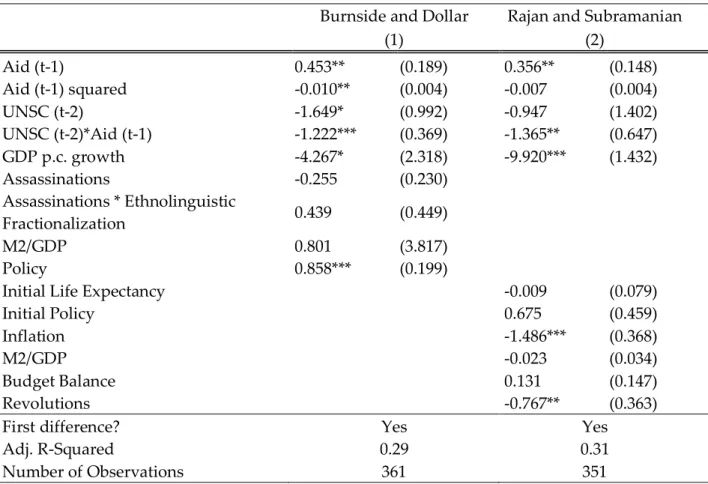
Column 1 of Table 1 shows the results for the Burnside and Dollar (BD) regressions on the extended data of Clemens et al. (2012), covering the 1970-2005 period. All data are averaged over four years. The dependent variable is the average annual growth rate of real GDP per
23 In addition, they seem to prefer a measure of early-impact aid over all aid. This measure has been
shown not to be a robust predictor of growth (Rajan and Subramanian 2008, Bjørnskov 2013). What is more, a major drawback with this measure is that disaggregated aid disbursements are not available for the entire period, so that disbursements have to be estimated based on commitments. Data on commitments in the earlier periods also suffer from severe underreporting, which is not addressed in Clemens et al. (2012) (see OECD/DAC CRS Guide, Coverage Ratios, accessed on March 3, 2014: http://www.oecd.org/dac/stats/crsguide.htm). We therefore prefer to focus on overall aid. To the extent that parts of aid are not systematically related to growth, the larger noise reduces the probability that we find a significant effect. As outlined above, we lag disbursements by one period to account for timing.
24 One could argue that UNSC membership should be included in differences instead of levels. To us, it
seems intuitive that the level rather than changes in UNSC membership conditions the effectiveness of changes in aid. Nevertheless, when we first-difference UNSC membership, the results are similar. The interaction remains negative and significant at the one-percent level in the BD sample, and significant at the ten-percent level in the RS sample.
25 We use the share of temporary UNSC membership lagged by two four-year periods, aid disbursements
as a percentage of GDP lagged by one period, and their interaction. Consistent with the original setup, the four-year periods in this specification can be understood as moving averages. For example, growth in the 1991-1994 period is related to aid disbursements in the 1987-1990 period.
15
capita; aid is measured as net Official Development Assistance (ODA) as a percentage of GDP.26
Column 2 focuses on Clemens et al.’s permutations of Rajan and Subramanian (RS) to test whether our results are due to the specific setup of the BD specifications. The RS regressions use data averaged over five years, and the extended sample of Clemens et al. (2012) covers the 1971-2005 period.27 Before we turn to testing specification (1) (described above), we use the first two
columns to focus on the effect of contemporaneous aid disbursements, conditional on UNSC membership in the previous period, and omit aid squared. While the table reports the variables of interest only, we report the full model for our preferred specifications (columns 7 and 8) in Appendix C.
As can be seen in column 1, the interaction between aid and the share of years the recipient has been a temporary member of the UNSC in the previous period is not significant at conventional levels. This is intuitive, as we cannot expect the effect of disbursements on growth to be immediate (Clemens et al. 2012). However, according to column 2 the coefficient is significant at the ten-percent level in the RS sample, suggesting a negative effect of political motivations even for contemporaneous aid. Part of the aid committed in the previous period might already have been disbursed (and affected growth) in that period or the modes of aid delivery – project preparation, conditionality etc. – of previously committed aid might have changed.
Columns 3 and 4 show how the timing of the aid-variable affects the outcome. When we lag aid by one period, we consequently lag the share of years a country is a member on the UNSC by two periods (as shown in equation (1) above but excluding aid squared). As Clemens et al. argue, this should substantially raise the coefficient of aid. While the coefficients of the aid variable are not significant at conventional levels, they do increase in magnitude. The resulting interaction between temporary UNSC membership and aid is negative and significant at the
26 The original source for GDP per capita growth is the World Bank’s World Development Indicators;
ODA is total net ODA in current US$ from Table 2 of the OECD’s Development Assistance Committee in percent of GDP in current US$, taken from the World Development Indicators (see the Technical Appendix to Clemens et al. 2012).
27 The data for per capita GDP growth are originally calculated based on the Penn World Tables, updated
by Clemens et al. for the year 2005 using the World Development Indicators. Net ODA is measured in the same way as in the BD regressions (see the Technical Appendix to Clemens et al. 2012).
16
ten-percent level in the BD specification (column 3), but not significant in the model of RS (column 4).
Note that aid by itself is not significant at conventional levels in any of the four specifications. This is in line with the results in Clemens et al. (2012) and clearly does not imply that aid is ineffective. If more aid is given to countries which are in greater need, and if those tend to have lower growth rates, the insignificant coefficients for aid might reflect this relationship rather than the absence of positive effects of aid on growth. If aid and growth are persistent over time, this holds whether or not we use lagged values of aid.
We next turn to our preferred estimations, which first-difference the dependent and the explanatory variables except membership on the UNSC (equation 2). This specification takes account of systematic time-invariant differences between members and non-members of the UNSC and their effect on growth. We report specifications excluding aid squared (columns 5 and 6) and including it (columns 7 and 8), to account for potentially diminishing returns to aid. The results support our hypothesis that aid granted during times of short-term political importance is indeed less effective.28 When we do not account for diminishing returns to aid by
including aid squared, the coefficient of the interaction term is negative and significant at the five-percent level in the BD specification (column 5) and negative and significant at the ten-percent level in the RS specification (column 6). When we include aid squared,29 the interaction
becomes significant at the one- and five-percent level, respectively (columns 7 and 8).30
28 Also note that UNSC membership is negative and significant at the ten-percent level according to
columns 5 and 7. This implies that UNSC membership reduces growth even in the absence of any aid. This is broadly in line with Bashir and Lim (2013), who find a direct effect of UNSC membership on growth controlled for aid inflows. The effect is however not robust. If we control for the (first-differenced) set of institutional variables provided by the International Country Risk Guide (ICRG) the coefficient of UNSC is no longer significant at conventional levels, while the coefficient of the interaction term stays significant at the one percent level in our preferred specification (of column 7).
29 Part of the literature on the effect of aid on growth argues that aid squared has to be included in a
meaningful growth regression, e.g., Durbarry et al. (1998). However, see Doucouliagos and Paldam (2009) for a critique.
30 We also tested whether the effect differs when we take only important years of UNSC membership into
account, as suggested in Kuziemko and Werker (2006). The results for the BD specification remain unchanged; in the RS specification the interaction term becomes insignificant, however. This is not surprising given that their measure is based on US newspapers and thus measures the importance of the UNSC predominantly for the United States rather than the average donor.
17
Figure 5: Marginal effect of changes in aid disbursements on changes in economic growth conditional on changes in aid disbursements and varying temporary UNSC membership (based on Table 1, column 7). The histogram shows the distribution of ΔAid in the regression sample. Note that the significant interaction term in the regression shows that these marginal effects differ significantly from each other. The derivation of the marginal effects can be found in Appendix D.
Figure 5 shows the marginal effects for the BD model and the 90%-confidence intervals.31 As can
be seen, the marginal effect of changes in aid on changes in growth depends on the magnitude of the change in aid and on membership on the UNSC. The effect declines for higher values of
ΔAid, reflecting diminishing returns to aid.32 For any value of ΔAid, the effectiveness of aid
decreases with the number of years the recipient country has spent on the UNSC two periods before (i.e., when the aid has been committed). The average effect of a 1 percentage point increase in aid as a percentage of GDP on yearly economic growth is 0.61 percentage points
31 A similar figure for the RS model is available on request.
32 The marginal effect of a change in aid is linear in the lagged difference and in the twice-lagged level of
aid (see Appendix D).
-.75 -.5 -.25 0 .2 5 .5 .75 M argi n al ef fe ct o f A id (i n period t-1) -10 -5 0 5 10 15
Aid (in period t-1)
4-year periods (90% confidence interval)
(UNSC-Membership = Not Member)
Marginal effect of Aid
-.75 -.5 -.25 0 .2 5 .5 .75 M argi n al ef fe ct o f A id (i n period t-1) -10 -5 0 5 10 15
Aid (in period t-1)
4-year periods (90% confidence interval)
(UNSC-Membership = 1/4 period)
Marginal effect of Aid
-.7 5 -.5 -.25 0 .2 5 .5 .7 5 M a rgina l e ffe ct o f A id (in p e riod t-1) -10 -5 0 5 10 15
Aid (in period t-1)
4-year periods (90% confidence interval)
(UNSC-Membership = 1/2 period)
Marginal effect of Aid
18
higher if the recipient has not served on the UNSC compared to if it has served two years (i.e., 1/2 of the four-year-period). The aid-growth relationship is positive for countries that have not served on the UNSC when aid has been committed,33 while being largely insignificant for
countries that have served one year, and significantly negative for those that have served two years and for which the increases in aid exceed 3 percent of GDP.
Table 2 reproduces the regressions in first differences (including aid squared) focusing on Africa only. African nations follow the strictest norm of rotation on the UNSC among all regional election caucuses, making the exogeneity of UNSC membership particularly hard to challenge (Dreher et al. 2014). The results are similar to those for all countries, as shown above. The coefficient on the interaction term is negative and significant at the five-percent level in the Burnside and Dollar regressions. The coefficients in the Rajan and Subramanian specification are, however, no longer significant at conventional levels. This is potentially due to the substantially smaller sample, and the fact that the five-year periods used by RS make it more difficult to capture the correct timing as proposed in our timeline.34
In Table 3 we turn to the model of Bueno de Mesquita and Smith (BdM/Smith).35
Column 1 includes fixed effects for years and regions, but not for countries. As can be seen,
33 This holds unless the change in aid exceeds 10 percent of GDP.
34 As a substantial share of politically motivated aid inflows come from the United States, we replicated
the analysis focusing on US aid only. This comes with two potential problems that might bias against finding a significant interaction: First, overall US aid might be politically motivated to a larger extent than ODA from all donors. It could then be difficult to differentiate between the growth-effects of normal aid and aid given during the recipient‘s time as temporary UNSC member. Second, it might not be possible to detect significant effects when focusing on aid from one donor exclusively as such aid might be insufficiently large to measurably affect growth. Our results are similar to those for all aid, but generally weaker: The interaction terms remain negative in the main regressions, but become significant at the one-percent level only in the BD specification in the Africa sample. Interestingly, however, we find a negative and significant effect at the one and ten-percent level respectively for autocratic countries. This supports the notion that the adverse effects of politically motivated aid are a particular concern in autocratic countries, which might not receive any aid without UNSC membership (see section 3 below).
35 Their source for GDP per capita growth is the World Bank’s World Development Indicators (2007),
measured in constant 2000 US$. Aid is measured as net official development assistance in percent of GDP and comprises aid from all sources (also taken from the World Development Indicators 2007). All regressions include as explanatory variables: (log) population size, (log) per capita GDP, the level of democracy and its interaction with UNSC membership (as do the main specifications in Bueno de Mesquita and Smith 2010). Note that contrary to Bueno de Mesquita and Smith we exclude high-income countries (as defined by the World Bank) from the sample, as they do not receive any aid. Again, we
19
countries that were temporary members of the UNSC at the beginning of a four-year-period do not experience significantly different rates of growth.36 In column 2 we lag temporary
membership on the UNSC by two periods. As can be seen, the twice-lagged effect of UNSC membership does not reduce growth at conventional levels of significance, indicating that UNSC membership per se does not hurt growth.
In accordance with our timeline, we again assume that aid which is committed while a country is on the UNSC gets disbursed with a lag of about one four-year-period and affects economic growth in the period following disbursement. Column 3 adds aid lagged by one period, twice-lagged UNSC membership and their interaction to the equation. Column 4 shows the same specification, but restricts the sample to Africa. The results are in line with those above, with the interaction between UNSC membership and aid being negative and significant at the five- and one-percent level respectively.
In columns 5-8 we replace the region-fixed effects with dummies for each country and add regional quartic time trends (as in Bueno de Mesquita and Smith 2010). It is thus the more rigorous specification, as it accounts for potential time-invariant omitted variables, different forms of regional trends, and common yearly shocks. The results are broadly in line with those above. While the interaction between aid and membership on the UNSC is negative but not significant at conventional levels for the overall sample (column 7), it is negative and significant at the one-percent level in the regressions focusing on Africa (column 8). As explained above, African countries provide the most reliably exogenous variation in politically motivated aid; thus a causal interpretation of this result is most warranted. Overall, our results support the hypothesis of an adverse effect of political interests on aid effectiveness. That is, politics matter.37
restrict the table to the variables of main interest and report the full specification for our preferred model in Appendix C.
36 This is contrary to the results of Bueno de Mesquita and Smith (2010). Unlike them, we cluster standard
errors at the recipient country level. Without clustering, the negative coefficient is significant at the ten-percent level.
37 We also run separate regressions for the period of the Cold War and the post-Cold War period. As
Berthélemy and Tichit (2004) show, the importance of colonial ties diminishes with the end of the Cold War. Headey (2008) also shows that bilateral aid became more effective after the end of the Cold War, in line with Dunning’s (2004) analysis of how aid affected the spread of democracy. If donors gained greater
20
The next section extends the main analysis by separately investigating democratic and autocratic recipients of aid and investigating possible transmission channels.
3. Extensions
As Nooruddin and Vreeland (2010) argue, UNSC votes of democratic countries provide greater legitimacy and are thus more valuable than those of non-democratic ones. Democracies should consequently have particular leverage while serving on the UNSC, potentially reducing the effectiveness of aid more strongly than aid given to autocracies. On the other hand, Bueno de Mesquita and Smith (2010) report the adverse effects of UNSC membership to be stronger in autocracies. This is because, on average, the potential to misuse aid is higher in autocracies. On balance, we expect a more pronounced interaction effect in autocracies. In the next set of regressions we investigate the effect of politically motivated aid in democracies and autocracies separately, measured according to the indicator of Cheibub et al. (2010).
Table 4 reports the results for the BD and RS specifications, while Table 5 shows them according to the specification of BdM/Smith. In Table 4 we focus on those regressions that control for time-invariant omitted variables by first-differencing the equation. For the BD sample the negative interaction is significant at the one-percent level in autocracies (columns 3 and 7) and larger than in democracies, where it is significant at the ten-percent level when aid squared is included (column 5) and insignificant without aid squared (column 1). In both models, the negative coefficients are substantially larger in magnitude in autocracies than in democracies. The RS specifications show positive coefficients for democracies and negative coefficients for autocracies, all failing to reach statistical significance however.
Table 5 shows a similar picture for the BdM/Smith specification, where only the interactions in autocracies have a negative coefficient. The negative effect is significant when we control for regional and time fixed effects (column 3). When we add time trends and country
leverage to enforce conditions after the end of the Cold War, and the accompanying risk of losing an ally to the opposing bloc decreased, we would expect the effect of geopolitical aid to be particularly harmful during the Cold War era. Indeed, the negative coefficient of the interaction term is larger during the Cold War era for the BD and RS sample; for the BdM/Smith sample there are no obvious differences visible. We also tested whether politically motivated aid is particularly harmful in times of economic crises, as suggested in Dreher et al. (2013). We find no systematic difference.
21
fixed effects in column 4 the coefficient remains negative but turns insignificant. In democracies the interaction turns positive and significant at the five-percent level with region fixed effects (column 1), and insignificant with country fixed effects (column 2). Overall, the greater political legitimacy of democratic countries’ votes on the UNSC does not seem to drive the results. Our results suggest that in autocratic countries which have potentially less interest in promoting development, the reduced pressure to use development aid for developmental purposes during UNSC membership might be particularly harmful. Given that autocracies are, on average, countries where the potential role of the donor in pushing for change is most prevalent, the adverse consequences of politically motivated aid are particularly unfortunate.
The results so far support our proposed timeline. However, this does not preclude other timings to be potentially important. Thus, Table 6 reports results from regressions that examine whether and to what extent other possible timings are supported by the data.
To test these possibilities, we replicate the regressions of Table 1, columns 7 and 8, for the BD and RS specifications respectively using alternative timelines. For BdM/Smith we focus on the specification of column 7 in Table 3. We test if the effectiveness of aid disbursed in different periods is affected by UNSC membership in the same period, one period before, and two periods before. For example, if aid disbursed during UNSC membership is less effective if the country has been on the UNSC in the previous period, contemporaneous membership could affect compliance via conditionality.
While Table 6 shows the coefficients and standard errors of the interaction terms only, note that the respective aid, aid squared and UNSC variables are also included in each regression (as are the remaining control variables). We also report the coefficients following our previously proposed and theoretically most likely timeline (Aidt-1*UNSCt-2) for comparison. As
can be seen, all other interactions are not significant at conventional levels, except the specification following BdM/Smith (column 3) for Aidt-1*UNSCt-1. The table shows that the
interaction is significant at the one-percent level, with a negative coefficient. This result implies that part of the aid committed during membership gets disbursed in the same period and is thus less effective one period later. Overall, and in particular for the BD and RS specifications
22
that employ a more rigorous set of control variables than BdM/Smith, the regressions support our proposed timeline, and thus the theoretical considerations underlying it.
What can explain these results? The previous literature identified a number of transmission channels for individual donors. Dreher et al. (2013) showed that political motives reduce the quality of World Bank projects. Also for the World Bank, Kilby (2011) reported that political allies are allowed to start projects with inferior preparation. Stone (2008) found that political favoritism undermines the credibility of IMF conditionality.
In order to test these transmission channels in our broader sample of aid by all DAC donors, we would require data on aid conditionality and compliance with these conditions, project success, and time and resources invested in project preparation. These data do not exist for a broad sample of donors. Data exist, however, on different aid modalities and the sectoral composition of aid across recipient countries on and off the UNSC. Previous research argues that the effectiveness of aid depends on the sector the aid is given to and the modalities through which it is delivered (Cordella and Dell'Ariccia 2007, Clemens et al. 2012, Bjørnskov 2013). To the extent that UNSC membership affects composition and modalities,38 the effectiveness of aid
would change.
While a detailed analysis is beyond the scope of this paper, Table 7 reports the amount of aid committed to the individual sectors while countries have been temporary members of the UNSC and at other times (in constant million 2011 US$). As can be seen, there are substantial differences between countries on and off the UNSC. Table 7 also reports a t-test for equality of a certain category’s share in total aid committed to UNSC members and non-members. The results show that the share increases significantly in 7 of the 26 sectors, and decreases in one sector. For example, UNSC members receive larger general budget support (+46%), more aid for other social infrastructure (+105%), larger food aid (+59%), and less emergency aid (-39%). According to Nunn and Qian (2013), US food aid increases the risk of civil conflict. Bjørnskov (2013) shows that a category of aid that includes emergency aid increases growth. Both
38 Bayer et al. (2014) provide initial evidence. Their results show that countries prefer to work with UN
agencies rather than the World Bank in implementing projects under the Global Environment Facility while being on the UNSC.
23
increases in food aid and reductions in emergency aid are thus likely to reduce the effectiveness of aid.
Strong differences also arise when we focus on the type of aid, as we show in Table 8. The results indicate increases in all types of aid for temporary members of the UNSC. In particular, budget aid increases by 192% during UNSC membership, while the increase in project aid is 95%. Loans increase by 137% and grants by 32%. The increases of these types of aid in a recipient’s overall aid are all statistically significant at the one-percent level. Note that budget support is the type of aid that offers most flexibility to the recipient government and is thus particularly attractive to use for political reasons. To the extent that these different types of aid affect economic growth differently (e.g., Cordella and Dell'Ariccia 2007), the different composition of aid might also explain the effect that we identified in this paper.
While we leave further explorations of the exact channels that explain the lower effectiveness of aid given to countries of short-term geopolitical importance for future research, these descriptive statistics show striking differences in how certain types of aid and aid to specific sectors change as a consequence of a country's changing political importance.
4. Conclusions
In this paper we addressed the question of whether a recipient’s short-term geopolitical importance reduces the effectiveness of its aid receipts. We made use of a straightforward proxy for the geopolitical importance of a country. Specifically, we exploited the quasi-random variation in aid commitments and modalities of delivery resulting from the recipient being of extraordinary geopolitical importance during its temporary membership on the UNSC. The previous literature has shown that temporary members of the UNSC receive substantial and unusual increases in aid (Kuziemko and Werker 2006, Dreher et al. 2009a, 2009b). To the extent that political motives for the allocation of aid affect its consequences, the aid a country receives while serving on the UNSC should be less effective on average. The literature also found that the time spent to prepare aid projects, the number of aid conditions as well as punishment of non-compliance with such conditions differ for politically important aid recipients. Overall, we
24
therefore expect aid given to countries of short-term political importance to be less effective in promoting growth than aid given at other times.
Rather than suggesting our own econometric model, we augmented three widely cited specifications from the literature (Burnside and Dollar 2000, Rajan and Subramanian 2008, Bueno de Mesquita and Smith 2010) with our exogenous measure (e.g., Bueno de Mesquita and Smith 2010, Vreeland and Dreher 2014) of politically motivated aid. Our results show that aid granted while a recipient has been a member of the UNSC is less effective in terms of increasing economic growth. This holds in particular in autocratically governed recipient countries. It also holds when we restrict our sample to African countries, which follow the strictest norm of rotation on the UNSC. That is, foreign aid granted to countries of short-term geopolitical importance is less effective than aid granted at other times particularly in those places where development would be most needed.
While we did not aim to rigorously test whether aid is effective, but rather, whether aid effectiveness is reduced due to the short-term political importance of recipients, our findings have direct implications for the existing and future aid effectiveness literature. To the extent the reader accepts the regressions presented in Clemens et al. (2012) and Bueno de Mesquita and Smith (2010) as causal tests for the effectiveness of aid, our results imply that overall aid tends to increase growth, while aid granted to countries of geopolitical importance is insignificant, or even harmful to growth. In any case, aid to important countries is less effective than aid given at other times. Political motives channel more aid to temporary UNSC members whose subsequent growth rates might increase to the extent that the marginal effect of aid remains positive. This increase would however come at the cost of reduced aid and larger losses of growth elsewhere.
An important implication of our results relates to the identification strategy in the previous aid effectiveness literature, much of which tries to identify the causal effects of overall aid by instrumenting for aid using political variables. Our results show that geopolitical variables are invalid as instruments for overall aid when “political aid” is different.39 The results
39 See also Fleck and Kilby (2006), Headey (2008), Bearce and Tirone (2010), Minoiu and Reddy (2010),
25
of previous studies aiming to identify the effect of all aid on growth by relying on variation caused by changing political alliances thus have to be treated with caution. More specifically, our results show that the estimated effects of politically motivated aid – mistakenly reported as effect of all aid in these studies – represent the lower bound of the true effect of all aid.
In terms of increasing the effectiveness of aid, there are arguably two possibilities. First, foreign aid could be separated from political motives, so that it truly becomes “development aid.” Given the incentives of donors to use aid to achieve their geopolitical goals this is unlikely to happen. Second, the exact channels by which geopolitical motives reduce the effectiveness of aid should be identified. The choice of a suitable remedy would depend upon which of the channels outlined above is responsible for the reduced effectiveness of aid. We leave such analysis for future research.
26
References
Angrist, Joshua D. and Alan B. Krueger, 1999, Empirical Strategies in Labor Economics,
Handbook of Labor Economics, 1277–1366.
Banks, Arthur S. and Kenneth A. Wilson, 2007, 2012, Cross-national time-series data archive, Databanks International, Jerusalem, Israel; http://www.databanksinternational.com.
Bashir, Omar S. and Darren J. Lim, 2013, Misplaced blame: foreign aid and the consequences of UN Security Council membership, Journal of Conflict Resolution 57, 3: 509-523.
Bayer, Patrick, Christopher Marcoux and Johannes Urpelainen, 2014, Choosing international organizations: when do states collaborate with the World Bank on environmental projects? Review of International Organizations 9, 4: forthcoming.
Bazzi, Samuel and Michael A. Clemens, 2013, Blunt Instruments: Avoiding common pitfalls in identifying the causes of economic growth, American Economic Journal: Macroeconomics 5, 2: 152-86.
Bearce, David H. and Daniel C. Tirone, 2010, Foreign aid effectiveness and the strategic goals of donor governments, Journal of Politics 72, 3: 837-851.
Bermeo, Sarah B., 2011, Foreign aid and regime change: a role for donor intent, World
Development 39, 11: 2021-2031.
Berthélemy, Jean-Claude and Ariane Tichit, 2004, Bilateral donors' aid allocation decisions: a three-dimensional panel analysis, International Review of Economics & Finance 13, 3: 253-274.
Besley, Timothy and Torsten Persson, 2012, The logic of political violence, Quarterly Journal of
Economics 126, 3: 1411-1445.
Bjørnskov, Christian, 2013, Types of foreign aid, University of Aarhus Working Paper 2013-08.
Bobba, Matteo and Andrew Powell, 2007, Aid effectiveness: politics matters, Inter-American Development Bank Research Department Working Paper 601.
27
Papers on Economic Activity 2003, 2: 113-206.
Breitwieser, Anja and Katharina Wick, 2013, What We Miss By Missing Data: Aid Effectiveness Revisited, University of Vienna, Department of Economics Working Paper No. 1302.
Bueno de Mesquita, Bruce and Alastair Smith, 2010, The pernicious consequences of UN Security Council membership, Journal of Conflict Resolution 54, 5: 667-686.
Bueno de Mesquita, Bruce and Alastair Smith, 2013, Aid: blame it all on “easy money,” Journal
of Conflict Resolution 57, 3: 524-537.
Burnside, Craig and David Dollar, 2000, Aid, policies and growth, American Economic Review 90, 4: 847-868.
Cheibub, José Antonio, Jennifer Gandhi and James Raymond Vreeland, 2010, Democracy and dictatorship revisited, Public Choice 143, 1-2: 67-101.
Clemens, Michael A., Steven Radelet, Rikhil R. Bhavnani and Samuel Bazzi, 2012, Counting chickens when they hatch: Timing and the effects of aid on growth, Economic Journal 122: 590-617.
Cordella, Tito and Giovanni Dell'Ariccia, 2007, Budget support versus project aid: a theoretical appraisal, Economic Journal 117, 523: 1260-1279.
Christensen, Zachary, Dustin Homer and Daniel L. Nielson, 2011, Dodging adverse selection: How donor type and governance condition aid’s effects on school enrollment, World
Development 39, 11: 2044-2053.
Creasey, Ellyn, Ahmed S. Rahman and Katherine A. Smith, 2011, Does Nation Building Spur Economic Growth? Economic Inquiry, forthcoming.
Doucouliagos, Hristos and Martin Paldam, 2009, The aid effectiveness literature: the sad results of 40 years of research, Journal of Economic Surveys 23, 3: 433-461.
Dreher, Axel, Matthew Gould, Matthew Rablen and James Raymond Vreeland, 2014, The determinants of election to the United Nations Security Council, Public Choice 158: 51-83.
28
favoritism: is politically-driven aid less effective? Economic Development and Cultural
Change 62: 157-191.
Dreher, Axel, Jan-Egbert Sturm and James Raymond Vreeland, 2009a, Development aid and international politics: does membership on the UN Security Council influence World Bank decisions? Journal of Development Economics 88, 1: 1-18.
Dreher, Axel, Jan-Egbert Sturm and James Raymond Vreeland, 2009b, Global horse trading: IMF loans for votes in the United Nations Security Council, European Economic Review 53: 742-757.
Drometer, Marcus, 2013, Institutional quality and foreign aid, Ifo, Munich.
Dunning, Thad, 2004, Conditioning the effects of aid: Cold War politics, donor credibility, and democracy in Africa, International Organization 58: 409-423.
Durbarry, Ramesh, Norman Gemmell and David Greenaway, 1998, New evidence on the impact of foreign aid on economic growth, CREDIT Research Paper 98/8.
Easterly, William and Ross Levine, 1997, Africa's growth tragedy: policies and ethnic division,
Quarterly Journal of Economics 112, 4: 1203-1250.
Faye, Michael and Paul Niehaus, 2012, Political aid cycles, American Economic Review 102, 7: 3516-3530.
Fleck, Robert K. and Christopher Kilby, 2006, How do political changes influence US bilateral aid allocations? Evidence from panel data, Review of Development Economics 10, 2: 210-223.
Galiani, Sebastian, Knack, Stephen, Xu, Lixin C., Zou, Ben, 2014, The Effect of Aid on Growth: Evidence from a quasi-Experiment, World Bank Policy Research Working Paper 6865.
Gary, Aurore and Mathilde Maurel, 2013, The effect of donors' policy coherence on growth, University of Paris I.
Headey, Derek, 2008, Geopolitics and the effect of foreign aid on economic growth: 1970-2001,
29
Hosli, Madeleine O., Rebecca Moody, Bryan O’Donovan, Serguei Kaniovski and Anna C. H. Little, 2011, Squaring the circle? Collective and distributive effects of United Nations Security Council reform, Review of International Organizations 6, 2: 163-87.
International Monetary Fund, 2005, International Financial Statistics, Washington, D.C.
Kilby, Christopher, 2009, The political economy of conditionality: An empirical analysis of World Bank loan disbursements, Journal of Development Economics 89, 1: 51-61.
Kilby, Christopher, 2011, Assessing the contribution of donor agencies to aid effectiveness: The impact of World Bank preparation on project outcomes, mimeo.
Kilby, Christopher, 2013, The political economy of project preparation: an empirical analysis of World Bank projects, Journal of Development Economics 105: 211-225.
Kilby, Christopher and Axel Dreher, 2010, The impact of aid on growth revisited: do donor and recipient characteristics make a difference? Economics Letters 107, 3: 338-340.
Kuziemko, Ilyana and Eric Werker, 2006, How much is a seat on the Security Council Worth? Foreign aid and bribery at the United Nations, Journal of Political Economy 114, 5: 905-930.
Marshall, M. G. and Keith Jaggers, 2003, Polity IV project country reports. CIDUM, University of
Maryland.
Minoiu, Camelia and Sanjay G. Reddy, 2010, Development aid and economic growth, Quarterly
Review of Economics and Finance 50, 1: 27-39.
Midtgaard, Trude M., Krishna Chaitanya Vadlamannati and Indra de Soysa, 2014, Does the IMF cause civil war? A comment, Review of International Organizations 9: 107-124.
Nizalova, Olena and Irina Murtazashvili, 2012, Exogenous treatment and endogenous factors: vanishing of omitted variable bias on the interaction term, IZA DP No. 6282.
Nooruddin, Irfan and James Raymond Vreeland, 2010, The Effect of IMF programs on public wages and salaries, in Rorden Wilkinson and Jennifer Clapp (eds.), Global Governance,
Poverty, and Inequality, London: Routledge.
30
Review 103, 3:86-92.
OECD, 2003, Harmonising donor practices for effective aid delivery, DAC Guidelines and
Reference Series, Paris: OECD.
Odedokun, Matthew, 2003, Analysis of deviations and delays in aid disbursements, UNU WIDER Discussion Paper No. 2003/26.
Rajan, Raghuram G. and Arvind Subramanian, 2008, Aid and growth, Review of Economics and
Statistics 90, 4: 643-665.
Roeder, Philip G., 2001, Ethnolinguistic frac