Estimating asset correlations from
stock prices or default rates –
which method is superior?
Klaus Düllmann
(Deutsche Bundesbank)Jonathan Küll
(Universität Karlsruhe (TH))Michael Kunisch
(Universität Karlsruhe (TH))Discussion Paper
Series 2: Banking and Financial Studies
No 04/2008
Editorial Board:
Heinz
Herrmann
Thilo
Liebig
Karl-Heinz
Tödter
Deutsche Bundesbank, Wilhelm-Epstein-Strasse 14, 60431 Frankfurt am Main,
Postfach 10 06 02, 60006 Frankfurt am Main
Tel +49 69 9566-1
Telex within Germany 41227, telex from abroad 414431
Please address all orders in writing to: Deutsche Bundesbank,
Press and Public Relations Division, at the above address or via fax +49 69 9566-3077
Internet http://www.bundesbank.de
Reproduction permitted only if source is stated.
ISBN
978-
3–86558–
396
–
3
(Printversion)
ISBN
978-
3–86558–
397
–
0
(Internetversion)
Abstract
This paper sets out to help explain why estimates of asset correlations based on equity prices tend to be considerably higher than estimates based on default rates. Resolving this empirical puzzle is highly important because, firstly, asset correlations are a key driver of credit risk and, secondly, both data sources are widely used to calibrate risk models of financial institutions. By means of a simulation study, we explore the hypothesis that dif-ferences in the correlation estimates are due to a substantial downward bias characteristic of estimates based on default rates. Our results suggest that correlation estimates from equity returns are more efficient than those from default rates. This finding still holds if the model is misspecified such that asset correlations follow a Vasicek process which affects foremost the estimates from equity returns. The results lend support for the hy-pothesis that the downward bias of default-rate based estimates is an important although not the only factor to explain the differences in correlation estimates. Furthermore, our results help to quantify the estimation error of asset correlations dependent on the risk characteristics of the underlying data base.
Keywords: Asset correlation, single risk factor model, small sample properties, structural model, Basel II
Non–Technical Summary
Default dependencies between borrowers are a key driver of credit risk in loan portfo-lios. Such dependencies are commonly measured by asset correlations between firms’ asset-value returns. Since asset returns are not observable, these correlations are often estimated from time series of stock returns or historical default rates. Both approaches have yielded quite different results in the literature. Since empirical studies use different samples it has not been possible to reconcile these differences. In this paper we explore the hypothesis that the observed differences are explainable by the properties of the sta-tistical methods of parameter estimation which differ between an estimation from stock returns and an estimation from default rates. A confirmation of this hypothesis can give risk managers guidance with selecting the appropriate data source for the estimation of asset correlations. In order to verify the hypothesis we apply a comprehensive simulation study with a multitude of risk parameters and credit portfolios of different size. We find that statistical methods play an important role in explaining the differences between asset correlation estimates from stock prices and from default rates. It is generally recommend-able to use stock prices for the estimation as the statistical errors are substantially smaller in this case. This observation still holds if the model is misspecified such that the asset correlations are not constant over time as assumed by the model but follow a stochastic process.
Nichttechnische Zusammenfassung
Abh¨angigkeiten zwischen den Ausfallereignissen von Kreditnehmern sind ein wesentlicher Treiber des Kreditrisikos in Kreditportfolien. Solche Abh¨angigkeiten werden gew¨ ohn-lich durch Asset-Korrelationen zwischen Firmenwert¨anderungen gemessen. Da Firmen-wert¨anderungen nicht beobachtbar sind, werden diese Korrelationen oft aus Zeitreihen von Aktienrenditen oder aus historischen Ausfallraten gesch¨atzt. Beide Ans¨atze haben in der Forschung zu erheblich unterschiedlichen Ergebnissen gef¨uhrt. Da empirische Un-tersuchungen unterschiedliche Stichproben verwenden, ist es bisher nicht m¨oglich gewe-sen, diese Unterschiede zu erkl¨aren. In diesem Arbeitspapier untersuchen wir die Hy-pothese, dass die beobachteten Unterschiede sich aus unterschiedlichen statistischen Eigen-schaften der Sch¨atzmethoden erkl¨aren, die jeweils bei der Sch¨atzung aus Aktienrenditen und aus Ausfallraten verwendet werden. Eine Best¨atigung der Hypothese kann Kre-ditrisikomanagern eine Hilfestellung geben bei der Auswahl der geeigneten Datenquelle f¨ur die Sch¨atzung von Asset-Korrelationen. Um diese Hypothese zu best¨atigen, verwen-den wir eine umfassende Simulationsstudie mit einer Vielzahl von Risikoparametern und unterschiedlich großen Kreditportfolien. Wir beobachten, dass die statistischen Methoden eine wichtige Rolle bei der Erkl¨arung der Unterschiede zwischen den Sch¨atzwerten von Asset-Korrelationen basierend auf Aktienrenditen oder Ausfallraten spielen. Es ist grund-s¨atzlich empfehlenswert, Aktienrenditen f¨ur die Sch¨atzung zu verwenden, da die statis-tischen Fehler in diesem Fall geringer sind. Diese Beobachtung gilt auch, falls das Modell insofern fehlspezifiziert ist, als die Asset-Korrelationen nicht wie im Model unterstellt ¨uber die Zeit konstant sind, sondern einem stochastischen Prozess folgen.
Contents
1 Introduction 1
2 Simulation Model and DGP 4
2.1 Asset Value Model and Data Generating Process . . . 4
2.2 Simulation of Default Events . . . 5
2.3 Stochastic Asset Correlation . . . 6
3 Methods for Estimating Asset Correlations 8 3.1 Estimation From Stock Prices . . . 8
3.2 Estimation of Asset Correlation From Default Rates . . . 10
4 Comparative Static Analysis 11 4.1 Simulation Setup and Performance Measures . . . 11
4.2 Performance Results of Estimators Based on Default Rates . . . 13
4.3 Performance Results of Estimators Based on Stock Prices . . . 19
4.4 Estimation Performance Under Stochastic Correlations . . . 23
Estimating Asset Correlations From Stock Prices or Default
Rates – Which Method is Superior?
11. Introduction
This paper sets out to help explain the empirical puzzle, why estimates of asset corre-lations based on equity prices tend to be considerably higher than correlation estimates from default rates. Since correlation estimates arguably constitute the most important factor driving the credit risk of a loan portfolio, sorting out the empirical puzzle is highly important for credit risk modelling.
We explore the hypothesis that the empirical puzzle is created by different statistical properties of the estimation methodologies which are applied dependent on the type of historical data. More specificly, we ask if the downward bias of correlation estimates that has already been detected in previous work by Gordy and Heitfield (2000) offers a sufficient explanation for the observed differences in estimates. Furthermore, our results allow to quantify this downward bias dependent on the risk characteristics of credit portfolios.
In order to measure a potential downward bias in the estimates of asset correlations, we carry out a clinical simulation study. This setup avoids typical limitations of comparing asset correlation estimates from historical default rates and equity returns. More precisely, the sample of firms for which stock prices are available is typically too small for a meaning-ful comparison with the corresponding default rates because default events are rare. Even if default rates are available for a sufficiently large sample of firms, this sample typically includes non-listed firms which precludes estimating their asset correlation from equity returns. The key advantage of a simulation study instead is the possibility to estimate correlations from stock prices and default rates consistently since both time series are generated by the same data generating process (DGP), based on the same Merton-type model.
It is not obvious from the outset if the estimation from stock prices or from default rates is more efficient. On the one hand defaults are rare events which require a longer time interval between two observation dates compared to equity data which are available on a daily basis. As a consequence, time series of default rates are based on yearly counted
1
We have benefited from comments by Thilo Liebig, Christoph Memmel, Peter Raupach, Marliese Uhrig-Homburg and participants of the Annual International Conference of the German Operations Research Society (GOR) in Karlsruhe 2006 and the seminar on “Banking Supervision and Financial Stability” at the Deutsche Bundesbank.
defaults and often contain not more than ten to twenty observations. As they cover a relatively long time period, they are vulnerable to regime shifts, for example structural breaks in the evolution of the economy or the introduction of a new bankruptcy code. On the other hand trading activities can generate additional noise in the stock prices. In this case, correlation estimates based on market prices may be perturbed by factors unrelated to credit risk, for example a sudden drop in the demand or the supply of assets.
For the estimation of asset correlations from stock prices we employ the usual estimation methodologies from the literature. In the case of correlation estimation from default rates, various methodologies have been applied in the literature. The most general approach would be to use model-free estimation techniques, employed first by Lucas (1995) and later refined by De Servigny and Renault (2002). However, it has been noted, for example by Gordy and Heitfield (2000), that a model-based estimation may provide more efficient estimates, given the model describes the true DGP well enough. Therefore, we employ the asymptotic single risk factor (ASRF) model2 which is consistent with a Merton-type model and which has gained great popularity as theoretic foundation of the internal ratings based approach in the Basel II framework.3
In order to avoid an inadvertently preferential treatment of stock returns, perturbations of stock prices from factors unrelated to credit risk are accounted for in a robustness check. For this purpose we assume that the asset correlations follow a stochastic process. More precisely, we introduce mean-reverting asset correlations as model error in the stock re-turns while still employing an estimation methodology based on a Merton-type model that assumes constant correlations. Although this model error affects also the estimation from default rates, we expect that its impact is smaller than for equity prices. Therefore, this procedure should provide a more realistic comparison between the correlation estimation from default rates and from stock prices.
Grundke (2007) includes a comprehensive overview of the existing empirical work on the estimation of asset correlations. Numerous empirical studies have so far produced quite diverse results. De Servigny and Renault (2002) compare sample default correlations and default correlations inferred from a factor model, which uses empirical equity correlations as proxies for the asset correlation. They find that the link between both default correlation estimates, although positive as expected, is rather weak, which adds to the puzzle that
2See Gordy (2001). 3
See Basel Committee on Banking Supervision (2005). The ASRF model provides under certain as-sumptions an asymptotic justification that capital charges for single exposures are portfolio invariant as they add up to the capital charge of the total portfolio. For the purpose of estimating asset correlations we do not need this asymptotic argument but we still refer to the model as the ASRF model because it has become widely known under this name.
we intend to explain. The result is robust against replacing the Gaussian copula by a t–copula. Furthermore, the volatility of the riskless interest rates appears not to have a direct impact on asset correlations. The authors neither give an explanation for the weak link between default rate based and stock price based correlation estimates nor do they test the assumption that equity correlations are good proxies for asset correlations. Roesch (2003) reports to our knowledge the lowest estimates of asset correlations which are estimated from default frequencies of German corporates in a factor model and vary between 0.5% and 3.5%, dependent on the business sector.4 Duellmann and Scheule (2003) employ a similar sample of German firms but differentiated between buckets characterized by size and default probability. The correlation estimates for the buckets considerably vary between one and fourteen percent. Dietsch and Petey (2004) use samples of French and German firms and obtain results which are between those of Roesch and those of Duellmann and Scheule.
Lopez (2002) instead estimates asset correlations from stock prices. For this purpose he employs a version of the ASRF model which is calibrated to the multi-factor model of the KMV Portfolio Manager software. His correlation estimates for a sample of medium and large US corporates lie between 10 and 26 percent. These asset correlation levels are confirmed by Zeng and Zhang (2001) and D¨ullmann et al. (2007), both also estimating from KMV data. In the Basel II framework the asset correlation parameter depends on the probability of default (PD) and for medium-size corporate borrowers also on firm size. Depending on the PD and neglecting the regulatory firm size adjustment, the asset correlation varies between twelve and twenty four percent. Although the asset correlation is a supervisory set parameter, it was originally calibrated to the economic capital of credit portfolios of large international banks which motivates their inclusion in the list of previous empirical results.
In summary the above mentioned empirical studies show that correlation estimates vary considerably. They are usually higher if they are based on stock prices than if they are based on default rates. In this paper we will explore possible explanations for this result. Our results may give guidance in which circumstances equity returns and in which default rates are more appropriate for the estimation of asset correlations. Finding that differences in estimation methodologies cannot explain the variation in the correlation estimates would suggest that the previously observed differences are instead caused by other reasons, for example, by sample mismatches.
The paper is organized as follows. In Section 2 we present the Merton-type credit risk model together with the DGP both for the stock prices as well as for the time series of
4
Modelling the (unconditional) default probabilities as time-varying and driven by macroeconomic fac-tors may have contributed to the relatively low correlation estimates.
default rates. The model and the DGP form the basis of our simulation study. Section 3 comprises the estimation from stock prices and default rates. The simulation results including a comparison of the estimation methodologies and an analysis of a model error in the form of stochastic asset correlations are presented in Section 4. Section 5 summarizes and concludes.
2. Simulation Model and DGP
Selecting the Merton Model as the underlying model of the DGP is motivated by the fact that it provides a structural link between default events and stock price returns. More specificly we use a multi-firm extension of the Merton (1974) model with N identical firms. Furthermore, this extension is consistent with the ASRF model.5 Later, the model is perturbed by a model error due to stochastic correlations in the DGP.
2.1. Asset Value Model and Data Generating Process
In the following we consider a portfolio of N homogenous firms. In the Merton (1974) model the asset value of every firm iis assumed to follow under the physical measurePa
geometric Brownian motion of the form
dVi,t =µVi,t dt+σVi,t dWi,t, (1)
where Vi,t denotes the asset value at time t of firm i, µ the drift and σ the volatility
parameter of the stochastic process. Since we assume all firms to be homogenous,µ,σ and the initial firm valueVi,0=V0are identical for every firm. In order to capture dependencies between firms, the Brownian motion Wi,t is decomposed into two independent Brownian
motions, a common systematic risk factor Xt and and a firm-specific risk factor Bi,t:
dWi,t= √
ρ dXt+
p
1−ρ dBi,t. (2)
Equation (2) gives the standard representation of a single factor model and explains why the parameter ρ is commonly referred to as the asset correlation. Note that the model assumes that the asset correlation ρ is the same for all pairs of firms. This assumption is typical for empirical studies as it allows this parameter to be estimated from a cross section of firms.
Simulating the time-continuous asset value process requires an appropriate discretisation. The common Euler scheme only gives good numerical results if the drift of the diffusion
coefficients is constant. Since we allow later on for stochastic correlations, the use of a higher order scheme is recommended.6 Starting with constant correlation, the asset value of firmi at timet+ ∆t is defined as follows:
Vi,t+∆t=Vi,t+Vi,t(r+σλ)∆t+Vi,tσ √ ∆t Wi,t+Vi,t 1 2σ 2∆t(W2 i,t−1), (3) withWi,t= √ ρXt+ p 1−ρBi,t.
In Merton-type models, the equity value Ei(Vi,t, h) of firm i at time t represents a call
option on the firm’s asset value Vi,t with the time to maturityh. It’s value is given by the
well-known Black and Scholes (1973) formula:
Ei(Vi,t, h) = Vi,tΦ(d1)−e−r hDΦ(d2) (4) with d1 = log V i,t D + (r+ 12σ2)h σ√h and d2 =d1−σ √ h.
While the asset values are simulated from the DGP given by equation (3), the corre-sponding equity values, which are the basis of the correlation estimation, are inferred from equation (4).
Equation (4) requires that the riskless short-term interest rate r is deterministic. This implicit assumption can be motivated inter alia by the findings of De Servigny and Re-nault (2002) that interest rate volatility does not significantly affect asset correlations, the estimation of which is the purpose of our study. The risk horizon h is set to one year in the simulation study following common risk management practice. A constant debt value D is justified as this variable is used as a calibration parameter to achieve a given PD of the firm. Since all firms are homogeneous in terms of PD, D is also constant.
2.2. Simulation of Default Events
The default rates need to be simulated in line with the DGP from the previous subsection. For this purpose, they are based on a portfolio of N borrowers whose asset values follow the DGP given by equation (3). Borrower-dependent PDs can negatively affect correlation estimates as standard models assume some kind of PD homogeneity across borrowers. In order to study the best case in terms of estimation accuracy, all firms in the portfolio are assigned the same PD.
6
In Kloeden and Platen (1992), chapter 10, the Milshtein scheme is recommended for short time intervals as it increases the order of strong convergence from 0.5 in the Euler scheme to 1. The increase in convergence is loosely spoken caused by accounting for the second order term of the Itˆo-Taylor Expansion.
Since borrowers can only either default or survive, holding the set of borrowers fixed introduces a survivorship bias. More precisely, the credit quality of the borrowers in the sample slowly increases over time as the borrowers with a negative evolution of their asset values drop out which also causes the sample size to decline.7 In order to control for these effects, we do not use a fixed set of borrowers but assume a homogeneous portfolio in which borrowers are reassigned every year to rating classes defined by fixed PDs. This procedure is implemented in the simulations by setting asset values and portfolio size back to the original values V0 and N from the beginning of the first year.
The number of defaulted firms is given in every year by the number of firms of which the asset values fall below the outstanding debt value D at the end of the year. The default probability P D at timet of a default at time t+h given the information about the firm value for each firm in the homogeneous portfolio is consistent with the Merton (1974) model and given by
P D =P(Vi,t+h < D) =P Vi,t exp (µ− σ 2 2 )·h+σ(Wi,t+h−Wi,t) < D , which leads to P D=P Wi,t+h−Wi,t √ h < log D Vi,t −(µ−σ2 2 )h σ√h = Φ c √ h (5) with c= log D Vi,0 −(µ− σ2 2 )h σ . (6)
Following standard procedure, the risk horizon h is in our simulation constant and set to one year. As the one–year default probability of each firm equals the probability that the asset returnWi,t+h−Wi,t of the period with lengthhfalls below the distance-to-defaultc,
counting these events in every simulation run provides the numerator of the default rate of the portfolio. Note that with the static risk horizon h, cases in which the asset value falls below the default threshold before the end of the period but the borrower is “cured” before the year end, are not counted as defaults.
2.3. Stochastic Asset Correlation
Comparing estimates of asset correlations from equity prices and default rates may be considered as giving an undue preference to the first method. The reason is it uses much more observations because stock prices are available with a higher frequency than default
7
rates. In order to balance this effect we introduce a misspecification that is likely to appear also in real equity prices but which affects the estimation from default rates less.
For this purpose we allow for stochastic asset correlations. The results can also contribute to answer the question how fluctuations in asset correlations over time affect the estimation accuracy given that their stochastic nature is not accounted for in the estimation method.
Stochastic asset correlations are not the only way to produce estimation noise and – if systematic – to influence default correlations. Stochastic volatility of asset values offers an alternative approach which can also be motivated by empirical findings in stock markets.8 In this case, equation (4) which relates asset values to equity values no longer holds which implies a considerable technical burden for the simulation analysis to generate equity values. Therefore, we prefer stochastic asset correlations which do not affect (4).
The case of stochastic asset correlations is implemented as follows. The deterministic asset correlationρin equation (2) is replaced by a stochastic variableρtsuch that the stochastic
innovations dZi,t are given by
dWi,t = √
ρtdXt+
p
1−ρtdBi,t. (7)
Consistency with the case of a deterministic correlationρsuggests that the long-run mean of the stochastic correlation equalsρ. For this purpose, we impose an Ornstein-Uhlenbeck process for the stochastic asset correlation with long term mean ρ. Given that asset correlations – contrary to interest rates and default correlations9 – are not necessarily positive, we assume the following Vasicek process under the physical measure P:
dρt=κ(ρ−ρt)dt+σρdZt. (8)
The parameter κdenotes the mean reversion parameter andσρ the volatility of the mean
reversion process. The stochastic innovations dXt, dBi,t and dZt are at any time t
pair-wise independent increments of Brownian motions. The stochastic process of the asset correlation in discrete form is given by
ρt+∆t=ρt+κ(ρ−ρt)∆t+σρ √
∆t Zt. (9)
8See Bakshi et al. (1997). 9
3. Methods for Estimating Asset Correlations
3.1. Estimation From Stock PricesThe estimation of asset correlations from stock prices is based on the structural model described in Section 2. We differentiate between a direct estimation method which es-timates asset correlations directly from equity returns and an indirect and conceptually better founded method, which requires in the first step to estimate the asset returns from which in the second step asset correlations are estimated.
Following Duan et al. (2003), asset correlations are approximated in the first, direct method by pairwise equity correlations, which are estimated from stock returns. Estimating asset correlations directly from equity prices is quite common in empirical studies and can be motivated by the equivalence of using equity and asset values in the limiting case when the length of the time horizon approaches zero. Using equity returns to estimate asset correlations has nevertheless been often criticized because it ignores the leverage in the capital structure. This is, however, considered a minor concern for high-grade borrowers.10 Since correlation estimation from market prices competes with an estimation from default rates particularly for less risky borrowers for which default events are even more scarce, we focus exactly on this segment for which the leverage argument should be a minor concern.
The first estimation method is based on stock returns without converting them first into asset returns. Therefore, it is referred to in the following as “direct” estimation method. Asset correlations are estimated by the mean of the pair-wise correlations of all firms:
ˆ ρP W = 2 N(N −1) N−1 X i=1 N X j=i+1
corr[log[E~i],log[E~j]], (10)
where E~i denotes the vector that collects the equity returns of firmi over time.
The second, “indirect” estimation method consists of two steps. In the first step, the asset values are estimated from stock prices and liabilities and transformed into log-returns. In the second step, the asset correlations are estimated from the asset returns of the first step. This procedure was also employed by Lopez (2002), Pitts (2004) and D¨ullmann et al. (2007) who obtained the asset values of non–financial companies from the MKMV model. We employ the MKMV method of estimating asset values from equity prices and balance sheet information. As given in Bohn and Crosbie (2003), MKMV uses a two step algorithm with m iteration steps to estimate the asset value and its standard deviationσ
from a time series of equity values.
(1.) Set m= 0 and use ˆσ(0)= 0.3 as a starting value, with r, T, Dgiven exogenously. (2.) Compute ˆVi,t(m+1) = BS−1(Ei,t,σˆ(m)) from the Black/Scholes formula BS(.), given
by equation (4), for allt.
(3.) Compute the standard deviation ˆσ(m+1) of the logarithmic asset value returns. (4.) Stop if |σˆ(m+1)−σˆ(m)| ≤, else increase m by one and return to (2.).
The algorithm produces Maximum Likelihood (ML) estimates of the volatility and the asset value11 and is superior to the method employed before by Jones et al. (1984).12
After having estimated the asset values in the first step and following Pitts (2004), a random effects model13 is employed in the second step to estimate the asset correlations. Besides the time-dependent random effect ˜Xtand the idiosyncratic disturbance term ˜Bi,t,
the only explanatory variable in the parsimonious model is a firm-dependent intercept αi
for every firm:
∆ log[Vi,t] =αi+σXX˜t+σBB˜i,t, where ˜Xt,B˜i,t ∼iid. N(0,1). (11)
Since we assume a homogenous portfolio,αiis constant across firms. Pitts (2004) uses the
ML estimates from the random effects model to estimate the asset correlation by taking into account that ˆσ2X corresponds toσ2∆tρ and ˆσB2 toσ2∆t(1−ρ) in equation (3). The asset correlation estimator ˆρ is then given by
ˆ ρ= σˆ 2 X ˆ σ2X+ ˆσB2 . (12)
Following the common procedure that asset correlations are directly estimated from equity returns, we apply the random effects estimator as well directly to stock price returns.
Summarizing, we employ two approaches for the estimation of asset correlations, both for those estimated from equity returns and for those estimated from asset returns (the latter being inferred before from equity returns). The first approach is based on the sample correlation of a time series of equity or asset returns and the second approach is based on the random effects model.
Finally, we replace the constant asset correlation by a stochastic variable which follows an Ornstein-Uhlenbeck process. Since we investigate this case as an example of model risk and a robustness check, we do not account for this feature in the parameter estimation and apply the same estimation methods as described in this subsection.
11
See Duan et al. (2004). 12
See Duan et al. (2003) for a discussion of the ML estimation in this context. 13See Hsiao (2003) for further details on random effects models.
3.2. Estimation of Asset Correlation From Default Rates
This subsection describes the ML and the Method-of-Moments (MM) methodologies which we employ to estimate asset correlations from default rates, generated from the DGP described in Section 2. In principle, default correlations can be estimated directly from observed default events as in Lucas (1995) and then reverted back into asset correlations. However, to improve estimation efficiency we make use of the model structure in the estimation procedure. From equation (3) follows for the probability of default:
P D = P Wi,t+√h−Wi,t h < c √ h = P √ ρ ( =∆Xt z }| { Xt+√h−Xt) h + p 1−ρ ( =∆Bi,t z }| { Bi,t+√h−Bi,t) h < c √ h . (13)
The law of large numbers implies that the default rate of the time period from tto t+h
converges for large portfolios and long time series to the conditional default probability
P Wi,t+h−Wi,t √ h < c √ h ∆Xt=x =P ∆√Bi,t h < c−√ρx √ h√1−ρ =g(x;ρ, c), (14)
which is obviously a function depending on the realization xof the common risk factorX
given ρ and c.
Since ∆Bi,t is an increment of a Brownian motion, ∆√Bhi,t is standard normal distributed.
Therefore, we get for the conditional default probability
g(x;ρ, c) = Φ c−√ρx √ h√1−ρ .
The corresponding density of the default frequency DFtis given in the limit by
f(DFt;ρ, P D) = √ 1−ρ ρ exp −(1−2ρ)δ 2 t −2 √ 1−ρδtγ+γ2 2ρ , (15) where δt= Φ−1(DFt) and γ = Φ−1(P D). (16)
Note that the time intervals for which the series of default frequencies (DFt)t=1,...,T is
computed do not overlap.
Maximizing the log-likelihood function
LL(P D, ρ, DF1, . . . , DFT) = T
X
t=1
leads to the following ML estimator:14 ˆ ρ = m2 T − m2 1 T2 1 +m2 T − m2 1 T2 d P D = Φ(T−1p1−ρ mˆ 1) m1= T X t=1 δt, m2 = T X t=1 (δt)2. (18)
The estimator is called the Asymptotic Maximum Likelihood (AML) estimator as it re-quires a large bucket of firms and a long time series.
Besides the ML methodology, Gordy (2000) also employs an MM estimator for the expected default rate ¯p and the asset correlation ρ. It is based on matching the first and second moment of g(X) with the empirical first and second moment of the default rates:15
E[g(X)] = ¯p (19)
E[g(X)2] = Φ2(Φ−1(¯p),Φ−1(¯p), ρ), (20) where Φ2(.) denotes the cumulative bivariate Gaussian distribution function. The left hand side of (20) is computed by the sample variance of the default frequencies and ρ
is backed out numerically. We refer to this estimation as the Method-of-Moments (MM) estimator.16
4. Comparative Static Analysis
4.1. Simulation Setup and Performance Measures
The estimation methodologies for asset correlations presented in the previous Section 3 are analyzed in a comparative static analysis. Its setup is designed to be fair to both estimation methodologies while minimizing the computational workload to the extent possible. The asset correlation estimators are applied to the same homogeneous portfolio of firms in each simulation run. Stock prices and default rates are generated consistently. In order to achieve generality of the results, the model parameters of the simulated portfolio, namely the asset correlationρ, the probability of defaultP D, the number of borrowers or portfolio
14
The standard errors of the estimator are given in the Appendix of D¨ullmann and Trapp (2004). 15
See Gordy (2000). 16
We have also considered a modified MM estimator with a “finite sample adjustment”. The results are sufficiently close to the original estimator that we omit them to conserve space. For further reference on both estimators see Appendix C of Gordy (2000).
size N and the length of the time seriesY are varied in the comparative static analysis. The parameter values of the DGP are shown in Table 1.
The range of asset correlations is mainly motivated by the parameter values in the risk weight functions for wholesale credit exposures in Basel II and previous empirical results.17
The default probabilities are set to correspond with rating grades, i.e. 0.5% with BBB, 1.2% with BB and 2% with B+. As the accuracy of an estimation from default rates is expected to decline with lower PDs due to the scarcity of default events, borrowers with higher ratings thanBBBshould only be considered if this estimation method still performs well in this credit category.
The minimum of 5 years for the length of the time series of default rates is inspired by the regulatory minimum requirements in Basel II for the estimation of PDs. The maximum of 40 years is close to the maximum length that is currently available in the industry, e. g. in rating agency databases.
Table 1
Parameter Values of the Data Generating Process This table shows the 24 parameter sets of asset correlation, length of time series and default probability which were used for the data generating processes.
Values Number of values Asset correlation ρ 10% and 25% 2
Length of time series Y 5, 10, 20 and 40 years 4 Probability of default P D 0.5%, 1.2% and 2.03% 3
24 combinations
For each of the twenty-four different parameter combinations, 10,000 simulations are run. The parameters of the asset value process which are the same for all simulation runs are
V0 = 1,000, σ = 0.3, µ = 0.12 and r = 0.03, which is constant for all maturities. The arguably most critical of these parameters is the asset volatility σ. It’s value is in line with empirical findings by Eom et al. (2003). The debt value D is a free parameter and calibrated to the desired P D by means of equation (5). The three PDs correspond with the empirical estimates for the three rating classes BBB-, ... and B+. The portfolio size N is set to 5,000 borrowers, which is enough for a meaningful estimation of default rates while still being realistic for portfolios of real banks.
Asset returns are simulated for weekly time intervals. Since defaults are rare events, the
17
See Basel Committee on Banking Supervision (2005), para 272 and for previous empirical results Section 1.
generated default rates are calculated on a yearly basis. In order to ensure consistency between default rates and stock prices, the yearly default rates are generated from the same asset returns. For this purpose, the weekly random asset returns Wi,t+∆t−Wi,t
are summed up in every year and divided by √52 to obtain the standardized yearly asset returns. The default rates are computed by counting how often negative yearly asset returns reach or exceed the distance-to-default, given by equation (6).
It turns out that the performance of an estimation from stock prices does not further improve if weekly stock prices are simulated for more than fifty firms and over more than two years. Therefore, we employ for the correlation estimation from market prices only a subset of fifty firms and two years of market prices, notwithstanding that we use the full sample of 5,000 firms and 40 years for the generation of default rates.
The following two indicators are used to measure the estimation performance of the two asset correlation estimators based on stock prices and also for the three estimators based on default rates in each of the 24 parameter settings:
Bias = S1 PS
s=1ρˆs−ρ,
Root mean squared error: RMSE = q
1
S
PS
s=1( ˆρs−ρ)2.
The root mean squared error (RMSE) is a hybrid measure which brings together the bias and the standard deviation of the estimator.
The performance analysis of the asset correlation estimators is structured as follows: The estimators based on default rates are analysed in subsection (4.2), followed by the esti-mators which require stock prices in subsection (4.3). In subsection (4.4) the robustness of our results is explored in the presence of a model error introduced by stochastic asset correlations.
4.2. Performance Results of Estimators Based on Default Rates
The performance measures bias and RMSE of estimations from default rates are listed in Table 2, given an asset correlation of 10%. The PD varies between 0.5% and 2.03% and the sample length for yearly default rates varies between 5 and 40 years. For every PD and sample length, bias and RMSE are given for the AML and the MM estimator.
Considering first a sample length of 40 years, the bias is less than a percentage point with a varying sign, dependent on the PD and the estimation method. For shorter sample lengths the bias becomes increasingly negative, indicating that the estimator is biased downwards
in small samples. For the shortest time series of only 5 years, the bias increases up to three percentage points (for the MM estimator) which is quite substantial given the true asset correlation is only 10%. The results indicate that the correlation estimators based on default rates are substantially downward biased in small samples. The relation between bias and PD is ambiguous. For a relatively long default rate history of at least 20 years and PDs up to 1.2% the generally negative bias becomes positive if the AML estimation method is applied.
The RMSE also increases if the sample length is gradually reduced from its maximum value of 40 years. An RMSE that is roughly 50% of the true asset correlation value for the highest PD of 2.03% and sample lengths up to 10 years reveals the limitations if asset correlations need to be estimated from default rates.
Comparing the two estimation methods, the MM estimates are more strongly biased down-wards than the AML estimates. The lower downward bias of the AML method becomes more visible for shorter sample lengths and for lower PDs. For the RMSE as performance measure, the differences are ambiguous. Although for sample lengths of 10–40 years the AML estimator has the lower RMSE, the difference is smaller in relative terms than in the case of the bias. Furthermore, in the 5-years case, the MM method performs slightly better in terms of RMSE than the AML estimator but the difference is arguably immaterial in practice.
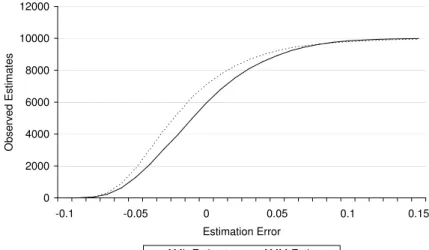
Figure 1 shows the distribution function of the estimation errors for the AML and the MM estimator, given an asset correlation of 10%. It reveals that the downward bias is stronger with the MM estimator. Furthermore, the distribution of this estimator is much less symmetric and positively skewed. The last finding indicates that erroneously high correlation estimates occur more often with the MM rather than the AML method. The superior performance of the AML estimator, in particular its lower downward bias, is plausible as it makes better use of the model structure.
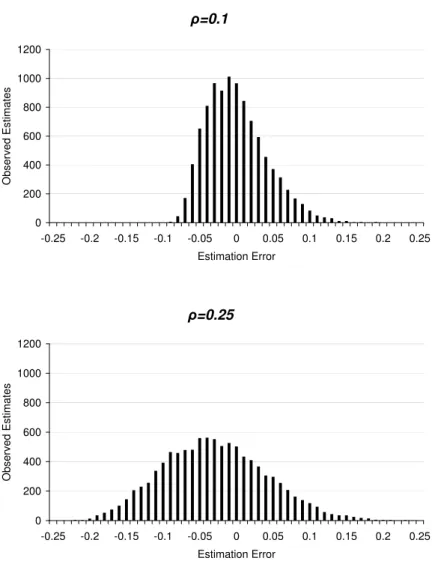
In order to measure the impact of the level of the true correlation parameter, Figure 2 shows the sample density distribution of the estimation error of the AML estimator, given asset correlations of 10% and 25%. Both density distributions clearly show that the bias strongly depends on the value of the correlation parameter. For the higher correlation of 25%, the mean bias is stronger and estimates are much more scattered than for a correlation of 10%. These results signal a strong dependence of the estimation performance on the true asset correlation.
Table 3 describes the performance of both estimators, given an asset correlation of 25%. Compared with the results in Table 2 for a correlation of 10%, the downward bias strongly
Table 2
Bias and RMSE of the AML and MM Estimator With a True Asset Correlation of 10%
This table shows the bias and RMSE of asset correlation estimates for the Asymptotic Maximum Likelihood (AML) method and the Method of Moments (MM), separately for three default probabilities (PD) and four sample lengths
Y of yearly default rates.
P D= 0.5% P D= 1.2% P D= 2.03% AML MM AML MM AML MM
Bias Y = 5 -.0137 -.0290 -.0167 -.0246 -.0191 -.0214 Y = 10 -.0005 -.0179 -.0047 -.0144 -.0077 -.0126 Y = 20 .0048 -.0103 .0003 -.0081 -.0016 -.0064 Y = 40 .0072 -.0055 .0034 -.0037 -.0011 -.0029 RMSE Y = 5 .0554 .0512 .0566 .0533 .0554 .0548 Y = 10 .0414 .0439 .0417 .0450 .0407 .0452 Y = 20 .03 .0374 .0301 .037 .0295 .0364 Y = 40 .0224 .0309 .0221 .0291 .0215 .0281
Figure 1. Distribution of the Estimation Errors of the AML and the MM Method
This figure shows the interpolated distribution function of errors in asset correlation estimates, both for the Asymptotic Maximum Likelihood (AML) method and the Method of Moments (MM). The DGP is characterized by an asset correlation of 0.1, a time series of 10 yearly default rates, 5,000 homoge-nous borrowers and a PD of 1.2%.
0 2000 4000 6000 8000 10000 12000 -0.1 -0.05 0 0.05 0.1 0.15 Estimation Error O b se rve d Est ima te s AML-Estimator AMM-Estimator
Figure 2. Histogram of Estimation Errors if the AML Method is Applied to Default Rates, Given Asset Correlations of 0.1 and 0.25
This figure shows histograms of errors in asset correlation estimates for the Asymptotic Maximum Likelihood (AML) method, given asset correlations in the DGP of 0.1 in the first panel and 0.25 in the second panel. The DGP is characterized by a time series of 10 yearly default rates, 5,000 homogenous borrowers and a PD of 1.2%. =0.1 0 200 400 600 800 1000 1200 -0.25 -0.2 -0.15 -0.1 -0.05 0 0.05 0.1 0.15 0.2 0.25 Estimation Error O b se rve d Est ima te s =0.25 0 200 400 600 800 1000 1200 -0.25 -0.2 -0.15 -0.1 -0.05 0 0.05 0.1 0.15 0.2 0.25 Estimation Error O b se rve d Est ima te s
Table 3
Bias and RMSE of the AML- and MM-Estimator With a True Asset Correlation of 25%
This table shows the bias and RMSE of asset correlation estimates for the Asymptotic Maximum Likelihood (AML) method and the Method of Moments (MM), separately for three default probabilities (PD) and four sample lengths
Y of yearly default rates.
P D= 0.5% P D= 1.2% P D= 2.03% AML MM AML MM AML MM Bias Y = 5 -.0891 -.1287 -.0623 -.1089 -.0528 -.0937 Y = 10 -.0683 -.0964 -.0345 -.0751 -.0276 -.0645 Y = 20 -.0564 -.0682 -.0228 -.0498 -.0142 -.0402 Y = 40 -.0504 -.0435 -.0168 -.0316 -.0067 -.0225 RMSE Y = 5 .1236 .1464 .1147 .1373 .1150 .1333 Y = 10 .0929 .1220 .0790 .1139 .0807 .1119 Y = 20 .0729 .1013 .0552 .0951 .0564 .0932 Y = 40 .0605 .0856 .0399 .0796 .0394 .0748
increases. Even for the longest sample length of 40 years the bias rises to 5 percentage points, also depending on the estimation method. Contrary to the findings for an asset correlation of 10% in Table 2, the bias is always negative. For the shortest time series of 5 years it can increase to 13 percentage points or around 50% of the true asset correlation. Again, the bias also depends on the estimation method, with the AML method coming out as superior in all parameter constellations.
The results for the bias also hold qualitatively if the RMSE is considered as performance indicator. The higher correlation increases the number of defaults, which could raise the expectation that the performance improves over Table 2. However, this is not the case as, for example for 5 years, the RMSE is still roughly 50% of the true correlation value.
Summarizing, we find that estimates from default rates are typically downward biased. This negative bias increases with shorter sample lengths, high correlations, lower PDs, and is higher for the MM-estimator than if the AML-estimator is applied. The level of the true correlation parameter also has a strong impact on the estimation performance. Increasing the asset correlation from 10% to 25% reveals not only a stronger downward
Table 4
Bias and RMSE of Asset Correlation Estimates as Pairwise Stock Price Correlations and Based on the Random Effects Model
This table shows the bias and RMSE of asset correlation estimates from stock returns. They are estimated by pairwise sample correlations (PW) and a random effects model (RE) based on six DGPs with three default probabilities (PD) and two asset correlation valuesρ. The generated samples consist of two years of weakly stock returns of 50 firms.
N = 50 P D= 0.005 P D= 0.012 P D= 0.0203 T = 2y PW RE PW RE PW RE ρ= 0.1 Bias -.0024 -.0094 -.0028 -.0106 -.0031 -.0113 RMSE .0150 .0171 .0149 .0175 .0150 .0180 ρ= 0.25 Bias -.0059 -.0201 -.0059 -.0218 -.0065 -.0236 RMSE .0283 .0338 .0285 .0349 .0282 .0356
bias, but also that the estimates are more dispersed. This finding confirms the need to consider not only the bias but also the RMSE when evaluating the small sample properties of the estimators.
4.3. Performance Results of Estimators Based on Stock Prices
As described in Section 3, we employ a direct and an indirect estimation method to infer asset correlations from market prices. The direct method uses equity returns whereas the indirect method requires first inferred asset returns from which asset correlations are estimated in a second step.
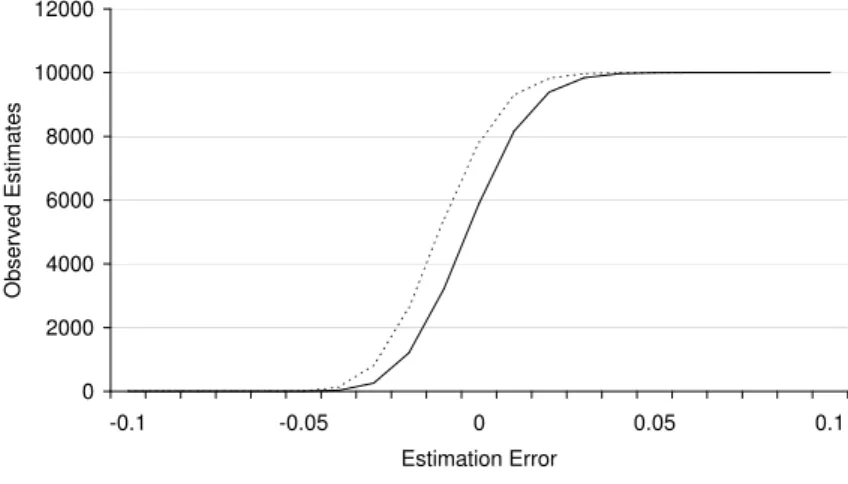
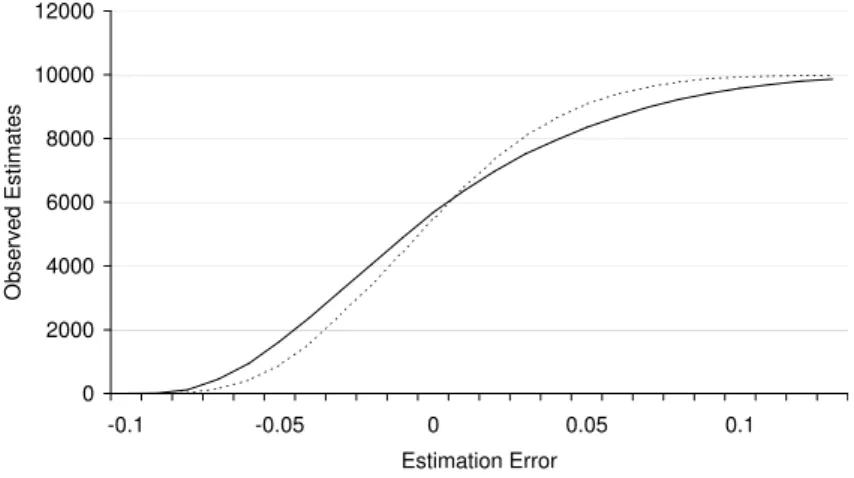
The two performance measures for the direct method, bias and RMSE, are shown in Table 4. We consider again three PDs and two asset correlation values. Furthermore, asset correlations are estimated based on a sample of equity returns both by the mean of pairwise sample correlations and in the framework of a random effects model. Comparing these two methods first, we find that the sample correlations are less biased and have a lower RMSE for all three PDs and for both asset correlation values. This observation is confirmed by Figure 3 which presents the cumulative distribution of estimation errors.
Although the mean sample correlation of equity returns is still downward biased, bias and RMSE are by far smaller than in the case of using default rates for the estimation
Figure 3. Distribution of Estimation Errors Based on Stock Prices
This figure shows the interpolated distribution function of errors in asset cor-relation estimates, both for pairwise sample corcor-relations and a random effects model. The DGP is characterized by an asset correlation of 0.1, a time series of 2 years of weekly stock returns of 50 firms and a PD of 1.2%.
0 2000 4000 6000 8000 10000 12000 -0.1 -0.05 0 0.05 0.1 Estimation Error O b se rve d Est ima te s
Table 5
Bias and RMSE of the Asset Correlation Estimates Based on Asset Returns
This table shows the bias and RMSE of asset correlation estimates from asset returns. They are estimated by pairwise sample correlations (PW) and a random effects model (RE) based on six DGPs with three default probabilities (PD) and two asset correlation values ρ. The generated samples consist of 2 years of weakly stock returns of 50 firms.
N = 50 P D= 0.005 P D= 0.012 P D= 0.0203 T = 2y PW RE PW RE PW RE ρ= 0.1 Bias -.0013 -.0005 -.0015 -.0006 -.0016 -.0007 RMSE .0148 .0149 .0148 .0148 .0149 .0149 ρ= 0.25 Bias -.0030 -.0011 -.0037 -.0017 -.0031 -.0010 RMSE .0277 .0278 .0278 .0279 .0278 .0279
of asset correlations. Consider, for example, the case of an asset correlation of 25% and a PD of 0.5%. According to Table 3, even with the longest sample length of 40 yearly default rates, the RMSE of the AML estimator is still 0.06% or double the RMSE of the correlation estimates based on equity returns in Table 4. The superior performance of the estimation from market prices also depends on the parameters of the DGP. It becomes ceteris paribus more pronounced with higher PDs and higher asset correlations.
Whereas Table 4 presents the estimators’ performance for the direct method, Table 5 gives the corresponding performance indicators for the indirect estimation method, based on inferred asset returns. Comparing first the results of the sample correlation estimates with those of the random effects model, we find that the latter method is superior in terms of bias but that both methods are nearly indistinguishable in terms of RMSE. Given the small absolute values of the downward bias for both methods, the difference in the bias is immaterial.
The similar performance of both indirect estimation methods based on asset returns con-trasts with the results for the asset correlation estimation from equity returns, given in Table 5, where the sample correlations emerged as the superior estimation method.
Considering that the indirect method of using inferred asset returns instead of equity returns is the theoretically better founded method, its superior performance is plausible. The random effects model applied to the asset returns exploits the model structure of the DGP better than the other methods. Therefore, it should be expected to be at least as
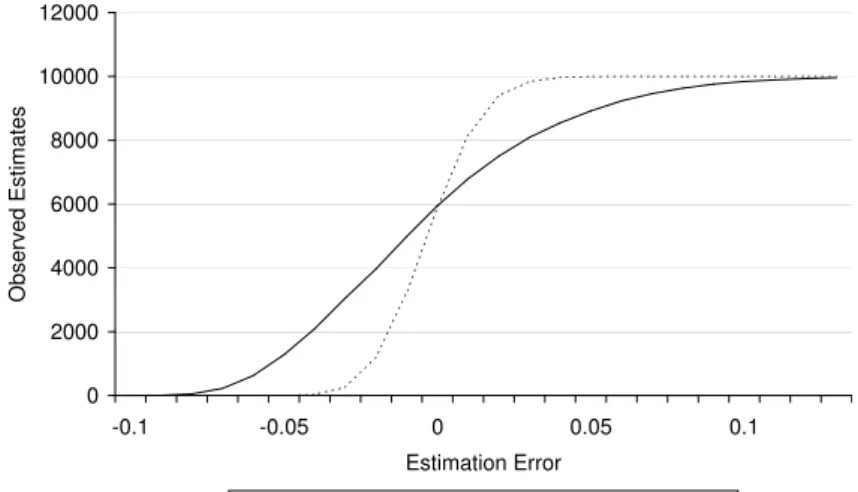
Figure 4. Distribution of Estimation Errors Based on Default Rates and From Asset Returns
This figure shows the interpolated distribution function of errors in asset corre-lation estimates, for the pairwise sample correcorre-lations and the AML estimator. The DGP is characterized by an asset correlation of 0.1, a time series of 10 years of default rates (2 years of weekly stock returns) for 5,000 firms (50 firms) and a PD of 1.2%. 0 2000 4000 6000 8000 10000 12000 -0.1 -0.05 0 0.05 0.1 Estimation Error O b se rve d Est ima te s
good as the other methods. If equity returns are used instead of asset returns the input data to the estimation are already misspecified. As a consequence, estimators are more robust against model errors if they pose less assumptions about the underlying model as, for example, in this case the mean sample correlation.
Finally, Figure 4 compares the distribution of estimation errors of the AML method based on default rates with the estimation based on the sample correlation of asset returns. It shows the substantially higher downward bias and also the fatter tails of the estimation errors, produced by the AML method.
Summarizing, we find that both, the direct estimation from equity returns and the indirect estimation from asset returns are superior to an estimation of asset correlations from default rates, both in terms of the bias and the RMSE. This holds even if a relatively short sample of two years of weekly equity returns is compared with a sample comprising 40 years of yearly default rate observations. Comparing the direct and the indirect estimation method we find that the indirect estimation is superior. The out-performance depends also on the estimation method and the true parameters of the DGP. With increasing PDs and higher asset correlations, the out-performance of the direct estimation method becomes more visible. Nevertheless, the differences in estimation accuracy between the sample correlation estimates based on equity returns and the estimates of the RE model based on asset returns may still be negligible in practice. In other words, the more simpler method of a direct estimation from equity returns can produce quite reasonable estimates.
These results hold in the absence of a model error, i. e. if the estimation is based on data generated from the model of the DGP. In the following section we explore, how robust they are against a model error, more specifically if asset correlations are no longer constant over time but follow an Ornstein-Uhlenbeck process.
4.4. Estimation Performance Under Stochastic Correlations
There is substantial evidence in the literature that asset correlations fluctuate over time.18 If correlations follow a mean-reverting process with a sufficiently short half-life, the ran-domness may have a stronger effect on correlation estimates from stock prices as they rely on a much higher data frequency compared with correlation estimates from default rates. If this hypothesis proves to be true, the result from the previous section that correlation estimation from default rates is strictly preferable may no longer hold.
It can be argued that accounting only for the model error of a mean-reverting process
of the asset correlations unduly benefits the estimation from default rates relative to the estimation from market prices. Since the required time series of default rates are typically long, estimation from default rates is arguably much more susceptible to structural brakes, introduced for example by changes in the legal framework, which are not considered. Given that the estimation from market prices has emerged as clearly superior in the case of a correctly specified model, it seems, however, justified to focus on a model error that affects mainly the already superior estimation method. In this case the results can be considered also as a robustness check for the superiority of the estimation from market prices.
The “robustness check” of stochastic asset correlations requires specifying the mean rever-sion parameterκ and the volatility σρ in equation (8) in Subsection 2.3. The parameters
of the stochastic asset correlation process are set toρ∈ {0.1,0.25},κ= 1 andσρ= 0.085.
The values of the mean ρ are given by the constant asset correlations used before. The parameters κ and σρ are set such that the asymptotic 90% confidence interval of the
stochastic correlation is given by ρ±10%.19 The value of one for κ corresponds with a half-life time of 0.7 years.20
Table 6 presents the correlation estimates, based on default rates, employing the AML and the MM method. Since the asset correlation is stochastic, we assume an average correlation of 10% for the DGP to facilitate a comparison with results in the previous section for a constant asset correlation. For five and 10 years the results are ambiguous but for 20 and 40 years the bias is higher in the case of stochastic correlations. The RMSE is always higher in this case but the difference is below one percentage point. The sensitivity of the estimation performance to PD and to the number of years is similar to the previous results in Table 2. The better performance if asset correlations are estimated from equity returns instead of from default rates is confirmed by Figure 5 for the case of stochastic correlations.
Table 7 corresponds with Table 6 but with an average asset correlation of 25% instead of 10% in the DGP. Although both bias and RMSE increase, the sensitivity to PD, the length of the time series and the estimation method (MM or AML) is similar.
Summarizing, introducing mean-reverting asset correlations increases the RMSE if the estimation is based on default rates but not substantially. This result supports the hy-pothesis that a mean-reverting asset correlation has only a minor impact on the estimation performance.
19The confidence level is obtained from the asymptotic distribution ofρ
t fort→ ∞which is given by N ρ,σ 2 ρ 2κ . 20
The half-life time is given by the formula−ln(0.5) κ .
Table 6
Bias and RMSE of the AML and MM Estimator With a Mean Asset Correlation of 10% and a Stochastic Asset Correlation Process
This table shows the bias and RMSE of asset correlation estimates for the Asymptotic Maximum Likelihood (AML) method and the Method of Moments (MM), separately for three default probabilities (PD) and four sample lengths
Y of yearly default rate observations. The asset correlations of the DGP follow an Ornstein-Uhlenbeck process with mean 0.1.
P D= 0.5% P D= 1.2% P D= 2.03% AML MM AML MM AML MM
Bias Y = 5 -.0128 -.0312 -.0145 -.0269 -.0161 -.0226 Y = 10 -.0005 -.0205 -.0005 -.0156 -.0036 -.0129 Y = 20 .0057 -.0123 .0016 -.0080 .0041 -.0053 Y = 40 .0095 -.0052 -.0021 -.0020 .0075 -.0009 RMSE Y = 5 .0600 .0551 .0644 .0579 .0649 .0615 Y = 10 .0454 .0497 .0504 .0524 .0502 .0547 Y = 20 .0340 .0445 .0379 .0462 .0382 .0470 Y = 40 .0260 .0388 .0288 .0400 .0287 .0380
Figure 5. Distribution of Estimation Errors for Stochastic Asset Correlations Estimated From Default Rates and by Equity Return Correlations
This figure shows the interpolated distribution function of errors in asset cor-relations which were estimated from default rates with the Asymptotic Max-imum Likelihood (AML) method and from stock returns by pairwise sample correlations. The DGP is characterized by an asset correlation of 0.1, a time series of 10 years of default rates (2 years of weekly stock returns) for 5,000 firms (50 firms) and a PD of 1.2%.
0 2000 4000 6000 8000 10000 12000 -0.1 -0.05 0 0.05 0.1 Estimation Error O b se rve d Est ima te s
Table 7
Bias and RMSE of the AML and MM Estimator With a Mean Asset Correlation of 25% Given a Stochastic Asset Correlation Process
This table shows the bias and RMSE of asset correlation estimates for the Asymptotic Maximum Likelihood (AML) method and the Method of Moments (MM), separately for three default probabilities (PD) and four sample lengths
Y of yearly default rate observations. The asset correlations of the DGP follow an Ornstein-Uhlenbeck process with mean 0.25.
P D= 0.005 P D= 0.012 P D= 0.0203 AML MM AML MM AML MM
Bias Y = 5 -.0895 -.1293 -.0612 -.1093 -.0545 -.0970 Y = 10 -.0674 -.0962 -.0353 -.0767 -.0265 -.0603 Y = 20 -.0560 -.0672 -.0219 -.0495 -.0120 -.0403 Y = 40 -.0514 -.0454 -.0157 -.0305 -.0052 -0.0225 RMSE Y = 5 .1248 .1477 .1155 .1388 .1177 .1351 Y = 10 .0931 .1235 .0804 .1178 .0831 .1151 Y = 20 .0728 .1042 .0562 .0998 .0579 .0963 Y = 40 .0612 .0888 .0402 .0839 .0411 .0808
Table 8
Bias and RMSE of Estimates From Pairwise Stock Prices Given a Stochastic Asset Correlation Process
This table shows the bias and RMSE of asset correlation estimates from stock returns. They are estimated by pairwise sample correlations (PW) based on six DGPs with three default probabilities (PD) and two asset correlation values
ρwhich follow Ornstein-Uhlenbeck processes with mean 0.1 and 0.25.
N= 50 P D= 0.005 P D= 0.012 P D= 0.0203 T = 2y PW PW PW ρ= 0.1 Bias -.0016 -.0014 -.0020 RMSE .0371 .0370 .0370 ρ= 0.25 Bias -.0046 -.0060 -.0066 RMSE .0465 .0455 .0463
Table 8 shows bias and RMSE if pairwise asset correlations are estimated from stock returns. Although the indirect estimation based on asset returns instead of stock returns is better founded in theory, the results from the previous section indicate that the differences between both cases are minor. Given the substantially lower computational burden, we apply only the direct method that uses stock prices as input. We do not present the results for the random effects model with stock price data as this model already proved to be inferior when applied to stock returns in the case of a constant correlation.
The numbers in Table 8 show a clear deterioration in the estimation performance, measured by RMSE, compared with Table 4. For an asset correlation of 0.25, a sample length of 20 years and a PD of 1.2%, the RMSE increases, for example, from 0.0285 to 0.0455. The bias instead stays nearly unaffected.
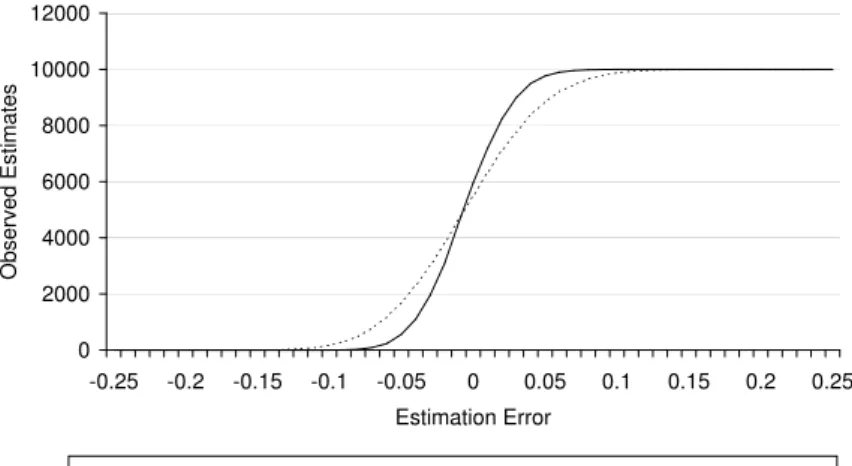
Figure 6 compares the estimation errors if the asset correlation is estimated by pairwise equity return correlations both without and with stochastic correlation. It confirms the finding of a higher dispersion of errors if the asset correlation follows a stochastic process.
Summarizing, the observed stronger increase in the RMSE for the estimation from market prices compared with the estimation from default rates confirms our expectation. Our results indicate that choosing between the use of market prices or default rates as data basis of the correlation estimation requires taking into account a trade-off: The closer the Merton model describes real world processes, the better estimates based on market prices perform. If the model is instead misspecified, for example as it is agnostic to the
Figure 6. Distribution of Estimation Errors Both Without and With Stochastic Correlations.
This figure shows the interpolated distribution function of errors in asset cor-relations which were estimated from stock returns by pairwise sample correla-tions. The DGP is characterized by an asset correlation of 0.25, a time series of 10 years for 5,000 firms and a PD of 1.2%.
0 2000 4000 6000 8000 10000 12000 -0.25 -0.2 -0.15 -0.1 -0.05 0 0.05 0.1 0.15 0.2 0.25 Estimation Error O b se rve d Est ima te s
Mean Pair Wise Correlation Mean Pair Wise Correlation stoch corr
stochastic character of asset correlations, the superiority over an estimation from default rates diminishes but it does not disappear in the studied case. The reason for the smaller difference in estimation accuracy between both estimation methods is that the estimation from default rates requires less assumptions on model structure which renders it more robust against model misspecifications.
5. Summary and Conclusions
Linear factor models, based on the classic Merton (1974) model, have become a corner-stone of credit risk modelling in the literature as well as in industry practice. In this model framework, default dependencies are typically captured by asset correlations. These key parameters of a model are usually estimated either from time series of stock prices or default rates. In this paper we explore to which extent differences in small sample prop-erties of the respective estimators are responsible for the substantial diversity in empirical estimates of asset correlations. For this purpose, we carry out a comprehensive simulation study in which the time series of default rates and stock prices of realistic length are
gen-erated from the same model, i. e. the same DGP. Furthermore, we introduce a model error in the form of stochastic, mean-reverting asset correlations. We compare the performance of the estimators from default rates with those from stock prices, using the bias and the RMSE as benchmarks. Our main findings are:
• Estimates from default rates are typically downward biased. This negative bias increases with shorter sample lengths, high correlations, lower PDs, and if the MM estimator is used instead of the AML-estimator.
• The level of the true correlation parameter has a strong impact on the estimation performance. Increasing the asset correlation from 10% to 25% increases not only the downward bias, but also produces more scattered estimates, particularly in the tails.
• Both, the direct estimation of asset correlations from equity returns and the indirect estimation from asset returns are superior to an estimation from default rates, both in terms of bias and RMSE. This holds even if a relatively short sample of two years of weekly equity returns is compared with a sample comprising 40 years of yearly default rate observations.
• Comparing the direct and the indirect estimation method we find that the indirect estimation based on inferred asset returns is superior. The better performance de-pends also on the true parameters of the DGP. With increasing PDs and higher asset correlations, the out–performance of the direct estimation method becomes more visible.
• If the constant asset correlation is replaced in the DGP by an Ornstein-Uhlenbeck process, the superiority of an estimation from equity prices instead of default rates diminishes but it does not disappear in the studied case.
These findings have implications for the interpretation of empirical studies of asset corre-lations and for future risk modelling:
1. Our results indicate that different small sample properties may have contributed to a large extent to the differences in correlation estimates which emerged in previous empirical studies but they cannot fully explain them.
2. If time series of market prices of equity and default rates are available, it is generally recommendable to estimate asset correlations from market prices. The differences in accuracy between the two market-price based estimation methods, i.e. the sample correlation based on equity returns and the RE model based on asset returns, may still be negligible in practice. In other words, the more simpler of the two methods of a direct estimation from equity returns already produces quite reasonable estimates.
3. We have observed relatively high RMSEs even in a clinical study in which the model is correctly specified which is unlikely in practical applications. This finding strongly advocates that care must be taken if correlation estimates are applied in credit risk modelling. The simulation setup used in this paper presents a way to quantify the estimation error.
Introducing a model error through stochastic, mean-reverting correlations is certainly only one of many plausible alternatives. Other causes of model errors which are also plausible given results from other empirical work, are, for example, a t-distribution of asset returns following Mashal et al. (2003) or a cross-sectional diversity of asset correlations, inspired by D¨ullmann et al. (2007). A more comprehensive analysis of the effect of various model errors is left for further work.
References
Ang, A. and Chen, J. (2002), ‘Asymmetric correlations of equity returns’, Journal of Financial Economics63, 443–494.
Bakshi, G., Cao, C. and Chen, Z. (1997), ‘Empirical performance of alternative option pricing models’,Journal of Finance 52(5), 2003–49.
Basel Committee on Banking Supervision (2005), International Convergence of Capital Measurement and Capital Standards, A Revised Framework. http://www.bis.org/ publ/bcbsca.htm.
Black, F. and Scholes, M. (1973), ‘The pricing of options and corporate liabilities’,Journal of Political Economy81, 637–654.
Bohn, J. and Crosbie, P. (2003), Modeling default risk. KMV Corporation.
Bollerslev, T., Engle, R. and J.M., W. (1988), ‘A capital asset pricing model with time varying covariances.’,Journal of Political Economy96, 116–131.
De Servigny, A. and Renault, O. (2002), Default correlation: Empirical evidence. Working Paper, Standard&Poor’s.
Dietsch, M. and Petey, J. (2004), ‘Should SME exposures be treated as retail or corporate exposures? A comparative analysis of probabilities of default and asset correlations in French and German SMEs’,Journal of Banking and Finance28, 773–788.
Duan, J.-C., Gauthier, G. and Simonato, J.-G. (2004), On the equivalence of the KMV and Maximum Likelihood methods for structural credit risk models. http://www.rotman.
utoronto.ca/~jcduan/mainfram.html.
Duan, J.-C., Gauthier, G., Simonato, J.-G. and Zaanoun, S. (2003), Estimating Merton’s model by Maximum Likelihood with survivorship consideration. http://www.rotman.
utoronto.ca/~jcduan/mainfram.html.
Duellmann, K. and Scheule, H. (2003), Determinants of the asset correlations of German corporations and implications for regulatory capital. Unpublished Working Paper.
D¨ullmann, K., Scheicher, M. and Schmieder, C. (2007), Asset correlations and credit portfolio risk – an empirical analysis. Deutsche Bundesbank Discussion Paper, Series 2, No. 13.
D¨ullmann, K. and Trapp, M. (2004), Systematic risk in recovery rates–an empirical analy-sis of US corporate credit exposures. Deutsche Bundesbank Discussion Paper, Series 2, No. 2.
Eom, Y., Helwege, J. and Huang, J. Z. (2003), ‘Structural models of corporate bond pricing: An empirical analysis’,Review of Financial Studies17(2), 499–544.
Gordy, M. (2000), ‘A comparative anatomy of credit risk models’, Journal of Banking and Finance24, 119–149.
Gordy, M. (2001), A risk-factor model foundation for ratings-based bank capital rules. Working Paper, Board of Governors of the Federal Reserve System.
Gordy, M. and Heitfield, E. (2000), Estimating factor loadings when ratings performance data are scarce. Memorandum, Board of Governors of the Federal Reserve System. Grundke, P. (2007), Regulatory treatment of the double default effect under the New Basel
Accord: How conservative is it? Unpublished Working Paper. Hsiao, C. (2003), Analysis of Panal Data, Cambridge, Cambridge.
Jones, E. P., Mason, S. and Rosenfeld, E. (1984), ‘Contingent claims analysis of corporate capital structures: An empirical investigation’,Journal of Finance50, 53–86.
Kloeden, P. E. and Platen, E. (1992),Numerical Solution of Stochastic Differential Equa-tions, Stochastic Modelling and Applied Probability, Springer-Verlag, New York. Longin, F. and Solnik, B. (1995), ‘Is the correlation in international equity returns
con-stant: 1960-1990?’, Journal of International Money and Finance14, 3–26.
Lopez, J. A. (2002), The empirical relationship between average asset correlation, firm probability of default and asset size. Working Paper, BIS Workshop: ”Basel II: An Economic Assessment”.
Lucas, D. J. (1995), ‘Default correlation and credit analysis’, Journal of Fixed Income 4(4), 76–87.
Mashal, R., Naldi, M. and Zeevi, A. (2003), ‘On the dependence of equity and asset returns’,Risk Magazine16(10), 83–87.
Merton, R. (1974), ‘On the pricing of corporate debt: The risk structure of interest rates’, Journal of Finance34, 449–470.
Pitts, A. (2004), ‘Correlated defaults: let’s go back to the data’,Risk Magazine17(6), 75– 79.
Roesch, D. (2003), ‘Correlations and business cycles of credit risk: Evidence from bankruptcies in Germany’,Financial Markets and Portfolio Management17, 309–331. Zeng, B. and Zhang, J. (2001), An empirical assessment of asset correlation models. KMV