FAST FLUX BOTNET DETECTION BASED ON
ADAPTIVE DYNAMIC EVOLVING SPIKING NEURAL
NETWORK
Ahmad Al Nawasrah
Thesis Submitted in Partial Fulfilment of the Requirements of the Degree of
Doctor of Philosophy
School of Computing, Science and Engineering
University of Salford, Salford, UK
2018
Supervisor:
i
TABLE OF CONTENTS
TABLE OF CONTENTS ...I LIST OF TABLES ... III LIST OF FIGURES ... V DECLARATION ...VIII ABBREVIATIONS ... IX LIST OF PUBLICATIONS ... XII ABSTRACT ...XIII KEYWORDS ...XIII CHAPTER ONE ... 1 INTRODUCTION ... 1 1.1 Introduction ... 1 1.2 Research Problem ... 4 1.3 Research Motivation: ... 6
1.4 Research Aim and Objectives ... 6
1.5 Research Methodology ... 7
1.6 Contributions of the Research ... 10
1.7 The Scope of the Research ... 10
1.8 Thesis Structure ... 10
CHAPTER 2 ... 13
BACKGROUND LITERATURE REVIEW AND RELATED WORK ... 13
2.1 Background ... 13
2.1.1 Single Fast Flux ... 15
2.1.2 Double Fast Flux ... 17
2.1.3 Hydra Fast Flux ... 20
2.1.4 Domain Flux ... 20
2.2 Literature Review ... 21
2.2.1 Host-based Detection Methods ... 24
2.2.2 Router-based Detection Methods ... 44
2.2.3 DNS-based Detection Methods ... 46
2.2.4 Hydra Flux Service Network ... 53
2.2.6 Dynamic evolving Spiking Neural Network (DeSNN) ... 53
2.3 Related Work ... 55
2.4 Conclusion ... 60
CHAPTER THREE ... 62
ADAPTIVE DYNAMIC EVOLVING SPIKING NEURAL NETWORK – ADESNN.... 62
3.1 Introduction ... 62
3.2 Adaptive Dynamic Evolving Spiking Neural Network ... 62
3.3 Dataset ... 69
3.4 Experiments, Result, and Comparison ... 70
3.5 Chapter Summary: ... 78
CHAPTER FOUR ... 80
SUPERVISED FAST FLUX KILLER APPROACH FFKA ... 80
ii
4.2 Fast Flux Killer Approach ... 80
4.3 Supervised Learning Phase ... 82
4.3.1 The Preprocessing Stage ... 82
4.3.2 Feature Extraction ... 83
4.3.3 Adaptive dynamic evolving spiking neural network ... 83
4.4 Dataset ... 84
4.5 Feature Selection ... 84
4.6 Feature Set ... 85
4.7 Experiments and Discussion ... 86
4.7.1 Introduction ... 86
4.7.2 Supervised Fast Flux Killer Approach Experiment ... 87
4.7.3 Feature Set Discussion ... 93
4.8 Conclusion ... 97
CHAPTER FIVE ... 99
HYBRID FAST FLUX KILLER APPROACH ... 99
5.1 Introduction ... 99
5.2 The Hybrid Fast Flux Killer Approach (Supervised and unsupervised) ... 100
5.2.1 Introduction ... 100
5.2.2 The FFKA Supervised Phase ... 100
5.2.3 The FFKA Unsupervised Phase ... 100
5.3 Dataset ... 103
5.4 Feature Set ... 103
5.5 Experiment and Discussion ... 103
5.5.1 The Results of the Hybrid FFKA ... 104
5.5.2 Comparison of Supervised and Hybrid approach ... 106
5.5.3 Parameter Adjustment and Customization ... 109
5.6 chapter summary ... 110
CHAPTER SIX ... 112
DISCUSSION, CONCLUSION AND RECOMMENDATION FOR FUTURE WORK ... 112
6.1 Discussion ... 112
6.2 Limitations and Future Work ... 116
6.3 Conclusion ... 117
REFERENCES ... 119
iii
LIST OF TABLES
Table 2. 1 Summary of passive approaches ... 25
Table 2. 2 Summary of score-based approaches. ... 28
Table 2. 3 Summary of machine learning approaches. ... 32
Table 2. 4 Summary of the approaches using decision tree algorithms. ... 34
Table 2. 5 Summary of approaches using geo-information. ... 36
Table 2. 6 Summary of spatial informational real-time approaches. ... 38
Table 2. 7 Summary of behavior-based approaches. ... 40
Table 2. 8 Summary of real-time learning approaches. ... 42
Table 2. 9 Summary of router-based approaches. ... 45
Table 2. 10 Summary of passive DNS-based detection approaches. ... 49
Table 2. 11 Summary of active approaches. ... 50
Table 2. 12 Summary of real-time approaches. ... 52
Table 2. 13 List of the features used in previous works ... 57
Table 3. 1 Characteristics of the WDBC dataset. ... 70
Table 3. 2 Accuracy measure used in all experiments ... 71
Table 3. 3 The 3-fold cross-validation result of both the original DeSNN and the proposed ADeSNN of the first experiment ... 73
Table 3. 4 The parameter values used in the 3-cross-validations of the first experiment ... 75
Table 3. 5 The 5-fold cross-validation result of both the original DeSNN and the proposed ADeSNN of the second experiment ... 76
Table 3. 6 The parameter values used in the second experiment ... 78
Table 4. 1 The proposed feature set ... 85
Table 4. 2 The accuracy measures of the detection algorithms ... 88
iv
Table 4. 4 The results of the three experiments by eliminating one new feature at a time. ... 94
Table 4. 5 The features set ranking importance ... 96
Table 5. 1 Results of the hybrid FFKA ... 104
Table 5. 2 Parameters used in the hybrid experiment ... 106
Table 5. 3 The comparison results of supervised and hybrid FFKA approach ... 107
v
LIST OF FIGURES
Figure 1. 1 The Research Methodology ... 8
Figure 2. 1 Comparison of IP resolutions of fast flux techniques ... 15
Figure 2. 2 Single fast flux of IP addresses of a malicious website ... 16
Figure 2. 3 Double FFSN of name server and IP addresses of the malicious website ... 18
Figure 2. 4 Multilayer FFSN of the Asprox botnet and hydra-flux service network ... 20
Figure 2. 5 Solution scope of FF botnet detection methods ... 22
Figure 2. 6 Chart of the solutions scope ... 23
Figure 2. 7 ADAPT system architecture(Otgonbold, 2014) ... 28
Figure 2. 8 FLUXOR system deployment(Passerini et al., 2008) ... 31
Figure 2. 9 The process of visiting a domain(Y. Zhao & Jin, 2015) ... 34
Figure 2. 10 Alternative decision tree detection approach(Qassrawi & Zhang, 2012) ... 41
Figure 2. 11 GRADE system architecture(H.-T. Lin et al., 2013) ... 42
Figure 2. 12 System architecture of the clustering detection method (Paul et al., 2014) ... 45
Figure 2. 13 Analysis procedure of an anomaly-based technique using a decision tree with AdaBoost algorithm (Vu Hong, 2012) ... 48
Figure 2. 14 LarSID architecture (Zhou et al., 2009) ... 51
Figure 2. 15 Hybrid detection system(Futai et al., 2013) ... 52
Figure 3. 1 An evolving spiking neural network (classification) (Kasabov et al., 2013) ... 63
vi
Figure 3. 3 The DeSNN algorithm architecture ... 68
Figure 3. 4 The accuracy measures of both DeSNN and ADeSNN ... 74
Figure 3. 5 The accuracy measures of both DeSNN and ADeSNN ... 77
Figure 4. 1 The architecture of the FFKA ... 81
Figure 4. 2 The pre-processing phase ... 82
Figure 4. 3 The overall detection accuracy ... 90
Figure 4. 4 The area under ROC curve ... 91
Figure 4. 5 The F measure score ... 91
Figure 4. 6 The root mean square error ... 92
Figure 4. 7 The accuracy comparison between the feature set experiments ... 94
Figure 4. 8 The RMSE of the feature set experiment ... 95
Figure 4. 9 Feature set ranking based on the feature selection method ... 96
Figure 5. 1 The Hybrid FFKA ... 102
Figure 5. 2 The results of the hybrid FFKA ... 105
Figure 5. 3 Comparison of the supervised and hybrid FFKA approaches ... 108
vii
ACKNOWLEDGMENT
First and foremost, I would like to express deep gratitude to my supervisors Prof. Farid Meziane and Dr.Ammar Almomani for their helpful contributions, encouragement, and guidance through my period of study.
Also, I would like to thank my brother Noun Alnawasreh for his support in every part of my life.
Finally, I wish to thank my parents, my wife Oroba, my siblings, and my dearest children Mera, Ameer, and Layan for their support.
viii
DECLARATION
No portion of the work referred to in this thesis has been submitted in support of an application for another degree or qualification of this or any other university, or institute of learning.
ix
ABBREVIATIONS
A The resolved record information returned from DNS ANN Artificial Neural Network
Auth_NS Authoritative Name Server AOR Average Online Rate
C2 Command and Control
CDN Content distributed network DDoS Distributed Denial-of-Service
DENFIS Dynamic Evolving Neural Fuzzy Inference System DeSNN Dynamic evolving Spiking Neural Network
DNS Domain name system/domain name server DoS Denial-of-Service
DyNFIS Dynamic Neural Fuzzy Inference System ECoS Evolving Connectionist System
eSNN evolving Spiking Neural Network
FF Fast Flux
FFDD Fast Flux Domain Detector FFN Fast Flux Network
FFM Fast Flux Monitor
x
FN False Negative
FP False Positive
FQDN Fully Qualified Domain Name
GRADE Genetic ReAl-time approach for FFSN DEtection HTTP Hypertext Transport Protocol
ICCAN Internet Corporation for Assigned Names and Numbers IP Internet Protocol
KFFS Killer Fast Flux System
LSGD Localized Spatial Geo-location Detection MAR Minimum Availability Rate
NS Name Server
RDNS Recursive Domain Name Server
RR Resource Record
RRDNS Round Robin DNS SLD Second Level Domain SNN Spiking Neural Network
SSFD Spatial Snapshot Fast flux Detection SVM Super Vector Machine
xi TLD Top Level Domain
TN True Negative
TP True Positive
xii
LIST OF PUBLICATIONS
A. ALnawasrah, A. Almomani, F. Meziane, M. Alauthman. Fast Flux Botnet Detection Based on Adaptive Dynamic Evolving Spiking Neural Network Algorithm, The 9th International Conference on Information and Communication Systems, (ICICT 2018), IEEE.
xiii
ABSTRACT
A botnet, a set of compromised machines controlled distantly by an attacker, is the basis of numerous security threats around the world. Command and Control (C&C) servers are the backbone of botnet communications, where the bots and botmaster send reports and attack orders to each other, respectively. Botnets are also categorised according to their C&C protocols. A Domain Name System (DNS) method known as Fast-Flux Service Network (FFSN) is a special type of botnet that has been engaged by bot herders to cover malicious botnet activities, and increase the lifetime of malicious servers by quickly changing the IP addresses of the domain name over time. Although several methods have been suggested for detecting FFSNs domains, nevertheless they have low detection accuracy especially with zero-day domain, quite a long detection time, and consume high memory storage. In this research we propose a new system called Fast Flux Killer System (FFKA) that has the ability to detect “zero-day” FF-Domains in online mode with an implementation constructed on Adaptive Dynamic evolving Spiking Neural Network (ADeSNN) and in an offline mode to enhance the classification process which is a novelty in this field. The adaptation includes the initial weight, testing criteria, parameters customization, and parameters adjustment. The proposed system is expected to detect fast flux domains in online mode with high detection accuracy and low false positive and false negative rates respectively. It is also expected to have a high level of performance and the proposed system is designed to work for a lifetime with low memory usage. Three public datasets are exploited in the experiments to show the effects of the adaptive ADeSNN algorithm, two of them conducted on the ADeSNN algorithm itself and the last one on the process of detecting fast flux domains. The experiments showed an improved accuracy when using the proposed adaptive ADeSNN over the original algorithm. It also achieved a high detection accuracy in detecting zero-day fast flux domains that was about (99.54%) in an online mode, when using the public fast flux dataset. Finally, the improvements made to the performance of the adaptive algorithm are confirmed by the experiments.
KEYWORDS
1
CHAPTER ONE
INTRODUCTION
Chapter Overview
This chapter provides the definitions of the area of research, the gap in the knowledge, the research aim and objectives, the research methodology, the research motivation, the scope of the research, and the structure of the thesis.
1.1 Introduction
Botnets are networks of compromised computers that are controlled remotely by attackers and are the basis of numerous security threats, such as distributed denial-of-service (DDoS) attacks, identity theft, phishing, and spam (Almomani, Obeidat, Alsaedi, Obaida, & Al-Betar, 2015; Almomani, Wan, et al., 2013; Barford & Yegneswaran, 2007; Dagon, Gu, & Lee, 2008; Fabian & Terzis, 2007; Grizzard, Sharma, Nunnery, Kang, & Dagon, 2007; Gu, Perdisci, Zhang, & Lee, 2008; Karasaridis, Rexroad, & Hoeflin, 2007; Levy & Arce, 2006; Rajab, Zarfoss, Monrose, & Terzis, 2006). Fast flux networks (FFNs) are a special type of botnet being used by criminals in the same manner as those used in round robin domain name systems (RRDNSs) and content distribution networks (CDNs) to offer high availability and flexibility for their malicious websites (Alieyan, Almomani, Manasrah, & Kadhum, 2015). Botnet writers disguise their malicious activities and design new tactics and mechanisms to hide their communications. One such a method is the IP fast flux, which is a mechanism that frequently changes IP addresses corresponding to a unique domain name. Another method is the domain flux, which is a mechanism that automatically and periodically generates domain names related to a URL of a command and control (C&C) server. The core idea of FFNs is to use bot computers as proxies (flux agents) that forward user queries to the backend servers called “motherships.” A recurrent and fast change in the IP addresses of proxies is essential to evade detection and a potential shut down and to ensure high availability to those backend servers.
2
FFNs are considered to be a new development in the operation and management of spam campaigns. Along with campaigns, spammers send thousands of emails that contain interesting advertisements of products or services (e.g., pharmaceutical, adult content, and phishing) to users’ email inboxes (Al-Duwairi & Al-Hammouri, 2014). These advertisements generally contain hyperlinks to malicious websites for the campaigns. Until recently, only a single static IP address is related to a website for a certain period of time; such a characteristic provides the security defenders the chance to take down that website. According to FFNs, a domain name of a malicious website points to more than one IP address (FF-agents), which is frequently and rapidly changing.
According to Kalige, Burkey, and Director (2012), HTTP botnets are considered dangerous because they attack and exploit systems. Current HTTP botnets use the strongest techniques to perform attacks. An example is the Asprox botnet, which has affected about 3.5 billions computers in the United States. The Asprox botnet uses an advanced double fast flux, called the hydra fast flux, as its main technique (Al-Bataineh & White, 2012). This technique renders efforts to take down and defeat C&C servers useless. Additional details are presented in Subsection 2.3.
The report of the Cost of Cyber-Crime Study (Enterprise, 2015) points out that the mean annualized cost of cyber-attacks for 252 benchmarked organizations is $7.7 million/year. The report also shows that these attacks are carried out with or supported by either a botnet or a web-based attack, and fast flux is used as an evasion technique to provide availability and resilience. The report mentions that the most dangerous cyber-crimes are those caused by denial of services (DoS) and web-based attacks. The fast flux evasion technique has been widely used in botnets and web-based botnets to carry out DoS and others attacks (e.g., phishing and spam), with fast flux serving as the backbone C&C communication between the compromised computers and the mothership/malicious website.
Cyber-criminals have stolen around $78 million through various means using financial malware (Marcus, 2012). In addition, McAfee stated that previous fraud cases in Eastern Europe could be attributed to Zeus and SpyEye activities; after tracing some of these attacks, they found a highly complex fast flux botnet, as well as hidden compromised servers supporting the
3
website’s long life (Marcus, 2012). Botnets are also responsible for spam e-mails. Spammers earn an average annual income of $50,000 to $100,000 (Su & Tsai, 2012). Fake online pharmacies are one of the many illegal activities available on the Internet; such activities are notorious for selling fake or inefficient medications and are involved in identity theft cases (Spamwiki, Online). A report from the Fortinet Global Cyber Security Research Team states that the fast flux technique has been used in fake Canadian online pharmacies to avoid detection (Pharmacy, Online). Security researchers have recently reported that a new variation of the “Gameover ZeuS” botnet makes use of the fast flux technique to protect its C&C servers (Inc, Online).
One of the core problems in botnet detection is the so-called unknown “zero-day” fast flux domain. Zero-day domains are defined as those related to bots (FF-agents) that are not blacklisted (Lin, Lin, & Chiang, 2013). A fast flux attack is a complex evasive technique that cannot be identified by many current techniques because attackers can use new and previously unseen bots. A number of potential solutions to fast flux botnet attacks have been proposed, but these solutions are not yet effective. These solutions range from passive, to active, to real-time approaches. The misclassification of malicious and legitimate domains increases with time, especially when dealing with unknown zero-day fast flux botnet domains. The proposed approach exploited the adaptive DeSNN to detect these zero-day fast flux domains, experiments are conducted to compare and show the improvement of adaptation made on the DeSNN algorithm on the performance of the algorithm itself, and on the process of detecting FF domains. Furthermore, other improvements are made on the adaptive algorithm to enhance the testing criteria, as well as making a contribution in the field of parameters customization. The rest of this chapter is arranged as follows. A research problem is provided in subsection 1.2. The research motivation is detailed in subsection 1.3. Research aim and objectives are discussed in subsection 1.4. Research methodology is discussed in subsection 1.5. Subsection 1.6 shows the contribution of the research. The scope of the research is presented in subsection 1.7 Finally, the thesis structure is shown in subsection1.8.
4
1.2 Research Problem
There is a myriad of security threats that are caused by botnets, such as distributed denial-of-service (DDoS) attacks, identity theft, and spam (Barford & Yegneswaran, 2007; Dagon et al., 2008; Fabian & Terzis, 2007; Grizzard et al., 2007; Gu et al., 2008; Karasaridis et al., 2007; Levy & Arce, 2006; Rajab et al., 2006). Referring to the FBI’s report of the “Operation Bot Roast” project, more than a million IP addresses belonging to normal users had been identified on the Internet, while the number continuously increases. Other statistics display that botnets generate large revenues for bot herders. Gartner estimated that the economic loss generated solely by phishing attacks is about 3 billion US dollars per year (Hsu, Huang, & Chen, 2010). Fast-Flux Service Networks (FFSN) are the core of certain botnet types and play the role of command and control carrier between the mothership and its bots. Fast-flux networks forward and host a scam service to provide a website (back-end server) with high availability, which helps them avoid being tracked and shut down by security professionals (Qassrawi & Zhang, 2012). Risks analytics report from 2016 identified that 84 percent of the campaigns analyzed in Ukraine, host a fast flux proxy infrastructure (Doborjeh & Kasabov, 2016). An attacker earns many benefits from the botnet fast flux techniques (Otgonbold, 2014). The first benefit is simplicity; the attacker can use just a few powerful back-end servers as motherships. FF-agents can also add an extra layer of protection against tracking and discovery. Finally, the extra layer of protection of these FF-agents extends the life span of the motherships.
The 2018 internet security threat report by Symantec was still very much concerned with redirecting the resolution of the DNS responses and the IPs to malicious websites (Semantec, 2018). Due to fast flux service networks, the biggest problem is distinguishing between malicious and benign FFSNs. Looking back to the related work, many researches have tried to differentiate between benign and malicious FFSNs, but they still need to increase the true positive (TP) and true negative (TN), while also trying to achieve an acceptable and accurate ratio of the classification of benign and malicious FFSNs (Martinez-Bea, Castillo-Perez, & Garcia-Alfaro, 2013; Perdisci, Corona, Dagon, & Wenke, 2009; Qassrawi & Zhang, 2012).
5
Passive, active, and real time approaches are used in fast flux botnet detection. According to Al-Duwairi and Al-Hammouri (2014), the main drawback of the passive approach is the need to deal with a huge amount of DNS traffic traces that correspond to legitimate and non-legitimate domain names. In contrast, the active detection-based approaches deal with less DNS traffic traces that correspond to non-legitimate domain names in most cases. Finally, the real-time approaches suffer from high FP and FN rates. Besides, none of the previously mentioned approaches helped to detect zero-day malicious domains and FFSN while simultaneously keeping track of the detection accuracy and the time required to detect such a botnet fast flux domain.
From the algorithmic point of view, many researchers have indicated that the DeSNN algorithm is one of the eSNN algorithms that has numerous features such as speed, which helps in detecting zero-day fast flux domains in a reasonable period (Hagras, Pounds-Cornish, Colley, Callaghan, & Clarke, 2004; Kasabov, Dhoble, Nuntalid, & Indiveri, 2013; Nuntalid, Dhoble, & Kasabov, 2011; Schliebs & Kasabov, 2013). However, the DeSNN algorithm suffers from the fact that several parameters must be set before running the algorithm. Contributing to this disadvantage, the sub-process of setting the initial weight of the spiking neural network based on the Rank Order (RO) may lead to the misclassification of incoming inputs. Besides, determining the best chosen value for the parameters is a significant problem.
Overall, the problems that are explored and solved in the current thesis are:
How to adapt the DeSNN algorithm to improve the classification performance.
How to detect the fast flux domains in online mode using the adaptive DeSNN algorithm.
How to choose a feature set that maximizes the classification performance.
How to improve the testing criteria of the DeSNN.
How to minimize the number of DeSNN parameters.
6
1.3 Research Motivation:
The detection of botnet fast flux zero-day domains that are not caught by existing methods is a significant challenge. This challenge motivated the proposal of a new methodology which would be able to detect the unknown “zero-day” fast flux domains in an online mode. Further motivations include:
The enhanced robustness of malicious websites. Fast flux assistance attackers keep their sites active as long as possible using victim machines.
There is an increasing interest in adaptive auto-learning approaches as an effective technology in Internet security, which can be applied to distinguish between malicious and legitimate domains in online mode and high speed.
The availability of a suitable online approach which is applicable to work in the real world for a lifetime with small memory usage.
The classification process of DeSNN needs to be modified to help in minimizing the damages made by fast flux attack.
1.4 Research Aim and Objectives
The aim of the proposed research is to build a novel approach for fast-flux botnet detection that utilizes life-long learning, leads to improve classification performance and various capabilities to solve the problem of Fast flux domain detection. To achieve this aim, the following objectives have been defined:
Develop an approach to solve the problem of Fast-flux service network, especially to detect the malicious unknown zero-day FFDN in online mode, with the minimum memory usage.
Propose an approach to detect fast-flux domain in online mode using a learning method with a minimum number of parameters used in the proposed algorithm.
Select the features that will lead to greater accuracy in detecting FF domains.
Evaluate the proposed approach by comparing it with existing approaches.
Improve the performance and accuracy (reducing FP and FN rates) of the classification by changing the weights initialization and the classification criteria.
7
1.5 Research Methodology
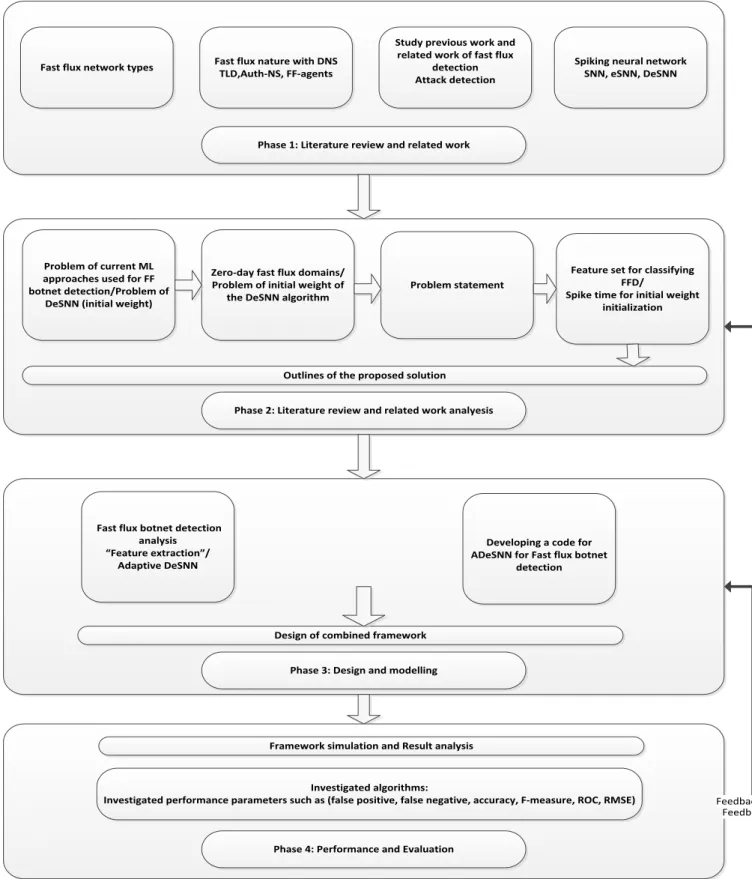
The research methodology defines the stages of how the research will be conducted. So, the stages are designated so that each step has a defined set of inputs and the expected output, and how the outputs of each stage helps in the next stage. Besides, the feedback from the front stages to the back ones will help in the process of modifying the errors and improve the performance in order to gain high accuracy or minimize errors. The research methodology employed in this research is depicted in Figure 1.1.
8
Spiking neural network SNN, eSNN, DeSNN
Phase 1: Literature review and related work Study previous work and
related work of fast flux detection Attack detection Fast flux network types Fast flux nature with DNS
TLD,Auth-NS, FF-agents
Feature set for classifying FFD/
Spike time for initial weight initialization
Outlines of the proposed solution
Problem statement Problem of current ML
approaches used for FF botnet detection/Problem of
DeSNN (initial weight)
Zero-day fast flux domains/ Problem of initial weight of
the DeSNN algorithm
Phase 2: Literature review and related work analyesis
Developing a code for ADeSNN for Fast flux botnet
detection
Design of combined framework Fast flux botnet detection
analysis “Feature extraction”/
Adaptive DeSNN
Phase 3: Design and modelling
Investigated algorithms:
Investigated performance parameters such as (false positive, false negative, accuracy, F-measure, ROC, RMSE) Phase 4: Performance and Evaluation
Framework simulation and Result analysis
Feedback Feedback
9
The following subsections describe in detail the activities performed during each phase.
Phase 1 (Literature Review)
The literature review discusses the currently developed approaches to filter fast flux botnet attacks, and outlines the most used techniques in detecting FF attacks. In addition, the literature review displays the spiking neural network algorithms and their development to serve the new adaptation proposed in this thesis.
Phase 2 (Literature Analysis)
This phase evaluates the major approaches against FF attacks, which are classified according to the detection method used. This section offers a better understanding of the current problem, possible solutions, and the scope of future studies to detect FFDs.
Phase 3 (Design and Modeling)
This shows the analysis process of a fast flux botnet and how the adaptation of DeSNN positively affects the learning performance, which added a value to the proposed approach which is dynamically used to detect fast flux domains. Also, this section compares the other algorithms used to solve this problem.
Phase 4 (Performance Evaluation)
The final phase presents the performance evaluation, the experimental environment of the proposed solution, and the dataset used to show the proposed approach’s effectiveness in detecting fast flux domains, especially the zero-day domains. Moreover, the accuracy measures used to prove the enhancement of the improvements made on the DeSNN algorithm according to the proposed adaptations are shown here.
10
1.6 Contributions of the Research
The main contribution of this thesis is to develop a novel approach called Fast Flux Killer Approach (FFKA), which adapts DeSNN algorithm. This approach has many sub-contributions in the field of fast flux domains detection and are be summarized as follows.
Increase the detection performance using the adaptive fast one-pass algorithm (ADeSNN). Employ the spike time as the initial weight, then the achieved performance is evaluated using true positive, true negative, recall, precision, f-Measure and overall accuracy.
Improve the detection accuracy, especially the classification criteria by conducting a similarity measure between the new and already trained inputs.
Design of a new feature set which can be used with the suggested algorithm to accurately classify fast flux domains.
Introduce a new adaptive dynamic classification threshold in order to classify new incoming inputs, as well as minimizing the memory storage used.
Adaptive life-long learning approach able to detect dynamically the unknown zero-day fast flux domains.
1.7 The Scope of the Research
The scope of this work is presented in two tracks. First, this research is about fast flux botnet detection aiming to detect those domains in which they behave like malicious fast flux domain. Second, this proposed approach is implemented as a host-based approach where it is able to be implemented at the local DNS server in order to work as a defender in case of threats and risks.
1.8 Thesis Structure
This thesis is divided into 6 chapter where the word developed to achieve the aim and objectives of this research is described. The next subsections will summarise each of these chapters.
Chapter One:
This chapter gave a brief introduction about fast flux botnets and listed the motivations of the researcher to pursue this study. The research problem, research aim, and objectives are also
11
listed here. Finally, this chapter presented the research methodology and the structure of the thesis.
Chapter Two:
A solid background about different types of fast flux and domain flux are discussed in this chapter. A rich literature review of what have been done in the area of fast flux is detailed. The author structured this chapter based on the scope of previous methods and solutions that tried to solve the problem of fast flux botnet detection. Additionally, the previous work done related to the proposed algorithm is mentioned. Furthermore, some brief information regarding the evolving spiking neural network is presented. This information is the foundation of the algorithm proposed in this work.
Chapter Three:
Part of the proposed solution was the changing of the initial weight. This is discussed in this chapter. In addition, the adaptive dynamic evolving spiking neural network and the original DeSNN are compared based on two public datasets. The results of the adaptive version with the original algorithm are then discussed in details.
Chapter Four
Here the first part of the proposed FFKA is introduced, the supervised phase which works offline to train the ADeSNN algorithm to detect the fast flux domains based on labelled data. Moreover, the testing criteria was introduced to use the similarity measure to classify the fast flux domains. This chapter also introduces the classification threshold that will be used in the next phase of the FFKA approach in an online mode in chapter five. The chapter concludes by a discussion and chapter summary.
Chapter Five:
This chapter presents the proposed FFKA approach to detect the zero-day fast flux domains in online mode supported by offline mode to enhance the classification performance. Moreover, this chapter shows the improvements on the classification process and the parameters
12
customization process and compares the results of the proposed Hybrid FFKA approach with the supervised phase in chapter four. The chapter concludes by a discussion and chapter summary.
Chapter Six:
This chapter give the overall discussion and present the conclusion of the work. In this chapter, we state the limitations of this research, recommendations, and the possible future works.
13
CHAPTER 2
BACKGROUND LITERATURE REVIEW AND RELATED WORK
Chapter Overview
This study covered the literature review regarding the fast flux botnet problem. This chapter is organized based on the three solution scope of the literature approaches which they were the host-based, router-based, and the DNS-based. Then the related work from the literature was discussed.
2.1 Background
Numerous websites provide commercial services to users. The efficiency of these services is highly dependent on their availability. Server systems are distributed to large redundant service networks in multiple areas to achieve high availability (Scharrenberg, 2008). The DNS is a hierarchical distributed naming system for computers and resources that are connected to the Internet (Shaikh, Tewari, & Agrawal, 2001). A browser usually automatically acquires the IP address of the desired host name to access a website. The DNS server typically returns the same reply each time. Thus, the same IP address is returned each time a host name is requested. Some requests, such as RRDNSs, CDNs, and fast flux service networks (FFSNs), do not work in the same manner as previously described. RRDNSs, CDNs, and FFSNs share similar characteristics, such as a low time to live (TTL) feature. RRDNSs and CDNs are DNS-based methods for load balancing that provide a high degree of performance, availability, and scalability for content websites. RRDNSs distribute user requests to their distributed servers by swapping the IP addresses of the DNS response of the same domain each time to provide load balancing. CDNs represent a network of globally distributed nodes to return the IP address of the nearest accessible node to the client; they thus support service speed and availability. Similarly, fast flux uses a similar concept of frequently changing IP addresses that correspond to a specific domain. This strategy helps cyber-criminals to remain undetected. The main
14
difference between FFSNs and CDNs is that CDN nodes are fully administered machines, whereas FFSNs are malware-infected computers (Lin et al., 2013).
The business side of fast flux hosting begins with malware authors. By developing phishing kits, this software package can be used to deliver phishing emails to a set (list) of victims and host an illegal website to which those emails are directed. Others sell lists of addresses for spam purposes, whereas others improve Bot software. A flexible, remotely controllable software known as bot software enables subsequent downloads on a particular computer once it has been installed on a victim’s computer. E-mail-borne worms are used by bot herders to infect and exploit thousands of computers. Such tools are the most valued these days by malware authors and criminals. Malware authors and bot herders are significant sections of the cyber-criminal community (ICANN Security and Stability Advisory Committee (SSAC), March 2008).
FFNs provide high availability and reliability to scam websites ("GNSO Fast Flux Hosting Working Group Publishes Final Report," 7 August 2009). The ICCAN report (ICANN Security and Stability Advisory Committee (SSAC), March 2008) defines a fast flux technique as one in which multiple IP addresses (sometimes hundreds or even thousands) are assigned and re-assigned to a single fully qualified domain name (FQDN), such as www.example.com. The URLs and domain names for the announced content are not resolved to any IP addresses of back-end servers. Instead of pointing to back-end servers, the URLs and domain names addresses are changed among many front-end agents, which serve as redirectors; thus, the content is forwarded to the back-end servers (the mothership) (Gasster, 2008; "GNSO Fast Flux Hosting Working Group Publishes Final Report," 7 August 2009; ICANN Security and Stability Advisory Committee (SSAC), March 2008).
Fast flux mainly involves two techniques, namely, the IP fast flux and the domain flux. The IP fast flux comes in two types as depicted in Figure 2.1: the single fast flux and the double fast flux. An extension type of the double flux is called the hydra flux (Subsection 2.1.3). The details of these techniques are discussed in the subsections that follow.
15 Mothership Request: www.bad.com User 1 2 3 Ho st _ R e q : w w w .b a d .c o m 4 10.10.10.1 Redircet_Req: www.bad.com Mothership User 1 2 3 Ho st _ R e q : w w w .b ad .c o m 4 Redircet_Req: www.bad.com Bulletproof hosted DNS Agent Agent 10.10.10.1 10.10.10.1 TLD 10.10.10.1 Request: www.bad.com NS.www.bad.com NS.www.bad.com
Single Fast Flux Double Fast Flux
Figure 2. 1 Comparison of IP resolutions of fast flux techniques
2.1.1 Single Fast Flux
Domain names are registered in an official registrar by an attacker for use in illegal activities by an official registrar. The attacker registers a domain name for an FFSN referring to illegal websites (e.g., bad.com) and another domain name (Resolvernameserver.com) to serve the mapping domain name resolution services. As mentioned previously, the attacker adds IP addresses to the bulletproof server and then provides the control of the FFSN to a mothership. In a single fast flux as displayed in Figure 2.2, the attacker deploys a bulletproof server to host the zone file. The bulletproof web hosting server leads customers to the desired malicious website. Such services are well-known among botnet owners, who need a reliable environment, and assist in deploying a botnet C&C server.
16 Mothership FF-agents Request: www.bad.com Victim/User 1 2 3 Bulletproof Name Server
Download the Zone file
Recruiting Agents 4 Response 192.10.10.1 50.74.0.12 100.7.10.1 5 6 HTTP Get:www.bad.com 192.10.10.1 Redircet_HReq: www.bad.com 8 7
Figure 2. 2 Single fast flux of IP addresses of a malicious website
Figure 2.2 shows the process of a single fast flux of the IP addresses of a malicious website. 1. The attacker recruits some of the compromised computers to work as proxies, which directly
redirect user requests to the mothership/operator.
2. The attacker adds the name server (Resolvernameserver.com) and records of the malicious website (www.bad.com/mothership) to the zone file via the registrar.
3. The victim (user) requests the FQDN (www.bad.com). Hence, a request is sent to the DNS looking to resolve the FQDN. Assuming the absence of caching, a recursive DNS server asks for the authoritative name server for this FQDN. The part of the recursive process from the top-level domain (TLD) to the authoritative server is omitted.
4. Instead of sending the IP address of the FQDN (www.bad.com), the authoritative name server sends back a list of the IP addresses of the proxies to the user.
5. The user initiates a GET message to one of the IP addresses in the list.
6. The FF-agent (proxy) simply redirects the message to the malicious web server (the mothership) to handle the message.
7. The malicious web server sends the response (answer) back to the FF-proxy. 8. The FF-agent returns the response to the user.
17
The A records of the web servers are constructed with short TTLs (Holz, Gorecki, Rieck, & Freiling, 2008), “A” is the resolved record information returned from DNS. The FFSN operators directly provide a new set of A records to replace the old set of records (of the FF-agents) when the TTLs of the request expire. Thus, there is very little chance of identifying and shutting down the web servers, which are supported by this FF technique. The records associated with the illegal website in the zone file of the DNS bot (Resolvernameserver.com) might appear as follows:
bad.com. 180 IN A 192.10.10.1 bad.com. 180 IN A 50.74.0.12 bad.com. 180 IN A 100.7.10.1
The TTL for each RR is clearly very low (180 s). The RRs are directly replaced with new bot (FF-agents) IP addresses when the TTL expires. The zone file might be read as follows after a time of TTL+1:
bad.com. 180 IN A 155.1.1.14 bad.com. 180 IN A 180.88.0.9 bad.com. 180 IN A 120.1.1.2
2.1.2 Double Fast Flux
Furthermore, the fast flux mothership/operator identifies the abovementioned domains, which correspond to its FFSN. The FF-agents in the two FFSNs are separated to simplify the understanding of the idea behind the double fast flux because FF-agents are commonly used to serve both DNS and HTTP requests at the same time (Xu, Wang, & Xie, 2013) as the mothership/operator. Figure 2.3 shows the double fast flux process.
18 Mothership FF-agents Request: www.bad.com Victim/User 1 2 3 Legitimate DNS(TLD)
Update TLD Zone file
Recruiting Agents 4 Response 11.11.11.11 22.22.22.22 33.33.33.33 5 6 HTTP Get:www.bad.com 192.10.10.1 Redircet_HReq: www.bad.com 8 9 10 7 FF-NAME SERVERS Recruiting NS(Agents) 11.11.11.11 22.22.22.22 33.33.33.33 11 12 13 Redircet_HReq: www.bad.com Response 192.10.10.1 50.74.0.12 100.7.10.1 Response 192.10.10.1 50.74.0.12 100.7.10.1 Request: www.bad.com
Figure 2. 3 Double FFSN of name server and IP addresses of the malicious website Figure 2.3 summarizes the double fast flux process of the IP addresses of the malicious website and the authoritative name server.
1. The attacker recruits some of the compromised computers to work as proxies, which directly redirect the user request to the FF mothership/operator.
2. The attacker recruits some of the compromised computers to work as NS proxies, which directly redirect the DNS request to the mothership/operator.
3. The attacker adds the name server records (Resolvernameserver.com) to the TLD zone file via the registrar and keeps updating the legitimate DNS RR of the authoritative name servers of the malicious domain.
4. The victim (user) sends a request for (www.bad.com) to the DNS server to resolve the FQDN. 5. The DNS returns a list of authoritative name servers for this FQDN, which are a part of the
malicious compromised pool of NS agents.
19
7. The authoritative name server forwards the DNS request to the mothership instead of resolving and directly returning the IP address of the FQDN.
8. The mothership returns a list of IP addresses that are FF-agent proxies of the website server (mothership).
9. The authoritative name server sends the IP addresses back to the user.
10.The user initiates a GET message to one of the IP addresses in the list (which is actually one of the FF-agents).
11.The FF-agent (proxy) simply redirects the message to the malicious web server (mothership) to handle the message.
12.The malicious web server sends the response back to the FF-agent. 13.The FF-agent returns the response to the user.
The attacker continuously updates the NS records of the TLD. Through the registrar, the domain owner has the ability to modify the domain information. The attacker frequently changes the IP addresses of the NS servers to point to different hosts and sets the TTL value for these NS servers to a very small value (e.g., 180 s). The RRs of the NS might be shown in a TLD zone file as follows:
bad.com. NS NS1.Resolvernameserver.com bad.com. NS NS2.Resolvernameserver.com NS1.Resolvernameserver.com A 11.11.11.11 NS2.Resolvernameserver.com A 10.0.0.2
The attacker automatically replaces the A records of the NS when the TTL expires. Therefore, the RRs of the NS might be shown in a TLD zone file as follows:
bad.com. NS NS1.Resolvernameserver.com bad.com. NS NS2.Resolvernameserver.com NS1.Resolvernameserver.com. A 22.22.22.22 NS2.Resolvernameserver.com. A 10.10.10.233
20
Consequently, there is very little opportunity to detect and shut down the name servers that support this fast flux attack. Combining the two FFSNs is an effective method for keeping the website alive for longer periods than websites that do not use the same techniques.
2.1.3 Hydra Fast Flux
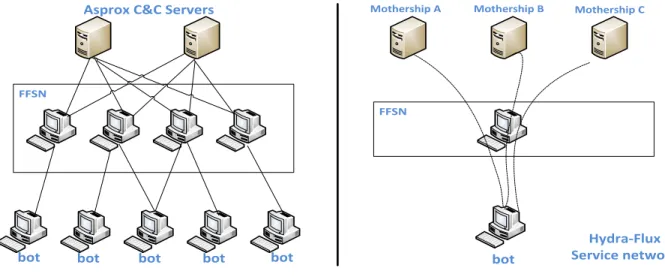
The new advanced FFSN does the same thing as the traditional FFSN, but taking it down is impossible. Similar to the traditional FFSN, the mothership of the new advanced FFSN can be deactivated by law enforcement, but the bots have an alternative IP address to another mothership related to the same FFSN. As depicted in figure 2.4 the Asprox botnet, the bots download a list of available motherships. Ultimately, alternative IP addresses adds a multilayer of double fast flux to the botnet and maintains extra availability to the malicious content. Figure 2.4 depicts the multilayer FFSN of the Asprox botnet, which is usually denoted as a hydra-flux service network.
FFSN
FFSN
bot
bot bot bot bot
Asprox C&C Servers
bot
Mothership A Mothership B Mothership C
Hydra-Flux Service network
Figure 2. 4 Multilayer FFSN of the Asprox botnet and hydra-flux service network
2.1.4 Domain Flux
Another type of fluxing technique is the domain flux. In contrast to the fast flux of the IP addresses related to a domain name, the domain flux is the process of fluxing domain names related to a URL of the C&C server.
21
The domain flux is used by bots to contact the C&C server. The domain generating algorithm generates the same domain names for both the C&C server and its bots when seeded with the same value. The C&C server is used to register some of the auto-generated domains. Stone-Gross et al. (2009) revealed that the Torpig botnet calculates domain names by combining the current week and year and adding the TLD (e.g., “weekyear.net”) to them. These auto-generated domains are then used by bots to contact the C&C server; if the connection fails, then the bots attempt to use the day information to produce the daily domains. If all the domains fail, then the bots use the hard-coded domain names in their configuration file as a last resort (Stone-Gross et al., 2009). All of these generated domain names are sent to the DNS server in an attempt to resolve it. The bots then establish contact with the C&C server. This process of failed requests generates a high observable number of non-existing domain responses in the DNS traffic that create a footprint of these bots that send most of the failed DNS requests (Jiang, Cao, Jin, Li, & Zhang, 2010; Pappas et al., 2009; S. Yu, 2014).
2.2 Literature Review
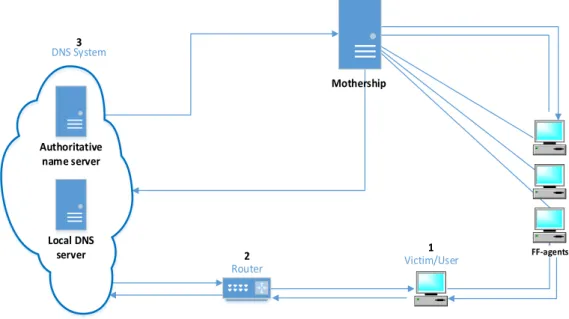
Numerous studies have explored botnet detection, especially fast flux botnet detection (Al-Duwairi & Al-Hammouri, 2014; Chahal & Khurana, 2016; Z. Chen, Wang, Zhou, & Li, 2011; Scharrenberg, 2008; Yu, Zhang, Kang, & Chen, 2012). Most previous researches discussed the detection of FFSNs or malicious fast flux domains, which serve as the main element of the fast flux botnet technique. The related works on fast flux argued about fast flux in terms of what is fluxed or what technique is used to detect an FF domain. However, to the best of our knowledge, the present study is the first to investigate fast flux botnet approaches on the basis of the solution scope of detection techniques as depicted in Figure 2.5.
22 Mothership FF-agents Authoritative name server Local DNS server DNS System Router Victim/User 1 2 3
Figure 2. 5 Solution scope of FF botnet detection methods
Figure 2. 5 presents the solution scope of fast flux botnet detection. In addition, the current study classifies fast flux botnet approaches according to the solution scope. Hence, number 1 in Figure 2.5 refers to host-based methods, number 2 refers to router-based methods, and number 3 refers to DNS-based methods. Moreover, the current study discusses the mode of each detection technique and identifies whether it is active, passive, or real time as depicted in Figure 2. 6. Within these parts, each approach discusses the features, the datasets, and the classifier used.
23 Scope of solution Router-based DND-based Host-based Real-time Host approaches Active Host approaches Passive host approaches Real-time DNS approaches Active DNS approaches Passive DNS approaches Score-based approaches Machine learning approaches
Decision tree approaches
Geo-locational approaches Spatial information-based approaches Behavior-based approaches Machine learning-based approaches
24
2.2.1 Host-based Detection Methods
Host-based means that the proposed approach is applied to a host device or a set of devices from the user point of view. According to the literature, the majority of the reported works were using the host-based detection approach. These approaches are divided into three subgroups: passive, active, and real-time approaches.
2.2.1.1 Passive Host-based Approaches
The idea behind passive approaches is that they rely on the monitoring part of a specific network area for a period of time. The collected data are then analyzed to prove predefined propositions. Passive monitoring provides the detection methods the advantage of not being noticed by attackers and adds no extra traffic flows to the network.
A Bayesian method is proposed to detect bots on the basis of DNS traffic similarity (Villamarín-Salomón & Brustoloni, 2009). The proposed approach relies on the idea that a bot at the same botnet has the same traffic similarity as the other botnets. One bot should be known at the beginning; then, the search for other bots with the same traffic similarities in the DNS traffic is initiated. However, the poor tuning of parameters generates large false positive (FP) values (Villamarín-Salomón & Brustoloni, 2009).
Another method of using decision trees to identify malicious FFSNs was proposed in (Zhao & Traore, 2012). The classifier begins by classifying malicious domains, and then monitors the suspicious ones for a longer period. The proposed approach may be able to identify legitimate and malicious FFSNs, but it may not easily classify them on the basis of malicious website behaviors. The proposed approach is also unable to detect unknown FFSNs, as well as unknown zero-day domains. In addition, the author suggested generating a new system that can develop its classifier while running on the basis of an existing dataset and newly generated data, which would enable the system to identify new threats (Zhao & Traore, 2012). Table 2.1 summarizes the passive approaches.
25
Table 2. 1 Summary of passive approaches
Authors Algorithm Mechanism Advantages Disadvantages
Zhao and Traore (2012) Decision tree Monitoring malicious domains to detect FFSNs Low computationa l complexity -Classification problem - -Unable to detect unknown zero-day domains Villamarín-Salomón and Brustoloni (2009) Bayesian method Detecting bots based on DNS traffic similarities and known bot traffic
Effective and robust
Parameter tuning causes FP
Overall, fast flux botnet domains still need to be detected in a short time because of the quick change in the IP addresses of motherships that hampers the easy tracking of their locations. Thus, detecting this type of “Fast Flux zero-day” domains as quickly as possible is important. Moreover, passive approaches deal with a huge amount of data and are thus unsuitable for fast processing in a short time with few resources.
2.2.1.2 Host-based Active Approaches
In contrast to passive approaches, active approaches require assistance from third-party data sources, such as the WHOIS or GeoIP database. Such third parties provide additional necessary information (e.g., IP address registrar name and creation data). The following subsections describe related works that applied host-based active approaches.
A) Score-based Approaches
Many fast flux domain detection approaches are based on the flux score calculation of a set of features adopted (Al-Duwairi & Al-Hammouri, 2014; C.-M. Chen, Cheng, & Chou, 2013; Holz et al., 2008; Hsu et al., 2014; Koo, Chang, & Chuang, 2012; Otgonbold, 2014; Sheng, Shijie, &
26
Sha, 2010). Holz et al. (2008) proposed a system that measures and detects a FFSN on the basis of the calculated flux score. Their proposed system takes malicious domains from spam emails and then uses the Dig tool to generate DNS lookups and reverse DNS lookups and thereby obtain necessary information about a feature set (number of A records, number of autonomous system numbers (ASNs), and number of (NS). Thus, the flux score calculation is fed for use later in distinguishing between malicious FFSNs and legitimate ones. Their results showed that the proposed system achieves a detection accuracy of 99.98%. However, the coefficients used in the score calculation require modification to ensure the highest possible accuracy of the detection system. Moreover, the set of features chosen cannot purely distinguish between FFSNs and CDNs.
Hsu et al. (2014) proposed a fast flux domain detector (FFDD) system that adds to Holz’s source of malicious domains and taking unknown URLs from spam or social networks. The FFDD system is used to calculate the flux score on the basis of the response time series between each of the two subsequent requests from a host to the FF-agent. The FFDD is a lightweight standalone system that does not need support from other parties. Consequently, the FFDD can accurately detect a fast flux domain with 3% FP and 2% FN in less than 20 min. Therefore, this technique is not suitable for fast flux detection.
Sheng et al. (2010) proposed two metrics, namely, the average online rate (AOR) and the minimum availability rate (MAR) to detect fast flux agents on the basis of the agents themselves. The calculations of these two methods are initiated from the beginning of the monitoring process. The monitoring is extended for 1 h using the AOR and MAR calculation once a malicious domain is detected. The results show that most FFSNs have lower values than legitimate ones. Moreover, these methods are easy to implement and deploy and are useful for distinguishing between benign and malicious FFSNs but not for FFSN detection. However, the metrics may work incorrectly if the group of agents is small or only a few agents are found (Sheng et al., 2010). According to Sheng, the metrics depend on the quality of the HTTP service, which may affect network accessibility and thus stop reaching agents.
The Google search engine has also been used as a technique to classify malicious domains by feeding the search process with IP addresses of suspicious domains (Duwairi &
Al-27
Hammouri, 2014). The number of hits is then observed. As expected, the number of hits comprising domains associated with FFSNs would be much less than the number of legitimate domains. The new legitimate domain could also mislead the classifier. The proposed system is still at its infancy and thus needs other features to confirm its detection accuracy.
Koo et al. (2012) proposed a computed formula to detect malicious domains being used in FFSNs, with the domains obtained from a malware domain list. They explored the actual status of FFSNs employed in cyber-crimes and analyzed the distribution of compromised computers. Consequently, the detection accuracy is high. However, their data were not sufficient to estimate the scope of the FFSN. Thus, their proposed procedure may lead to misclassified domains. (Chen et al., 2013) proposed a probability formula to detect malicious fast flux domains. The network behavior of malicious domains are formalistic based on the time–space behavior of malicious FF-domains. In addition, an analysis was proposed to reduce the time complexity of feature modeling. The results of this study show that the proposed solution performs better than the blacklists. However, a threshold is still needed to compute the probability formula. Moreover, gathering information about domain names requires more time, which affects detection performance.
Otgonbold (2014) proposed a fast flux formula to help detect fast flux domains in the wild. The proposed ADAPT system takes inputs from the domain zone file to collect the DNS information needed in the detection system. The zone file is targeted because it contains domains scattered all around the globe using the Tor network as shown in Figure 2. 7. The system’s clients gather suspicious domains from various DNS servers over the Tor network and then analyzes the collected information. Thus, the decision is made as to whether the domain needs further scanning to confirm its maliciousness. The results of this study indicate that the proposed system is capable of detecting malicious fast flux domains in their infancy. However, the RDNS server should be queried to collect full DNS information, and such requirement could affect detection performance. The current version of Grails also shows a memory leak problem, which causes out-of-memory exceptions and long-running tasks. Table 2. 2.2 summarizes the calculated score-based approaches.
28
DB
ADAPT Server DNS Servers ADAPT Clients Domain zone files TORNetwork Suspected domain
Figure 2. 7 ADAPT system architecture(Otgonbold, 2014)
Table 2. 2 Summary of score-based approaches.
Authors Algorithms Mechanism Advantages Weakness
Holz et al. (2008)
Flux score The flux score is computed on the basis of DNS records Uses two consecutive DNS lookups - Coefficients require periodic adjustment - Feature is not distinguishable Hsu et al. (2014)
Flux score Fast flux score is computed on the basis of the response time
differences of
subsequent requests of FF domains
Lightweight stand-alone system
29 Sheng et
al. (2010)
AOR, MAR Once the existence of a fast flux domain agent is discovered, its activities are monitored every hour using calculations based on AOR and MAR
Easy to implement and deploy; metrics are time saving
- Inaccurate result - Based on the quality of the HTTP service Al-Duwairi and Al-Hammouri (2014) Number of hits in the Google search engine Depending on the number of hits of query responses using the Google search engine
Lightweight approach
- Still in the development phase - Needs more features to confirm detection accuracy - Misclassifies new domains as malicious Koo et al. (2012) Calculated formulas Calculated formulas based on the actual status of the FFSN being employed High detection accuracy - Data problem - Misclassified domains Chen et al. (2013) Probability formula - Time–space behavior of malicious FF domains and network behavior of domains are formulistic
Outperforms blacklists
- Threshold is needed - Long detection time
Otgonbold (Otgonbol d, 2014) Flux score formula - Detection system collects domains from DNS zone files
Detects malicious fast flux domains in their infancy
- RDNS servers should be queried,
30
- Anonymously
provides domains all around the globe in a short period of time with little resource using the Tor network
which could affect performance
- Out-of-memory exception
B) Machine Learning-based Approaches
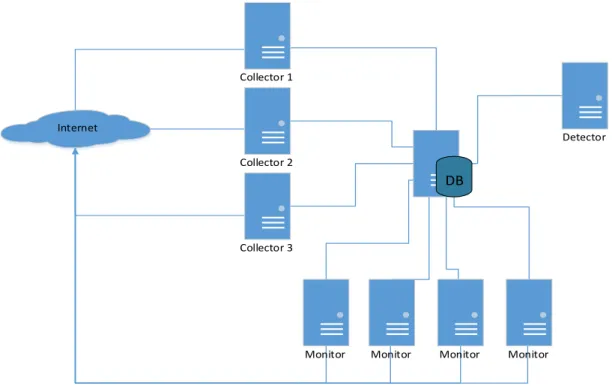
A number of machine learning algorithms are used to classify domains as either malicious or benign (Chen, Huang, & Ou, 2014; Passerini, Paleari, Martignoni, & Bruschi, 2008) as summarized in Table 2.3. In the naïve Bayes classifier proposed by Passerini et al. (2008), all malicious domains are collected from spam emails. Their detection and monitoring “FluXOR” system relies on the idea of a host being a victim to such scam. The system begins to send requests and gathers the feature set information to feed the naïve Bayes classifier as in Figure 2. 8. The naïve Bayes classifier is a supervised algorithm, which is not suitable for detecting unknown attacks. FluXOR reduces the time of detection to 1–3 h, which is still relatively long; a domain with a TTL of more than 3 h is still considered legitimate (Huang, Mao, & Lee, 2010).
31
DB
Monitor Monitor Monitor Monitor
Detector Collector 1
Collector 3 Collector 2 Internet
Figure 2. 8 FLUXOR system deployment(Passerini et al., 2008)
Chen et al. (2014) proposed a Bayesian probability theory to distinguish between benign and malicious domains using dissimilar ASNs, reverse DNS lookups, and domain registration time features. They aimed to detect a fast flux website on the basis of its fluxed characteristics. The result of this proposed system presents its ability to identify possible threats. Nevertheless, their judgment was not perfect enough to reflect the good precision of the proposed system.
Chen et al. (2011) used the k-nearest neighbor (KNN) and random forest (RF) as sampling techniques to solve the imbalanced problem, with respect to FFSN detection. In addition, they proposed a sampling technique that is combined with feature extraction from datasets for use in fast flux detection. The result showed that the TTL is an important feature to the classification of the proposed technique. However, its detection accuracy in the case of a long TTL is affected. The support vector machine (SVM) was proposed by Yu et al. (2012) to detect fast flux botnets by analyzing the patterns of DNS queries from FF botnets. They extracted six features to build the weighted SVM classifier for use in distinguishing legitimate and FF botnet domains. They noted that using SVM to identify fast flux botnets is effective and provides a satisfactory
32
detection accuracy. Overall, the proposed method entails a long detection time because it waits for additional information from a third party. Moreover, such a supervised method is not helpful in detecting new and unknown zero-day attacks.
Table 2. 3 Summary of machine learning approaches.
Authors Algorithms Mechanism Advantages Weakness Passerini et al. (2008) Naïve Bayesian classifier
Analyzes a set of features observed from the victim’s point of view on botnet scams Reduces detection delay - Long detection delay - Unable to detect zero-day domains Chen et al. (2014) Bayesian probability theory Uses different characteristics to distinguish benign and malicious domains Enhances detection accuracy of web-based botnets - Achieves inaccurate precision Chen et al. (2011)
KNN and RF Use the resampling technique to solve the imbalanced classification problem with respect to FFSN detection Solve the imbalanced dataset problem - Long TTL affects detection accuracy Yu et al. (2012) Weighted SVM
Extracts six features to the
weighted SVM by
analyzing the patterns of DNS responses to FFSNs Satisfies detection accuracy - Earlier domains create FP - Unable to detect zero-day domains
33
C) Decision Tree-based Approaches
Celik and Oktug (2013) proposed the C4.5 decision tree algorithm to evaluate various DNS feature sets and put forward a detection approach, which is a high-dimensional feature vector with various features, including timing network, spatial, and NS and DNS response information. C4.5 evaluates each feature set of previous vectors and decides which one is the best feature vector on the basis of detection accuracy. Combining all features together provides a detection accuracy of 98.9%. However, the detection is unaffected in those timing and domain name feature sets. The C4.5 unsupervised algorithm depends on clustering and is good for detecting unknown attacks; however, it suffers from a low accuracy level in most applications (Almomani, Gupta, Atawneh, Meulenberg, & Almomani, 2013).
D. Zhao and Traore (2012) proposed another method (REPTree) for botnet detection using a decision tree with reduced error pruning. This type of machine learning decision tree is used to classify and identify malicious FFSNs by defining and computing some of the network metrics captured from network flows. Although decision tree-based classifiers are considered as a well-known classification technique with low computational complexity, the authors were not sure of the results because some benign websites were misclassified as malicious websites. They also searched for other reliable evidence. Table 2. 4 summarizes the approaches using the decision tree algorithm.
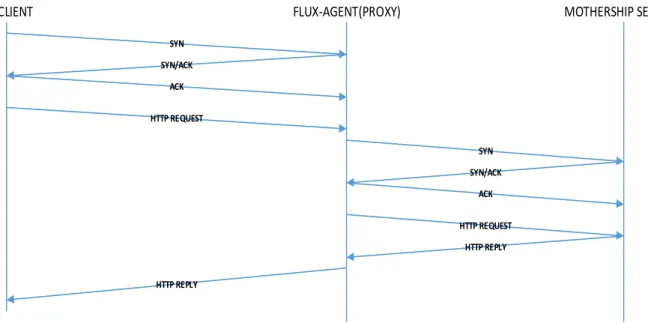
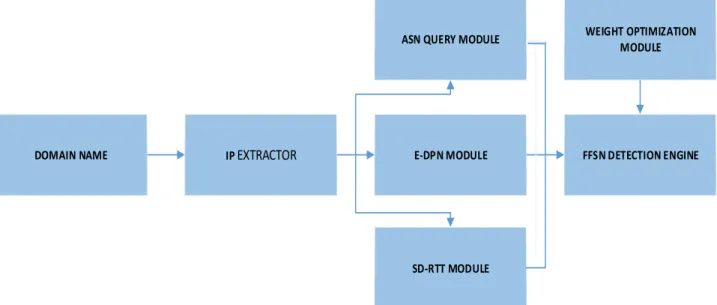
The classification and regression tree algorithm is used in the method proposed by Y. Zhao and Jin (2015). This method uses a small dataset to quickly distinguish legitimate and malicious FFSNs. This method is mainly based on FFSN domains, DNS, and the process of HTTP visiting. The domain distinct features are shown in Figure 2. 9. Another researcher used distinct mapping of features (Pa, Yoshioka, & Matsumoto, 2015). The classification process needs less than a few days, and the detection accuracy is 90%. The detection time is also relatively long, and other detection methods exhibit higher accuracy and lower detection time. Moreover, this method cannot detect zero-day domains.
34 SYN SYN/ACK ACK HTTP REQUEST SYN SYN/ACK ACK HTTP REQUEST HTTP REPLY HTTP REPLY
CLIENT FLUX-AGENT(PROXY) MOTHERSHIP SERVER
Figure 2. 9 The process of visiting a domain(Y. Zhao & Jin, 2015) Table 2. 4 Summary of the approaches using decision tree algorithms.
Authors Algorithms Mechanism Advantages Disadvantages Celik and Oktug (2013) C4.5 decision tree A number of feature sets are experimented on to detect FFN.
Detect unknown attacks
- Unaffected by some of feature sets - Low level of accuracy D. Zhao and Traore (2012) Decision tree using reduced error pruning (REPTree) Computed metrics of captured network flows that are analyzed using REPTree. Low computational complexity -Misclassification -Needs additional discriminators