Private Student Loan Asset Backed Securities:
A Default Curve Analysis
The Honors Program
Senior Capstone Project
Student’s Name: Nicholas Gentile
Faculty Sponsor: Dr. Peter Nigro
April 2013
2
Table of Contents
Abstract ... 3
Section I: Introduction ... 4
Section II: Literature Review ... 9
Origins and Development of Student Lending... 9
Development of the Private Market ... 14
FFEL Loan Characteristics ... 19
Private Loan Characteristics ... 22
Major Players in the Private Loan Market ... 27
Section III: Data ... 39
Section IV: Empirical Results ... 44
Univariate Tests ... 44
Multivariate Models ... 59
Section V: Econometric Challenges and Methods ... 64
Section VI: Conclusion ... 65
Appendices ... 66
Appendix I: Descriptive Statistics ... 66
3
Abstract
Business and mainstream media devote significant attention to the student lending industry and its possible threat to the economy. While the private loan component of student lending may not be largest part of this one trillion dollar industry, it is likely to be the space where evidence supporting the media’s concerns are found. This paper examines the variation in cumulative default rates for private student loan asset backed securities issued between 2001 and 2007, revealing the dynamics of these opaque financial instruments. The study analyzes internal pool data and external economic data, uncovering the primary factors that shape the respective cumulative default curves for each trust. The data reveals that the cumulative default curves are influenced by both underwriting procedures of the originator and the timeframe that the trust enters its repayment period. This paper provides detailed industry research and pool-level trust analysis which enhances the understanding of a little-understood area of the capital markets.
4
Section I: Introduction
In 2010, total outstanding student loan debt surpassed total credit card debt for the first time. At that time, federal student loans represented $665 billion of the total (80%) with private student loans comprising the remainder (20%). In May 2012 the “student loan debt clock” surpassed $1 trillion in total loans. Figure 1 shows steady student loan growth over the last decade. . These figures, however, do not include capitalized interest for federal education loans which could add 6 to 7 percent to the total amount (FinAid 2012) The rise in outstanding student debt, combined with rising default rates (13.4% within 3 years of graduation, lifetime projected at 23% for loans originated in 2013), is leading to speculation over the stability of the student lending market (Kansas City Federal Reserve 2012, Bloomberg 2012).
The student lending industry is very intricate. The combination of federal and private loan varieties creates a complex system which involves academic institutions, guarantee agencies, investors, borrowers and their families. Figure 2 provides for a representation of these
5
relationships. The diagram demonstrates the complexity of the student lending process, both due to the number of parties involved, as well as the various transfers of funds.
The federal loan program is the most widely used tool to finance higher education, making up over two-thirds of all post-secondary aid (College Board 2011). For the 2010-2011 academic year, federal guaranteed loans comprised 93% of the $112 billion in originated student loans. While the federal loan market is much larger than the private market, the latter represents an important part of higher education funding, which in the words of the Consumer Financial Protection Bureau (2012), “does not appear to be well understood by the public”.
Over the past few years, policy makers, government agencies and the media are increasingly worried that student loans represent the next financial bubble. In 2011, Moody’s Analytics reported that, “Fears of a bubble in educational spending are not without merit” (Kingkade 2011). In 2012, Forbes put out an article with the title, “Student Loan Bubble Sets up to be Subprime
6
Disaster Part Deux” (Bonner 2012). More recently, Time Magazine asked, “Student Loan Debt Crisis: How’d We Get Here and What Happens Next?” (While 2013). The general tone of public opinion appears to center around the belief that the student lending market poses the risks and poses a huge threat to the economy
Over the past two decades, securitization emerged as a popular method of financing student loans, serving as both an attractive investment for yield-seeking investors, and providing funding for additional student lending for both federal and private institutions. Securitization pools individual loans into securities that are backed by the future cash flows that borrowers make in repayment (Lee & Egan 2009). Figure 3 shows the growth in the securitized student loan market both in terms of annual issuance and loans outstanding. As of the fourth quarter of 2012, there were $232 billion in student loan asset backed securities (SLABs) outstanding, down from a peak of $242 billion the year before (SIFMA 2012). Additionally, in 2012, $26 billion of new SLABs were issued.
7
Securitized pools are constructed from loans originated by the issuer, purchased from other originators by the issuer, or a combination of the two. Student loan securitizations can also be characterized by the type of loan; either federal or private. SLABs can contain one or both types of student loans. Federal loans are guaranteed by the state entity which originated the loan, which is then reinsured by the federal government. This guarantee does not guarantee the timely payment of principal and interest on the SLAB, but rather on the underlying loan itself. In the event of default, the loan holder (in the case of a securitization, the trustee) can submit a claim to the guarantee agency, which submits a claim to the reinsurance provider, the U.S. Department of Education (Lee & Egan 2009). This means that, implicitly, federal loans are backed by the full faith and credit of the United States.
Until 2008, the private lending market created its own version of a guarantee agency. The main player was The Education Resources Institute (TERI), a non-profit formed by a collection of Massachusetts schools. Working with First Marblehead bank, at its peak, TERI guaranteed over $16 billion in private student loans. Following its bankruptcy in 2008, private originators/issuers were left to either use other third-party guarantors, or simply issue the SLABs without any guarantee (CFPB 2012). Individuals and institutions that fear student lending becoming the next financial bubble should focus their concerns on the unguaranteed private loans that comprise a major portion of some SLABs, rather than those backed mainly by government guaranteed loans. Fitch Ratings echoed this sentiment in a recent report on the student lending market,
“Fitch believes that the recent increase in past-due and defaulted student loans presents a risk to investors in private student loan ABS, but not those in ABS trusts backed by FFELP [federal] loans. While FFELP loans are largely protected from these trends [underemployment and unemployment], private student loan trusts, especially those that were structured aggressively and with less stringent credit standards before the recession, are expected to
8
continue experiencing high defaults and ratings pressure” (Business Insider 2012)
Further parallels exist between the subprime crisis and the student lending industry. Two of the main causal factors of the subprime crisis were predatory lending and predatory borrowing. David Musto (2008), a finance professor at Wharton, identifies predatory lending as making a loan that reduces the expected welfare of the borrower by having an expectation that the loan will end in default. A more controversial discussion centers on the concept of predatory borrowing: the idea that individuals take out loans with at least some knowledge that they will be unable to maintain the debt.
This paper attempts to identify a significant difference in the default curves for private student loans issued pre-crisis (2007-2008), and, if a difference is found, to explain the variation with causal factors. While the private market is comparatively small, only 20% of outstanding loans and 7% of new issuances, the general lack of oversight, regulation, and awareness makes it an important research opportunity. In addition to the scarcity of research on the topic, the private student lending market carries risks that are alleged to be a threat to the financial system of the United States.
The remainder of the paper is organized as follows. Section II reviews the literature related to student lending. Emphasis is placed on the development of the market from the mid-1960s to today in an effort to show what developments led to the current situation. Additionally, the federal loan market is discussed in order to highlight similarities and differences with the private loan market. While the literature specifically focused on the private student loan industry is limited at best, it is featured in detail, along with an overview of the major players in the space. Section III describes the data used in the paper. Section IV provides empirical results. Section V
9
discusses the various econometric challenges faced in this study and the methods used in light of those challenges. Lastly, Section IV provides a conclusion and discussion of areas of further research.
By conducting this research, this report sheds light on an opaque, yet potentially ominous, part of the American financial system. By addressing the CFPB’s (2012) claim that private student lending is “not well understood by the public,” this study reveals the dynamics of the market that are driving what many fear, is a ticking time-bomb.
Section II: Literature Review
Origins and Development of Student Lending
The student lending industry traces its origins back to the Higher Education Act of 1965. Section 421 of the Act established the Federal Family Education Loan Program (FFELP), providing a federal program of student loan insurance for students or lenders, paid a portion of the interest on loans to qualified students, guaranteed a portion of each loan insured under the program. As shown in Figure 4, the FFELP loan volume and average loan amounts have increased over time (Rust 2009).
10
The Act put forth ideas for “default reduction activities,” including a program of partial loan cancellation to reward disadvantaged borrowers for good repayment behavior, establishing a financial and debt management counseling program, establishing a program of placing high-risk borrowers in jobs, and developing public service announcements that would detail the consequences of student loan default (P.L. 89-329 1965). There is little evidence that these plans were ever developed after the adoption of the Act.
Following the Higher Education Act, student loans were more or less treated like any other form of debt. The 1978 Bankruptcy Reform Act amended the U.S. Bankruptcy Code to exclude educational loans made, insured, or guaranteed by a federal government program, ending borrowers’ ability to discharge any federal loan in bankruptcy court. Congressional rationale for this decision was driven largely by anecdotal evidence that students were filing for bankruptcy immediately upon graduating in order to avoid repayment. A 1976 New York Times article documents that approximately 12,000 former students filed bankruptcy claims on $21 million in federal loans between 1974 and 1976 compared to only 9,000 bankruptcies occurred on just $17 million in loans in the previous 15 years. The lack of stigma felt by those recent graduates filing for bankruptcy was exemplified by one student saying, “I do have a sense of responsibility, but this bankruptcy thing doesn’t bother me. They were institutions who lost, not people.” At this time, federal defaults represented 18%, or $2.2 billion of the $13 billion in outstanding loans. A 2012 New York Times article highlighted that there were now 5.9 million borrowers in default on $76 billion in outstanding loans (Lewin 2012). In 1984, the Bankruptcy Amendments and Federal Judgeship Act extended the bankruptcy exclusion from federal to all private student loans. Upon signing the bill, President Ronald Reagan cited the provision in the law that
11
preventing debts incurred as a result of drunk driving from being discharged in bankruptcy, yet made no mention of its impact on college students.
As the federal loan industry developed and grew, budgeting and accounting for student lending programs became more problematic. Under the guarantee model, the U.S. government records no direct up-front costs. Economists worried that the federal government was making long term financial commitments without accounting for eventual costs. In 1990, President George H.W. Bush signed the Federal Credit Reform Act. This law required the U.S. government to begin a direct lending program using U.S. Treasury Funds. Figure 5 shows volume trends in the government’s direct loan program (New America Foundation 2012). President Bill Clinton expanded this program to provide the same loans to students at a much lower cost to taxpayers. As part of the 1993 budget agreement, Congress began to phase in direct lending with a provision allowing the Secretary of Education to require colleges to switch to direct loans until at least 60% of the market fell under that umbrella. In 1994, the Republican controlled Congress targeted the fledgling direct loan program for elimination. Stopping short of closing the program, Congress prohibited the Department of Education from encouraging or requiring colleges to switch to direct loans, and as a result, participation in the program fell as institutions returned to the guarantee system. See figure 5 for the direct loan share of the total federal loan volume over time.
12
Figure 6 shows the relationship between FFELP and Direct Loans over the past two decades. Following the decision to phase out the Direct Loan program, the FFELP program continued to grow as the main financing vehicle for government-related student loans. By 2007, new origination volume in the Direct loan program reached its lowest point since its creation.
Figure 5: FFELP vs. Direct Loan Volume (1993-2012) Figure 5: Direct Loan Share of Federal Volume
13
The trend towards FFEL guarantees reversed with the onset of the financial crisis in late 2007 and 2008. The fluctuations in the credit markets threatened the ability of private lenders to originate loans under the FFELP banner, and several banks closed their student lending businesses. Colleges began switching back to the Direct Loan program as FFELP guarantees on privately originated loans became more difficult to obtain. In May 2008, Congress passed Ensuring Continued Access to Student Loans Act to maintain student borrowers’ access to capital. The Act provided the Department of Education with the ability to purchase or enter into forward contracts to purchase FFELP guaranteed loans from the private lenders that originated them (Sampson 2008). This meant that the federal government was purchasing loans it guaranteed in order to maintain liquidity in the student lending market. This turned the FFELP into a quasi-Direct Loan program, and as a result, made it redundant.
In 2010, President Obama signed legislation that revamped the federal student lending program. The new law ended the FFEL program by eliminating the subsidies paid to banks to act as intermediaries for student lending. This change was projected to save the federal government $68 billion over the next decade (Baker & Herszenhorn 2008). Since then, all new loans have been made under the Direct Loan program.
Concurrently, President Obama ended the FFEL program and announced reforms on existing debt. For example, he implemented the income-based repayment plan, in which their annual repayments are limited to 10% of their annual income above a basic living allowance (150% of the poverty threshold, currently $16,500). This change is expected to affect over 1.2 million borrowers. Another provision of the President’s reforms include forgiving remaining loan balances after 20 years, or 10 years if the student elects to become a public service worker.
14
Luckily for SLABs investors, these provisions only apply to loans originated after 2014, which would be fully covered by the Direct Loan Program.
Currently, two pieces of legislation are under debate in Congress that could affect the student lending market. First, the “Fairness for Struggling Students Act,” introduced by Senator Dick Durbin, seeks to repeal the amendment to the bankruptcy code that excludes private student loans from being discharged in bankruptcy. The bill includes a provision that allows borrowers who maintained a good faith payment history for a period of years to discharge their debt. Second, the “Know Before you Owe Act,” also sponsored by Senator Durbin, would require schools to advise students of the risks associated with student debt before they sign on to private student loans. It also requires the school to confirm and approve the necessary loan amount before origination (2013).
Development of the Private Market
Although private lenders have been involved with student financing since the implementation of the 1965 Higher Education Act and the FFELP, their prominence can be attributed to a few key events over time. As loan volume grew from 1966 to 1971, private lenders aggregated large portfolios of student loans, and due to the extended repayment nature of the product, they began to run out of new capital to continue lending. As a result, Congress created SLM in the 1972 Amendment to the Higher Education Act. First, in 1972, is the establishment of the Student Loan Marketing Association (SLMA), or Sallie Mae (hereafter referred to as SLM), established a vibrant secondary market and warehouse facility for student loans (U.S. Treasury 2006).
In addition to serving as a liquidity provider for the FFELP, the Omnibus Budget Reconciliation Act of 1981 granted SLM the authority to include non-federally insured loans in its purchase and
15
warehousing programs (General Accounting Office 1984). This provision allowed SLM to generate the liquidity necessary for private lenders to originate loans for those borrowers who possessed credit profiles that did not qualify for a federal guarantee.
In 1992 the Securities and Exchange Commission (hereafter SEC) provided further stimulus to the private lending market by allowing the non-mortgage ABS to gain a foothold in the capital markets by facilitating registered offerings of ABS. Under the 1992 amendments, offerings of investment grade ABS could be shelf-eligible (SEC 2011). Rule 415 of the SEC authorizes companies to file a single prospectus, from which they are able to issue additional offerings in the future without having to re-file. This allowed private institutions easy access to the capital markets in order to raise additional funds for loan origination.
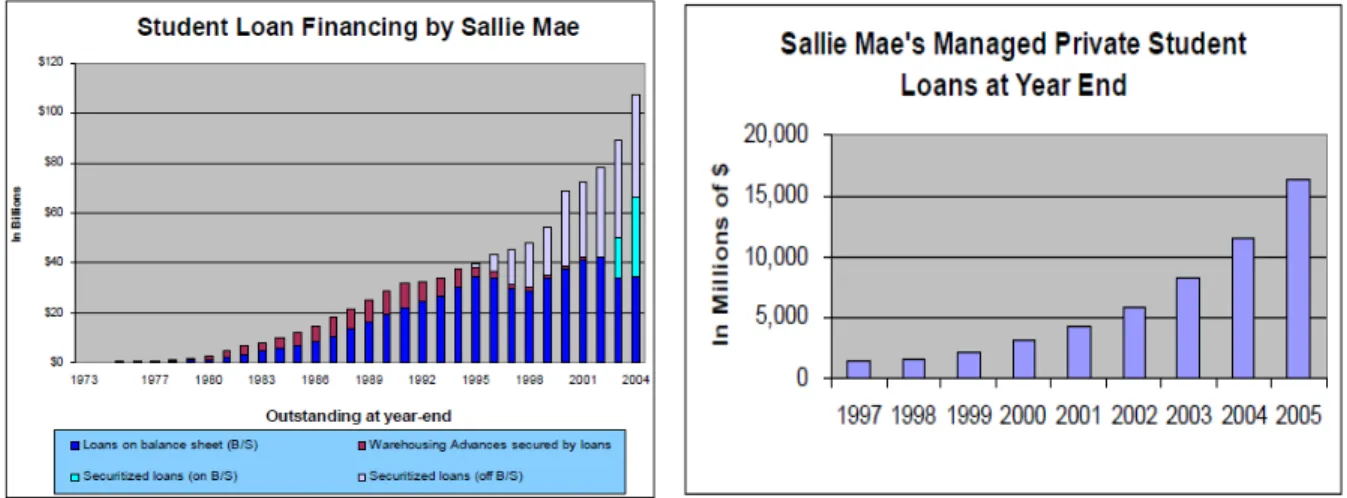
Securitization of student loans was one of the major factors leading to to the privatization of SLM. In 1995, SLM completed its first ABS transaction, (Sallie Mae Student Loan Trust 1995-1) raising $1 billion in the sale of floating rate student-loan backed securities. SLM, surprised at the relative ease of accessing the capital markets and of the successful securitization of loans, accelerated its desire to become a private entity. In 1997, SLM shareholders voted to reorganize the company, rolling off any remaining GSE debt and replacing it with private debt, which SLM did with much success by issuing $120 billion in ABS during the transition phase. The privatization also allowed SLM more freedom to serve the non-guaranteed student loan market (U.S. Treasury 2006). Figure 6 shows the trends in SLM’s methods for student financing from its inception to 2004. The focus on securitization can clearly be seen beginning in 1995-1996, followed by a rapid growth in securitized loans while on-balance sheet loan amounts remained
16
stagnant. Figure 7 shows how the growth in securitized lending was mirrored by the growth SLM’s private loan portfolio.
Figure 6: SLM Financing Methods Figure 7: SLM Private Loan Growth
Figure 8 shows how the national private lending market grew similar to SLM. As SLM began its transition from a GSE to a private company, the overall market for private, non-federally guaranteed was relatively small. A decade later, with the continued development of securitization, combined with increasing investor demand for AB paper fueled rapid growth in the private lending market (CFPB 2012).
17
Another factor behind the rapid growth of the private lending business was the equally rapid ascension in college tuition. For the ten-year period ending with the 2004-2005 academic year, average tuition at public four year colleges increased by 51% (Bartlett 2005). As shown in figure 9, the rise in tuition prices outpaced medical expenses, CPI and food prices by factors of two, four and six respectively. For context, Bryant University’s tuition was approximately $4,000 in 1977, which would be nearly $15,000 in 2012 dollars. Bryant tuition in 2012 was $36,000, an increase of 900% in 35 years. Despite the upward trend in college tuition, the federal government did not the FFELP loan limit from 1992 to 2008 (CFPB 2012). This widened the gap between federal aid and real tuition costs to widen, leaving room for private lenders to develop their market.
Figure 9: Consumer Inflation Trends (Bloomberg)
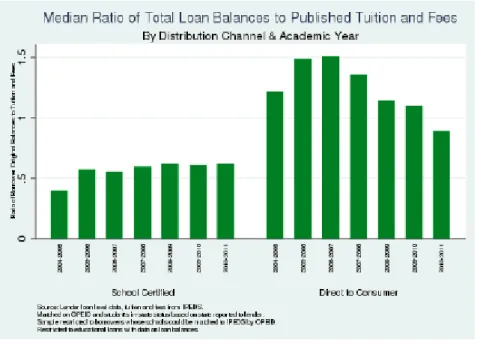
The private student loan market developed two loan products: “school certified” and “direct to consumer”. School certified loans are approved by the lender with funds sent directly to the school. “Direct-to-consumer” (hereafter DTC) loans are made directly to borrowers. DTC loans allow students to take on debt exceeding the required tuition amount, and possibly spend it on
18
education. Figure 11 shows the percentage of students that maximized their federal borrowing ability before turning to the private market (Cunningham & Kienzel 2011). Lenders operating outside the supervision of the educational institution often led borrowers to take out these more expensive loans prior to taking out the maximum amount of federal loans that are available to them. In a 2007-2008 study, only 46% of all undergraduate private loan borrowers maximized their federal loan amounts.
Figure 10: Utilization of Federal Loan Programs (FICO)
The push for DTC loans encouraged risky borrowing behavior among new students. Figure 12 shows the large over-borrowing by students with DTC loans. According to Moody’s (2009) DTC loans lack the safeguards featured by school channel loans that mitigate the risks the borrowed funds would be used for purposes other than the original educational intent. In 2009, Moody’s estimated that the expected lifetime default rate for a First Marblehead DTC loan would be 2.9 times that of school channel loans. By 2012, First Marblehead predicted the
19
lifetime default rate on its best quality loans would be 10.4% while the worst quality products, largely DTC loans, default 52.3% over their lifetime.
Figure 11: DTC Driven Over-borrowing (CFPB)
The prevalence of DTC loans declined rapidly following the financial crisis led to a tightening of credit standards. DTC loans comprised 32% of all undergraduate loans in 2008, this number fell to 8% in 2009 and were nearly nonexistent by 2011 (CFPB 2012). The proposed “Know Before You Owe Act” in Congress, if passed, would prevent the DTC market from ever returning to its previous form, which is likely a positive event for borrowers and investors alike.
FFEL Loan Characteristics
The FFEL program is comprised of four different types of loans: Stafford, Unsubsidized Stafford, PLUS, and Consolidation loans. The loans have different underwriting and repayment characteristics that affect borrower. Figure 11 shows for the origination volumes by product type for 1990-2000. The Unsubsidized Stafford loan volume grew rapidly from its inception to 2000. This can be attributed by borrowing from students and families who, while not meeting the
20
income requirements for the subsidized products, still needed assistance in meeting rising college tuition payments.
Figure 12: FFELP Product Volumes (1990-2000) (Department of Education)
The Stafford loan program includes both subsidized and unsubsidized versions. Subsidized Stafford loans are federally guaranteed student loans based on demonstrated financial need. During the period in which the borrower is enrolled on at least a part-time basis, or during any future deferment periods, the federal government pays the interest on the loan. Unsubsidized Stafford loans are federally guaranteed loans that are not based on any demonstrated financial aid and interest accrues from the time of disbursement to the school. The borrower is not required to make any interest or principal payments until six months after graduation, which allows the interest to be capitalized if the borrower so chooses. Both these programs have annual borrowing limits. Currently, limits for the unsubsidized program are based on the tax status of the student (independent or dependent), which is shown in Table 1 (Edvisors 2013).
21 Year Subsidized Unsubsidized (dependent) Unsubsidized (independent) Freshman $3,500 $2,000 $6,000 Sophmore $4,500 $2,000 $6,000 Junior $5,500 $2,000 $7,000 Senior $5,500 $2,000 $7,000
Table 1: FFELP Loan Limits
Prior to 1992 the FFEL program was known as the Guaranteed Student Loan (GSL) Program and also covered the Supplementary Loans for Students (SLS) Program. Figure 14 shows how the interest rates on these loans have changed over time. During the 1981-1992 time period interest rates on SLS loans were changed annually with various limits (7-9%, 12%, and 14%.) From 1988 to 1992, SLS loans carried a fixed rate of 8% which rose to 10% four years after origination. In 1987, variable rate loans were introduced (Finaid 2013).
Figure 13: Stafford Loan Rate History
The FFELP loan provides borrowers options when encountering difficulty in meeting their repayment requirements. First, the FFELP allows for deferment which releases the borrower
22
from the requirement of paying the principal on their loan. During this period, the federal government continues to make payments on subsidized Stafford loans. For unsubsidized loans, however, the interest accrues, leaving the borrower with the option of either paying the interest, or allowing capitalizing it. The time limits for the deferrment option vary with the borrower’s situation The borrower may defer payments indefinitely so long as they are enrolled in school at least half time, pursuing a graduate fellowship, in military service, or in rehabilitation training. If the borrower recently returned from active duty, they may defer for up to 13 months, while borrowers either unemployed or enduring economic hardship, the deferrment may last 36 months. Deferrments are not guaranteed and requests must be approved by the original lender (ISAC 2010). Second, the FFELP may suspend payments, known as forebearance. Forbearance terms are vaguer than those of deferrment with the length of time, and even the ability to do enter forbearance entirely up to the discretion of the lender based on borrower circumstances. Forbearance is granted in one year increments, with no limit on the number of times the request filed or granted. Federal regulations require that the lender certify the reason for the borrower’s request and use forbearance as a tool to return delinquent loans to current status or avoid default. Forebearance only applies if the lender believes that the borrower fully intends to eventually repay the loan (McGarvey & Nelson 2008). Some causes that would justify forbearance include unforeseen severe health or personal problems, inability to pay within the original window, and having monthly payments exceeding 20% of the borrower’s income (Michon 2013).
Private Loan Characteristics
The private student loan market is much more diverse than the federal market. Loan terms, interest rates, willingness to offer repayment and modification options vary by lender. Private lenders generally lack the default avoidance and risk mitigation tools provided by federal loan
23
programs (CFPB 2012). The only common option with federal loans is short-term forbearance, which lacks any identifiable guidelines. Additionally, private lenders do not offer income-based repayment options or loan forgiveness. Some lenders have indicated a willingness to develop rehabilitation programs that “would satisfy accounting rules and prudential regulators” (Touhey et. al. 2012).
The CFPB Student Loan Ombudsman’s first annual report in 2012 raises many concerns regarding the servicing of private student loans, specifically with borrower requests to enter into repayment options and loan modification plans that were allegedly offered in the original loan terms. The CFPB attributes these difficulties loan servicing rights that are bought and sold by different financial institutions. The report notes that borrowers note difficulty in enrolling into alternative repayment options that were advertised prior to origination. A common theme in borrower complaints is that they were unable to receive clear information regarding their repayment options, and even those who were able to get in contact with their servicer were generally unsuccessful in obtaining a modification. The CFPB report also uncovered lenders charging a monthly fee to borrowers in forebearance (Kamenshine 2012). It is difficult to understand why a servicer would charge an additional fee to someone who was already unable to meet their payment requirements.
A 2012 TransUnion report sheds light on repayment modification. The report found that 51% of student loans were in deferment or forbearance, up from 44% in 2011. While these figures may seem high, it is important to note that they include those borrowers utilizing the in-school deferrement option. Those borrowers have postponed payment on a total of $338 billion in outstanding student loans, marking a 70% increase from the prior year. Breaking down the
24
overall market numbers into federal and private loan varieties reveals the availability, or lack thereof, of repayment options in the two markets. Figure 15 shows forbearance rates for both private and federal loans The deferrment/forbearance rate for federal loan holders was 53% in March, compared to 19% of private loan holders (Androitis 2013). Another driver of the discrepancy in deferrment/forbearance rates between the two markets can be the fact that private loans are subject to tighter underwriting, such as requiring cosigners, meaning the multitude of risk mitigation tools may not be necessary (Nelson 2007).
Figure 14: Private and Federal Loan Forebearance
Student’s ability to utilize different repayment options to avoid falling behind on payments, raises some of the risks for unsubsidized and private loans. These increasing loan balances due to interest capitalization, combined with the inevitable end of the deferment period, exposes borrowers to higher debt levels than they started with, which is concerning given the unemployment/underemployment rate for recent college graduates under the age of 25 is 53.6%, its highest mark in 11 years (InsideARM 2013, Yen 2012). If the option to defer is unsuccessful, the next step is forbearance.
25
Figure 16 shows the results of a 2008 DBRS study that analyzed the quarterly forbearance rates of SLABs containing only FFELP loans and found a high correlation between the pool forbearance rates and the previous quarter’s unemployment rates, and concluded that investors may be likely to forecast future forbearance rates by using quarterly unemployment data (DBRS 2008).
Figure 15: Forbearance and Unemployment Rates
26
Although figure 17 shows the total unemployment rate for the United States, it is difficult to find an accurate depicting the unemployment rate for new college graduates. The Bureau of Labor Statistics reports that college graduates have the lowest unemployment rates in their age group, this is due to the fact that the BLS does not take underemployment into account. The difference between those who graduated college and those who only graduated high school is that underemployment for a high school graduate would likely only apply to part-time employment; a full-time job as a janitor, for example, would be considered in-line with expectations. A recent college graduate resorting to the janitorial trade does not constitute full employment.
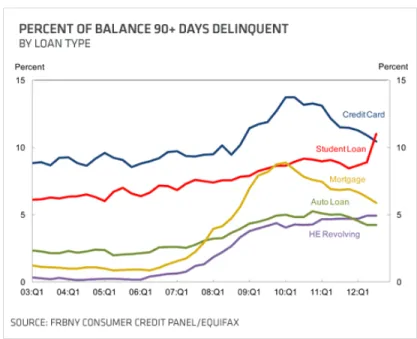
After college borrowers attempt deferment or forbearance options, the next status a student loan status is delinquency which begins the first day after a missed payment. The Institute for Higher Education Policy (2011) examined delinquency trends for the 2005 student cohort and found that 26% of borrowers were delinquent at some point during their repayment experience. Of that number, 21% fell into delinquency after using the default avoidance tools of deferment and forbearance (Cunningham & Kienzel 2011). A 2013 FICO report found that the student loan delinquency rate from 2010-2012 was 15.1%, up from 12.4% between 2005-2007 (Hamilton). As shown in Figure 18, these findings explain how delinquency rates on student loans have surpassed any other form of consumer debt. (Evans 2012).
27
Figure 17: Loan Delinquency
Understanding while student loan defaults are at the center of much of the concern regarding the industry, it is important to understand the story behind delinquency rates as it provides a more accurate depiction of how many borrowers are having difficulty meeting their repayment requirements. With the default avoidance tools and the extended delinquency window on federal loans (270 days vs. 120 days for private loans), the current default picture is not an entirely accurate representation, nor does it fully take into account future defaults once delinquent loans run out of options (KC Fed 2012). Even the delinquency rate itself does not provide a true understanding of the problems in the market. When calculating the delinquency rate, the delinquency total only includes those borrowers who are behind on their payments while not in a default avoidance program, while the total loans outstanding value includes those borrowers.
Major Players in the Private Loan Market
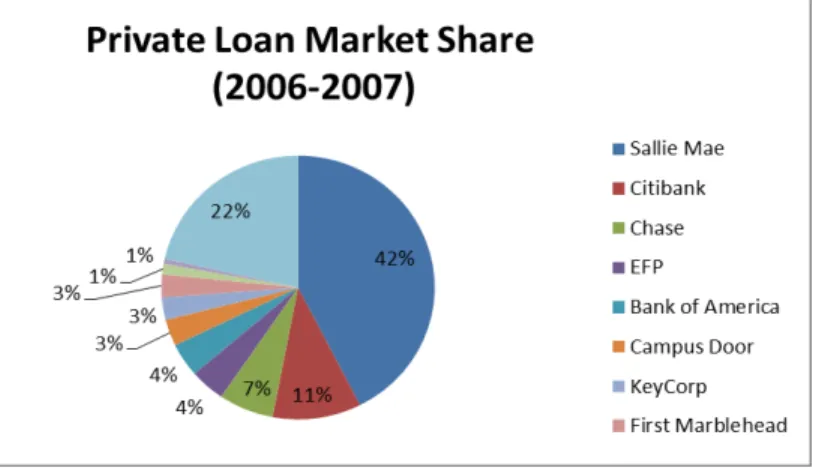
Sallie Mae is the largest non-government originator of student loans, but it is not the only corporation operating in the space. Figure 19 shows private lending market composition for the
28
2006-2007 year (Student Lending Analytics 2008). Many of the United States’ largest banking institutions originated, at one time or another, both FFELP loans and private student loans. .
Figure 18: 2006-2007 Private Loan Market Share
Following the financial crisis, several of those lenders either went defunct or withdrew from the market. These institutions were in turn replaced by new entrants including major financial firms like Discover Financial Services and Wells Fargo which now rival Sallie Mae in share.
Sallie Mae began originating private loans in the mid 1990s. Figure 20 shows both the growth in its private loan portfolio, as well as the percentage of those loans that were not in repayment. In 1996 the company introduced the Signature Education Loan Program making loans available to students at four-year colleges and universities to make up the difference between the cost of attendance and any federal student aid. The program limited borrowing to the difference between the cost of attendance and any other financial aid they received. SLM Financial, a wholly owned subsidiary of Sallie Mae expanded the business’s private loan operations to career training, adult learning, and K-12 education, underwriting and pricing these loans according to standard consumer credit scoring criteria (SLM Corp. 2000).
29
By 2005, SLM expanded its private lending business through focusing on its direct-to-consumer Tuition Answer program that made loans outside of the traditional financial aid process. The Tuition Answer program, started in 2004, utilized direct mail campaigns and web-based advertising to target students and parents. Under this program, borrowers could take out a loan for between $1,500 and $40,000 for “college-related expenses” without requiring any school certification. At this point, only 50% of SLM’s private education loans had co-signers, seemingly a dangerous level for the lender, but the increasd risk was reflected in increasing interest income as private loans averaged a 4.62% interest margin versus 1.39% for FFELP loans.
By their 2007, SLM began to witness flaws with its focus on the alternative lending products, yet the profitability of the division was still the main story. The year’s annual report includes the following:
We expect to continue to focus on generally higher-margin Private Education Loans, originated both through our school channel and our direct-to-consumer channel, with particular attention to upholding our more stringent underwriting standards. In January 2008, we notified some of our school customers whosse students have non-traditional loans that we were curtailing certain highdefault rate lending programs and reviewing the pricing of others. Actual credit performance at these programs was materially below our original expectations.
Despite SLM’s acknowledgement of the products’ risk, the share of private loans made to those borrowers with a co-signer only increased from 50% in 2005 to 52% in 2007. The private lending business continued to be quite profitable for the company, as the 5.15% net interest margin on those loans generated 36% of the core interest income for the year, despite the fact that they only represented 17% of the managed loan portfolio.
In 2008, SLM realized the serious problem posed by its activities in the private lending market. In the beginning of the year, the company announced the end of its non-traiditional lending
30
practice and revised the structure, pricing, underwriting, servicing, collecting, and funding of Private Education Loans. The percentage of private loans with a cosigner increased dramatically over the course of the year, from 52% the year before to 74%; reflecting SLM’s discovery that having a cosigner decreases default rates by 50%. Private loans were still very profitable for the company with a 5.09% net interest margincompared to 83 basis points for FFELP loans.
In 2011, SLM further revised its lending procedures for the private market. The company reported that 62% of the private portfolio loans were cosigned and 91% of loans originated in 2011 were cosigned. The company did report that previous loan loss provisions for loans that defaulted between 2008 and 2011 were not meeting its post-default projections. SLM makes an estimated charge-off for each loan once they become 212 days past due. The company also reported that in 2011, $7.2 billion in loans were currently in interest-only programs, representing 24% of all loans in repayment.
In its 2012 full-year earnings release, SLM reported that its fourth quarter profit fell as it increased loan loss provisions as a result of the continued, if not increased, inability of student borrowers to repay their debt. The company reported an increase in loan loss provisions of 16% over the prior year as it witnessed its net charge off rate rise from 3.52% to 4.19% (Associated Press 2013). Please see figure 18 for SLM’s net private loan portfolio and associated repayment behavior over time.
31
Figure 19: SLM Private Loan Portfolio
Over the last decade, the Student Loan Corporation (hereafter SLC), has been a large originator of private student loans. Figure 21 shows SLC’s private portfolio growth over the period. SLC was incorporated in 1992 to manage the student loan business of Citibank N.A., the banking arm of the financial services conglomerate Citigroup. SLC purchased the private loans originated by Citibank New York State (CNYS) under the CitiAssist program. Launched in 1997 CNYS private loans are for students who do not qualify for federal aid or need additional funding to cover the costs of college education. The loans are tied to the prime rate with repayment characteristics modeled on the FFEL Program.
32
For much of the 2000s, CitiAssist loans were generally originated in a conservative manner. Primarily school-channel based, the lending amounts revolved around certification from the school’s financial aid advisor. During the financial crisis, SLC reported minimal credit deterioration to its private loan portfolio, citing only slight rises in delinquency and forbearance rates. The crisis, however, did force the company to cease private consolidation loan operations in October of 2008.
In 2009, SLC revised its private loan servicing procedures. The company outlined changes involving borrowers with payment difficulties facing stricter performance criteria to be granted forbearance or deferment. The company noted expected these changes would materially increase losses from private loans. Similarly to Sallie Mae, SLC began an interest-only repayment option which was utilized by 19% of private loan borrowers.
At the time, SLC was the third largest originator of private loans (shown in Figure 22) but in late 2010, SLC announced liquidation of its assets that would shift the private loan market composition. Sallie Mae purchased $28 billion of SLC’s federal loans and related assets, Citibank purchased $8.7 billion in both federal and private student loans, and Discover Financial Services purchased $4.2 billion in private student loans that included 74% cosigned loans, 65% loans in repayment, and 70% insured loans (McIntyre 2010). With the acquisition, Discover became a top originator of private student loans (Discover 2010).
33
Figure 21: 2009 Private Loan Market Shares
Discover was a relatively late entrant to the private lending market, beginning their program in 2007. The goal of the program was to establish variable rate Certified Private Loans for families and students with zero origination and prepayment fees with spreads ranging from 50 – 625 basis points based on credit criteria (Methodist University).
Discover encouraged reponsible borrowering by requiring school certification and directly disbusing loans to the institution. The loans featured various timely repayment and education incentives including a cash reward at graduation equal to 2% of the outstanding loan balance.
In 2010, Discover announced that it was selling any federally guaranteed loans it held in its portfolio in order to focus on the newly acquired assets from SLC which quadrupled the size of its private loan holdings, as shown in Figure 23. In 2011, Discover purchased an additional $2.5 billion in private loans from Citibank despite the the possibility of repealing the private student loan exclusion from bankruptcy They claim this is not a material concern, however, since their underwriting practices and percentage of loans with cosigners mitigates any risk to the business
34
Figure 22: Discover Private Loan Portfolio
KeyCorp is yet another player in the private loan space. Figure 24 shows their student lending portfolio for the period they were involved in the business. KeyCorp makes very little mention of its student lending business in its annual reports, aside from providing the total amount of education loans it services or administers.
Figure 23:KeyCorp Student Loan Portfolio (Barclays)
KeyCorp prospectuses for its securitized loan trusts offer the most insight into it student lending business. In the mid-1990s, KeyCorp purchased student loans originated by The Access Group, a nonprofit entity that was a leader in providing loans for law students. Access Group was
35
founded in 1983 to provide both federal and private student loans. In 1993, they created a spinoff, Law Access Inc., to handle the private loans that expanded beyond loans to law students. KeyCorp purchased the Access Group loans, insured them against default with TERI, and packaged them into securities for sale. TERI guaranteed the total principal amount in the event of a borrower default (no payment for 120 days), a borrower bankruptcy, the death of the borrower, or the total and permanent disability of the borrower. All of the private loans in the 1996 securitization were insured.
By 2000, KeyCorp securitizations began to include a substantial amount of unguaranteed private loans (31.69% of total private), driven mainly by the Key Alternative Loan Program. The Alternative Loan Program was introduced in 1995 as another tool for students to use to finance their education with similar terms as the other private loans originated by the Access Group and guaranteed by TERI. The prospectus does not mention the reason for KeyCorp not choosing to insure these loans against default.
KeyCorp issued its last securitization in 2006 in a trust featuring a group of private loans that were nearly all unguaranteed (98.98%). The unguaranteed private loans included loans from the Key Alternative Loan Program, Campus Door Loans, Key CareerLoans, Private Graduate Loans, and Achiever Loans (K-12). The financial crisis led KeyCorp to announce it would limit new education loans to government backed programs, thereby eliminating itself from the private lending market. KeyCorp attributed this plan to management’s decision to “deemphasize their out-of-footprint businesses.” Shortly after announcing the switch to an entirely federally-backed education lending model in September of 2009, KeyCorp announced that it was discontinuing education lending.
36
The biggest player in the private lending market was First Marblehead (hereafter FMD). FMD’s main business objective, prior to its restructuring in late 2009-2010, was to provide services for private education lending in the United States. FMD did not originate, guarantee, or service loans, but rather collected fees from processing and securitizing third party loans. In addition to the securitization process, FMD also assisted lenders with underwriting, documentation and disbursement, and customer support. Figure 25 provides information on FMD’s private lender clients’ two major business lines: “make and sell” and “make and hold.” The former grouping referred to those lenders that securitized and sold its originated student loans and the latter referring to those institutions which retained the loans on their balance sheets.
Figure 24: FMD Client Business Lines
The shift towards the securitization model shown in Figure 25 was greatly beneficial to FMD (representing 78% of revenue for FY 2007). This focus on securitization reflected a key provision in the First Marblehead approach, which reads: “Using our services, our clients can offer student borrowers access to customized, competitive student loan products while enhancing their fees but minimizing their resource commitment and exposure to credit risk.” For FMD’s
37
clients, securitization offered the opportunity to increase loan volume and fees, without keeping any “skin-in-the-game” as far as risk retention goes.
FMD’s role in the securitization process was to establish the bankruptcy remote special purpose entities that would house the purchased (which in some cases were sourced, processed, and underwritten by FMD) and assist with the bond issues. In return, FMD earned advisory and administrative fees, as well as a residual interest payment from the securitization. By 2004, FMD structured and facilitated 22 private student loan securitizations. And this number rose to 36 securitizations by 2007. In 2006 alone, the trusts that FMD created and advised would have been, combined, the fourth largest issuer of SLABs.
In addition to its securitization business, FMD’s strategic alliance with TERI allowed it to become such an integral part of the private student lending market. In 2001, FMD entered into a relationship with TERI with the goal of enhancing the company’s risk management and loan processing abilities. The alliance was a partial acquisition of TERI, resulting in FMD purchasing its historical database and loan processing operations, along with 161 TERI employees in exchange for $7.9 million in promissory notes, $1 million in cash, and a 25% share on all future TERI-guaranteed FMD-facilitated securitizations.
The TERI-FMD alliance resulted in the creation of a master servicing agreement in which TERI sub-contracted FMD to provide origination, pre-claims, claims, and default management services for TERI’s client lenders. In addition to the servicing agreement, the entities also entered into a master guaranty agreement in which TERI possessed the right of first refusal to guarantee FMD’s clients’ current and future loan programs. FMD also agreed to create a market for its clients to sell TERI-guaranteed loans through FMD-facilitated securitizations. Under this
38
agreement, FMD was required, to the best of its abilities, to generate securitizations of TERI-guaranteed loans twice per year.
Shortly after FMD filed its 2007 10-k report, business deteriorated due to the credit market issues that developed in the latter half of 2007 and into 2008, FMD was unable to issue any new securitizations. This issue was made worse in April 2008 when TERI filed for voluntary bankruptcy, citing liquidity problems caused by credit market volatility and increased borrower defaults/delinquencies (Business Wire 2008). The TERI bankruptcy became a bigger issue for FMD than the constricted debt markets. FMD generated much of their business from TERI-sourced client relationships. As a result of the bankruptcy filing, three major lenders (Bank of America, Royal Bank of Scotland, and J.P. Morgan Chase) terminated their relationships with FMD. These three lenders generated 56% of FMD’s loans available for securitization in 2008.
As a result of being shut out of the securitization market, FMD resorted to changing its entire business model during 2009 and 2010. FMD began to focus more on fee-for-service offerings like portfolio management and asset servicing. The company also introduced “Monogram,” a program that incorporates refinements to the company’s origination process. As of 2010, FMD began originating loans under the Monogram program in agreement with SunTrust Bank. FMD designed the Monogram focus to distance the company from the capital markets and make it less dependent on the securitization market. Without TERI, FMD has used the Monogram program to fund various credit enhancement efforts on the portfolios. As of its 2012 10-k, FMD had gotten its Monogram program fully functional; originating its own education loans through its banking subsidiary, Union Federal Bank.
39
The successes and failures of the institutions involved in the private loan market revolve heavily on the practice of securitization. First Marblehead evidenced how the securitization process, when functioning as intended, can be a great boon to business, but in the event the system breaks down, it can cripple a business’s lending operation.
Section III: Data
The data includes student loan trusts originated between 2001 and 2007 packaged by KeyCorp and Sallie Mae. Table 2 provides complete trust names and identifiers. The Sallie Mae Trusts are comprised of private student loans, while the KeyCorp securitizations contain both federal and private loans. The KeyCorp securitizations are tranched into several groups of public and private loans, however, we focus on the Group II of each trust which contain only private loans. In total, the sixteen private loan trusts represent a total principal amount of $20.885 billion, representing approximately 25% of the private loan market for the period. The monthly trust performance data start from origination through August 2012. The data includes 428 individual records of cumulative defaults for the respective trusts.
40
Trust Name Identifer
SLM Private Credit Student Loan Trust 2002-A 1 SLM Private Credit Student Loan Trust 2003-A 2 SLM Private Credit Student Loan Trust 2003-B 3 SLM Private Credit Student Loan Trust 2003-C 4 SLM Private Credit Student Loan Trust 2004-A 5 SLM Private Credit Student Loan Trust 2004-B 6 SLM Private Credit Student Loan Trust 2005-A 7 SLM Private Credit Student Loan Trust 2005-B 8 SLM Private Credit Student Loan Trust 2006-A 9 SLM Private Credit Student Loan Trust 2006-B 10 SLM Private Credit Student Loan Trust 2006-C 11 SLM Private Credit Student Loan Trust 2007-A 12
KeyCorp Student Loan Trust 2001-A 13
KeyCorp Student Loan Trust 2002-A 14
KeyCorp Student Loan Trust 2003-A 15
KeyCorp Student Loan Trust 2004-A 16
Table 2: Trust Names and Identifiers
The student loan trust prospectuses contain a variety of information regarding loan type, and borrower characteristics that can be used as tools in investigating the cumulative default patterns. Table 3 provides borrower specific information. The number of borrowers in each trust ranges from 29,157 to 166,394, averaging 95,121. The Sallie Mae trusts are considerably larger than the KeyCorp issuances and both issuers grew the size of their securitizations over time. The average principal amount outstanding per borrower ranges from $10,999 to $17,971, averaging $13,138.19. The Sallie Mae securitizations generally had the same average loan amount per borrower, while KeyCorp’s average principal grew by 26% in the span of 4 years. The Sallie Mae prospectuses also provide information regarding borrower credit worthiness. The average FICO score for borrowers at origination ranges from 714 to 736, averaging 719. At issuance, these scores declined, ranging from 696 to 712 and averaging 706. This decline can be attributed to borrowers who had no credit score at origination but developed a credit history as they began
41
repayment. Loans were also made to borrowers with sub-prime credit or nonexistent credit scores. At origination, these loans made up 0.7% to 38.7% of the total principal, averaging 13.4%. These percentages generally declined over the period as the issuers began to require more co-signers to mitigate credit risks. At issuance, the share of sub-prime or no credit history borrowers ranges from 6.9% to 13%. These values are more representative of the overall credit-worthiness of the pool as most borrowers have developed a credit history by that point.
Identifer Borrowers Av. Prin Outstanding per Borrower Origination FICO % Prin w/ Origination FICO sub-630 or non-existant Cut-Off FICO % Prin w/ Cut-Off FICO sub-630 or non-existant 1 48,548 $ 14,220 718 14.90% 703 13.00% 2 77,197 $ 13,021 715 33.40% 710 10.10% 3 103,358 $ 12,068 719 24.60% 712 6.92% 4 91,587 $ 13,648 736 16.20% 712 9.70% 5 104,834 $ 11,944 716 38.70% 696 10.10% 6 109,001 $ 11,767 720 8.00% 703 8.80% 7 132,087 $ 11,394 717 5.40% 701 9.80% 8 128,332 $ 11,690 721 2.90% 710 8.70% 9 165,026 $ 12,121 719 1.90% 707 9.60% 10 166,394 $ 12,016 718 11.10% 708 7.20% 11 98,962 $ 10,999 714 3.50% 700 12.20% 12 153,654 $ 13,020 718 0.70% 710 7.80% 13 29,157 $ 14,250 . . . . 14 41,174 $ 15,151 . . . . 15 33,575 $ 16,542 . . . . 16 39,057 $ 17,971 . . . .
Table 3: Borrower Characteristics
Table 4 provides loan status as a share of total trust principal. The prospectuses break down the loans into five main groups: in-school, grace, deferment, forbearance, and repayment. The loan status mix is fairly different between issuers. Sallie Mae securitizations feature anywhere from 44.5% to 85.4% of in-school loans, averaging 60.18%. On the other hand, in-school loans for
42
KeyCorp issuances range from 4.09% to 21.25%, averaging 10.37%. This difference means that the repayment performance of a majority of Sallie Mae loans was unknown at the time of issuance as borrowers had yet to enter the repayment period, while a vast majority of KeyCorp loans were already out of school and facing repayment. The trusts also featured varying amounts of loans in the grace period (6 months following graduation). The Sallie Mae issuances range from 7.3% to 44.1% of principal in the grace status, averaging 15.4%. KeyCorp issued trusts with considerably more loans in the grace period, ranging from 33.89% to 48.91% and averaging 43.85%. This difference means that, at issuance, a large portion of KeyCorp borrowers were fresh out of school and nearing the repayment period.
Identifer In School Grace Deferred Forbearance Repayment
1 16.60% 44.10% 1.60% 2.70% 35.00% 2 47.40% 7.30% 0.10% 4.60% 40.60% 3 61.30% 7.30% 0.00% 2.40% 29.00% 4 51.40% 23.00% 0.10% 4.20% 21.30% 5 44.50% 13.50% 2.30% 9.10% 30.60% 6 85.40% 7.70% 1.00% 1.20% 4.70% 7 71.40% 12.30% 1.30% 1.70% 13.30% 8 68.20% 19.80% 1.10% 1.70% 9.20% 9 77.60% 8.40% 1.00% 2.20% 10.80% 10 65.90% 13.60% 0.80% 3.20% 16.50% 11 61.40% 19.90% 1.30% 3.50% 13.90% 12 71.10% 8.00% 1.10% 2.40% 17.40% 13 4.09% 48.91% 2.69% 6.47% 37.84% 14 7.51% 33.89% 19.33% 3.44% 35.83% 15 8.63% 46.75% 14.59% 0.40% 29.63% 16 21.25% 44.26% 12.08% 0.20% 22.21%
Table 4: Loan Status as a Percent of Total Principal
Table 5 provides percentages of principal by loan type. The prospectuses break down loan type into five main groups: four-year undergrad and liberal arts graduate loans, 2-year undergraduate loans, law school loans, MBA loans, and medical school loans. The first group comprises
43
majority of the principal in the trusts, ranging from 46.6% to 86.7% and averaging 69.1% across the issuers. Two-year loans, regarded as the riskiest student product, ranges from 0% to 28.5% and averages 6.1%. Sallie Mae kept their 2-year loans to a minimum for most of the period (averaging 2.47% for trusts 1-11), but this value jumped to 28.5% for trust 12, a noticeable increase in risk profile for the entire trust. KeyCorp, while featuring high percentages (averaging 10.94%), kept their loan profile fairly consistent. Law loans, while initially a sizeable portion of the trusts, fell out of favor as the years went on, ranging from 3.5% of total principal to 22.1%, averaging 11%. The same story is true for Sallie Mae regarding MBA and medical loans. The share of MBA loans ranges from 0.8% (KeyCorp didn’t issue this type of loan) to 15.3%, averaging 4.2%. Medical loans make up between 1.4% and 18% of the trusts, averaging 7%. For Sallie Mae, these loans became a marginal product in the later securitizations, while KeyCorp medical loans averaged 13% of the total trust principal over the period.
44
Identifer Undergrad Loans 2-Year Loans Loans Law MBA Loans Medical Loans
1 47.70% 1.80% 20.20% 15.30% 14.90% 2 66.40% 1.30% 22.10% 4.90% 5.10% 3 73.20% 3.00% 14.30% 4.50% 5.00% 4 68.00% 3.60% 15.20% 10.20% 2.90% 5 67.90% 4.10% 13.20% 4.70% 10.00% 6 77.50% 2.30% 7.40% 6.70% 5.90% 7 81.60% 4.90% 5.90% 4.50% 3.10% 8 86.70% 0.30% 6.10% 4.30% 2.60% 9 86.50% 0.50% 5.90% 5.00% 2.20% 10 82.40% 2.90% 9.80% 2.20% 2.60% 11 81.60% 2.50% 6.50% 3.30% 5.00% 12 46.60% 28.50% 3.50% 0.80% 1.40% 13 56.00% 0.00% 22.00% 0.00% 18.00% 14 61.00% 12.77% 7.00% 0.00% 12.00% 15 57.00% 17.00% 9.00% 0.00% 11.00% 16 63.00% 14.00% 7.00% 0.00% 11.00%
Table 5: Loan Type as a Percent of Total Principal
Section IV: Empirical Results
Univariate Tests
The central focus of this research is to determine if the mean cumulative default values are significantly statistically different between the trusts and if they have changed over time. Figure x shows the raw cumulative default values for the trusts in the study and appear to have different shapes and slopes. The KeyCorp trusts (13-16) differ from the Sallie Mae trusts (1-12) with default curves indicating a higher rate of credit deterioration than the Sallie Mae trusts. The numbers associated with the trusts in Figure x are based on vintage, i.e., Trust 1 is the oldest Sallie Mae issuance and Trust 13 is the oldest KeyCorp issuance. The older vintages have longer performance issuance information.
45
Figure 25: Cumulative Default by Period
Figure 25 suggests that there may be difference across issuers and time when examining turst performance. Normally, the T-Test is used to test the difference in groups, as there are only two issuers in the study, but further tests would involve multiple groups. Also, T-Tests rely on assumptions that are violated by the type of data in this study; namely the variance in means across groups. For those reasons, the statistical testing method will feature the ANOVA test.
The null hypothesis of the one-way ANOVA is that the means of the groups are equal. The alternative hypothesis is that at least two of the group means are significantly different. The one-way ANOVA carries numerous assumptions, one of which is variance equality. This is a key issue with respect to the data in the study. The cumulative defaults for the trusts are time-series values. The variance of the mean increases as the trust ages, meaning, the variances within this data set are unequal, effectively violating one of the assumptions of the One-way ANOVA test.
46
The unequal variance issue is exacerbated by the unequal sample sizes of the trusts. As some trusts were naturally originated at an earlier date than others, they have more record periods. The combination of these two factors would leave any One-way ANOVA result suspect at best, as the p-values would be too conservative or liberal for any conclusion to be reached with confidence.
Fortunately, the One-way ANOVA is robust with respect to the homogeneity of variance assumption. If a statistical test is robust, it means that the output is minimally affected by a violation of that assumption. The prerequisite for the ANOVA “robustness” is that the group sizes need to be more or less equal (Northern Arizona University). The record periods for the trusts range from a high of 40 to a low of 8. In order to get the One-way ANOVA to work, the sample size of the largest group must be no more than 1 ½ times that of the smallest group. As such, only 12 records were included from 15 of the trusts, with the last trust providing 8. The study now is testing whether or not the cumulative default rates on the trusts were statistically different within the first 2-3 years following origination.
Figure 26 shows the difference in cumulative default rates by issuer which appear vastly different. Statistically, the difference in mean default rates, by seasoning, for the issuers generated an F-statistic of 156.85, which at 187 degrees of freedom, resulted in a probability > F of 0.000 meaning that the null hypothesis of mean equality can be rejected. Thus, the KeyCorp trusts do perform worse than their Sallie Mae counterparts.
47
Figure 256: Cumulative Default by Issuer
Given the significant differences in default curves, the next question is to find if the results are impacted by cohort year. The cohort years were constructed as dummy variables for analysis, and the univariate tests reveal some years were significant while others were not. All cohort years for each issuer are shown in figures 27 and 28 below for comparison purposes. Both figures reveal the trend indicated by the original depiction, that is, trusts issued later on in the observation period performed worse than their peers. This is evidence that the trusts were either constructed differently as the years went on, or they were exposed to different repayment environments early in their lifecycle.
48
Figure 27: Cumulative Default by Cohort Year (KeyCorp)
Figure 28: Cumulative Default by Cohort Year (Sallie Mae)
Having established that the cumulative default rates are statistically different by issuer and cohort year, the next step is to determine if the trusts are significantly different from each other across issuer and cohort year. First, the one-way ANOVA test determined that the trusts are significantly different from each other with an F-statistic of 6.83 and a p-value of 0.000. Figure 29 and 30 show the cumulative default curve by trust for each issuer. These charts reveal trends that are consistent with the original picture. The KeyCorp chart reveals that later vintage trusts did perform worse than earlier vintage issuances. The Sallie Mae chart, while less clear, shows
49
the same trend. The last three trusts in the Sallie Mae group performed the worst, while all the other issuances were more or less had similar curves. This level of analysis shows that the make-up of the trusts are significantly different enough to cause changes in the cumulative default patterns.
50
Figure 30: Cumulative Default by Trust (Sallie Mae)
Given the variation in cumulative default trends for the trusts, the next question is whether these differences are due to borrower characteristics of the trusts.
Figure 31 and 32 provides the relationship between percentage of loans in 2 or 4 year programs and cumulative default rates for Sallie Mae. For illustrative purposes, the charts depict the default curves for the trusts with the highest and lowest percentage of loans in each program type. For undergrad programs, Trust 8 has the highest percentage of principal in undergrad loans (86.7%) and Trust 12 has the lowest percentage (46.6%). Trust 7 has the highest percentage of principal in two-year loans (4.7%) while Trust 8 has the lowest (0.3%). The two-year program trend is the most important feature to highlight. Two-year programs are mostly held at for-profit educational institutions that have been in the spotlight for encouraging heavy student borrowing in order to make the tuition payments that drive bottom line profitability. These institutions are not likely to give out any sort of scholarship or subsidized aid packages, and as a result, students
51
are left to borrow the full cost of tuition, which in some cases rivals that of well-regarded four-year colleges. Students graduating from these programs (which is hardly guaranteed) may not end up being employed at a position that pays a salary suitable for repaying the loans.
Figure 31: Cumulative Default by % Undergrad Loans
52
Figures 33 and 34 show the relationship between loan status and cumulative defaults for Sallie Mae trusts. The initial credit quality of the loan pools may also be captured by the percentage of loans in forbearance when the trusts are formed. Trusts with higher percentages typically have higher cumulative default rates than those trusts with the lowest percentages. Trust 5 features the greatest percentage of loans in forbearance at issuance (9.1%) while Trust 6 has the lowest amount (1.2%). This trend is less clear for the deferment option due to the Sallie Mae trusts all having similar starting values for the percent of loans in deferment. Trust 5 has the highest percentage of loans in deferment (2.3%) and Trust 3 has the lowest (0%).
53
Figure 34: Cumulative Default by % Loans in Deferment
SLAB investors, like most fixed income investors, rely on the FICO when examining these pools. The average FICO scores at origination can also provide clues as to how the trusts will perform. Figure 35 shows the relationship between origination FICO scores and cumulative default rates. The chart shows that there is a sizeable difference in cumulative default rates at the end of three years for the trust with the highest average FICO score at origination (Trust 4, 736) and the trust with the lowest (Trust 11, 714). While these values do not take into account loans that featured borrowers without a credit score, it does provide some insight to the general credit quality of the borrowers in the trust.
54
Figure 35: Cumulative Default by Origination FICO
While a trust’s default behavior is caused by varying internal aspects due to underwriting, these factors cannot entirely explain the performance history. External economic conditions may also impact borrower repayment. The internal trust dynamics influence how each issue performs in the external environment. Table 6 provides the minimums and maximums for selected economic variables which varied dramatically over the performance horizon. For example, the range of GDP growth over the period exceeds 15%. The 90-day treasury bill, an integral factor for floating rate products like student loans, fell from a high of 5% to essentially zero in approximately a year. The unemployment rate, normally 5-6% in normal economic conditions, jumped to nearly 10% during the recession. This unemployment number does not account for unemployment, which is an important issue relating to new college graduates and debt repayment.
55
Variable Min Max
Unemployment 4.40% 9.90%
GDP Growth -8.90% 6.70%
CPI Change YoY -1.50% 5.40%
90 Day T-Bill 0.00% 5.00%
Table 6: Economic Variables
Figure 36 provides the relationship between the national unemployment rate and the cumulative default rate for the Sallie Mae securities. Cumulative defaults appear to increase with the unemployment rate which is not a groundbreaking discovery, although, the trusts appear to be fairly resilient to mild to moderate unemployment. The rapid climb in defaults occurred right as the nation crossed the 6.5% unemployment level. Figure 37 paints a clearer picture of the cumulative default-unemployment relationship. As soon as the unemployment rate in the period was 1% higher than it was at origination, cumulative defaults began to rise dramatically. Both these charts illustrate how weak the trusts were in the face of deteriorating employment conditions. In a high-unemployment scenario, companies are less likely to hire inexperienced college graduates who were likely expecting full employment following their graduation.