Towards an Understanding of the Role of Standard Setters in
Standard Setting
(Article begins on next page)
The Harvard community has made this article openly available.
Please share
how this access benefits you. Your story matters.
Citation
Allen, Abigail M., and Karthik Ramanna. "Towards an
Understanding of the Role of Standard Setters in Standard
Setting." Journal of Accounting & Economics 55, no. 1 (February
2013).
Published Version
doi:10.1016/j.jacceco.2012.05.003
Accessed
February 19, 2015 1:40:14 PM EST
Citable Link
http://nrs.harvard.edu/urn-3:HUL.InstRepos:11320611
Terms of Use
This article was downloaded from Harvard University's DASH
repository, and is made available under the terms and conditions
applicable to Open Access Policy Articles, as set forth at
http://nrs.harvard.edu/urn-3:HUL.InstRepos:dash.current.terms-of-use#OAP
Copyright © 2010, 2011, 2012 by Abigail Allen and Karthik Ramanna
Working papers are in draft form. This working paper is distributed for purposes of comment and discussion only. It may not be reproduced without permission of the copyright holder. Copies of working papers are available from the author.
Towards an understanding of
the role of standard setters in
standard setting
Abigail Allen
Karthik Ramanna
Working Paper
10-105
May 24, 2012
Towards an understanding of the role of standard setters in standard setting*
Abigail Allen and Karthik Ramanna Harvard Business School
First draft: May 21, 2010 This draft: May 24, 2012
Abstract
We investigate the effect of standard setters in standard setting: We examine how certain professional and political characteristics of FASB members and SEC commissioners predict the accounting “reliability” and “relevance” of proposed standards. Notably, we find FASB members with backgrounds in financial services are more likely to propose standards that decrease “reliability” and increase “relevance,” partly due to their tendency to propose fair-value methods. We find opposite results for FASB members affiliated with the Democratic Party, although only when excluding financial-services background as an independent variable. Jackknife procedures show that results are robust to omitting any individual standard setter.
* We thank Mary Barth, Robert Bloomfield (the reviewer), Michelle Hanlon (the editor), Paul Healy, S.P. Kothari,
Krishna Palepu, Sugata Roychowdhury, Doug Skinner, Ross Watts, and seminar participants at Minnesota, MIT, the 2010 HBS IMO Conference, and the 2011 AAA FARS Conference for helpful comments; Beiting Cheng, Michael Kregar, Scott Renner, and the HBS division of research for excellent research assistance; and Charry Boris, Ron Guerrette, and the FAF for generous help with sourcing data on comment letters and exposure drafts. Any errors are our responsibility.
1
1. Introduction
As the Financial Accounting Standards Board (FASB) closes in on four decades, the role
of its standards in shaping U.S. and international corporate reporting is widely acknowledged.
An empirical literature on the political economy of FASB standard setting has emerged over that
period to explore the origins of accounting standards largely through an analysis of constituent
comment-letter lobbying (e.g., Watts and Zimmerman, 1978). But such comment-letter lobbying
is only part of the political economy that determines accounting standards (e.g., Ramanna, 2008,
studies the role of congressional intervention). At the core of the standard-setting process are the
individuals that comprise the FASB and its sanctioning authority, the Securities and Exchange
Commission (SEC). In this paper, we develop and test some exploratory hypotheses with a view
towards building an understanding of the role of FASB and SEC regulators in U.S. GAAP.
Although the idea that FASB and SEC regulators can matter in standard setting is
intuitively appealing, it has not been subject to empirical testing. This is due in part to limited
data availability, but also in part to neoclassical economics, which is widely used in accounting
research and tends to view “individuals” as “so empirically unimportant as to allow the use of
Occam’s razor in positive models” (e.g., Kalt and Zupan, 1984, p. 279). Recently, however,
empiricists in finance and accounting have begun exploring the role of individuals on
equilibrium outcomes, particularly in the context of individual managers and firm policies (e.g.,
Bertrand and Schoar, 2003; Bamber, Jiang, and Wang, 2010; Dyreng, Hanlon, and Maydew,
2010). Moreover, in the regulation literature itself, there is some evidence of regulators’
preferences mattering in outcomes at both the congressional (e.g., Kau and Rubin, 1979) and the
setting, tests of influence of FASB and SEC regulators can help refine our understanding of the
political economy of U.S. GAAP.
We conduct our study through an analysis of FASB exposure drafts proposed from 1973
(the FASB’s inception) through 2007. There are 149 such exposure drafts in our sample after
data limitations. Our primary tests involve regressing assessments of the nature of an exposure
draft on the average background characteristics of extant FASB and SEC regulators.
We evaluate a proposed SFAS (Statement of Financial Accounting Standards) by
focusing in particular on its impact on accounting “relevance” and “reliability”—two
characteristics usually cited as fundamental accounting properties in accounting textbooks (e.g.,
Stickney, Weil, Schipper, and Francis, 2010, pp. 23, 114). There are no obvious metrics to use in
evaluating exposure drafts; our choice of “relevance” and “reliability” reflects our judgment on
their importance to accounting. Since at least the publication of its conceptual statements in the
late 1970s (e.g., FASB, 1978; 1980), the FASB itself has viewed “relevance” and “reliability” as
“the two primary qualities that make accounting information useful for decision making” (FASB,
1980, p. 5), adding that “serious disagreement” often arises “about whether the superior
relevance of the results of one [accounting] method outweighs the superior reliability of the
results of [another]” (FASB, 1980, p. 8). Moreover, the increased prominence, since the
mid-1990s, of fair-value accounting in standard setting has generated additional interest in the
“trade-off” between “relevance” and “reliability.” The FASB has often justified the increased use of fair
values by arguing it will increase the “relevance” of accounting numbers (e.g., Johnson, 2005).
In contrast, some academics have argued accounting estimates generated under fair-value
accounting will decrease the “reliability” of financial reports (e.g., Watts, 2003).1
1 While “reliability” and “relevance” can be trade-offs in some circumstances, it is an empirical question as to
To obtain assessments of exposure drafts’ impact on “relevance” and “reliability” that are
independent of researcher judgment, we develop a measure based on comment letters filed by the
Big 8/6/5/4 auditors (hereafter, “Big N auditors”). There are 908 such comment letters in our
sample after data limitations. The advantage to using Big N auditors’ comment letters is that they
are available on most exposure drafts in our sample period and are contemporaneous (i.e., no
hindsight bias). The letters are, however, likely to reflect the auditors’ private incentives, which
can confound inferences if endogenous to our explanatory variables (i.e., the characteristics of
FASB and SEC regulators). To mitigate this concern, in robustness tests we use an alternative
assessment of the exposure drafts from two seasoned research assistants (with over thirty years
of combined experience in accounting) blind to the objective of this study.
We build a biographical database of all 39 FASB members and all 41 SEC
commissioners serving between 1973 and 2007. Drawing on empirical political-economy
research that has examined the characteristics of regulators on regulation (see Dal Bo, 2006, for a
review), we focus on two sets of characteristics: professional and political. The professional
characteristics are length of regulatory tenure, industry background in auditing, and industry
background in investment banking/ investment management (hereafter, “financial services”);2
the political characteristics are affiliations, if any, with the Democratic and Republican parties.
Prior research has consistently found high correlations between regulators’ professional and
political characteristics and so has examined these characteristics both independently and jointly
in multivariate regressions. We adopt this approach in our empirical design.
In examining professional characteristics independently, we find that longer average
FASB and SEC tenures are associated with exposure drafts perceived by auditors as decreasing
2 When studying industry background, the regulatory literature has focused on industries most closely associated
with the regulations being studied. In our setting, we focus on auditing and financial services, viewing them as front-line intermediaries in the production and use of accounting information.
accounting “reliability;” but, we find no evidence of an association between the regulators’
tenures and exposure drafts’ “relevance.” If decreased “reliability” is an undesirable property of
accounting (e.g., Watts, 2003), the result is consistent with longer regulatory tenures
compromising accounting quality.3 Concerning industry backgrounds, we expect regulators with
prior employment in auditing to be more sympathetic to accounting “reliability” (since “reliable”
accounting lowers auditors’ litigation risk; e.g., Watts, 2003); in contrast, we expect members
with prior employment in financial services to be sympathetic to valuation-relevant accounting
(e.g., ICI, 2008), and thus more likely to promote “relevance” at the expense of “reliability”
(e.g., Johnson, 2005). We do not find results associating regulators’ careers in auditing with
“reliability” and “relevance.” However, we find evidence that exposure drafts proposed by FASB
members and SEC commissioners with prior experience in financial services are viewed by the
Big N auditors as decreasing accounting “reliability.” Further, in the case of FASB members,
experience in financial services is associated with exposure drafts viewed by the Big N auditors
as increasing accounting “relevance.” Additional analysis suggests these associations are partly
due to the tendency of FASB members with financial-services backgrounds (the proportion of
which increases in our sample period) to propose standards that use fair-value methods.
In studying regulators’ political characteristics, we are motivated by prior
political-science research that has shown that political affiliations are salient predictors of regulator
behavior: e.g., Cohen (1986) provides evidence that Democratic regulators are on average less
sympathetic to corporate interests. In examining political characteristics independently, we find
evidence that increased proportional membership of Democrats on the FASB is associated with
exposure drafts that are perceived by the Big N auditors as both increasing accounting
3 Stigler (1971) argues that longer regulatory tenures compromise regulation by promoting greater “coziness”
“reliability” and decreasing accounting “relevance.” However, when we examine the regulators’
professional and political characteristics jointly, we find that the results on backgrounds in
financial services alone survive. Thus, in our population and time period, political affiliation
does not appear to be a significant factor beyond financial services affiliation. We note that there
is no ex-ante theory that suggests either professional or political characteristics are more
important than the other in explaining regulatory decisions (e.g., Dal Bo, 2006), thus future
research is needed to draw more definitive conclusions.
There are certain other caveats to our analysis. First, the small population of regulators in
our study might mean that influential observations are driving reported statistical significance.
We mitigate this concern through a jackknifing procedure where we re-estimate all regressions
successively eliminating each regulator to determine if she/he is instrumental to inferences: this
procedure does not alter inferences on variables discussed as statistically significant. Second, the
scope of our study is limited by our choice of dependent and independent variables: other
dependent variables (e.g., “comparability,” compliance costs, net-income effect) and independent
variables (e.g., age, gender, education) can be considered. Thus, our findings should be
interpreted as the result of a first look at the relationship between standard setters and GAAP.
These caveats notwithstanding, the results described above are robust to numerous
substantive and econometric controls, including controls for cross-sectional dependence of
observations, auditor-specific effects, and aggregate market conditions. Additionally, we conduct
a number of sensitivity tests, including (i) using research assistants’ (instead of the Big N
auditors’) evaluations of exposure drafts; (ii) assigning greater weight to FASB and SEC
chairmen when calculating the average background characteristics of extant regulators (to assess
economic growth (to assess the sensitivity of our findings to broader macroeconomic
conditions). These results are discussed in Section 5.
Broadly, the evidence in this paper suggests individual standard setters have equilibrium
effects on standard setting. Kothari, Ramanna, and Skinner (2010) summarize two theories to
explain accounting standard setting: “capture” and “ideology.” Under capture theory, constituent
lobbying determines standard-setting outcomes since regulators are “captured” by their
special-interest constituents; under ideology theory, constituent lobbying is only one input to standard
setting, which is also influenced by regulators’ ideologies. If accounting standard setting is more
aptly described by ideology theory, one would expect to see the systematic impact of regulators’
characteristics in accounting standards, as we find. However, empirically it is difficult to rule out
“capture” because the selection of regulators is itself a political process, which may be beholden
to special interests. For example, our findings associating the growing proportion of FASB
members from financial services to fair-value standards can be explained by the growth of the
financial-services sector over our sample period: changing political economies associated with
the growth of finance may have resulted in the increased proportion of finance-industry veterans
on the FASB, who in turn proposed fair-value standards. Going forward, a research program in
this area that draws on our initial look at the question can provide additional insights into the role
of individual regulators and special-interest politics on the nature of accounting regulation.
The rest of the paper is organized as follows. Section 2 lays out the motivation for our
research-design choices and discusses associated limitations. Section 3 describes the construction
of variables and develops associated hypotheses. Section 4 discusses descriptive statistics and the
multivariate regression strategy. Section 5 presents and interprets the multivariate results,
2. Motivating research-design choices
2.1. Which dependent variables?
To empirically assess the role of standard setters in standard setting, we require a
reasonable and parsimonious metric to evaluate proposed standards. The analogous literature that
explores the role of individual managers in firm policies generally employs explicit performance
and governance metrics such as earnings, stock returns, disclosure standards, and accounting
quality.4 Such obvious metrics are not applicable to our setting. In evaluating standards, we use
“reliability” and “relevance” as discussed above. “Reliability” and “relevance” are widely
viewed as being among accounting’s “fundamental qualitative characteristics” by both
academics (e.g., Stickney et al., 2010, p. 765; Dyckman, Magee, and Pfeiffer, 2011) and the
FASB (e.g., FASB, 1978; 1980).5,6 In addition to “reliability” and “relevance,” there are likely
other possible metrics to evaluate accounting standards, including “comparability,”
“consistency,” and whether the standards are income increasing. In this sense, there is
considerable scope for additional research along the lines we have pursued.
2.2. Which independent variables?
In selecting the characteristics of FASB members and SEC commissioners to study, we
are motivated by prior political-economy research in this area. Dal Bo (2006), in a recent review,
4 See, for example, Bamber
et al. (2010); Dyreng et al. (2010); and Ge, Matsumoto, and Zhang (2011). 5
The classification of standards as along “reliability” and “relevance” can also be related to research on the demands of debtholders versus equityholders on financial reporting practices. Debtholders are usually seen as demanding “reliability” (e.g., Watts, 2003), while equityholders are seen as demanding either “relevance” (e.g., Barth, 2006) or both “reliability” and “relevance” (e.g., LaFond and Watts, 2008).
6 Recently, the FASB modified its conceptual framework to move away from “reliability” towards “representational
faithfulness.” This change was likely made (at least in part) due to criticisms that the FASB was undermining the “reliability” of accounting standards (e.g., Watts, 2003). In response to these criticisms, some FASB members argued that “reliability” had been “misunderstood” to mean “verifiability;” the concept of “representational faithfulness” was advanced to replace “reliability” (e.g., Schipper, 2005). The change was proposed at a joint FASB-IASB board meeting on May 25, 2005, and the change was introduced into the conceptual framework in 2010. Since the change was initiated towards the end of our sample period, and went into effect after our sample period, we use “reliability,” not “representational faithfulness,” in our analyses.
notes that empirical research on the role of regulators in regulation, while (p. 215) “well short of
abundant,” has largely focused on regulators’ professional characteristics—particularly, industry
backgrounds—and regulators’ political party affiliation. In addition, he points to empirical work
on the role of regulators’ terms-in-office on regulatory outcomes. Given the exploratory nature of
our study, we focus on these independent variables.
On industry backgrounds, ex ante, we have a broad choice of industry classifications to
organize the data (e.g., SIC codes). However, given the limited number of FASB members
(n=39) and SEC commissioners (n=41) in our sample period, we are unable to use such
broad-based industry classifications. Prior empirical research on regulators’ industry backgrounds has
focused on industries most closely associated with those regulations (e.g., Cohen, 1986, studies
whether Federal Communications Commission, FCC, regulators with broadcasting industry
experience are more supportive of that industry). In our case of studying accounting standard
setting, we identify auditing and financial services as the most closely associated industries. We
focus on backgrounds in auditing because accounting and auditing are joint products in financial
reporting and because of the historical evidence on the close input of the audit industry in
standard setting (e.g., Watts and Zimmerman, 1982, 1983). We focus on backgrounds in
financial services because the financial services industry is a front-line intermediary in using
accounting information. This includes investment management, which uses accounting
information on the buy side, and investment banking, which uses accounting information on the
sell-side. Thus, we expect an investigation of standard setters with backgrounds in auditing and
financial services to provide a useful lens into standard setting.7
7 In addition to tenure lengths, industry backgrounds, and party affiliation, it is possible that other characteristics of
FASB and SEC regulators also matter. For example, in the context of studying the idiosyncratic styles of CEOs, Bertrand and Schoar (2003) examine whether managers’ age, gender, and education matter. In unreported tests, we examine whether such characteristics of FASB and SEC regulators are systematically associated with the standards
2.3. Limitations of the research design
We attempt to provide some empirical evidence on the role of standard setters in standard
setting. Such evidence can complement existing findings on the role of constituent
comment-letter lobbying and congressional intervention in standard setting (see Kothari et al., 2010, for a
recent review). Empirically, we focus on the association between standard setters and the
exposure drafts they propose. Exposure drafts appear prior to direct comment-letter lobbying and
thus provide a relatively clean setting (relative to final standards) to examine the role of standard
setters. Of course, constituent lobbying can influence the exposure draft process as well, but such
ex-ante lobbying is difficult to observe, and our research design does not address its possible
effects on standard setting. Further, it is possible that the selection of regulators to the FASB and
SEC is itself a function of constituent lobbying. Such lobbying, in turn, is likely driven by extant
economic and political circumstances, for example, macroeconomic conditions, globalization
(e.g., growth of IFRS), the rise of the financial services sector, or the rise of information
technologies.8 While our research design allows us to infer a role for standard setters in standard
setting, it does not allow us to conclusively establish whether this role derives from some
intrinsic ideology of regulators or from prevailing political economies.
3. Variable measurement and hypotheses
3.1. Dependent variables: decreased “reliability” and increased “relevance”
To evaluate the FASB exposure drafts in our sample period independently of researcher
judgment, we rely on two separate methods. First, we examine relevant comment letters filed by
they propose. We also test whether the regulators’ backgrounds in academia and government systematically vary with their proposals. The results are inconclusive.
8 On the role of macroeconomics on regulation, Bertomeu and Magee (2011) propose a model where accounting
the Big N auditors. Second, we use two research assistants who are blind to the objectives of the
study to manually assess the exposure drafts (this process is described later in the sub-section).
The key advantage to using Big N auditors’ comment letters is that they provide a
consistent and contemporaneous source of exposure-draft evaluations. The evaluations are
consistent in that the Big N auditors comment on a large majority of exposure drafts in our
sample period, so we do not have to rely on evaluations from disparate sources. The evaluations
are contemporaneous in that the letters do not suffer from hindsight bias. Moreover, Big N
auditors are sophisticated consumers of accounting standards, so we expect their evaluations to
have information content.
The changing industrial organization of the U.S. auditing oligopoly means that our set of
“Big N auditors” begins with the “Big 8” in 1973 and ends with the “Big 4” in 2007. Table 1
provides a timeline of the changing dynamics of the U.S. audit industry. There are 170 distinct
FASB exposure drafts that became 163 distinct SFAS in our sample period, 1973–2007. The
absence of Big N auditor comments letters on six SFAS over that period decreases our sample
size to 157 SFAS (Table 1 provides details on the SFAS without comment letters). These 157
SFAS can be traced back to 149 distinct exposure drafts (several exposure drafts resulted in
multiple SFAS). There are collectively 908 unique comment letters by the Big N auditors on the
149 exposure drafts. We obtain paper copies of these comment letters from the FASB archives in
Norwalk, Connecticut, and then digitize the comment letters using a combination of optical
character recognition software and manual transcription. The digitized letters are then analyzed
for contextually relevant occurrences of word stems “relevan” and “reliab” to create our
auditor-based measures of the exposure drafts’ impact on decreased “reliability” and increased
variables, inc_relv and dec_relb, intended to capture the intensity of auditors’ concerns that a
proposed standard will increase “relevance” and decrease “reliability,” respectively. The
variables inc_relv and dec_relb are defined as follows. For each Big N auditor comment letter
“i” on a proposed SFAS “j”:
_ 1 _ _ … (1)
_ 1 _ _ … (2)
In the above equations, _ _ is the word count of the first instance of the word stem “relevan” used in the context of increased “relevance” in comment letter “i” on proposed
SFAS “j;” _ _ is the word count of the first instance of the word stem “reliab” used
in the context of decreased “reliability” in comment letter “i” on proposed SFAS “j;” is the
total word count of comment letter “i” on proposed SFAS “j.” In measuring inc_relv and
dec_relb, we focus on the relative positions of the word stems “relevan” and “reliab” within a
comment letter in order to get a measure of the relative importance of the auditors’ sentiments on
“relevance” and “reliability.” The implicit assumption is that the stronger an auditor feels on
“relevance” or “reliability,” the earlier the concept will be discussed in the comment letter.9 By
construction, inc_relv and dec_relb are confined to the range [0, 1] and are expected to increase
in the strength of an auditor’s opinion of an exposure draft’s impact on increased “relevance”
and decreased “reliability,” respectively.
9 This assumption is consistent with the usual format of comment letters, which generally begin with an introductory
paragraph highlighting key issues before tackling technical details in the body of the letter. Thus, if “relevance” and “reliability” are sufficiently important concerns for a letter writer, we expect the terms to be mentioned in the introductory paragraph, resulting in higher scores on inc_relv and dec_relb. In untabulated analysis, we tested the
robustness of our results to this assumption by defining alternative binary dependent variables that are not sensitive to the relative location of substantive references to “relevance” and “reliability.” Results of this analysis are inconsistent with the concern that location-based construction may be driving our primary results.
The Big N auditors’ evaluations of exposure drafts are likely to be influenced by their
private incentives: for example, if auditors are biased towards identifying decreased “reliability”
over increased “relevance” because of litigation concerns, or if auditors are biased by the extant
composition of their client base.10 In our tests, we do not expect these incentives to be correlated
with our independent variables (i.e., the characteristics of FASB and SEC regulators), thus we
expect these biases to add a scalar or a random variable to the regressand. Nevertheless, to
mitigate the concern that auditor incentives can affect inferences in our tests, we supplement our
auditor-based evaluations of the FASB exposure drafts with manual assessments by two research
assistants who are blind to the objectives of the study but have extensive experience and practical
familiarity with accounting. We use the standard dual-coder model in having the research
assistants evaluate the exposure drafts. That is, the research assistants first independently
evaluate each exposure draft based on a rubric discussed in Appendix B; then, the research
assistants meet to resolve, if possible, instances of disagreement in their assessments. Of the 170
exposure drafts that became the 163 SFAS in our sample period, we are able to obtain, from the
FASB archives, copies of 145 exposure drafts representing 137 distinct SFAS. Copies of the
remaining exposure drafts, all dating from the 1980s and before, are not readily available in the
FASB archive.11 The 145 exposure drafts are manually assessed and then merged with the 149
exposure drafts for which we have auditor-based evaluations, yielding a common sample of 126
exposure drafts. In the subsequent section, we explore the correlation in our dependent variables
across the auditor and research-assistant evaluations. The research assistants’ evaluations of
10 Nelson, Elliott, and Tarpley (2002) provide some survey-based evidence on auditors’ incentives.
11 In the case of several exposure drafts from the 1980s and before, only one paper copy exists at the FASB archive. The FASB publications department is in the process of digitizing all historic records, but the exposure drafts missing from our study were not available at the time we conducted the analysis.
decreased “reliability” and increased “relevance” are denoted Manual_dec_relb and
Manual_inc_relv, respectively.
3.2. Independent variables: characteristics of FASB members and SEC commissioners
As noted earlier, our primary tests focus on the professional characteristics (i.e., tenure
lengths and industry backgrounds) and political characteristics (i.e., party affiliations) of FASB
members and SEC commissioners, because prior literature has studied these variables in the
context of other regulators (e.g., Gormley, 1979; Cohen, 1986; Dal Bo, 2006, Leaver, 2009). The
first FASB members took office in 1973 (shortly after the FASB’s founding), and there have
been 39 members on the board through December 2007. For each of these 39 members, we
collect data on their length of tenure on the FASB, their backgrounds, if any, in auditing and
financial services, and their political affiliations. In the same period, there have been 41 SEC
commissioners, and we collect similar data on the commissioners.
Data on the duration of service on the board and the most recent employer prior to
appointment to the board for FASB members are obtained primarily from two sources: (1) press
notices issued by the FASB at a member’s initial appointment; and (2) the FASB’s annual
informational bulletin, “Facts about FASB.” We create two non-exhaustive indicator variables to
classify the members’ pre-FASB employers for further analysis: the first variable identifies
whether a member worked for an audit firm prior to joining the board; the second whether the
member worked for an investment bank or investment management firm. The equivalent data on
the SEC commissioners’ tenure and professional background are obtained from the SEC’s
historical archives, as well as from newspaper biographies of the commissioners (usually
In addition, we also build a database of the 39 FASB members’ political affiliations.
Conceptually, we are interested in whether the members identify as Democrats or Republicans.
Since members of the FASB are not explicit political appointees (they are appointed by the
non-governmental Financial Accounting Foundation), the members’ party affiliations are not readily
known. Thus, we infer members’ political identities by studying the history of their campaign
contributions (if any). The Federal Election Commission (FEC) archives data on campaign
contributions over $200 by U.S. individuals. Members contributing to the Democratic Party are
coded as Democrats; those contributing to the Republican Party are coded Republicans; while
members not contributing to either party are not assigned a political identity.12 In the case of
SEC commissioners, party affiliations are declared at or prior to appointment, so political
identities need not be inferred from campaign contributions.
Our empirical tests are concerned with evaluating the influence of FASB and SEC
regulators on exposure drafts. Accordingly, for each exposure draft in our sample, we average
the personal characteristics of all FASB members and SEC commissioners in office at the time.
For example, for the exposure draft that became SFAS 106, we average across the seven FASB
members and five SEC commissioners in office as of February 1989 (the date the exposure draft
was issued) their lengths of service on the board (hereafter, Tenure FASB and Tenure SEC,
respectively). Similarly, we compute across the members and commissioners, the proportion
with prior employment in auditing (hereafter, % Auditor FASB and % Auditor SEC,
respectively), the proportion with prior employment in investment banking/ investment
management (hereafter, % Financial FASB and % Financial SEC, respectively), the proportion
contributing to the Democratic Party (hereafter, % Dem Donor FASB and % Democrat SEC,
12 To the extent that the FEC database is not comprehensive, our measure of political contributions is measured with
respectively). We also compute the proportion of FASB members contributing to the Republican
Party (hereafter, % Rep Donor FASB). An equivalent variable for SEC commissioners is
obviated by the fact that the proportion of Republicans and Democrats in the SEC sample is
collectively exhaustive. In subsequent empirical tests, we do not include % Auditor SEC because
only one of the 41 SEC commissioners that served during our sample period worked for an audit
firm prior to appointment to the commission.
The assumption implicit in averaging FASB members’ and SEC commissioners’
characteristics by exposure draft is that these documents represent the average position of the
members and commissioners, respectively, in office at the time.13 In sensitivity tests described
later, we examine the robustness of our results to assigning greater weight to FASB and SEC
chairmen when calculating the average background characteristics.
3.3. Hypotheses development
Tenure FASB and Tenure SEC can be used to assess the impact of the average length of
standard-setters’ terms on regulatory capture. In the classical economic theory of regulation
(Stigler, 1971), longer terms (i.e., higher values of Tenure FASB and Tenure SEC) signify greater
“coziness” between regulators and the regulated, compromising regulatory outcomes. However,
Leaver (2009) develops and tests a model of regulation where longer terms insulate regulators
from political pressure, thus improving regulatory outcomes. If decreased “reliability” is an
undesirable accounting property, a positive association between Tenure FASB/Tenure SEC and
our proxies for decreased “reliability” (i.e., dec_relb and Manual_dec_relb) is consistent with
longer term-lengths compromising regulatory outcomes per Stigler’s theory. Similarly, if
13 The maximum number of FASB members (SEC commissioners) at any given time during our sample period is
seven (five). However, because new members do not immediately take office upon the resignation of another member, the size of the board can on occasion be less than seven (five).
increased “relevance” augments accounting, a negative association between Tenure
FASB/Tenure SEC and our proxies for increased “relevance” (i.e., inc_relv and
Manual_inc_relv) is consistent with Stigler’s theory.
% Auditor FASB, % Financial FASB, and % Financial SEC can be used to assess the
impact of FASB members’ and SEC commissioners’ industry backgrounds on accounting
standard setting. Prior research in political science has shown that regulators tend to be more
supportive of the industries they hail from (perhaps because they seek employment or consulting
opportunities in those industries upon completion of their regulatory terms, e.g., Cohen, 1986).
Given their role in assuring financial reports, and the substantial legal liability associated with
this role (e.g., Kellogg, 1984; Watts, 2003), we expect auditors, ex ante, to be more sympathetic
to standards promoting “reliability” at the expense of “relevance.” Moreover, if accounting
regulators’ industry backgrounds matter in standard setting, FASB members and SEC
commissioners with backgrounds in auditing will, ceteris paribus, be more likely associated with
standards promoting “reliability” (potentially over “relevance”). Thus, we predict negative
coefficients between % Auditor FASB and our proxies for both decreased “reliability” and
increased “relevance.” In contrast, ceteris paribus, we expect FASB members and SEC
commissioners with backgrounds in financial services (defined as investment banking and
investment management) to be more supportive of standards expected to improve accounting’s
relevance through the use of fair values.14 Moreover, if the FASB is correct about its arguments
linking fair values to increased “relevance” and, sometimes, decreased “reliability” (Johnson,
2005), regulatory backgrounds in financial services are likely to result in standards with such
14 Anecdotal evidence is consistent with this conjecture: e.g., the Investment Company Institute, the U.S. industry
association for investment management firms, has strongly supported the use of fair-value accounting (ICI, 2008). Further, the Big 3 investment banks—Goldman Sachs, Morgan Stanley, and Merrill Lynch—were all enthusiastic supporters of fair-value-based rules for mergers and acquisitions, including in subsequent goodwill impairment testing, during the standard-setting process for SFAS 141 and 142 (e.g., Ramanna, 2006).
properties. Thus, we predict positive coefficients between % Financial FASB/% Financial SEC
and our proxies for both increased “relevance” and decreased “reliability.”
The empirical literature in political science has also considered the implications of
regulators’ political affiliations on regulations, finding that Democratic regulators are on average
less sympathetic to regulations benefiting corporate interests (Dal Bo, 2006). Extending this
finding to accounting regulations, we can expect Democratic FASB and SEC regulators to be
more sympathetic to standards that mitigate corporations’ information advantage over outsiders.
Evidence that corporations’ information advantage benefits managers, e.g., Healy and Whalen
(1999), is germane to this prediction. Such benefits can engender anti-corporate sentiment (e.g., a
perception that managers exploit information advantages to receive “excess compensation”) that
is more likely to resonate with Democrats. Linking Democrats’ relative focus on mitigating
corporations’ information advantage to promoting “reliability” over “relevance” is trickier. On
the one hand, increased “reliability” over “relevance” can mitigate corporations’ information
asymmetry over outsiders because: (1) ceteris paribus, managers are inherently more likely to
emphasize good news over bad news (e.g., Kothari, Shu, Wysocki, 2009); (2) regulatory
solutions that are focused on mitigating corporations’ information advantage emphasize, on
average, timely discussion of bad news (e.g., Watts, 2003); and (3) such solutions—conservatism
and verifiability—result in greater “reliability” over “relevance” (e.g., Kothari et al., 2010, p.
256). On the other hand, firms themselves have incentives to prefer “reliability” to “relevance,”
for example, corporations can benefit from accounting conservatism (e.g., through lower capital
costs; LaFond and Watts, 2008; Zhang, 2008). Thus, the equilibrium relation between % Dem
Donor FASB/ % Democrat SEC and our proxies for increased “relevance”/ decreased
Nevertheless, we include this variable in our analysis because % Dem Donor FASB and % Rep
Donor FASB are not collectively exhaustive, and an analysis with % Rep Donor FASB can
provide additional insights.15
4. Descriptive statistics and multivariate research design
4.1. Descriptive statistics
Appendix C provides a summary definition of all variables in the study. Table 2, Panel A,
reports summary statistics for our measures of decreased “reliability” (dec_relb and
Manual_dec_relb) and increased “relevance” (inc_relv and Manual_inc_relv). The
comment-letter-based statistics are for the 908 Big N auditor comment letters, and the manually assessed
statistics are for the 145 exposure drafts examined by our research assistants. The mean value of
dec_relb (Manual_dec_relb) is 0.07 (0.31) and the median value is zero (zero). There is
considerable variation in dec_relb (standard deviation is 0.22), and much of the variation is
across (and not within) proposed standards. The maximum average value of dec_relb is observed
on the exposure draft for SFAS 141R, Business Combinations. A major provision in this
exposure draft was to allow an acquirer to recognize acquired net assets at their fair values,
without regard to the cost of the acquisition. Eliminating acquisition cost as the upper bound for
net-asset-value recognition can introduce considerable subjectivity in financial reporting; thus it
seems reasonable that SFAS 141R’s exposure draft received a high dec_relb score.
15 Two additional factors can confound predictions on political affiliation. First, the variables
% Dem Donor FASB
and % Rep Donor FASB are not collectively exhaustive because we cannot identify the political affiliation, if any,
for FASB members in our sample who have never made campaign contributions in excess of $200. Second, the political distance between Democrats and Republicans on the FASB is unlikely to be as wide as that in the general population, because FASB members are usually drawn from the relatively homogenous business community (including investors’ representatives).
The mean value of inc_relv (Manual_inc_relv) is 0.04 (0.65). The median values of
inc_relv and Manual_inc_relv are zero. The standard deviation of inc_relv is 0.17 (over four
times the mean), suggesting, as with dec_relb, that there is considerable variance among
comment letters in their assessments on increased “relevance.” In unreported tests, we find that
over two-thirds of this variation is across (and not within) proposed standards. The maximum
average value of inc_relv for any given proposed SFAS is observed on the exposure draft for
SFAS 159, The Fair Value Option for Financial Assets and Financial Liabilities. SFAS 159 is a
standard intended to “improve relevance of financial statements” (FASB, 2007), so the high
inc_relv score on the exposure draft is consistent with inc_relv measuring increased “relevance.”
In untabulated tests, we further examine the validity of inc_relv and dec_relb as measures
of increased “relevance” and decreased “reliability,” respectively. Specifically, we randomly
sampled 54 of the 908 big auditor comment letters (6%) to manually assess whether the letters
expressed sentiments on increased “relevance” and decreased “reliability.” In all but five of the
54 sampled letters (9%), our evaluation agreed with inc_relv and dec_relb. In all five exceptions,
inc_relv and dec_relb were coded zero because the actual word stems “relevan” and “reliab”
were never used, while our manual assessment was that the letters did in fact express sentiments
on increased relevance and/or decreased reliability (i.e., there are no false positives in the coding
of inc_relv and dec_relb). The 9% misclassification refers exclusively to false negatives, which
essentially result in a low power issue, biasing against finding results.
Table 2, Panel B, reports Pearson (Spearman above the diagonal) correlation coefficients
are based on clustering at the SFAS level.16 The variables dec_relb and Manual_dec_relb
(inc_relv and Manual_inc_relv) are significantly correlated with each other, ρ=0.341 (ρ=0.203),
at the 95% confidence level or higher, suggesting that our comment-letter-based proxies and our
manually assessed proxies capture similar concepts. The various proxies for decreased
“reliability” and increased “relevance” are also significantly correlated with each other. This
result is consistent with the FASB’s conception of “relevance” and “reliability” as trade-offs.
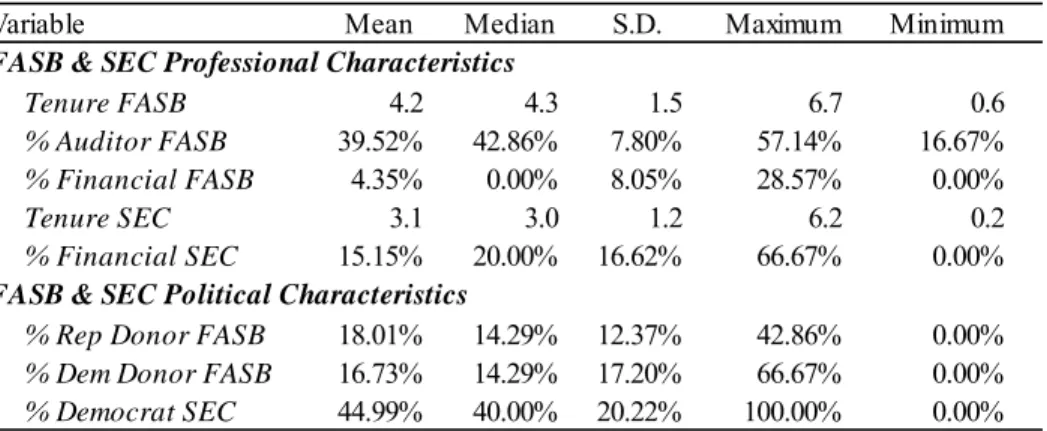
Table 3, Panel A, reports summary statistics for the FASB members’ and SEC
commissioners’ personal characteristics. These measures constitute the set of explanatory
variables in subsequent regression-based tests. The mean value of Tenure FASB is 4.2 and the
median is 4.3, suggesting that, on average, an exposure draft is issued by a board with just over
four years of individual service experience. In contrast, the mean and median values of Tenure
SEC are 3.1 and 3.0, respectively, suggesting SEC commissioners are on average less
experienced in their extant jobs. Figure 1 plots the time series of Tenure FASB and Tenure SEC
over the sample period. There does not appear to be any discernible time trend in average service
experience on the two bodies.
On average, about 40% of FASB members were most recently employed in auditing (%
Auditor FASB), while about 4% of FASB members were most recently employed in investment
banking/ investment management (% Financial FASB). Figure 2 plots the time series of these
two variables over the 1973–2007 period: % Auditor FASB appears to have held steady over
time, while % Financial FASB, which was zero through about the mid-1990s, appears to have
increased to just under 30% in 2007. The average proportion of SEC commissioners most
recently employed in financial services (% Financial SEC), at 15%, is higher than the
16 That is, significance of correlation coefficients is computed using the
t distribution as ∗√ 2 ,
corresponding FASB statistic. Figure 2 also plots the trend in % Financial SEC, which appears
to show considerable time series variation.
The average (median) proportion of FASB members contributing to the Democratic
Party, % Dem Donor FASB, is 16.73% (14%). The statistics are similar for % Rep Donor FASB
at 18% (14%). Figure 3 plots the time series of these two variables: % Dem Donor FASB is
higher than % Rep Donor FASB in the first few years of the FASB’s existence, while % Rep
Donor FASB is higher in the period between 1995 and 2002. The average proportion of
Democratic SEC commissioners (% Democrat SEC) is 45%, which indicates the average statistic
for Republican SEC commissioners in about 55%. Overall, the partisan proportions for SEC
commissioners are higher than those for FASB members because the former are known with
certainty and are collectively exhaustive in the sample. The time series variation in % Democrat
SEC (Figure 4) is predictable, given that commissioners are appointed by the U.S. president.17
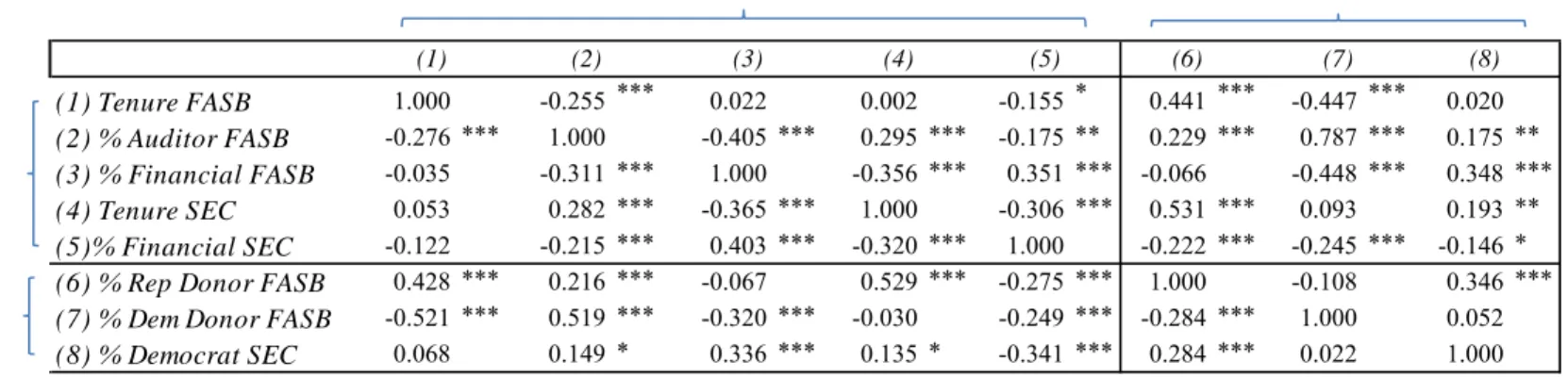
Pearson correlations (Spearman above the diagonal) between the explanatory variables in
Panel A, Table 3 are shown in Panel B, Table 3. Statistical inferences are based on clustering by
year. There are strong correlations between the background variables (i.e., tenure and prior
employment) and the personal politics variables among FASB members and SEC
commissioners. For example, Tenure FASB is positively associated with % Rep Donor FASB
(0.428) and negatively associated with % Dem Donor FASB (-0.521); % Auditor FASB is
positively associated with both % Rep Donor FASB (0.216) and % Dem Donor FASB (0.519).
Also, % Financial SEC is negatively associated with % Democrat SEC. These correlations are
17 No more than three of the five SEC commissioners at any given time can belong to the same party; so, for
example, a Democratic U.S. president cannot name five Democrats to the commission. Nevertheless, the proportion of SEC commissioners from the same party does sometimes exceed three-fifths because of vacancies and time lags between appointments.
consistent with findings in prior research involving the backgrounds and personal politics of
FCC commissioners (e.g., Gormley, 1979; Cohen, 1986).
4.2. Multivariate research design
We are interested in assessing how our measures of FASB proposals’ impact on
“reliability” and “relevance” vary with characteristics of standard setters. Accordingly, the
dependent variables in our regressions are variously, dec_relb, inc_relv, Manual_dec_relb, and
Manual_inc_relv. In specifying the explanatory variables in these regressions, we follow prior
research on regulators by examining the effect of professional and political characteristics both
independently and jointly. In the first set of regressions, we only include as explanatory variables
the measures of FASB and SEC regulators’ professional characteristics: Tenure FASB, %
Auditor FASB, % Financial FASB, Tenure SEC, and % Financial SEC. We do not include
measures of the regulators’ political characteristics because of the high observed correlations
between political and personal characteristics.18 Appropriately, results from such regressions
must be interpreted as exploratory, not definitive. The formal specification for our first set of
regressions is given in equation (3).
, % , % ,
, % …(3)
In equation (3), “i” is a big auditor comment letter and “j” is an exposure draft. Standard
errors in estimating equation (3) are clustered two-ways, by proposed SFAS and big auditor
18 In his review of the literature on regulators’ impact on regulation, Dal Bo (2006) notes that (p. 217) “although
industry background seems to matter, it is not clear that it has a very strong effect once one considers the role of political affiliations.” He attributes this result to the high correlations, noting, for example, that in the case of the FCC, “no Democratic administration appointed a commissioner with [broadcasting] industry background” during the 1955–1974 period. In essence, there is no ex-ante theory that suggests either professional or political
characteristics are more important than the other in explaining regulatory decisions, and, given the given the high correlations and small sample sizes in these regressions, there is some value to examining professional and political characteristics independently.
(using the method described in Petersen, 2009). We estimate two specifications of equation (3)
(and all subsequent regressions), one with Big N auditor fixed effects and one without. The Big
N auditor fixed effects specifically identify the “Big 5” auditors; thus for example, a comment
letter by Touche Ross from the period preceding the establishment of Deloitte & Touche will be
identified by a Deloitte & Touche fixed effect.
We test for the association between our dependent variables and the FASB and SEC
regulators’ political characteristics (i.e., % Dem Donor FASB, % Rep Donor FASB, % Democrat
SEC) in a second set of regressions. The formal specification for our second set of regressions is
given in equation (4) below.
% , % , % …(4)
In equation (4), DepVar and the subscripts “i” and “j” are as defined in equation (3).
Standard error clusters are also as described earlier.
In a final set of regressions, we include all independent variables described in equations
(3) and (4). Coefficients in all regressions are estimated using ordinary least squares (OLS). We
report results both with and without controls for two market-based variables: the annual
value-weighted market return (VWRETD) and the standard deviation of the daily value-weighted
market return (sd_VWRETD) in the twelve months preceding the issuance of a proposed SFAS.
5. Multivariate results
5.1. Results using Big N auditors’ comment letters
Table 4 reports OLS estimation results where the measure of decreased “reliability” from
auditor comment letters (dec_relb) is the dependent variable. There are seven columns to Table
characteristics are the explanatory variables (as in equation (3)); in columns four to six, FASB
members’ and SEC commissioners’ political affiliations are the explanatory variables (as in
equation (4)); the seventh column reports the regression combining all explanatory variables. In
the first and fourth columns, we do not include the market-based variables, VWRETD and
sd_VWRETD, as temporal economic controls; in all other columns, these variables are included.
In addition, columns two and five do not include auditor fixed effects, whereas columns three,
six, and seven do. In the following discussion, we focus on the results from columns three, six,
and seven, since these columns have the most exhaustive specifications, only discussing the
other columns when inferences differ. All regressions in Table 4 use the sample of 908 comment
letters. Standard errors in all regressions are clustered by Big N auditor and SFAS, and are
robust to heteroskedasticity.
When professional characteristics are examined independently, we find both Tenure
FASB and Tenure SEC are positively associated with decreased “reliability,” suggesting that
longer terms of service on the FASB and SEC are associated with a perception of decreased
accounting “reliability” (the coefficient on Tenure FASB is insignificant when market-based
controls are excluded). If decreased “reliability” is an undesirable accounting property, this result
is consistent with longer term-lengths compromising regulatory outcomes, per Stigler’s theory of
regulation. To put the coefficients’ magnitudes in perspective, the implication from column (3) is
that a one standard deviation increase in FASB tenure (SEC tenure) is associated with a decrease
in “reliability” that is about 30% (38%) of the mean dec_relb value. We also find evidence that
% Financial FASB and % Financial SEC are positive and significant predictors of FASB
proposals perceived as decreasing accounting “reliability.” A one standard deviation increase in
74% (49%) of the mean dec_relb value. This evidence is consistent with the proposition that a
prior career in investment banking/ investment management predisposes standard setters to
produce standards that deemphasize accounting “reliability.” Contrary to our expectations, we
find no evidence in Table 4 linking % Auditor FASB and decreased “reliability.”
When political characteristics are examined independently, the coefficient on % Dem
Donor FASB is significant and negative in explaining dec_relb. The implication from column (6)
is that a one standard deviation increase in % Dem Donor FASB is associated with an increase in
“reliability” that is about 64% of the mean dec_relb value. The evidence suggests that increased
proportional representation of Democrats on the FASB is associated with the production of
standards that are viewed as increasing accounting “reliability.” We do not find a similar result
with the proportion of Democrats on the SEC.
In combining all explanatory variables in column (7), only the results on % Financial
FASB and % Financial SEC are statistically significant. This result is consistent with prior
studies that combine regulators’ professional and political characteristics, where high
correlations between these variables and the small population size are seen to confound statistical
inferences (Dal Bo, 2006). However, in unreported tests we find variance inflation factors from
this regression are inconsistent with severe multicollinearity suggesting that, for our sample,
financial services affiliation is the overriding explanatory variable.
Table 5 reports OLS estimation results where the measure of increased “relevance” from
auditor comment letters (inc_relv) is the dependent variable. Table 5 is otherwise identical to
Table 4 in all respects. As in Table 4, we focus on discussing results from columns three, six, and
seven of Table 5. When professional characteristics alone are the explanatory variables, we find
increasing accounting “relevance.” In column (3), one standard deviation increase in %
Financial FASB is associated with an increase in “relevance” that is about 73% of its mean
value. This evidence is consistent with the proposition that a prior career in investment banking/
investment management predisposes standard setters to produce standards that increase
accounting “relevance.” When political characteristics alone are the explanatory variables, we
find % Dem Donor FASB is significant and negative in explaining inc_relv. In column (6), one
standard deviation increase in % Dem Donor FASB is associated with a decrease in “relevance”
that is about 65% of the mean inc_relv value. Column (6) also reveals a statistically negative
association between % Rep Donor FASB and proposals perceived as increasing “relevance.” We
are not aware of a theory to interpret this result. In combining all explanatory variables in
column (7) of Table 5, only the coefficient on % Financial FASB is statistically significant.
To summarize the key findings from Tables 4 and 5: across tests using auditor comment
letters, the data are consistent with the proposition that a prior career in financial services
predisposes FASB standard setters to favor accounting “relevance” over “reliability.”
5.2. Results using manual assessments of exposure drafts
Our primary comment-letter-based measures of decreased “reliability” and increased
“relevance” are sensitive to auditors’ distinct incentives, which may be endogenous to our
explanatory variables. Accordingly, we use manual assessments by two research assistants, as
discussed in Section 3 and Appendix B, as alternative dependent variables (Manual_dec_relb
and Manual_inc_relv) to address this concern.
Table 6 Panel A presents the descriptive statistics for: (A) the exposure drafts common to
which we only have manual assessments (n=19); and (C) the sub-sample of exposure drafts for
which we only have auditor comment letters (n=23). Using a two-sample differences-in-means
t-test we compare the average values of explanatory variables across the three groups. Of
particular note, Tenure FASB and Tenure SEC are significantly lower in sub-sample (C), while %
Dem Donor FASB is significantly higher. These differences are largely caused by data
availability for the manually assessed sub-sample. That sub-sample (columns (A) and (B))
excludes several exposure drafts from the early years of the FASB (1980s and before), a period
characterized by lower values for Tenure FASB and Tenure SEC and higher values for % Dem
Donor FASB, as shown in Figures 1–3.
Table 6 Panel B presents OLS estimation results where Manual_dec_relb and
Manual_inc_relv are the dependent variables. There are six columns to Table 6 Panel B:
Manual_dec_relb is the dependent variable for the first three columns, Manual_inc_relv for the
next three. The first column for each dependent variable includes only regulators’ professional
characteristics as independent variables; the second column for each dependent variable includes
only regulators’ political characteristics as independent variables; the final column for each
dependent variable includes both professional and political characteristics. In all columns, we
include auditor fixed effects and the market-based controls. Each regression is based on 126
observations, one for each exposure draft where both auditor comment letters and manual
assessments are available. Standard errors are heteroskedasticity robust.
The results in Table 6 Panel B show that % Financial FASB is a significant determinant
of both Manual_dec_relb and Manual_inc_relv, which is consistent with regression results using
auditor comment letters (Tables 4 and 5). As in Table 4, we find a significant negative
political variables; we do not find a similar result on Manual_inc_relv. In contrast to Table 4, in
Table 6 Panel B we do not find significant coefficients on Tenure FASB, Tenure SEC, and %
Financial SEC in regressions on Manual_dec_relb. The non-results on the tenure variables are
likely explained by the exclusion of several exposure drafts in the Table 6 Panel B regressions
due to data limitations, as discussed above.
Overall, to summarize the key findings from Tables 4, 5, and 6: across tests using auditor
comment letters and manual assessments of exposure drafts, the data are consistent with the
proposition that a prior career in financial services predisposes FASB standard setters to favor
accounting “relevance” over “reliability.” Our coding rubric for the manual assessment of
exposure drafts’ focus on “relevance” over “reliability” relies on the use of fair-value methods in
these proposals (see Appendix B for details). Thus, the key finding on financial services
affiliation can be explained, in part, as the tendency of regulators with a financial services
background to propose standards that use fair-value methods in recognition and disclosure.
When combined with the descriptive evidence from Figure 2 and Table 3, which shows an
increase in the proportion of FASB members from financial services from the mid-1990s through
2007, this result can provide a partial explanation for the growth of fair-value accounting.
5.3. Robustness and sensitivity tests
With the small population of FASB and SEC regulators in our sample, there is a concern
that one individual with an extremely strong personality can be driving the results described thus
far. The analogous literature on managers and firm policies employs technologies around
job-switching to address this concern (e.g., Bertrand and Schoar, 2003). Due to the unique nature of
technologies. An alternative robustness test is a jackknifing procedure where we re-estimate all
our regressions successively eliminating each regulator (and reconstructing all independent
variables accordingly) to determine if any member was instrumental to our statistical inferences.
Unreported results obtained from this procedure are inconsistent with the proposition that any
one FASB member is instrumental to the factors previously identified as statistically significant:
Across 39 jackknifed subsamples—each eliminating one FASB member—we find no cases
where elimination of an individual from our sample changes the sign or significance of our
primary results.19
The implicit assumption underlying construction of our independent variables is that an
exposure draft represents the average position of all extant FASB members and SEC
commissioners; however, it is possible that the chairmen of these groups have greater influence
than other members. In unreported robustness tests, we examine the effects of assigning greater
weight to FASB and SEC chairmen when calculating the average background characteristics of
an extant board. In particular, we assign the background characteristics of FASB and SEC
chairmen twice the weight of non-chair members. While the choice of doubling the weight on
chairmen is admittedly arbitrary, the objective of this test is simply to assess whether the relative
importance of FASB chairmen subsumes the results shown earlier. All substantive results
discussed in Tables 4 and 5 are robust to the procedure described above.
Finally, as discussed earlier, it is possible that the selection of a set of regulators on the
FASB and SEC in a given time period depends, at least in part, on more fundamental
macroeconomic conditions. Accordingly, we study the sensitivity of our results to these
19 The successive elimination of two FASB members in the jackknife procedure does turn, in some cases, the
previously insignificant coefficient on %Auditor FASB significantly negative (as predicted): one of these members
has a financial services background, the other an auditing background. One implication is that our failure to find evidence on %Auditor FASB in the regression that includes all independent variables is driven by the influential
conditions. In restricting the sample to periods of expansion in the U.S. economy (as identified
by the NBER), financial services background and Democratic Party affiliations remain
significant predictors of increased “relevance” (inc_relv) and decreased “reliability” (dec_relb),
consistent with results reported in Tables 4 and 5. The only result from those tables not carrying
through is the negative coefficient on % Rep Donor FASB on inc_relv for which we have no
ex-ante prediction and which is not consistent across all specifications.
6. Conclusions
Motivated by an interest in broadening the understanding of accounting standard setting
beyond the role of constituent comment-letter lobbying and congressional intervention, we
examine the role of FASB and SEC regulators in the process. Specifically, we examine how the
professional and political characteristics of these regulators vary in the nature of exposure drafts
proposed from 1973 to 2007. Because there is no obvious metric to evaluate the proposals, we
rely principally on Big N auditors’ contemporaneous evaluations of the exposure drafts along
dimensions of “reliability” and “relevance.” Our focus on “reliability” and “relevance” reflects
our judgment on their importance to accounting, also evidenced in several leading accounting
textbooks and in the FASB’s conceptual framework. The regulators’ professional characteristics
we study are tenure, background in auditing, and background in financial services; the political
characteristics are affiliation, if any, with the Democratic and Republican parties. Our key
finding is that FASB members with a prior professional affiliation with the financial services
industry are more likely to propose standards that decrease “reliability” and increase “relevance,”
partly due to their tendency to propose fair-value methods of measurement. Given that the