• No results found

Predicting tomato crop yield from weather data using statistical learning techniques

N/A
N/A
Protected

Academic year: 2021

Share "Predicting tomato crop yield from weather data using statistical learning techniques"

Copied!
264
0
0

Loading.... (view fulltext now)

Full text

(1)

by

Margaret de Villiers

Thesis presented in partial fulfilment of the requirements

for the degree of Master of Commerce in Mathematical

Statistics in the Faculty of Economic and Management

Sciences at Stellenbosch University

Department of Statistics and Actuarial Sciences,

University of Stellenbosch,

Private Bag X1, Matieland 7602, South Africa.

Supervisor: Prof. Daniel W. Uys

(2)

Declaration

By submitting this thesis electronically, I declare that the entirety of the work

contained therein is my own, original work, that I am the sole author thereof

(save to the extent explicitly otherwise stated), that reproduction and

pub-lication thereof by Stellenbosch University will not infringe any third party

rights and that I have not previously in its entirety or in part submitted it for

obtaining any qualification.

Date:

March 2017

Copyright

©

2017 Stellenbosch University

All rights reserved.

(3)

Abstract

Predicting crop harvest quantities accurately is important in managing a

farm-ing enterprise effectively, facilitatfarm-ing decisions regardfarm-ing crop management,

al-location of resources, anticipated delivery times and quantities to customers

and produce pricing, to name but a few. The aim of this project is to

de-velop statistical models for predicting harvest quantity of field-grown crops on

a commercial tomato farm in South Africa using weather data.

Planting and harvest data for a seven-year period were provided by the

tomato farm, while daily and 10-daily weather data for the same period were

obtained from a nearby weather station and from satellite data. The data

sets were cleaned, and the time series data were summarised in the form of a

single summary statistic for each weather variable over the growing period of

each crop. Median and total harvest density (t/ha) were each modelled using

multiple linear regression, the lasso, regression trees, bagged regression trees,

random forests and boosted regression trees.

All of the crop and weather variables turned out to be informative in

pre-dicting tomato yield, with the average of the daily average wind speed and

the average of the daily maximum relative humidity readings over the crops’

growing periods emerging as the most important predictors of median and

total harvest density, respectively. Random forests modelled median harvest

density the most accurately with an estimated mean absolute prediction

er-ror of 0

.

37 t/ha, while bagged regression trees modelled total harvest density

the most accurately with a mean absolute prediction error of 12

.

67 t/ha. The

model parameter estimators of all of the modelling techniques tended to have

low variances, and the sizes of the prediction errors are most likely due to

factors such as the absence of important predictors (soil fertility, irrigation

regimes, etc.) from the models and the summary of the weather time series

over the crops’ growing periods into single values.

(4)

Opsomming

Die akkurate voorspelling van oes opbrengs is belangrik in die effektiewe bestuur

van ’n boerdery. Beter besluite ten opsigte van gewasbestuur, die toewysing

van hulpbronne, afleweringstye, hoeveelhede wat aan klante gelewer moet word

en produkpryse kan geneem word indien opbrengs akkuraat voorspel word. Die

doel van hierdie projek is om statistiese modelle te ontwikkel wat aangewend

kan word om tamatie oes opbrengs te voorspel deur gebruik te maak van

klimaatsveranderlikes.

Oop land tamatie aanplantings van ’n kommersi¨

ele

tamatie boerdery in Suid-Afrika is vir di´

e doel gebruik.

Aanplantings- en opbrengsdata vir ’n sewejaar tydperk is vanaf die

tamatie-plaas verkry, terwyl daaglikse en 10-daaglikse klimaatsmetings vir dieselfde

tydperk by ’n nabygele¨

e weerstasie asook vanaf satellietdata ingesamel is.

Die datastelle is skoongemaak, en opsommende maatstawwe is vir elke

kli-maatsveranderlike oor die groeitydperk van elke aanplanting bereken.

Medi-aan en totale opbrengs (t/ha) is afsonderlik gemodelleer met behulp van

meer-voudige lineˆ

ere regressie, die lasso, regressiebome, “bagged” regressiebome,

ewekansige woude en “boosted” regressiebome.

Al die aanplantings- en klimaatsveranderlikes is betekenisvol in die

voor-spelling van opbrengs, met die gemiddelde van die daaglikse gemiddelde

wind-spoed en die gemiddelde van die daaglikse maksimum relatiewe

humiditeits-lesings oor die aanplantings se groeitydperke as belangrikste voorspellers van

onderskeidelik mediaan en totale oes opbrengs. Ewekansige woude het

medi-aan opbrengs die akkuraatste voorspel met ’n beraamde gemiddelde absolute

voorspellingsfout van 0

.

37 t/ha, terwyl “bagged” regressiebome die totale

op-brengs die akkuraatste voorspel het met ’n gemiddelde absolute

voorspellings-fout van 12

.

67 t/ha. Die beramers van modelparameters van al die

model-leringstegnieke het klein variansies. Die groottes van die voorspellingsfoute

is waarskynlik te wyte aan faktore soos die afwesigheid van belangrike

(5)

spellers (soos bv. grondvrugbaarheid en besproeiingstegnieke), asook die

ops-ommende maatstawwe wat vir die klimaatsveranderlikes oor die groeitydperk

van elke aanplanting bereken is.

(6)

Acknowledgements

I would like to express my sincere gratitude to the following people and

organ-isations:

ˆ

My supervisor, Prof. Danie Uys, whose unwavering guidance, support,

patience and understanding throughout the project were invaluable for

the completion of my Masters degree. You are a true friend, Danie!

ˆ

The South African Statistical Association (SASA) and the National

Re-search Foundation (NRF) for jointly granting me a bursary for pursuing

a Masters in Mathematical Statistics.

ˆ

The academic staff of the Department of Statistics and Actuarial Science

at Stellenbosch University. It is a pleasure to be taught by lecturers that

are passionate about their subjects and dedicated to their roles in shaping

future statisticians. The friendliness and support of the academic and

support staff and the comradeship of the students made for a pleasant

working environment.

ˆ

George Schwalb of GRS Actuarial Consulting, Stellenbosch. George

ini-tially suggested the topic for this thesis and set up communication

chan-nels with staff on the tomato farm.

ˆ

The CEO and staff of the tomato farm that provided me with crop data

for this project. They spent many hours of their busy schedules not only

preparing and sending me the data, but also explaining their tomato

cultivation practices to me. Their advice was indispensable during the

data-cleaning process and for placing the results of the analyses within

the context of the agricultural practices on the farm. I hope that the

results of this study prove useful to them.

(7)

ˆ

The South African Weather Service (SAWS) furnished me with hourly

weather data from some of their weather stations in Limpopo Province.

Although this data set did not end up in the final analyses, it was very

useful for comparative purposes during the data-cleaning process.

ˆ

The Agricultural Research Council (ARC) supplied me with daily and

hourly weather data from weather stations very close to the localities of

interest in Limpopo Province. The statistical models were trained on

some of this data.

ˆ

Environmental Analysis and Remote Sensing Earth Environment

Mon-itoring B.V. (EARS-E2M), a Dutch company, sent me relative

evapo-transpiration data, which were also used in the training of the statistical

models.

ˆ

On a more personal level, I would like to thank my family, whose

un-faltering love, help and support made the work load feel lighter and the

seemingly impossible seem more achievable.

ˆ

Our neighbour’s cat, Kitts. She sat with me through many long evenings

and nights of work. Her companionship during the quieter hours was

comforting. I am grateful to our neighbours for allowing Kitts to spend

her time with us.

(8)

Contents

Declaration

i

Abstract

ii

Opsomming

iii

Acknowledgements

v

Contents

vii

List of Figures

x

List of Tables

xvi

Notation and abbreviations

xviii

1

Thesis overview

1

1.1

Problem statement and study objectives . . . .

1

1.2

Clarification of key concepts . . . .

2

1.3

Research design and methodology . . . .

3

1.4

Importance of the study . . . .

4

1.5

Chapter outline . . . .

4

2

Literature Review

6

2.1

Tomatoes as an agricultural crop

. . . .

6

2.2

Predicting crop yield . . . .

10

2.3

Commonly recorded weather variables

. . . .

13

2.4

Statistical modelling techniques . . . .

18

2.5

Aims of this study

. . . .

65

(9)

3

Data description and exploratory analyses

67

3.1

The tomato crop data set

. . . .

67

3.2

The weather and evapotranspiration data set . . . .

92

3.3

The crop and weather variables combined . . . .

119

4

The linear model and related methods

126

4.1

Introduction . . . .

126

4.2

The null model . . . .

127

4.3

Multiple linear regression . . . .

128

4.4

The lasso

. . . .

144

4.5

Discussion . . . .

151

5

Regression trees and tree-based methods

155

5.1

Introduction . . . .

155

5.2

Regression trees . . . .

156

5.3

Bagged regression trees . . . .

166

5.4

Random forests . . . .

173

5.5

Discussion . . . .

179

6

An adaptive tree-based method: Boosting

183

6.1

Introduction . . . .

183

6.2

Methods . . . .

184

6.3

Results . . . .

184

6.4

Discussion . . . .

190

7

Discussion

196

Appendices

203

A R code for the modelling analyses

204

A.1 Preparing the data sets . . . .

204

A.2 The null model . . . .

207

A.3 Multiple linear regression . . . .

208

A.4 The lasso

. . . .

215

A.5 Regression trees . . . .

218

A.6 Bagged regression trees . . . .

223

(10)

A.8 Boosted regression trees . . . .

227

(11)

List of Figures

2.1

Partitioning of the input space by a decision tree

. . . .

35

3.1

Harvest time series of three block crops in Field crop 3 . . . .

69

3.2

Planting events and harvest time series of two block crops in Field

crop 20

. . . .

70

3.3

Planting events and harvest time series of two block crops in Field

crop 32

. . . .

71

3.4

Original and cleaned distributions of the separate harvest masses

of the block crops . . . .

76

3.5

Original and cleaned distributions of the separate harvest densities

of the block crops . . . .

76

3.6

Original and cleaned distributions of the median harvest masses of

the block crops . . . .

76

3.7

Original and cleaned distributions of the median harvest densities

of the block crops . . . .

77

3.8

Original and cleaned distributions of the total harvest masses of

the block crops . . . .

77

3.9

Original and cleaned distributions of the total harvest densities of

the block crops . . . .

77

3.10 Original and cleaned distributions of the areas of the block crops .

78

3.11 Original and cleaned distributions of the growing periods of the

block crops

. . . .

78

3.12 Original and cleaned distributions of the harvest periods of the

block crops

. . . .

78

3.13 Original and cleaned distributions of the crop durations of the block

crops . . . .

79

(12)

3.14 Original and cleaned distributions of the number of harvest events

of the block crops . . . .

79

3.15 Distributions of the harvest masses of the training block crops . .

80

3.16 Distributions of the harvest densities of the training block crops .

81

3.17 Median harvest densities of the fields in the training data . . . . .

82

3.18 Total harvest densities of the fields in the training data . . . .

82

3.19 Harvest mass versus area for the training block crops . . . .

83

3.20 Harvest density versus area for the training block crops . . . .

83

3.21 Harvest density versus planting density for the training block crops

84

3.22 Planting and harvest dates for the training block crops . . . .

84

3.23 Median harvest density for different planting times

. . . .

85

3.24 Total harvest density for different planting times . . . .

85

3.25 Growing period for different planting times . . . .

86

3.26 Harvest period for different planting times . . . .

86

3.27 Crop duration for different planting times

. . . .

87

3.28 Harvest density versus growing period

. . . .

87

3.29 Harvest density versus harvest period . . . .

88

3.30 Harvest density versus total crop duration . . . .

88

3.31 Harvest density versus number of harvest events . . . .

89

3.32 Median versus total harvest density . . . .

90

3.33 Scatterplots of the crop variables in the training data set . . . . .

91

3.34 Map of the tomato farm and ARC weather station

. . . .

93

3.35 Original and cleaned time series of daily maximum and minimum

temperature . . . .

95

3.36 Original and cleaned time series of daily maximum and minimum

relative humidity . . . .

96

3.37 Original and cleaned time series of daily average wind speed . . .

97

3.38 Original and cleaned time series of daily total rainfall . . . .

98

3.39 Original and cleaned time series of daily total reference

evapotran-spiration . . . .

99

3.40 Time series of dekad relative evapotranspiration . . . .

100

3.41 Daily maximum and minimum temperature and relative humidity

throughout the year

. . . .

101

(13)

3.42 Daily average wind speed, daily total rainfall, daily total reference

evapotranspiration and dekad relative evapotranspiration

through-out the year . . . .

102

3.43 Summary statistics of daily maximum temperature for the training

block crops

. . . .

103

3.44 Summary statistics of daily minimum temperature for the training

block crops

. . . .

104

3.45 Summary statistics of maximum relative humidity for the training

block crops

. . . .

105

3.46 Summary statistics of minimum relative humidity for the training

block crops

. . . .

106

3.47 Summary statistics of daily average wind speed for the training

block crops

. . . .

107

3.48 Summary statistics of daily total rainfall for the training block crops108

3.49 Summary statistics of daily total reference evapotranspiration for

the training block crops

. . . .

109

3.50 Summary statistics of dekad relative evapotranspiration for the

training block crops . . . .

110

3.51 Harvest density versus median daily maximum temperature for the

training block crops . . . .

114

3.52 Harvest density versus average daily minimum temperature for the

training block crops . . . .

114

3.53 Harvest density versus average daily maximum relative humidity

for the training block crops

. . . .

115

3.54 Harvest density versus average daily minimum relative humidity

for the training block crops

. . . .

115

3.55 Harvest density versus average daily average wind speed for the

training block crops . . . .

116

3.56 Harvest density versus average daily total rainfall for the training

block crops

. . . .

116

3.57 Harvest density versus minimum daily total reference

evapotran-spiration for the training block crops . . . .

117

3.58 Harvest density versus minimum dekad relative evapotranspiration

(14)

3.59 Scatterplots of the ARC and EARS-E2M weather time series

sum-mary statistics in the training data set . . . .

119

3.60 Scatterplots of the crop variables and the weather time series

sum-mary statistics in the training data set . . . .

120

4.1

Model predictions versus validation responses for the null models

of median and total harvest density . . . .

127

4.2

Statistics for median harvest density models of different sizes chosen

by best subset selection

. . . .

130

4.3

Input terms included in the median harvest density models for

dif-ferent complexity measures . . . .

131

4.4

Statistics for total harvest density models of different sizes chosen

by best subset selection

. . . .

132

4.5

Input terms included in the total harvest density models for

differ-ent complexity measures . . . .

133

4.6

Model residuals of the multiple linear regression model of median

harvest density containing the eleven linear terms . . . .

134

4.7

Model residuals of the multiple linear regression model of total

harvest density containing the eleven linear terms . . . .

136

4.8

Model predictions versus validation responses for the multiple linear

regression models of median and total harvest density containing

the linear terms . . . .

137

4.9

Model residuals of the multiple linear regression model of median

harvest density containing the eleven linear and four quadratic terms138

4.10 Model residuals of the multiple linear regression model of total

harvest density containing the eleven linear and four quadratic terms140

4.11 Model predictions versus validation responses for the multiple linear

regression models of median and total harvest density containing

the linear and quadratic terms . . . .

142

4.12 Model residuals of the multiple linear regression model of median

harvest density containing the linear and quadratic terms from best

subset selection . . . .

143

4.13 Model residuals of the multiple linear regression model of total

harvest density containing the linear and quadratic terms from best

subset selection . . . .

145

(15)

4.14 Model predictions versus validation responses for the multiple linear

regression models of median and total harvest density containing

the linear and quadratic terms selected by best subset selection

.

146

4.15 Cross-validation to determine the optimum value of the complexity

parameter

λ

for the lasso models of median and total harvest density147

4.16 Coefficient paths over the complexity parameter values for the lasso

model of median harvest density . . . .

148

4.17 Coefficient paths over the complexity parameter values for the lasso

model of total harvest density . . . .

148

4.18 Model predictions versus validation responses for the lasso models

of median and total harvest density containing linear and quadratic

terms

. . . .

151

5.1

Cross-validation errors achieved on different complexity parameter

settings for the regression trees . . . .

157

5.2

Regression tree of median harvest density

. . . .

158

5.3

Regression tree of total harvest density . . . .

161

5.4

Cross-validation errors achieved on the nested sequence of

regres-sion trees for pruning . . . .

165

5.5

Pruned regression tree of median harvest density

. . . .

166

5.6

Pruned regression trees of total harvest density

. . . .

167

5.7

Model predictions versus validation responses for the full and pruned

regression trees of median and total harvest density . . . .

168

5.8

Prediction error for different numbers of trees in the bagged

regres-sion tree model . . . .

169

5.9

Importance of the input variables in the bagged regression tree

models of median and total harvest density . . . .

170

5.10 Partial dependence plots of the fitted response curve against each

of the input variables in the bagged regression tree model of median

harvest density . . . .

171

5.11 Partial dependence plots of the fitted response curve against each

of the input variables in the bagged regression tree model of total

harvest density . . . .

172

5.12 Model predictions versus validation responses for the bagged

(16)

5.13 Prediction error for different numbers of trees in the random forest

model . . . .

174

5.14 Importance of the input variables in the random forest models of

median and total harvest density . . . .

175

5.15 Partial dependence plots of the fitted response curve against each

of the input variables in the random forest model of median harvest

density . . . .

176

5.16 Partial dependence plots of the fitted response curve against each

of the input variables in the random forest model of total harvest

density . . . .

177

5.17 Model predictions versus validation responses for the random forest

models of median and total harvest density . . . .

178

5.18 Validation errors achieved with different input variable subset sizes

for the random forest models

. . . .

178

6.1

Cross-validation errors of the full boosted regression tree models

containing different numbers of trees . . . .

185

6.2

Importance of the input variables in the full boosted regression tree

model of median and total harvest density . . . .

186

6.3

Partial dependence plots of the fitted response values against each

of the input variables in the full boosted regression tree model of

median harvest density . . . .

187

6.4

Partial dependence plots of the fitted response values against each

of the input variables in the full boosted regression tree model of

total harvest density . . . .

188

6.5

Partial dependence plots of the fitted response curve against each

of the input variables in the full boosted regression tree model of

median harvest density . . . .

189

6.6

Partial dependence plots of the fitted response curve against each

of the input variables in the full boosted regression tree model of

total harvest density . . . .

190

6.7

Model predictions versus validation responses for the full boosted

regression tree model of median and total harvest density . . . . .

191

6.8

Cross-validation errors for the number of input variables to be

(17)

List of Tables

3.1

Variables in the tomato crop data set . . . .

73

3.2

Correlation coefficients for the crop variables in the training data set 90

3.3

Time series variables in the weather data set . . . .

94

3.4

Correlation coefficients for the daily maximum temperature

sum-mary statistics and harvest density in the training data set . . . .

111

3.5

Correlation coefficients for the daily minimum temperature

sum-mary statistics and harvest density in the training data set . . . .

111

3.6

Correlation coefficients for the daily maximum relative humidity

summary statistics and harvest density in the training data set . .

111

3.7

Correlation coefficients for the daily minimum relative humidity

summary statistics and harvest density in the training data set . .

112

3.8

Correlation coefficients for the daily average wind speed summary

statistics and harvest density in the training data set . . . .

112

3.9

Correlation coefficients for the daily total rainfall summary

statis-tics and harvest density in the training data set . . . .

112

3.10 Correlation coefficients for the daily total reference

evapotranspi-ration summary statistics and harvest density in the training data

set . . . .

113

3.11 Correlation coefficients for the dekad relative evapotranspiration

summary statistics and harvest density in the training data set . .

113

3.12 Correlation coefficients for the summary statistics of the weather

variables in the training data set

. . . .

122

3.13 Correlation coefficients for the crop variables and summary

statis-tics of the weather variables in the training data set . . . .

123

3.14 Input variables for modelling tomato harvest density . . . .

124

3.15 Variables modelled by the tomato harvest models . . . .

125

(18)

4.1

Coefficients for the multiple linear regression model of median

har-vest density containing only the linear terms . . . .

135

4.2

Coefficients for the multiple linear regression model of total harvest

density containing only the linear terms

. . . .

137

4.3

Coefficients for the multiple linear regression model of median

har-vest density containing the linear and quadratic terms

. . . .

139

4.4

Coefficients for the multiple linear regression model of total harvest

density containing the linear and quadratic terms . . . .

141

4.5

Coefficients for the multiple linear regression model of median

har-vest density containing the linear and quadratic terms selected by

best subset selection . . . .

144

4.6

Coefficients for the multiple linear regression model of total harvest

density containing the linear and quadratic terms selected by best

subset selection . . . .

146

4.7

Coefficients for the lasso models of median and total harvest density

containing the linear and quadratic terms

. . . .

150

4.8

Validation errors of linear models of total and median harvest density152

5.1

Cross-validation errors of regression trees with different cost

pa-rameters specified . . . .

157

5.2

Validation errors of linear and tree-based models of total and

me-dian harvest density

. . . .

179

6.1

Validation errors of linear, tree-based models and boosting of total

(19)

Notation and abbreviations

Mathematical notation

infinity

approaches, e.g.

n

→ ∞

:=

is defined as

is approximately equal to

=

implies

;

is much larger than; is much smaller than

for all, e.g.

x

2

0

x

R

is a subset of or is equal to

union

is an element of

min

{f

(

x

)

}

the minimum value that

f

(

x

) can reach, e.g.

x

R

=

min(

x

2

+ 1) = 1

argmin

x

{f

(

x

)

}

the argument

x

that minimises

f

(

x

), e.g.

x

R

=

argmin

x

(

x

2

+ 1) = 0, since

f

(0) = 1

max

{f

(

x

)

}

the maximum value that

f

(

x

) can reach, e.g.

x

R

=

max(1

x

2

) = 1

argmax

x

{f

(

x

)

}

the argument

x

that maximises

f

(

x

), e.g.

x

R

=

argmax

x

(1

x

2

) = 0, since

f

(0) = 1

w

a scalar

|w|

the absolute value of

w

(20)

0

p

a column vector consisting of

p

zeroes

1

p

a column vector consisting of

p

ones

w

a column vector containing one or more entries

w

n

column vectors containing

n

entries

(

w

n

)

T

the transpose of the column vector

w

n

k

w

n

k

the norm of

w

n

w

T

u

the inner product of

w

with

u

W

the matrix

W

of unspecified dimensions

W

n

×

p

the

n

×

p

matrix

W

(

W

n

×

p

)

1

the inverse of the

n

×

p

matrix

W

(

W

n

×

p

)

T

the transpose of the

n

×

p

matrix

W

Statistical symbols

B

number of bootstrap samples

C

α

(

T

)

the cost-complexity criterion for a nested subtree

T

T

0

of the unpruned tree

T

0

for a fixed value of the

tuning parameter

α

d

the size of the subset of input variables included in a

model

H

0

;

H

a

the null and alternative hypotheses of a hypothesis

test

I

2

l

(

T

);

I

l

2

the squared relative importance of the

l

th

input

vari-able

x

l

in a single regression tree and in a linear

com-bination of regression trees, respectively

ˆ

ı

2

j

the squared improvement in the training error as a

re-sult of the split at the

j

th

internal node in a regression

tree

J

number of mutually exclusive rectangular regions into

which the input space is partitioned in a regression

tree model

(21)

K

number of folds into which the training set is randomly

partitioned in

K

-fold cross-validation

M

the number of terms in a multiple linear regression

model or the number of iterations in a boosted

regres-sion tree model

n

the number of observations in the training data set

n

1

, n

2

, . . . , n

J

the number of training observations in each of the

J

regions of a decision tree model

p

the number of input variables

q

the number

q

p

of the

p

input variables to be

ex-cluded from a model

R

2

coefficient of determination

R

1

, R

2

, . . . , R

J

the

J

regions of the input space determined by a

de-cision tree model corresponding to the

J

leaves of the

decision tree

R

1

m

, R

2

m

, . . . , R

J m

the

J

regions of the input space determined by the

decision tree fit during the

m

th

iteration of a boosted

regression tree model

R

;

R

1

(

j, s

);

R

2

(

j, s

)

region

R

of the input space, along with the two regions

R

1

(

j, s

) and

R

2

(

j, s

) resulting from the split of

R

into

two subregions using the

j

th

input variable

X

j

and

split point

X

j

=

s

r

or

r

(

x, y

)

sample correlation coefficient (between the observed

values of variables

X

and

Y

)

r

= (

r

1

, . . . , r

n

)

T

the model residuals of the

n

training observations

r

m

= (

r

1

m

, . . . , r

nm

)

T

the model residuals of the

n

training observations

af-ter

m

1 iterations in a boosted regression tree model

T

a decision tree

T

0

, T

1

, T

2

, . . .

a nested sequence of decision trees with

T

0

represent-ing the full (unpruned) tree and

T

1

, T

2

, . . .

represent-ing progressively shallower trees in which the terminal

node resulting in the smallest decrease in the RSS

train

has successively been pruned from the previous tree in

the sequence

(22)

|T

|

the size of the tree

T

, measured in terms of the number

of terminal nodes in

T

T

(

x

i

|

Θ

m

)

the prediction for

x

i

from the tree fit during the

m

th

iteration of a boosted regression tree model with

pa-rameters

Θ

m

X

or

X

n

×

(

p

+1)

the

n

×

(

p

+ 1) matrix with

1

n

as the first column and

the

i

th

row containing 1 as the first entry, followed by

the observed values of the

p

input variables for the

i

th

training observation

x

i

X

or

X

p

or

X

p

+1

the

p

-dimensional (

p

-D) vector of the input random

variables (

X

1

, X

2

, . . . , X

p

)

T

or the (

p

+ 1)-D vector

(1

, X

1

, X

2

, . . . , X

p

)

T

, which includes an intercept

x

1

,

x

2

, . . . ,

x

n

the

n

observations of the input vector in the training

data set

x

1

, x

2

, . . . , x

p

the

p

input variables in the training data set

Y

the response random variable

y

an observed value of the response

y

= (

y

1

, . . . , y

n

)

T

the

n

responses of the training observations

y

the average of the

n

observed response values in the

training data set

b

y

a predicted value for the response

b

y

= (

b

y

1

, . . . ,

b

y

n

)

T

the predicted responses for the

n

training observations

b

y

R

1

,

b

y

R

2

, . . . ,

y

b

R

J

the mean responses of the training observations in each

of the

J

regions of a decision tree model

Z

or

Z

n

×

(

p

+1)

the training data set i.e.

Z

n

×

(

p

+1)

= [

z

1

, . . . ,

z

n

]

T

=

[(

x

T

1

, y

1

)

T

, . . . ,

(

x

T

n

, y

n

)

T

]

T

z

1

,

z

2

, . . . ,

z

n

the

n

observations of the

p

input random vectors and

of the response in the training data set, where

z

i

=

(

x

T

i

, y

i

)

T

Z

or

Z

n

×

(

p

+1)

a bootstrap sample of the training data set i.e.

Z

n

×

(

p

+1)

=

[

z

1

, . . . ,

z

n

]

T

, where

z

1

, . . . ,

z

n

are

n

observations

ran-domly selected with replacement from the training

data set

(23)

Z

1

, . . . ,

Z

B

the

B

bootstrap samples of the training data set

α

the tuning parameter in pruned decision trees

β

or

β

p

or

β

p

+1

the vector of true coefficients (

β

1

, . . . , β

p

)

T

or (

β

0

, β

1

, . . . , β

p

)

T

β

0

, β

1

, . . . , β

p

the true coefficients (based on the population)

b

β

or

β

b

p

or

β

b

p

+1

the vector of estimated coefficients

b

β

0

,

β

b

1

, . . . ,

β

b

p

the estimated coefficients

b

β

lasso

or

b

β

lasso

p

+1

the coefficients estimated by the lasso algorithm, given

a specific tuning parameter

λ

b

β

LS

or

β

b

p

LS

+1

the coefficients estimated by the multiple linear

regres-sion algorithm using the least-squares approach

k

β

p

k

1

the

`

1

norm of the coefficient vector

β

p

is given by

k

β

p

k

1

=

P

p

j

=1

j

|

k

β

p

k

2

the

`

2

norm of the coefficient vector

β

p

is given by

k

β

p

k

2

=

q

P

p

j

=1

β

j

2

γ

jm

the constant that, in the

m

th

iteration of a boosted

regression tree model, maximises the fit of the training

observations in the

j

th

region of the input space to the

model

ε

the error term in a statistical model

η

the bag fraction in a boosted regression tree model

Θ

m

the parameters (split variables, cutpoints and

predic-tions) for the tree model

T

(

· |

Θ

m

) fit during the

m

th

iteration of a boosted regression tree model

λ

tuning parameter in the lasso and in ridge regression

µ

X

the expected value of the random variable

X

ν

the shrinkage or learning parameter in a boosted

re-gression tree model

ρ

or

ρ

XY

the correlation between the random variables

X

and

Y

σ

2

(24)

Z

N

(

µ

Z

, σ

Z

2

)

Z

is normally distributed with a mean of

µ

Z

and a

variance of

σ

2

Z

Bias

b

θ

the bias of

θ

b

as an estimator of the parameter

θ

Cov

XY

(

X, Y

)

the covariance between the random variables

X

and

Y

E

X

(

X

)

the expected value of the random variable

X

F

n

the empirical cumulative distribution function of the

random vector

X

p

based on

n

independent and

iden-tically distributed observations

F

X

the cumulative distribution function of

X

p

f

X

the density function of

X

p

f

the function giving the true relationship between

x

p

and

Y

b

f

the function giving the estimated relationship between

x

p

and

Y

b

f

bag

b

(

x

p

);

f

b

bag

(

x

p

)

the prediction from the

b

th

bootstrap tree and from

the whole bagged regression tree model, respectively,

of the response for the observation

x

p

b

f

rf

b

(

x

p

);

f

b

rf

(

x

p

)

the prediction from the

b

th

bootstrap tree and from

the whole random forest model, respectively, of the

response for the observation

x

p

f

m

1

(

x

i

);

f

m

(

x

i

)

the prediction for

x

i

from the boosted regression tree

model after

m

1 and

m

iterations, respectively

I

(

A

)

the indicator function, which returns 1 if

A

is true,

and 0 otherwise

h

(

x

p

)

a transformation of the predictor variables in the

train-ing data set

L{Y,

f

b

(

x

p

)

}

a loss function

`

1

the

`

1

norm of the coefficient vector

β

p

is given by

k

β

p

k

1

=

P

p

j

=1

j

|

`

2

the

`

2

norm of the coefficient vector

β

p

is given by

k

β

p

k

2

=

q

P

p

(25)

Var

X

(

X

)

the variance of the random variable

X

Statistical abbreviations

adj.

R

2

adjusted

R

2

BIC

Bayesian information criterion

BRT

boosted regression trees

BS

bootstrap

BSS

best subset selection

CART

classification and regression trees

CoD

curse of dimensionality

CV

cross-validation

D

dimensional

DCM(s)

dynamic crop model(s)

df

degrees of freedom

EPE

expected prediction error

FDA

functional data analysis

GAM(s)

generalised additive model(s)

i.d.

identically distributed

i.i.d.

independent and identically distributed

lin.

linear

LLN

law of large numbers

MAE

mean absolute error

MAE

test

MAE of the test data set

MLR

multiple linear regression

MSE

mean squared error

MSE

train

MSE of the training data set

MSE

validate

MSE of the validation data set

MSE

test

MSE of the test data set

OOB

out-of-bag

(26)

quad.

quadratic

RF(s)

random forest(s)

RMSE

root mean squared error

RSE

residual standard error

RSS

residual sum of squares

RSS

0

; RSS

1

the RSS of the training data set resulting from a

mul-tiple linear regression model containing

p

q

(RSS

0

)

or all

p

of the input variables (RSS

1

)

RSS

R

m

; RSS

R

m

(

j,s

)

the RSS of the

m

th

region in the input space (based

on a split of the

j

th

input variable at cutpoint

x

j

=

s

)

in a regression tree model

RSS

train

the RSS of the training data set

SE

standard error

SLT

Statistical Learning Theory

TSS

total sum of squares

Chemical symbols

C

carbon

CO

2

carbon dioxide

Other abbreviations

ARC

South African Agricultural Research Council

EARS-E2M

Environmental Analysis and Remote Sensing Earth

Environment Monitoring B.V.

ET

evapotranspiration

ET

0

reference evapotranspiration

ET

pan

pan evapotranspiration

GPS

global positioning system

RE

relative evapotranspiration

RH

relative humidity

(27)

Units of measurement

C

degree(s) Celsius

cm

centimetre(s)

d

day(s)

g

gram(s)

h

hour(s)

ha

hectare(s)

km

kilometre(s)

m

metre(s)

mm

millimetre(s)

s

second(s)

t

metric tonne(s)

Editorial abbreviations

edn.

edition

e.g.

for example

et al.

and others

i.e.

that is

no.

number

pers. comm.

personal communication

pp.

pages

(28)

Chapter 1

Thesis overview

This chapter contains an outline of the thesis. Brief descriptions of the goals

of the study and the methods applied to address these goals are given. This

chapter also provides concise explanations of terminology used throughout

the document. The objectives of this study are discussed within the broader

context of the utility of statistical modelling in agriculture. Finally, the chapter

closes with a description of the layout of the rest of the document.

1.1

Problem statement and study objectives

Growing crops in an open-field setting presents diverse problems to a farmer.

Crop plants exposed to the open air are more vulnerable to pest infestations,

and diseases from nearby plants can decimate crops. However, one of the chief

sources of uncertainty in the success of a crop comes from the weather: Wet

conditions can flood crops leading to root rot, dry conditions cause desiccation,

and high winds damage the plants, to name but a few. Although a farmer

cannot control the weather, precautionary measures can be taken to protect

crops from impending changes in the weather, and remedial steps can minimise

the damage caused by unforeseen weather conditions.

However, minimising the effects of adverse weather on harvest quantities

requires knowledge of the effects of weather conditions on crop success. In

addition to knowing how to maximise yield in the face of inclement weather,

being able to predict crop yields based on weather records from previous weeks

and the weather conditions expected over the coming weeks can help in the

synchronisation of produce harvest and distribution.

(29)

This study investigates the effects of growing conditions on the densities

(t/ha) of tomatoes harvested from crops containing closely related tomato

cul-tivars on a commercial tomato farm in South Africa. Statistical models are

developed for understanding the effects of weather conditions on harvest

den-sities, and for predicting harvest densities from prevailing weather conditions

during the development of the crop plants.

1.2

Clarification of key concepts

The following terms are used throughout the thesis, and are therefore defined

here for the reader’s convenience:

Field crops and block crops

The tomato crops investigated in this project

were grown in fields that are subdivided into blocks to facilitate crop

management on the farm. The plants grown in a particular field in a

particular year constitute a

field crop

, with most field crops containing

several

block crops

. Since crops are chiefly managed at the block level,

the block crops were chosen as the objects in the modelling analyses.

Growth period, harvest period and crop duration

A block crop’s

growth

period

refers to the length of time between the date that the tomato

seedlings were planted out into the field and the first harvest date of the

crop. The

harvest period

of a block crop is the time between its first

and last harvest dates, and consists of numerous harvest events.

Crop

duration

is simply the sum of a block crop’s growth and harvest periods.

Yield versus harvest

Yield

is a measure of the quantity of fruit produced

by a crop.

Harvest

, on the other hand, is the quantity of fruit picked

and delivered to the warehouse. Although the analyses in this document

model harvest quantities, a crop’s harvest can be viewed as an

approx-imation of its yield (provided that the farmer is relatively consistent

in his decisions of when to start and stop harvesting a crop based on

yield density (tonnes/hectare), and that most of the produce tends to be

harvested).

Harvest quantity, harvest mass and harvest density

This study

(30)

make the relative successes of different sized block crops more

compara-ble. Two measures of harvest density are modelled: total and median.

Total harvest density

is the cumulative harvest from a block crop over

its harvest period i.e. its

total harvest mass

, after correcting for its area.

Similarly,

median harvest density

is the median quantity of tomatoes

harvested during the crop’s separate harvest events i.e. its

median

har-vest mass

, after correcting for area. Harvest mass is measured in tonnes,

block crop areas in hectares, and harvest densities are therefore expressed

in tonnes/hectare (or t/ha).

Transpiration, reference and relative evapotranspiration and dekad

Evapotranspiration

(ET) measures the evaporation of moisture from the

soil, as well as transpiration from the crop plants.

Transpiration

is the

loss of water from a vegetative surface to the atmosphere, predominantly

during gaseous exchange. Total daily

reference ET

(ET

0

) measures the

ET from a reference crop, e.g. grass, in terms of water depth (in mm)

per day.

Relative ET

(RE), on the other hand, gives the reduction in

ET as a result of reduced water availability.

The ET

0

variable used in this study consists of daily readings taken

by a ground-based weather station, whereas the RE variable comprises

estimates made every ten days (i.e.

dekad

readings) from satellite data.

1.3

Research design and methodology

The harvest quantities total and median harvest density were each modelled

using planting, harvest and weather variables. For each weather variable the

median, average or minimum of the values recorded over the growing periods

of the block crops was calculated, depending on which summary statistic was

most strongly correlated with the two response variables. The cleaned crop

and weather data set was partitioned into a training, validation and test set.

Preliminary analyses were conducted on the training set to investigate the

rela-tionship between each predictor and the response variables, and a subset of the

original variables was selected as input variables for the statistical modelling

analyses.

(31)

The harvest densities were analysed using several different statistical

learn-ing theory algorithms in an effort to understand the effects of weather

con-ditions on crop success and to predict harvest densities accurately. The

al-gorithms applied were multiple linear regression, the lasso, regression trees,

bagged regression trees, random forests and boosted regression trees. The

accuracy of each model in predicting unseen cases was assessed using the

val-idation set.

The results of the different modelling techniques were compared, and an

independent estimate of the accuracy of the best model for each response was

obtained using the test set. The most important influences on harvest density

are discussed, and the models providing the highest prediction accuracies are

highlighted.

1.4

Importance of the study

Since the models in this study were fit to data from a particular tomato farm,

these models are of primary interest to the the tomato farm under

investiga-tion. However, the cultivars included in this study constitute tomato cultivars

commonly grown for commercial purposes. Moreover, the weather variables

included in the analyses (temperature, rainfall, relative humidity, wind speed

and evapotranspiration) are amongst the most commonly recorded weather

variables for agricultural and other purposes. Consequently, the insights

re-garding the effects of various growing conditions on tomato yield gleaned from

these analyses are widely applicable. Furthermore, the results of the statistical

analyses provide indications of the applicability of these algorithms to

mod-elling harvest densities in tomatoes, as well as in other agricultural crops. This

study therefore contributes towards the field of modelling harvest densities for

agricultural applications.

1.5

Chapter outline

The following chapter (Chapter 2) contains a review of the cultivation of

tomato crops. The discussion then shifts towards methods that have been

used for predicting the yield of tomato and other crops, and describes some of

the weather variables that have been used for this purpose. Some theoretical

(32)

background on the statistical modelling approaches applied in this project is

then given, before closing with the objectives of the study.

Chapter 3 contains a preliminary investigation of the data. The chapter

starts with a description of the planting and harvest data obtained from the

tomato farm, and the division of the crop data into the training, validation

and test sets. The next section describes the weather data acquired from a

nearby weather station and estimated from satellite data, and the integration

of the weather data into the training, validation and test sets. The harvest

and weather variables are then analysed together in order to choose the most

informative variables for the modelling analyses.

Chapters 4 to 6 present the results obtained using the statistical modelling

algorithms. In Chapter 4, multiple linear regression and the lasso are applied,

the latter involving the regularisation of the multiple linear regression

coeffi-cients. The analyses then shift towards nonlinear statistical modelling

tech-niques in Chapter 5, which contains methods based on decision trees. These

methods include regression trees, bagged regression trees and random forests.

Chapter 6 concludes the statistical modelling chapters with the more

com-plex, black-box approach—boosted regression trees—which tends to produce

accurate (although less interpretable) statistical models.

Chapter 7 contains a discussion of the findings of the statistical analyses.

The most accurate models for predicting harvest density are identified and

the most important predictors are discussed. The limitations of the study are

outlined, and suggestions for alternative approaches and techniques for future

work are also provided.

(33)

Chapter 2

Literature Review

This study involves modelling tomato crop harvest density using weather and

other predictors that reflect the growing conditions of the crops. This chapter

provides the theoretical background for the subsequent analyses, containing

an overview of tomatoes as a commercial crop, a review of methods applied

so far for modelling crop yield and a discussion of the statistical modelling

techniques performed in this project. The chapter ends with the aims of the

study.

2.1

Tomatoes as an agricultural crop

Except where otherwise stated, the reference for this section is Heuvelink

(2005

b

).

The commercial tomato cultivars of today all find their origins in the species

Solanum lycopersicum

L. (The International Plant Names Index), a native

of Central and South America. Tomatoes were domesticated and used as a

food crop in Mexico, before being introduced to Spain and its colonies by the

conquistadors during the 16

th

century. From Spain, tomatoes spread to Italy

and gradually to other major European countries. Tomatoes were initially

considered poisonous due to their bright red colour, and were therefore grown

mainly as an ornamental plant. However, by the mid-16

th

century tomatoes

were being cultivated as a food crop in southern Europe. Europeans introduced

the tomato to many parts of Asia in the 17

th

century and to North America

and Japan in the 18

th

century. By the end of the 18

th

century tomatoes were

also a widespread food crop in north-western Europe. Today tomatoes are

(34)

consumed worldwide, their popularity at least in part due to their versatility

(they can be used in sandwiches, salads, pizza, ketchup, sauces, drinks, etc.).

Tomatoes are amongst the world’s top 15 food crops, with well over a 100

million metric tonnes produced annually (Food and Agricultural Organization

of the United Nations statistical database). China is currently the world’s

chief producer and consumer of tomatoes.

2.1.1

Tomatoes for fresh consumption

Tomato cultivars that produce fruit destined for the fresh market are perennial

indeterminate vines that can grow for up to three years under suitable

condi-tions, but are usually grown as an annual in temperate regions. Seedlings are

cared for in greenhouses before being transplanted to their final destination

in the open field or in protective structures (greenhouses, nethouses, plastic

tunnels, etc.). The plants are provided with adequate moisture and nutrients

regularly. Depending on the cultivar, the first inflorescence appears 21 days

af-ter transplanting under optimal conditions. Indeaf-terminate varieties can reach

a length of 180 cm or more, and therefore require support in the form of poles

linked with tightly-stretched twine. Plants are typically tied for the first time

when they are 30 cm to 40 cm tall, and every 25 cm to 30 cm thereafter. Some

of the side branches are pruned when 7 cm to 10 cm long in order to increase

fruit size and shorten the growing period, and the fruit is kept clear of the soil

by tying. Towards the end of the growing period tomato plants are decapitated

(the growing tip is removed) in order to increase the proportion of resources

that the plant allocates to the fruit. Fruit is borne in clusters along the stems.

The fruit develop over a protracted period of time, resulting in a harvest

pe-riod of several weeks or a few months. The tomatoes are harvested manually

in order to minimise damage to the fruit. The level of ripeness at which the

tomatoes are harvested depends on, amongst others, the desired quality of

the fruit and the distance of the market from the production area. Growing

cultivars for fresh consumption is therefore labour-intensive and costly. That

being said, good-quality fruit can be sold at higher prices in the market.

The tomato plant evolved in the tropical highlands of Central and South

America, and therefore does best in warm climates. Tomatoes need 90 to 120

days of frost-free weather and an average temperature above 16

C, and

suf-fer damage to their vegetative and reproductive parts (including the fruit) if

(35)

exposed to temperatures from 0

C to 12

C for prolonged periods.

Chilling

injury

causes growth to slow and the foliage to discolour or develop lesions.

Chilling of the roots results in the plant wilting. Optimum daytime

temper-atures are 25

C to 30

C, while optimum night-time temperatures are 16

C

to 20

C. Waterlogging and other causes of anaerobic conditions around the

roots induce the downward curvature of the leaves.

2.1.2

Stages in the development of tomato plants

After the tomato seed begins to grow, the taproot emerges from the seed.

Ad-ventitious roots subsequently emerge along the decumbent stem, augmenting

the existing root system. The roots of a tomato plant can extend to a depth

of up to 2 m, although the most active part of the root system is close to the

soil surface. Factors affecting root development include atmospheric humidity

as well as soil temperature, moisture and nutrient content.

The young stem grows from an apical bud at the tip of the main stem.

Seven to eleven alternate, compound leaves form before the initial apical bud

is converted into a terminal inflorescence. The lateral bud in the apex of the

most recently formed leaf then becomes the new apex from which stem

elon-gation takes place and new leaves and flower parts are initiated. Despite the

fact that stem elongation proceeds from a lateral bud, growth occurs along the

initial axis since the newly-formed terminal inflorescence is displaced into a

lat-eral position. This succession of latlat-eral growths is repeated for the rest of the

plant’s life, with the current apical bud becoming a terminal inflorescence and

a lateral bud assuming the role of the apical bud after the formation of every

three leaves. The elongation rate of the resulting sympodial stem is influenced

by, amongst others, daytime temperature and light intensity. Temperatures

a little over 28

C are optimal and low daily irradiances result in longer but

thinner (and therefore weaker) stems. Temperature (24 h mean temperature),

and to a lesser extent light intensity, are also critical in determining the rate of

leaf appearance, which in turn limits the rate of flower initiation (since one

in-florescence is formed for every three leaves initiated). Flower initiation is also

influenced by environmental factors such as light intensity, ambient

temper-ature, carbon dioxide concentrations, nutrient concentrations in the soil and

soil moisture. Leaf size is highly variable, with an increased

photoassimilate

Figure

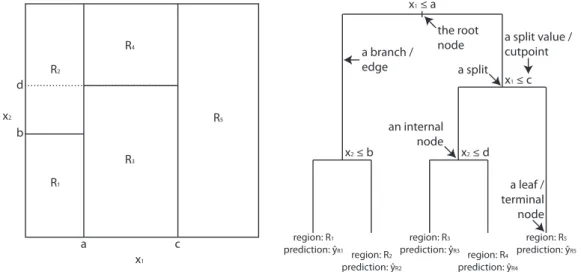
Figure 2.1: A partition by recursive binary splitting of the 2-D input space into five regions (left), and the same partitioning represented in the form of a regression tree (right), with some terminology indicated.
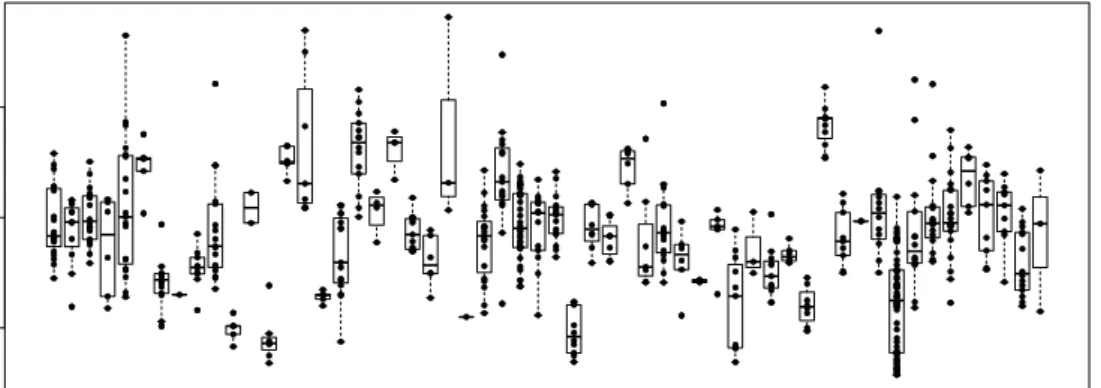
Figure 3.18: Total harvest densities of the fields in the training data.
Figure 3.19: Harvest mass versus area for the training block crops.
Figure 3.21: Harvest density versus planting density for the training block crops.
+7

References

Related documents