J. SHANE CULPEPPER
RMIT University and The University of Melbourne and
ALISTAIR MOFFAT
The University of Melbourne
Conjunctive Boolean queries are a key component of modern information retrieval systems, espe-cially when web-scale repositories are being searched. A conjunctive queryqis equivalent to a |q|-way intersection over ordered sets of integers, where each set represents the documents con-taining one of the terms, and each integer in each set is an ordinal document identifier. As is the case with many computing applications, there is tension between the way in which the data is rep-resented, and the ways in which it is to be manipulated. In particular, the sets representing index data for typical document collections are highly compressible, but are processed using random access techniques, meaning that methods for carrying out set intersections must be alert to issues to do with access patterns and data representation. Our purpose in this paper is to explore these tradeoffs, by investigating intersection techniques that make use of both uncompressed “integer” representations, as well as compressed arrangements. We also propose a simple hybrid method that provides both compact storage, and also faster intersection computations for conjunctive querying than is possible even with uncompressed representations.
Categories and Subject Descriptors: E.2 [Data Storage Representations]: Composite structures; H.3.2 [Infor-mation Storage]: File organization; H.3.3 [Infor[Infor-mation Search and Retrieval]: Search process
Additional Key Words and Phrases: Compact data structures, information retrieval, set intersec-tion, set representaintersec-tion, bitvector, byte-code
1. INTRODUCTION
The computation of set intersections is essential in information retrieval systems. The dom-inant indexing data structure leveraged by search engines is the inverted index [Witten et al. 1999; Zobel and Moffat 2006]. In an inverted index, an ordered set of document identifiers referred to as an inverted list or postings list is stored for each term that appears in the collection, identifying which documents contain the term. These lists are then processed via conjunctive Boolean queries in order to identify the subset of documents which contain all of a given set of search terms – the conjunction, or intersection of the sets indicated by the lists.
The literature describes a range of techniques for computing set intersections, falling
Authors’ addresses: J. Shane Culpepper, School of Computer Science and Information Technology, RMIT University, Victoria 3001, Australia. Alistair Moffat, NICTA Victoria Research Laboratory, Department of Computer Science and Software Engineering, The University of Melbourne, Victoria 3010, Australia. The work described in this paper was presented in preliminary form at the 14th SPIRE Symposium on String Processing and Information Retrieval, Santiago, November 2007; and at the 12th ADCS Australasian Document Computing Symposium, Melbourne, December 2007. Na-tional ICT Australia (NICTA) is funded by the Australian Government’s Backing Australia’s Ability initiative, in part through the Australian Research Council.
broadly into two groupings:
—approaches that assume that the set are stored as sorted arrays of integers, and thus that thedth integer in the list can be accessed inO(1)time; and
—approaches that assume that the lists are stored and accessed sequentially, possibly in some compressed form, and thus that accessing thedth integer in the list might take time that grows as a function ofd, even if it is sublinear ind.
Our presentation in this paper first explores the execution and cost of methods based around these two quite different starting points, and evaluates their relative performance, assuming throughout that all of the required data is being held in random-access memory. We then re-visit a third set representation, one that is usually dismissed as being inordinately ex-pensive for storing index data, but one that with judicious balancing of concerns provides a notable speed up of set intersection operations, without adding greatly to the overall cost of storing the index. We limit our investigation to in-memory indexes in order to provide a clean abstraction for our efficiency evaluation in a manner similar to other recent em-pirical investigations [Strohman and Croft 2007; Transier and Sanders 2008]. The next section lays the foundation for all three of these approaches, by describing the underlying operations required of all set data structures.
2. SET OPERATIONS AND SET INTERSECTION
There are two broad categories of operations on sets. Operations which return information derived from the current state of a set are referred to as query operations, and operations which change the contents or state of a set are update operations.
2.1 Dictionaries and Sets
The dynamic dictionary abstract data type assumes that two update operations and one query operation must be supported:
INSERT(S, x) Return the setS∪x. DELETE(S, x) Return the setS−x.
MEMBER(S, x) ReturnTRUE, and a pointer toxifx∈S; otherwise return
FALSE.
The simpler static dictionary does not require the two update operations, but does require that a suitable initialization process be provided that creates a queryable structure from a list of the set’s members. Such “bulk load” processes are usually more efficient than a sequence of INSERToperations would be.
When the objects being stored in a static dictionary are integers, one simple representa-tion of a static dicrepresenta-tionary is as a sorted array of explicit values, referred to in this work as theSAEVset representation, where “explicit” means that each ordinal integer is stored in unmodified form, independently of the others in the set. The MEMBERoperation over a set ofnitems stored inSAEVformat can be implemented inO(logn)time using binary search.
Dictionaries are often used to build more elaborate data structures which support com-posite set operations that typically manipulate multiple elements in a single atomic opera-tion, and are constructed using one or more of the elemental operators listed above:
INTERSECT(S, T) Return the setS∩T. UNION(S, T) Return the setS∪T. DIFF(S, T) Return the setS−T.
EQUAL(S, T) ReturnTRUEifS=T, otherwise returnFALSE. SPLIT(S, x) Return the two sets{z|z∈Sandz≤x}and
{z|z∈Sandz > x}.
RANGE(S, x, y) Return the set{z|z∈Sandx≤z < y}.
Note that the SPLITand RANGEoperations assume that the set is ordered, and that com-parisons may be performed on the items being manipulated. If an ordering requirement is added, several more primitive operations can be considered, including a “finger search” mechanism:
PRED(S) Return a pointer to the element inSthat immediately precedes the current one.
SUCC(S) Return a pointer to the element inSthat immediately follows the current one.
F-SEARCH(S, x) Return a pointer to the least elementz∈Sfor whichz≥x, wherexis greater than the value of the current element. RANK(S, x) Return|{z|z∈Sandz≤x}|.
SELECT(S, r) Return a pointer to therth largest element inS.
In inverted index processing, the INTERSECT, UNION, and DIFFoperations can be im-plemented using F-SEARCH, PRED, and SUCCoperations. The latter three operators are state-modifying, in that they require that a “current” element have been determined by a previous operation, and in turn move that designator to a different element as a side ef-fect of their execution. As the sequence of operations unfolds, the locus of activity shifts through the set being processed. In some representations, these operations can in turn be built on top of RANKand SELECT. For instance, SUCC(S)can be implemented as SELECT(S,1 +RANK(S, c)), wherecis the current item.
2.2 Binary Intersection of Ordered Sets
The INTERSECToperation is the critical one involved in conjunctive Boolean query pro-cessing; and also in ranked query processing when the ranking is a static one, based on fixed attributes of the page, with all presented answers required to contain every query term [Zobel and Moffat 2006]. To resolve these queries, the document collection is prepro-cessed to generate a set of inverted lists, in which each term is represented by an ordered set of ordinal document numbers in which that term appears. To process a conjunctive Boolean queryqcontaining|q|terms, a|q|-way intersection of|q|pre-computed sets is then required.
The simplest case is when|q| = 2, and two sets are to be intersected; and the most obvious approach is to spendO(|S|+|T|)time on a standard sequential merge, picking out the elements in common to the two sets via a loop in which a single comparison is made at each iteration, and depending on the outcome of the comparison, a SUCCoperation is applied to one or the other of the two lists. This approach is the correct one for UNION
Algorithm 1 Binary set intersection
INPUT: Two ordered setsSandT, with|S|=n1and|T|=n2, andn1≤n2. OUTPUT: An ordered set of answersA.
1: A← { } 2: x←FIRST(S) 3: whilexis defined do 4: y←F-SEARCH(T, x) 5: ifx=ythen 6: APPEND(A, x) 7: end if 8: x←SUCC(S) 9: end while 10: returnA
input sets may not be destroyed during the operation, but is not efficient for INTERSECT
in the cases when|S| ≪ |T|.
Algorithm 1 describes a more complex but also more efficient intersection algorithm, in which each element of the smaller set,S, is tested against the larger set,T, and retained if it is present [Hwang and Lin 1972]. The search retains state as it proceeds, with the eliminator element, x, stepped through the elements of S; and the F-SEARCH (finger search) operation used inT to leapfrog over whole subsequences, pausing only at one corresponding value inT for each item in S. An auxiliary operation, FIRST, is used to establish an initial state inS; andT is implicitly assumed to have also been initialized, so that the first F-SEARCHstarts from its least item.
The essential primitive operations in Algorithm 1 are SUCC and F-SEARCH, with|S| of each performed. In fact, the SUCCoperation in setS can be replaced by a symmetric call to F-SEARCH(S, y)if SUCCis not available as an operation, but the expected num-ber of elements jumped is just one, and in practice SUCCis likely to execute faster than F-SEARCH.
A range of ways in which F-SEARCH can be implemented is discussed in the next subsection, and SUCCcan for most purposes be assumed to requireO(1)time.
2.3 Algorithms for Efficient F-Search
Binary search overn2elements requires1 +⌊logn2⌋comparisons, and if setT is stored as a sorted array of explicit values (SAEVformat), then binary search can be used to underpin the F-SEARCH operations required in Algorithm 1. In particular, binary search is the optimal approach when|S|= 1. As a slight improvement, the current element inT can be used to delimit the search, to gain an incremental benefit on the second and subsequent F-SEARCHcalls.
There are also other searching methods that can be applied to SAEV representations, including linear search, interpolation search, Fibonacci search, exponential search (also referred to as galloping search by some authors), and Golomb search [Hwang and Lin 1972]. The desirable characteristic shared by these alternatives is that the search cost grows as a function of the distance traversed, rather than the size of the array. For example, linear search requiresO(d)time to move the finger byditems; and as is described shortly, exponential search requiresO(logd)time [Bentley and Yao 1976]. A sequential linear
Algorithm 2 Golomb F-SEARCH
INPUT: A sorted listLofnelements, a pre-calculated Golomb parameterb, a search keyx, and a current position inLindicated by curr.
OUTPUT: An offset in the sorted listLifxis found, the offset of the successor of
xif not found, or ENDOFLISTifxis greater thanL[n].
1: pos←curr+b
2: while pos< nandL[pos]< xdo
3: curr←pos 4: pos←curr+b 5: end while 6: if pos> nthen 7: pos←n 8: end if
9: offset←BINARY-SEARCH(L[curr+ 1. . .pos],pos−curr, x) 10: if offset=ENDOFLISTthen
11: curr←pos 12: else
13: curr←pos+offset 14: end if 15: if curr> nthen 16: return ENDOFLIST 17: else 18: return curr 19: end if
merge – dismissed above as being inefficient whenn1 ≪ n2– results if linear search is
used in Algorithm 1.
In situations when1 ≪n1 ≪n2, use of exponential search in the F-SEARCH imple-mentation is of considerable benefit. In an exponential search, probes intoT are made at exponentially increasing rank distance from the current location, until a value greater than the search key is encountered. A binary search is then carried out within the identified subrange, with this “halving” phase having the same cost as the “doubling” phase that pre-ceded it. In this approach each F-SEARCHcall requires1 + 2⌊logd⌋comparisons, where
dis the difference between the rank of the finger’s previous position and the new rank of the finger pointer. Overn1 calls for whichPni=11 di ≤ n2, the convex nature of the log
function means that at mostO(n1+n1log(n2/n1))comparisons are required. Note that
this approach has the same worst case asymptotic cost as using binary search whenn1is
O(1), and has the same worst case asymptotic cost as linear search whenn2/n1isO(1).
If average comparison cost is of interest, the F-SEARCHcan make use of the interpo-lation search mechanism [Gonnet et al. 1980]. This searching algorithm has an average execution cost ofO(log logn)when the data is drawn from a uniform distribution, but in the worst case might requirencomparisons. In practice, the running time of interpolation search is often worse than binary search, because each comparison involves more associ-ated computation and hence more time. However, modern processors are closing the gap between interpolation and binary search, and complex calculations are becoming cheaper than navigating across cache lines [Hennessy and Patterson 2006].
Algorithm 3 Small versus small intersection,svs
INPUT: A list of|q|ordered setsS1. . . S|q|. The function INTERSECTis
defined in Algorithm 1. OUTPUT: An ordered set of answersA.
1: without loss of generality assume that|S1| ≤ |S2| ≤ · · · ≤ |S|q|| 2: A←S1
3: fori= 2to|q|do
4: A←INTERSECT(A, Si) 5: end for
6: returnA
The F-SEARCHalgorithm can also be based on Golomb searching, in a mechanism de-scribed by Hwang and Lin [1972]. Algorithm 2 shows an implementation of this technique. Search proceeds in a manner somewhat similar to exponential F-SEARCH, but with a fixed forwards step ofbitems used at each iteration. Once overshoot has been achieved, a bi-nary search takes place over the (at most)bitems that have been identified. When searching through a set of sizen2for the elements of a set of sizen1, the correct value for the stepbis
0.69(n2/n1), with a total search cost that is again proportional toO(n1+n1log(n2/n1))
[Gallager and van Voorhis 1975].
Variable-length integer coding techniques and F-SEARCHalgorithms are duals of each other. For example, linear search is the dual of the unary code; binary search the dual of the binary code; the exponential search of Bentley and Yao [1976] is the dual of the Elias
Cγcode [Elias 1975]; and the search described by Hwang and Lin [1972] is the dual of the Golomb code [Golomb 1966]. Likewise, the search method of Baeza-Yates [2004] is the dual of the interpolative codes of Moffat and Stuiver [2000], and is conceptually similar to the divide and conquer merging techniques explored by Moffat and Port [1990]. Via this duality it is possible for any integer coding mechanism to be applied to the F-SEARCH
task and then employed in an intersection algorithm onSAEV-representations.
3. MULTI-SET INTERSECTION
When more than two sets are being intersected, the simplest approach is to iteratively apply the standard two-set intersection method using as a sequence of pairwise operations. Algorithm 3 shows this small versus small (svs) approach. The smallest set is identified, and then that set is intersected with each of the others, in increasing order of size. The candidate set is never larger thanS1was initially, so the worst-case cost of this approach
using aSAEVdata representation using an F-SEARCHthat takesO(logd)time to process a jump of lengthdis given by
|q| X i=2 n1log ni n1 ≤ n1(|q| −1) log n|q| n1 ,
where it is assumed that the sets are ordered by size, withn1 ≤n2 ≤ · · · ≤ n|q|. The
svs method is simple and effective, and benefits from the spatial locality inherent from processing the sets two at a time. Even so, each different F-SEARCH implementation gives rise to a differentsvscomputation.
binary intersection approach described by Baeza-Yates [2004] can also be iterated in a small-versus-small manner.
3.1 Holistic Intersection Algorithms
The alternative to thesvsapproach is to combine all of the sets using a single concerted sweep through them all. The resultant holistic algorithms offer the possibility of being adaptive to the particular data arrangement present, and can potentially outperform thesvs approaches. Still working with theSAEV representation, the simplest holistic approach is to treat each item in the smallest set as an eliminator, and search for it in each of the remaining sets. Conceptually, this method is identical to an interleaved version ofsvs. Other adaptive approaches have been proposed which primarily differ in the way that the eliminators are selected at each iteration. Barbay et al. [2006] provide a detailed overview of how such combinations interact, and summarize a range of previous work.
The two prevailing eliminator selection techniques are the adaptive algorithm of De-maine et al. [2000], denotedadpfor our purposes; and the sequential algorithm (seq) of Barbay and Kenyon [2002]. Inadp, the sets are initially monotonically increasing in size. At each iteration, the eliminator is the next remaining item from the set with the fewest remaining elements. If a mismatch occurs before all|q|sets have been examined, the sets are reordered based on the number of unexamined items remaining in each set, and the successor from the smallest remaining subset becomes the new eliminator. This approach reduces the number of item-to-item comparisons expected to be required, but at the possi-bly non-trivial cost of reordering the|q|lists at each iteration of the main loop.
Barbay and Kenyon [2002] proposed an alternative modification, and suggest that every list should be allowed to supply eliminators. Their sequential algorithm, denoted here asseq, uses as the next eliminator the element that caused the previous eliminator to be discarded, and continues the strict rotation among the sets from that point. Only when an eliminator value is found in all the sets – and hence is part of the intersection’s output – is a new eliminator chosen from the smallest set. This approach has the advantage that the sets do not need to be reordered, while still allowing all of the sets to provide eliminators. However, this method suffers from a practical disadvantage: more F-SEARCHoperations are likely to accrue when the eliminator is drawn from a populous set than when it is drawn from one of the sparse sets in the intersection.
3.2 Locality-Dependent, Adaptive Intersection
Holistic methods may have a memory access pattern that is less localized than do svs methods, because all of the sets are processed concurrently. To ameliorate this risk, we propose a further alternative, described by Algorithm 4. The eliminator is initially drawn from the smallest set. When a mismatch occurs, the next eliminator is the larger of the mismatched value and the successor from the smallest set. Processing starts inS2 if the eliminator is again taken fromS1, otherwise processing begins inS1. The intuition behind
this approach is two-fold. The first is that, while it is true that in the absence of other information, the best eliminator will arise in the smallest set, the likelihood of another set becoming significantly smaller thanS1during processing is small. The second intuition is
that, having discovered a bigger than anticipated jump in one of the sets, that value should naturally be tested against the first set, to see if additional items can be discarded.
Algorithm 4 Max successor intersection,max INPUT: A list of|q|ordered setsS1. . . S|q|.
OUTPUT: An ordered set of answersA.
1: without loss of generality assume that|S1| ≤ |S2| ≤ · · · ≤ |S|q|| 2: A← { } 3: x←FIRST(S1) 4: startat←2 5: whilexis defined do 6: fori=startat to|q|do 7: y←F-SEARCH(Si, x) 8: ify > xthen 9: x←SUCC(S1) 10: ify > xthen 11: startat←1 12: x←y 13: else 14: startat←2 15: end if 16: break 17: else ifi=|q|then 18: APPEND(A, x) 19: x←SUCC(S1) 20: startat←2 21: end if 22: end for 23: end while 24: returnA
3.3 Multi-Set Intersection in Practice
In this section we empirically compare the intersection methods described in the previous sections, still working exclusively in the framework established by theSAEV representa-tion. First, we describe the origins of the data used, and consider the statistical properties of two large query sets which form the basis of the empirical study. We then compare and contrast the various INTERSECTand F-SEARCHcombinations, setting the scene for the introduction of other representations in the Sections 4 and 5.
Our experiments are based on the integer lists that comprise the inverted index of the
GOV2 collection of theTRECTerabyte Track, seehttp://trec.nist.gov. The to-tal collection contains just over25million crawled web documents, roughly87million distinct alphabetic “words”, and occupies426GB of space. The vocabulary and inverted lists were constructed using theZettairsearch engine, seehttp://www.seg.rmit. edu.au/zettair. Words that appeared with frequency one or two were assumed to be handled outside of the set of inverted lists, for example, within the vocabulary. After this re-duction, a total of19,783,975index lists remained, each of which was then stored inSAEV
format as an ordered sequence of document numbers in the range1tou= 25,205,181. Two query sets were used for the experiments. The first query set was extracted from a
Table I. The27,004Microsoft queries and131,433TRECqueries. The average query length for the Microsoft andTRECqueries is2.73and4.00terms respectively. The “averageni” columns
show the average number of integers per index list across all terms for queries of that length. Query length Microsoft queries TRECqueries
Total Matches Averageni Total Matches Averageni
|q| queries (’000) (’000) queries (’000) (’000) 2 15,517 124 1,018 28,174 34 560 3 7,014 78 2,433 33,505 21 1,603 4 2,678 56 3,712 28,937 14 2,670 5 1,002 41 4,712 18,864 9 3,445 6 384 27 5,169 10,317 7 4,093 7 169 15 5,746 5,252 6 4,607 8 94 10 6,050 2,772 5 4,999 9+ 146 5 5,985 3,612 3 5,502
query log supplied by Microsoft, with the property that every query had a top-three result in the .govdomain at the time it was originally executed. The second query set was extracted from the 2005 and 2006TREC“million-query” track. All single word queries from each set were eliminated, and the remaining queries filtered to ensure that each had at least one conjunctive match in theGOV2 collection. There were a total of27,004unique queries retained in the Microsoft query set, all of length two or greater; and131,433queries retained in theTRECquery set. Table I shows the distribution of query lengths in the two test sequences; the average number of document matches for each query length; and the average number of documents containing each query term, computed for each query as
(P|q|
i=1ni)/|q|. Compared to the Microsoft queries of the same length, theTRECqueries
tend on average to involve terms that are less frequent in the collection, and thus more selective in terms of answer numbers. Across both logs, the longer queries tend to involve, on average, terms that are more frequent in the collection; but even relatively short queries of three words involved computing intersections over millions of document numbers.
In order to focus solely on the efficiency of the intersection algorithms being tested, the inverted lists for the terms pertinent to each query were read into memory. The execution clock was started, and that query executed five consecutive times, in each case returning the full candidate set of document numbers. The clock was then stopped again, and theCPU
time for the run was added to a running total, according to the length of the query evaluated. For example, the time recorded for queries of length two drawn from the Microsoft query set is the average of5×15,517 = 77,585query executions.
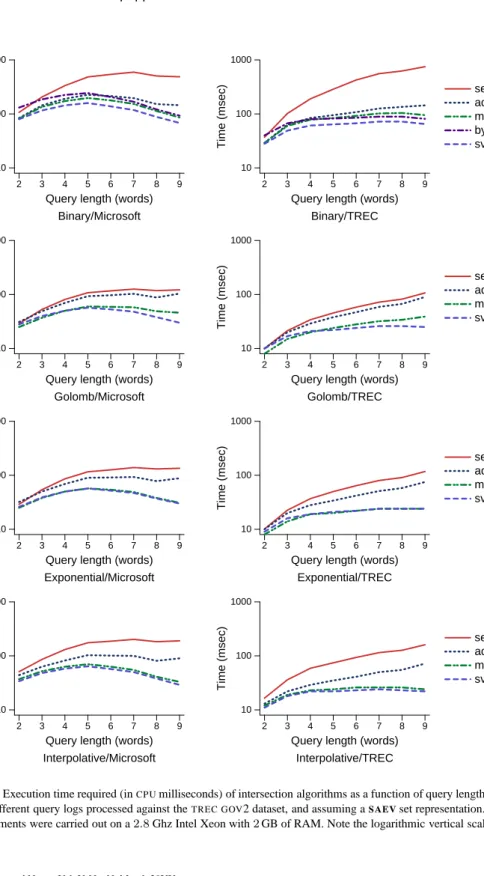
Figure 1 compares the averageCPUtime per query for each intersection method. The top pair of graphs show the baseline approach of combining binary search with the different INTERSECTmethods. The second row of graphs similarly shows the performance of the same methods when Golomb F-SEARCH is used; the third row, the performance of an exponential F-SEARCH; and the final pair of graphs the performance of an F-SEARCH
based on interpolation search. In each of the four pairs of graphs, the left-hand one shows the measured behavior using the Microsoft query log, and the right-hand one shows the measured behavior using theTRECquery log.
Binary search (in the top pair of graphs) is relatively inefficient, as it generates more cache misses than the other methods. The result is a noticeable performance degradation relative to methods which achieve localized access. At the bottom of the figure, interpo-lation search performs significantly fewer comparisons on average across all INTERSECT
2 3 4 5 6 7 8 9 Query length (words) 10 100 1000 Time (msec) Binary/Microsoft 2 3 4 5 6 7 8 9
Query length (words) 10 100 1000 Time (msec) Binary/TREC seq adp max bya svs 2 3 4 5 6 7 8 9
Query length (words) 10 100 1000 Time (msec) Golomb/Microsoft 2 3 4 5 6 7 8 9
Query length (words) 10 100 1000 Time (msec) Golomb/TREC seq adp max svs 2 3 4 5 6 7 8 9
Query length (words) 10 100 1000 Time (msec) Exponential/Microsoft 2 3 4 5 6 7 8 9
Query length (words) 10 100 1000 Time (msec) Exponential/TREC seq adp max svs 2 3 4 5 6 7 8 9
Query length (words) 10 100 1000 Time (msec) Interpolative/Microsoft 2 3 4 5 6 7 8 9
Query length (words) 10 100 1000 Time (msec) Interpolative/TREC seq adp max svs
Fig. 1. Execution time required (inCPUmilliseconds) of intersection algorithms as a function of query length, for two different query logs processed against theTREC GOV2 dataset, and assuming aSAEVset representation. All experiments were carried out on a2.8Ghz Intel Xeon with2GB of RAM. Note the logarithmic vertical scale.
Table II. Time required (inCPUmilliseconds) for thesvsintersection algorithms (which was the most efficient in all cases) as a function of query length and F-SEARCHalgorithm, for two different query logs processed against theTREC GOV2 dataset, and assuming aSAEVset representation. All experiments were carried out on a2.8Ghz Intel Xeon with2GB of RAM.
Query length Microsoft queries TRECqueries |q| Bin Inter Exp Gol Bin Inter Exp Gol
2 80 34 26 28 28 11 9 10 3 116 48 39 40 49 18 16 17 4 144 58 50 50 61 22 19 21 5 159 64 57 57 64 22 21 22 6 138 57 52 53 67 23 22 24 7 118 50 47 48 72 24 24 26 8 88 38 37 38 72 23 24 26 9+ 68 29 30 30 65 22 24 25
of the arithmetic involved in calculating each probe means that it is no faster that the other searching approaches. In terms ofCPU performance, thesvs andmax methods outper-form theadpandseqmulti-set approaches, as a consequence of a more tightly localized memory access pattern.
One issue that arose with the Golomb-based F-SEARCHapproach depicted in the third row of graphs is the choice of parameterb. In thesvsimplementation, the value ofb ap-propriate to each list is chosen immediately prior to that list being included in the ongoing sequence of intersections. But with theseq,adp, andmaxapproaches, a value ofbis com-puted for each list at the commencement of processing, based on the length of the shortest list. That same set ofbvalues is then used throughout the computation, which means that if the intersection yields only a few answers, then the searching procedure may usebvalues that are too low.
The best overall choices across the different eliminator selection approaches are thesvs andmax mechanisms, coupled with the exponential search or Golomb search for short queries, or coupled with the interpolative search for long ones. When conjunctive queries are computed using these combinations, the execution times of thesvsandmaxmethods tend not to grow as more terms are added to the query. This is because the cost is largely determined by the product of the frequency of the rarest element, and the number of terms. The longer the query, the more likely it is to include at least one low-frequency term, with the sum of the marginal savings that accrue on each one of the binary intersections more than recouping the cost of processing a greater number of lists.
Finally, note that the top two graphs also show the binary search-based method of Baeza-Yates [2004], which is adaptive by virtue of the search sequence. It operates on two sets at a time, but within those two sets has little locality of reference when compared to thesvs andmaxapproaches, and is a little slower in practice.
Table II shows the average time in milliseconds for each of the four F-SEARCHmethods when combined with thesvsapproach, since it always the most efficient in practice. The exponential search (Exp) and Golomb search (Gol) exhibit nearly identical performance across all values of|q|, but withExphaving a slight edge throughout the range. This su-periority could arise if the eventual answers to each query are not uniformly spread across the document range, and instead tend to form clusters within the document space. Inter-polation search (Inter) is also fast when|q|is large, when the last intersections performed involve a very small set. Binary search (Bin) is never the fastest when combined with the svsintersection method. These observations also hold true when these F-SEARCH
Table III. The average number of F-SEARCHcalls initiated for theTRECquery set. The average length of the shortest list,n1, is also shown.
Query length n1 svs adp bya seq max 2 118,138 118,138 118,134 118,139 156,405 107,191 3 150,801 183,918 183,086 183,921 273,401 162,636 4 161,965 210,971 209,593 210,975 358,891 184,154 5 156,616 210,167 208,721 210,172 404,953 181,733 6 156,455 213,907 212,114 213,913 454,434 183,682 7 154,810 216,606 214,231 216,613 511,181 186,833 8 144,740 206,936 205,322 206,943 523,296 178,123 9+ 127,778 185,787 184,036 185,797 549,895 160,495
approaches are coupled with other algorithms, includingseqandadp.
Another way of quantifying efficiency is to count the number of F-SEARCHcalls initi-ated. Table III shows the average number of F-SEARCHcalls required across the131,433 TRECqueries, categorized by query length. The number of calls to resolve any given query is largely a function of the query length and the number of terms in the shortest list. How-ever, as queries get longer, on average the rarest query term becomes progressively less frequent, and extended queries can involve fewer F-SEARCHcalls than shorter ones, pro-vided that an appropriate choice of eliminator is made at each step. In this regard, method seqis clearly more expensive than the others, and the newmaxmethod a little better.
From these experiments we conclude that when the sets in question represent term occur-rences in documents in a large collection of web pages, and are stored inSAEV representa-tion, the classic small-versus-small approach to intersection is the fastest. In combinarepresenta-tion, the non-parameterized exponential F-SEARCHimplementation is the approach that is the most versatile across the broad spectrum of query lengths.
4. COMPRESSED SET REPRESENTATIONS
The intersection methods discussed so far assume each set is stored in SAEVformat as a sorted array of explicit values. This is, however, an expensive way to store the sets that arise from the inverted lists in information retrieval systems, and any claims about relative performance must be re-evaluated when more compact storage representations are employed.
4.1 Compact Sequences of Relative Differences
The index lists in a retrieval system are commonly stored as lists of first-order differences, or gaps, between consecutive items [Zobel and Moffat 2006]. Within this broad framework there are then many possible ways of representing the differences, and we will refer to these generically as being compact sequence of relative differences, orCSRDapproaches, and take as axiomatic that the items in the sequence are unique integers and sorted, and thus that the differences are all strictly positive. For example, when converted to differences, the sorted set
S ={1,4,5,6,8,12,15,16,18,20,25,26,27,28,30},
is transformed to
{1,3,1,1,2,4,3,1,2,2,5,1,1,1,2},
which is then stored using some form of variable-length code that favors small values over large.
As a combinatorial limit, a set ofndistinct items drawn from the universe1. . . ucan be represented in as few as log2 u n = log u! (u−n)!n! ≈n logu n+ 1.44 , (1)
bits (see Brodnik and Munro [1999] or Sadakane and Grossi [2006] for discussion). Look-ing at this bound from the point of view of a sequence ofngapshdi|1≤i≤ni, any cod-ing mechanism that represents the sequence inO(nlog(u/n))bits, whereu=Pn
i=1di, is a compact representation, and is at most a constant factor inefficient compared to the combinatorial lower bound. In particular, any static integer code with the property that the codeword for integerxrequiresO(logx)bits can be used. Codes that meet this require-ment include the Eliasγandδcodes [Elias 1975]; and static byte-codes. Golomb codes are explicitly fitted to the situation described, and if alln-subsets of1. . . uare equally likely, provide a one-parameter equivalent of the multi-parameter Huffman code that would be derived from the probability distribution governing thed-gaps. Witten et al. [1999] and Moffat and Turpin [2002] describe all of these methods, and we refer the reader to those descriptions rather than repeat them here.
Unfortunately, theCSRDrepresentations have a serious drawback: the differencing and
compression transformations both produce representations that must necessarily be ac-cessed sequentially. This restriction means that primitive set operations other than SUCC
are expensive. In particular, the only viable F-SEARCHalternative is essentially a linear search, which means that INTERSECT of lists of lengthn1andn2requiresO(n1+n2)
time. Even MEMBERqueries incur anO(n)cost when using simpled-gap representations. That is, compact set representations are space effective, but unless they are enhanced with auxiliary structures, are not efficient for set intersection applications such as text retrieval. Recent work on succinct set representations which use sophisticated bitvector representa-tions provide a viable alternative to balancing efficiency and effectiveness, but it is unclear how such data structures can be effectively integrated in current inverted index-based sys-tems [Okanohara and Sadakane 2007; Claude and Navarro 2008].
4.2 Bitvectors
A setS of integer values over a known universe1. . . u can also be represented using a bitvector, in an approach we refer to as BITV. A bitvector is a u-bit sequence in which thexth bit is1if and only ifx ∈ S. For example, assuming thatu = 32, the setS in Section 4.1 would be represented as the bitvector10011101000100110101000011110100. If the set being represented is dense over the universe1. . . u, that is,u/n =O(1), then bitvectors are both space-effective and also access-efficient. On the other hand, when
n ≪ u, bitvectors are more expensive than the compact representations described in the previous subsection. Using a bitvector dramatically shifts the cost balance of several of the primitive set operations. Operations INSERT, DELETE, and MEMBERall takeO(1)
time in theBITVrepresentation; but UNION, DIFF, and INTERSECTtakeO(u)time, and without additional support via auxiliary structures, F-SEARCH, SUCC, and PRED also become more expensive. In practice, UNION, DIFF, and INTERSECT can benefit from bit-parallelism to obtain a constant factor speedup, but this does not affect the asymptotic cost of the operations.
Control operations such as RANKand SELECTare also expensive in unadorned bitvec-tor representations. If the application requires these or other control operations such as
Table IV. Effectiveness of storage, and efficiency of access, for three different representations of integer sets, with emphasis on the operations needed in text retrieval systems, assuming that a subset ofn(and a second larger one of sizen2, where the operation has two parameters) items in the range1. . . uis being manipulated. In the F-SEARCHoperation,dis the number of items that are stepped over. In the case of theBITVapproach and the F-SEARCHoperation it is assumed that thenelements form a random subset of1. . . u.
Attribute SAEV CSRD BITV
Space required (bits) nlogu n(log(u/n) + 1.44) u
MEMBER(time) O(logn) O(n) O(1)
F-SEARCH(time) O(logd) O(d) O(u/n)
INTERSECT(time) O(nlog(n2/n)) O(n+n2) O(u)
Table V. Total space cost (gigabytes) to store three different subsets of the inverted lists of terms appearing in more than two documents in the426GBTREC GOV2 collection.
Data Representation TREC GOV2 Microsoft queries TRECqueries 19,783,975 words 15,208 words 44,862 words
BITV 58,051.4 44.6 131.6
SAEV,32-bit integers 22.6 14.1 17.1
CSRD, byte codes 7.4 3.8 4.8
Combinatorial limit 5.9 2.7 3.5
F-SEARCH, PRED, or SUCC, the basic bitvector representation is no longer sufficient. Ja-cobson [1989] showed that the addition of a controlled amount of extra space allows RANK
and SELECTto be supported inO(logu)time. As a consequence, SUCC, and PREDcan also be supported in equivalent time. Building on that work, Munro [1996] demonstrated that RANKand SELECTcan be accomplished inO(1)time. The new structure, called an “indexable” bitvector, depends on the use of auxiliary lookup tables which store cumula-tive ranks for blocks of elements. The tradeoff for the performance boost is an additional
o(u)bits of space, required to store the lookup tables.
Additional variations on bitvectors have been reported recently, including some which attempt to reduce the space overhead associated with sparse bitvectors (see for example, Clark [1996], Pagh [2001], Raman et al. [2002], Okanohara and Sadakane [2007], and Claude and Navarro [2008]). However, the space overhead can still be significant in certain set arrangements. Note that the crucial motivation for many of the alternative bitvector arrangements is support for efficient RANKand SELECToperations, neither of which are strictly necessary for set intersection.
Table IV summarizes the three alternative set representations that have been discussed. In each case it is assumed that a subset ofnitems in the range1. . . uis being manipulated, and that the F-SEARCHoperation steps pastdmembers of the set. The column headed
BITV further assumes that the set is dense. In the case of theCSRDandBITV represen-tations, it is also assumed that no auxiliary information is being stored. (But note that in both cases F-SEARCHoperations can be faster when the base arrangement is augmented by auxiliary index structures.)
4.3 Space Usage in Practice
Table V shows the cost of storing three different subsets of the inverted lists of theGOV2 collection. In the second column, every term that appears in more than two of the collec-tion’s documents has its list included in the sum, and the values represent the cost of storing a full index. The third and fourth columns then show the cost of storing inverted lists for
only the subsets of the terms required by the two query sets indicated by the column head-ing. For example, storing the full set of inverted lists inSAEVformat using32-bit integers gives rise to an index of nearly23GB. When compared with the combinatorial cost of the full index (as defined in Equation 1, summed over all the lists) of6GB, the advantage of storing the index inCSRDformat is apparent. Byte codes coupled withCSRDformat
do not attain the combinatorial bound, nevertheless they provide attractive space savings compared to uncompressed integers andSAEVformat. At the other end of the spectrum, storing the full index inBITV format is prohibitively expensive; and even if only the re-quired query terms are considered, theBITVformat – which is the most efficient in terms of MEMBERqueries – is relatively costly, even if those terms could somehow have been known in advance.
5. BALANCING SPACE AND TIME USAGE
ForCSRDrepresentations it is possible to accelerate F-SEARCHoperations by adding ad-ditional information to the compressed sequence. For example, Moffat and Zobel [1996] add a synchronization point every√nth position, so that blocks of√nitems can be by-passed when MEMBERand F-SEARCHoperations involve search keys not present in that block. More elaborate approaches have also been proposed which attempt to offset the costs of a linear scan through alld-gaps using variations on balanced binary search trees. Gupta et al. [2006] describe a two-level data structure where each level is itself search-able and compressed, extending earlier work by Blandford and Blelloch [2004]. In the Gupta et al. [2006] method, each block of elements at the lower level is represented as a balanced binary search tree, and stored implicitly via a pre-order traversal, with additional skip pointers embedded to find each child’s left subtree. Sitting on top of each tree block is an index which allows the correct tree to be quickly identified. By balancing the size and efficiency of the two structures, good asymptotic performance is achieved.
5.1 Auxiliary Indexing
In this section we propose a more pragmatic approach to address the same need. The structure, which we refer to as an auxiliary index, balances space and time usage in a relatively straightforward manner, and allows fast implementation. It makes use of a partial index of uncompressed items together with offsets into the compressed sequence.
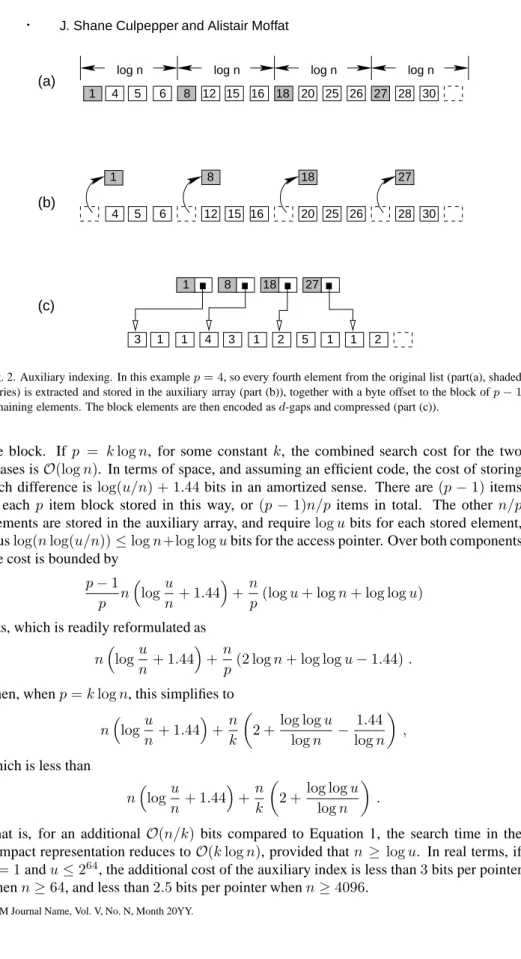
Figure 2 outlines the proposed arrangement. First, everypth element is extracted from the compressed list, added to an auxiliary array, and stored as an uncompressed integer. The choice of a value forpis discussed shortly. Next, the remaining items are represented asd-gaps, and stored as groups ofp−1differences, compressed sequentially. Finally, a bit offset (or byte offset, in the case of byte-code compression techniques) is added to the auxiliary array, so that the blocks of the compressed data can be accessed independently of each other.
When a MEMBERoperation is required, the keys in the auxiliary array are traversed using anySAEV-based searching method, including the F-SEARCHapproaches described in Section 2. If the value being sought is located in the auxiliary array, it is returned. If not, a sequential search is undertaken in the appropriate block ofpelements using aCSRD
mechanism. Alternatively, the block can be completely decompressed into an array, and searched using aSAEV-based MEMBERoperation.
The cost of searching when the set containsnvalues is at mostO(log(n/p))for a binary search in the auxiliary index, followed byO(p)-time spent decoding and searching within
30
(c) (b)
(a) log n log n log n log n
.
.
.
.
1 8 18 27 4 5 6 12 15 16 20 25 26 28 30 1 8 18 27 2 5 2 1 3 4 1 1 1 1 3 1 4 5 6 8 12 15 16 18 20 25 26 27 28Fig. 2. Auxiliary indexing. In this examplep= 4, so every fourth element from the original list (part(a), shaded entries) is extracted and stored in the auxiliary array (part (b)), together with a byte offset to the block ofp−1 remaining elements. The block elements are then encoded asd-gaps and compressed (part (c)).
the block. If p = klogn, for some constant k, the combined search cost for the two phases isO(logn). In terms of space, and assuming an efficient code, the cost of storing each difference islog(u/n) + 1.44bits in an amortized sense. There are(p−1) items in each pitem block stored in this way, or(p−1)n/p items in total. The othern/p
elements are stored in the auxiliary array, and requirelogubits for each stored element, pluslog(nlog(u/n))≤logn+log logubits for the access pointer. Over both components the cost is bounded by
p−1 p n logu n+ 1.44 +n
p(logu+ logn+ log logu)
bits, which is readily reformulated as
nlogu n+ 1.44
+n
p(2 logn+ log logu−1.44).
Then, whenp=klogn, this simplifies to
nlogu n + 1.44 +n k 2 + log logu logn − 1.44 logn ,
which is less than
nlogu n+ 1.44 +n k 2 +log logu logn .
That is, for an additionalO(n/k) bits compared to Equation 1, the search time in the compact representation reduces toO(klogn), provided thatn≥ logu. In real terms, if
k= 1andu≤264
, the additional cost of the auxiliary index is less than3bits per pointer whenn≥64, and less than2.5bits per pointer whenn≥4096.
Table VI. Total space cost (gigabytes) ofCSRDrepresentation and auxiliary indexing, on the same basis as is presented in Table V.
Data Representation TREC GOV2 Microsoft queries TRECqueries 19,783,975 words 15,208 words 44,862 words
CSRD, byte codes 7.4 3.8 4.8
CSRD, byte codes, auxiliary index,k= 4 8.0 4.1 5.1 CSRD, byte codes, auxiliary index,k= 2 8.5 4.4 5.5 CSRD, byte codes, auxiliary index,k= 1 9.5 4.9 6.2
2 3 4 5 6 7 8 9
Query length (words)
10 100 1000 Time (msec) Microsoft Queries 2 3 4 5 6 7 8 9
Query length (words)
10 100 1000 Time (msec) TREC queries svs+bc svs+bc+aux bvc svs
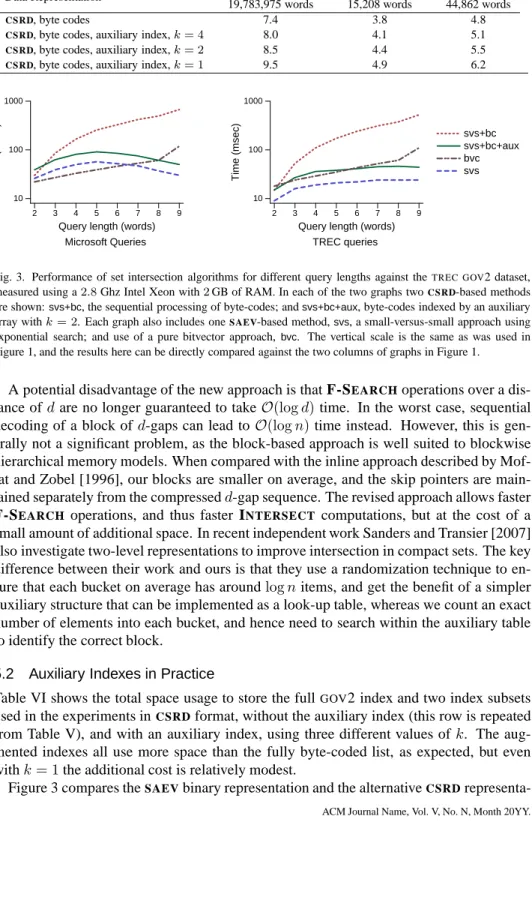
Fig. 3. Performance of set intersection algorithms for different query lengths against theTREC GOV2 dataset, measured using a2.8Ghz Intel Xeon with2GB of RAM. In each of the two graphs twoCSRD-based methods are shown:svs+bc, the sequential processing of byte-codes; andsvs+bc+aux, byte-codes indexed by an auxiliary array withk= 2. Each graph also includes oneSAEV-based method,svs, a small-versus-small approach using exponential search; and use of a pure bitvector approach,bvc. The vertical scale is the same as was used in Figure 1, and the results here can be directly compared against the two columns of graphs in Figure 1.
A potential disadvantage of the new approach is that F-SEARCHoperations over a dis-tance ofdare no longer guaranteed to takeO(logd)time. In the worst case, sequential decoding of a block ofd-gaps can lead to O(logn)time instead. However, this is gen-erally not a significant problem, as the block-based approach is well suited to blockwise hierarchical memory models. When compared with the inline approach described by Mof-fat and Zobel [1996], our blocks are smaller on average, and the skip pointers are main-tained separately from the compressedd-gap sequence. The revised approach allows faster F-SEARCH operations, and thus faster INTERSECT computations, but at the cost of a small amount of additional space. In recent independent work Sanders and Transier [2007] also investigate two-level representations to improve intersection in compact sets. The key difference between their work and ours is that they use a randomization technique to en-sure that each bucket on average has aroundlognitems, and get the benefit of a simpler auxiliary structure that can be implemented as a look-up table, whereas we count an exact number of elements into each bucket, and hence need to search within the auxiliary table to identify the correct block.
5.2 Auxiliary Indexes in Practice
Table VI shows the total space usage to store the fullGOV2 index and two index subsets used in the experiments inCSRDformat, without the auxiliary index (this row is repeated from Table V), and with an auxiliary index, using three different values ofk. The aug-mented indexes all use more space than the fully byte-coded list, as expected, but even withk= 1the additional cost is relatively modest.
representa-tion. Fully compressed representations such as thesvs+bcapproach perform well for short queries, but are much slower than theSAEV-basedsvsapproach on longer ones, in which it is more likely that at least some common terms will arise. Use of the auxiliary array in thesvs+bc+auxmethod increases processing speed on long queries, and allows intersec-tions to be handled in times closer to those attained by the uncompressedsvsapproach. This improvement is a result of intersection benefiting from non-sequential access and, as queries get longer, the increasing sparsity of the most discriminating term list.
Figure 3 also shows the time taken by the bitvector approach,bvc, which is usefully fast on short queries, but as expected, has a cost that grows approximately linearly in the number of query terms. Bitvectors are able to store common query terms in relatively small amounts of space. Indeed, their only real deficiency is the exorbitant storage costs for rare terms, an observation that leads directly to the hybrid approach that is explored in the next section.
5.3 Hybrid Representations
The simplicity of bitvectors, and their useful blend of efficiency and effectiveness for INTERSECT and MEMBERqueries on dense sets, suggests that using them to store at least some of the term lists of the index may be beneficial. To this end, we now consider a hybrid approach, in which the dense lists in the index, corresponding to frequently occur-ring terms, are stored using aBITVrepresentation, and the sparse terms are stored using a
CSRDrepresentation. Given that each byte-coded difference occupies a minimum of eight bits, using a bitvector for all terms that occur in more thanu/8of the documents in a col-lection containing a total ofudocuments cannot increase the index size. Other thresholds are also possible, and in the experiments described shortly, the bitvector representation is used whenever more thanu/kof the documents contain that term, for values ofkin the set{8,16,32}.
Two alternative ways of using the resultant hybrid index have been evaluated. In the first method, denotedhyb+m1, the sets of byte coded and bitvector lists are intersected separately, and then combined using a sequence ofO(1)-time MEMBERoperations. That
is, if there are anyBITVterms, they are intersected using bitwiseANDoperations to yield a bitvectorB. If there are no byte-codedCSRDsets, then the expanded set of document numbers derived fromB is returned. Or, if there are byte-coded sets, they are intersected using thesvsapproach to yield a candidate setC. Then, if there are no bitvector sets,Cis returned. Otherwise, for eachx∈C, ifB[x] = 1, thenxis appended to the answer set.
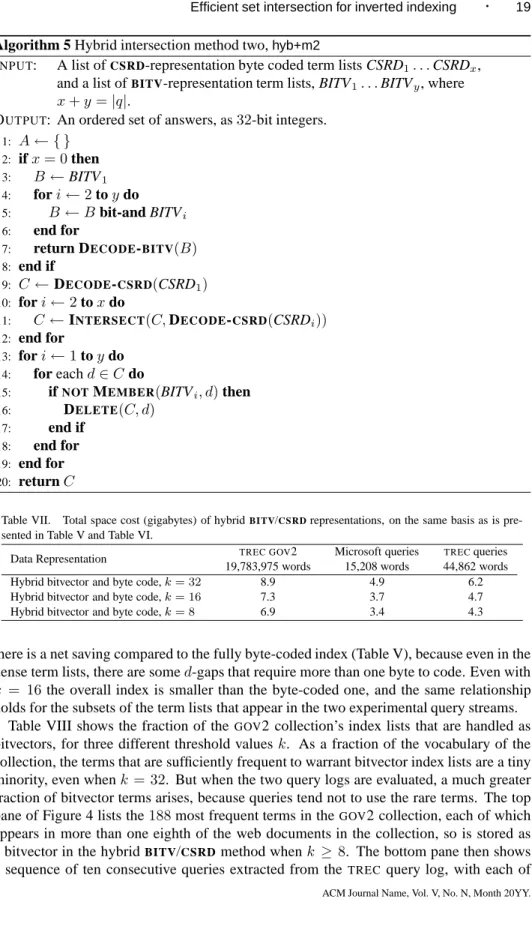
In the second hybrid method,hyb+m2, all byte-coded lists are intersected to produce a candidate list. Then, each of the remaining bitvector lists is searched via a MEMBERquery, replacing the bitvector INTERSECToperations with multiple MEMBERoperations, each of which takesO(1)time. The motivation for this alternative comes from the realization that intersection of the byte-coded sets should result in a sparse set of potential candidates, and that a sequence of MEMBERqueries may be preferable to anyO(u)-time INTERSECT
operations. Algorithm 5 describes this second approach in detail.
5.4 Hybrid Representations in Practice
Table VII shows the cost of storing theGOV2 index data using compressed lists and bitvec-tors in a hybrid approach. The most effective partitioning point for the compact hybrid representation isk = 8, with terms occurring in fewer thanu/8 = 3,150,648documents stored using a CSRDapproach and the byte-code representation. Note that whenk = 8
Algorithm 5 Hybrid intersection method two,hyb+m2
INPUT: A list ofCSRD-representation byte coded term lists CSRD1. . .CSRDx, and a list ofBITV-representation term lists, BITV1. . .BITVy, where x+y=|q|.
OUTPUT: An ordered set of answers, as32-bit integers.
1: A← { } 2: ifx= 0then 3: B ←BITV1 4: fori←2toydo 5: B←Bbit-and BITVi 6: end for
7: return DECODE-BITV(B) 8: end if 9: C←DECODE-CSRD(CSRD1) 10: fori←2toxdo 11: C←INTERSECT(C,DECODE-CSRD(CSRDi)) 12: end for 13: fori←1toydo 14: for eachd∈Cdo
15: ifNOTMEMBER(BITVi, d)then
16: DELETE(C, d)
17: end if
18: end for
19: end for
20: returnC
Table VII. Total space cost (gigabytes) of hybridBITV/CSRDrepresentations, on the same basis as is pre-sented in Table V and Table VI.
Data Representation TREC GOV2 Microsoft queries TRECqueries 19,783,975 words 15,208 words 44,862 words Hybrid bitvector and byte code,k= 32 8.9 4.9 6.2 Hybrid bitvector and byte code,k= 16 7.3 3.7 4.7 Hybrid bitvector and byte code,k= 8 6.9 3.4 4.3
there is a net saving compared to the fully byte-coded index (Table V), because even in the dense term lists, there are somed-gaps that require more than one byte to code. Even with
k = 16the overall index is smaller than the byte-coded one, and the same relationship holds for the subsets of the term lists that appear in the two experimental query streams.
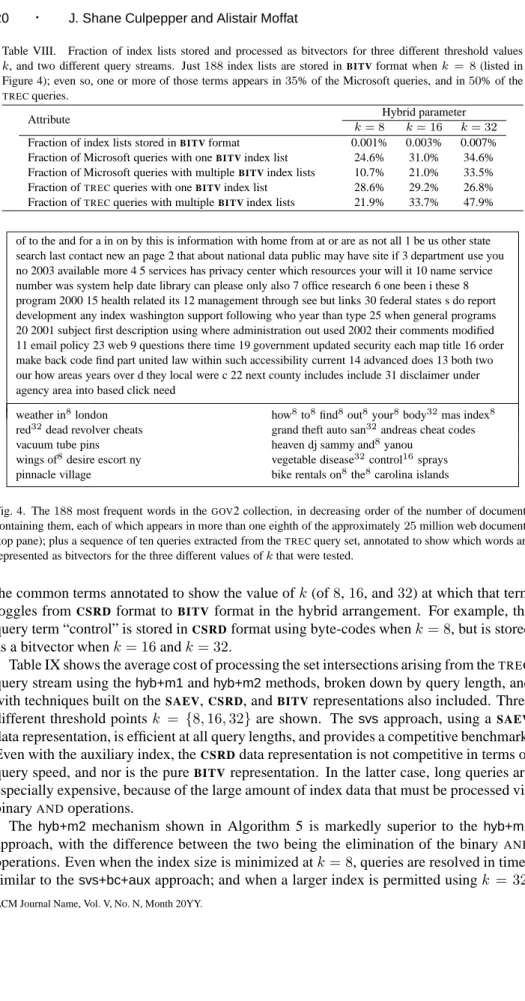
Table VIII shows the fraction of theGOV2 collection’s index lists that are handled as bitvectors, for three different threshold valuesk. As a fraction of the vocabulary of the collection, the terms that are sufficiently frequent to warrant bitvector index lists are a tiny minority, even whenk= 32. But when the two query logs are evaluated, a much greater fraction of bitvector terms arises, because queries tend not to use the rare terms. The top pane of Figure 4 lists the188most frequent terms in theGOV2 collection, each of which appears in more than one eighth of the web documents in the collection, so is stored as a bitvector in the hybridBITV/CSRDmethod whenk ≥8. The bottom pane then shows a sequence of ten consecutive queries extracted from the TRECquery log, with each of
Table VIII. Fraction of index lists stored and processed as bitvectors for three different threshold values k, and two different query streams. Just188index lists are stored inBITVformat whenk = 8(listed in Figure 4); even so, one or more of those terms appears in35% of the Microsoft queries, and in50% of the
TRECqueries.
Attribute Hybrid parameter
k= 8 k= 16 k= 32 Fraction of index lists stored inBITVformat 0.001% 0.003% 0.007% Fraction of Microsoft queries with oneBITVindex list 24.6% 31.0% 34.6% Fraction of Microsoft queries with multipleBITVindex lists 10.7% 21.0% 33.5% Fraction ofTRECqueries with oneBITVindex list 28.6% 29.2% 26.8% Fraction ofTRECqueries with multipleBITVindex lists 21.9% 33.7% 47.9%
of to the and for a in on by this is information with home from at or are as not all 1 be us other state search last contact new an page 2 that about national data public may have site if 3 department use you no 2003 available more 4 5 services has privacy center which resources your will it 10 name service number was system help date library can please only also 7 office research 6 one been i these 8 program 2000 15 health related its 12 management through see but links 30 federal states s do report development any index washington support following who year than type 25 when general programs 20 2001 subject first description using where administration out used 2002 their comments modified 11 email policy 23 web 9 questions there time 19 government updated security each map title 16 order make back code find part united law within such accessibility current 14 advanced does 13 both two our how areas years over d they local were c 22 next county includes include 31 disclaimer under agency area into based click need
weather in8 london how8 to8 find8 out8 your8 body32 mas index8 red32
dead revolver cheats grand theft auto san32
andreas cheat codes vacuum tube pins heaven dj sammy and8
yanou wings of8
desire escort ny vegetable disease32 control16
sprays pinnacle village bike rentals on8
the8
carolina islands
Fig. 4. The188most frequent words in theGOV2 collection, in decreasing order of the number of documents containing them, each of which appears in more than one eighth of the approximately25million web documents (top pane); plus a sequence of ten queries extracted from theTRECquery set, annotated to show which words are represented as bitvectors for the three different values ofkthat were tested.
the common terms annotated to show the value ofk(of8,16, and32) at which that term toggles fromCSRDformat to BITV format in the hybrid arrangement. For example, the query term “control” is stored inCSRDformat using byte-codes whenk= 8, but is stored as a bitvector whenk= 16andk= 32.
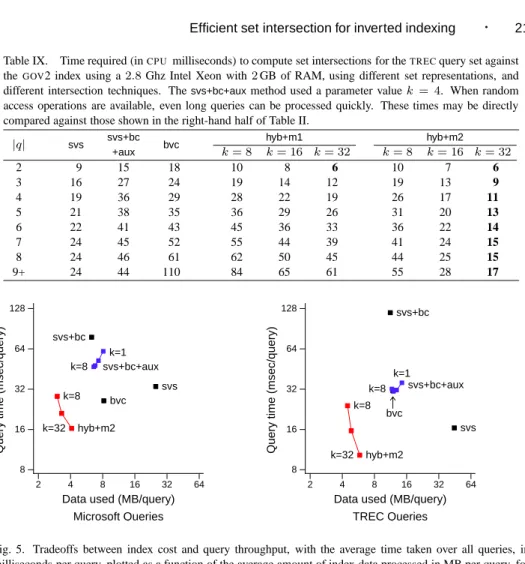
Table IX shows the average cost of processing the set intersections arising from theTREC
query stream using thehyb+m1andhyb+m2methods, broken down by query length, and with techniques built on theSAEV,CSRD, andBITVrepresentations also included. Three different threshold pointsk = {8,16,32}are shown. Thesvsapproach, using aSAEV
data representation, is efficient at all query lengths, and provides a competitive benchmark. Even with the auxiliary index, theCSRDdata representation is not competitive in terms of query speed, and nor is the pureBITV representation. In the latter case, long queries are especially expensive, because of the large amount of index data that must be processed via binaryANDoperations.
The hyb+m2 mechanism shown in Algorithm 5 is markedly superior to thehyb+m1 approach, with the difference between the two being the elimination of the binaryAND
operations. Even when the index size is minimized atk= 8, queries are resolved in times similar to thesvs+bc+auxapproach; and when a larger index is permitted usingk = 32,
Table IX. Time required (inCPU milliseconds) to compute set intersections for theTRECquery set against theGOV2 index using a2.8Ghz Intel Xeon with2GB of RAM, using different set representations, and different intersection techniques. Thesvs+bc+auxmethod used a parameter valuek= 4. When random access operations are available, even long queries can be processed quickly. These times may be directly compared against those shown in the right-hand half of Table II.
|q| svs svs+bc bvc hyb+m1 hyb+m2 +aux k= 8 k= 16 k= 32 k= 8 k= 16 k= 32 2 9 15 18 10 8 6 10 7 6 3 16 27 24 19 14 12 19 13 9 4 19 36 29 28 22 19 26 17 11 5 21 38 35 36 29 26 31 20 13 6 22 41 43 45 36 33 36 22 14 7 24 45 52 55 44 39 41 24 15 8 24 46 61 62 50 45 44 25 15 9+ 24 44 110 84 65 61 55 28 17 2 4 8 16 32 64
Data used (MB/query) 8
16 32 64 128
Query time (msec/query)
Microsoft Queries svs bvc svs+bc k=1 k=8 svs+bc+aux k=8 k=32 hyb+m2 2 4 8 16 32 64
Data used (MB/query) 8
16 32 64 128
Query time (msec/query)
TREC Queries svs bvc svs+bc svs+bc+aux k=1 k=8 hyb+m2 k=8 k=32
Fig. 5. Tradeoffs between index cost and query throughput, with the average time taken over all queries, in milliseconds per query, plotted as a function of the average amount of index data processed in MB per query, for two different query sequences.
the execution times fall below the benchmark provided by the puresvsapproach.
5.5 Bringing It All Together
Figure 5 summarizes the various measurements that have resulted from our experiments. The axes of the two graphs represent the primary resources consumed during querying in a text retrieval system – the average amount of data transferred from secondary stor-age into memory in order for a query to be resolved (or from memory into cache, in a memory-resident system); and the averageCPUtime taken per-query to process that data and determine the conjunction of the query terms. In each of the two graphs the average is computed over the full set of queries:27,004Microsoft queries in the left-hand graph, and
131,433TRECqueries in the right-hand one. The layout of the graphs means that methods in the top-right corners involve both high data volumes and long query-processing times, and are relatively uninteresting. On the other hand, methods along the lower-left frontier define a range of interesting options.
The “pure” CSRD byte-coded index, denoted svs+bc is the slowest of the methods shown. It is not competitive with alternatives that provide fast MEMBERqueries, and
the simple tactic of adding an auxiliary index (the connected points labeledsvs+bc+aux) reduces execution time by a factor of as much as four. The pureBITVapproach (the point labeledbvcin each graph) is also relatively fast, and requires surprisingly little data trans-fer – the many low-frequency terms that cause the extreme storage cost of the bitvector index (Table V) are not ones that occur in typical queries; and the terms that do occur in typical queries are relatively efficient when stored as bitvectors. For the same reason, the bvcapproach also requires less data to be transferred for average queries than does the pure
SAEVapproach, labeledsvsin the graphs, while operating at comparable speed.
The clearly best method amongst those illustrated in Figure 5 is theBITV/CSRDhybrid method described in Section 5.3. It outperforms the other implementations in terms of both speed and data traffic – being faster than theSAEV-basedsvsmethod; and requiring less data to be transferred per query than the pureCSRD-mode byte-coded index. It also offers a clear tradeoff between query speed and data transfer cost. Withk= 32the stored index is a little larger and per-query data costs are a little higher than withk= 8, but query throughput approximately doubles.
6. CONCLUSIONS
Three distinct representations for sets and for computing set intersections have been ex-amined, and experiments carried out to quantify the usefulness of each. The particular application considered is that of finding the conjunction of a set of query terms, where the sets being intersected represent the identifiers of web pages in a crawl of the.gov domain, and the conjunction of the terms identifies the web pages that contain all of the query terms. The query streams used are both drawn from web search engine logs.
The key findings from this work are that:
—Storing the sets as sorted arrays of explicit values (SAEVformat) allows fast intersections
to be computed, with the cost determined more by the frequency of the rarest term in the query than by another other factors, including the number of terms in the query. Of the various algorithms for working withSAEV representations, the traditionalsvsmethod provides fast execution, but the newmax method described in this paper is almost as fast, and requires fewer F-SEARCHcalls.
—But, as is already well known, the total storage requirement for SAEV-format index information is high.
—Storing the sets as compact sequences of relative differences (CSRDformat) is much less costly in terms of storage space, but makes MEMBERoperations more expensive, and hence intersection operations slower. Even when an auxiliary index of the type described in this work is added, querying time remains slower than with theSAEVformat andsvs approach.
—Storing the sets as bitvectors (pureBITV format) is expensive in terms of total index storage space, but for typical query sequences allows fast computation of intersection, with data transfer requirements that are not dissimilar to those associated with CSRD
format representations.
—A hybrid index arrangement combiningBITVrepresentation for a minority of very com-mon terms, andCSRDrepresentation for the majority of less common terms, provides economical storage of the total index, and also allows very fast execution of queries, even long ones. In addition, the average per-query volume of index data that must be
transferred from disk is around half of the best of any of the other approaches that were tested.
These finding have immediate implications in document search and retrieval applica-tions, which often select answers based on conjunction, with the eventual ranking deter-mined by the static factors such as assessed page quality, page rank, and so on, that are used to order the documents in the collection.
An area that we have not explored in these experiments is that of phrase querying. When some or all of the query terms must appear consecutively for a document to match, more elaborate positional indexing is required, so that word locations within documents can also be compared before answer documents are identified. Even so, the first step in processing such queries is to determine whether the set of query terms co-exist in the document in a conjunctive sense. Once that has been determined, a secondary index of word positions for the terms in that document can be used to establish whether or not the phrase itself also occurs. That is, the techniques described in this paper are also applicable to phrase and other complex querying tasks.
REFERENCES
BAEZA-YATES, R. A. 2004. A fast set intersection algorithm for sorted sequences. In Proceedings of the 15th Annual Symposium on Combinatorial Pattern Matching (CPM 2004), S. C. Sahinalp, S. Muthukrishnan, and U. Dogrus ¨oz, Eds. LNCS, vol. 3109. Springer, 400–408.
BARBAY, J.ANDKENYON, C. 2002. Adaptive intersection andt-threshold problems. In Proceedings of the 13th Annual ACM-SIAM Symposium on Discrete Algorithms (SODA 2002), D. Eppstein, Ed. 390–399. BARBAY, J., L ´OPEZ-ORTIZ, A.,ANDLU, T. 2006. Faster adaptive set intersections for text searching. In
Proceedings of the 5th International Workshop on Experimental Algorithms (WEA 2006), C. `Alvarez and M. J. Serna, Eds. LNCS, vol. 4007. 146–157.
BENTLEY, J.ANDYAO, A. C.-C. 1976. An almost optimal algorithm for unbounded searching. Information Processing Letters 5, 3 (August), 82–87.
BLANDFORD, D. K.ANDBLELLOCH, G. E. 2004. Compact representations of ordered sets. In Proceedings of the Fifteenth Annual ACM-SIAM Symposium on Discrete Algorithms (SODA 2004), J. I. Munro, Ed. 11–19. BRODNIK, A.ANDMUNRO, J. 1999. Membership in constant time and almost-minimum space. SIAM Journal
on Computing 28, 5, 1627–1640.
CLARK, D. 1996. Compact PAT trees. Ph.D. thesis, University of Waterloo.
CLAUDE, F.ANDNAVARRO, G. 2008. Practical rank/select queries over arbitrary sequences. In Proceedings of the 15th International Symposium on String Processing and Information Retrieval (SPIRE 2008), A. Amir, A. Turpin, and A. Moffat, Eds. LNCS, vol. 5280. Springer, 176–187.
DEMAINE, E. D., L ´OPEZ-ORTIZ, A.,ANDMUNRO, J. I. 2000. Adaptive set intersections, unions, and dif-ferences. In Proceedings of the 11th Annual ACM-SIAM Symposium on Discrete Algorithms (SODA 2000). 743–752.
ELIAS, P. 1975. Universal codeword sets and representations of the integers. IEEE Transactions on Information Theory IT-21, 2 (March), 194–203.
GALLAGER, R. G.AND VANVOORHIS, D. C. 1975. Optimal source codes for geometrically distributed integer alphabets. IEEE Transactions on Information Theory IT-21, 2 (March), 228–230.
GOLOMB, S. W. 1966. Run-length encodings. IEEE Transactions on Information Theory IT-12, 3 (July), 399– 401.
GONNET, G. H., ROGERS, L. D.,ANDGEORGE, J. A. 1980. An algorithmic and complexity analysis of iterpolation search. Acta Informatica 13, 1 (January), 39–52.
GUPTA, A., HON, W.-K., SHAH, R.,ANDVITTER, J. S. 2006. Compressed dictionaries: Space measures, data sets, and experiments. In Proceedings of the 5th International Workshop on Experimental Algorithms (WEA 2006), C. `Alvarez and M. J. Serna, Eds. LNCS, vol. 4007. 158–169.
HENNESSY, J. L.ANDPATTERSON, D. A. 2006. Computer architecture: A quantitative approach, fourth ed. Morgan Kaufmann, San Francisco, CA.
HWANG, F. K.ANDLIN, S. 1972. A simple algorithm for merging two disjoint linearly ordered list. SIAM Journal on Computing 1, 31–39.
JACOBSON, G. 1989. Space-efficient static trees and graphs. In Proceedings of the 30th Annual IEEE Symposium on Foundations of Computer Science (FOCS 1989). 549–554.
MOFFAT, A.ANDPORT, G. S. 1990. Splay tree melding: Theme and variations. In Proceedings of the 13th Australasian Computer Science Conference. Monash University, 275–284.
MOFFAT, A.ANDSTUIVER, L. 2000. Binary interpolative coding for effective index compression. Information Retrieval 3, 1 (July), 25–47.
MOFFAT, A.ANDTURPIN, A. 2002. Compression and Coding Algorithms, first ed. Kluwer Academic Publisher, Boston.
MOFFAT, A.ANDZOBEL, J. 1996. Self-indexing inverted files for fast text retrieval. ACM Transactions on Information Systems 14, 4, 349–379.
MUNRO, J. I. 1996. Tables. In Proceedings of the 16th Annual Conference on Foundations of Software Tech-nology and Theoretical Computer Science, V. Chandru and V. Vinay, Eds. LNCS, vol. 1180. Springer, 37–42. OKANOHARA, D.ANDSADAKANE, K. 2007. Practical entropy-compressed rank/select dictionary. In
Proceed-ings of the 10th Workshop on Algorithm Engineering and Experiments (ALENEX 2007). 60–70.
PAGH, R. 2001. Low redundancy in static dictionaries with constant time query. SIAM Journal on Comput-ing 31, 2, 353–363.
RAMAN, R., RAMAN, V.,ANDRAO, S. S. 2002. Succinct indexable dictionaries with applications to encoding k-ary trees and multisets. In Proceedings of the 13th Annual ACM-SIAM Symposium on Discrete Algorithms (SODA 2002), D. Eppstein, Ed. Society for Industrial and Applied Mathematics, 233–242.
SADAKANE, K.ANDGROSSI, R. 2006. Squeezing succinct data structures into entropy bounds. In Proceedings of the Seventeenth Annual ACM-SIAM Symposium on Discrete Algorithms (SODA 2006). ACM Press, 1230– 1239.
SANDERS, P.ANDTRANSIER, F. 2007. Intersection in integer inverted indices. In Proceedings of the 10th Workshop on Algorithm Engineering and Experiments (ALENEX 2007). 71–83.
STROHMAN, T.ANDCROFT, W. B. 2007. Efficient document retrieval in main memory. In Proceedings of the 30th Annual International Conference on Research and Development in Information Retrieval (SIGIR 2007). ACM Press, 175–182.
TRANSIER, F.ANDSANDERS, P. 2008. Compressed inverted indexes for in-memory search engines. In Pro-ceedings of the 11th Workshop on Algorithm Engineering and Experiments (ALENEX 2008), J. I. Munro and D. Wagner, Eds. 3–12.
WITTEN, I. H., MOFFAT, A.,ANDBELL, T. C. 1999. Managing Gigabytes: Compressing and Indexing Docu-ments and Images, second ed. Morgan Kaufmann, San Francisco.
ZOBEL, J.ANDMOFFAT, A. 2006. Inverted files for text search engines. ACM Computing Surveys 38, 2, 6–1 – 6–56.