Disclaimer: The views expressed are those of the author(s) and do not
TREASURY WORKING PAPER
98/7
Devolution and the New Zealand
Resource Management Act
Suzi Kerr, Megan Claridge &
Dominic Milicich*
(Contract to New Zealand Treasury, managed by Benedikte Jensen) ABSTRACT
Many past and potential New Zealand reforms involve significant devolution, i.e. the transfer of authority to make decisions on behalf of society from a higher to a lower level of government. In particular the Resource Management Act (RMA), the health and education reforms, and decisions about the institutions for addressing Maori issues have led to significant devolution of authority. Employment policy and social welfare are areas where devolution is an important policy option. The role and function of local government also is inherently an issue of the appropriate level of devolution. Many of these reforms have now been in place for a number of years, so it is appropriate to review our experience of devolution, identify the successes, and attempt to address the problems that have arisen.
Two papers address issues of when and how we should devolve authority from central to local government. This paper looks at devolution both from a general theoretical standpoint and from the perspective of the New Zealand Resource Management Act 1991 (RMA), with residential land use as an illustration. Although the RMA is discussed throughout both papers, the framework developed applies to any area of policy for which devolution decisions are being considered. The second paper, Treasury Working Paper 98/7a, applies the framework to the optimal pattern of devolution for policies relating to kiwi protection.
* Suzi Kerr - University of Maryland at College Park, Megan Claridge & Dominic Milicich – NZ Treasury.
Contents
EXECUTIVE SUMMARY ... 3
1 INTRODUCTION ... 7
Devolution and decentralisation... 7
The Resource Management Act ... 8
Aims and structure of this paper... 9
2 WHY AND WHAT SHOULD WE REGULATE? ... 11
EXTERNALITIES AND PUBLIC GOODS... 11
INFORMATION FAILURES... 12
3 POLITICAL/SOCIAL DECISION MAKING AND COST BEARING... 13
THE PROBLEM WITH PUBLIC GOODS: PREFERENCE REVELATION... 13
SOCIAL CHOICE MECHANISMS... 14
WHEN DOES DEVOLUTION IMPROVE SOCIAL CHOICE? ... 16
Informed decision making ... 16
Balanced decision making... 17
Cost effective decision making... 22
THE FRAMEWORK: POLITICAL DECISION MAKING AND COST BEARING... 25
MOBILITY AND DEVOLUTION... 27
4 IMPLEMENTATION... 29
Diseconomies of scale: flexibility ... 30
Economies of scale: efficiency... 31
Information... 32
Innovation ... 32
THE FRAMEWORK: EFFICIENT IMPLEMENTATION... 34
5 CAN WE SEPARATE DECISION MAKING FROM IMPLEMENTATION?... 36
Contracting problems ... 36
Solutions to contracting problems ... 37
Advantages of separating political and implementation roles: the regulator / provider split ... 38
THE FRAMEWORK: THE WHOLE PICTURE... 39
6 ACCOUNTABILITY OF GOVERNMENT ... 41
Sovereignty issues... 43
APPENDICES... 47
APPENDIX ONE: THE RESOURCE MANAGEMENT ACT 1991... 47
Major Aspects of the RMA... 47
Role of Central Government... 48
Roles of Local Authorities ... 48
Public Participation... 49
Local Government Reform ... 49
APPENDIX TWO: WHY AND WHAT SHOULD WE REGULATE?... 51
Externalities / Incomplete Allocation of Property Rights ... 51
Information Failures... 56
APPENDIX THREE: THE TIEBOUT MODEL OF MOBILITY AND PREFERENCE REVELATION... 58
Mobility in New Zealand ... 59
Problems with Mobility and Efficiency ... 60
APPENDIX FOUR: OTHER EXTERNALITIES... 62
Tax externalities ... 62
lnterjurisdictional Competition ... 63
“Not in my backyard” NIMBY... 64
APPENDIX FIVE: EQUITABLE SHARING OF COSTS AND BENEFITS... 65
REFERENCES ... 67
Table of Figures Figure 1 Devolution Framework ... 6
Figure 2 Single and Double Peaked Preference Density Functions ... 15
Figure 3: Devolution and Political Decision Making ... 25
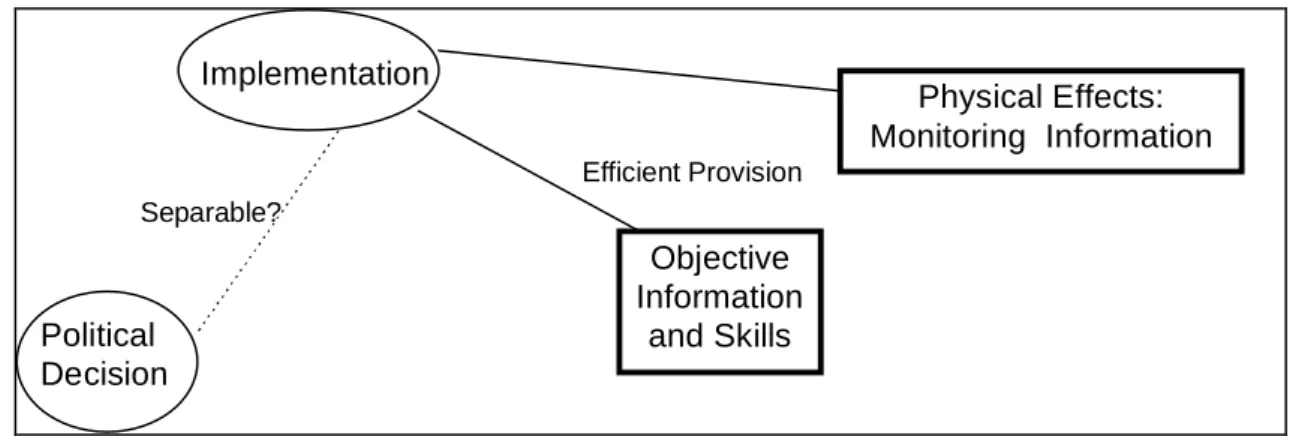
Figure 4: Devolution and Efficient Provision... 34
Figure 5 Devolution and Public Goods... 39
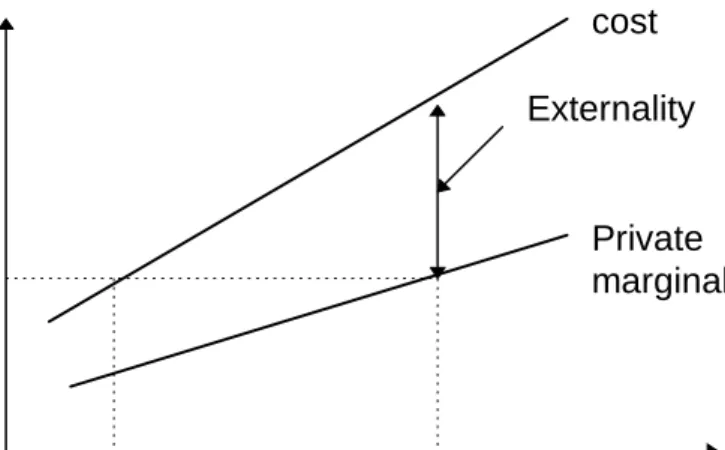
Figure 6 Over-production of externalities... 52
Figure 7 Under-provision of Public Goods ... 53
EXECUTIVE SUMMARY
This paper addresses issues of when and how we should devolve authority from central to local government. It develops a framework to help answer the following three questions:
1. What level of government should make social and political decisions about policy objectives?
2. What level of government should bear the costs of these decisions? 3. What level of government should implement them?
The paper looks at devolution both from a general theoretical standpoint and from the perspective of the New Zealand Resource Management Act (RMA). Although the RMA is discussed throughout, the framework will apply to any area of policy for which devolution decisions are being considered.
The Resource Management Act is based on a very devolved framework. There is a role for national government but in practice, most decisions and implementation occurs at regional and local government level.
Devolution issues are complex and there are seldom ‘pure’ results, particularly in the case of such a wide-ranging policy area as resource management. Our conclusions about the RMA offer a mixture of solutions, from legislative adjustments to change the level of government, to complementary policies that support the current structures.
We regulate resource use for a number of reasons. Where public goods and commons issues are significant we provide and protect the resource through regulation. Where externalities that affect few people are significant, we most appropriately provide a clear definition of property rights and a process for negotiation and dispute resolution. Where there are significant information failures we might set and enforce national standards, and provide public education.
The paper accepts that we are going to regulate resource use and focuses on the issue of how we best achieve this. In addressing the three devolution question listed above, the paper divides up analysis into decision making and cost bearing (section 4), implementation (section 5) and the relationship between the two (section 6). What are the criteria for devolution?
Social Decision Making and Cost Bearing
The problem with efficient public good provision is that the government is unable to reveal private preferences in any exact manner.
People reveal their preferences through two imperfect mechanisms: voting with their feet (Tiebout model of mobility) and social choice mechanisms (involvement in political processes). We concentrate primarily on social decision making processes.
Does devolution improve social choice mechanisms and lead to better preference revelation? We have identified three principles and criteria for deciding when devolution of decision making is appropriate.
1 Informed decision-making.
The best decisions reflect all the relevant subjective and objective information. Those who experience the effects should make the decisions, since it is they who have subjective preferences about the issue. People with the skills and resources to access objective information should also be involved in decision making.
2 Balanced decision making.
If people within the jurisdiction that makes the decision bear all benefits and costs, there are no interjurisdictional externalities that could lead to over or under-provision of the public good. Decisions should therefore be located, where possible, with the jurisdiction of effects and costs. People who make decisions should be those who receive benefits, and bear costs.
3 Cost effective decision making
Where costs of decision making are high and preferences are relatively homogeneous, national policies can save considerably on duplication costs. The location of decision making must be informed by considerations of cost effectiveness.
The Tiebout model suggests that having multiple jurisdictions is valuable for better reflecting heterogeneous preferences and improving accountability. The possibility of mobility makes it more important to match costs and benefits within a jurisdiction so that people cannot avoid costs while still receiving benefits by moving out of the jurisdiction. Mobility also has implications for the government role at the local level. Local governments cannot effectively redistribute income without inducing out-migration by rich people and in-migration by the poor.
Implementation
We define implementation as activities aimed at achieving non-discretionary goals set by social decision-makers. The relative advantage of central versus local implementers depends heavily on the balance between locally and centrally held information. Local government can most easily access local information, such as monitoring of compliance and knowledge of specialised
conditions. General technical information may be most available to central government.
Economies of scale may lead to implementation being achieved most efficiently at the central level. For other activities where flexibility is important, local implementation may be more effective.
Separability of Implementation from Decision-Making?
How should the contract be written between the political decision-maker and the implementer if they are not the same? Clear objectives and lines of accountability are essential. However, this can be difficult to achieve in the case of an arms length contract between central and local government. The relative advantages of the different potential decision makers and implementers should be weighed against the degree of difficulty in contracting before a decision is made to separate decision-making from implementation.
Accountability of Government
When we have decided the most appropriate political decision maker and implementer, we need to consider how this fits with the current accountability structure. The question is whether local or central government political structures are more accountable for political decisions. If, for example, we consider local government to be less accountable, we may prefer central implementation despite the other advantages of local government.
Sovereignty
Conversely, in spite of the many arguments in favour of centralised decision making and implementation we may still bias toward devolving decision making to local communities if the social importance of local identity and control outweighs the social choice and efficiency benefits of more centralised control.
Framework for Analysis of Devolution
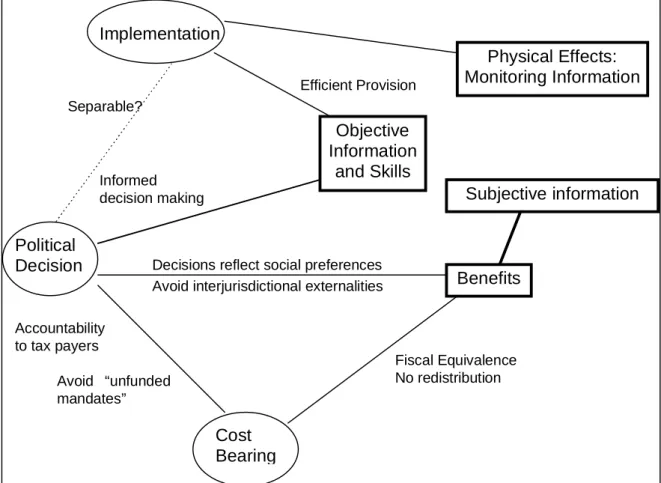
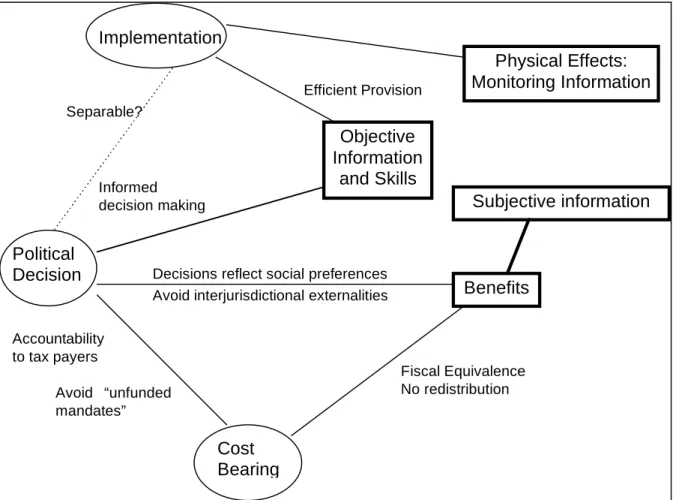
Figure 1 gives a stylised representation of the different decisions and tradeoffs discussed above. The boxes on the right represent the facts relating to a specific issue, the importance of different types of information and their location. The ellipses on the left represent decision nodes. Implementation, political decisions, and cost bearing can be borne in different “locations”, ie. different jurisdictions or levels of government. Matches in terms of location, between ellipses, and between ellipses and boxes generate benefits, more efficient implementation, reduced contracting difficulties, more balanced decision making, and more equitable cost bearing.
Figure 1 Devolution Framework Subjective information Benefits Objective Information and Skills Political
Decision Decisions reflect social preferences
Cost Bearing Accountability to tax payers Avoid “unfunded mandates” Fiscal Equivalence No redistribution Implementation Efficient Provision Separable? Informed decision making
Avoid interjurisdictional externalities
Physical Effects: Monitoring Information
1 INTRODUCTION
Devolution and decentralisation
Devolution is defined as the transfer of authority from a higher to a lower level of government. The objective of this paper is to establish criteria for when this should occur. When should we devolve authority to regulate externalities and public goods from central to local government?
In considering devolution, there are three questions that need to be answered. 1. What level of government should make social and political decisions about
policy objectives?
2. What level of government should bear the costs of these decisions? 3. What level of government should implement them?
Devolution of authority must be considered together with arguments for and against decentralisation of implementation. Decentralisation can be defined as the use of a lower level of government as an implementing agent for central government policy. In a pure decentralised system, local government merely carries out the instructions of central government in a non-discretionary way. In reality these are not usually clearly distinguished. Nevertheless, they are conceptually distinct and to understand the optimal allocation of authority and responsibility and the tradeoffs involved in choosing them, we must keep them clearly separate in our analysis.
Many past and potential New Zealand reforms involve a combination of devolution and decentralisation. In particular the Resource Management Act (RMA), the health and education reforms, and decisions about the institutions for addressing Maori issues have led to significant devolution of authority. Employment policy and social welfare are areas where devolution is an important policy option. The role and function of local government is also inherently an issue of the appropriate level of devolution. Many of these reforms have now been in place for a number of years, so it is appropriate to review our experience of devolution, identify the successes, and attempt to address the problems that have arisen.
The issues involved in devolution are complex. Different public good issues have different characteristics that lead to different optimal policy structures. A case by case analysis is required. Nevertheless, we hope that we are able to uncover general principles to help guide us in making sensible devolution decisions.
This paper addresses the issue of devolution both from a general theoretical standpoint and from the perspective of the New Zealand Resource Management Act. Applying theoretical principles in a particular policy context
throughout the paper helps make the developing framework more concrete and tests its principles.
The Resource Management Act
The Resource Management Act 1991 is the principal legislation governing the use of New Zealand’s land, air, water, ecosystems, soils, geology and the built environment. It also controls noise, pollution and geothermal activities. The RMA integrated resource and environmental management by combining 59 separate statutes. A fuller description of the major features of the RMA, and what it replaced, is contained in Appendix One.
The RMA is based on a very devolved framework. A central underlying assumption is that governing bodies closest to resources are the most appropriate to govern the use of those resources. Although a role for national government is specified, in practice, most decisions and implementation occur at the level of regional and local government. Resource management reform in New Zealand was related to local government reform. The Local Government Act 1989 laid the foundation for the amalgamation of over 800 local authorities, boards, boroughs etc into the 86 local authorities existing currently.
The RMA has been promoted internationally as a leading example of integrated, enlightened resource management. Its structure contrasts significantly with systems such as that in the United States that combines federal and state, and with many European systems that are heavily national and to a certain extent
Europe-wide through the EC.1 Understanding the effects of New Zealand's
chosen form of regulation has implications within and beyond New Zealand. As mentioned above, there are no easy answers to devolution questions. The RMA covers such a wide range of issues with different geographical boundaries, and varying levels of scientific complexity and preference heterogeneity that we will not emerge with one ‘pure’ result. New Zealand is a very small country and cannot hope to perfectly solve each issue separately. With regard to the RMA, in some cases the current level of devolution, and the concomitant funding and implementation structures, creates serious problems that need to be addressed by changing the level of government that addresses the issue. However, this paper concludes that the overall institutional structure is broadly appropriate for core land use, built environment and air and water quality issues. In many other cases no optimal, problem-free structure exists, or that achieving it would damage the cohesion of the overall regulatory structure. In these cases we can identify the inevitable conflicts and problems and propose policies complementary to the RMA to encourage the flow of
1 The US system combines a federal agency, the Environmental Protection Agency, and
national environmental legislation such as the Clean Air Act and Clean Water Act, with implementation at several levels, state, region, and local community.
information, skills and resources, reduce duplication of effort, and improve accountability and cooperation.
Aims and structure of this paper
The paper provides a methodology to analyse devolution, both in the context of the RMA, and any other devolved areas of government business, actual or proposed. The methodology can be used to assess the successes and failures of devolution to date, to identify options for policy reform and to analyse the likely effects of any potential policy reforms.
Section two of the paper discusses the justification for government’s role in regulating where there are externalities, public goods and information failures. For those externalities that government does decide to directly regulate, the question of how to regulate remains. Of particular interest in this paper is how the level of government that makes and implements decisions affects the choices made, and their efficiency and fairness.
There are three essential issues that have to be confronted in making policy about the efficient regulation of externalities and public goods.
1. Social and political decisions need to be made about what society’s
objectives should be. What is the optimal level of public goods?
2. Costs need to be borne appropriately.2
3. Decisions need to be implemented and objectives achieved efficiently.
For each of these functions we need to consider which level of government is best equipped to carry them out. Who should make the political decisions? Who should bear the costs? Who should implement?
The choice may be between several levels of government – the RMA has roles for central, regional and district bodies. Our analysis simplifies this into a discussion of central vs. local government. The arguments and principles can be applied to a more multi-tiered structure because we uncover criteria for deciding the optimal level of government.
In addressing the three devolution questions listed above, the paper divides analysis into decision-making and cost bearing, implementation, and then the relationship between the two.
2 It is important to mention at the outset that this paper considers cost bearing primarily in so far as it relates to efficiency of decision-making. There are many more issues to do with equitable cost bearing that are important but, although touched upon, are not the focus of this paper.
Section 3 discusses political decision-making and cost bearing together. When thinking about efficient decision making, cost bearing is a factor that cannot be separated out, so it is useful to consider them both at once.
Section 4 considers the third of our devolution questions: which level of government is the most efficient implementer?
In some cases it is difficult to separate political decisions from implementation; devolution and decentralisation are intrinsically linked. Section 5 discusses the problems which arise when there are conflicts between optimal devolution of decision making and cost bearing and the optimal level of government for implementation.
As we proceed we will build up a diagram, that represents a framework summarising the complex interrelations between factors that influence our decisions. This framework provides a useful and relatively simple way of applying our theory of devolution to real RMA situations.
Section 6 deals with accountability and sovereignty issues. Conclusions and recommendations follow in section 7.
A companion paper (WP 98/7a) illustrates how the framework applies to an actual RMA problem. It deals with significant natural areas and the provision of kiwi habitat in the Far North. This draws out issues of balanced social decision-making and efficient provision when both local and central government input are essential.
The paper is long. Readers may wish to be selective in the aspects they read. The companion paper (WP 98/7a), for example, can be read independently of the main theoretical section. We hope that the links between the theory and companion paper are clear, so the reader who wants more detail on the concepts used in the case can easily find the relevant theoretical section.
2 WHY AND WHAT SHOULD WE REGULATE?
The main purpose of this paper is to address questions about how we regulate. However, before we begin we need to briefly remind ourselves of the reasons why we regulate at all, and the rationale behind what we decide to control. A fuller exposition of these arguments is given in Appendix Two.
“The purpose of this Act is to promote the sustainable management of natural and physical resources.” (Section 5, RMA 1991)
Why is special legislation needed for the management of natural and physical resources?
Externalities and Public Goods
The fundamental problem with resources is that many of the property rights are not fully allocated and enforced. Property rights need to be defined, transferable and enforceable for efficient markets to function. Whenever property rights are incompletely defined or enforced, externalities and public good situations arise and resources can be allocated inefficiently without intervention. In addition, some agents will be able to claim the unallocated resources for their own use. This is an undemocratic, inequitable way to allocate resources that were previously held in common.
In many instances private solutions are possible. The Coase Theorem suggests that, where transaction costs are low, all that is necessary is for the State to define and enforce property rights, and negotiation and the common law system will allocate resources efficiently. This is a very unintrusive form of regulation.
Regulation of non-public externalities (e.g.: obstruction of private views) could be limited to defining property rights and facilitation – also relatively unintrusive. Local government should be able to facilitate agreements on externalities that affect very small numbers of people. Their role should be limited to mediation, and recording and enforcing agreements among affected parties. Elsewhere they can reduce transaction costs by certifying the credibility of information, and providing a forum for discussion.
There are, however, limits to private solutions that call for more invasive regulation by government. For which issues are the failures of private solutions to externalities sufficiently great that further government regulation is needed? Theory suggests government should focus on regulating externalities that affect public goods and common property resources, particularly those that have the following characteristics:
1. Transaction costs are high due to information asymmetries or costs of
coordination. This is often the case when an externality affects a large number of people, comes from several sources, or has effects over a
number of years. Air pollution is a good example. In this situation it is unreasonable to expect all the affected parties to negotiate successfully.
2. Property rights can not be allocated or enforced adequately. Some goods
are inherently difficult to allocate (e.g. fish that migrate). Some property rights are difficult to enforce (e.g.; limited liability companies, dealing with risks of pollution rather than actual pollution, may not take adequate precautions).
3. Some interests are not represented. This occurs with high coordination costs and large imbalances in resources for negotiation (it is likely to affect environmental groups, Maori, community groups etc who are negotiating with business). Furthermore, future generations are unable to represent themselves and government may need to act as their agent.
Information failures
Imperfect information about the effects of resource use is another important market failure in the allocation of resources; it may also warrant government intervention.
Issues may be new which means that individuals have not developed experience, and institutions to disseminate information are poorly developed. Effects may be unobservable, uncertain or occur over a long time frame. Understanding the effects may require specialised expertise or scientific knowledge.
There is a role for government regulation in areas where there are critical information problems. These could be situations where the potential harm is great, costs of avoidance are low relative to the harm, and individual information is poor.
It is reasonably uncontentious that there is a role for government regulation in some cases of public goods, externalities and information failures.3 Let’s return to our central concern. Given that we are going to regulate some goods and activities, what level of government is best placed to do it?
3 Much debate rages as to the nature and scope of that role. Almost everything produces
externalities – smiling, dress sense, old cars on front lawns, aesthetics of buildings. Which externalities and public goods should the government care about? How much regulation should there be? Where is the limit of government involvement? It is important to keep in mind that this is ultimately a political question and the most basic one that must be decided by whatever level of government makes decisions. People have strong and diverse subjective preferences about this. While logic and analysis can clarify the issues and empirical evidence can inform them, questions about the role of government are, ultimately, a matter of preferences and judgement, not an objective issue.
3 POLITICAL/SOCIAL DECISION MAKING AND COST BEARING4
When the American settlers rose against the British in the War of Independence, their catch cry was “no taxation without representation”. One argument for devolution of resource management is based on a similar concern: concern that those who are affected, both positively and negatively, by a regulation are those who are able to control that regulation. If an activity has only local effects, there is no call for allowing the preferences of distant actors to have any play or for forcing them to bear any of the costs.
The Problem with Public Goods: Preference Revelation
The fundamental problem with efficient public good provision is that government is unable to reveal private preferences for public goods. The value of many consumption goods, both public and private, is largely subjective, and dependent on individual preferences rather than having objective productive value. However, in the case of private goods, consumers reveal their private preferences and marginal valuations through their purchases. The level and allocation of private goods is pareto efficient in a well functioning market. No equivalent market mechanism exists to provide public goods, which makes it difficult to decide the efficient level of public goods. In addition, no market forces provide incentives for efficient production.
At the optimal level of public good provision, the sum of all marginal valuations is equal to the marginal cost (Samuelson, 1955). If individuals’ shares of the costs of providing a public good are related to their stated valuations, then individuals have an incentive to understate their marginal valuation. This occurs because a decrease in an individual’s stated valuation will have a small impact on the level of provision. She will, however, pay a lower share of cost for all units of the good. People will choose to understate their valuation and free ride on other’s contributions (Bergstrom, Blume and Varian, 1986). In contrast, if cost shares are not linked to people’s responses, it costs a person nothing to
4 The arguments outlined in this section all deal with issues of efficiency. If preferences are not well represented and/or decisions are unbalanced, there may be opportunities for pareto improvement. Cost bearing also has ethical implications although discussion of distributional issues is outside the scope of this paper. One point to note for our purposes, however, is that national government is better at redistribution. Local governments cannot redistribute income between or even within the jurisdiction. National government could impose high costs on one jurisdiction or group (a minority of any type) particularly if decision making is unbalanced. Discussion of this can be found in Appendix Five.
overstate their valuations in an attempt to gain more of the public good. These forces imply that the costs of providing public goods will not relate closely to the benefits individuals receive from them.5
Despite these difficulties in making an objective analysis, governments do in fact have to make decisions about public good provision based on assessments of this private, subjective information. This inevitably involves social processes that are inconsistent, inefficient and possibly unfair.
People can reveal their preferences in two ways:
First, devolution allows people to ‘vote with their feet’. If bundles of taxes and public goods vary among jurisdictions, people can reveal their preferences by choosing where they live. This form of preference revelation is captured in the Tiebout Model (Tiebout, 1956). It is particularly effective for decisions such as choices of school. It puts pressure on local authorities to offer public goods people want and to be efficient. The mechanism is limited by the costs of mobility, the limited number of choices available and the many other limitations on location choice, such as job locations.
The second way people reveal their preferences is through social choice mechanisms. People express their preferences through voting or direct involvement in political processes, submissions, lobbying etc. Lets look first at these social choice mechanisms before considering under what circumstances devolution may improve them.
Social Choice Mechanisms
Political or voting mechanisms for choosing levels of public goods are always imperfect. Arrow’s Impossibility Theorem indicates that no social choice rule consistently satisfies basic conditions.
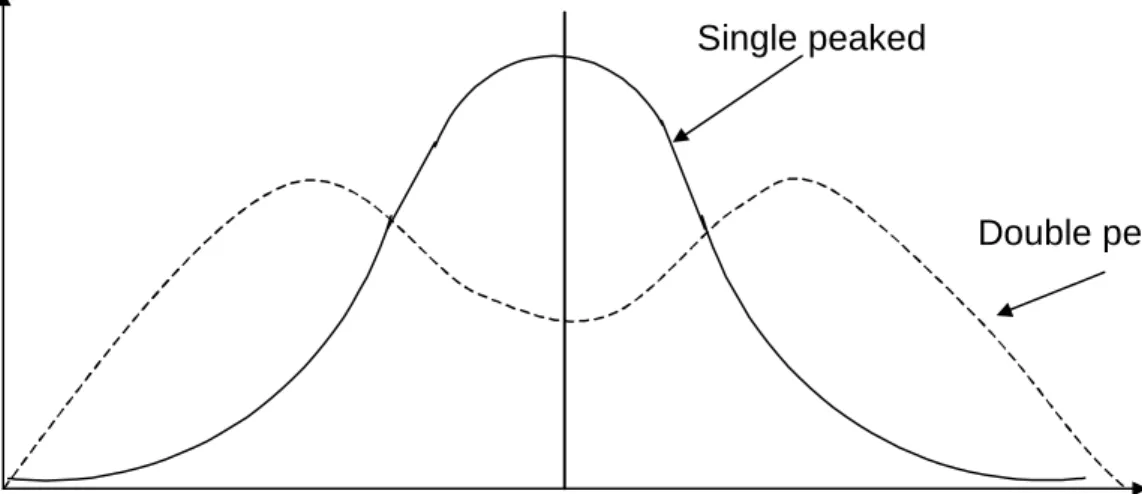
Any unweighted voting rule leads to poor social decisions when there are differences in the intensity of preference. People with a large stake in the issue (e.g.: landowners who might have to bear significant costs, or people strongly affected by pollution) have the same votes as people with little direct interest. In a system with majority rule, the ‘median voter’ determines the outcome. If preferences are not ‘single peaked’, this can lead to particularly poor decisions. On most issues there is a spectrum of choices about how much of the good to provide. If preferences are single peaked, the density function has a single maximum and the mean, mode and median are reasonably closely related. On
5 Some theoretical mechanisms will lead to perfect preference revelation. These have
problems, however, both theoretically and in reality. Incentive compatible mechanisms such as the Clark-Grove mechanism yield revenue that cannot be used without violating incentive compatibility. They are also vulnerable to manipulation (Tidemann and Tullock). On the practical side, because of their complexity, they are infeasible for large groups or large numbers of issues.
some issues, however, voter preferences are likely to be double peaked. One group of people will prefer a low level of provision and another will prefer a high level. Few people want an intermediate level but this is the level that is chosen in a majority vote.
Figure 2 Single and Double Peaked Preference Density Functions
Quantity of public good 0
Single peaked
Double peaked No. of people for
whom this is optimal level
f(Q)
Q Median
An individual could also have double-peaked preferences. An example may be sewage control in a city. If sewage is poorly treated, people simply don’t use the beach. Mediocre control has some cost but is insufficient to allow beach use so is of no value to many people. However, excellent sewage treatment would allow full use of the coast so people would value it. An individual would either prefer no sewerage control, or very good control. Mediocre control, however, is the level that will be chosen in a majority vote. In cases with double peaked preferences, majority voting may lead to an outcome that no one wants. Another common problem with majority voting is that where ‘voting cycles’ exist (no one option is preferred by a majority to all others in pairwise votes), the outcome in a series of votes may depend on the order in which voting occurs. This means that whoever sets the agenda has considerable power.
In reality we do not vote on every issue. We vote for agents who make the detailed decisions on our behalf. When there is a wide range of issues, any agent is unlikely to truly represent any individual’s basket of preferences let alone the preferences of society as a whole. In a large jurisdiction, each vote has little impact.
Social choice is clearly an inexact process. The key issue of relevance to this paper is whether devolution improves social choice mechanisms and leads to better preference revelation.
When does Devolution Improve Social Choice?
Will devolution mean that individual preferences are better reflected in decisions? The answer is not simple. Sometimes local government is a better decision-maker; sometimes central government is. It depends on the details of the issue under consideration. What the following sub-sections aim to uncover are the criteria that it depends on. What are the principles for social choice mechanisms working well?
We have identified three principles for efficient decision making:
1 Informed decision making
The best decisions reflect all the relevant objective and subjective information.
2 Balanced decision making
The best decisions take into account costs and benefits.
3 Cost effectiveness
Duplication should be avoided where decision-making costs are high and preferences are homogeneous.
Informed decision making
Good decisions reflect all the relevant objective and subjective information. People reveal their subjective preferences by participating in the political processes in their jurisdictions. If decisions are made by jurisdictions that do not include all affected people, there is no mechanism for the affected people outside the jurisdiction to reveal their preferences. Thus, when the jurisdiction is smaller than the area of the externalities, even with benign political processes, not all preferences will be reflected in decisions.
The importance of subjective preferences in making efficient decisions depends on the nature of the issue. In some issues most benefits are subjective, for example, the number of trees in an area, preservation of the historic character of an area. Preferences on these issues are likely to be very heterogeneous. In other issues, the benefits are more objective, for example, health effects from local air pollution. Educated preferences on these issues are likely to be more homogeneous.
If the decision-making jurisdiction is larger than the area where effects are felt, preferences can be revealed but other problems arise. If central government makes policy it tends to have one policy, which applies to the entire country
even where multiple policies are possible. For perceived equity reasons, it is difficult for central government to differentiate policies. It would be even more difficult for central government to tax differently in different areas. People would not make a clear connection between the variance in tax and the variance in regulations and public services. Central government has a heterogeneous constituency, so if preferences are also heterogeneous, few people will be highly satisfied by the level of public good chosen.
As jurisdictions become geographically smaller, the constituency will tend to become more homogeneous so that the outcome converges toward the interests of each individual. In situations where distinct groups have strong preferences, it may make sense to design the jurisdiction around this group to minimise internal heterogeneity. (Olson, 1980) For example, iwi could be argued to have distinct preferences for resource management that suggests separate iwi authorities on some issues. With local government the connection between rates, regulation and services is transparent. If preferences for regulation and public services are very heterogeneous among local jurisdictions a national policy will be much less efficient than a multitude of local policies. Many decisions also involve objective facts and complex processes. In these cases, if decisions are made without access to good objective information and skills for analysing complex processes, results may be poor. If decision-makers realise their lack of information, they may seek it from elsewhere. Frequently, however, they may not be aware of the information and skills needed, or be able to contract for it effectively. Effective contracting for advice requires some understanding of the nature of advice required, and an ability to assess the quality of information received.
In reflecting all the relevant information, then, it is important to consider the following:
• Where is the subjective information held? This will require determining
where the effects are felt, since it is those affected that will have subjective preferences. Are these preferences relatively homogenous or extremely varied?
• Where is the objective information held? How easily can it be transferred?
• What is the relative importance of subjective and objective information?
As a general principle, decision making should rest with the level of government that can access the greatest amount of relevant information.
Balanced decision making
When public goods are provided out of tax revenue, the concern that those who are affected by a regulation also control it is expressed as Fiscal Equivalence, “a match between those who receive the benefits of a collective good and those
who pay for it”.6 Decisions can be inefficient when the costs are borne by either a larger group than receive the benefits, or a smaller group.
Within Jurisdictions
One specific public choice problem in the RMA, is that the primary method of provision of public goods, and prevention of externalities, is regulation. Purchase of the public good is not generally an option. Therefore all costs are borne by land/resource owners, not shared across the jurisdiction. This leads to over-provision in a democracy because government (taxpayers) do not bear the costs of their decisions (Epstein, 1995). After the regulation has been imposed, the land will be used in a constrained efficient way.7
The public choice and efficiency problems created by uneven cost bearing within a jurisdiction are probably lessened by devolution because the afflicted agent is ‘larger’, in a political sense, in a local jurisdiction that in central government. Because agents are more homogeneous in a smaller jurisdiction, those who are forced to provide the public good will be a larger percentage of the population on each issue. On the other hand, in central government, similar situations will occur frequently so there may be more pressure to have fair, consistent decisions.
Between Jurisdictions: Interjurisdictional Externalities
The same public choice problems that occur within a jurisdiction will occur between jurisdictions if the costs and benefits are not borne/received by the same people. Any form of devolution leads to a limited number of government bodies, each of which deals with a range of issues and a fixed geographical area. In New Zealand 74 territorial local authorities and 12 regional authorities cover resource management issues in their jurisdictions. This means that for almost every individual issue there is a mismatch between the jurisdiction and the spatial distribution of the effects. When the jurisdiction is smaller than the area affected an interjurisdictional externality is created.
Sources of Interjurisdictional Externalities Environmental externalities
The most obvious externality is where an environmental benefit or harm goes beyond the jurisdiction. E.g.: nation-wide benefits from biodiversity protection.
6 Olson, 1980 p. 30
7 However, uncertainty about the possibility of future takings can lead to significant
distortions in behaviour. For example, a landowner who discovers a large stand of rimu on his property would not want to notify the government, because he may be constrained from felling it. If he thinks government will discover it, he will fell it quickly before a regulation can be imposed, even if he would not have chosen to in the absence of regulation.
Decision-makers will tend to under-supply the environmental benefit because all the costs are borne inside the jurisdiction, but only the fraction of the benefits received within the jurisdiction will be taken into account. The decision-makers will allow over-production of polluting activities, because the benefits from the polluting activity are contained inside while some of the harm is suffered outside.
Network extemalities
A network externality arises when adding another agent to the network not only provides service to the agent added but also improves services to all others in the network. For example, providing telephone service to another community helps those in that community and also benefits others who want to communicate with them. Extending a network may also lower the costs of the next extension. If linking decisions are all made separately they may not be individually rational even if they would be jointly efficient. If some agents provide significant network externalities because of critical location or size of population it may be worth subsidising their connection. Conversely, they may want to exploit their position of strength to extract the value of those externalities. The transaction costs of coordinating a network may be high enough to justify central control on network issues.
Pecuniary externalities
A decision within a jurisdiction may restrict resource use in such a way that it diminishes the opportunities for capital and labour looking to migrate into the jurisdiction. It is sometimes argued that strong regulation disadvantages businesses that wish to locate in an area, and therefore it should be constrained.
There are externalities from the decision but they are “pecuniary externalities”. Pecuniary externalities are simply the operation of the price system; they are an efficient part of the market’s response to scarcity. Assuming there are no other interjurisdictional externalities, and the public choice mechanism operates effectively, these decisions are disappointing for agents who would like to use the resources, but not inefficient. If people wish to constrain the use of their own resources they should be allowed to. The jurisdiction is deciding to use the scarce resources for conservation or local public goods rather than gaining their commercial value.
This needs to be distinguished however from the use of the RMA by existing businesses to prevent entry by competitors on the ground that the entrants will lower the profits of existing businesses. The adverse effects of the entrants on the local businesses is merely the operation of the market, these adverse effects will be offset by gains to local consumers and workers. Use of regulation to prevent entry occurs only because of failures in the local social choice mechanism. There is no role for government intervention on the grounds of pecuniary externalities. However, if regulation to address public
goods problems creates a pecuniary externality as a side effect this is not inefficient.
Other, more subtle instances of externalities between jurisdictions include tax externalities, deleterious interjurisdictional competition and the “not in my backyard” or NIMBY phenomenon. These are discussed in Appendix Four: Other Externalities. Risk sharing is another form of cost bearing. The optimal allocation of risk in regulation is discussed in Appendix Six: Risk Bearing.
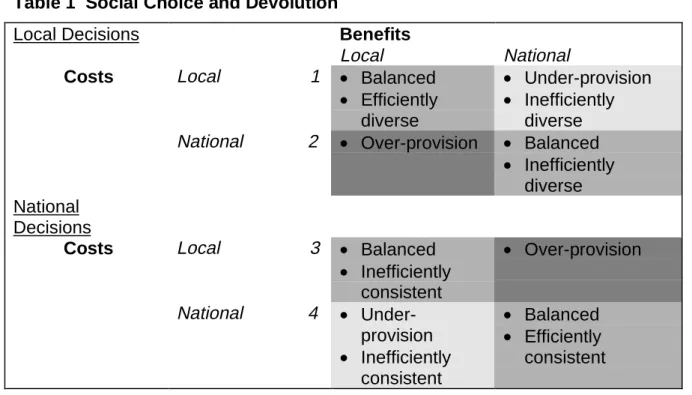
Balanced efficient decisions occur when decisions, costs and benefits are all located in the same jurisdiction. When benefits and decision making have the same jurisdiction but this jurisdiction is mismatched with the cost bearing jurisdiction, fiscal externalities occur; when decision making and cost bearing have the same jurisdiction but this jurisdiction is mismatched with the benefit jurisdiction, environmental externalities occur. Externalities of either type lead to unbalanced decisions. Matching the level of decisions to the level of benefits allows appropriate diversity in policies; it permits heterogeneous local policies where applicable and avoids them where they are inappropriate. Table 1 summarises the effects of mismatches.
Table 1 Social Choice and Devolution
Local Decisions Benefits
Local National
Costs Local 1 • Balanced
• Efficiently diverse
• Under-provision
• Inefficiently diverse National 2 • Over-provision • Balanced
• Inefficiently diverse National
Decisions
Costs Local 3 • Balanced
• Inefficiently consistent • Over-provision National 4 • Under-provision • Inefficiently consistent • Balanced • Efficiently consistent
Local Decision Making
If the benefits are received by a larger group than the decision makers, and costs are borne by the decision-making group, public goods will tend to be under-provided (row one, right column). Where the same or similar externalities are produced in every jurisdiction, however, local authorities may cooperate to all increase/reduce externalities to the efficient level. This especially occurs
where they see it as a repeated situation. They may believe that if they behave cooperatively this period, others will reciprocate in the next.
Another clear source of poor decision making arises when the decision making group is able to impose part or all of the costs on another group (row two). If the costs are borne by a larger group than the decision-makers (e.g.: local decision making but national cost bearing), and the benefits from the public good are primarily local, public goods will tend to be over-provided. The government is not accountable to its “taxpayers”. If benefits are also national, the decision will only reflect local interests and the decision will be inefficient but not systematically biased.
National Decisions
Consider the contrasting case, where central government determines a policy for the benefit of the nation, and then requires local government to implement it and bear the costs (row three, right column). This situation is referred to as an ‘unfunded mandate’. Unfunded mandates can lead to inequitable cost bearing, and inefficient financing.8 Although all affected agents are located in the central government jurisdiction, costs are borne by a minority so public choice is unbalanced. Public goods will tend to be overproduced.
If the decision making jurisdiction is larger than the area of the effects, and costs are shared throughout the jurisdiction, those outside the area will lose from a provision to address the externality that involves public expenditure (row four, left column). Representatives of these outsiders will vote against the provision, unless regulators make deals across areas so all locally efficient outcomes are supported.9 In addition, voters with little direct interest in an issue may seek to impose their preferences on other groups and areas, particularly where they bear no direct cost.
To summarise, balanced decisions require that those that make the decisions are those that receive the benefits and bear the costs. This avoids interjurisdictional externalities that could lead to under or overprovision of the good. There may still be uneven cost bearing within a jurisdiction.
In considering whether to devolve decision making the following questions need to be considered:
• Where are the benefits/effects felt?
• Who bears the costs currently? Is it the same area that receives the
benefits? Where could costs more appropriately be borne?
8 An example of this arises in the case of significant natural areas in Northland. See Case
Study II.
Cost effective decision making
One national policy requires only one decision-making process, so if the costs of decision making are high, national policies save considerably by cutting out duplication. Costs will be especially high where issues are publicly very contentious or involve complex information and analysis.
Even if national decision making is more expensive, a national decision only needs to be made once, while a regional decision must be made 16 times and a territorial local authority decision must be made 78 times. If preferences are nationally homogeneous, e.g.: an issue such as drinking-water quality standards, this duplication is wasteful even if each jurisdiction makes an appropriate decision. In contrast, making multiple decisions on whether to constrain the style of residential development, and if so how, is expensive but worthwhile if preferences vary significantly among jurisdictions. One national decision will lead to poor representation of preferences.
The following are central in assessing whether cost effectiveness issues will form part of the decision of whether to devolve decision-making:
• Is the cost of decision making high?
• Is there homogeneity or heterogeneity of preferences?
• If there are high costs and heterogeneous preferences, how do we trade
A case study that highlights these issues is that of cell phone tower placement.
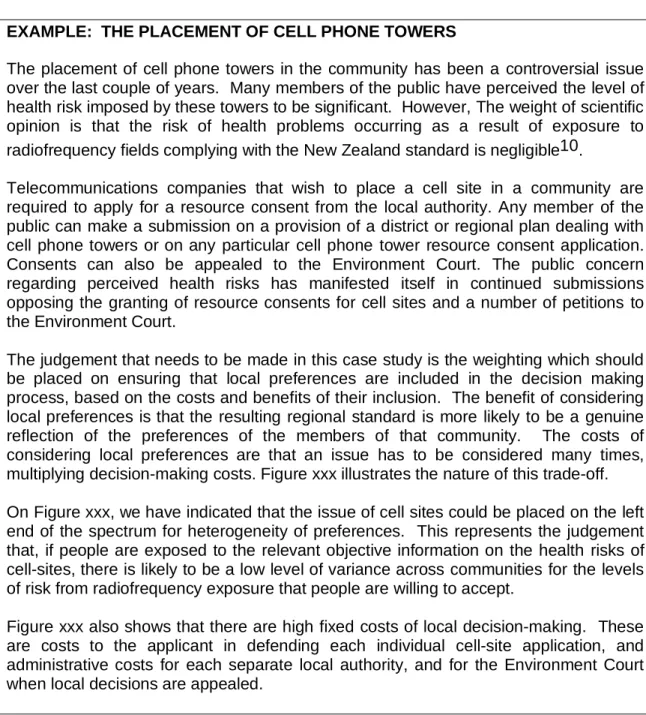
EXAMPLE: THE PLACEMENT OF CELL PHONE TOWERS
The placement of cell phone towers in the community has been a controversial issue over the last couple of years. Many members of the public have perceived the level of health risk imposed by these towers to be significant. However, The weight of scientific opinion is that the risk of health problems occurring as a result of exposure to radiofrequency fields complying with the New Zealand standard is negligible10.
Telecommunications companies that wish to place a cell site in a community are required to apply for a resource consent from the local authority. Any member of the public can make a submission on a provision of a district or regional plan dealing with cell phone towers or on any particular cell phone tower resource consent application. Consents can also be appealed to the Environment Court. The public concern regarding perceived health risks has manifested itself in continued submissions opposing the granting of resource consents for cell sites and a number of petitions to the Environment Court.
The judgement that needs to be made in this case study is the weighting which should be placed on ensuring that local preferences are included in the decision making process, based on the costs and benefits of their inclusion. The benefit of considering local preferences is that the resulting regional standard is more likely to be a genuine reflection of the preferences of the members of that community. The costs of considering local preferences are that an issue has to be considered many times, multiplying decision-making costs. Figure xxx illustrates the nature of this trade-off. On Figure xxx, we have indicated that the issue of cell sites could be placed on the left end of the spectrum for heterogeneity of preferences. This represents the judgement that, if people are exposed to the relevant objective information on the health risks of cell-sites, there is likely to be a low level of variance across communities for the levels of risk from radiofrequency exposure that people are willing to accept.
Figure xxx also shows that there are high fixed costs of local decision-making. These are costs to the applicant in defending each individual cell-site application, and administrative costs for each separate local authority, and for the Environment Court when local decisions are appealed.
10 Cell sites generate a radiofrequency field. At very high levels of exposure to these fields, adverse effects on humans have been observed. The New Zealand voluntary standard, produced by Standards New Zealand, recommends that exposure limits for the public should be at least fifty times lower than the levels at which adverse effects have been identified and cell sites operate at levels of only a few percent of the limits stated in the standard.
EXAMPLE: THE PLACEMENT OF CELL PHONE TOWERS CONTINUED Figure xxx
Total
Cost
Heterogeneity
of preferences
Total Cost of National Decision (incorrect reflection of preferences)Total Cost of sum of Local Decisions
(costs of repetition)
National Local
Cell sites?
The low level of heterogeneity means that any welfare costs generated by imposing one decision on a range of different communities is low. Meanwhile national decision making greatly reduces the administration costs of repetitive decision making. Therefore our view is that decisions on the health effects of cell phone tower placements should be made at the national level.
The RMA does provide for national policy setting. Central government can make national policy statements (sec 45-55) or set national environmental standards (sec 43) requiring local government to deal with this issue in a certain fashion.
The likelihood that individuals are not accurately estimating the level of risk involved indicates that information campaigns or guidelines may be valuable to ensure that individuals’ preferences are based on full information. Better information may lead to a decrease in the propensity of people to continually oppose resource consents.
The Framework: Political Decision Making and Cost Bearing
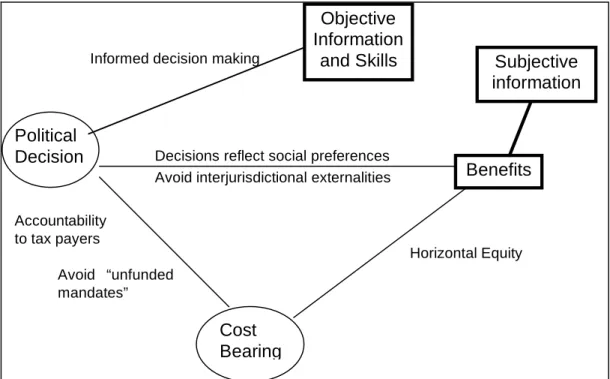
Figure 3 offers a framework that summarises the key points from the previous
discussion. The framework can be used in two basic ways: to understand problems in current government structures, and to predict the benefits and drawbacks of options for reform.
Figure 3: Devolution and Political Decision Making
Benefits Political
Decision Decisions reflect social preferences
Cost Bearing Accountability to tax payers Avoid “unfunded mandates” Horizontal Equity Avoid interjurisdictional externalities
Subjective information Objective
Information and Skills Informed decision making
The boxes on the right represent factual characteristics about the issue of concern - their locations are given. The oval bubbles on the left represent decisions to be made - their locations are choices that we must make. Matches between the location of boxes or bubbles indicate elements of efficiency in social decision making. Mismatches represent problems that are likely to arise and need to be addressed. We’ll use the example of subdivision to illustrate the way the diagram works.
Illustration: Social choices about Subdivision and Local Land Use
To analyse a particular issue, we first need to identify the community that directly benefits from regulation. In the case of the subdivision question, this is the owners of the land that borders the proposed subdivision and the local neighbourhood, and to a lesser extent the city where the subdivision is located. The people in these areas will have unobservable subjective preferences about the value of the benefits of the regulation. People care about the physical effects and have views about the appropriate definition of property rights. Some people believe communities have significant rights to control private land use
because it affects the community as a whole, whereas others believe in the predominance of private property rights. For issues such as subdivision these preferences are critical information for good decision making. For other issues they may be less important.
The other characteristic we need to determine is the location and importance of observable, objective information. In the case of subdivision, objective information, such as knowledge about road design, siltation problems, drainage and so on, is available locally because of local experience but also could be gained at the national level.11 In any case, for this issue the critical information is the local people’s preferences about the nature of the community they live in. Once we have established the nature and location of the fixed aspects of the subdivision issue we can turn our attention to the variable elements. The bubbles indicate the ‘location’ of political decision-making and cost bearing. In the case of subdivision under the RMA, both political decisions and costs are local. Given that benefits are local, and subjective information is more difficult to obtain than objective for this issue, the institutional structure is well aligned.12 Matches or links between the loci, boxes and bubbles, bring improvements in the efficiency of social decision making. In the case of subdivision, where benefits, costs and decisions match, preferences will be represented, and decision making will be relatively balanced. There are few interjurisdictional externalities, and the neighbourhood bears all costs. If citizens think decisions are poor, they can vote against council members or be more directly involved in influencing local policy.
It is possible that the jurisdiction for subdivision is still too large although people throughout the Territorial Local Authority (TLA) could be argued to have a legitimate interest. Relatively uninterested parties may seek to impose their preferences on those directly affected. Ideally, in this case, the TLA will primarily act as a facilitator for neighbourhood decision-making on issues with very small externality boundaries such as fences, house colour and distance from boundary.
The diagram only captures two of the three criteria for good decision making. One remaining issue that must be considered is whether the costs of duplicating objective information outweigh the benefits that arise through local control of a local issue. In this case they don’t. Subjective preferences are very important
11 A contrasting example would be deciding appropriate levels of drinking water treatment.
Here knowledge about the costs and physical effects of different systems is more important than variance in preferences about water quality. Preferences are probably fairly homogeneous.
12 In the case of drinking water quality, benefits are at the regional level and objective information is critical. Under the RMA, regional councils make decisions about drinking water provision. Regional council boundaries roughly match watersheds. Water users and ratepayers bear costs. Again, decisions, benefits and costs are aligned.
and likely to be extremely heterogeneous, so any advantage of lack of duplication through one decision being made centrally is likely to be outweighed by the advantages of maximising preference revelation through localised decision making.
Mobility and Devolution
Mobility has some positive effects on the efficiency of public good provision. When there are multiple jurisdictions offering a range of packages of taxation/regulation and public services, a pseudo market emerges. People will reveal their preferences for public goods by choosing the jurisdiction in which they live. More jurisdictions imply greater choice and more competition to provide both the packages people prefer and to provide services in an efficient way. The Tiebout model, which formalises the operation of this pseudo market, is discussed in more detail in Appendix Three.
New Zealanders are a relatively mobile people. Between 1991 and 1996, 24% of New Zealanders chose a new jurisdiction to live in. Different TLAs do have different “cultures” to a certain extent, e.g.: Waitakere City and Manukau City have very different characters, so people have some choice. Although location decisions are heavily dependent on job opportunities, this mobility still allows some preference revelation and puts some pressure on local jurisdictions.
Mobility also causes some significant problems with regulation. Any interjurisdictional externalities are exacerbated when people can move away from the areas bearing costs and into the areas receiving benefits. Decision-making is not only unbalanced, but can also lead to unstable communities. We probably do not want to directly restrict mobility on the basis of these problems, but we do want to be aware of them to understand the detrimental side effects of certain policies.
Mobility limits the ability of local governments to redistribute income either directly or through services. A jurisdiction that redistributes from high income to low income will tend to lose high-income people and gain low-income people. As they lose the high income, high tax paying people they become unable to support their previous level of service provision. It also becomes more difficult to support diverse communities.
When economies of scale in public good provision exist, small communities may suffer from out migration because of tax externalities. A person leaving a small community lowers the cost of public services by less than the loss of revenue. Thus the migrant imposes an externality on the remaining community. Conversely, where diseconomies of scale arise in large communities, a person entering a large community may increase that community’s tax take by less than the cost of providing additional services. This problem could be addressed by making communities more similar in size to make best use of any economies of scale and avoid diseconomies. Alternatively larger communities may want to
subsidise small communities, or tax new development in large cities to prevent inefficient migration toward overcrowded cities.
Thus mobility complements devolution by improving preference revelation, but also makes appropriate handling of interjurisdictional issues and redistribution critical. Institutional structures need to take into account the dynamic impact of mobility.
4 IMPLEMENTATION
We have considered social decision making and efficient cost bearing together. Implementation is the third function for which decisions about level of government need to be made.
We define implementation to be the activities to achieve non-discretionary goals set by social decision-makers. Implementers may need to make decisions about the most efficient approach to achieve the goals but these decisions will be based purely on objective criteria, not preferences. If society has preferences about the type of instruments used to achieve outcomes, these should be specified as part of the goals given to the implementers.
In common parlance ‘implementation’ usually combines objective decisions and some subjective decisions, but separating the two roles makes analysis clearer. Even if central government made the key decisions about objectives there might be reasons why you would want to devolve choices about how to get there. In this situation two types of social decisions must be made. First the macro decisions about environmental outcomes, and second the micro outcomes about regulatory instruments and local cost sharing. Different levels of government may make these. In our analysis these should be looked at as two distinct social decisions and separated from the actual implementation of the regulatory instruments once the social decisions are made.
If central government implements its own decisions it could use a series of local agencies. For example, although the Department of Social Welfare has local offices, they are controlled under centralised policies. In contrast, where central government decides to decentralise implementation it can write contracts with local providers. For example the national government contracts with hospitals to carry out certain numbers of heart operations. The hospitals decide how to do the operations and run the cardiac unit but do not decide how many patients to operate on or which patients to choose.
If the national government issues a national policy statement, it mandates local government to carry out this mandate. National government sets the objectives and local government implements them. If the local government wants to use national government services and skills to implement its own policies, it writes a contract with the appropriate national government agency. When local government makes and implements decisions the two roles may be indistinguishable.
Under the RMA, local government is providing a process for public participation and mediation, regulatory decision making (i.e.: plans), and implementation of regulations through decisions in individual situations (for example: resource consents). Government’s other role in the RMA is the collection, analysis and provision of information. The appropriate level of government for this function is discussed in Appendix Seven.
Local government may regulate externalities and provide public goods more efficiently than central government or less efficiently. Its relative efficiency varies by issue and depends on the location of relevant information, the skills and resources of each body, and the potential for co-ordination of local and central information and decisions. As in the previous section, we are looking for criteria or principles that will help guide the decision about the most appropriate level of implementation.
Let’s look at what theory might say about which level of government is the most efficient implementer. We have identified three criteria or principles to guide implementation location decisions.
1 Diseconomies of scale: flexibility
Where local circumstances are diverse, the best implementation will tailor diverse solutions.
2 Economies of scale: efficiency
Economies can arise through providing more of a given good or avoiding duplication of objective decisions.
3 Information
Implementers need to access the relevant information about local conditions and actions and technical/scientific aspects of the issue.
4 Innovation
New ideas can occur anywhere, but the skills to develop them and resources to diffuse them may be more available nationally.
When flexible policies are optimal, or if good local information is essential to efficient implementation, local implementation will tend to be more efficient. However economies of scale regarding specialist skills, operational capabilities and information create a case for centralised implementation. Who the best implementer will be will vary case by case depending on the trade-off among these considerations. In some instances the advantages of bigger size will be more crucial. In others access to local info and flexible local solutions will be more pertinent.
Diseconomies of scale: flexibility
The RMA focuses on outcomes rather than fixing rules. This flexibility, where a range of behaviours may all achieve the desired objective, is crucial. It allows tailor made solutions to local conditions. Local government may be able to achieve desired outcomes in a more flexible way. If there are diseconomies of scale in the number of different decisions an authority must make, a smaller jurisdiction, which deals with fewer situations, can make more diverse decisions on those situations. A larger authority may resort to fixed rules that cover a range of situations. More diverse decisions allow focus on achieving given
environmental outcomes rather than fixing rules for the way those outcomes are achieved.
Of course the price of flexibility can be uncertainty for businesses and individuals about how regulations will affect them. This uncertainty could be dealt with by working out solutions to all future situations in advance. This is extremely costly. Solutions must be negotiated for situations that may not occur for many years if at all.13 Alternatively the jurisdiction can set up some general guidelines in advance to reduce uncertainty but then deal with individual situations as they arise. This saves up-front costs but does leave some uncertainty and scope for strategic behaviour to alter future decisions.14
Diseconomies of scale in the organisation of decision-making processes may also arise if bureaucracies get beyond some critical size. Small jurisdictions may be more flexible and less bureaucratic.
Economies of scale: efficiency
As was the case with cost-effective decision making, to the extent that problems and situations repeat, central implementation benefits from economies of scale. This is particularly true where decisions are heavily based on objective rather than subjective factors. For example, hazardous waste management, such as the appropriate design of landfills, is a problem in all jurisdictions. This is not an area with large differences in preferences. No one wants to be exposed to dangerous chemicals when they can fairly cheaply avoid it. Designing appropriate rules for landfill design does, however, require a high level of technical information and skill. Having one set of rules on storage of hazardous waste avoids unnecessary duplication. In cases like these, decisions and implementation are best carried out centrally.
Economies rather than diseconomies of scale may exist for provision of some public goods. For example, in Auckland, sewage management, landfills, and transportation management, are all more efficiently provided at a regional scale rather than very locally. However, we can only exploit economies of scale if the jurisdiction that provides the good can be expanded without violating fiscal equivalence. (Olson, 1980) Sewage treatment in a sparsely populated region will not necessarily be made more efficient by combining that region with another. Sewage still needs to be treated close to its source.
Some regulatory instruments may be only available to central government. This could be because of links to other central government institutions; for example
13 This is the route Northland chose with its plan for Significant Natural Areas. See Case
Study II.
14 In the economics literature this is referred to as an incomplete contract. One key problem which arises is “hold up”, where the investments, or information revelation of one party reduce their bargaining power in future negotiations.