Automatic Processing of
Code-mixed Social Media Content
Utsab Barman
B.Tech., M.Tech.
A dissertation submitted in fulfilment of the requirements for the award of
Doctor of Philosophy (Ph.D.)
to the
Dublin City University
School of Computing
Supervisors:
Dr. Jennifer Foster
Dr. Joachim Wagner
I hereby certify that this material, which I now submit for assessment on the programme of study leading to the award of Ph.D. is entirely my own work, that I have exercised reasonable care to ensure that the work is original, and does not to the best of my knowledge breach any law of copyright, and has not been taken from the work of others save and to the extent that such work has been cited and acknowledged within the text of my work.
Signed:
(Candidate) ID No.: Date:
Contents
Acknowledgements xi Abstract xii 1 Introduction 1 1.1 Challenges of Code-Mixed NLP . . . 3 1.2 Research Questions . . . 4 1.3 Contributions . . . 6 1.4 Structure of Thesis . . . 92 Code-mixing: Linguistic Aspects 11 2.1 Types of Code-mixing . . . 11
2.2 Motivations for Code-mixing . . . 12
2.3 Linguistic Theories of Code-mixing . . . 13
2.3.1 Grammatical Constraints of Poplack (1980) . . . 13
2.3.2 Matrix Language Frame (MLF) . . . 14
2.4 Indian Languages and Code-mixing . . . 16
2.5 Conclusion . . . 16
3 Data 17 3.1 English-Hindi-Bengali Facebook Corpus . . . 18
3.1.1 Annotation . . . 18
3.1.2 Inter Annotator Agreement . . . 21
3.2 Unlabelled Monolingual Data . . . 27 3.3 Conclusion . . . 28 4 Language Identification 29 4.1 Chapter Organization . . . 31 4.2 Background . . . 31 4.3 Research Questions . . . 35 4.4 Experiments . . . 37 4.4.1 Resource . . . 37 4.4.2 Dictionaries . . . 37
4.4.3 Support Vector Machine (SVM) . . . 39
4.4.4 Conditional random field (CRF) . . . 41
4.4.5 Long Short Term Memory (LSTM) . . . 41
4.5 Analysis and Discussion . . . 49
4.5.1 Statistical Significance Test . . . 50
4.5.2 Ambiguous vs Non-ambiguous Words . . . 50
4.5.3 Code-Mixing Points . . . 51
4.5.4 Monolingual vs Code-Mixed Sentences . . . 54
4.5.5 Word-based Vs. Word+Character-based LSTM . . . 54 4.5.6 Error Categories . . . 55 4.6 Conclusion . . . 57 5 Part-of-Speech Tagging 60 5.1 Chapter Organization . . . 61 5.2 Background . . . 62 5.3 Research Questions . . . 67 5.4 Experiments . . . 68 5.4.1 Baseline . . . 68
5.4.2 Exploiting Monolingual Taggers . . . 69
5.5 Analysis and Discussion . . . 75
5.5.1 Statistical Significance Testing . . . 75
5.5.2 Effect of LID as Pre-processing module . . . 75
5.5.3 Stacked vs Pipeline Systems . . . 76
5.5.4 Monolingual vs Code-mixed Sentences . . . 76
5.5.5 Code-mixing Points . . . 77 5.5.6 Error Categories . . . 78 5.6 Conclusion . . . 79 6 Multitask Learning 81 6.1 Chapter Organization . . . 83 6.2 Background . . . 83 6.3 Research Questions . . . 89 6.4 Experiments . . . 89
6.4.1 Factorial Conditional Random Fields (FCRF) . . . 90
6.4.2 Long Short Term Memory (LSTM) . . . 92
6.5 Analysis and Discussion . . . 98
6.5.1 Statistical Significance Testing . . . 99
6.5.2 Ambiguous vs Non-ambiguous Words . . . 99
6.5.3 Code-Mixing Points . . . 100 6.5.4 Model Comparisons . . . 103 6.6 Conclusion . . . 104 7 Conclusions 106 7.1 Use Cases . . . 108 7.2 Future Work . . . 109
7.2.1 Improving Performance at Code-mixed Points . . . 109
7.2.2 Unified LID and POS Tagging for Indian Languages . . . 109
7.2.3 LID for Similar Languages . . . 109
Bibliography 111
List of Figures
1.1 Example of Romanisation, Bengali has been written using Roman scripts. . . 1 3.1 English-Bengali-Hindi Code-mixed Data Set (Curated): POS
distri-bution across language labels, column visualization. . . 27 4.1 Architecture of the dictionary-based system, where EN = text8
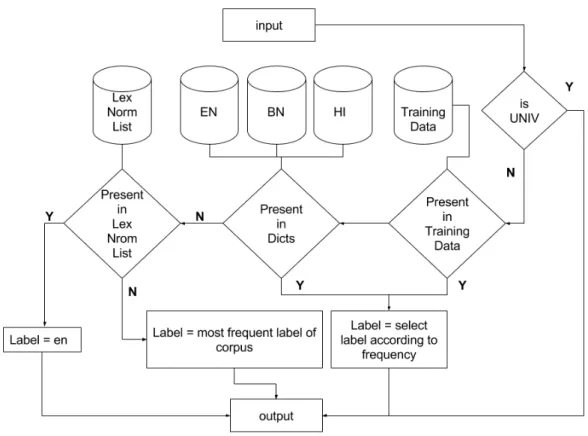
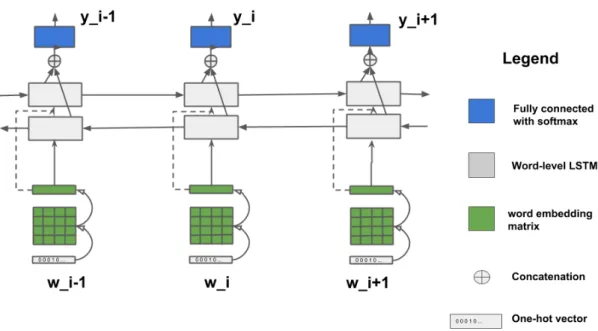
cor-pus, BN = Bengali lyrics corcor-pus, HI = Hindi lyrics corcor-pus, Training Data = relevant 4/5 of training data and LexNorm List = lexical normalisation list of Baldwin . . . 38 4.2 Model Architecture: Word-level LSTM Model for LID, unrolled across
three time steps, where wi−1:i+1 are the words and yi−1:i+1 are
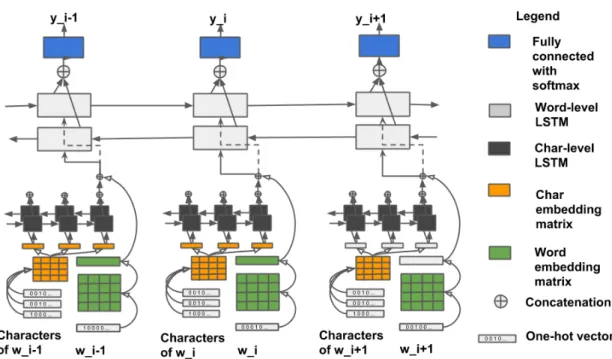
lan-guage labels. . . 44 4.3 Model Architecture: Word + Character-level LSTM model, unrolled
across three time steps, where wi−1:i+1 are the words and yi−1:i+1 are
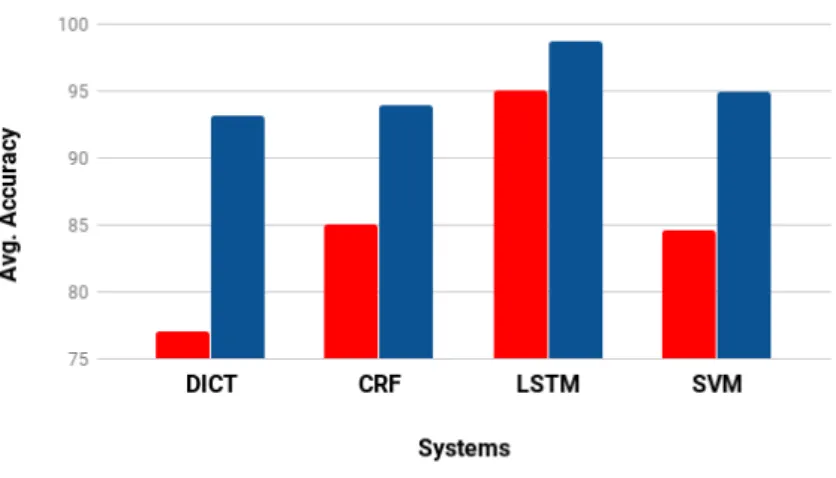
language labels. . . 46 4.4 Performance of different systems for ambiguous and non-ambiguous
tokens where DICT = dictionary-based system (e.g. EBHTL), SVM = SVM-based system (e.g. GDLCP1N1), CRF = CRF-based system
(e.g. GDLCP1N1) and LSTM = LSTM-based system (e.g. word +
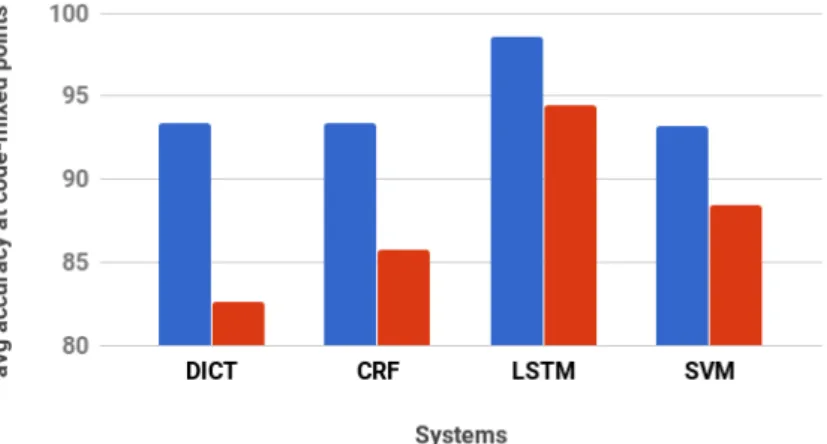
4.5 Performance at code-mixed points and surroundings: Considering 0 as code-mixing point, +i means i token to right of a code-mixed point and -i means i token to the left where DICT = dictionary-based sys-tem (e.g. EBHTL), SVM = SVM-based syssys-tem (e.g. GDLCP1N1),
CRF = CRF-based system (e.g. GDLCP1N1) and LSTM =
LSTM-based system (e.g. word + character level bidirectional LSTM-LSTM-based system). . . 52 4.6 Performance at code-mixed point: Ambiguous and non-ambiguous
tokens, where DICT = dictionary-based system (e.g. EBHTL), SVM = SVM-based system (e.g. GDLCP1N1), CRF = CRF-based system
(e.g. GDLCP1N1) and LSTM = LSTM-based system (e.g. word +
character level bidirectional LSTM-based system). . . 53 4.7 Performance of different systems on monolingual and code-mixed
sen-tences where DICT = dictionary-based system (e.g. EBHTL), SVM = SVM-based system (e.g. GDLCP1N1), CRF = CRF-based system
(e.g. GDLCP1N1) and LSTM = LSTM-based system (e.g. word +
character level bidirectional LSTM-based system). . . 53 5.1 Pipeline systems: system V1 and V2 (Section 5.4.2.1). . . 69 5.2 Stacked systems: system S1 and S2 (Section 5.4.2.2). . . 71 5.3 Pipeline Systems in Stacking: S3 (stacked-V1) and S4 (stacked-V2) . 72 5.4 Performance of different systems on monolingual and code-mixed
sen-tences where V2 = pipeline system, S2 = stacked system and LSTM = LSTM-based system. . . 77 5.5 POS accuracy at code-mixed points and surroundings. . . 78 6.1 Sharing a common representation across multiple tasks. This
ap-proach is also known as hard parameter sharing. . . 86 6.2 Multiple Layers for Multiple Tasks: A high-level architecture. . . 87
6.3 Neural architecture of Hashimoto et al. (2016). This performs multi-ple lower-level tasks to commulti-plete a higher-level task where POS = POS tagging DEP = dependency parsing and CHUNK = chunking. These tasks are accomplished by the use of task-specific separate LSTMs. Picture credit (Hashimoto et al., 2016). . . 87 6.4 Neural architecture of Bhat et al. (2018). This performs POS tagging
and parsing. This tasks are accomplished by the use of task-specific separate LSTMs. Picture credit (Bhat et al., 2018). . . 88 6.5 Joint Labelling Approach: Model architecture unrolled across three
time steps. . . 93 6.6 Multi-level Approach: Model architecture unrolled across three time
steps. . . 95 6.7 Cascaded Approach: Model architecture unrolled across three time
steps. . . 97 6.8 Performance of different systems for ambiguous and non-ambiguous
tokens in LID. approach. . . 99 6.9 Performance of different systems for ambiguous and non-ambiguous
tokens in POS tagging. . . 100 6.10 Performance of different systems at code-mixed points in LID where
joint = joint approach, cascaded = cascaded approach, multi-level = multi-level approach. . . 101 6.11 Performance of different systems at code-mixed points in POS tagging.101
List of Tables
3.1 English-Bengali-Hindi Code-mixed Data Set (Curated): Language la-bel distribution of tokens. . . 24 3.2 English-Bengali-Hindi Code-mixed Data Set (Curated): Language
la-bel distribution of sentences. . . 25 3.3 English-Bengali-Hindi Code-mixed Data Set (Curated): POS label
distribution of tokens. . . 26 3.4 English-Bengali-Hindi Code-mixed Data Set (Curated): POS
distri-bution across language labels . . . 26 4.1 Average cross-validation accuracy of dictionary-based detection, where
E = text8 corpus, B = Bengali song lyrics, H = Hindi Song Lyrics, T = relevant 4/5 of the training data, and L = LexNormList. All-E, All-B and All-H are those systems where all tokens are predicted as English, Bengali and Hindi respectively. Reported results are average of 5-fold cross-validation accuracy. . . 39 4.2 Features generated for a word ‘amar’ which is a part of a text
frag-ment: ‘je amar prothom’. . . 40 4.3 Average cross-validation accuracy for SVM word-level classification,
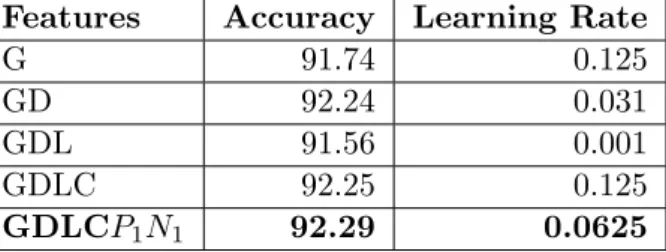
G = char-n-gram, L = binary length features, D = presence in dictio-naries and C = capitalization features and P-i = previous i word(s) , N-i= next i word(s). . . 41
4.4 Average cross-validation accuracy for CRF word-level classification, G = char-n-gram, L = binary length features, D = presence in dictio-naries and C = capitalization features and P-i = previous i word(s) , N-i= next i word(s). . . 42 4.5 Hyper parameters for embedding training . . . 43 4.6 Hyper for word-Level LSTM . . . 45 4.7 Accuracy of LSTM with word2vec, CWE and fasttext embeddings.
Reported results are average five fold cross-validation accuracy. . . 46 4.8 Hyper parameters for word + character-level LSTM . . . 49 4.9 Comparison of word-level and word+char-level LSTM forfasttext
em-beddings. Reported results are average of five fold cross-validation . . 49 4.10 Performance of word+char-level LSTM. . . 49 4.11 Per label accuracy of different systems, where dict = dictionary-based
system (e.g. EBHTL), SVM = SVM-based system (e.g. GDLCP1N1),
CRF = CRF-based system (e.g. GDLCP1N1) and LSTM =
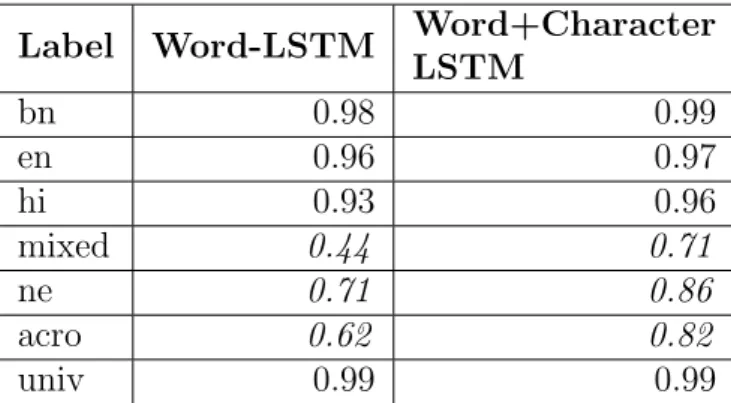
LSTM-based system (e.g. word + character level bidirectional LSTM-LSTM-based system). . . 50 4.12 Comparison of Word-based and Word + Character-based LSTM:
Re-ported Results are F1 scores. . . 55 4.13 Confusion Matrix of Word + Character-level LSTM Model . . . 55 4.14 Top three errors categories for different systems where DICT =
dictionary-based system (e.g. EBHTL), SVM = SVM-dictionary-based system (e.g. GDLCP1N1),
CRF = CRF-based system (e.g. GDLCP1N1). . . 57
5.1 Average cross-validation accuracy of POS tagging systems. . . 73 5.2 Word + Character-level LSTM with and without language features. . 74 5.3 Hyper parameters for word + character-level LSTM . . . 74 5.4 Performance of the LSTM based model with language features. . . . 74 5.5 Performance of the LSTM based model without language features. . 74
5.6 POS tagging accuracy of V1, V2 and S2 with gold-level language labels and SVM-based language labels. . . 76 5.7 Confusion Matrix for the LSTM with fasttext skip-gram
embed-dings with language features. . . 79 6.1 Performance of FCRF in LID and POS tagging with different features
sets. Reported results are average cross-validation accuracy. . . 90 6.2 LID features generated for a word ‘amar’ which is a part of a text
fragment: ‘je amar prothom’. . . 91 6.3 Performance of MTL approaches and individual taggers. . . 94 6.4 Label wise F1 score for LID: Performance of three MTL approaches. . 102 6.5 Label wise F1 score for POS: Performance of three MTL approaches. 102 6.6 Performance of three different MTL approaches in two code-mixed
data sets, where A: code-mixed data set of Barman et al. (2016) and B: code-mixed data set of Jamatia et al. (2015). Reported results are average of five-fold cross-validation accuracy. . . 104 A.1 Average Cross-Validation Accuracy for SVM-6-Way based Prediction
for Nepali-English Training, Data Set, G = Char-N-Gram, L = Binary Length Features, D = Dict.-Based Labels and C = Capitalization features. For more detail, please visit the Language Identification Chapter. . . 1 A.2 Test set results (overall accuracy) for Nepali-English and
Acknowledgments
My deepest regards and thanks to my supervisors, Dr. Jennifer Foster and Dr. Joachim Wagner, probably, the best supervisors one can ever have. Without them finishing this thesis was not possible by any means. I also like to thank Dr. Andy Way and Dr. Qun Liu for their motivation and support. My sincere thanks to Dr. Monojit Choudhury for his valuable comments, suggestions and inspirations. I would like to thank ADAPT centre for providing me the opportunity to pursue this PhD. My thanks and regards to the colleagues and friends of ADAPT. Finally, I would like to thank my parents for their support and love, without them this journey was impossible.
Automatic Processing of
Code-mixed Social Media Content
Utsab Barman
Abstract
Code-mixing or language-mixing is a linguistic phenomenon where multiple language mix together during conversation. Standard natural language processing (NLP) tools such as part-of-speech (POS) tagger and parsers perform poorly because such tools are generally trained with monolingual content. Thus there is a need for code-mixed NLP. This research focuses on creating a code-mixed corpus in English-Hindi-Bengali and using it to develop a world-level language identifier and a POS tagger for such code-mixed content. The first target of this research is word-level language identification. A data set of romanised and code-mixed content written in English, Hindi and Bengali was created and annotated. Word-level language iden-tification (LID) was performed on this data using dictionaries and machine learn-ing techniques. We find that among a dictionary-based system, a character-n-gram based linear model, a character-n-gram based first order Conditional Random Fields (CRF) and a recurrent neural network in the form of a Long Short Term Memory (LSTM) that consider words as well as characters, LSTM outperformed the other methods. We also took part in the First Workshop of Computational Approaches to Code-Switching, EMNLP, 2014 where we achieved the highest token-level accuracy in the word-level language identification task of Nepali-English. The second target of this research is part-of-speech (POS) tagging. POS tagging methods for code-mixed data (e.g. pipeline and stacked systems and LSTM-based neural models) have been implemented, among them, neural approach outperformed the other approach. Further, we investigate building a joint model to perform language identification and POS tagging jointly. We compare between a factorial CRF (FCRF) based joint model and three LSTM-based multi-task models for word-level language identifi-cation and POS tagging. The neural models achieve good accuracy in language
identification and POS tagging by outperforming the FCRF approach. Further-more, we found that it is better to go for a multi-task learning approach than to perform individual task (e.g. language identification and POS tagging) using neural approach. Comparison between the three neural approaches revealed that without using task-specific recurrent layers, it is possible to achieve good accuracy by careful handling of output layers for these two tasks e.g. LID and POS tagging.
Chapter 1
Introduction
Code-mixing is a linguistic phenomenon where language switching occurs at a sen-tence boundary (inter-sentential), or within a sensen-tence (intra-sentential) or within a word (word-level). This phenomenon can be observed among multilingual speakers in many languages. While communicating, writers/speakers mix their native and a foreign language and/or they embed foreign language words in native language sen-tences. It is a well known practice among social media users from language-dense areas and from bilingual or multilingual societies (C´ardenas-Claros and Isharyanti, 2009; Shafie and Nayan, 2013). It can occur not only between languages but also di-alects of the same language (Gardner-Chloros, 1991). Further, languages that have non-Roman script are often written using Roman script in social media and SMS communication (Sowmya et al., 2010). This is known as Romanisation. Figure 1.1 is an example of Romanisation, where Bengali has been written using Roman scripts. The following is an example, taken from a Facebook group of Indian students which exhibits trilingual code-mixing and Romanisation:
Figure 1.1: Example of Romanisation, Bengali has been written using Roman scripts.
Example 1.0.1. Original: Yaar tu to, GOD hain. tui JU te ki korchis? Hail u man!
Translation: Buddy you are GOD. What are you doing in JU? Hail u man!
Three languages are present in this comment: English, Hindi (italics) and Bengali (bold). Bengali and Hindi words are written in romanised forms. These phenomena (code-mixing and Romanisation) can occur simultaneously and increase the ambi-guity of words. For example, in the previous comment, ‘to’ could be mistaken as an English word but it is a romanised Hindi word. Moreover, the romanised form of a native word may vary according to the user’s preference. When speakers mix languages within a conversation, a sentence or even within a word and Romani-sation is present, standard NLP tasks, for example, Language Identification (LID), Part-of-Speech (POS) Tagging and Name Entity Recognition (NER) are challenging. Code-mixed NLP in Indian languages is an interesting problem and it is being investigated by a number of researchers (Das and Gamb¨ack, 2014; Sequiera et al., 2015b; Dey and Fung, 2014; Bhat et al., 2018) in recent years. Indian languages that belong to the same language family (e.g. Bengali and Hindi) also share a large number of common words. The romanised versions of such words may follow the same orthographic structure which will increase the ambiguity for automatic processing. Besides, there are also other challenges associated with code-mixed NLP, discussed in the next subsection (Section 1.1).
In this thesis, we present our studies of automatic processing (LID and POS Tagging) of code-mixed social media content in the following Indian languages: En-glish, Bengali and Hindi1. The rest of the chapter is organized as follows: Section 1.1
describes the challenges associated with code-mixed NLP in Indian language. We formulate our research questions in Section 1.2. Section 1.3 enlists the contributions of this thesis and in 1.4 we describe the structure of this thesis.
1We have also carried out SVM based LID for Nepali-English data in the shared task of LID
at the First Workshop on Computational Approaches to Code Switching, EMNLP, 2014 Solorio et al. (2014b). These results are included in the Appendix.
1.1
Challenges of Code-Mixed NLP
Following are the challenges associated with automatic NLP when dealing with code-mixed and romanised Indian social media content.
• Ambiguous Words: Let us consider the Example 1.0.1, the word ‘to’ in
the example could be mistaken as an English word but it is a romanised Hindi word. Again, ‘man’ is a English word but the similar lexical form can be viewed as a variable representation of a romanised Bengali word ‘mon’. Furthermore, Bengali and Hindi belong to the same language family and share a set of common vocabulary. For example, ‘baba’, ‘ma’, ‘ghar’, ‘desh’ belongs to the shared vocabulary of Bengali, Hindi and many other Indian languages. During automatic processing (e.g. LID, POS tagging), these words must be tagged properly given the proper context.
• Variable Lexical Representations: The romanised form of a native word
may vary according to the user’s preference. There is no standard lexical form for most romanised Bengali and Hindi words. For example, ‘korchis’ in Example 1.0.1 is a romanised Bengali word and it can be written as ‘krchis’, ‘krchs’, ‘korchs’ and ‘karchis’.
• Word-level Code-mixing: Language mixing also occur at word-level. For
example, ‘chapless’ is mixed word of Bengali and English. The first part ‘chap’ is a Bengali word and the latter part ‘less’ is an English suffix. To detect and to identify the involved languages for such words is probably the deepest level of language identification which needs to be addressed for automatic code-mixed NLP.
• Reduplication: Another challenge is proper tagging of reduplicated words.
This phenomenon is quite common in Indian languages. For example, ‘deka teka’, the first word ‘deka’ means ‘to see’ in Bengali, however the second word does not have a meaning on its own but together with the first word it
becomes a multi word expression (MWE) which means ‘to see’. Reduplication also takes part in code-mixing in an interesting fashion. For example ‘post fost’, ‘boss toss’. The first words (i.e. ‘post’ and ‘boss’) in these example are English which are followed by Bengali reduplicated words (i.e. ‘fost’ and ‘toss’). Moreover in the second example, ‘toss’ also bears lexical ambiguity (i.e. English word ‘Toss’). Word-level LID and POS tagging of such expressions are difficult when multiple languages and Romanisation is involved.
• Word Orders: Indian languages and English follow different word orders. English follows Subject-Verb-Object format. On the other hand, Indian lan-guages (e.g. Bengali and Hindi) follow Subject-Object-Verb format. When code-mixing occurs between English and Indian languages, these two types of word-order get mixed up. This phenomenon presents challenges to POS tag-ging. POS taggers trained with monolingual content on a particular language might get biased to a specific word-order and perform poorly for the other languages.
1.2
Research Questions
Code-mixing is a prominent characteristic of multilingual social media content. The nature of social media content is noisy and exhibits several challenges for auto-matic NLP, for example, short-length, spelling variation, non-gramauto-matical con-structs. Code-mixing increases the challenges by incorporating lexical ambiguity (i.e. same spelling but different meanings in different languages). For this reason, code-mixing is attracting serious attention within the NLP community worldwide. In recent research various challenges associated with code-mixed NLP (e.g. language modelling, POS tagging, parsing, machine translation) have been investigated and discussed in depth (C¸ etino˘glu et al., 2016). A number of workshops are being or-ganized to re-investigate standard NLP tasks for code-mixed social media data, for example, Language Identification (LID) (Solorio et al., 2014a), Part-of-Speech
(POS) tagging (Jamatia and Das, 2016), Sentiment Analysis (Patra et al., 2018). The aim of this thesis is to develop NLP capabilities for automatic processing of code-mixed and romanised social media content. We focus on two important tasks: (1) word-level LID and (2) POS tagging. The first one is essential for a number of NLP tasks (e.g. POS tagging, Machine Translation) and the second one also plays a vital role for automatic understanding (e.g. sentiment analysis) of code-mixed social media content. We also introduce a novel multi-tasking framework to perform LID and POS tagging jointly. Though we use standard machine learning (ML) methods like Support Vector Machines (SVM) and Conditional Random Fields (CRF), we also explore the use of Recurrent Neural Networks (RNN). Standard machine learn-ing methods relies on hand-crafted features. The generation of such features de-mands human effort and domain knowledge. On the other hand, neural approaches learn the representations or features needed for the task automatically. In recent NLP literature, it has been seen that neural approaches outperform standard feature based ML methods significantly (Collobert and Weston, 2008). With this in mind, we formulate our first research question:
1. Is it possible to achieve better performance than feature based ML (SVM and CRF) by using a neural approach for LID and POS tagging of code-mixed social media content?
It has been seen in recent literature of code-mixed NLP that monolingual taggers are used to achieve multilingual objectives (Solorio and Liu, 2008b; Vyas et al., 2014). Considering these facts we aim to investigate the following question:
2. How well can we exploit monolingual taggers to perform POS tagging for code-mixed data? Further, can a neural approach be effective?
Recent studies have shown that performing a joint labelling or multi-task learning (MTL) results in better performance than performing individual tasks (Chen et al., 2016). Multi-task learning with code-mixed data is a relatively under explored area.
In that context we want to investigate a multi-task model for code-mixed data that performs LID and POS tagging jointly. Considering the previous studies of MTL in NLP, it is interesting to see:
3. How well does a neural MTL approach perform for code-mixed con-tent? Does MTL achieve better accuracy than individual taggers for code-mixed data?
Based on these (1, 2 and 3), we present task specific research questions for LID in Section 1.3 of Chapter 4, for POS tagging we present task specific research questions in Section 1.2 of Chapter 5 and for MTL these questions are presented in Section 1.3 of Chapter 6.
1.3
Contributions
In this thesis, we present our study ‘Automatic Processing of Code-mixed Social Media Content’ with a trilingual (English-Bengali-Hindi) code-mixed corpus. We investigate word-level LID, POS tagging and a muti-tasking framework to perform LID and POS tagging simultaneously. Following are the contributions of this re-search:
• Corpus: Language and POS annotated English-Bengali-Hindi code-mixed
corpus, collected from Facebook (Barman et al., 2014a, 2016). This corpus has been used by other researchers (Das and Gamb¨ack, 2014; C¸ etino˘glu et al., 2016).
• Experiments on Language Identification: We perform word-level
lan-guage identification using dictionaries, SVM, CRF and LSTM. We investigate the use of hand-crafted features (e.g. character-n-grams, presence in dictionar-ies, length of a word and capitalisation information) with SVM and CRF. We investigate three different word embeddings (e.g. word2vec, CWE and fast-text) with LSTM. We propose a novel LSTM-based neural architecture that
combines word and character embeddings to learn a common representation of words, that can be useful for word-level LID with code-mixed data. We find that the proposed model can outperform a word-level LSTM based system sig-nificantly. Moreover, it can also achieve good word-level performance for less frequent instances (e.g. name entity, acronym and word-level code-mixing) in our code-mixed corpus.
• Experiments on POS Tagging: We investigate POS tagging with our
code-mixed corpus using SVM and CRF with hand-crafted features, using a pipeline of a language identifier and three monolingual taggers (e.g. English, Hindi and Bengali), stacking (Solorio and Liu, 2008b) approaches that combine monolin-gual taggers, language identifiers and transliterations of romanised code-mixed data and a word + character-level LSTM-based system (same architecture as LID) that incorporates language information in word representation. We find that, among all of these approaches, the LSTM-based approach performs best. We also find that a stacking approach is better than the monolingual tagger combination, and features like LID labels and transliterations of tokens in-crease the performance of a stacking approach.
• Experiments on MTL approaches: We perform joint labelling of LID and
POS tagging using a Factorial CRF and three neural MTL approaches. To the best of our knowledge this is the first attempt to employ neural MTL to perform word-level tasks (e.g. LID and POS tagging) with code-mixed social media content. We find that a neural approach that uses a common repre-sentation of words to predict multiple labels, LID and POS, is outperformed by individual neural LID and POS taggers. On the other hand, the two other neural approaches that use the common representation of words and share the output of one task to the input of another task, can perform better than the previously mentioned neural MTL approach and individual neural LID and POS taggers. Finally, we show that it is not always necessary to introduce
multiple RNN layers to model multiple tasks, using only a shared RNN layer and output propagation it is possible to achieve similar performance. Further, a shared RNN layer combined with output propagation can reduce the num-ber of model parameters and training time significantly compared to a MTL model that uses multiple RNN to model multiple tasks.
The following papers were published during the course of the project.
• Barman, U., Das, A., Wagner, J., and Foster, J. (2014a). Code mixing: A challenge for language identification in the language of social media. In Pro-ceedings of the First Workshop on Computational Approaches to Code Switch-ing. EMNLP 2014, Conference on Empirical Methods in Natural Language Processing, pages 13–23, Doha, Qatar. Association for Computational Lin-guistics.
This paper describes our data collection (English-Bengali-Hindi code-mixed corpus), annotation (language) and initial experiments on word-level LID.
• Barman, U., Wagner, J., Chrupa la, G., and Foster, J. (2014b). DCU-UVT:
Word-level language classification with code-mixed data. In Proceedings of the First Workshop on Computational Approaches to Code Switching , pages 127–132.
This paper is the result of our participation in the shared task of LID at the First Workshop on Computational Approaches to Code Switching, EMNLP, 2014. In this shared task our language identifier for Nepali-English code-mixed social media content achieved highest word-level accuracy among all participants.
• Barman, U., Wagner, J., and Foster, J. (2016). Part-of-speech tagging of
code-mixed social media content: Pipeline, stacking and joint modelling. In Proceedings of the Second Workshop on Computational Approaches to Code Switching, pages 30–39.
This paper describes the POS annotated subset of our English-Bengali-Hindi code-mixed corpus. In this paper we compare three approaches to POS tag-ging: (1) pipeline (e.g. linear combination of LID and monolingual taggers), (2) stacking and (3) joint modelling using Factorial CRF (FCRF).
The following paper was published during the course of the project but this is not related to the topic of this thesis.
• Wagner, J., Arora, P., Cortes, S., Barman, U., Bogdanova, D., Foster, J., and
Tounsi, L. (2014). DCU: Aspect-based polarity classification for semeval task 4. In Proceedings of the 8th International Workshop on Semantic Evaluation (SemEval2014), pages 223–229.
This paper describes our work on aspect-based sentiment analysis. Our SVM-based system achieved the best performance among all participants of this shared task.
1.4
Structure of Thesis
The rest of the thesis is structured as follows:
• Chapter 2: In this chapter we discuss linguistic aspects of code-mixing
in-cluding types and motivations for code-mixing and two popular linguistic the-ories of code-mixing. We also describe some aspects of code-mixing in Indian languages.
• Chapter 3: In this chapter we describe our data collection and annotation
process. Our corpus is a trilingual romanised code-mixed corpus of English, Bengali and Hindi. We also present the characteristics of the annotated data in this chapter.
• Chapter 4: This chapter describes the machine learning methods used in
Condi-tional Random Fields (CRF) and Recurrent Neural Networks (RNN). We also describe neural word embeddings in this chapter.
• Chapter 5: Word-level language identification is a key preprocessing step
that needs to be resolved before any other steps, e.g. part-of-speech tagging and parsing. The task is to assign language labels to each word of a sentence. We report our language identification experiments with English-Hindi-Bengali code-mixed data using both dictionary lookup and machine learning methods, e.g. SVM, CRF and RNN in the form of Long Short Term Memory (LSTM).
• Chapter 6: POS tagging is the process of assigning each word in a
sen-tence to its particular POS. This is an important step that helps in further understanding (sentiment analysis, named-entity recognition etc.) of natural language. In this chapter we present our experiments on POS tagging with code-mixed data using machine learning methods (e.g. SVM, CRF and LSTM) and using combinations of monolingual taggers.
• Chapter 7: Multi-task learning is the approach of modelling several tasks
to-gether. In this chapter, we perform multi-task learning, LID and POS tagging of code-mixed data using a Factorial CRF and three neural approaches. These neural approaches are mainly based on LSTM but differ in architectures.
• Chapter 8: In this chapter, we discuss our findings based on the research
Chapter 2
Code-mixing: Linguistic Aspects
A number of researchers have investigated different aspects of code-mixing including socio-linguistic (Auer, 1984; Kachru, 1978) and structural analysis (Sankoff and Poplack, 1981; Myers-Scotton and Jake, 1995; Muysken et al., 2000). In this chapter we discuss these aspects of code-mixing. We also describe two widely discussed theories of code-mixing - the grammatical constraint model of Poplack (1980) and the Matrix Language Frame theory of Myers-Scotton and Jake (1995) in this chapter.
2.1
Types of Code-mixing
Scholars distinguish between inter-sentence, intra-sentence and intra-word code mix-ing. Inter-Sentential code-mixing occurs at sentence boundaries. Example 2.1.1 is an instance of Hindi-English inter-sentential code-mixing. English is written in bold and Hindi in italics.
Example 2.1.1.
Itna izzat diye aapne mujhe !!! Tears of joy. :’( :’(
Some researchers, (Poplack, 1980) also refer to‘extra-sentential’code-mixing, this occurs when certain words or phrases from one language are inserted at the end of a sentence of another language. Some English examples are: “okay”, “well” or “you know”. Intra-Sententialmixing occurs within a sentence or a clause.
Exam-ple 2.1.2 is an examExam-ple of English-Bengali intra-sentential code-mixing. English is written in bold and Bengali in italics.
Example 2.1.2.
... sei bujhe i have 2 choose between dwaitto nie chokano ba move on ,
however difficult it may be ...
On the other hand, word-level mixing occurs within a word itself, such as at a morpheme boundary. In Example 2.1.3 the word ‘tymer’ is an example of word-level code-mixing. The word ‘tym’ is a lexical variant of the English word ‘time’ and ‘er’ is a Bengali genitive inflection. Similarly in Example 2.1.4 the word ‘chapless’ is another example of word-level code-mixing. In the text fragment the word ‘chap’ is Bengali. It means ‘tension’ and ‘less’ is an English suffix. The meaning of this text fragment is ‘tension-less job’.
Example 2.1.3. tymer dam English Translation: value of time
Example 2.1.4. chapless kaj English Translation: tension-less job
2.2
Motivations for Code-mixing
Studies can be found in the literature (Milroy and Muysken, 1995; Muysken et al., 2000; Alex, 2008; Sharma and Motlani, 2015; Auer, 2013) that mainly discuss the sociological and conversational necessities behind code-mixing as well as its linguistic properties. While investigating the types of code-mixing, Muysken et al. (2000) described some linguistic processes that are responsible for the generation of different types and patterns of code-mixed content: these are , ‘insertion’, ‘alternation’ and ‘congruent lexicalisation’. Muysken et al. (2000) define code-mixing as following:
“... all cases where lexical items and grammatical features from two languages appear in one sentence”.
Some researchers have stated that code-mixing is the representation of the exchange of language models, like morphemes, terms, or sentences from one language into another (Kachru, 1976). Li (2000) and San (2009) indicate that mainly linguistic motivations trigger code-mixing in highly bilingual societies. On the other hand, Dewaele (2010) claims that ‘strong emotional arousal’ instigates code-mixing. Social media study (Hidayat, 2012) show that social media users mainly use inter-sentential switching, and reports that 45% of the switching is motivated by lexical needs, 40% is used for talking about a particular topic, and 5% for content clarification. Dey and Fung (2014) present a speech corpus of English-Hindi code-mixing in student interviews. They analyse the grammatical contexts and motivations behind code-mixing in their corpus. They find that each sentence in their corpus contains almost 68% of Hindi word and 32% English words. Moreover, intra-sentential code-mixing is more prominent than inter-sentential switching in their corpus. They also find that most Hindi speakers, during the interviews, perform code-switching (from English to Hindi) because of the ease of use.
2.3
Linguistic Theories of Code-mixing
2.3.1
Grammatical Constraints of Poplack (1980)
Poplack (1980); Sankoff and Poplack (1981) investigated the grammatical aspects of code-switching and proposed that during code-switching the constituents preserve their monolingual structural characteristics. According to (Poplack, 1980; Sankoff and Poplack, 1981) code-mixing is governed by two constraints: the free-morpheme constraint and the equivalence constraint. The free morpheme constraint indicates that a language switch can occur between a lexical form and a bound morpheme unless that lexical form is integrated into the language of the bound morpheme. The second constraint states that language switches happen only at points where the surface structures of the languages coincide, i.e. that in a bilingual code-switched sentence, a code switch tends to occur at a point where the juxtaposition of languages
does not ‘violate a syntactic rule of either language’. Let us consider an example:
Example 2.3.1. chap nei I ’ll take care of that ...
The above snippet is an example of Bengali (italics) English (bold) bilingual code-mixing and supports the model of Poplack (1980) because the constituents on both sides of the switch are grammatical in Bengali and English. However, scholars often criticise this theory for being insufficiently restrictive, sometimes code-mixed sentences that are valid by the theory does not occur in real life communication. For example:
Example 2.3.2. Original: They had visto la pel´ıcula italiana Translation: They had seen the Italian movie
The above sentence seems to be valid by free-morpheme constraint but generally does not appear in Spanish English code-mixing (Belazi et al., 1994).
2.3.2
Matrix Language Frame (MLF)
Matrix Language Frame (Joshi, 1982; Myers-Scotton, 1997, 1995) proposes a frame-work to explain bilingual code-mixing. It assumes, during bilingual intra-sentential code-mixing, the participating languages are related in the following way - (1) one language (L1) provides a morpho-syntactic frame which is also the dominant lan-guage, (2) the other language (L2) acts as guest and words from the other language are embedded in the morpho-syntactic frame of L1. Let us consider the following snippet:
Example 2.3.3. Yaar tu to GOD hain.
In the above example, two languages are present English (bold) and Hindi. It can be clearly seen that Hindi is the matrix language of the sentence and English word ‘GOD’ is ‘embedded’ in the sentence. In MLF model morphemes are distinguished
in two categories - the content morphemes and system morphemes. Content mor-phemes comes from the embedded language (L2) and are generally - nouns, verbs and adjectives. In the above example the word ‘GOD’ is an example of a content morpheme. On the other hand, morphemes that constitutes the grammatical frame are system morphemes (e.g function words) . According to this model, during bilin-gual code-mixing, system morphemes can only come from the matrix language and content morphemes can be taken from both the matrix language and embedded language. In this theory, distinctions are also made between the matrix language hierarchy and embedded language hierarchy. The former can be described as one language taking control of the grammar of the bilingual utterance and latter can be described as when the switched elements are at the periphery of the utterance. Bhat et al. (2016); Winata et al. (2018b) have argued about the limitations of MLF re-garding the identification of the matrix language, sometimes it is not straightforward due to the criteria by which matrix language is determined.
It is worth mentioning that in recent years, these two models were implemented computationally. The models of Poplack (1980) and Myers-Scotton and Jake (1995) were implemented in recent studies (Pratapa et al., 2018; Bhat et al., 2016). Pratapa et al. (2018) tried to create synthetic grammatically valid code-mixed data based on the Equivalence Constraint theory of Poplack (1980). They showed that appropriate use of this synthetic data with original data reduce the perplexity of an code-mixed language model. On the other hand Bhat et al. (2016) implemented models for intra-sentential code-switching based on the Equivalence Constraint (Poplack, 1980) and Matrix Language Frame (Myers-Scotton and Jake, 1995) and proposed a new model that combines features of both the theories. They also observed that both of the models are highly constrained and do not allow some commonly seen code-mixed patterns of Hindi-English data of social media.
2.4
Indian Languages and Code-mixing
Some important studies of code-mixing in Indian languages was done by Kachru (Kachru, 1976, 1986, 1983, 1978). He described code-mixing as a ‘nativisation’ process (Kachru, 1983). He also pointed out that in South Asia as carrying English is a symbol of ‘modernization’, ‘success’, and ‘mobility’ (Kachru, 1986). Code mixing is very frequent in the Indian sub-continent (Gamb¨ack and Das, 2014) because languages change within very short geographical distances and people generally have a basic knowledge of their neighboring languages. India is a country with hundreds of spoken languages, among which 22 are official 1. English and Hindi are two of
the widely spoken languages of India. Almost every state in India has their own language. Further, a number of dialects are also possible for Indian languages. The nature of code-mixing in Indian languages varies from state to state. For example, in a state where Bengali is the main language (e.g. West Bengal), code-mixing can occur between English-Bengali, English-Hindi, Bengali-Hindi, moreover trilingual mixing of English-Hindi-Bengali is also possible. Kachru (1983) called the processes of mixing as Englishization (English is mixed), Nativisation (where Native language is mixed). It is worth mentioning that Indian languages that belong to the same language family (e.g. Bengali and Hindi) also share a large number of common words. The romanised versions of such words may follow the same orthographic structure which will increase the ambiguity for automatic processing of code-mixed content from Indian social media.
2.5
Conclusion
In this chapter, we have discussed different types of code-mixing, motivations behind code-mixing and two popular linguistic theories regarding code-mixing. We have also discussed the nature of Indian language code-mixing. In the next chapter, we will describe the data and the annotation process of our code-mixed corpus.
Chapter 3
Data
This chapter talks about the data collection and the annotation procedure for social media text. The collected and processed data set is a mixture of three languages: English, Hindi and Bengali. To perform code-mixed NLP we choose Indian lan-guages because India is a country hundreds of spoken lanlan-guages, among which 22 are official 1. Code mixing is very frequent in the Indian sub-continent (Gamb¨ack and Das, 2014) because languages change within very short geographical distances and people generally have a basic knowledge of their neighboring languages.
The data source for this research is a Facebook forum of Jadavpur University, Kolkata, India. The corpus is created using the posts and the comments of this fo-rum. The reason to select such data source is that researchers have found, code mix-ing is frequent among speakers who are multilmix-ingual and younger in age (C´ ardenas-Claros and Isharyanti, 2009). The participants of this forum are students between the 20-30 year age group. The university is located at Kolkata, West Bengal, which is one of the metro cities of India, where Bengali is the major spoken language. However, it is the political and the cultural capital of West Bengal so Hindi and En-glish is also spoken widely. The young population of the city is trilingual. Bengali is the mother tongue, Hindi is widely spoken for geo-cultural reasons and English is the medium of higher education. This chapter describes the corpus creation, the
annotation rules and data characteristics. This corpus has been used create the language identifiers, the POS taggers and the multitasking systems.
3.1
English-Hindi-Bengali Facebook Corpus
A Facebook group2 and 11 Facebook users (known to the authors) were selected to
obtain publicly available posts and comments. The Facebook graph API explorer was used for data collection. Since these Facebook users are from West Bengal, the most dominant language is Bengali (Native Language), followed by English and then Hindi (National Language of India). The posts and comments in Bengali and Hindi script were discarded during data collection, resulting in 2335 posts and 9813 comments.
3.1.1
Annotation
Four annotators took part in the annotation task. Three were computer science stu-dents and the other was one of the author. The annotators are proficient in all three languages of our corpus. A simple annotation tool was developed which enabled these annotators to identify and distinguish the different languages present in the content by tagging them. Annotators were supplied with 4 basic tags (viz. sentence, fragment,inclusion andwlcm (word-level code mixing)) to annotate different levels of code mixing. Under each tag, six attributes were provided, viz. English (en), Bengali (bn), Hindi (hi), Mixed (mixd), Universal (univ) and Undefined (undef ). The attribute univ is associated with symbols, numbers, emoticons and universal expressions (e.g. hahaha, lol). The attribute undef is specified for a sentence or a word for which no language tags can be attributed or cannot be categorized as univ. In addition, annotators were instructed to annotate named entities separately. What follows are descriptions of each of the annotation tags.
Sentence (sent): This tag refers to a sentence and can be used to mark inter-2https://www.facebook.com/jumatrimonial
sentential code mixing. Annotators were instructed to identify a sentence with its base language (e.g. en, bn, hi and mixd) or with other types (e.g. univ, undef) as the first task of annotation. Only the attribute mixd is used to refer to a sentence which contains multiple languages in the same proportion. A sentence may contain any number of inclusions, fragments and word-level code mixing. A sentence can be attributed as univ if and only if it contains symbols, numbers, emoticons, chat acronyms and no other words (Hindi, English or Bengali). A sentence can be at-tributed as undef if it is not a sentence marked as univ and has words/tokens that cannot be categorized as Hindi, English or Bengali. Some examples of sentence-level annotations are the following:
1. English-Sentence:
[sent lang=“en”] what a...6 hrs long...but really nice tennis.... [/sent] 2. Bengali-Sentence:
[sent lang=“bn”] shubho nabo borsho.. :) [/sent] 3. Hindi Sentence:
[sent lang=“hi”] karwa sachh ... :( [/sent] 4. Mixed-Sentence:
[sent lang=“mixd”] [frag lang=“hi”] oye hoye ... angreji me kahte hai ke [/frag] [frag lang=“en”] I love u.. !!! [/frag] [/sent]
5. Univ-Sentence:
[sent-lang=“univ”] hahahahahahah....!!!!! [/sent] 6. Undef-Sentence:
[sent lang=“undef”]Hablando de una triple amenaza. [/sent]
Fragment (frag): This refers to a group of foreign words, grammatically re-lated, in a sentence. The presence of this tag in a sentence conveys that intra-sentential code mixing has occurred within the sentence boundary. Identification of fragments (if present) in a sentence was the second task of annotation. A sentence (sent) with attribute mixd must contain multiple fragments (frag) with a specific
language attribute. In the fourth example above, the sentence contains a Hindi fragment oye hoye ... angreji me kahte hai ke and an English fragment I love u.. !!!, hence it is considered a mixd sentence. A fragment can have any number of inclusions and word-level code mixing. In the first example below, Jio is a popular Bengali word appearing in the English fragment Jio.. good joke, hence tagged as a Bengali inclusion. One can argue that the word Jio could be a separate Bengali inclusion (i.e. can be tagged as a Bengali inclusion outside the English fragment). But looking at the syntactic pattern and the sense expressed by the comment, the annotator kept it as a single unit. In the second example below, an instance of word-level code mixing, typer, has been found in an English fragment (where the root English word type has the Bengali suffix r).
1. Fragment with Inclusion:
[sent-lang=“mixd”] [frag-lang=“en”] [incl-lang=“bn”] Jio.. [/incl] good joke [/frag] [frag lang=“bn”] ”amar Babin” [/frag] [/sent]
2. Fragment with Word-Level code mixing:
[sent-lang=“mixd”] [frag-lang=“en”] ” I will find u and marry you ” [/frag] [frag-lang=“bn”] [wlcm-type=“en-and-bn-suffix”]typer [/wlcm]hoe glo to! :D [/frag] [/sent]
Inclusion (incl): An inclusion is a foreign word or phrase in a sentence or in a fragment which is assimilated or used very frequently in native language. Identifi-cation of inclusions can be performed after annotating a sentence and fragment (if present in that sentence). An inclusion within a sentence or fragment also denotes intra-sentential code mixing. In the example below,seriously is an English inclusion which is assimilated in today’s colloquial Bengali and Hindi. The only tag that an inclusion may contain is word-level code mixing.
1. Sentence with Inclusion:
[sent-lang=“bn”]Na re [incl-lang=“en”]seriously[/incl]ami khub kharap achi. [/sent]
Word-Level code mixing (wlcm): This is the smallest unit of code mixing. This tag was introduced to captureintra-word code mixing and denotes cases where code mixing has occurred within a single word. Identifying word-level code mixing is the last task of annotation. Annotators were told to mention the type of word-level code mixing in the form of an attribute (Base Language + Second Language) format. Some examples are provided below. In the first example below, the root word class is English and e is an Bengali suffix that has been added. In the third example below, the opposite can be observed – the root wordKando is Bengali, and an English suffix z has been added. In the second example below, a named entity suman is present with a Bengali suffix er.
1. Word-Level code mixing (EN-BN):
[wlcm-type=“en-and-bn-suffix”] classe [/wlcm] 2. Word-Level code mixing (NE-BN):
[wlcm-type=“NE-and-bn-suffix”]sumaner [/wlcm] 3. Word-Level code mixing (BN-EN):
[wlcm-type=“bn-and-en-suffix”] kandoz [/wlcm]
3.1.2
Inter Annotator Agreement
We calculate word-level inter annotator agreement (Cohen’s Kappa) on a subset of 100 comments (randomly selected) between two annotators. Two annotators are in agreement about a word if they both annotate the word with the same attribute (en, bn, hi, univ, undef), regardless of whether the word is inside an inclusion, fragment or sentence. Our observations that the word-level annotation process is not a very ambiguous task and that annotation instruction is also straightforward are confirmed in a high inter-annotator agreement (IAA) with a Kappa value of 0.884.
3.1.3
Data Characteristics
In our corpus, inter- and intra-sentential code mixing are more prominent than word-level code mixing, which is similar to the findings of Hidayat (2012) . Our corpus contains every type of code mixing in English, Hindi and Bengali viz. inter/intra-sentential and word-level as described in the previous section. Some examples of different types of code mixing in our corpus are presented below.
1. Inter-Sentential:
[sent-lang=“hi”] Itna izzat diye aapne mujhe !!! [/sent] [sent-lang=“en”] Tears of joy. :’( :’( [/sent]
2. Intra-Sentential:
[sent-lang=“bn”] [incl-lang=“en”] by d way [/incl] ei [frag-lang=“en”] my craving arms shall forever remain empty .. never hold u close .. [/frag] line ta baddo [incl-lang=“en”] cheezy [/incl] :P ;) [/sent]
3. Word-Level:
[sent-lang=“bn”] [incl-lang=“en”]1st yr [/incl]eo to ei [wlcm-type=“en+bnSuffix”] tymer [/wlcm]modhye sobar jute jay .. [/sent]
Annotators were instructed to tag an English word as English irrespective of any influence of word borrowing or foreign inclusion but an inspection of the annotations revealed that English words were sometimes annotated as Bengali or Hindi. There are two reasons why this is happening:
• Same Words Across LanguagesSome words are the same (e.g. baba,maa, na,khali) in Hindi and Bengali because both of the languages originated from a single language Sanskrit and share a good amount of common vocabulary. It also occurred in English-Hindi and English-Bengali as a result of word bor-rowing. Most of these are commonly used inclusions like clg, dept, question, cigarette, andtopic. Sometimes the annotators were careful enough to tag such words as English and sometimes these words were tagged in the annotators’
native languages. During cross checking of the annotated data the same error patterns were observed for multiple annotators, i.e. tagging commonly used foreign words into native language. It demonstrates that these English words are highly assimilated in the conversational vocabulary of Bengali and Hindi.
• Phonetic Similarity of SpellingsDue to phonetic typing some words share
the same surface form across two and sometimes across three languages. As an example, to is a word in the three languages: it has occurred 1209 times as English, 715 times as Bengali and 55 times as Hindi in our data. The meaning of these words (e.g. to, bolo, die) is different in different languages. This phenomenon is perhaps exacerbated by the trend towards short and noisy spelling in SMC.
When building word-level annotated corpora for code-mixed NLP, such character-istics (e.g. word-borrowing, annotation errors) can result in poor performance for the classifiers due to label inconsistency. To reduce such errors, manual inspection has been done over the annotated corpora to select and extract correctly labelled sentences. No normalization (e.g. ‘toh’ for ‘to’ in Bengali) is done for phonetically similar words across languages. We assume that correct labels for these words can be learned during classification if contextual clues are considered. Further, we assign ‘mixed’ label to all word-level code-mixing instances in this subset. The curated sub-set contains 1,239 code-mixed posts and comments from the English-Bengali-Hindi corpus. This corpus contains word-level language annotations. Each word in the corpus is tagged with one of the following labels: (1) English (en), (2) Hindi (hi), (3) Bengali (bn), (4) Mixed (mixed), (5) Universal (univ), (6) Named Entity (ne) and (7) Acronym (acro). The label Universal is associated with symbols, punctuation, numbers, emoticons and universal expressions (e.g. hahaha and lol). This subset contains 25,383 tokens and 6,883 types.
The language label statistics of our data are shown in the Table 3.1. In terms of tokens Bengali is the dominant language (48.40%) of the corpus, followed by English
Label Count Percentage bn 12285.0 48.40 en 5917.0 23.31 hi 1496.0 5.89 mixed 67.0 0.26 ne 657.0 2.59 acro 213.0 0.84 univ 4748.0 18.71
Table 3.1: English-Bengali-Hindi Code-mixed Data Set (Curated): Language label distribution of tokens.
(23.31%) and the least frequent language is Hindi (5.89%) in terms of token. The proportion of universal tokens is 18.71%. The instances of word-level code-mixing is 0.26%, which is the lowest percentage among all labels. The proportion of named entities and acronyms are also very low, 2.59% and 0.84% respectively.
We also measure the label of type-level ambiguity (discussed in Section 3.1.3) in our corpus. We find 95.64% of all types are unambiguous and 4.32% are ambiguous in nature. Among the ambiguous types, the most frequent ambiguity is the Bengali-Hindi ambiguity, which is 33.66% of total ambiguous types. Some examples of these types are ‘toh’, ‘baap’, ‘dar’, ‘jiyo’ and ‘mamu’. These ambiguous types are either from the shared vocabulary of Bengali and Hindi or a result of Romanisation. The proportion of Bengali-English ambiguity is relatively low (19% of total ambiguous types), this ambiguity is caused by phonetic similarity of spellings due to Romani-sation. This fact is also valid for English Hindi ambiguous types, which contributes, only 4.33% to the total ambiguous types. The most ambiguous type found in the data is ‘a’, which is present as a part of a name entity, as an acronym, as an English token, as a Bengali token and as a part of word-level code-mixing.
Given the token-level tags, we also analyze the amount of code-mixed and mono-lingual sentences in our corpus. We split a post or a comment based on the four types of sentence marker, ‘.’, repeated occurrences of ‘.’, ‘!’ and ‘?’. The sentence-level language distribution is shown in Table 3.2. The splitting results in 3,048 sentences of which 53.21% are monolingual and the rest are code-mixed sentences.
Label Count Percentage bn 660.0 21.65 en 428.0 14.04 hi 139.0 4.56 univ 395.0 12.96 en bn 1264.0 41.47 en hi 111.0 3.64 hi bn 24.0 0.79 en bn hi 27.0 0.89
Table 3.2: English-Bengali-Hindi Code-mixed Data Set (Curated): Language label distribution of sentences.
We find that 45.90% of the total sentences are bilingual code-mixing. Only 0.89% of the total sentences are trilingual code-mixing. The most frequent type of bilingual code-mixing is Bengali-English code-mixing (41.47% of the total sentences), followed by English-Hindi (3.64% of the total sentences). The least frequent type of bilingual code-mixing is Bengali-Hindi which is only 0.79% of the total sentences. We also find that 12.96% of the total sentences are universal sentences. These sentences con-sist of language independent tokens, e.g. symbols, numbers, names. We find that the average length of monolingual sentences varies between 6.37 to 7.32 except the universal sentences. The average length of universal sentences is 1.51. The average length of bilingual sentences varies from 8.75 to 11.68 and the trilingual sentences have an average length of 17.85.
Manual annotation for POS for this subset is done using the universal POS tag set3 of Petrov et al. (2011). These annotations were performed by an annotator who
is proficient in all three languages of the corpus. As we had no second annotator proficient in all three languages, we cannot present the inter-annotator agreement for the annotations. The POS label distributions for our data set are shown in Table 3.3. In terms of frequency, the top three POS categories are noun, verb and punctuation, (30% tokens are noun, 16% are verb and 15% are punctuation). The least frequent labels are numbers, ‘X’ (mostly emoticons) and conjunctions.
3An alternative tag set is the one introduced for code-mixed data by Jamatia and Das (2014)
However, we prefer the universal tag set because of its simplicity, its applicability to many languages and its popularity within the NLP community.
Label Count ADJ 1836 ADP 1255 ADV 701 CONJ 686 DET 834 NOUN 7751 NUM 148 PRON 2306 PRT 1234 PUNCT 3959 VERB 4086 X 587
Table 3.3: English-Bengali-Hindi Code-mixed Data Set (Curated): POS label dis-tribution of tokens.
P\L en bn hi mixed ne acro univ Total
ADJ 566 1184 85 0 0 0 1 1836 ADP 340 750 163 0 0 0 2 1255 ADV 323 342 28 1 0 0 7 701 CONJ 164 491 20 0 0 0 11 686 DET 318 495 20 1 0 0 0 834 NOUN 2740 3519 478 63 657 213 81 7751 NUM 33 5 0 0 0 0 110 148 PRON 463 1640 199 0 0 0 4 2306 PRT 87 1061 83 0 0 0 3 1234 PUNCT 0 0 0 0 0 0 3959 3959 VERB 871 2796 414 2 0 0 3 4086 X 12 2 6 0 0 0 567 587
Table 3.4: English-Bengali-Hindi Code-mixed Data Set (Curated): POS distribution across language labels
Figure 3.1: English-Bengali-Hindi Code-mixed Data Set (Curated): POS distribu-tion across language labels, column visualizadistribu-tion.
The distribution of POS tags across language labels is depicted in Table 3.4 and in Figure 3.1. In terms of language, Bengali is the most dominant across all POS labels except ‘NUM’. Only 5 occurrences of Bengali numbers can be seen in the corpus. It can be observed that some universal tokens (0.01%) are tagged as nouns. These tokens are mainly universal sounds (e.g. ’vroooomm vroooomm’) and creative spelling variations (e.g. ‘dadaaaaaaa’, ’a****a’, ’kkrrr’). Most of the mixed tokens (97%) are nouns, these are mainly nouns with suffixes from other languages, for example: ‘school er, time r’ (Bengali suffixes - ‘er’, ‘r’ are augmented with English nouns).
3.2
Unlabelled Monolingual Data
The following corpora (unlabelled) were collected to create dictionaries and to train word embeddings in our experiments.
• Bengali Song Lyrics Corpus: This is a collection of romanised Bengali song
30,933 types.
• Hindi Song Lyrics Corpus: This is a collection of romanised Bengali song
lyrics collected from www.smriti.com/hindi-songs. It contains 501,212 to-kens and 19,547 types.
• Unlabelled Facebook Corpus: This is a collection of 77K unlabelled
mono-lingual or code-mixed posts and comments in English, Bengali and Hindi. It contains 1,553,290 tokens and 86,662 types.
3.3
Conclusion
In this chapter, we have describe the data collection and annotation procedure. We also have described our data characteristics. We found intra-sentential code-mixing is prominent in our social media corpus. We also found that word-ambiguity due to Romanisation is also present in our corpus. In the next chapters, we use this corpus to build LID and POS tagging systems.
Chapter 4
Language Identification
Language identification (LID) is the task of identifying the language(s) of a given text or utterance. The necessity of accurate LID of a given document is multifold. For example, delivering web content in user’s native language is an important fac-tor to attract visifac-tors (Kralisch and Mandl, 2006). Several NLP and Information Retrieval (IR) methods start with the assumption that the language of an input is known or fixed. In that context, a major target of LID is to make sure that only relevant input (i.e in a particular language) is presented to such NLP and IR sys-tems. For Machine Translation (MT), LID is also a prerequisite factor that describes the source language of a document from which it is to be translated into a target language.
LID has been investigated both linguistically (Johnson, 1993; Grefenstette, 1995) and statistically (Dunning, 1994; Damashek, 1995) and has been categorized as a text categorization task (Cavnar and Trenkle, 1994; Elworthy, 1999). It has been in-vestigated at various granularities: from document-level (Dunning, 1994; Damashek, 1995; Prager, 1999; McNamee, 2005), sub document-level (Yamaguchi and Tanaka-Ishii, 2012; King and Abney, 2013), sentence-level (Zaidan and Callison-Burch, 2011) and word-level (Nguyen and Do˘gru¨oz, 2013; Solorio and Liu, 2008a). Document level LID is the task of assigning a unique language to a document. Researchers have achieved good accuracy in document-level LID with formal content (Dunning, 1994;
Damashek, 1995; McNamee, 2005) (e.g. news articles and Wikipedia). It is rel-atively easier than other types of LID (e.g. sentence-level, word-level) when large monolingual documents and a small number of languages are considered (McNamee, 2005). Sub-document level LID is performed for multilingual documents, is more difficult than the document-level LID and has been investigated for forum (King and Abney, 2013) and blog posts (Yamaguchi and Tanaka-Ishii, 2012). Sentence-level LID is more fine grained than the previous two and has been studied for different domains, for example: short text (Baldwin and Lui, 2010a), queries (Gottron and Lipka, 2010), tweets (Lui and Baldwin, 2014). The last and probably the deepest level LID (Das and Gamb¨ack, 2014) is performed on the word-level with code-mixed content, and in recent years has been investigated by a large number of NLP re-searchers (Solorio et al., 2014b; Sequiera et al., 2015b).
The majority of research on LID is concentrated on widely spoken and well resourced languages (e.g. English) (Hughes et al., 2006). On the other hand, there is a growing need for research on the low-resourced languages, especially, in the domain of the social media content. The nature of social media content is noisy and exhibits several socio-linguistic phenomena, e.g. short length, informality, Romanisation, spelling variation, multilingualism. Each of these factors presents challenges to the LID systems that are trained with formal content. So researchers (Hughes et al., 2006; Das and Gamb¨ack, 2015) have focused more on obtaining accurate word-level LID for social media content. Further, Hong et al. (2011) show that half of the tweets in Twitter are not English. Hughes et al. (2006) also argue that the approaches which perform well for major languages may not perform well for minority languages. In recent research, supporting low resourced languages (Lui and Baldwin, 2014; Hong et al., 2011), handling code-mixing (Solorio and Liu, 2008a), Romanisation of non-Roman script languages (Barman et al., 2014a; Das and Gamb¨ack, 2014) have become popular topics of LID research.
4.1
Chapter Organization
In this chapter, we present our experiments on word-level LID with a trilingual (English-Bengali-Hindi) code-mixed social media content. We discuss related studies of LID with code-mixing in Section 4.2, present our research questions in Section 4.3, and describe our experiments in Section 4.4. Section 4.5 describes the analysis of the performance of different systems and finally we summarize this chapter in Section 4.6 by answering the research questions and by highlighting other findings.
4.2
Background
Before discussing the related research of word-level LID with code-mixed data, first we discuss some important work on LID. As discussed above, LID has been inves-tigated mainly in four ways: document classification, short text classification, word and sub word-level sequence classification.
One of the most important works on automatic LID was carried out by Cavnar and Trenkle (1994), where LID was treated as document classification. They use n-gram models to create document and language profiles and classified each document by measuring rank-order similarity across language profiles. The use of n-grams has been popularized by Cavnar and Trenkle (1994) and many other researchers have used and updated it in many ways (Dunning, 1994; Sibun and Reynar, 1996). Dun-ning (1994) used Markov models and a Bayesian classifier that discriminates words and byte n-grams across languages in the training set and finds similar patterns in the test set. They performed their study for news articles. Grefenstette (1995) performs a comparative study of two methods: (1) character trigram-based and (2) short word-based for European languages and found both of these methods perform well for long texts (word count ≥ 50), but that a trigram-based method is more robust for shorter texts. Prager (1999) used atf-idf based vector space model which uses the cosine similarity between the training and test language model. In their study words and n-grams were used to classify monolingual documents in 20
dif-ferent languages and found that for short texts their method did not perform well. In another comparative study (Padr´o and Padr´o, 2004), Markov models, trigram frequency vectors, and n-gram text categorization were used to perform LID in six different languages, among these models, the Markov models outperformed the other two methods. Similar studies have been made by other researchers (Grothe et al., 2008), where methods like short word-based model, frequent word-based model and the character n-gram-based model are compared, after tuning different parameters, the performance of all three methods become similar. Supervised machine learning based LID (e.g. k-Nearest Neighbours, SVM, Naive Bayes) with n-grams as features was presented in the study of Baldwin and Lui (2010b). They performed LID for web documents and found that a simple 1-NN model and an SVM with a linear ker-nel (that uses byte n-grams as features) is best for the their task. They concluded that LID becomes challenging (1) if the number of target languages is large, (2) the size of the training set is small and (3) document length is shorter. Later, Lui and Baldwin (2011) developed a Naive Bayes-based method for cross-domain language identification, which mines the discriminated features across 97 languages and across 5 data sets and outperforms the method of Cavnar and Trenkle (1994). Finally, Lui and Baldwin (2012) developed an off-the-shelf LID tool (langid.py) that uses Naive Bayes algorithm with n-grams as features. It is a well known tool for LID among the NLP community for its ease of use and robustness. Among other document-level LID studies, hidden Markov models (HMM) (Xafopoulos et al., 2004), URL-based LID by keyword extraction (Baykan et al., 2008) and corpus creation for low-resourced languages (Scannell, 2007) can be seen.
Sentence-level LID, on the other hand, is much harder than document level LID because of the short length and possible inclusion of noise (i.e. tweets or social media posts and comments). Tromp and Pechenizkiy (2011) used a graph-based n-gram approach to classify tweets in six languages. Bergsma et al. (2012) investigated LID techniques with tweets of 9 languages. In their work they only considered monolingual tweets. Vogel and Tresner-Kirsch (2012) included linguistic features
on top of the method of Tromp and Pechenizkiy (2011) and achieved near perfect accuracy. The use of Bayesian classifiers was also investigated for tweets (Laboreiro et al., 2013) and short texts (e.g.film subtitles) (Winkelmolen and Mascardi, 2011). Goldszmidt et al. (2013) used character frequencies to build a boot-strapping-based statistical LID to classify tweets of five different languages. They used Wikipedia for training and found that Wikipedia is not suitable for such data because the words of social media are quite different from their training data. Carter et al. (2013) investigated the use of contextual features, hash tags, author, mentions in five major European languages: Dutch, English, French, German, and Spanish. They found the combination of all features performed best. LID for short text in Indian languages (e.g. Hindi, Bengali, Marathi, Punjabi, Oriya, Telugu, Tamil, Malayalam and Kannada) was investigated by Murthy and Kumar (2006) using linear regression. However, their work was based on language specific scripts. They did not consider Romanisation in their work.
The granularity of multilingualism is not limited to the sentence level. Code-mixing (e.g. intra-sentential and word-level) is a prominent example of this fact. When multiple languages are mixed in a sentence it is necessary to use a word-level strategy. Recently, a number of research articles have been published for code-mixed LID. Solorio and Liu (2008a) tried to predict the points inside a set of spoken Spanish-English sentences where the speakers switch between the two languages. To do this, they used a dictionary-based and character n-gram-based LID approach. They also showed that by exploiting language information, monolingual POS tag-gers can be used to achieve a good accuracy to detect code-switch points. Yam-aguchi and Tanaka-Ishii (2012) performed language identification through dynamic programming using artificial multilingual data, created by randomly sampling text segments from monolingual documents. King