CLASSIFYING GPR IMAGES USING CONVOLUTIONAL NEURAL NETWORKS
By
Maha Almaimani
Dr. Dalei Wu Dr. Yu Liang
Associate Professor of Computer Science Professor of Computer Science
Committee Chair Committee Member
Dr. Li Yang
Professor of Computer Science Committee Member
CLASSIFYING GPR IMAGES USING CONVOLUTIONAL NEURAL NETWORKS
By
Maha Almaimani
A Thesis Submitted to the Faculty of the University of Tennessee at Chattanooga in Partial Fulfillment
of the Requirements of the Degree of Master of Science: Computer Science
The University of Tennessee at Chattanooga Chattanooga, Tennessee
ABSTRACT
This thesis focused on classifying GPR cylinders' B-scans according to their depth, size, material, and the dielectric constant of the underlying medium using four different architectures of convolutional neural networks. Two CNNs were newly proposed for this study, while the other two were used by other authors. These CNNs were trained using a couple of adjusted training options including initial learning rate, learn rate drop factor, and learn rate drop period; which had a positive impact on a part of the used models, while the option maximum number of epochs worked good with all of the used models. Results show that the first newly proposed CNN showed a superior performance due to the use of a deep network with a large amount of small filters. Using this model, it was found that the best results were carried out when GPR B-scans were classified according to the cylinders' materials.
DEDICATION
This thesis is dedicated to the souls of my parents, specially my mother who passed away during my Master's journey. My deepest gratitude to my three kids (Maya, Marya, and Mahir), and my wonderful husband (Alaaeldin), I would not be here today if not for his encouragement and support.
ACKNOWLEDGEMENTS
I would like to thank Dr. Wu for his guidance and for giving me the chance to work under his supervision. It has been a great honor for me to work with him. My sincere appreciation also goes to my family, friends, colleagues, and the staff of the Department of Computer Science and Engineering at the University of Tennessee at Chattanooga, who shared my enthusiasm and helped me go through disappointments. I also would like to thank the members of the committee Dr. Yu Liang, and Dr. Li Yang.
TABLE OF CONTENTS ABSTRACT ... iii ACKNOWLEDGEMENTS ...v LIST OF ABBREVIATIONS ...x LIST OF SYMBOLS ... xi CHAPTER ...1 I. INTRODUCTION ...1 1.1 Significance ...1 1.2 Objectives ...2
II. REVIEW OF RELEVANT LITERATURE ...3
2.1 GPR History ...3
2.2 Related Work ...7
III. METHODOLOGY ...10
3.1 Software Set ...10
3.2 Data Set Configuration ...10
3.3 Data Preprocessing ...20
3.4 CNN Background ...22
3.5 Proposed System Architectures ...27
3.6 Proposed CNN Models ...28
IV. EXPERIMENTS AND RESULTS...36
4.1 Using Default Training Options ...37
4.2 Adjusting the Initial Learning Rate ...39
4.3 Adjusting the Learn Rate Drop Factor and the Learn Rate Drop Period ...41
4.4 Adjusting the Maximum Number of Epochs ...43
V. SUMMARY AND FUTURE WORK ...45
LIST OF TABLES
1 History of GPR Research Since 1900 ... 6
2 The Relationship Between Frequency Rate and Depth; and the Relationship Between Frequency Rate and Resolution ... 12
3 The Number of Outputs for Each Classification Category in the Four Proposed CNN Models... 30
4 The Characteristics of the Proposed CNNs ... 35
5 Training the Proposed CNNs Using the Default Training Options While the Maximum Number of Epochs Was Set to 1 ... 38
6 Training the Proposed CNNs Using the Default Training Options While the Maximum Number of Epochs Was Set to 100 ... 39
7 Results After Adjusting the Initial Learning Rate to (0.0001) and Epochs=1 ... 40
8 Results After Adjusting the Initial Learning Rate to (0.0001) and Epochs=100 ... 41
9 Epochs=8, and Initial Learning Rate Adjusted to 0.0001 for CNN2 and CNN4 ... 42
10 Learn Rate Drop Factor=0.5, Learn Rate Drop Period=4, Epochs=8, and Initial Learning Rate Adjusted to 0.0001 for CNN2 and CNN4 ... 42
11 The Best Combination of the Adjusted Training Options for Each Proposed CNN ... 43
12 The Needed Number of Epochs for Each Model to Achieve an Accuracy of More Than 90% Using the Training Options Adjustment Combination in Table 11 ... 44
LIST OF FIGURES
1 A graphic illustrating the basic principle of GPR ... 3
2 A graphic showing the relationship between A-scan, B-scan, and C-scan ... 4
3 An A-scan of a buried metal cylinder ... 4
4 A B-scan of a buried metal cylinder ... 5
5 A screenshot showing the license screen for GprMax v3.1.1 ... 11
6 A B-scan generated using a frequency of 1.5e8 ... 13
7 A B-scan generated using a frequency of 0.5e9 ... 13
8 A B-scan generated using a frequency of 1.5e9 ... 14
9 A B-scan generated using a frequency of 3.5e9 ... 14
10 A screenshot showing an error during a simulation using a high, out-of-range frequency... 15
11 A B-scan generated using a time window of 3e-9 ... 16
12 A B-scan generated using a time window of 10e-9 ... 16
13 A B-scan generated using a time window of 20e-9 ... 17
14 A screen shot of a gprMax script used to create a B-scan of a buried PVC cylinder ... ... 18
15 Geometry of a buried PVC cylinder imaged using Paraview ... 19
16 B-scan of a buried PVC cylinder ... 19
17 A screenshot showing HDFView v.3.3.0 ... 20
18 Two GPR images showing (L-R) before rescaling; and after rescaling using HDFView ... 21
20 The way CNN models work ... 23
21 Basic CNN architecture ... 23
22 The result after convolving a 5*5 filter... 25
23 Zero padding ... 25
24 The pooling process ... 27
25 Proposed system architectures ... 28
26 The first newly proposed CNN model ... 30
27 The second newly proposed CNN model ... 31
28 The third proposed CNN model ... 33
29 The fourth proposed CNN model ... 34
30 The four Proposed CNN models. ... 35
31 A screenshot showing the default training options for CNNss ... 38
32 A Screenshot showing a 0% classification accuracy because mini batch loss = NaN ... ... 39
LIST OF ABBREVIATIONS GPR: Ground Penetrating Radar
UXO: Unexploded Ordnance GP: Genetic Programming GA: Genetic Algorithm
ANN: Artificial Neural Network CNN: Convolutional Neural Network Convnet: Convolutional Neural Network
LIST OF SYMBOLS x: The pixel value
ℓ: The iteration number α: The learning rate θ: The parameter vector E(θ): The loss function
CHAPTER I INTRODUCTION 1.1 Significance
Ground penetrating radar (GPR) is a very common non-destructive subsurface imaging tool used in many applications related to infrastructure evaluations like rebar detection [1], unexploded ordnance (UXO) detection [2], landmine detection [3], pipeline detection [4], avalanche victims detection [5] [6], soil moisture assessment [7], liquid contamination detection [8], soil contamination measurement [9], bridge deck inspection [10], railroad ballast monitoring [11] [12], etc. Object detection is one objective that was focused on in these applications. Of equal importance to object detection is buried object characterization or, in other words, finding the characteristics of the buried object. These characteristics include: object localization, object depth detection, object shape identification, object size estimation, object dimension estimation, object material recognition and classification. Currently, not many research projects focus on all of them. These projects mostly focus on detection. Due to the importance of GPR use in
infrastructure applications, an automatic methodology to find the characteristics of buried targets in GPR images is very necessary [13]. Thus, an automatic technique is presented in this
document to classify images according to their size, material, depth and the dielectric constant of the underground medium.
1.2 Objectives
The experimental objectives of this project included investigating the effect of different training options on four convolutional neural networks (convnets, CNNs, convolutional nets) and finding the best combination of training options for each of the suggested CNNs. In addition, finding which of these four models would work the best in classifying cylinders' B-scan images according to their characteristics: depth, material, size, and the dielectric constant of the
underground medium. Finally, examining which of the four classification categories would be the most accurately classified.
This document includes a total of four chapters beside the introduction. The next chapters are arranged as follows: Chapter 2 gives a literature review related to the GPR field. Chapter 3 describes the methodology of the project. Chapter 4 is about experiments and results. Finally, Chapter 5 concludes the thesis and provides a list of future work.
CHAPTER II
REVIEW OF RELEVANT LITERATURE 2.1 GPR History
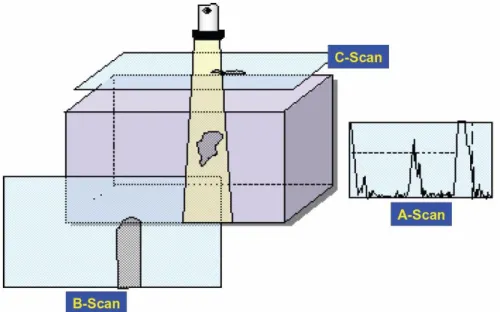
It is necessary to understand the mechanism that lies behind GPR before delving into its history. GPR works by transmitting electromagnetic waves into the ground. The propagated waves from the source through the ground hit the buried objects and then are reflected back to the receiver (Figure 1) [14] to form what so called an A-scan. Different A-scans at different scan positions are stacked to form a B-scan GPR image. Furthermore, stacked 2D B-scans form what is known to be a 3D C-scan [15]. These three types of scans are then processed to detect the buried objects and show their characteristics. The relationship between the three different kinds of scans is visualized in Figure 2 [16]. Examples of an A-scan and a B-scan are shown in Figure 3 [17] and Figure 4 [17]. B-scans were used in this project, leaving A-scans and C-scans behind the scope.
Figure 2 A graphic showing the relationship between A-scan, B-scan, and C-scan
Figure 4 A B-scan of a buried metal cylinder
Table 1 History of GPR Research Since 1900
Time Research done
1900 – 1950 Propagating radio waves above the surface.
1950 – 1955
First attempt to measure the features of the subsurface using radio wave signals.
1955 – 1960
Finding indications that radio frequency is able to penetrate into the subsurface.
1960 – 1965 Developing radio echo sounding in ice.
1965 – 1970
Ice radio echo sounding activity continued in addition to the use of other materials like coal and salt.
1970 – 1975 Understanding the antennas ' wave fields on the ground surface. 1975 – 1980 Initial results using GPR were presented.
1980 – 1985
“Georadar” was developed by OYO Corporation of Japan and low frequency radars were introduced.
1985 – 1990 Better understanding of GPR's pros and cons.
1990-1995
The highest peak in GPR progression by the emerging of many GPR developments like digital data processing, and 2D numerical simulation. Moreover, GPR meetings started to be held.
1995 – 2000
3D numerical modeling development due to the evolution of computers.
2000_present
GPR products becoming sophisticated, stable, reliable and reproducible. Also, many techniques and algorithms are being developed to process GPR data.
2.2 Related Work
Many techniques have been deployed to find the characteristics of GPR images. One way is by using the pattern recognition approach [19]. This approach recognized the materials of the buried objects automatically, but was not able to recognize their shapes or estimate their sizes.
The use of Genetic Programming (GP) was another method to analyze GPR images. Genetic programming is an evolutionary learning method that is similar to genetic algorithm (GA) in its ability to search for the global optimal solution which could minimize efforts on the training processes. GP is preferred because the size and structure of its solution is unlimited, while those of the GA solutions are restricted to user-defined constraint. GP was used by [20] to analyze GPR images and came up with promising results that showed the method's robustness. However, [20] did not show that this method is reliable by using it in more practical situations that include multiple targets or various orientations of targets.
A method to classify and recognize features in GPR images based on Support Vector Machines (SVMs) was also used by many authors. This approach was used by [21] to identify voids inside concrete and estimate their depth. Results were interesting but the approach needed to be improved to recognize the shape and the distribution of the voids. SVMs were also used to identify the material of underground utilities by [22]. This research suggested that in order to get more accurate classification results using SVMs, the segment length of A-scan should be
adjusted. Furthermore, B-scan information such as feature of amplitude and frequency should be added to the raw data. Moreover, a proper kernel function and a convenient range for data normalization should be selected.
Neural networks or Artificial Neural Networks (ANNs) have been used to find buried objects' characteristics. A paper published in 2016 by [13], exploited three neural networks
algorithms to estimate the shape, material, size, and depth of the buried object, as well as the dielectric constant of the underground medium simultaneously. The proposed neural networks were able to classify the shape of the buried objects to one of three shapes: circle, triangle, or square. Furthermore, they could classify the buried objects' material to either: air, limestone, or metal. Results showed that an error emerged when a metal circular object was being recognized. Furthermore, triangle size estimation demonstrated that the proposed methodology needed some improvement to get more accurate results. ANNs were also used by [23] to classify underground buried object' shape whether it was a cylinder or a cube metal. The problem with neural networks is that they show limited performance in the case of nonlinear, high dimensional samples. They are also sensitive to learning samples and they have limited generalization ability according to [21]. Neural Networks suffer from a group of limitations, therefore, Convolutional Neural Networks were introduced in this project to overcome the limitations and classify GPR images more accurately.
Convolutional Neural Networks have revolutionized the field of computer vision and image classification since 2012. CNNs are deep neural networks where each neuron accepts inputs from neurons on the previous layer with no existence of cycles, thus they are called feed forward CNNs [24]. They differ from shallow neural networks that consist of only one layer, therefore, by using kernels they do not struggle from computational complexity when the input size is dramatically increased. Shallow models might be effective in solving simple problems but they will have difficult time dealing with complicated real world applications [25]. Furthermore, in contrast to other deep neural networks, CNNs work on 2D images directly. They also use the Back Propagation algorithm which is Gradient Decent. The major task of the Back Propagation algorithm is to optimize the accuracy of predicting models by reducing the error related to each
neuron [26]. Convolutional neural networks have been used in the ground penetrating radar field by a couple of authors to detect buried targets such as [27], who evaluated the use of CNNs to classify 2D GPR pictures. CNNs were also exploited in a study conducted by [3] to detect landmines. Moreover, [28] used the transfer learning technique with CNNs to detect threats. In neural networks field, transfer learning means a pre-trained neural network model can be used to solve a new similar problem instead of wasting time and effort training a network from scratch. The study conducted by [28] used the popular Cifar10 dataset, and a dataset of high resolution aerial imagery for detecting solar photovoltaic arrays to pre-train their CNN. Until recently, CNNs were used only to detect objects, without classifying GPR images according to their characteristics (i.e., depth, size, material, etc.). Therefore, this research deployed Convolutional Neural Networks to solve this problem.
CHAPTER III. METHODOLOGY
3.1 Software Set
Four software packages were used in this project: 1. GprMax v3.1.1: to generate B-scan images [17].
2. Paraview v4.3: to visualize geometry created by gprMax [29]. 3. HDFView v3.0.0: to pre-process the images by rescaling them [30]. 4. Matlab R2017b: to do the following:
a. Resize the images.
b. Convert the images to grey scale.
c. Feed the images to the proposed Convolutional Neural Networks' for the sake of training.
d. Test the CNNS [31]. 3.2 Data Set Configuration
There are two types of GPR systems: the stepped frequency systems and the time domain systems. SF-GPR systems are better than the time domain ones in giving a real reading of the subsurface structure, but they require a larger measurement time. Therefore, they are not suitable for extensive public utility searches like pipes, neither for modelling transient phenomena [32]. Therefore, in this research, gprMax, a time domain system was used. GprMax, is an open source
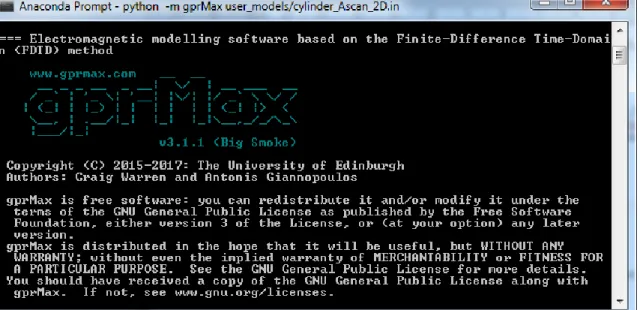
command-line driven software that was written in Python (Figure 5). It uses the
Finite-Difference Time-Domain (FDTD) method to simulate the electromagnetic wave propagation of Ground Penetrating Radar [17].
Figure 5 A screenshot showing the license screen for GprMax v3.1.1
GprMax has very powerful features such as: • Built in libraries of antenna models. • The ability to model realistic subsurface. • The ability to model realistic objects. • The ability to build heterogeneous objects.
• The ability to build objects with rough surfaces [17].
GprMax was originally developed in 1996 by Antonis Giannopoulos. Today, three versions exist and the latest one were used in this research. GprMax can work on both CPU and GPU, single and multiple. In our experiment, gprMax ran on a single CPU and the GPR
waveform was generated as a Ricker waveform.
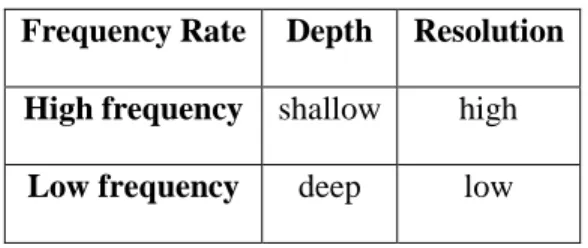
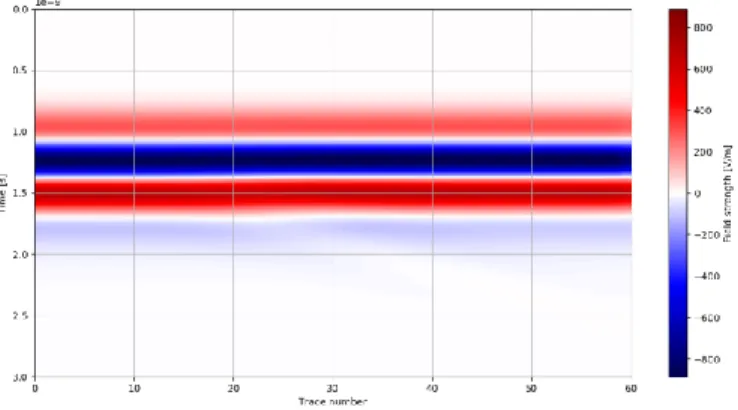
To select the best centre frequency and time window values, a couple of experiments were conducted. In the case of frequency, the use of high frequency results better resolution and the use of low frequency results more penetration depth. Table 2 [32] shows the relationship between frequency rate and depth. It also shows the relationship between frequency rate and resolution. Different frequencies were applied on a couple of objects with different sizes, depths, materials, and underlying dielectric constants. Results were as follows: Having a low frequency did not show good results. Figures 6, 7, 8, and 9 depicts cylinders of the same size, depth,
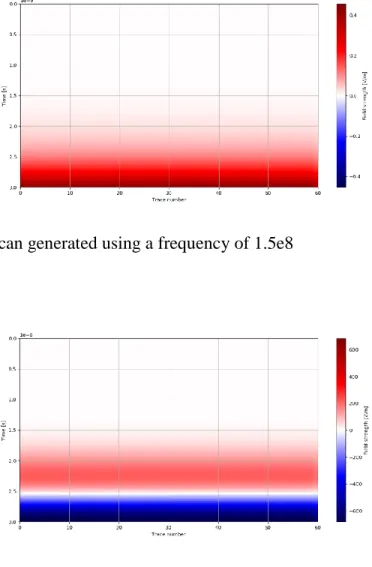
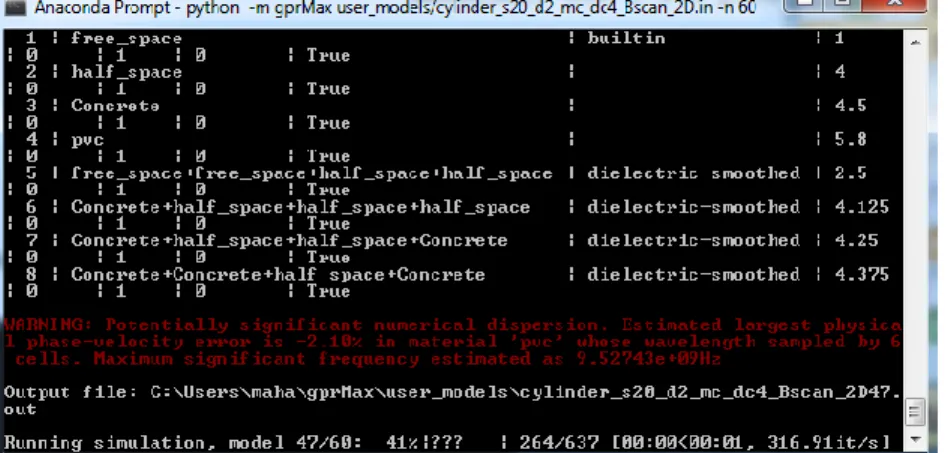
material, and dielectric constants, but were produced using different frequencies. Figure 6, where the frequency equalled 1.5e8 shows the worst result. Figures 7 and 8 where the frequencies were 0.5e9 and 1.5e9 respectively show better results, but not the best. Figure 9 shows the best result with a frequency of 3.5e9. Setting higher and higher frequencies produce better results, but they take more time to be generated. Worth to notice, each model has a range of frequencies. Using out of range frequencies (i.e., really high or really low frequencies) generated an error during simulation. Figure 10 shows an error message because of using an out of range high frequency (i.e., 4.5e9).
Table 2 The Relationship Between Frequency Rate and Depth; and the Relationship Between Frequency Rate and Resolution
Frequency Rate Depth Resolution High frequency shallow high
Figure 6 A B-scan generated using a frequency of 1.5e8
Figure 8 A B-scan generated using a frequency of 1.5e9
Figure 10 A screenshot showing an error during a simulation using a high, out-of-range frequency
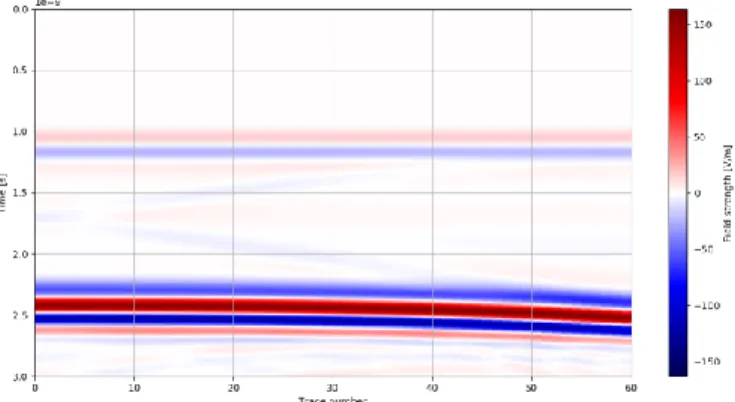
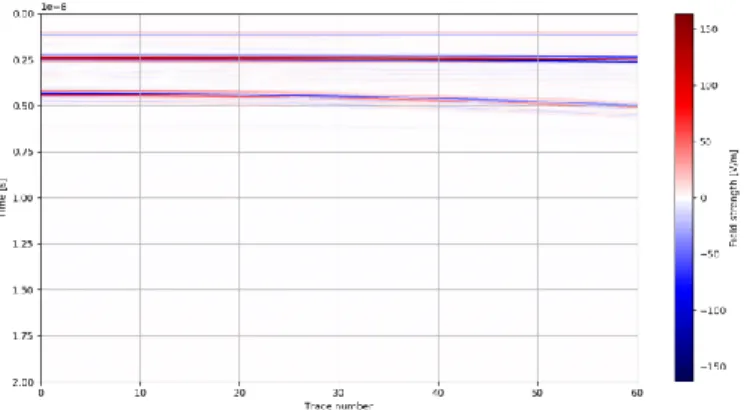
In the case of time window, giving more time for the waves to propagate from the source through the ground to the buried object and reflect back to the receiver results a wider B-scan or, in other words, a zoomed out image. Figures 11, 12, and 13, for example, had the time windows adjusted to 3e-9, 10e-9, and 20e-9 respectively. Noticed in Figure 11 (i.e., generated with time window= 3e-9) that some waves were cropped out similar to what the zoom in tool does. Figure 12, however, shows more details that Figure 11 was not able to catch due to the limited time window. Furthermore, Figure 13 shows a more zoomed out picture that might not be really necessary since no more waves emerged in the picture and more time was needed to propagate such an image.
Figure 11 A B-scan generated using a time window of 3e-9
Figure 13 A B-scan generated using a time window of 20e-9
After conducting many experiments on the centre frequency and the time windows, the GPR Ricker waveform was set using a centre frequency of 1.5 GHz to get a good resolution with a reasonable penetration depth. The time window was set to 3 nanoseconds to give enough time for the waves to propagate from the transmitter and reflect back to the receiver resulting images with enough details. GPR A-scan traces were collected in a horizontal direction from left to right using 60 steps on different sized domains. The amplitude of the GPR antenna above the ground was 1 mm.
Following [13], different geometry models buried in a half-space with different scenarios, were created using the FDTD simulation, including the following:
• Object shape: cylinder.
• Object Material: metal, concrete, polyvinyl chloride (i.e., PVC). • Object depth: 2 cm, 100 cm.
• Object size/radius: 20 mm, 50 mm, 100 mm, 150 mm, 200 mm. • Dielectric constant of the subsurface medium: 4, 6, 8.
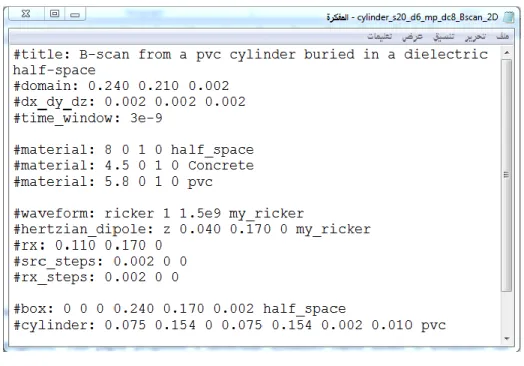
Figure 14 shows gprMax script to create a B-scan of a PVC cylinder sized 20 mms buried in a half space with a relative permittivity of 8.
Figure 14 A screen shot of a gprMax script used to create a B-scan of a buried PVC cylinder
To make sure that the geometry is correct Paraview was used. ParaView is an open-source, multi-platform data analysis and visualization application [29]. GprMax generates .vti files through A-scans that can be visualized by Paraview. Figure 15 illustrates the geometry presented in Figure 14 using Paraview. Figure 16 presents the generated B-scan from Figure 14.
Figure 15 Geometry of a buried PVC cylinder imaged using Paraview
Figure 16 B-scan of a buried PVC cylinder
Around 200 images of cylinders were used in this research. To facilitate the recognition of these images a naming system was introduced. This naming system included the name "cylinder", the cylinder size, the cylinder depth, the cylinder material, the dielectric constant of
the underground medium in which the cylinder was buried in, and finally the type of the scan. An example of the files naming system is: cylinder_s20_d2_mm_dc6_Bscan_2D, where the cylinder's size is 20 mm, its depth is 2 cm, its material is metal, the dielectric constant of the underground medium is 6, and the scan type is B-scan.
3.3 Data Preprocessing
Since the images created using gprMax had different scales (illustrated in Figure 16), they needed to be pre-processed in a way that all of them have the same scale (i.e., normalized). This is accomplished using HDFView v3.0.0 (Figure 17). GprMax produces B-scan pictures and .out files along with them. Rescaling the .out files to the smallest scale would result some loss of information Therefore, the .out files were rescaled to the largest scale found in the images dataset which found to be between -1451.39 and 1710.09. Figure 18 shows an example of a GPR image before and after rescaling.
Figure 18 Two GPR images showing (L-R) before rescaling; and after rescaling using HDFView
After rescaling all of the B-scans, they were changed from RGB scale to grey scale, and then resized from 637x60 to 112x60 in order to reduce the amount of memory needed to train the proposed convolutional neural nets. Hence, the pre-processing steps in Figure 19 included rescaling (using HDFView), and changing colour format and resizing (using Matlab), without the need of any of the complex pre-processing steps (e.g., edge detection, segmentation, support vector machine (SVM) classifiers, etc).
Figure 19 Steps of pre-processing GPR images
3.4 CNN Background
Convolutional neural networks were revolutionized on 2012 when Alex Krizhevsk used them to win the annual Olympics of computer vision by reducing the classification error record from 26% to 15% [33]. CNNs are commonly used when data consist of images. They are
categorized as supervised learning, in which data are labeled, unlike unsupervised learning where data do not need labeling. Convnets are made of layers and information is passed through those layers. Any CNN model works by taking an image array, where each pixel value in the image is in a specific range. The output of a CNN model would be a probability of this image being of a certain class (Figure 20). This is accomplished by training the CNN model using training data. More specifically, CNNs turns the input images into a set of automatically selected features or any useful observations (e.g., edges, corners, textures, patterns, etc.). Then, the last block of layers performs the classification and produces the output using the output layer. The output layer returns the strength of the network to predict and classify images according to a set of available classes (Figure 21).
Figure 20 The way CNN models work
Figure 21 Basic CNN architecture
There are some convnets related terms that need to be known before delving into the CNN layers:
• Filter/kernel/neuron: a matrix (e.g., of size 5*5) that include weights which change with every iteration over the training data to identify the most important features in an image. These weights are multiplied by the adjacent image pixel values. Then all of
these multiplications are summed up to represent a single number. This is done for every location in the input image producing an activation map or a feature map. It can be visualized as a flash light that shines over an area of an image and
slides/convolves across all the areas in that image. Its depth should be similar to the input's depth, 3 in the case of colored images and 1 in the case of gray images. Figure 22 [34] illustrates how the filter works inside the convolutional layer.
• Stride: the number of steps taken by the filter while scanning the images to train the convolutional net [35].
• Receptive field: the region being shined on using the filter [36].
• Padding: adding new numbers to the borders of the image to preserve its size [35]. An example of zero padding is illustrated in Figure 23 [37].
• Epoch: a single iteration over all the images [31]. • Training data: images used to train the network [31].
• Test data: data used to test that the network works correctly [31].
• Accuracy: the ratio of the number of the truly classified images to the number of images in the test data [31].
• Mini batch: a small randomly selected subset of training data [31].
• Mini batch accuracy: the percentage of classified images in the subset dataset [31]. • Mini batch loss: the percentage of incorrectly classified images in the subset dataset
Figure 22 The result after convolving a 5*5 filter
Figure 23 Zero padding
The layers usually seen in any convolutional net are the followings (described in the terms of Matlab R2017b) [37] :
• The features detecting layers:
1. The image input layer: the parameters of this layer include the height, width, and the channel size of the input images. For gray scale images the channel size is 1 and for colored images the channel size is 3 corresponding to the RGB values. Besides manipulating the images size, this layer is capable of
specifying any transformations, such as normalization or data augmentation (flipping or cropping the data randomly).
2. The convolutional layer: this layer takes two arguments. The first argument is filter size, which includes height and width of the filter that scans along
training dataset. The second argument is number of filters, which determines the number of feature maps.
3. The ReLu layer: ReLu is an abbreviation for the Rectified Linear Unit function. Its main purpose is to change any subzero pixel values to zero in order to accelerates the learning process. The ReLu layer job is mathematically described in Equation 1 where x is the pixel value.
Max(0,x) (eq. 1)
4. The pooling layer: is a down sampling layer that usually follows the
convolutional layer or the activation function. It reduces spatial dimensionality (i.e., height and width) and computational overhead by discarding insignificant data and preserving detected features. There are many kinds of pooling layers, such as average pooling layer and maximum pooling layer that takes the average/maximum value in a sliding window. The arguments of this layer are:
pool size and stride. The pooling process is illustrated in Figure 24 [37]. • The classification layers:
1. The fully connected layer: one or more of the fully connected layers usually follows the convolutional layer and the pooling layer. The last fully connected layer is fully connected with the output of the previous layer. It combines all the learned features across the previous layers to classify images.
2. The soft max layer: the soft max activation function is usually used by the fully connected layer for the sake of classification. It returns probabilities that are assigned later to a set of available classes.
3. The classification/output layer: is the final layer in CNN models. It assigns the input probabilities returned by the soft max function to a set of available classes.
Figure 24 The pooling process
3.5 Proposed System Architectures
The proposed system architectures (Figure 25) takes a set of GPR images and apply certain operations on them according to each proposed CNN. The output of these CNNs would be a probability of each image being of a certain class (e.g., concrete, PVC, or metal in the case of using the material architecture).
Figure 25 Proposed system architectures
3.6 Proposed CNN Models
Applying CNNs on GPR data is a complicated process since there is a massive amount of convolutional networks' designs with a wide set of configurable parameters (i.e., different filter sizes, different number of filters, different order of layers, etc.). Therefore, two CNNs were selected from a set of proposed models by other authors to detect buried objects in GPR images (i.e., CNN3 [38] and CNN4 [3].). They were slightly modified to match the inputs size and the desirable outputs of this project. The other two CNNs (i.e., CNN1 and CNN2) were inspired from Mathworks.com. They have been selected based on their similarity to the recommended models CNN3 and CNN4.
Figure 26 depicts CNN1, the first proposed CNN architecture, which is described as follows:
1. An input layer that accepts gray B-scans of size 112*60*1.
1 (the default settings of stride and padding). 3. A first batch Normalization Layer.
4. A first ReLu layer.
5. A first max pooling layer with pool size 2 and stride of 2.
6. A second convolutional layer with 32 filters of size 3x3, with default stride and padding.
7. A second batch Normalization Layer. 8. A second ReLu layer.
9. A second max pooling layer with pool size 2 and stride of 2.
10.A third convolutional layer with 64 filters of size 3x3, with default stride and padding. 11.A third batch Normalization Layer.
12.A third ReLu layer.
13.A fully connected layer with different number of outputs (i.e., output size) according to each classification category (i.e., cylinders size, depth, material, and the dielectric constant of the underground medium). Table 3 shows the number of outputs for each classification category using the four proposed CNN models.
14.A soft max layer. 15.A classification layer.
Figure 26 The first newly proposed CNN model
Table 3 The Number of Outputs for Each Classification Category in the Four Proposed CNN Models Classification Category Number of Outputs Details Classification of dielectric constant 3 4, 6, 8 Classification of depth 2 2 cm, 100 cm
Classification of material 3 Concrete, metal, PVC
Classification of size 5 20 mm, 50mm, 100 mm, 150mm, 200 mm
The second Convnet model (i.e., CNN2) (illustrated in Figure 27) is as follows: 1. An input layer that accepts gray B-scans of size 112*60*1.
2. A convolutional layer with 20 filters of size 5x5, with default stride and padding. 3. A ReLu layer.
4. A max pooling layer with pool size 2 and stride of 2.
5. A fully connected layer with different output sizes according to each classification category (Table 3).
6. A soft max layer. 7. A classification layer.
Figure 27 The second newly proposed CNN model
The third convolutional network (i.e., CNN3 [38]) is described below (Figure 28): 1. An input layer that accepts gray B-scans of size 112*60*1.
2. A first convolutional layer with 16 filters of size 3x3, with default stride and padding. 3. A first ReLu layer.
padding.
5. A second ReLu layer.
6. A first max pooling layer with pool size 2 and stride of 2.
7. A third convolutional layer with 16 filters of size 3x3, with default stride and padding. 8. A third ReLu layer.
9. A fourth convolutional layer with 16 filters of size 3x3, with default stride and padding.
10.A fourth ReLu layer.
11.A second max pooling layer with pool size 2 and stride of 2. 12.A first fully connected layer with 16 neurons.
13.A fully connected layer with different output sizes according to each classification category (Table 3).
14.A soft max layer. 15.A classification layer.
Figure 28 The third proposed CNN model
CNN4 [3] illustrated in Figure 29 and based on LeNet is described as the following: 1. An input layer that accepts gray B-scans of size 112*60*1.
2. A first convolutional layer with 20 filters of size 5x5, a stride of 1 and padding of size 1.
3. A second convolutional layer with 20 filters of size 5x5, a stride of 1 and padding of size 1.
4. A ReLu layer.
5. A max pooling layer with pool size 2 and stride of 2. 6. A first fully connected layer with 500 neurons.
7. A second fully connected layer with different output sizes according to each classification category.
9. A classification layer.
Figure 29 The fourth proposed CNN model
CNN1 and CNN2 where designed in a way that they look similar to CNN3 and CNN4, while these later two models where chosen because they have shown to be affective with B-scans [38] [3] (Figure 30). The characteristics of the four architectures used to classify GPR B-scans are detailed in Table 4. Experimental designs including training options are discussed in Chapter 4.
Figure 30 The four Proposed CNN models.
Table 4 The Characteristics of the Proposed CNNs Proposed/Recommended Number of blocks Number of layers Filter size Number of
filters Number of neurons
CNN1 Newly proposed 4 15 3*3 16-32-64 611,529
CNN2 Newly proposed 2 7 5*5 20 309,129
CNN3 Recommended by [38] 5 15 3*3 16-16-32-32 1,296,985
CHAPTER IV
EXPERIMENTS AND RESULTS
All of the four previously mentioned proposed convolutional models were trained using 75% of the synthetic data mentioned in Section 3.2 and tested by the rest of the data (i.e., 25%). Training the dataset was done on a single CPU using stochastic gradient descent with momentum (SGDM). SGDM is specified in Equation 2, where ℓis The iteration number, αisthe learning rate, θ is the parameter vector, E(θ) is the loss function, and ∇E(θ) is the gradient of the loss function. Each model was used to classify 2D cylinders' scans according to four classification categories: cylinders' depth, material, size, and dielectric constant of the burying medium.
θℓ+1=θℓ−α∇E(θℓ) (eq. 2)
The steps of the experiment were as follows:
1. Find the effect of adjusting training options on the accuracy of the four CNN models. The investigated options include:
a. The initial learning rate.
b. Learn Rate Drop Factor and Learn Rate Drop Period. Suggested by [38]. c. The maximum number of epochs.
2. Train the four models using the best combination of the previously mentioned training options, and then find which architecture works the best.
3. Find which of the four classification categories is most accurately classified. 4.1 Using Default Training Options
Layers included within CNN models come with many parameters known as weights. The initial values of those weights are random. These weights are updated and finalized by training the network on specific data. Hence, those weights determine how the networks behave when data is passed through them. Two exactly similar network models will behave differently if they were trained using different datasets or different training options. Conversely, different models will behave differently if they were trained using the same training options. Thus, for each proposed CNN, training options should be investigated to know which subset of them would produce a better accuracy.
In this first experiment, the four convolutional models were trained using the default training options illustrated in Figure 31, while the maximum number of epochs was set to 1 and 100. The results of training each model using the default training options are shown in Tables 5 and 6 below. Table 5 illustrates that using the default training options with a single epoch gave approximately similar results. Looking at Table 6, maximizing the number of epochs produced results in the case of using CNN1 and CNN3. Unfortunately, with CNN2 and CNN4 a NaN error emerged (Figure 32). The NaN error produced 0% accuracy with all classification categories. NaN means that the learning rate is enormously increasing in a way that it cannot be represented in numbers any more. Learning rate is the pace at which a network learns new features about certain data. A network starts learning slowly about significant features, but every time the network passes on data (i.e., epoch) the network gets faster in learning because it gets familiar with the data. The very fast learning process produces the NaN error. A suggested solution to this problem is to reduce the initial learning rate dramatically. Initial learning rate is one of the
training options. Adjusting the initial learning rate is discussed in detail in the next section.
Figure 31 A screenshot showing the default training options for CNNss
Table 5 Training the Proposed CNNs Using the Default Training Options While the Maximum Number of Epochs Was Set to 1
Classification categories CNN1 CNN2 CNN3 CNN4 Dielectric constant 57.1% 26.1% 33.3% 50% Depth 50% 50% 50% 36.3% Material 52.3% 40.4% 33.3% 35.7% Size 20% 20% 20% 45% Average 44.8% 34.1% 34.1% 41.7%
Table 6 Training the Proposed CNNs Using the Default Training Options While the Maximum Number of Epochs Was Set to 100
Classification categories CNN1 CNN2 CNN3 CNN4 Dielectric constant 97.6% 0% 35.7% 0% Depth 72.7% 0% 40.9% 0% Material 97.6% 0% 47.6% 0% Size 100% 0% 20% 0% Average 91.9% 0% 36% 0%
Figure 32 A Screenshot showing a 0% classification accuracy because mini batch loss = NaN
4.2 Adjusting the Initial Learning Rate
The initial learning rate is the pace at which a network starts to learn by about data features. The default initial learning rate equals 0.0100. This rate was reduced to solve the NaN problem mentioned in the previous section. The results of adjusting the initial learning rate using a single epoch for training are shown in Table 7. Comparing Table 7 to Table 5 it was found that using the adjusted initial learning rate with the four used network models decreased their
rate and produced a NaN error that was solved by decreasing the initial learning rate. Using 100 epochs and comparing Table 8 (after adjusting the rate) to Table 6 (before adjusting the rate), the adjusted initial learning rate solved the problem of NaN for CNN2 and CNN4, but dropped out the accuracy rate of CNN1 from an average of 91.9% to 88.5% and CNN3 from 36% to 30.7%. This means that adjusting the initial learning rate does not always work for the best. It solved the NaN error for two CNN models (i.e., CNN2 and CNN4), but degraded the performance of both CNN1 and CNN3.
Table 7 Results After Adjusting the Initial Learning Rate to (0.0001) and Epochs=1 Classification categories CNN1 CNN2 CNN3 CNN4 Dielectric constant 33.3% 34.7% 33.3% 11.9% Depth 50% 52.1% 27.2% 50% Material 33.3% 23.2% 38.1% 33.3% Size 40% 30.2% 22.5% 45% Average 39.1% 35% 30.2% 35%
Table 8 Results After Adjusting the Initial Learning Rate to (0.0001) and Epochs=100 Classification categories CNN1 CNN2 CNN3 CNN4 Dielectric constant 100% 90.4% 33.3% 57.1% Depth 59% 40.9% 36.3% 59% Material 97.6% 80.9% 33.3% 45.2% Size 97.5% 87.5% 20% 62.5% Average 88.5% 74.9% 30.7% 55.9%
4.3 Adjusting the Learn Rate Drop Factor and the Learn Rate Drop Period
Learn Rate Drop Factor is the number by which the learning rate is decreased, while Learn Rate Drop Period is the number of epochs which after it the learning rate will be
decreased. Adjusting these two options was suggested by [38] to increase the models efficiency. Following [38], the decreasing factor of learning rate was set to 50% every 4 epochs. To see the effect of these suggested values, a single epoch could not be chosen for training, because the Learn Rate Drop Period was set to 4 epochs. Therefore, 8 epochs were applied. Furthermore, the initial learning rate was adjusted for CNN2 and CNN4 to avoid the NaN error. Comparing the results of applying these parameters before adjusting the Learn Rate Drop Factor and the Learn Rate Drop Period (Table 9) and after adjusting them (Table 10) it was found that the
performance of CNN1, CNN2 and CNN3 was increased, but the performance of CNN4 was decreased.
Table 9 Epochs=8, and Initial Learning Rate Adjusted to 0.0001 for CNN2 and CNN4 Classification categories CNN1 CNN2 CNN3 CNN4 Dielectric constant 64.2% 38.1% 33.3% 33.3% Depth 54.5% 40.9% 40.9% 59% Material 47.6% 42.8% 33.3% 45.2% Size 42.5% 52.5% 20% 35% Average 52.2% 43.5% 31.8% 43.1%
Table 10 Learn Rate Drop Factor=0.5, Learn Rate Drop Period=4, Epochs=8, and Initial Learning Rate Adjusted to 0.0001 for CNN2 and CNN4
Classification categories CNN1 CNN2 CNN3 CNN4 Dielectric constant 52.3% 50% 33.3% 40.4% Depth 59% 50% 54.5% 45.4% Material 61.9% 45.2% 33.3% 23.8% Size 67.5% 52.5% 20% 25% Average 60.1% 49.4% 35.2% 33.5%
From the above experiments it was found that training options affect differently on different kinds of convolutional networks. In other words, the same training options applied on different networks would produce fluctuated results Thus, Table 11 was created to show which of the mentioned training options worked good to each of the four networks.
Table 11 The Best Combination of the Adjusted Training Options for Each Proposed CNN Adjusted training option CNN1 CNN2 CNN3 CNN4
Initial learning rate = 0.0001 x x
Learn rate drop factor= 50%, and learn rate drop period= 4 epochs x x x
4.4 Adjusting the Maximum Number of Epochs
Using the combination of adjusted training options in Table 11 along with the right number of epochs at Table 12 proved promising results. Cylinders based on their sizes, depths, materials, and the dielectric constant of the underground medium were able to be at least 90% correctly classified with a fair number of epochs considering the low amount of data. Table 12 illustrates the needed number of epochs to reach at least 90% accuracy using the early suggested combination of training options (Table 11). The training options were adjusted as follows: initial learning rate= 0.0001, learn rate drop factor=0.5, and learn rate drop period=4. Noticeably, the suggested model CNN1 had the best performance with all classification categories with an average of 60.7 epochs. Furthermore, classifying GPR scans according to the cylinders' materials was the most accurate, with an average total of 86.7 epochs. The next accurate was classifying cylinders according to their depth, then size, then dielectric constant of the burying medium (Table 12).
Table 12 The Needed Number of Epochs for Each Model to Achieve an Accuracy of More Than 90% Using the Training Options Adjustment Combination in Table 11 Classification
categories
CNN1 CNN2 CNN3 CNN4 Average
Dielectric constant 49e 53e 146e 158e 101.5e
Depth 90e 111e 100e 153e 94.5e
Material 56e 60e 136e 200e 86.7e
Size 48e 52e 225e 144e 98.7
Average 60.7e 69e 151.7e 163.7e
In conclusion, it was found from the earlier experiments that there is no single training option that worked the same for the four suggested convolutional networks. Adjusting the initial learning rate and the learn rate drop parameters had a two sided effect. They worked perfectly with some models, but poorly with others, unlike maximizing the number of epoch which always improved accuracy. A combination of adjusted initial learning rate, learn drop factor, learn drop period (Table 11), and maximum number of epochs resulted the four CNN models to classify the GPR dataset more accurately (Table 12). Furthermore, the newly proposed model, CNN1, showed the best performance using the suggested combination of training options. CNN1 is differentiated from the other previously mentioned networks by having 3 convolutional layers with different amount of 3*3 filters. Having a larger number of smaller filters improves the accuracy of a CNN model because they are able of catching more features [38]. In addition it was found that classifying the B-scans was more accurate in the case of cylinders' materials.
CHAPTER V
SUMMARY AND FUTURE WORK
GPR is a rapidly evolving, non-destructive technology that is used to image the underground objects. These images are then used to detect and recognize the features of the buried targets to solve many existing problems such as landmine detection, avalanche victims' detection, concrete and soil moisture assessment, liquid and soil contamination measurement, bridge deck inspection, railroad ballast monitoring and many other research projects. Thus, it is a wide and important research topic. Classifying GPR data with the existence of human factor needs an enormous amount of experience and time especially when dealing with an excessive amount of data images. Therefore, an automatic technique is very necessary to solve this issue.
A couple of programmed methods to classify GPR data have been used by researchers including the accomplishment of using Pattern Recognition, Genetic Programming, Support Vector Machines, and Neural networks. Detecting images was beyond the scope of this project since a lot of research experiments were done to deal with this matter. This project focused on classifying cylinders' B-scans according to their depth, size, material, and the dielectric constant of the underground medium deploying four different models of convolutional neural networks. Two of these networks were proposed in this study, while the other two were used by other authors [38] [3]. These CNNs were trained using different adjusted training options including initial learning rate, learn rate drop factor, and learn rate drop period which had a positive impact on a part of the used models. Unlike the maximum number of epochs which worked good with
all of the four suggested models. After using the best combination of training options to train the four models, the first proposed convolutional model, CNN1, showed a superior performance due to the use of a deep network with a large amount of small filters. Using this model, it was found that the best results were carried out when GPR B-scans were classified according to the
cylinders' materials and the worst resulted from classifying images according to the dielectric constant of the burying medium.
Future work on this research includes investigating other training options such as: mini-batch size, dropout, and validation data. Also, training the first proposed CNN to real GPR data instead of using simulated images. This data might include images of more complex shapes or multiple targets. Another suggestion would be replacing 2D images with 3D ones.
REFERENCES
[1] A. Venkatachalam, X. Xu, D. Huston, and T. Xia, "Development of a new high speed dual-channel impulse," IEEE Journal of Selected Topics in Applied Earth Observations and Remote Sensing, vol. 7, pp. 753-760, Sep. 2013.
[2] A. Andrews, J. Ralston, and M. Tuley, "Research of ground-penetrating radar for detection of mines and current status and research strategy," Institute for Defense Analyses, Dec. 1999.
[3] S. Lameri, F. Lombardi, P. Bestagini, M. Lualdi, and S. Tubaro, "Landmine detection from GPR data using convolutional neural networks," European Signal Processing Conference, Sep. 2017.
[4] S. Ni ,Y. Huang, K. Lo, and D. Lin, "Buried pipe detection by ground penetrating radar using the discrete wavelet transform," Elsevier, vol. 37, no. 4, pp. 440-448, Jun. 2010.
[5] C. Jaedicke, "Snow mass quantification and avalanche victim search by ground penetrating radar," Surveys in Geophysics, vol. 24, pp. 431-445, Nov. 2003.
[6] F Fruehauf, A. Heilig, M. Schneebeli, W. Fellin, and O. Scherzer, "Experiments and algorithms to detect snow avalanche victims using airborne ground-penetrating radar," IEEE, vol. 47, pp. 2240 - 2251, Apr. 2009.
[7] Y. Zhang, D. Burns, D. Huston, and T. Xia, "Sand moisture assessment using instantaneous phase information in ground penetrating radar data," Proceedings of SPIE, Mar. 2015. [8] J. Daniels, R. Roberts, and M. Vendl, "Ground penetrating radar for the detection of liquid
contaminants," Elsevier, vol. 33, no. 1-3, pp. 195-207, Jan. 1995.
[9] G. Xiujun, W, Shuqiang, W. Xianli, "Detecting three types of contaminated soil with ground penetrating radar," IEEE, Jun. 2012.
[10] Y. Zhang, P. Candra, G. Wang, and T. Xia, "2-D Entropy and short-time fsourier transform to leverage GPR data analysis efficiency," IEEE Transactions on Instrumentation and Measurement, vol. 64, pp. 103-11, Jan. 2015.
[11] Y. Zhang, A. Venkatachalam, and T. Xia, "Ground-penetrating radar railroad ballast inspection with an unsupervised algorithm to boost the region of interest detection efficiency," Journal of Applied Remote Sensing, vol. 9, Jul. 2015.
[12] Y. Zhang, A.S. Venkatachalam, T. Xia, Y. Xie, and G. Wang, "Data analysis technique to leverage ground penetrating radar ballast inspection performance," IEEE Radar
Conference, May 2014.
[13] D. Huston, and T. Xia Y. Zhang, "Underground object characterization based on neural networks for ground penetrating radar data," Proceedings of SPIE, Apr. 2016.
[14] Ground Penetrating Radar (GPR) Underground Locating Services, accessed February 2018, http://www.global-gpr.com/ground-penetrating-radar.html
[15] C. Wolff, Radar Tutorial, accessed October 2017,
http://www.radartutorial.eu/02.basics/Ground%20penetrating%20radar.en.html [16] Worltech, accessed January 2018, http://www. worltech.com/eng/product_cscan2.asp [17] C. Warren, A. Giannopoulos, and I. Giannakis, GprMax: Open Source Software to Simulate
Electromagnetic Wave Propagation for Ground Penetrating Radar, accessed October 2017, http://docs.gprmax.com/en/latest/examples_simple_2D.html
[18] A. Annan, "GPR – trends, history, and future developments," Proceedings of the EAGE Conference, Jun. 2001.
[19] E. Pasolli, F. Melgani, and M. Donelli, "Automatic analysis of GPR images: a pattern-recognition approach," IEEE Transactions on Geoscience and Remote Sensing, vol. 47, Jul. 2009.
[20] J. Kobashigawa, H. Youn, M. Iskander, and Z. Yun, "Classification of buried targets using ground penetrating radar: comparison between genetic programming and neural
networks," IEEE Antennas and Wireless Propagation Letters, vol. 10, Sep. 2011. [21] X. Xie, P. Li, and L. Liu, "GPR identification of voids inside concrete based on support
vector machine (SVM) algorithm," 14th International Conference on Ground Penetrating Radar, Jun. 2013.
[22] M. El-Mahallawy and M. Hashim, "Material classification of underground utilities from GPR images using DCT-based SVM approach," IEEE, vol. 10, Nov. 2013.
[23] S. Kanafiah, N. Kamal, A. Firdaus, M. Ridzuan, M. Majid, N. Syahirah, I. Ibrahim, Y. Jusman, A. Zaki, M. Ismail, and C. Abdul Rahman, "Recognition system of underground object shape using ground penetrating radar datagram," IEEE International Conference
[24] K. O’Shea and R. Nash, An Introduction to Convolutional Neural Networks, accessed December 2017,
https://white.stanford.edu/teach/index.php/An_Introduction_to_Convolutional_Neural_N etworks
[25] M. Bejiga, A. Zeggada, A. Nouffidj, and F. Melgani, "A Convolutional neural network approach for assisting avalanche search and rescue operations with UAV imagery," Remote sensing, vol. 9, Jan. 2017.
[26] R. Higa, Quora, accessed January 2018,
https://www.quora.com/What-are-the-benefits-of-the-backpropagation-algorithm-vs-estimating-gradient-numerically
[27] R. Sakaguchi, K. Morton, L. Collins, and P. Torrione, "Recognizing subsurface target responses in ground penetrating radar data using convolutional neural networks," Proceedings of SPIE, May 2015.
[28] J. Bralich, D. Reichman, L. Collins, J. Malof, "Improving convolutional neural networks for buried target detection in ground penetrating radar using transfer learning via
pretraining," Proceedings of SPIE, May 2017.
[29] Kitware, Sandia National Labs, and CSimSoft, Paraview, accessed December 2017. https://www.paraview.org/
[30] The HDF Group, accessed January 2018, https://support.hdfgroup.org/downloads/ [31] TheMathWorks, accessed September 2017,
https://www.mathworks.com/products/new_products/latest_features.html [32] Turk A., A. Hocaoglu, and A. Vertiy, Subsurface Sensing, 1st ed. Wiley, 2011. [33] A. Krizhevsky, I. Sutskever, and G. Hinton, "ImageNet classification with deep
convolutional neural networks," NIPS, 2012.
[34] M. Nielsen, Deep Learning, accessed September 2017, http://neuralnetworksanddeeplearning.com/chap6.html
[35] A. Deshpande, A Beginner's Guide to Understanding Convolutional Neural Networks Part 2, accessed December 2017,
https://adeshpande3.github.io/A-Beginner%27s-Guide-To-Understanding-Convolutional-Neural-Networks-Part-2/
[36] A. Deshpande, A Beginner's Guide to Understanding Convolutional Neural Networks, accessed December 2017,
https://adeshpande3.github.io/adeshpande3.github.io/A-Beginner%27s-Guide-To-Understanding-Convolutional-Neural-Networks/
[37] A. Saxena, Convolutional Neural Networks (CNNs): An Illustrated Explanation, accessed January 2018,
https://xrds.acm.org/blog/2016/06/convolutional-neural-networks-cnns-illustrated-explanation/
[38] D. Reichman, L. Collins, and J. Malof, "Some good practices for applying convolutional neural networks to buried threat detection in ground penetrating radar," IEEE, Jun. 2017.
VITA
Maha Almaimani was born in Madinah, Saudi Arabia, to Habib Almaimani and Jawaher Almowalled on November 30, 1989. She is the oldest sister of six siblings. She attended the sixth high school for females in Madinah and got her Bachelor's in Computer Science from Taibah University in 2012. Almaimani received a full scholarship from the Saudi Arabian Cultural Mission to advance her education. She graduated with a Master's of Science from the University of Tennessee at Chattanooga in Computer Science in May 2018.