EVALUATION OF THE SKILLS OF K-12 STUDENTS REGARDING THE
NATIONAL EDUCATIONAL TECHNOLOGY STANDARDS FOR STUDENTS
(NETS*S) IN TURKEY
Adile Aşkım KURTAnadolu University, Education Faculty, Computer &Instructional Technologies Department [email protected]
Ahmet Naci ÇOKLAR
Anadolu University, Graduate School of Educational Sciences [email protected]
Kerem KILIÇER
Anadolu University, Graduate School of Educational Sciences [email protected]
Yusuf YILDIRIM Ziya Gökalp Primary School [email protected]
ABSTRACT
The goal of teaching technology used in every field of daily life as well as in every stage of education, is to have individuals acquire the necessary skills in technology use. In this era, these skills are among the essentials for individuals to discover the world with the help of technology. This study was carried out on students who completed their K-12 education and just started university. The purpose of the study was to evaluate their skills regarding the educational technology standards and to examine the factors that influence these skills. Consequently, it was found that the students examined had an average level of educational technology standards. Moreover, it was also revealed that their easy access to the internet via their own computers as well as the education level of their mother helped them develop their skills.
Key Words: Educational Technology Standards, K-12 Students, NETS
1. INTRODUCTION
Technology, as a bridge between science and application, has helped social life in many respects since the existence of early humans (Demirel, Seferoğlu & Yağcı, 2003). Technological advances have gained speed in the historical process. These advances are certainly parallel to the increase in information. While technological advances are rather slower in agricultural societies, industrial societies witness more advances in technology such that it is even difficult to keep with these advances in today’s information society. The rapid and widespread development of technology has deeply influenced not only the activities in educational institutions but the other social institutions as well. When the related literature is examined, it is seen that the concept of educational technology refers to the use of technology in any field of education (Gülbahar, 2005).
1.1. The Concept of Educational Technology
The concept of educational technology emphasizes the use of technology in any field of education. In this respect, the use of technology in education starts with the first educational activities in schools. For instance, educational technology was used in hunting societies because authentic models were used even when it was necessary to use an arrow and a spring in order to teach hunting. Today, the use of information and communication technologies in educational environments is considered as the planning, application, evaluation and the development of learning-teaching processes so as to support learning (Alkan, 2005; Hızal, 1993).
Educational technologies enable students to structure information from the primary source. Besides keeping students’ interest alive throughout the learning process, educational technologies also lead to permanent learning. Moreover, educational technologies provide teachers with the opportunity to develop activities appropriate to mass education (Alkan, 2005; İşman, 2005; Karaağaçlı, 2004). The use of these new and rapidly-developing technologies in education such as computers has helped with the skills and proficiencies of all the individuals like students, administrators and especially the teachers in educational institutions. Therefore, in order to increase the use of educational technologies in the education process, many countries have started to apply different programs. As a consequence of these programs, the teachers and the students increased their use
technologies in the education process. In line with this need for unity, educational technology standards were determined, and these standards helped to reveal what skills and information teachers, students and administrators should have. For this purpose, several attempts have been made on national basis throughout Europe and especially in USA to develop these educational technology standards.
1.2. Educational Technology Standards
In 1979, International Society for Technology in Education (ISTE), a non-profit organization, was established for the purpose of functional and standardized use of educational technologies in USA. In order to increase the effective use of educational technologies in teaching training and in K-12 schools, the institution provides leadership and the sources necessary for the development of school leadership as well as for learning and teaching. Among the most significant attempts of the institution is the National Educational Technology Standards (NETS) project started in 1993 to determine the standards that should be obeyed in educational institutions in USA. The basic goal of this project is to improve the learning outcomes of students in USA by developing national standards regarding the educational use of technology in K-12. In the scope of this project, common standards for educational technologies in USA and the related indicators were determined (NETS, 2007). These standards are intended to form a criterion for teachers, administrators and students (UNESCO, 2002).
In Europe, there are national standards rather than international educational technology standards. However, NETS refers to the use of educational technologies in education by teachers, administrators and students, while the standards determined in Europe are rather technical and aim at helping individuals to have a perspective. Though considered as national standards, NETS is also adopted by other countries all around the world and constitutes the basis of educational technology standards to be prepared. Using these standards, countries such as Australia, China, Costa Rica, Denmark, Ireland, Latin America, England and Japan developed national and regional educational technology standards or adapted the current standards to their own situations (ISTE, 2007; UNESCO, 2002). Considering the NETS project as a process, it is seen that the standards and the related indicators that students, teachers and administrators should have determined for the planning and use of education technologies in 1998 for students, in 2000 for teachers and in 2001 for administrators (NETS, 2007). These were NETS-T (Teachers), NETS-A (Administrators) and NETS-S (Students).
• NETS-T includes the standardized qualities and proficiencies that teachers should have for the use of educational technologies.
• NETS-A covers the standardized proficiencies that administrators, who have an important role in the education process, should have for the use of educational technologies.
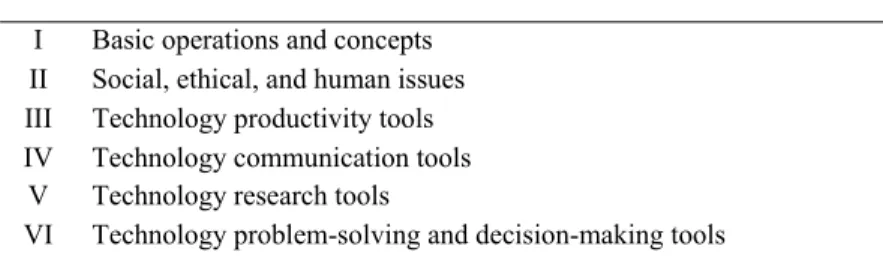
• S defines what students should do for the use of educational technologies. While A and NETS-T constitute a common group of standards for administrators and teachers respectively, NENETS-TS-S, as a group of standards for students, is different. The reason for this difference is that NETS-S includes various standards from those of pre-school period called P-12 to those of high school 12th grade. Students in this group fall into 4 different categories with respect to their development levels. According to this, the standards were determined. It was also taken into consideration that pre-school students and high school students are not at the same level in terms of educational technology use. These four categories comprise the standards for the pre-school and 1st grade students (Grades PreK – 2), the standards for the 3rd and 5th grade students (Grades 3 – 5), the standards for the 6th and 8th grade students (Grades 6 – 8), and finally, the standards for the 9th and 12th grade students (Grades 9-12) (Çoklar & Kuzu, 2006). Moreover, considering all the categories of NETS-S, it is seen that the proficiencies that students are supposed to consist 6 dimensions (NETS, 2007). These dimensions are shown in Table 1.
Tablo 1. NETS*S Standards I Basic operations and concepts
II Social, ethical, and human issues III Technology productivity tools IV Technology communication tools
V Technology research tools
In spite of the fact that there are no standards on use of educational technology for students in Turkey yet, students use technology in education system intensely. In this context, evaluating the technology use of students according to NETS*S standards which are well accepted throughout the world and emphasizes on both technical and social domains is main focus of this study.
2. METHOD
This study aims at revealing the overall state of students in terms of educational technology standards. The survey method was applied in this study to collect the research data. In line with the sub-goals, both singular and correlational survey models were employed. For the analysis of the data, SPSS 15.0 was run, and the significance level was taken as .05.
2.1 Purpose
This study was carried out on students who just started their university education in Anadolu University in Turkey. The study investigates the general conditions of these students focusing on their skills related to educational technology standards. For this purpose, the present study tries to find answers to the following questions.
1. What are the general conditions of students with respect to educational technology standards? 2. Is there a significant difference between the students’ level of educational technology standards and;
a.their gender?
b.whether the students have a computer where they accommodate or not? c.whether the students have internet connection where they accommodate or not? d.the education level of their mother?
e.the education level of their father?
2.2. Limitations
This study is limited to;
• the first grade students of Education Faculty, Anadolu University, 2006-2007 academic year • NETS*S standards (the educational technology standards for students).
2.3. Participants
The study was conducted at Anadolu University, which admits students from different cities all through Turkey according to their scores of the university entrance exam and according to their K-12 school types. The study was carried out on 293 first grade students attending 9 teacher training programs of the Education Faculty of Anadolu University in the academic year of 2006-2007 as the Department of Computer and Educational Technologies, the Department of Primary-School Education, the Department of Special Education, and the Department of Foreign Languages. Seven students were excluded from the study as they did not respond to the data collection tool as required. Because NETS*S standards are for K-12 and because the students had just graduated from K-12, the study covered only the first grade students. The demographic background of the participants can be seen in Table 2.
Table 2. Demographic Background of the Participants
Frequency Percentage (%) Gender Male 101 35.3 Female 185 64.7 Total 286 Computer Yes 128 44.8 No 158 55.2 Total 286
Internet Connection Yes 98 34.3
No 186 65.0
Total* 284
Mother’s Education Level Not a diploma and Primary School Education 182 63.6
High School 73 25.5
2-year/4-year University Level Education and Master’s Degree/Doctorate
29 10.1
2-year/4-year University Level Education and
Master’s Degree/Doctorate 57 19.9
Total* 284
(*) Non-responded data not included
2.4. Data Collection Tool
The data collection tool of the study was developed by the researchers considering the NETS*S standards and the current education programs in Turkey. The data collection tool developed was made up of two parts. The first part of the tool included statements about personal information, and the second part comprised statements about educational technology standards. The statements about educational technology standards were prepared as 5-item likert type like “Never”, “Rarely”, “Sometimes”, “Often”, “Very Often.”
In the process of developing the data collection tool prepared on the basis of NETS*S standards, the researchers first prepared items as a rough draft and gathered them all in an item pool. A total of 33 items gathered in the item pool were sent to 5 experts, 4 of whom were expert in the field of Educational Technologies and 1 of whom was expert in the field of Education Programs and Teaching. Following the expert-feedback process, 5 items were excluded from the data collection tool, and some of the items were changed. Thus, the final version of the data collection tool included 28 items. Following its application, the reliability coefficient (Cronbach Alpha) of the data collection tool was calculated as α=0.93.
3. FINDINGS AND INTERPRETATIONS
This part of the study presents and interprets the findings about students’ levels of educational technology standards as well as about the sub-dimensions of these standards. Furthermore, there are also findings presented and interpreted in this past regarding whether students’ levels of educational technology standards differ according to their gender, according to whether they have a computer and internet connection where they accommodate, and according to education level of their parents.
3.1. The Conditions of Students in Terms of Educational Technology Standards
In order to reveal the overall conditions of the students in terms of educational technology standards, the results obtained from the five-item likert-type questionnaire were examined for their evaluation criteria. The evaluation criteria were calculated with the formula of (n-1/n)*number of items, n=5 for the five-item likert-type. The analyses were carried out considering the number of the items separately for each sub-dimension. The evaluation criteria for each dimension can be seen in Table 3.
Table 3. Evaluation Criteria
Evaluation Criteria Overall
Χ
NETS*S I-IIΧ
NETS*S III-IV-V-VIΧ
Never 28.0 – 50.4 6.0 – 10.8 4.0 – 7.2
Rarely 50.5 – 72.9 10.9 – 15.7 7.3 – 10.5
Sometimes 73.0 – 95.4 15.8 – 20.6 10.6 – 13.8
Often 95.5 – 117.9 20.7 – 25.5 13.9 – 17.1
Very Often 118.0 – 140.0 25.6 – 30.0 17.2 – 20.0
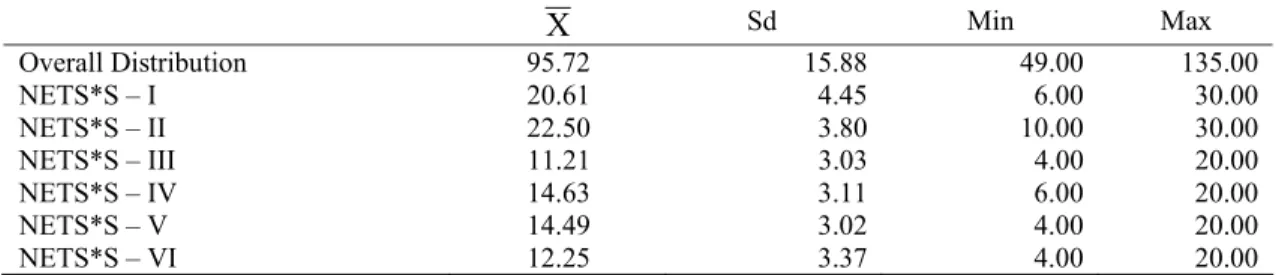
Based on the total scores obtained from the 28-item data collection tool for educational technology standards, the overall mean score of the 286 students was found 95.72 (Table 4). The data collection tool produces a score of at least 28 and at most 140. Examining the difference between the scores, as shown in Table 3, it is seen that according to the mean of the scores of the educational technology standards, the students generally met the educational technology standards and had an overall skill above the average level.
Table 4. Overall Distribution of the Participants Regarding NETS*S
Χ
Sd Min Max Overall Distribution 95.72 15.88 49.00 135.00 NETS*S – I 20.61 4.45 6.00 30.00 NETS*S – II 22.50 3.80 10.00 30.00 NETS*S – III 11.21 3.03 4.00 20.00 NETS*S – IV 14.63 3.11 6.00 20.00 NETS*S – V 14.49 3.02 4.00 20.00 NETS*S – VI 12.25 3.37 4.00 20.00Table 4 presents the overall situation in terms of the sub-dimensions of the NETS*S standards. According to the table, it is seen that the students had an average level with respect to the sub-dimensions of “Basic operations and concepts”, “Technology productivity tools” and “Technology problem-solving and decision-making tools” and had a good level with respect to the other sub-dimensions of “Social, ethical, and human issues”, “Technology communication tools” and “Technology research tools.”
Taking these results into consideration, it is seen that according to the sub-dimension of “Basic operation and concepts,” the students were in a better condition in terms of such skills as the general use of technological devices and the use of technological devices appropriate to their specific purposes like the preparation of projects/papers than they were in terms of overcoming the problems encountered while using the technological devices. On the other hand, the current situation revealed, does not reflect the expectations of the researchers regarding this sub-dimension because education in Turkey mostly depends on technological information and skills. This situation means that education in Turkey does not fully achieve its goal.
For the sub-dimension of “Social, ethical, and human issues,” the students were found to be good at their skills in respecting social, ethical and cultural values for the use of technological devices and in paying attention to ethical issues while getting information with the help of technological devices. Regarding this sub-dimension, it was found that the students paid enough attention to social and ethical issues and that they did not pay as much attention to the health issues (sitting position, eye health, etc).
For the sub-dimension of “Technology productivity tools,” the students had average-level skills in terms of the use of technological devices for increasing creativity and for supporting learning. Within this sub-dimension, it was seen that the students had lower-level skills in publishing the papers they prepared (web, internet, CD, etc.) than they did in other issues.
When the sub-dimension of “Technology communication tools” is considered, it is seen that the students used e-mail services and chat-software programs well enough to communicate and share information with their friends, teachers and other people. On the other hand, in this sub-dimension, the students had the lowest skill-level in using technological devices for group-works.
Regarding the sub-dimension of “Technology research tools,” the students were found to prefer to use search engines for accessing to information on the internet than to benefit from such services as magazine, book, e-library and Wap. For the presentation of the projects prepared, it was revealed that the students had lower skill-level in their use of technology.
As for the sub-dimension of “Technology problem-solving and decision-making tools,” it was found out that the students used technological devices mostly for analyzing the information they obtained and for having a different perspective. However, the students had lower skill-level in using technological devices for overcoming the problems they experienced in their daily lives.
3.2. Findings Related to the Relationship between Students’ Levels of Educational Technology Standards and Their Gender
The findings related to whether there was a significant difference between the students’ gender and their scores regarding the educational technology standards are presented in Table 5.
Table 5. t-Test Results Related to the Students’ Gender and Their Educational Technology Standards
Gender N
Χ
Sd df t pMale 101 97.05 17.11 284 1.051 .294
Female 185 94.99 15.16
As can be seen in Table 5, the students’ levels of educational technology standards do not differ with respect to their gender [t(284)=1.051, p>.05]. The male students’ levels of educational technology standards (Χ=97.05) do not statistically differ from the female students’ levels of educational technology standards (Χ=94.99). Based on this finding, it could be stated that the educational technology standard levels are the same for either gender.
3.3. Findings Related to the Relationship between Students’ Levels of Educational Technology Standards and Their Having a Computer and Internet Connection Where They Accommodate
Supposing that the educational technology standard level of students is influenced by their having a computer and internet connection in their accommodation places, the data obtained were analyzed in terms of these two variables. The findings are as follows:
Findings Related to the Relationship between Students’ Levels of Educational Technology Standards and Their Having aComputer Where They Accommodate
Table 6 presents the findings regarding whether there was a significant difference between the students’ scores of educational technology standards and their having acomputer where they accommodate. The findings are presented in Table 6 below.
Table 6. t-Test Results Related to the Students’ Educational Technology Standards and Their Having a Computer Where They Accommodate
Computer N
Χ
Sd df t pYes 128 100.13 15.32 284 4.357 .000
No 158 92.15 15.46
When Table 6 is examined, it is seen that there is a significant difference between students’ levels of educational technology standards and their having a computer where they accommodate [t(284)=4.357, p<.05]. The educational technology standard levels of students who had a computer in their accommodation places (
X
=100.13) significantly differ from the educational technology standard levels of those who did not have a computer in their accommodation places (X
=92.15). This finding reveals that having a computer in students’ accommodation places is of great significance in terms of their levels of educational technology standards. Thus, it could be said that being able to use a computer at any time rather than using it only at school plays an important role in the development of the skills for educational technology standards.Findings Related to the Relationship between Students’ Levels of Educational Technology Standards and Their HavingInternet Connection Where They Accommodate
Table 7 shows the findings regarding the relationship between the students’ scores of educational technology standards and their having internet connection where they accommodate.
Table 7. t-Test Results Related to the Students’ Educational Technology Standards and Their Having Internet Connection Where They Accommodate
Internet
Connection N
Χ
Sd df t pYes 98 99.98 14.97 282 3.348 .001
No 186 93.47 15.89
Table 7 demonstrates that there is a significant difference between students’ levels of educational technology standards and their having internet connection in their accommodation places [t(282)=3.348, p<.05]. There is a significant difference between the educational technology standard levels of students who had internet connection in their accommodation places (
X
=99.98) and the educational technology standard levels of those who did not have internet connection in their accommodation places (X
=93.47). This finding reveals that it is important to have internet connection in the accommodation place for the educational technology standard level. It could be concluded that the internet should be considered as a tool for an access to information is of great significance in terms of the development of the skills in educational technology use.3.4. Findings Related to the Relationship between Students’ Levels of Educational Technology Standards and the Education Levels of Their Parents
The data were analyzed for the mother and the father separately in order to see whether there was a significant difference between the students’ scores of the educational technology standards and the education levels of their parents.
Findings Related to the Relationship between Students’ Levels of Educational Technology Standards and the Mother’s Education Level
The relationship between the mother’s education level and the students’ levels of educational technology standards is presented in Table 8 and Table 9.
Table 8. The Results of Descriptive Statistics Regarding the Students’ Educational Technology Standards and the Mother’s Education Level
Mother’s Education Level N
Χ
Sd Standard Error- Not a Diploma and Primary School Education 182 93.71 16.10 1.19
B- High School 73 98.65 14.55 1.70
- 2-year/4-year University Level Education and Master’s
Degree/Doctorate 29 101.00 16.36 3.03
Total 284 95.72 15.93 0.94
Table 9. The Results of Analysis of Variance Regarding the Students’ Educational Technology Standards and the Mother’s Education Level
The Source of Variation Sum of Squares df
Χ
F p Significant Difference Between Groups 2170.54 2 1085.27 4.375 .013 A-B, A-CWithin Groups 69699.58 281 248.04
Total 71870.12 283
When the Table 8 and the Table 9 are examined, it is seen that there was a statistically significant difference between students’ educational technology standards and the mother’s education level [F(2-281)=4.375, p<.05]. In other words, students’ levels of educational technology standards significantly change depending on the mother’s education level.
According to the results of the LSD test carried out to see which group caused the difference, it is seen that the educational technology standard skills of students whose mothers’ education levels were either “2-year/4-year University Level Education and Master’s Degree/Doctorate” (
X
=101.00) or “High School” (X
=98.65) were better than those whose mothers’ education levels were “Not a Diploma and Primary School Education” (X
=93.71). Considering the traditional Turkish family structure, this finding could be attributed to the significant role of a mother in the education of her children. Thus, it can be noted that as the education level of the mother increases, so do children’s skills in technology use.Findings Related to the Relationship between Students’ Levels of Educational Technology Standards and the Father’s Education Level
The relationship between the father’s education level and the students’ levels of educational technology standards was examined, and the findings are presented in Table 10 and Table 11.
Table 10. The Results of Descriptive Statistics Regarding the Students’ Educational Technology Standards and the Father’s Education Level
Father’s Education Level N
Χ
Sd Standard ErrorA-Not a Diploma and Primary School Education 131 93.61 15.70 1.37
B-High School 96 97.17 15.69 1.60
C-2-year/4-year University Level Education and Master’s
Degree/Doctorate 57 98.33 16.33 2.16
Total 284 95.76 15.90 0.94
Table 11. The Results of Analysis of Variance Regarding the Students’ Educational Technology Standards and the Father’s Education Level
The Source of the Variance Sum of Squares df Mean Square F p
Significant Difference
Between Groups 1175.39 2 587.69 2.345 .098 -
Within Groups 70431.80 281 250.64
When the Table 10 and the Table 11 are examined, it is seen that there was not a statistically significant relationship between the students’ educational technology standards and the father’s education level [F(2-281)=2.345, p>.05]. In line with this finding, the students’ levels of educational technology standards do not change based on the father’s education level. Thus, considering this finding, it could be stated that the father’s education level does not influence children’s skills in educational technology use in contrast with the previous finding that the mother’s education level had an effect on children’s skills in educational technology use. In other words, this result shows that the father is not as effective as the mother in children’s education according to the structure of a traditional Turkish family.
4. CONCLUSION AND SUGGESTIONS
This study examines the overall conditions of students’ skills in educational technology standards. As a consequence of the research, the students who just started university in Turkey were found to meet the NETS*S standards and their skills were observed to be above average. In general, students recognize the basic operations and concepts related to education technologies, know about the benefits and limitations of technological devices, use technological devices successfully, take ethical issues into consideration while using technological devices, use technological devices to support their own learning and to develop themselves, prefer search engines to other sources while searching for information, make good use of technological devices to share information with other people, use technological devices to find any information they need for their research studies and analyze the information they get with the help of technological devices. On the other hand, it is seen that students are not proficient enough in technical issues, they do not pay enough attention to health issues, they are not much successful in carrying out cooperative-based learning activities in online environments, and that they do not often benefit from technological devices in overcoming the problems they experience in daily life. This situation demonstrates that the course of Computer and Technology Literacy that K-12 students have taken does not fully achieve its goals although the course predominantly covers basic skills. In addition, it was observed that students have problems in their skills regarding online education, which is a future concept of education.
When students’ skills regarding educational technology standards are taken into consideration, it is seen that no difference occurs with respect to gender; in other words, both male and female students have the same level of skills. On the other hand, it was found that being able to use a computer at any time develops students’ skills regarding educational technology standards. Furthermore, the internet was found to be another factor that helps develop these skills. One striking conclusion is that the education level of parents is important for the development of students’ skills regarding education technology standards. As the education level of the mother increases, children’s perspective into education technologies and their skills in using these technologies increase as well. However, the education level of the father does not do so. The influence of the education level of the mother on children’s skills reflects the significant role of the mother in the development and education of children as it is in a traditional Turkish family.
In order to help improve the skills of K-12 students regarding educational technology standards, first of all, certain subjects related to overcoming the problems that students may experience using technological devices should be included in the curriculum of education programs. Moreover, students should be provided with the opportunity to do practical applications regarding how to use education technologies in daily life and how to solve the problems they face. Students should be taught how they will make use of technology in their education process so as to search for the projects and papers they are assigned, to analyze the information they get and to interpret and report the results. Considering the fact that students had the lowest skill-level in using technological devices for the purpose of group work, online education should be introduced to students not at university level but rather at primary school level. Besides, there should be activities that will help students gain experience in working in groups and in searching and learning during online education. In this way, students will be more likely to become more successful and more conscious about online educational applications during their university education and their later life. Lastly, it should be kept in mind that not only using technology but also being close to it will improve the technology-related skills. Thus, students should be provided with the opportunity to live with computers and the internet. For this purpose, it is necessary that computers be used not only in computer courses but also in other courses or at least technology be inserted in lessons.
REFERENCES
Alkan, C. (2005). Eğitim teknolojisi (Yenilenmiş 7. Baskı). Ankara: Anı Yayıncılık,
Çoklar, N. & Kuzu. A. (2006). Öğretmenlerin teknolojiyi eğitimde kullanmalarına yönelik standart oluşturma çabaları: NETS. 6th International Educational Technology Conference, 19-21 Nisan 2006, Gazimağusa, KKTC.
Demirel, Ö., Seferoğlu S. & Yağcı E. (2003). Öğretim teknolojileri ve materyal geliştirme (4.baskı). Ankara: Pegem A Yayıncılık
Gülbahar, Y. (2005). Web-destekli öğretim ortamında bireysel tercihler. The Turkish Online Journal of Educational Technology, (4)2, Retrieved May 25, 2007, from http://www.tojet.net/articles/429.htm Hızal, A. (1993). Eğitim teknolojisi ders notları (Basılmamış Ders Notları). Eskişehir: Anadolu Üniversitesi,
Eğitim Fakültesi.
ISTE. (2007). International Society for Technology in Education. National educational technology standards for administrators, Retrieved May 15, 2007, from http://www.iste.org
İşman, A. (2005). Öğretim teknolojileri ve materyal geliştirme. Ankara: Pegem A Yayıncılık Karaağaçlı, M. (2004). Eğitimde teknoloji ve materyal. Ankara: Pelikan Yayıncılık
NETS. (2007). National educational technology standards, Retrieved March 15, 2007, from http://cnets.iste.org Stuve M. & Cassady J. (2005). A factor analysis of the NETS performance profiles: Searching for constructs of
self-concept and technology professionalism. Journal of Technology and Teacher Education, 13(2), 303-324.
UNESCO (2002). Information and communication technologies in teacher education: A planning guide. France: Division of Higher Education.