MARIO MALCANGI
Universita' degli Studi di Milano - Department of Computer Science, Italy
SMARTWEATHER: A MULTIDISCIPLINARY PROJECT FOR
SCIENTIFIC AND TECHNICAL HIGH SCHOOLS
Abstract:
SmartWeather is a driver project intended to integrate the multidisciplinary knowledge target to scientific and technical high schools, so that a systemic approach to learning can be applied. The project is based on a three-layer cultural model, with physics at the top as a foundation for measurements and observation, followed by other scientific and technical disciplines that develop methods and, ultimately, humanistic and linguistic disciplines to integrate technical and scientific knowledge. SmartWeather is a web-based meteorological station that uses measurement and observation information for short-time weather forecasting with a language-reasoning model to make forecast decisions. The project ran for 4 months, from January to April 2014, a prototype of the weather station has been released and presented at a special initiative (UniMi-Under18) promoted by the Università degli Studi di Milano on May 2014, where the students experienced the presentation of the project results to public.
Keywords:
1. Premises
Making science relevant to the life of students is a way science courses can capitalize the natural potential that is embedded in every human being, mainly when he is in the learning stage. Young children are able to explore complex tasks by observing and predicting the behavior of physical phenomena applying fuzzy-based reasoning paradigms to model the natural world. This ability is based also on knowledge integration, a powerful natural capability that young children apply when they are interrogating about the natural phenomena and try to interpret them. Some times this inference process can fail (e.g. when they see in a film the airscrew of an airplane to run in reverse, and they believe to be true), but an increase in knowledge integration leads to match the right solution.
Instruction, mainly in high school, is based on learning rather than understanding. Text reading, lectures listening, preassembled step-by-step investigation hides the potential curiosity and intuition capabilities of each student. This approach to teach science and technical subjects is not efficient because it short-cuts the natural ability of the teenagers to learn by intuition, observation, and knowledge integration. Linn and Eylon (2011) demonstrated that the absorption process generally fails because students learn very little from materials designed to transmit information. When absorption fails, more exciting elements are added to motivate students, but also this strategy is not adequate to help students to learn science (Linn & Eylon, 2011).
Combining disciplines on student’s learning is a way that demonstrated to be effective. Computational science, the combination of science and applied mathematics, can lead to meaningful learning (Taub, 2014) and causes the emerging of knowledge integration process. Technology and its innovative uses is the medium leading to knowledge integration (Linn & Eylon, 2011).
2. Three-layer cultural model
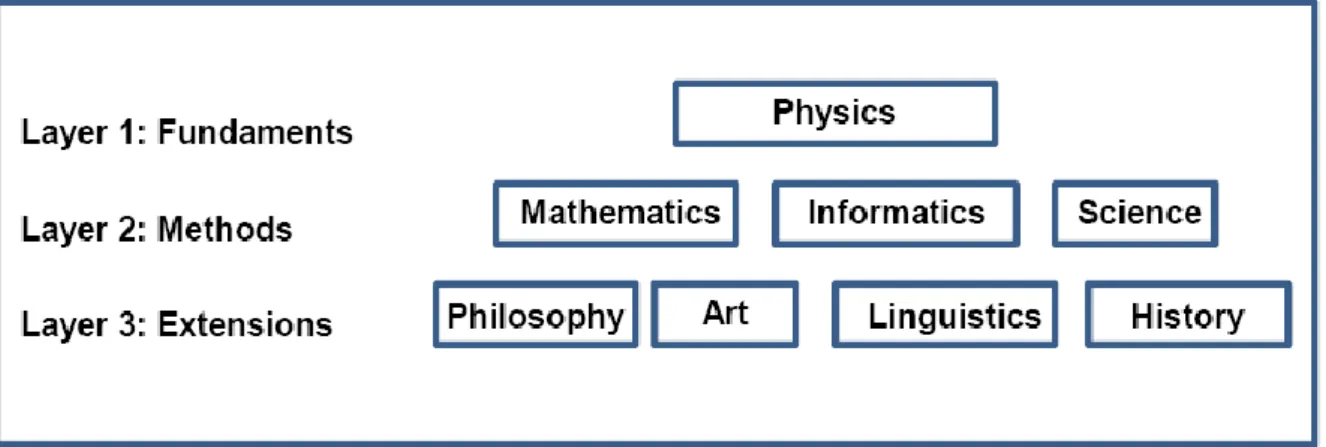
A three-layer cultural model has been proposed (Figure 1). The purpose of this model is to lead students to integrate their knowledge, starting from physical measurements and observations, and then applying known methods to execute the humanistic and linguistic extensions.
Figure 1. Three-layer cultural model for scientific and technical learning.
Physics is at the top as a foundation for measurement and observation, followed by scientific and technical disciplines to establish methods and, ultimately, humanistic and linguistic disciplines to integrate technical and scientific knowledge.
Computational science is applied to enable the construction of computational models, combining applied mathematics and informatics. This will enable to the student to acquire the knowledge and the strategies to understand and learn physics and how it is related to the other subjects of the study curricula.
Physics foundations are the starting point for measurement and observation abilities. Methods such as mathematics and informatics play the role of knowledge integrators and at the same time the way to make evidence of the measurements and observations. The cultural extensions complete the knowledge integration and enhance the student’s ability to observe and predict the physical phenomena using fuzzy-based reasoning paradigms to model the natural world.
3. Reference project
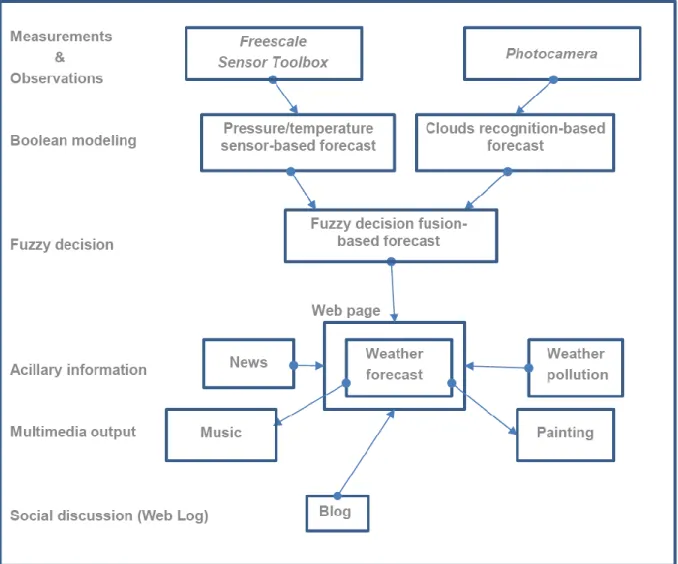
The reference project (Figure 2) has been designed to implement the three-layer cultural model based on measurements and observations in the physics domain. The weather-forecast process has been chosen to this purpose because its multicultural implications, such as measurements, observations, prediction, etc.
Figure 2. Reference project framework
The reference project is based on a web-page hosting the weather-forecast application. The weather-forecast application combines Boolean computing with fuzzy inference. Ancillary information such as weather history, pollution, Boolean logic (Aristotelian) vs. Fuzzy logic (Buddhist), etc. Multimedia output includes weather forecasts with music and/or images (paintings). A discussion log focuses on weather topics.
This reference project has been designed so that all the three layers of the cultural model are involved during the target application development. Physics foundations are applied first for measurement and observation applied to the real world, then mathematical methods are applied for extracting feature information. Boolean logic-based algorithms are modelled applying informatics methods (logic programming). Fuzzy logic-like inference methods are applied to enable the connection between the natural reasoning model of the student and the artificial reasoning model of mathematics, informatics, and science.
The integration of physics, mathematics and informatics knowledge defines the context of computational science. This integration leads the student to understand
physics better because, for example, when he have to define a programming variable he needs to be aware of the related knowledge of physics or mathematics, improving and making effective his knowledge.
The technology plays a fundamental role in powering this educational framework because make available a set of tools that accelerates the development process and enables the knowledge integration. For example, off the shelf sensor technology (toolbox, sensor hubs, etc.) puts the analog information at desktop level as plug-and-play, and the point and click web development tools enable the integration of heterogenic information on a web page.
Ancillary information contribute to knowledge integration because it is the way to understand how the physical world can be modelled by means of linguistic and philosophic reasoning methods and how the information can be carried on different media.
4. Case history
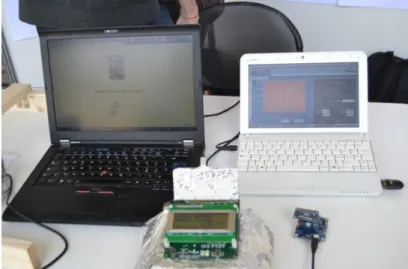
SmartWeather project ran in a third-year high school class. Two classrooms of students was involved in the project development, organized in groups, one for each subproject. Each group has been aggregated by subject competence, so that at least one student acted as “expert” of a specific topic. The project ran for 4 months, from January to April 2014. A first prototype of the weather forecast system (Fig. 3) has been released and presented at a special initiative (UniMi-Under18) promoted by the Università degli Studi di Milano on May 2014, where also other high and middle schools presented educational projects supported by the university. During this event the students experienced also the presentation of the project results to public.
Figure 3. Embedded weather forecast station: prototype of the SmartWeather forecast system with the web page (up left), Freescale Semiconductor barometric pressure sensor toolbox (up right), Freescale Semiconductor APEX sensor board (bottom left), and Freescale Semiconductor MPL3115A2 barometric pressure sensor (bottom right).
5. Discussion and conclusions
SmartWeather, a driver project for scientific and technical high schools, has been designed to stimulate the integration of the knowledge taught in so that a systemic approach to learning can be applied. The proposed three-layer cultural model, with physics at the top as a foundation for measurement and observation, demonstrated to be a valid framework to stimulate knowledge integration and the computational science approach to learning.
Acknowledgments
Acknowledgements: the SmartWeather project is running in the third-year high school class at Liceo Scientifico Maria Ausiliatrice in Milan, Italy. The author thanks Prof. Irene Poli and Prof. Sara Furcas who have applied this project in their physics laboratory. Thanks also go to students who have participated in developing the project, each applying her or his specific skill and working in various task-oriented groups.
A special acknowledgment is due to Freescale Semiconductor for technology support with MEMS sensors and related high-level software toolkits.
The SmartWeather project is part of the UniMI Under-18, an initiative of Università degli Studi di Milano.
References
ACM/IEEE. (2008) Computer Science Curriculum 2008: An Interim Revision of CS 2001 Kali, Y., Orion, N., & Eylon, B.-S. (2003). Effect of knowledge integration activities on students' perception of the earth's crust as a cyclic system. Journal of Research in Science Teaching, 40(6), 545-565
Linn, M. C., & Eylon, B.S. (2011). Science learning and instruction: taking advantage of technology to promote knowledge integration. New York: Routledge
Liu, O. L., Lee, H.-S., Hofstetter, C., & Linn, M. C. (2008). Assessing Knowledge Integration in Science: Construct, Measures, and Evidence. Educational Assessment, 13(1), 33-55
Perkins, D. (1993) Teaching for understanding. American Educator, 17(3), 28-35
Taub, R., Armoni, M., Ben-Ari, M.M. (2014). The Effect of Computer and Active Simulation Design on Physics Learning. Proceedings of the 9th Chais Conference for the Study of Innovations and Learning Technologies: Learning in the Technological Era, 94-99
Yerushalmi, E., Puterkovsky, M., & Bagno, E. (2012). Knowledge Integration While Interacting with an Online Troubleshooting Activity. Journal of Science Education and Technology, 1-12