DEVELOPING A PERFORMANCE
MEASUREMENT FRAMEWORK FOR
MUNICIPAL CONSTRUCTION PROJECTS IN
SAUDI ARABIA
By
SALEH ALSULAMY
A thesis submitted in partial fulfilment of the
requirements of Edinburgh Napier University,
for the award of Doctor of Philosophy
DECLARATION
This is to certify that I am responsible for the work submitted in this thesis, that no portion of the work referred to in the thesis has been submitted in support of an application for another degree or qualification of this or any other university or other institute of learning Signature: ……….
DEDICATION
This thesis is dedicated to:
My spirit (My Father) may Allah have mercy on him
My head crown (My mother)
My love (My Wife)
My heart (My Children):
Ammar, Marwan, Iyah, and Hisham
My Brothers and Sisters:
Saleha, Jameelah, Nouf, Naif, Aisha, Fatimah, Majid, Anwar, Munira, Nihal, Anwaar, Tamadhor and Faisal
My Close friend:
Abdullah Alhawati
ABSTRACT
Performance measurement has the main aim of helping organizations to realize how decision-making processes can be harnessed to improve success rate in past activities and how the understanding from the current and past can lead to future improvements. Specifically, a comprehensive performance measurement practise must enhance the achievement of the key aim of the project stakeholders, the objectives of the project itself, and the needs of the users all of which should be capable of being represented in raw data to be manipulated and measured by a performance measurement tool. The performance of a project is directly related to its potential for success, and on the other hand, the CSFs of a project have a direct bearing on the project’s performance. In essence, the efficiency and effectiveness measures of a project are essential yardsticks for assessing project performance and success.
The stakeholders in a project have needs and expectations which the project is being conceived to satisfy, therefore, these needs and expectations must be held paramount during the conceptual design, development execution, and operation stages of a project. This is applicable to the general construction industry and in particular, in construction projects implemented by municipal organisations. However, municipal construction project have been fraught with delays, cost overruns and failure in operational performance. Hence, the overall aim of this research is to develop a framework within which municipal construction project performance can be measured in the SA at any stage of the project, and specifically to increase its effectiveness and efficiency of the project in order to improve the project’s performance to the satisfaction of stakeholders.
This study was implemented through the administration of a questionnaire survey based on a hypothesis that requires the identification of the challenges and obstacles that are facing the implementation of municipal construction project in SA. The collected data is based on responses from three major organisations; government, contractors and consultants that are involved in the delivery of municipal construction projects in SA. Mean and analysis of variance (ANOVA statistic) was used to manipulate the data from the questionnaire within the SPSS v.20 software environment. The resulting framework was subjected to a validation procedure which involved a structured interview process based on a focus group consisting of experts that were specially selected for the purpose establishing the extent to which the framework is practical, clear, applicable and
comprehensive. Also, the focus group was used to determine the significance of the CSFs, PMs, and success (efficiency and effectiveness) measures.
Overall, this study found that a total absence of performance measurement concept process permeates the management of construction projects in SA and in the municipality construction projects in particular. To close this gap, this study was embarked upon to investigate and identify the various performance measurement approaches and frameworks that are used to support the guidance of project performance toward success. Notably, this study emphasises the importance of stakeholder needs and expectation forming the bases of municipality construction projects in SA. Specifically, this study suggests that the measurement of project performance in municipality construction projects in SA should be integrated in a holistic framework containing several elements that will help to guide construction projects toward success.
PUBLICATIONS ARISING
09/2012 Alsulamy, S., Wamuziri, S., & Taylor, M. (2012). A Conceptual Evaluation of Benchmarking for Performance Measurement in Construction Projects Saudi Arabia. IFME 2012 Exhibition. Helsinki. 06/2012 Alsulamy, S; Wamuziri, S and Taylor, M (2012) Evaluation of key metrics for measurement of project performance In: Smith, S.D (Ed) Procs 28th Annual ARCOM Conference, 3-5 September 2012, Edinburgh, UK, Association of Researchers in Construction Management, 1101-1110.
01/2014 Alsulamy S; Gupta N K; Sloan B. (2014) Factors influencing municipal construction project performance. Proceedings of the ICE - Municipal Engineer, Volume 167, Issue 2, pp 108-117, January 2014/
03/2014 Alsulamy S; Gupta N K; Sloan B and Wamuziri S. (2014). Identification of Performance Measures for Municipal Construction Projects in Saudi Arabia. Int. J. of Civil and Environmental Engineering, Volume 36, Issue 1, pp 1192-120, March 2014.
2014-In Press
Alsulamy S; Gupta N K; Sloan B and Wamuziri S. (2014). A Novel Model for Measuring Performance of Municipal Construction Projects in Saudi Arabia. Int. J. of Project Management
ACKNOWLEDGEMENTS
In the name of Allah, the Most Merciful and the Most Gracious, I give praise and thanks to Him for giving me the strength to complete this research. This successful achievement could not have been without blessing from Allah Almighty and support from my family and their patience. Hence, my special and very grateful thanks must go to my father. I pray to Allah and thank him, for cultivating in me the spirit of appreciation of the high value of education, and dear mother for giving me pray and to patient for I have been far away from her during my studies.
I especially want to express sincere thanks to my beloved wife Ebtisam for her support, patience and smile during the long period of this thesis and to my lovely sons (Ammar, Marwan, Hisham) and princess daughter (Iyah) for their understanding of not spending enough time with them. Also, I wish to express my gratitude and deep appreciation to my brothers and sisters for their constant motivation.
Also, I wish to express my sincere thanks and gratitude to my, supervisors Professor Naren Gupta and Professor Brian Sloan for their continued guidance, advice, support, encouragement and help to introduce this thesis. I am also grateful to my previous supervisor Professor Sam Wamuziri, who left Edinburgh Napier University for his valuable support and contributions to this research. As well as, a grateful thanks to Professor Robert Raeside for his support to do SPSS analysis.
I would like to thank all those who assisted me in the completion of this thesis, and grateful to all the employees who answered the questionnaire.
Saleh Alsulamy
16/09/14TABLE OF CONTENTS DECLARATION ... I DEDICATION ... II ABSTRACT ... III PUBLICATIONS ARISING ... V ACKNOWLEDGEMENTS ... VI TABLE OF CONTENTS ... VII
FIGURES ... xiii
TABLES ... xv
LIST OF ABBREVIATIONS ... xvii
1. CHAPTER ONE: BACKGROUND TO THE RESEARCH ... 1
1.1 Introduction ... 1
1.2 Statement of the problem ... 2
1.3 Research Aims and Objectives. ... 3
1.3.1 Aim ... 3
1.3.2 Objectives ... 3
1.4 Focus of the Research ... 4
1.5 Research Questions ... 5
1.6 Research Design ... 5
1.7 Outline of the research ... 8
2. CHAPTER TWO: PERFORMANCE MEASUREMENT SYSTEM KNOWLEDGE ... 11
2.1 Introduction ... 11
2.2 Historical Context of Performance Measurement Systems ... 11
2.3 Definition of Performance Measurement ... 12
2.4 Purpose of Performance Measurement ... 13
2.5 Barriers of Performance Measurement ... 15
2.6 Process of Performance Measurement ... 16
2.7 Models of Performance Measurement... 18
2.7.1 The Balanced Scorecard ... 18
2.7.2 European Foundation for Quality Management ... 21
2.7.3 Baldrige Criteria for Performance Excellence ... 22
2.8.1 Key Performance Indicators ... 23
2.8.2 Benchmarking ... 30
2.9 Conclusion ... 36
3. CHAPTER THREE: MUNICIPAL PERFORMANCE MEASUREMENT .... 38
3.1 Introduction ... 38
3.2 Application of Performance Measurement in Government ... 38
3.3 Types of Performance Measurement System in Government ... 39
3.4 Public Project Success Criteria ... 40
3.5 Experience of Municipalities in Performance Measurement ... 41
3.5.1 The Atlanta Dashboard ... 41
3.5.2 Performance Management Analysis for Dutch Municipality ... 42
3.5.3 Municipal Performance Measurement Program ... 42
3.5.4 Aims of Performance Measurement System for Municipalities ... 43
3.6 Critical Aspect for Structuring Performance Measurement System ... 46
3.7 Participation of Citizens in Performance Measurement System ... 47
3.8 Conclusions ... 48
4. CHAPTER FOUR: ASSESSING CONSTRUCTION PROJECT PERFORMANCE ... 49
4.1 Introduction ... 49
4.2 Performance Measurement in Construction Industry ... 49
4.3 Construction Performance Measurement Approaches ... 51
4.4 Measuring Municipal Construction Project Performance ... 54
4.5 Key Processes and Requirements for Performance Measurement ... 56
4.6 Barriers in Construction Industry Performance Measurement ... 60
4.7 Construction Project Performance Success and Project Success ... 61
4.8 Construction Project Performance Success Components ... 63
4.8.1 Role of Drivers Success and Success Measures ... 63
4.8.2 Critical Success Factors ... 64
4.8.3 Project Performance Measures ... 66
4.8.4 Project Success Measures ... 67
4.9 Main Construction Project Stages ... 71
5. CHAPTER FIVE: CURRENT CONSTRUCTION PRACTICE IN SAUDI
ARABIA ... 75
5.1 Introduction ... 75
5.2 Saudi Arabian Economy ... 76
5.3 Saudi Construction Industry ... 76
5.3.1 Saudi Construction Projects Value ... 77
5.3.2 Procurement System for Municipal Construction Project ... 78
5.3.3 Weakness Aspects in Saudi Construction Market ... 80
5.4 Conclusion ... 83
6. CHAPTER SIX: RESEARCH METHODS FOR STUDY ... 84
6.1 Introduction ... 84 6.2 Research philosophy ... 84 6.2.1 Ontology ... 85 6.2.2 Epistemology ... 86 6.3 Research Paradigms ... 86 6.3.1 Positivism ... 86 6.3.2 Interpretivism ... 87
6.3.3 Epistemological Orientation of the Current Research ... 88
6.4 Research Logic ... 90 6.4.1 Deductive Approach... 91 6.4.2 Inductive Approach ... 91 6.4.3 Research theory ... 93 6.4.4 Research Hypotheses ... 94 6.5 Research Approaches ... 95 6.5.1 Quantitative Approaches ... 95 6.5.2 Qualitative Approaches ... 96 6.6 Research Strategy ... 96
6.7 Data Collection Methods ... 98
6.7.1 Questionnaires Survey ... 99
6.7.2 Interviews Survey... 101
6.8 Data Analysis Procedure ... 103
6.8.1 Descriptive Statistics ... 104
6.8.2 Inferential Statistics ... 104
6.10 Research Procedure ... 107
6.10.1 Research Stage I: Review of Literature ... 107
6.10.2 Research Stage II: Preliminary Data Collection and Pilot Study ... 108
6.10.3 Research Stage III: Data Collection (Questionnaires) ... 111
6.10.4 Research Stage IV: Data Analysis ... 112
6.10.5 Research Stage V: Development, Validation and Recommendations .... 113
6.11 Data Collection Techniques ... 115
6.11.1 Sample Size ... 115
6.11.2 Parameters ... 117
6.11.3 Questionnaires Distribution Procedure ... 117
6.12 Result of Pilot Study ... 118
6.13 Analysis Methods and Instruments ... 119
6.13.1 Approaches to Analysis... 119
6.13.2 Validation of Research Hypothesis ... 120
6.13.3 Comparison of Mean ... 121
6.13.4 Analysis of Variance ... 122
6.13.5 Factor Analysis ... 123
6.13.6 Content analysis of Interview Analysis... 125
6.14 Analysis of Respondents’ Characteristics ... 126
6.14.1 Analysis of Response Rate ... 126
6.15 Interview Approaches (Focus Group) for Framework Validation ... 131
6.16 Conclusions ... 132
7. CHAPTER SEVEN: ANALYSIS OF FINDINGS ... 133
7.1 Introduction ... 133
7.2 Assessing Reliability of Respondents’ Answers ... 133
7.3 Test of Research Hypotheses ... 134
7.3.1 Analysis of Obstacles and Barriers Affecting Performance ... 137
7.3.2 Hypothesis Testing for H1 to H5 ... 142
7.3.3 Discussion of Hypothesis Testing Result for H1 to H5 ... 142
7.3.4 Hypothesis Testing for H6 ... 145
7.4 Analysis and Ranking of Variables ... 152
7.4.1 Measurement Components Process: ... 152
7.4.2 Critical Success Factors at Project Stages ... 153
7.4.4 Project Success Measures ... 173
7.5 Factor Analysis Approach Result ... 179
7.5.1 Success Factors ... 180
7.5.2 Project Performance Measures ... 188
7.5.3 Efficiency and Effectiveness Measures ... 196
7.6 Conclusion ... 199
8. CHAPTER EIGHT: INTERPRETATIONS AND DISCUSSIONS ... 200
8.1 Introduction ... 200
8.2 Critical Evaluation of Performance Measurement System ... 200
8.3 Limitation of Current Performance Measurement Systems ... 202
8.4 The key Components of Successful Performance Measurement Framework 203 8.5 Construction Project Performance Success and Project Success ... 206
8.6 Critical Success Factors and Success Measures in Construction ... 208
8.6.1 Critical Success Factors ... 208
8.6.2 Performance Measures ... 208
8.6.3 Success Measures (Efficiency and Effectiveness) ... 209
8.7 Extraction Criteria for the Variables in the Developed Framework ... 209
8.7.1 Factors Influencing Municipal Construction Projects Performance ... 210
8.7.2 Project Performance Measures ... 217
8.7.3 Project Success Measures ... 222
8.8 Conclusion ... 225
9. CHAPTER NINE: PROPOSED FRAMEWORK AND VALIDATION ... 227
9.1 Introduction ... 227
9.2 Framework Design and Development Principles ... 228
9.3 Framework Purpose ... 231
9.3.1 Performance measurement system in the developed countries ... 231
9.3.2 Current practice in municipalities organisations in SA... 231
9.4 Benefits of the Model ... 231
9.5 Framework Structure and Components ... 232
9.5.1 The Process of Construction Project Activities Management... 233
9.5.2 Measurement Process and Tool ... 237
9.6 Framework Validation ... 242
9.6.1 Validation aim and Objectives ... 242
9.6.3 Validation Interview Questions Design ... 244
9.6.4 Characteristics of Experts Participants... 246
9.6.5 Analysis of Validation Data ... 248
9.6.6 Suggestions to improve the framework... 256
10. CHAPTER TEN: CONCLUSION AND RECOMMENDATIONS ... 258
10.1 Introduction ... 258
10.2 Summary of the Research Process ... 258
10.2.1 Objectives ... 260
10.3 Achievement of Research Aim and Objectives ... 261
10.3.1 Literature Review Findings ... 261
10.3.2 Preliminary Data (Telephone Interview) ... 262
10.3.3 Main Survey Data (Questionnaire) ... 263
10.3.4 Framework Development and Validation ... 263
10.4 Contributions of the research and findings to knowledge ... 264
10.4.1 Overall knowledge ... 264
10.4.2 Contribution to the Saudi Municipal Construction Projects ... 265
10.5 Limitations of the research ... 265
10.6 Recommendations and future work ... 266
REFERENCES ... 268 Appendix 1 ... 289 Appendix 2 ... 292 Appendix 3 ... 295 Appendix 4 ... 296 Appendix 5 ... 297 Appendix 6 ... 300 Appendix 7 ... 301 Appendix 8 ... 310 Appendix 9 ... 315
FIGURES
Figure 1-1: Problem background ... 3
Figure 1-2: Research methodology diagram ... 8
Figure 2-1: Performance measurement and manager roles (Phusavat et al. 2009) ... 14
Figure 2-2: Translating vision and strategy (Kaplan & Norton, 2005) ... 19
Figure 2-3: The EFQM model (Beatham et al. 2004) ... 22
Figure 2-4: Malcolm Baldridge Criteria (Vokurka, 2001) ... 23
Figure 2-5: KPI development and implementation (Enoma & Allen, 2007) ... 25
Figure 2-6: Seven steps to implementation of KPIs (Ibrahim et al. 2010) ... 26
Figure 2-7: KPIs (Toor & Ogunlana, 2009) ... 27
Figure 2-8: Alignment of KPIs (Beatham et al. 2004) ... 29
Figure 2-9: Main elements of internal benchmarking (Mohamed, 1996) ... 32
Figure 2-10: The nine-step benchmarking process (Neely et al. 2005) ... 35
Figure 3-1: Efficiency and Effectiveness (Ghobadian & Ashworth, 1994) ... 40
Figure 3-2: Lelystad municipality Strategy (De Waal & Gerritsen, 2006) ... 42
Figure 3-3: Benefits of performance measurement (Housing, 2007). ... 44
Figure 5-1: Municipal construction procurement approach (Alsapan et al. 2012) ... 79
Figure 6-1: Research strategy philosophies and process (Alkraiji, 2011) ... 90
Figure 6-2: Deductive vs. Inductive Logic ... 91
Figure 6-3: Deductive approach procedure ... 93
Figure 6-4: Key Aspects of the Study ... 105
Figure 6-5: Study themes ... 105
Figure 6-6: Research process ... 107
Figure 6-7: Municipal construction procurement approach (Interview Result) ... 110
Figure 6-8: Research procedure (inputs, research methods, and outputs) ... 114
Figure 6-9: Organisation of Saudi municipalities ... 115
Figure 7-1: Reliability of respondents’ answers ... 134
Figure 7-2: Received training, experience and practiced in PMSs ... 146
Figure 7-3: Respondents’ perception for performance measurement processes... 152
Figure 7-4: Critical success factors of conceptual, planning and tender stage ... 155
Figure 7-5: Critical success factors of production stage ... 159
Figure 7-7: Performance measures of conceptual, planning and tendering stage... 165
Figure 7-8: Performance measures of production stage ... 169
Figure 7-9: Performance measures at operation stage ... 172
Figure 7-10: Efficiency measures at production stages ... 175
Figure 7-11: Effectiveness measures at operation stage ... 178
Figure 7-12: Scree plot of success factors at conceptual, planning and tender stage . 182 Figure 7-13: Scree plot of success factors at production stage ... 186
Figure 7-14: Scree plot of success factors at operation stage ... 188
Figure 7-15: Scree plot of PMs at conceptual, planning and tender stage ... 190
Figure 7-16: Scree plot of performance measures at production stage ... 194
Figure 7-17: Scree plot of performance measure at operation stage ... 196
Figure 7-18: Scree plot of efficiency measures at production stage ... 197
Figure 7-19: Scree plot of effectiveness measures at operation stage... 199
Figure 9-1: The gap between knowing and doing (Pfeffer & Sutton, 1999)... 229
Figure 9-2: Bridge the gap between current and desired practise ... 230
TABLES
Table 2-1: Founder and years designing KPIs (adapted) (Beatham et al. 2004)... 24
Table 5-1: Construction industry growth in SA (Research and Markets, 2011) ... 78
Table 5-2: Construction performance problems (Al-Hammad, 1995) ... 82
Table 5-3: Causes of failures in Saudi construction industry (Jadid, 2013) ... 83
Table 6-1: Telephone interview response result ... 109
Table 6-2: Samples size ... 116
Table 6-3: Pilot study respondents ... 119
Table 6-4: Response rate ... 126
Table 6-5: Analysis of job title ... 128
Table 6-6: Analysis of company size ... 129
Table 6-7: The mean of professional employees’ number ... 129
Table 6-8: Number of work experience in construction years ... 130
Table 6-9: Analysis of project types ... 131
Table 7-1: Assessing reliability of respondents’ answers ... 134
Table 7-2: Likert weighted ranking... 136
Table 7-3: Government respondents' perception of obstacles and barriers ... 137
Table 7-4: Contractors' perception of obstacles and barriers... 138
Table 7-5: Consultants' perception of obstacles and barriers ... 139
Table 7-6: Respondents' perception of obstacles and barriers ... 144
Table 7-7: Factor analysis of obstacles and barriers ... 145
Table 7-8: Received training, experience and practiced PMSs ... 146
Table 7-9: PMSs Known and Used ... 148
Table 7-10: Performance measures practiced and techniques ... 149
Table 7-11: Hypothesis acceptance result ... 151
Table 7-12: Respondents’ perception for performance measurement processes ... 152
Table 7-13: Critical success factors of conceptual, planning and tender stage ... 154
Table 7-14: Critical success factors of production stage ... 157
Table 7-15: Success factors of operation stage ... 161
Table 7-16: Performance measures of conceptual, planning and tendering stage ... 164
Table 7-17: Performance measures of production stage ... 167
Table 7-19: Efficiency performance measures at production stages ... 174
Table 7-20: Effectiveness measures at operation stage ... 177
Table 7-21: Analysis of success factors at conceptual, planning and tender stage ... 182
Table 7-22: Factor analysis of success factors at production stage ... 185
Table 7-23: Factor analysis of success factors at operation stage ... 187
Table 7-24: Performance measurement at conceptual, planning and tender stage ... 190
Table 7-25: Factor analysis of performance measure at production stage ... 193
Table 7-26: Factor analysis of performance measure at operation stage ... 195
Table 7-27: Factor analysis of efficiency measures at production stage ... 197
Table 7-28: Factor analysis of effectiveness measures at operation stage ... 198
Table 8-1: Likert weighted ranking... 210
Tables 8-2 presents the different factors from the statistical analysis of the research . 210 Table 8-3: Most significant CSFs (factor analysis integrated with mean result) ... 216
Table 8-4: Most significant PMs (factor analysis integrated with mean result) ... 221
Table 8-5: Most significant PSMs (factor analysis integrated with mean result) ... 225
Table 9-1: Personal background ... 248
Table 9-2: Framework acceptance and PMs ... 250
Table 9-3: The key participants and main stages in municipal construction project ... 250
Table 9-4: Result of Factor Analysis integrated with mean result for CSFs ... 252
Table 9-5: Result of Factor Analysis integrated with mean result for PMs ... 254
LIST OF ABBREVIATIONS
% of VA for of variance accounted for
Agr Agronomist
ANOVA Analysis of Variance
Arch Architect
BSC The Balanced Scorecard
CEng Civil Engineer
Cons Consultant
Cont Contractor
CPV Cumulative percentage variance CSFs Critical Success Factors
EEng Electrical Engineer
EFQM The European Foundation for Quality Management
Eig Eigenvalue
Eng Engineer
FL Factor loading
Gov Government
KMO Kaiser-Meyer-Olkin
KPIs Key Performance Indicators
SA Saudi Arabia
MBNQA Malcolm Baldrige National Quality Award
MEng Mechanical Engineer
MM Municipality Mayor
PD Projects Director
PM Performance Measurement
KPIs Key Performance Indicators
PM Project Manager
PMF Performance Measurement Framework
MPMP Municipal Performance Measurement Program
PMS Performance Measurement System
PoVE Percentage of variance explained
PMs Project Performance Measures
PSMs Project Success Measures
PWC Public Work Contract
QS Quantity Surveyor
SEng Site Engineer
"To measure is to know." Lord Kelvin
"You cannot measure what you do not define." (Fink, 2006)
“If you cannot measure it, you cannot manage it.” Peter Drucker
“If you cannot measure it, you cannot improve it.” Lord Kelvin
"If you don't measure results, you cannot tell success from failure" (evaluate); "If you cannot see success, you cannot reward it" (motivate); "If you cannot see success, you cannot learn from it" (lean best practise); "If you can demonstrate results, you can win
1.
CHAPTER ONE: BACKGROUND TO THE RESEARCH
1.1 Introduction
The construction industry plays a key role in the performance of all economic sectors. The Saudi Government has supported construction projects through substantial investment in infrastructure projects including roads, parks, buildings, road lighting, road slope protection, bridges, and irrigation (Abbas, 1998). The municipal ministry is charged with this responsibility and is a major stakeholder in the implementation and management of these projects. In response to significant pressure from high level authorities to deliver such projects to citizens, hundreds of these projects commence annually. However, a lack of experience, insufficiently skilled staff, routinely poor execution processes, and poor project management practices, such as monitoring, control, and performance measurement, have been major weaknesses within Saudi construction projects (Assaf, & Hejji, 2006; Sedairy, 2001; Sedairy, 1999; Khalil & Ghafly, 1999a; Al-Khalil & Al-Ghafly, 1999; Al-Hammad, 1995). In recent years, some studies have been conducted regarding this within the Saudi construction industry. However, research into municipal projects still remains a problem area with a dearth of research studies. Likely reasons for this lack of research may be due to insufficient specialists in municipal agencies. This is apparent through weak project performance and failure to achieve goals with respect to the basic success criteria which are; time, quality and target (Al-Nagadi, 2010; Al-Sedairy S. T., 2001).
So far, in SA, there has been little consideration given to applying PMSs in the construction sector (Ankrah & Proverbs, 2005). Despite the lack of interest in the application of PMSs in construction sector, the three basic criteria of time, cost, and quality can still be applied to determine the success of the project (Haponava & Al-Jibouri, 2010). However, ambiguity and weaknesses in the relationship between the owner and contractor of construction projects are still present and have not been investigated adequately (Löfgren & Eriksson, 2009). With regard to the practice of performance measurement in the government sector, it is apparent from previous research that the understanding of the concept of performance measurement is limited and not applied efficiently and properly (Bracegirdle, 2003). Bracegirdle suggested areas for further discussion, such as the actual returns that can be achieved for investing in
performance measurement. Latiffi et al (2009) recommended the examination of the relationship between organisations’ strategic development and performance measurement, as well as investigating criteria of measures selection.
Despite the limited number of studies conducted in the construction sector in SA (Alsuliman, Graeme & Chen, 2012), the research to date has tended to focus on the causes of various problems that face construction projects rather than implementing and assessing new methods to improve performance (Assaf, & Al-Hejji, 2006; Al-Sedairy S. T., 2001; Al-Sedairy S. t., 1999; Al-Khalil & Al-Ghafly, 1999a). Several reasons were being responsible for the poor performance of construction projects during their lifecycles (planning stage, execution stage, and operation stage). The most important factor was found to be the lack of a comprehensive performance framework for all phases of the project, as well as the absence of a strategic agenda for the construction sector in general. Thus, it is obvious from the above that there is an urgent need to develop a system through which to determine current performance, resolve problems and benchmark them against best practice in order to meet the expectations of stakeholders, municipalities, contractors and consultant. According to Kaplan & Norton (1996, p. 100), “if you can’t measure it, you can’t manage it”, as well as, “You cannot manage what you do not measure’’ (Fink, 2006, p. 85); consequently, you cannot measure what you do not define” (Fink, 2006), therefore, it will be necessary to include CSFs, PMs and PSMs, as well as a benchmarking system.
This study intends to investigate issues relating to the difficulties of project performance measurement and project performance improvement in SA and the benefits derived from best practices (as applied in developed countries) and their potential application in SA.
1.2 Statement of the problem
One of the most significant problems facing construction projects in developing countries is the lack of consideration and planning in the pre-implementation stage, as well as the failure of projects during their execution. As a result, the desired goals are neither achieved nor integrated with the general developmental or economic strategy of the country (Al-Hammad, 1995). Whilst there is also a lack of methods and mechanisms to monitor and control projects, as can be the case in developed countries, some research has been undertaken in developed countries regarding how to control and measure the
performance of construction projects in the public and private sectors (Haponava & Al-Jibouri, 2009; Ankrah & Proverbs, 2005; Beatham et al. 2004). It is essential, therefore, that these are investigated to select suitable methods and appropriate mechanisms that can be applied to address the poor performance of construction projects in SA. However, a new PMS is anticipated to address and remedy these issues involving institutional aims, plans, goals and strategies. Figure 1-1 shows the background of problem.
Figure 1-1: Problem background
1.3 Research Aims and Objectives. 1.3.1 Aim
The main aim of this research is the development of a framework to measure municipal construction project performance in Saudi Arabia at any stage of the project and, thus, enable its performance to be improved. In general, the study will concentrate on issues relevant to raising efficiency and effectiveness in project outcomes in municipalities in SA. To achieve this aim, there are several objectives that must be considered and investigated.
1.3.2 Objectives
In order to achieve the research aim, the following objectives were set:- National Planning and Income
Other Industries Weak and Unsatisfactory Municipal Construction Projects (Infrastructure Projects)
Inadequate planning and strategies
Municipal Construction Project
Citizens' Dissatisfaction (Unsatisfied life quality)
Poor projects awarding conditions
Poor skills, and unqualified managers and teamwork Weakness of the
regulations and instructions application Lack of standards, specification and data
Absence of performance measurement systems
- Review existing performance measurement framework being used in the construction industries and public authorities of the developed countries including the performance measurement process, project stages, project stakeholders, CSFs, and PMs and PSMs.
- Identify project stages, key participants and stakeholders involved in the delivery of municipal construction project and the relationship among them,
- Identify the procurement and execution procedures of construction projects in municipalities in SA;
- Examine the current process and approach to managing and measuring construction projects in municipalities in SA and problematic areas;
- Explore and determine the performance measurement process, CSFs, and PMs and PSMs in the implementation of municipal construction projects;
- Develop a practical and effective framework for evaluating municipal construction projects performance in SA;
- Evaluate and validate the proposed performance measurement framework through experts’ opinion and perceptions; and
- Conclude result of study and recommend further investigation in the field of construction projects performance measurement and other in relation.
1.4 Focus of the Research
The research scope of this study is limited to construction projects in municipalities in SA. However, this research will divide project performance into two key areas. The first area will focus on PMSs knowledge around the World, where the current models that are in use will be investigated to ascertain the extent to which they achieve their goals. In addition, relevant research studies in this area will be reviewed and analysed to explore the possibility of creating an improved method to measure municipal projects.
The second area concentrate on the current practise in municipalities in SA. Here, the current project execution approaches at all project stages will be identified. This will be with a view to explain the problem areas, project stages and key performers such as
owners (municipal team), contractors, consultants. The research has a quantitative and qualitative aspect, which means that the focus is on descriptive and factual information as well as theoretical. To achieve reliable results, a large amount of data will have to be collected.
1.5 Research Questions
The research questions to be investigated to achieve the objectives are: -
What are the PMSs used to assess construction project performance around the world?
What are the processes of performance measurement for construction projects around the world?
What are the strengths and weaknesses in current performance measurement practices?
What are the key stakeholders and stages in municipal construction projects in SA?
What are the obstacles and challenges facing municipal construction projects in SA?
What is the process of execution of construction projects in municipalities in SA? What methods and techniques are being used to measure construction projects
performance in municipalities in SA?
What are the processes of performance measurement for construction projects in municipalities in SA?
1.6 Research Design
The method is a fundamental prerequisite for successful research. The most essential research methods and the most commonly used in scientific research are the theoretical and practical approaches; although, there are many other scientific methods (Remenyi, 1996). The principal step for the success of research is to choose the appropriate methodology, which in turn depends on the aims of the research and questions that are to be answered. It is a guide to the researcher to design a suitable approach to gather data and to help analyse this data. Thus, the research is based on qualitative and quantitative techniques.
This research has been undertaken on the basis of measuring the performance of the construction projects in municipalities in SA through all stages of project execution. In addition, theoretical approaches are included to review previous research further to practical approaches that are concerned with field work to collect information and data through questionnaires and interviews. The research programme can be classified into five basic phases as seen in Figure 1-2.
Phase One: The literature review stage is considered an essential part of research as it is intended to develop an understanding of the nature of the problem and establish the study aim and objectives and identify research theories and hypotheses seeking to construct the theoretical framework for the research questions. This exploratory phase is particularly concerned with literature that investigates success of construction project performance in various countries of the developed world. The objective of investigating previous studies and research is to establish knowledge regarding concepts of PMSs in terms of their processes in government and the private sector, and to identify the PMSs, CSFs, PMs, stakeholders, and key project stages and stakeholders in the construction projects. The existing PMSs were used to formulate an initial questionnaire used for the pilot study in the second phase, and formulation of a conceptual framework.
Phase Two: The interview and pilot study stage took place to design the questionnaire. The interview is conducted to identify project stages and key participants involved in the delivering of construction projects in municipalities in SA and the relationships between construction project performers, and citizens, also, current procurement system practiced in construction projects in municipalities in SA. Moreover, six key practitioners in municipalities exclusively were interviewed to answer the above questions. The pilot study is conducted to test the accuracy of questions being asked and to establish appropriate questions to obtain the required information. A sample size of ten respondents was considered adequate enough to develop the final questionnaire.
Phase Three: This phase deals with the task of data collection to answer the questions and discover the stakeholders’ perceptions about CSFs, PMs, and PSMs. The questionnaire was directed to all participants in the project; the public sector (mayors and officials) and the private sector (contractors and consultants). Also, the following will be explored:
- Problematic Areas ,
- Performance Measurement Process,
- Critical Success Factors,
- Performance Measures, and
- Performance Success Measures.
Phase Four: The first objective of this stage is to test research hypotheses, also, to determine the CSFs, the PMs and PSMs in the implementation of municipality construction projects. The data will be described by means of various statistical analyses as the data is mostly ordinal in nature. These will include descriptive statistics to analyse the trends in perceptions/opinions, e.g., frequency distribution, measurement of dispersion; and, inferential statistics to analyze ratings/rankings, analysis of variance (ANOVA), chi-square, and discover the CSFs, PMs and PSMs through factor analysis. The data will also be tested for reliability and validity using appropriate statistic, e.g., Cronbach’s alpha which is the most commonly used for ordinal data. All the data will be analysed using Statistical Product and Service Solutions (SPSS v20) software. Output trends will be studied respondents’ perceptions, satisfaction levels, formulation of PMS. The second objective is to interpret and discuss the analysis results that obtained from chapter 7.
Phase Five:The final stage was structured into two tasks. The first task is developing a practical framework for evaluating construction project performance including validation of the performance measurement framework that will be finalised after this phase. The validation process will be conducted within a construction project in municipalities. The experts will be chosen from government officials, contractors and consultants. The second task is conclusion and recommendations. A set of recommendations will be constructed based on pooled recommendations from the stakeholders’ surveys, experts’ interviews, and the researcher’s observations in the field. Figure 1-2 shows research methodology diagram.
Framework Development and Validation
Stage Main Survey (Data Collection Stage)
Literature Review Stage
Preliminary Data Collection & Pilot Study Stage
Deductive Logic
Literature Review
Quantitative by Questionnaire (Government, Contractors and Consultants)
Descriptive Statistics
Inferential Statistics (ANOVA, Chi-Square, and Factor Analysis, Cronbach’s Alpha)
Experts’ Opinion by Focus Group Interview [14 Experts]
Methods and Instruments Stages
Questionnaire
Qualitative by Telephone Interview
Data Analysis And discussion Stage Chapter 6 Chapter 6, 7 & 8 Chapter 6 Chapter 2, 3, 4 & 5 Chapter 8, 9 &10
Figure 1-2: Research methodology diagram
1.7 Outline of the research
The purpose of this research is to review the literature that has been written regarding performance measurement in general, and in the construction industry and government sector in particular, as well as investigating and researching the current conditions of the Saudi construction market. Therefore, it is constructed in ten chapters.
Chapter 1 is concerned with background research, which highlights the problem statement to draw out the research aims, objectives and questions, in addition to considering the theory and hypotheses of the study.
Chapter 2 investigates, reviews, and presents the historical background of performance measurement including aims of performance measurement, the definition of performance measurement, and the challenges and processes of its implementation, in addition to identifying the commonly used measurement models such as the Balanced Scorecard, the Malcolm Baldridge National Quality Award, the European Foundation Quality
Management, and Key Performance Indicators, as well as other approaches such as Benchmarking. In addition, given the objectives of the research, which focus on measuring the performance of construction projects in the municipal sector in SA, the application of performance measurement will be investigated in greater depth in this section of report. The subsequent contents of the review are concentrated on the practice of measurement in the construction industry, obstacles facing its implementation, and the most important requirements and processes in addition to defining success including CSFs and PMs. Furthermore, in this chapter, the literature review regarding the practice of performance measurement in the public sector will be discussed. The experience of municipalities in the utilisation of performance measurement will be investigated, in addition to demonstrating the current situation in the municipalities’ authority and construction market and their weaknesses and challenges.
Chapter 3 discusses the findings of the research in performance measurement in private and public organisation in developed countries such as the UK, USA, Canada, and Australia, in addition to the Saudi construction industry. The gaps in knowledge is identified and presented.
Chapter 4 assesses the construction industry in the economy and the role of PMSs in improving of construction projects. There are numerous different approaches and each is assessed and its key features discussed.
Chapter 5 explores the Saudi Arabia construction industry, also the current practise and process of delivering municipal construction project.
Chapter 6 outlines research design and methods, including identifying appropriate approaches, tools and instruments, and analysis techniques which should be employed. Also, it deals with study sample size, telephone interview and questionnaire design and their administration, reliability of collected data. As well as, it presents pilot study result, validation method including experts’ samples and interview questions.
Chapter 7 presents statistical quantitative data analysis of the questionnaire survey conducted to collect data from participants who involved in municipal construction projects in SA. It explores result of hypothesis test, also documents variables of CSFs, PMs and PSMs based on three stakeholders namely: municipality, contractor and
consultant across the three stages of construction project life cycle (conceptual, planning and tendering stage and production stage and operation stages). It examines the significant differences in the perception of respondents by employment of analysis of variance (ANOVA), as well as, factor analysis techniques were used to reduce these variables, and then extract most important variables by companied means and factor analysis approaches.
Chapter 8 discusses research findings in the light of the literature review, it also discusses the key principal to build performance measurement framework.
Chapter 9 explores creation of proposed framework and its components based on results obtained from discussion chapter derived from survey and literature review and framework validation.
Chapter 10 illustrates a summering of the research achievements and presents the contribution for both knowledge and municipal construction project. It also shows the limitations of the research, as well as, recommendations that can be taken in consideration in measuring performance of municipal construction project in SA and future suggestions.
2.
CHAPTER TWO: PERFORMANCE MEASUREMENT SYSTEM
KNOWLEDGE
2.1 Introduction
PMSs have become fundamental tools in the successful management of organisations in order to ensure they achieve their goals. Performance measurement is referred to as the process to determine to what extent the (general) aim and (specific) objectives of a project have been achieved (Sinclair & Zairi, 1995). It can be undertaken in order to enhance an organisation’s ability to draw up superior plans, to better implement innovation and learning, and to permit incremental organisational development.
Therefore, the concept, definition, purpose, problems, and processes of performance measurement shall be investigated. Three specific models of performance measurement shall be discussed (the BSC, the EFQM Excellence model, and the Baldrige Criteria), as well as two generic methods of performance measurement (KPIs and benchmarking), which shall be discussed in greater detail. The three specific models of performance measurement are branded PMSs with prescribed processes; whereas, the two generic methodologies are performance measurement tools that can be applied in any PMS.
2.2 Historical Context of Performance Measurement Systems
Performance measurement has improved over the past decade with the appearance of many new methods that can measure financial and non-financial aspects (Neely et al. 2003). There has also been the appearance of new organisations promoting specific PMSs. These frameworks vary according to place of application, and whether they are for organisations, projects, or stakeholder performance (Yang et al. 2010).
According to Greiling (2005), the concept of performance measurement as a discrete process was first proposed in the 1940s by the New York Bureau of Municipal Research as a budgetary system. Successive expansions and developments of the concept took place in the 1960s and 1970s. In the 1980s, zero-based budgeting systems were developed, which became a key topic in the public sector into the 1990s (Nudurupati et al. 2007). Performance measurement was adopted by the accounting sector in the 1970s, where financial indicators (lagging indicators) were applied. Since then, many systems
and frameworks have emerged and developed to include non-financial indicators and subjective indicators such as quality, customer satisfaction, and innovation, eg, the BSC and KPIs.
The concept of performance measurement has evolved over three distinct generations: the first generation of PMSs was designed to measure financial information, but was criticised for not integrating actual PMs; the second generation was created to address the weaknesses of the first by taking into consideration strategies and success factors and to deploy them in the process; and, the third generation was developed to link financial and non-financial information to the concept of cash flow (Neely et al. 2003).
Performance measurement, as a management tool that determines success or failure of performance, whether organisationally or functionally, can be thought of as a means to provide answers to three key questions: “How well an organization performing? Is the organization achieving its objectives? How much has the organization improved from the last period?” (Phusavat et al. 2009 p. 647). Beatham et al. (2004, p. 95) mentioned that performance measurement has been conducted by managers who “want to know where they are and what they have to do to improve”. Thus, PMSs are widely applied in the business sector (Edwards & Thomas, 2005). Ghobadian & Ashworth (1994) suggest that PMSs have three levels: the individual PMs, the group of PMs, and the relationship between the PMs and internal environment.
2.3 Definition of Performance Measurement
Performance measurement is often extensively discussed; however, it is not often defined (Ghobadian & Ashworth, 1994). Before starting to review and investigate the previous research regarding performance measurement, it is necessary to define some terms that are applicable to PMSs: -
Ahmad, Gibb, & McCaffer (1998, p. 187) defining performancemeasurement as “a
process that involves the assignment of numerals to objects or events according to rules or to represent properties”.
Performance measurement is “the process of determining how successful organizations or individuals have been in attaining their objectives” (Sinclair & Zairi, 1995, p. 50).
Performance measurement is defined as a “process of assessing progress toward achieving predetermined goals, including information on the efficiency with which resources are transformed into goods and services (outputs), the quality of those outputs (how well they are delivered to clients and the extent to which clients are satisfied) and outcomes (the results of a programme of activity compared to its intended purpose)” (Kulatunga, Amaratunga, & Haigh, 2007, p. 679).
Performance measures are the numerical or quantitative indicators that show how well each objective is being met (Sapri & Pitt, 2005). Moreover, they area “vital sign of the organisation and how well the activities within a process or the outputs of a process achieve a specific goal” (Sapri & Pitt, 2005, p. 432).
Performance measurement systems are “a systematic way of evaluating the inputs,
outputs, transformation and productivity in a manufacturing or non-manufacturing operation”(Neely et al. 2005 p. 1242).
2.4 Purpose of Performance Measurement
The behavioural dynamics of an organisation are major factors in the performance, and, as stated by Crowther (1996), “It is of direct and immediate importance to the business community, as the very survival of a business depends on its ability to evaluate performance”. The availability of reliable and consistent evaluation of previous achievement is a pivotal requirement for future planning and progress, and allows for cross-sectional comparison with other competing businesses as well as longitudinal comparison within the organization.
As cited by Beathem et al (2004), seven reasons are identified by Neely (2000) stating why performance measurement is now a management priority: the dynamic nature of work, increasing competition, specific improvement initiatives, national and global quality awards, changing organizational roles, more enlightened consumers, as well as information technology. These reasons can equally be applied to the construction industry. Therefore, it is the main function of such a system to help find explanations for any problems, to command and measure definite actions, and to forecast for future occasions.
Nevertheless, good performance measurement relies on the efficiency of human resource management. An inability to provide appropriate financial data or ensure smooth,
consistent running of performance management systems limit many local authorities to the extent to which they can be utilised for budgetary decision making. In 1973, the traditional understanding of performance measurement was stated by Teague & Eilon (1973) in terms of three purposes: to achieve goals; to assess, improve and control processes; and to benchmark the performance (Sapri & Pitt, 2005). However, in the 1990s, there was a change in the purpose of measuring performance towards meeting customer satisfaction and quality (Neely et al. 2003). Consequently, according to Bracegirdle (2003), PMSs now have the following three purposes: to provide accountability; to improve performance; and to determine expenditure.
According to Phusavat et al. (2009) performance measurement provides quantitative and qualitative data to improve performance by decision making as seen in Figure 2-12-1.
Figure 2-1: Performance measurement and manager roles (Phusavat et al. 2009)
Public managers have been applying this data for managerial purposes – these being to evaluate, control, budget, motivate, promote, celebrate, learn, and improve (Behn, 2003). In addition, Ghobadian & Ashworth (1994) mention that performance measurement has been applied to increase effectiveness and efficiency of provided services – “effectiveness” referring to meeting customers’ expectations, and “efficiency” meaning the use of resources in an economical way to provide the required service.
Beatham et al (2004) surmise that performance measurement in organisations is being included as part of their strategic control plans for the following reasons: -
Position checking: to continually monitor progress and define current position.
Database
Policy & roles, strategy & gaols,
instructions & standards, & scenarios & events
Information Decision Makers Experiences Framework Data Decisions & Actions Performance Measurement Workplace and Environment
Position communicating: to inform employees and customers on at least an annual basis through performance reports in order to increase transparency and encourage participation.
Priorities confirmation: to identify the priorities of activities, performance information, and data to be provided.
Progress compulsion: to enable the organisation to discover potential improvement areas in order to improve performance.
2.5 Barriers of Performance Measurement
The traditional measures that have been used to monitor financial performance, such as “profit” and “turnover”, are most appropriate to businesses. However, despite their importance in monitoring financial aspects, they do not, in themselves, raise the level of competitive performance or technology. Moreover, they have been criticized for encouraging short-term goals and focusing on minimisation of conflict.
The challenges of execution and improvement of PMSs can be seen clearly in some key areas such as consumption of time and resources, difficulties in data gathering, public access to performance measurement data, and, moreover, the creation inside governmental authorities of a culture positively disposed to performance measurement (Bracegirdle, 2003).
PMSs are widely applied in the business sector; however, numerous problems prevent municipalities from utilising performance measurement as a method of benchmarking. There are several key aspects to these problems. Firstly, there is a lack of financial indicators for the private sector to utilise due to the fact that services in government are invariably by definition “unprofitable”. Secondly, local government deals with constantly variable duties and to focus on any key service area in order to assess its performance is a very difficult task. Choosing a suitable measurement for municipal performance is complex as well. Thirdly, publicity of performance data to citizens has priority in municipalities, although this aspect of external scrutiny is less of an issue for the business sector (Edwards & Thomas, 2005).
Neglect of comprehensive strategic priorities and focus on functional thinking are deemed common hindrance in public sector (De Waal & Gerritsen, 2006). Similarly, a lack of a
corporate approach means that departments within a municipality are not concerned with organisational interests and objectives. As a consequence of this, a weakness of strategic thinking is reflected in the PMS. Enhancement of citizens’ participation in performance measurement in governance is still weak, thereby requiring further consideration.
Pollanen (2005) states that performance measurement in the government sector are not being broadly applied due to four types of obstacles that inhibit performance measurement acceptance and execution, which are: -
1. Institutional, eg, resistance to transparency;
2. Technical, eg, lack of specifications and standards;
3. Financial, eg, significant investment of resources and time; and, 4. Pragmatic, eg, poor convenience and reliability.
A potential reason for this is that it is very hard for local government to measure a particular service because some have imperceivable and unknown outcomes that are difficult to measure (Swindell & Kelly, 2002). There are also problems related to developing common definitions for indicators and key concepts within the public sector. Obviously, this prohibits effective comparisons between different public sector organisations. However, common databases have been developed, such as one by World Bank Governance, which is noted as being one of the best with other databases having conceptual problems (Walle, 2008). Consequently, there are growing requests for common indicators to enable comparison between the public sectors of different countries (Walle, 2008).
2.6 Process of Performance Measurement
In general, Ghobadian & Ashworth (1994) state that any PMS has four phases: -
1. Determine requirements and identify PMs; 2. Identify desired goals;
3. Monitor achievements; and,
4. Have on-going reviews of areas of failure.
Any such system will consist of processes, criteria and mechanisms to which it is necessary to align an organisation’s desired goals (Phusavat et al. 2009). To specify and develop good performance measurement, several criteria should be taken into account.
The measures should be valid, reliable, understandable, resistant to deviation, comprehensive, non-redundant and focused on controlling performance (Ammons, 1995). Furthermore, it is possible to divide the components that contribute towards performance into three types (Ahmad, et al. 1998): -
1. Hardware, which involves plant, equipment and so on;
2. Software, which involves processes, people and structures; and, 3. Behaviours.
Therefore, any measurement system should attempt to be aware of all components that contribute towards performance.
A more complex division of the PMS was devised by Sinclair & Zairi (1995), which divided the process into main phases of strategy development and goal deployment, and then process management and measurement.
The first phase was then further divided into thirteen steps: -
1. Identify the mission and aims based on the stakeholders’ (society, clients and practitioners) requirements and expectations.
2. Create CSFs to achieve goals and needs. 3. Design PMs such as KPIs for each CSF. 4. Determine targets for KPIs.
5. Assign directors and managers responsibilities.
6. Improve short and long terms plans to meet desirable and outstanding performance.
7. Deploy the goals, missions, plans, KPIs, targets, CSFs, and responsibility to specific actions process.
8. Manage process.
9. Measure performance through comparison of KPIs with desired planned performance.
10. Discover potential areas of improvement and determine an action plan. 11. Link actions with performance.
12. Identify the organisation’s capability and compare it to KPIs. 13. Reward outstanding performance.
The second level is further divided into eleven steps (Sinclair & Zairi, 1995): -
1. Set and structure a process map.
2. Design process PMs (input, in-process, and output) based on missions, plans, goals and users’ needs including data gathering methods, measurement definitions, and measurement frequencies.
3. Set performance targets. 4. Allocate responsibilities.
5. Develop plans to achieve process performance targets.
6. Create sub-processes to plans, goals, measures, and responsibilities. 7. Execute processes.
8. Measure performance and compare the results to KPIs and targets. 9. Utilise performance data.
10. Annually, compare process capability against measures. 11. Reward outstanding process.
Although more complex than the four phases of the Ghobadian & Ashworth (1994) analysis, the basic principles of deciding the goals, defining measures, monitoring achievements, and reviewing progress still feature.
2.7 Models of Performance Measurement
2.7.1 The Balanced Scorecard
The BSC model was designed in 1992 by Kaplan & Norton as a new method to measure the performance of the four business “dimensions”: -
1. Financial; 2. Customers;
3. Business processes; and, 4. Learning and innovation.
Learning and innovation are considered to be “leading indicators”; whereas, the focus of the BSC is towards financial measures, which are considered “lagging indicators”. This represents one of the weaknesses of BSC models, as well as causing many problems in its performance. Letza (1996) states that this method must be integrated with the
participants’ goals and general strategies, so that the BSC can translate the strategies into goals to measure them. It measures previous activities, known as lagging indicators, as used in many organisations. The BSC model also has the potential to use leading measures when an organisation translates its strategies and visions into a comprehensive framework as in Figure 2-2.
Figure 2-2: Translating vision and strategy (Kaplan & Norton, 2005)
The BSC model is described by Kaplan & Norton as a method that aims to “move beyond a PMS to become the organizing framework for a strategic management system” (Banker et al. 2004). The BSC model presents a framework for understanding the relationship between aims, activities and outcomes; moreover, it can link strategy, plans, and budgets in order to create process systems to monitor and manage the performance. It has been designed as a PMS for monitoring and innovation rather than to provide accountability (Ho & Chan, 2002).
Kaplan (2001) mentions that the BSC is being used in the public sector to enhance its ability to connect its responsibilities, objectives, strategic goals, and operational processes with measures. In addition, it is utilised as a method of integrating communication methods in order to achieve desired outcomes. The focus of the public sector is not only on performance management, but it is also concerned with providing performance reports through defined performance indicators (Wisniewski et al. 2004). As such, the BSC is seen as an appropriate means to offer a selective framework for the government sector to give performance indicators, reports, accounting statements, and to enable comparison.
The purpose of the development of the BSC is to address the weaknesses in traditional PMSs, which include the inability to link overall strategy with organisational goals, an excessive focus on lagging indicators, and short-termism (Atkinson, 2006). One of the advantages of the BSC is that it provides a coordinated manner in which to link strategies and priorities clearly and coherently with economic and service plans in order to ensure on-going performance development (Wisniewski et al. 2004).
Beatham et al (2004) noted in their evaluation of the model that the positive features of the BSC include that it is commonly accepted, and known to be effective where non-financial measures need to be linked to non-financial goals; however, it is highly dependent on the involvement of senior management (Beatham et al. 2004).
Nevertheless, since the BSC model started in 1992, it has been criticised for having weaknesses in its implementation such as it does not focus on the major factors that play key roles in performance (Kagioglou et al. 2001). It has also been suggested that BSC has shortcomings in compiling and implementation. It does not take into consideration interactions between prospective partners, for example, customer or suppliers, and their effect on each other. Consequently, the BSC method was criticised for not being an appropriate method to offer effective solutions to problems that relate to suppliers, employees, and the community (Kennerley & Neely, 2002b).
Whilst it emphasises the measurement of profit-related factors, there is increased attention on utilising the BSC in government organisations such as municipalities. However, according to Haponava & Al-Jibouri (2012) and Yang et al (2010), the BSC model is criticised as a performance measurement tool in that it is only really applicable for enabling organisations to identify strategies to achieve targets by taking appropriate actions and measurement and not applicable to measure project performance. Despite these weaknesses, it has been seen that in those municipalities which have implemented the BSC model, there was an effective integration with strategies, while municipalities that have not used it, it highlighted weaknesses in the compatibility between the measurement of performance and implementation of strategies.
Neely, et al (2003) suggested that to overcome the weaknesses of the BSC model, it has to be enabled to answer the following questions: -
2. What strategies do we have to put in place to satisfy these needs? 3. What processes do we need to have in place to execute our strategy? 4. Which capabilities do we need to perform our processes?
5. What do we expect from our stakeholders in return?
The answers to these questions are to encourage and enable an organisation to design a comprehensive and integrated success framework.
2.7.2 European Foundation for Quality Management
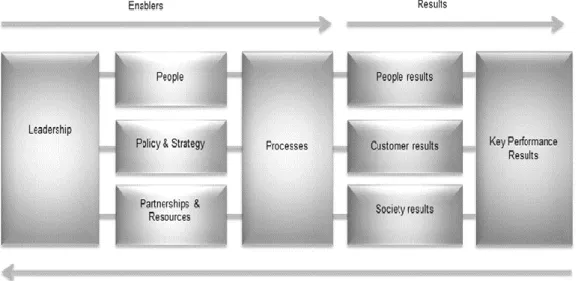
In 1989, the EFQM Excellence Model was shaped by European Foundation for Quality Management for quality management purposes. Its focus was to improve overall organisational quality, and it is unique in that it distinguishes between results (PMs) and organisations’ enablers (Westerveld, 2003). The EFQM model uses nine fundamental concepts of excellence to enhance the continuous improvement of an organisation. These are results orientation, people development and involvement, customer focus, continuous learning, innovation and improvement, leadership and constancy of purpose, partnership development, management by process and facts, and public responsibility (Beatham et al. 2004).
The EFQM Excellence Model has been utilised by companies in the construction industry and others such as manufacturing, finance, insurance, and as part of management through Total Quality Management. It is suggested for use as a means of self-assessment in order to benchmark with other organisations, as a guide for improvement, an approach to thinking, and a structure for the organisation's management system (EFQM, 2010). Beatham et al. (2004) added that the purpose is to conduct a regular review of an organisation’s activities. The main aim for implementation of the EFQM model is to identify the performance improvement areas (Beatham et al. 2004).