1
Manav Rachna University, Faridabad, India 2University of Petroleum and Energy Studies, Dehradun, India 3
Kalinga Institute of Industrial Technology, Bhubaneswar, India Received 24 September 2018; revised 15 June 2019; accepted 22 November 2019
World Wide Web provides numerous opinionated data that can influence users. Reviews on online data highly affect the user’s perception while buying a particular or related product from an online shopping site. The online review provided by a customer helps other customers to make up their decision regarding purchasing that item. Looking at the developer’s and producer’s perspective, the opinions of customers on their manufactured items is helpful in identifying deformities as well as scope for improving its quality. Equipped with all this information, the product can be developed and managed more efficiently. Along with the overall rating of the product, the feature-based rating will have a great impact on the decision-making process of the customer. In this paper, an optimized scheme of aspect level sentiment analysis is presented to analyze the online reviews of a product. Reviews ratings have been used for learning approach. Inherently biased reviews are considered to optimize the Aspect Level Sentiment Analysis. Bi-polar aspect level sentiment analysis model has been trained using multiple kernels of support vector machine to optimize the results. Lexicon based aspect level sentiment analysis is performed first and later on the basis of bipolar words adjustment, and its effect on results, aspect level sentiment analysis for efficient optimization has been performed. A Web Crawler is developed to extract data from Amazon. The results obtained outperformed traditional lexicon based Aspect Level Sentiment Analysis.
Keywords: Sentiment Analysis, Aspect level Sentiment Analysis, Mobile Phone Review Mining, Machine Learning, Bi-Polar Words, Support Vector Machine
Introduction
Sentiment Analysis1,2 can be done on any data (reviews, tweets, comments, etc.)3 which can help to identify various views and opinions4 of users on the basis of which better decision making can be done on a particular domain. Sentiment analysis comprises of different challenging areas under it like NLP overheads, Spam and fake, bipolar words, Negations, finding optimal size and DG Unit location5 etc. The aspect-based sentiment analysis is often domain specific, which helps to analyze the positive and negative aspects of the data6. In this paper, it has been proved that the sentiment polarity of a sentence is not only determined by the content but is also highly related to the context of some bipolar words. Thus, to improve the accuracy, a bipolar word adjustment model has been proposed for aspect-level sentiment classification using Support Vector Machine (SVM) as the base classifier. The bi-polar word7 adjustments can detect and modify the wrongly entered ratings.
The rating vector of the bi-polar words is also utilized to adjust ratings specified in the rating matrix.
Methodology
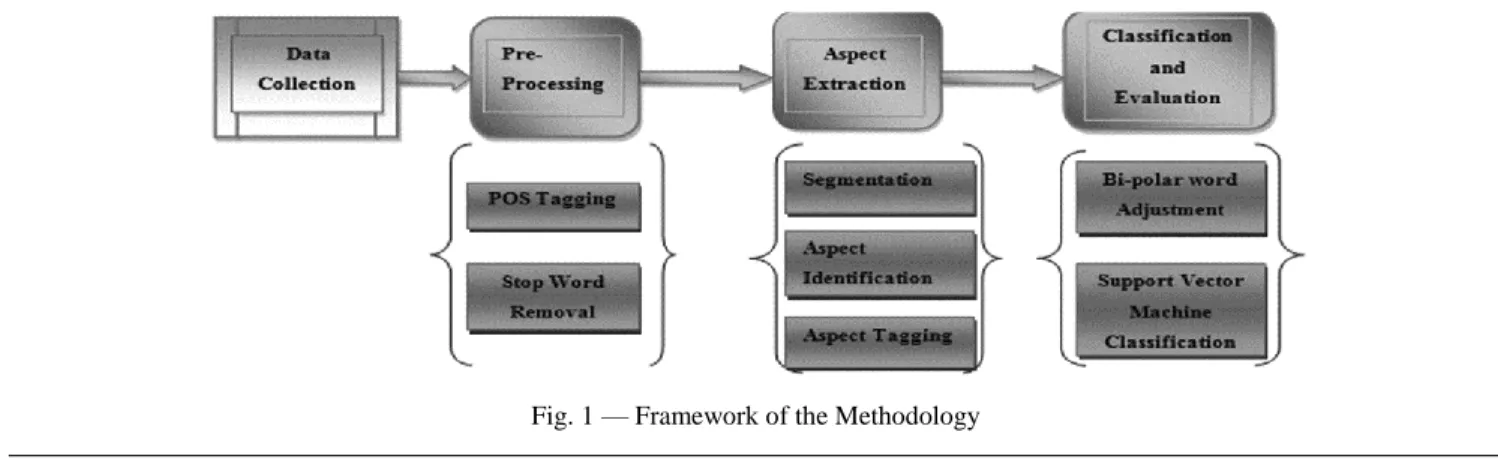
The first and foremost step of the work is to extract the data for which aScrapy based web crawler is developed to fetch user reviews on given products from Amazon. Next step is pre-processing of data and then Extraction of Aspect is done. Finally, Bipolar word adjustment model has been incorporated with SVM Classifier to optimize the overall classification and evaluation of results. The overall flow of the work is presented in figure 1.
The challenges in the field of sentiment analysis aspired us to present a novel and optimized approach for Aspect Level Sentiment Analysis. The proposed algorithm following the methodology is as follows
Algorithm: Optimized Aspect Level Sentiment Analysis
Input: File “Customer Reviews on a Product” Output: Bipolar words adjusted reviews having Product Aspect Score.
——————
*Author for Correspondence E-mail: [email protected]
1. Sentiments() Input File
2. Aspect and Sub-Aspect Extraction 3. while not the end of file do
4. for each review in file do
5. Perform Data cleaning and remove stop words. 6. if bipolar(word) then
7. perform bipolar word adjustment 8. end
9. end
10. Calculate sentiment score for each review in the file by performing Aspect Level sentiment analysis using SVM classifier for linear, polynomial and RBF kernel.
11. Display overall and aspect based rating of the product.
12. end
Web crawler (Data Collection)
A crawler is build up which is used to collect the reviews from the Amazon (www.amazon.in). It is able to crawl the Web pages on the URL provided and collect the data as required. Scrapy provides a powerful framework for extraction of data, processing it, and then saving it as comma separated values (CSV) as shown in table 1. It shows the sample data collected using a web Crawler. The e-commerce website of Amazon is being selected to work with because it is a platform to explore different kind of products at one place and the wide range of customers reviews are there to collect as a data. The developed Crawler is very fast which can able to call 5000 API request in less than a minute. A custom dataset was developed and available at github*.
Preprocessing
Data cleaning has been done in this phase. It is easier to filter out unnecessary tokens for that stop words removal is done, stop words are the most commonly occurring words which are not relevant in the context of the data. SentiWordNet8 dictionary has been utilized, and the score is given to SVM9 to classify Reviews after the Bi-Polar adjustment. The predefined score of a positive or negative word in Senti Word Net dictionary with which the weighted score has been given to the tagged work for identification of final sentiment score.
Aspect Extraction
In this work, Aspect Level Sentiment Analysis is performed using product reviews of Amazon customers. The main step for the same is to identify the important aspects of data. Though different aspects can be utilized in reviews in different synonym forms, an aspect dictionary for all aspects has been developed which comprises of different aspects and sub-aspects of the product. For example, important aspect of a product “mobile” can be its battery, Performance, Screen, camera etc. Synonyms of battery can be “charge, jack, energy, power, unit,
mah, backup” etc.
Classification and Evaluation
The collected data is divided into training and testing data. Data that has been utilized for training help to train the model for classification of data as Positive, Negative, or Neutral, then testing is performed on the data. In the presented work, SVMs Fig. 1 — Framework of the Methodology
Table 1 — Sample of Crawled data using Scrapy based Crawler the users identify has been anonymized.
Date Rating User (anonymized) Opinion
01-Feb-18 2 R2A89WS6Z2PZJQ My headset and charger were duplicates..can 22-Oct-18 4 R254I5MGIEJYZP The good things about the iPhone 6s: Camera is 04-Oct-18 5 RD9EG1LC3ZZCK A great product! There are multiple reviews in ….
approaches are meaning reducing techniques, as it only assigns sentiment of words singularly. It makes classification even worse as the sentiment mining of complex natural language can have meanings which lie in both sentiment domains. Also, a problem arises if one or more words with alternating sentiment values or polarities11,12 are combined to form a sentence. This can easily change the polarity of the sentence or review. For example, the user mentioned "high noise" in a product review is positive because
high has positive polarity, and noise has associated
negative polarity, or it can be classified as neutral.
SVM based Learning
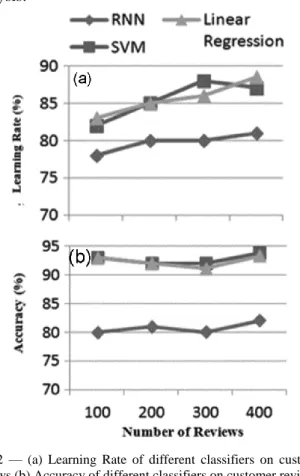
A comparative analysis has been done on the basis of different popular classifier’s strength and weakness. The classifier chosen for the work i.e. SVM is effective in many terms which are being compared with other powerful classifiers. Its capacity to maximize the hyper plane margins and the different kernel make it highly reliable to work with. Although the LSTM approach is proven to be very good to tackle with time series but the trained model in the presented work is providing improved results with SVM classifier. The classifiers are tested for the product reviews domain on the parameters of Learning Rate and Accuracy using different number of reviews. The comparative analysis of classifiers is
used in work, including Linear, Polynomial & Radical Basis Function (RBF) 15,16 to solve the sentiment analysis.
Table — 2 Analysis of different classifier strength, weakness and results of classifiers for different parameters on dataset
Classifier Strength Weakness Best Learning
Rate achieved
Best Accuracy achieved Recurrent Neural
Networks
Does not overfit the data
Genetic heterogeneity supported
Needs full cross-validation. 81% 82.02% SVM Non-linear decision boundaries can be
modeled.
Robust for overfitting and works well in high dimensional space.
Does not stuck at local minima.
Memory Intensive due to presence of kernels.
88% 93.8%
Linear Regression Regularized to avoid overfitting.
Updation with stochastic gradient descent is easy.
Poor Performance with non-linear data.
Not flexible with complex patterns.
89% 93.3%
Fig. 2 — (a) Learning Rate of different classifiers on customer reviews (b) Accuracy of different classifiers on customer reviews.
This problem is transformed using the Lagrange Multipliers theory, and Optimal Lagrange coefficients17 sets are obtained. A separating hyper plane is written as in eq. 1.
… (1)
where , is weight vector of n attributes and is bias.. SVM classifier formula18 is defined as in eq. 2.
... (2)
where and areparameters used to train the kernel which is given as in eq.3.
... (3)
Experimental setup
To demonstrate the performance of the proposed work, several experiments on our dataset have been conducted. All experiments were implemented in Combination of Python and MATLAB R2016a environment on an Intel pc with 8 GB RAM. SVM for Binary Classification have been utilized with three SVM Gaussian kernels Linear, Polynomial and RBF.
The SVM was converted into multi-class classifier where user rating represented the class.
Evaluation
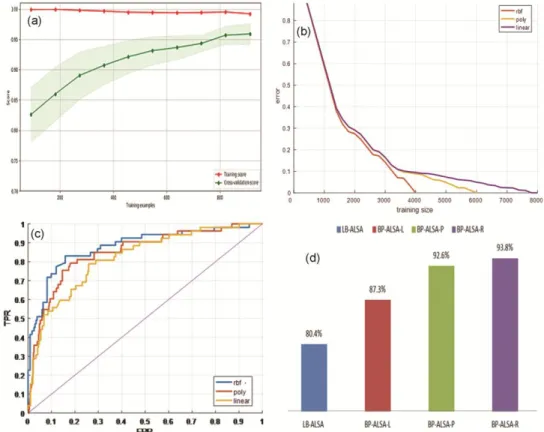
Evaluation of a model is very tricky part because one parameter can show the effectiveness of algorithm while other one can show the weakness. So, analyzing and evaluating the performance of an algorithm depends on several factors. For the evaluation of the proposed work, various metrics have been utilized, such as Learning rate, MSE, Accuracy, Precision, Recall, confusion matrix, and roc curves. Figure 3(a) shows the Learning rate of BP-ALSA algorithm during testing or cross validation phase achieving up to 97% score meaning that about only approximately 3% of information loss is found during the testing. The MSE (Mean Squared Error) is calculated using summing error achieved from all the product reviews divided by the total reviews as in eq. 4.
... (4)
The classifier is given a set of training data, and after training error rate and convergence of error, minimum error achieved for RBF kernel is 0.062 at
Fig. 3 — (a) Learning rate of BP-ALSA algorithm during testing or cross validation phase (b) Mean Squared Error of BP-ALSA with three kernels c) Receiver Operating Characteristic Curves using SVM Kernels (d)Perceived accuracy of the four classifiers LB-ALSA, BP-ALSA-L, BP-ALSA-P, BP-ALSA-R
the lowest error of 0.074. The least accurate was the linear kernel taking more than 8000 samples and producing the highest error of 0.127. However, all BP-ALSA version provides better error rate and convergence than our existing attempt LB-ALSA [x] which gives the maximum error of 19.6%. MSE graph for the work is shown in figure 3(b) and performance comparison of lexicon based approach and bipolar word adjustment approach for aspect level sentiment analysis is shown in table 3.
The receiver operating characteristic curve (ROC) is plotted with TPR against the FPR where TPR is on y-axis and FPR is on the x-axis. As depicted in figure 3(c), this is clear that the RBF kernel has most AUC as compared to other kernels for all threshold ranges. The AUC of RBF kernel is around 0.945, and polynomial kernels are about 0.916, and the linear kernel is 0.883. For a total of 16496 negative instances in the dataset, an achievement of almost 15811 (57.22% of the whole dataset) reviews to be classified as negatives and only 685 instances to be classified as positives. For a total of 11137 positive instances in the dataset, an achievement of about 10794 (36.58% of the whole dataset) reviews to be classified as positive and only 685 instances to be classified as negatives. Overall accuracy for 27633 instances for RBF kernel comes around to be 93.80%.
The Accuracy of the ALSA can thus be calculated using MSE as shown in eq. 5.
... (5)
The Perceived accuracy of the four classifiers LB-ALSA, ALSA-L, ALSA-P, ALSA-R. BP-ALSA with RBF kernel being the best of all is shown in figure 3(d).
Conclusion and Future Scope
Basic dictionary-based sentiment analysis approaches have proven to be the weak classifier of user sentiments, as they only assign sentiment of words singularly, which makes classification worse. In this research work, bi-polar word adjustment of
advantage of our work is that confusing bi-polar words have been removed and parallel processing techniques based on map-reduce have been incorporated, which optimize the classification accuracy. Another advantage of performing BP-ALSA is that the reviews sentiments can be extracted explicitly during its decoding step, and these opinions can serve as justifications for predictions. This property makes sentiment analysis significantly more interpretable compared with existing methods and allows us to have a better understanding of the underlying predictions about the products.
References
1 Liu B,Sentiment Analysis and Opinion Mining, Mor & Cla Pub, (2012).
2 Pang B, & Lee L, Opinion Mining and Sentiment Analysis, Found. Trends Inf. Retr.2, 1–135 (2008).
3 Prabhadevi S, Jayavel S, & Kapoor R, Algorithm of Sentiment Analysis for Computing Machines, Jourof Sc& Indus Res(CSIR-JSIR), Vol. 74, December 2015, pp. 670-674.
4 Valli M S, & Arasu G T, An Efficient Feature Selection Technique of Unsupervised Learning Approach for Analyzing Web Opinions, Jourof Sc& Indus Res (CSIR-JSIR), Vol. 75, April 2016, pp. 221-224.
5 Bakshi S, Thakur T, Khanna R, & Gupta A, DG Placement and Capacity Using an Improved Human Opinion Dynamics Based Optimization TechniqueJourof Sc& Indus Res (CSIR-JSIR), Vol. 76, July 2017, pp. 427--432.
6 Schouten K, & Frasincar F, Survey on Aspect-Level Sentiment Analysis,IEEE Trans. Knowl. Data Eng.28, 813– 830 (2016).
7 Aizawa A, An Information-theoretic Perspective of TF & MDASH;IDF Measures. Inf. Process. Manag.39, 45–65 (2003).
8 Baccianella S, Esuli A, & Sebastiani F, Senti Word Net 3.0: An Enhanced Lexical Resource for Sentiment Analysis and Opinion Mining,Proceedings of LREC’10), European Languages Resources Association, (2010).
9 Lilleberg J, Zhu Y, & Zhang Y, Support Vector Machines and Word2vec for Text Classification with Semantic Features,IEEE 14th Int Conf on Cogn Inform Cogn Comp (ICCI*CC) 136–140 (2015). doi:10.1109/ICCI-CC.2015.7259377.
10 Cambria E, Affective Computing and Sentiment Analysis,IEEE Intell. Syst.31, 102–107 (2016).
11 Kumar M Ra P, &Prabhu Jb, Role of Sentiment Classification in Sentiment Analysis: a Survey. Annals of Lib and Inf Stud, Vol. 65, pp. 196-209(2018).
12 Giatsoglou M,et al. Sentiment Analysis Leveraging Emotions and Word Embeddings. Expert Syst. Appl.69, 214–224 (2017).
13 C, C T,& Joseph S, A syntactic approach for aspect based opinion mining, Proc of 2015 IEEE 9th Int Conf on Semantic Comp 24–31 (2015). doi:10.1109/ICOSC.2015. 7050774.
14 Scholkopf B,& Smola A J,Learning with Kernels: Support Vector Machines, Regularization, Optimization, and Beyond,MIT Press,(2001).
15 Banu R K, & Ravanan R, A Competency Framework Model to Assess Success Pattern For Indian Faculties A NP Based
Data Mining Approach,Jour of Sci & Ind Res(CSIR-JSIR), Vol. 75, (2016), pp. 662--666.
16 Cristianini N, & Shawe-Taylor J,An introduction to support vector machines : and other kernel-based learning methods,Cambridge University Press,(2000).
17 Flekova L, Preotiuc-Pietro D, & Ruppert E, Analysing Domain Suitability of a Sentiment Lexicon by Identifying Distributionally Bipolar Words, WASSA @EMNLP (2015). 18 Al-Smadi M, Qawasmeh O, Al-Ayyoub M, Jararweh Y, &
Gupta B, Deep Recurrent neural network vs. support vector machine for aspect-based sentiment analysis of Arabic hotels’ reviews,J. Comput. Sci.27, 386–393 (2018).