Multidisciplinary Studies Full Paper Proceeding GIMAR-2015, Vol. 1, 183-195
IS BN: 978-969-9948-09-1
*All correspondence related to this article should be directed to Saif Ur Rehman Khan,University of Modern Sciences, Dubai. Department GIMAR 2015
Consumer Behavior in Social-Commerce
Saif Ur Rehman Khan1 and Misbah Sadiq2 1
University of Modern Sciences, Dubai. 2Department of Finance, Faculty of Management, Johor, Malaysia.
Abstract
Social co mmerce (s -co mme rce) is the subset of electronic co mmerce wh ich involves the use of Internet-based med ia which allows people to participate in marketing, selling, comparing, buying, and sharing of products and services. The present study aims to investigate consumer behavior towards s -comme rce using five core variables: perce ived usefulness, perceived enjoyment, attitude, intention to use and perceived social support. A total of 120 s-co mmerce users in Skudai, Ma laysia were approached on the basis of convenience sampling. Respondents were asked about their consumer behavior through a questionnaire-based survey. The relationship between perceived usefulness and perceived enjoyment on intention to use of s -comme rce through mediating role of attitude and moderating role of perce ived social support were e xa mined in this study.
Findings indicate that perceived usefulness, perceived enjoyment, attitude, intention to use and perceived social support are found to correlate with each other. Furthermore, analysis confirms that attitude performs the role of med iator between perceived usefulness, perceived enjoyment with intention to use. Furthermore, perce ived usefulness performed the role of mediator on the re lationship between perceived enjoyment and attitude but could not perform the role of moderator on the re lation between (1) perce ived usefulness and attitude, and (2) between attitude and intention to use. Findings and imp licat ions are exa mined and discussed in later portion of this study.
© 2015 The Authors. Published by Global Illuminators. This is an open access article under the CC BY-NC-ND license (http://creativecommons.org/licenses/by-nc-nd/4.0/)
Peer-review under responsibility of the Scientific & Review committee of GIMAR-2015.
Keywords: S-Co mmerce, Perce ived Usefulness, Perceived Enjoy ment, Attitude, Intention To Use, Perceived Soc ial Support.
Introduction
Social commerce (s-commerce) is a new form of electronic commerce that involves using social media, an online media, that supports social interaction and consumer contribution to assist online buying and selling of products and services (Shen & Eder, 2011). S-commerce include consumer ratings and reviews, consumer recommendations and referrals, social shopping tools (shared shopping online), forums and communities, social media optimization, social applications and social advertising (Qiu & Benbasat, 2009). Nowadays, most people have created their own account in the social media platform such as Facebook, Twitter and other social media link as a method of social interaction. Since social media have become readily accessible, more consumers use it as a source of information about companies, brands, products, and services (Zhou, Zhang, & Zimmermann, 2013). For this indication, e-retailers have implemented several social programs such as Social Media
Commerce, Facebook Commerce Platform or other social networking as an effective medium for the distribution of their goods and services. E-retailers wish to take advantage of these social technologies and services to expand their businesses.
The progressive development of technologies suggests that the era of s-commerce will become the mainstream for marketing, following the success of social networking sites (Marsden, 2010; Stephen & Toubia, 2010). However, the effectiveness of s-commerce is not solely depends on the technology but consumer behavior and experience toward s-commerce are crucial and can have a great impact as well. Consumers always look for more social and interactive ways to stimulate their engagement in commerce. Consumer behaviors on s-commerce are driven by their beliefs and assessment on the use of s-s-commerce. Hence, one of the challenges of s-commerce is how to design services that are useful, valuable, enjoyable and most importantly, user-centered for consumer. By better understanding consumer behavior, marketers can obtain the insights they need to plan their s-commerce strategies. It can also strengthen their business relationships with customers, increase traffic to company websites, identify new business opportunities, and support product and brand development (Michaelidou,Siamagka, & Christodoulides, 2011).
In light of the importance of consumer behaviors, this study examines consumer behaviors of s-commerce by proposing a research model (Figure 1) that incorporates various factors. In particular, given the nature of social interaction and s-commerce, this study focused on direct relationship among consumer behavioral through perceived usefulness and perceived enjoyment of s-commerce. In addition, this study also investigates the mediating role of consumer attitude in the relationship between perceived usefulness and perceived enjoyment towards consumer intention to use s-commerce. Furthermore the moderator role of perceived social support on the relationship between perceived usefulness-attitude and attitude- intention was examined in this study as well. It is hope that the findings of this study will help the marketer understand on the attitude of the consumer (buyer), how they perceive usefulness of s-commerce, how to encourage their enjoyment and how they perceive social support factor that lead them to the intention to buy in s-commerce.
Figure 1: Proposed research model for s-commerce
1. Lite rature Review
Perceived Usefulness
Perceived usefulness is defined as „„the extent to which a person believes that using a particular technology will enhance his or her transaction performance‟‟ (Davis, 1989). Perceived usefulness is the characteristic of capable of being used advantageously (Shin &
Perceived Usefulness
Perceived Enjoyment
Attitude Intention to Use
Perceived Social Support
Shin, 2011). Similarly, there is a strong direct relationship between perceived usefulness and attitude (Fazio & Zanna, 1981; Hossain & De Silva, 2009). Consumer perceived usefulness of the website from the influence of website satisfaction (Wixom & Todd, 2005). Hence, a good s-commerce website should provide relevance, accuracy, understanding and usefulness information for consumer (Susser & Ariga, 2006). A website with good quality content can significantly influence the consumer attitudes and their interaction with s-commerce (Hasan & Abuelrub, 2011). Hence, consumer will easily trust, satisfy and tend to buy from a website that provide complete information on a product or service. Consumer will make a bet ter purchase decision and predicts the product satisfaction prior to actual purchase after they value the website information accurately (Hossain & De Silva, 2009). Besides that, perceived usefulness has a significant effect on customer satisfaction (Devaraj,Fan, & Kohli, 2002) and loyalty intention (Cyr, Head, & Ivanov, 2006) towards online shopping as well which leads to s-commerce usefulness. Marketers have grasp understanding that online service continuance is from the consumer perspective. Once a cons umer perceived the usefulness of buying online, they will have the intention to adopt s-commerce in future. Therefore, it can be hypnotized as:
H1: Perceived usefulness will be a positive predictor of attitude.
Perceived Enjoyment
Perceived enjoyment is defined as the extent to which the activity of using a computer system is perceived to be personally enjoyable in its own right, aside from the instrumental value of the technology (Shin, 2013). Perceived enjoyment plays an important role in forming online consumer satisfaction and continuance intention in s-commerce (Hsu & Chiu, 2004; Huang & Benyoucef, 2013; Kang, Hong, & Lee, 2009; Lin, Wu, & Tsai, 2005; Thong, Hong, & Tam, 2006). Perceived enjoyment behavior only found after consumer making a purchase in s-commerce. Consumer will not found the feeling of enjoyment if they never have any experience in purchasing a product from s-commerce. In this regard, Nah, Eschenbrenner, and DeWester (2011) reported that perceived enjoyment on a brand experience in virtual world predicts the intention to engage with the brand offline. Moreover, some consumers are satisfied with the online shopping experience as compared to offline shopping because the advantages they received in terms of time and cost. A satisfied customer that obtains pleasure from both material and emotion in s-commerce (Jarvenpaa & Todd, 1996) will encourage their repeat visits.
The interactive commerce website contributes to perceived enjoyment in s-commerce as well. Consumers will perceived the enjoyment if they are satisfied with the system performance of the website (Huang & Benyoucef, 2013). The interactive s-commerce website allows an individual to send internal message to friends, knowing the new friends background information, their interest, share photos and videos. Consumer will effectively found that this website is more enjoyable and find the opportunity to use this site as a link to spread their business. Thus, it is hypothesized that:
H2: Perceived enjoyment will have a positive rela tion with attitude. Attitude
Attitude is the way a person think or feel about someone or something, then it reflected in a person's behavior. Attitude can influence how a person evaluates s-commerce and their acceptance on s-commerce. According to Castaneda, Munoz-Leiva, and Luque (2007), user that reflect positive feelings or attitudes toward s-commerce is more likely to begin and continue buying from the Internet. Attitude has become one of the key variables of s-commerce acceptance (Chen & Tan, 2004; Richard, 2005). Consumer acceptance on s-commerce is influenced by previous experience (perceived usefulness) and user interest (perceived enjoyment).
There is a strong direct relationship between perceived usefulness and attitude (Fazio & Zanna, 1981; Hossain & De Silva, 2009). Purchasing experience in s-commerce will affect a consumer attitude and behavior since consumer is always concerns on their experience when making a decision to purchase. Consumer experience considerably conditions their decision- making process (Hutchinson, 1983) and influences their perceptions, attitudes and behaviors (Montoya-Weiss, Voss, & Grewal, 2003; Sheth & Parvatiyar, 1995). Consumer who had obtained purchasing experience in s-commerce tends to trust the site and easily repeat their purchasing behavior with less uncertainty (Gefen, Karahanna, & Straub, 2003). Hence, perceived usefulness increasingly affects consumer attitude and, therefore, it strengthens the intention to perform a greater number of transactions in future (Taylor & Todd, 1995).
S-commerce website system functions such as share links, quick access to products, help option designs, feedbacks, and rating reviews are likely to increase consumer perceived enjoyment on s-commerce and change their attitude on s-commerce site which encourage their intention to use s-commerce in the future (Grange & Benbasat, 2010). According to Constantinides and Fountain (2008 ), perceived usefulness and perceived enjoyment dramatically motivate consumer attitude and loyalty towards s-commerce. Thus, it is hypothesized that:
H3: Attitude will mediate the relationship between perceived usefulness and intention to use.
H4: Attitude will mediate the relationship between perceived enjoyment and intention to use.
Perceived Social Support
Social support allow consumer to cultivate, foster and maintain online relationship in social network sites (Wu & Wang, 2011). Consumer tends to get social support from other consumers that have an experience in s-commerce for suggestion on trusted s-commerce sites. In addition, some consumers are willing to help others in promoting goods and services that have been used by leaving the comments, recommendations and feedback. Consumer behavior does not necessarily remain stable over time. Factors that induce consumer to make an initial e-purchase may have different effects on their subsequent decisions or repurchasing behavior because social support from other consumers may modify certain perceptions and attitudes (Gefen et al., 2003; Taylor and Todd, 1995;Thompson, Higgins, & Howell, 1994). Social support may have an important role in the product acceptance and recommendation to other friends (Ng, 2013).
Individual who directly interact with each other and have a strong social tie may tend to mimic other people's behavior or experience because of direct communication and influence. S-commerce involves online communities that support social connection to enhance conversation between consumers (Kim & Srivastava, 2007). Constantinides,
Lorenzo and Gómez-Borja (2008) suggest communities can be easily created based on special interest group and consumer should be able to freely share their experience and knowledge within the community. Similarly, Murugesan (2007) addresses the establishment of social networks or social supports provide support collaboration and gather collective intelligence in making purchasing decision in s-commerce. Thus it hypothesized that:
H5: Perceived social support will moderate the relationship between perceived usefulness and attitude.
H6: Perceived social support will moderate the relationship between perceived enjoyment and attitude.
H7: Perceived social support will moderate the relationship between attitude and intention to use.
Research Design and Methods
This part explains the procedure through which data was collected, as well as evidence about the measures and analytical approach that have been designed.
Sample and data collection procedures
Students studying in Universiti Teknologi Malaysia (UTM) and Universiti Selangor (UNISEL), Shah Alam, Malaysia were participated in this study. The current study used a convenience sampling technique to collect data from these respondents. A self-administered questionnaire-based survey was used and a total of 200 questionnaires were d istributed among students experienced s-commerce, resulting in 120 responses that were useable for analysis (the response rate 60 percent).
Measures
Questionnaire was developed from the adaption of previous research study of Shin (2013). Contents of questionnaire are containing 18 questions and divided into two sections. First section focus on respondents‟ background information, second section is to measure the entire five variables in s-commerce which are perceived usefulness, perceived enjoyment, attitude, intention to use, and perceived social support. Each variable has three measurement items by using Likert scale ranging from 1 (strong disagree) to 4 (strongly agree).
Findings and Discussions Reliability Test
There are five variables in this study had undergone several reliability tests in a row. Statistical information for the five variables is showed in Table 1. Results showed that all of the constructs were considered to have adequate reliability.
Table 1: Reliability Analysis S. No Variable Cronbach‟s α CR AVE 1. Perceived Usefulness 0.781 0.61 0.52 2. Perceived Enjoyment 0.890 0.68 0.54 3. Attitude 0.793 0.60 0.51 4. Intention to Use 0.816 0.62 0.52
5. Perceived Social Support 0.869 0.64 0.53
Note:CR = Composite Reliability, AVE = Average Variance Extracted Validity Test
Table 2 displays correlations between the variables. Correlations in table 2 indicating that construct validity of the instrument was confirmed.
Table 2: Correlations between Variables
1 2 3 4 5
1. Perceived Usefulness 1.000
2. Perceived Enjoyment 0.399*** 1.000
3. Perceived Social Support 0.288** 0.216* 1.000
4. Attitude 0.248* 0.388** 0.371*** 1.000
5. Intention to Use 0.276** 0.531*** 0.196 0.478*** 1.000 Note: * p < 0.05, **p < 0.01, ***p < 0.001
Fit of the Model
Table 3 shows the estimate of fit indices of the structural model. A rule of thumb to indicate goodness-of- fit indices for Comparative Fit Index (CFI), Goodness-of-Fit-Index (GFI), Adjusted Goodness-of-Fit-Index (AGFI) is greater than 0.90. GFI in this study indicate good fit. According to Browne and Cudeck (1993), Root Mean Square Error Approximation (RMSEA) values ≤ 0.08 can be considered as a good fit, whereas values > 0 .10 are not acceptable. This study showed that AGFI and RMSEA are near to fit with the model and the.
Table 3:
Fit Indices of the Structural Model
Fit Measures Fit Indices
Comparative Fit Index (CFI) 0.913
Goodness-of-Fit-Index (GFI) 0.938
Adjusted Goodness-of-Fit-Index (AGFI) 0.886 Root Mean Square Error Approximation (RMSEA)
Chi-square – Х2 [ 92] = 432.11, p < 0.004
0.112
One of the reasons of non- fit structural model in this study may be due to the small sample size which only has 120 respondents. Besides that, most of the respondents were from the community that only use social networking site for buying or selling and only have basic information on s-commerce contrast to previous researches where respondents have an excellent knowledge in s-commerce, such as professional associations, blogs and forums.
Path Coefficient and Hypotheses Testing
In this study, two hypotheses (H1 and H2) were developed to measure the direct relationship and the remains hypotheses were mediating effect (H3 and H4) and moderating effect (H5, H6, H7). Paths coefficient in this study supported H1 and H2. The results were reported and depicted in Table 4.
The effect of perceived usefulness on attitude was significant and positive (β = 0.267, t = 2.533, p < 0.05) and this finding supported the hypothesis H1. The influence of perceived enjoyment on attitude was highly significant (β = 0.337, t = 4.162, p < 0.001) and supported the positive relationship of H2.
Table 4. Adjusted t-statistics and path coefficients
Hypothesis Path
Coefficient
t-value H1 Perceived Usefulness Attitude 0.267* 2.533 H2 Perceived Enjoyment Attitude 0.337*** 4.162 Note: *p < 0.05; **p < 0.01; ***p < 0.001
Consumer perceived usefulness o f the s-commerce based on the information they received, how s-commerce are excellent in secure their information, good protection in payment transaction and other advantages. H1 is consistent with literature review where a good s-commerce website should provide the relevance, accuracy, understanding and usefulness information (Susser & Ariga, 2006). Once the consumer experienced the s-commerce advantages they have a strong intention to use s-s-commerce in future and recommend to others.
Another significant finding is consumer perceived enjoyment when using s-commerce which supported the H2. Findings showed that s-commerce is not only represent as a medium of online business but also act as a social platform which allow consumer to interact with other social activities such as entertainment, education and information. Perceived enjoyment has been found to be an important antecedent to customer satisfaction and continuance intention of online service (Hsu & Chiu, 2004; Kang et al., 2009; Lin et al., 2005; Thong et al., 2006).Shen and Eder (2011) predict s-commerce is likely to evolve into a social platform that unifies all functions and features which enables consumers to connect with online communities through social networking services.
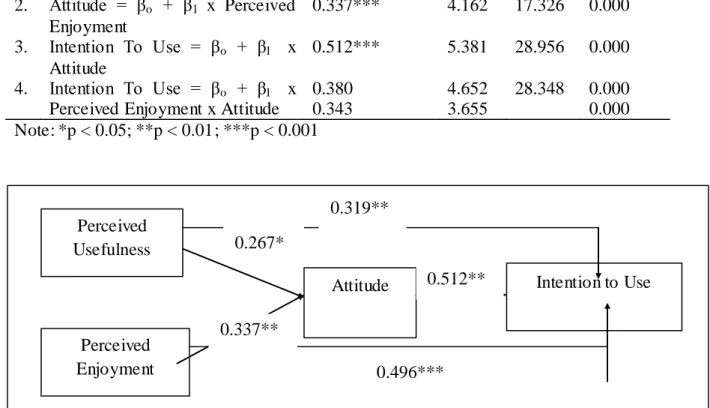
To examine whether attitude was a mediating variable, Baron and Kenny (1986)‟s procedure was followed. The procedures for regression analyses are as follows: (1) regressing the independent variable on the dependent variable; (2) regressing the independent variable on mediator variable; and (3) regressing the independent variable and mediator variable on the dependent variable (Baron & Kenny, 1986). If the independent variable shows significance on the mediator, the mediator shows significance in the dependent variable, and the independent variable is not significant on the dependent variable, there is likely a mediator between the independent variable and dependent variable (Baron & Kenny, 1986). Therefore, the study verified each hypothesis via a three-step approach: (1) the path regression between perceived usefulness and intention to use as well as the path regression between perceived enjoyment and intention to use, respectively (these results must be significant); (2) the path regression between perceived usefulness and attitude, between perceived enjoyment and attitude (these results must be significant); (3) the path regression of perceived usefulness, perceived enjoyment, and attitude on intention to use. If perceived usefulness and perceived enjoyment show significance on attitude, attitude shows significance on intention to use, and perceived usefulness or perceived enjoyment shows no significance on intention to use, then attitude is likely a mediator. According to the findings in Table 5 and Table 6, perceived usefulness and perceived enjoyment featured significant path coefficients (Perceived Usefulness → Intention to Use: 0.319, p < 0.01; Perceived Enjoyment → Intention to Use: 0.496, p < 0.001) on intention to use, thus confirming to the first step of Baron and Kenny‟s test. The coefficients between perceived usefulness and perceived enjoyment on attitude were positive (Perceived Usefulness → Attitude: 0.267, p < 0.05; Perceived enjoyment → Attitude: 0.337, p < 0.001), as was the impact of attitude on intention to use (Attitude → Intention to Use: 0.512, p < 0.001), fitting the requirement in the second step of Baron and Kenny‟s method. Lastly, the mediation model confirmed with the third step of Baron and Kenny‟s test, indicating path coefficients o f perceived usefulness and perceived enjoyment on attitude, path coefficients of attitude on intention to use, and finally, path coefficients of perceived usefulness and perceived enjoyment on intention to use (Figure 2).
Table 5: The mediating effects of attitude between perceived usefulness and intention to use
Note: *p < 0.05; **p < 0.01; ***p < 0.001 Model Unstandardized Regression coefficient (β) t-value F Sig. 1. Intention to Use = βo + β1 x Perceived Usefulness 0.319** 2.846 8.097 0.005 2. Attitude = βo + β1 x Perceived Usefulness 0.267* 2.533 6.414 0.013 3. Intention to Use = βo + β1 x Attitude 0.512*** 5.381 28.956 0.000 4. Intention to Use = βo + β1 x
Perceived Usefulness x Attitude
0.194 0.468 1.859 4.817 16.569 0.066 0.000
Table 6:
The mediating effects of attitude between perceived enjoyment and intention to use
Model Unstandardized Regression coefficient (β) t-value F Sig. 1. Intention To Use = βo + β1 x Perceived Enjoyment 0.496*** 6.204 38.485 0.000 2. Attitude = βo + β1 x Perceived Enjoyment 0.337*** 4.162 17.326 0.000 3. Intention To Use = βo + β1 x Attitude 0.512*** 5.381 28.956 0.000 4. Intention To Use = βo + β1 x
Perceived Enjoyment x Attitude
0.380 0.343 4.652 3.655 28.348 0.000 0.000 Note: *p < 0.05; **p < 0.01; ***p < 0.001
Figure 2: The Mediating Effect of Attitude
The mediating effect is significant because of the fit structural model in this study. Thus, attitude is proven to be a full mediation between perceived usefulness/enjoyment and intention to use. The H3 and H4 were accepted.
Moderating Effect
To examine whether perceived social support is important as a moderating role on (1) the path of perceived usefulness and attitude, (2) the path of perceived enjoyment and attitude, and (3) the path of attitude and intention to use. Result of statistical analysis is showed in Table 12.
Table 12: Moderating effect of Perceived Social Support
Variable β value t-value Sig
Perceived Usefulness (PU) Attitude Perceived Social Support Attitude PU × PSS Attitude 0.154*** 0.211** 0.126 1.581 1.657 3.357 0.017 0.015 0.112 Perceived Usefulness Perceived Enjoyment
Attitude Intention to Use 0.319** 0.267* 0.512** * 0.337** * 0.496***
Perceived Enjoyment (PE) Attitude Perceived Social Support Attitude PE × PSS Attitude 0.323 0.132 0.301*** 3.550 2.153 3.313 0.213 0.091 0.001 Attitude (A) Intention to use
Perceived Social Support Intention to use A × PSS Intention to use 0.469*** 0.119** 0.022 4.889 2.003 0.228 0.000 0.002 0.820
Note: *p < 0.05; **p < 0.01; ***p < 0.001, PSS = perceived social support as moderator
The path of perceived usefulness and attitude
The relationship between perceived usefulness o n attitude is significant (β = 0.154, t = 1.581) and there is no significant relationship between perceived social support as a product on attitude (β = 0.126, t = 3.357, p = 0.112). Therefore, keeping in view the statistical rules of moderation, the moderating effect of perceived social support on the relationship between perceived usefulness and attitude is not supported the H5. The moderating effect is not significant in this study may be due to the reason that consumers evaluate s-commerce as a useful and functional technology but perceived lack of help and support from other consumers and finally it reflect their negative attitude toward s-commerce.
The path of perceived enjoyment and attitude
The path relationship between the perceived enjoyment on attitude is non-significant (β = 0.323, t = 3.550, p = 0.213) and perceived social support as a product on attitude is significant (β = 0.301, t = 3.313, p = 0.001). Hence, the moderating effect of perceived social support on the relationship between perceived enjoyment and attitude is significant and supported the H6. Consumers experienced the enjoyment of using s-commerce and received emotional helps and social supports from other consumers are more likely to have a positive feeling on s-commerce. This is consistent with the idea of Huang and Benyoucef (2013) that consumer perceived enjoyment experience with s-commerce will encourage their repeat visits in future.
The path of attitude and intention to use
The path relationship between attitude and intention to use is significant (β = 0.469, t = 4.889, p = 0.000) but the relationship between perceived social support and intention to use is non-significant (β = 0.022, t = 0.228, p = 0.820). The moderating effect of perceived social support on the relationship between attitude and intention to use is not significant and not supported with the H7. The consumer might have a positive attitude on s-commerce and have the intention to use in the future but have a poor social support from other consumer in making this decision. Likewise, consumer only uses s-commerce as a medium of interaction with their friends but not involve in the process of buying and selling transaction.
Conclusion
The aim of this study is to investigate the relationship of consumer beha vior in s-commerce by proposing a research model that incorporates various factors. To conclude, perceived usefulness and perceived enjoyment have a positive relationship on attitude. The
proposed model that examines the mediating effects of attitude is significant but the result still non-significant due to unfit structural model. Whereas, perceived social support has only moderated the relationship between perceived enjoyments and attitude.
As with any study of this nature, a number of limitations have to be pointed out. The first limitation is the issue of generalization. Small sample size collected in this study lead to the poor-fit structural model. Thus, the findings must be interpreted with caution and cannot be conclusively used to generalize to all the consumer behavior towards s-commerce. The second limitation relates to the cross-sectional nature of the current study. Future research to investigate consumer behavior towards s-commerce by utilizing longitudinal methodology, can be adopted.
References
Baron, R.M., & Kenny, D.A. (1986). The moderator-mediator variable distinction in social psychological research: conceptual, strategic and statistical
considerations. Journal of Personality and Social Psychology, 51, 1173-1182. Castaneda, J.A., Munoz-Leiva, F., & Luque, T. (2007). Web Acceptance Model (WAM):
Moderating effects of user experience. Information & Management, 44, 384-396. Chen, L.D., & Tan, J. (2004). Technology adaption in E-Commerce: Key determinants of
virtual stores acceptance. European Management Journal, 22, 74-86.
Constantinides, E., & Fountain, S. (2008): Web 2.0: Conceptual foundations and Marketing Issues. Journal of Direct, Data and Digital Marketing Practice, 9, 231-244.
Constantinides, E., Lorenzo C., & Gómez-Borja, M.A. (2008). Social media: A new frontier for retailers? European Retail Research, 22, 1-27.
Cyr, D., Head, M., & Ivanov, A. (2006). Design aesthetics leading to M-Loyalty in mobile commerce. Information and Management, 43, 950-963. Davis, F. (1989). Perceived usefulness, perceived ease of use, and user acceptance of
information technology. MIS Quarterly, 13, 319-340.
Devaraj, S., Fan, M., & Kohli, R. (2002). Antecedents of B2C channel satisfaction and preference: Validating E-Commerce metrics. Information Systems Research, 13, 316-334.
Fazio, R.H., & Zanna, M.P. (1981). Direct experience and attitude-behavior
consistency. In L. Berkowitz (Ed.), Advances in experimental social
psychology (pp. 161-202). New York: Academic Press.
Gefen, D. Karahanna, E., & Straub. D.W. (2003). Trust and TAM in online shopping: An integrated model. MIS Quarterly, 27, 51-90.
Grange, C., Benbasat, I. (2010). Online social shopping: The functions and symbols of design artifacts. 2010 43rd Hawaii International Conference on System
Sciences, 5-8 January, 2010, Hawaii.
Hasan, L., & Abuelrub, E. (2011). Assessing the quality of web sites. Applied Computing and Informatics, 9, 11-29.
Hsu, M.H., & Chiu, C.M. (2004). Internet self-efficacy and electronic service acceptance. Decision Support Systems, 38, 369-381.
Hossain, L., & De Silva, A. (2009), Exploring user acceptance of technology using
social networks. Journal of High Technology Management Research, 20, 1-18.
Huang, Z., & Benyoucef, M. (2013), From e-commerce to social commerce: A close
look at design features. Electronic Commerce Research and Applications, 12, 246-259.
Hutchinson, J.W. (1983). Expertise and the structure of free recall. In: Bagozzi, R.P.,
Tybout, A.M. (Eds) Advances in consumer research, (pp. 585-589). Michigan: Association for Consumer Research.
Jarvenpaa, S.L., & Todd, P.A. (1996). Consumer reactions to electronic shopping on the World Wide Web. International Journal of Electronic Commerce, 1, 59-88. Kang, Y.S., Hong, S.G., & Lee, H.S. (2009). Exploring continued online service usage
behavior: The roles of self- image congruity and regret. Computers in Human Behavior, 25, 111-122.
Kim, Y. A., & Srivastava, J. 2007. Impact of social influence in e-commerce decision
making. In Proceedings Of The Ninth International Conference On Electronic Commerce, 293-302. Minneapolis: USA.
Lin, C.S., Wu, S., & Tsai, R.J. (2005). Integrating perceived playfulness into
expectation-confirmation model for web portal context. Information and Management, 42, 683-693.
Marsden, P. (2010). Social commerce: Monetizing social media. Retrieved from November 20 2013 from
http://digitalintelligencetoday.com/documents/Syzygy_2010.pdf
Michaelidou, N., Siamagka, T.N., & Christodoulides, G. (2011). Usage, barriers and
measurement of social media marketing: An exploratory investigation of small and medium B2B brands. Industrial Marketing Management, 40, 1153-1159. Montoya-Weiss, M.M., Voss, G.B., & Grewal, D. (2003). Determinants of online channel
use and overall satisfaction with a relational, multichannel service provider. Journal of the Academy of Marketing Science, 31, 448-458.
Murugesan, S. (2007). Understanding Web 2.0. IT Professional, 9, 34-41.
Nah, F., Eschenbrenner, B., & DeWester, D. (2011). Enhancing brand equity through flow and telepresence: A comparison of 2D and 3D virtual worlds. MIS Quarterly, 35, 731-748.
Ng, C.S.P. (2013). Intention to purchase on social commerce websites across cultures: A cross-regional study. Information & Management, 50, 609-620.
Qiu, L., & Benbasat, I. (2009). Evaluating anthropomorphic product recommendation agents: A social and relational perspective to designing Information Systems. Journal of Management Information Systems, 25, 145-181.
Richard, M. O. (2005). Modeling the impact of internet atmospherics on surfer behavior. Journal of Business Research, 58, 1632-1642.
Shen, J., & Eder, L.B. (2011). An examination of factors associated with user acceptance of social shopping websites. International Journal of Technology and Human Interaction, 7, 19-36.
Sheth, J.N., & Parvatiyar, A. (1995). Relationship marketing in consumer markets:
antecedents and consequences. Journal of the Academy of Marketing Science, 23, 255-271.
Shin, D., & Shin, Y. (2011). Why do people play social network games? Computers in Human Behaviour, 27, 852-861.
Shin, D.H. (2013). User experience in social commerce: In friends we trust. Behaviour & Information Technology, 32, 52-67.
Stephen, A.T., & Toubia, O. (2010). Deriving value from social commerce networks. Journal of Marketing Research, 47, 215-228.
Susser, B., & Ariga, T. (2006). Teaching e-commerce Web page evaluation and design: A pilot study using tourism destination sites. Computer & Education, 47,
399-413.
Taylor, S. & Todd, P. (1995). Decomposition and crossover effects in the theory of planned behavior: A study of consumer adoption intentions. International Journal of Research in Marketing, 12, 137-156.
Thompson, R.L., Higgins, C.A., & Howell, J.M. (1994). Influence of experience on
personal computer utilization: Testing a conceptual model. Journal of Manage Information System, 11, 167-187.
Thong, J.Y.L., Hong, S.J. & Tam, K.Y., (2006). The effects of post-adoption beliefs on the expectation-confirmation model for information technology continuance.
International Journal of Human-Computer Studies, 64, 799-810. Wixom, B.H., & Todd, P.A. (2005). A theoretical integration of user satisfaction and
technology acceptance. Information System Research, 16, 85-102. Wu, H.L., & Wang, J.W. (2011). An empirical study of flow experiences in social
network sites. The 15th Pacific Asia Conference on Information systems
(PACIS), 7-11 July, Brisbane: Australia.
Zhou, L. & Zhang, P., & Zimmermann, H. (2013). Social commerce research: An integrated view. Electronic Commerce Research and Applications, 12, 61-68.