Fakultät für Mathematik und Informatik Fachbereich Informatik
Cryptographic Techniques for Privacy and Access
Control in Cloud-Based Applications
Dissertation zur Erlangung des Grades des Doktors der Ingenieurwissenschaften der Fakultät für Mathematik und Informatik
der Universität des Saarlandes
von Manuel Reinert
Dekan: Prof. Dr. Sebastian Hack
Prüfungsausschuss:
Vorsitzender: Prof. Dr. Christoph Sorge Berichterstattende: Prof. Dr. Matteo Maffei
Die Digitalisierung ist eine der größten Herausforderungen für Industrie und Gesellschaft. Neben vielen Geschäftsbereichen betrifft diese auch, insbesondere sensible, Nutzerdaten. Daher sollten persönliche Informationen so gut wie möglich gesichert werden. Zugleich brauchen Cloud-basierte Software-Anwendungen, die der Nutzer verwenden möchte, Zugang zu diesen Daten.
Diese Dissertation fokussiert sich auf das sichere Auslagern und Teilen von Daten unter Wahrung der Privatsphäre, auf das Abfragen von geschützten, ausgelagerten Daten und auf die Nutzung persönlicher Informationen als Zugangsberechtigung für erpressungsre-sistente Bewertungsplattformen. Zu diesen drei Themen präsentieren wir kryptographische Techniken und Protokolle, die den Stand der Technik voran treiben. Der erste Teil stellt Multi-Client Oblivious RAM (ORAM) vor, das ORAM durch die Möglichkeit, Daten unter Wahrung von Vertraulichkeit und Integrität mit anderen Nutzern zu teilen, erweitert. Der zweite Teil befasst sich mit Freuquency-hiding Order-preserving Encryption. Wir zeigen, dass dem Stand der Technik eine formale Betrachtung fehlt, was zu Angriffen führt. Um Abhilfe zu schaffen, verbessern wir die Sicherheitsdefinition und beweisen, dass das existierende Verschlüsselungsschema diese durch minimale Änderung erfüllt. Abschließend entwickeln wir ein erpressungsresistentes Bewertungsportal. Erpressungsresistenz wurde bisher hauptsächlich im Kontext von elektronischen Wahlen betrachtet.
Digitization is one of the key challenges for today’s industries and society. It affects more and more business areas and also user data and, in particular, sensitive information. Due to its sensitivity, it is important to treat personal information as secure and private as possible yet enabling cloud-based software to use that information when requested by the user.
In this thesis, we focus on the privacy-preserving outsourcing and sharing of data, the querying of outsourced protected data, and the usage of personal information as an access control mechanism for rating platforms, which should be protected from coercion attacks. In those three categories, we present cryptographic techniques and protocols that push the state of the art. In particular, we first present multi-client oblivious RAM (ORAM), which augments standard ORAM with selective data sharing through access control, confidentiality, and integrity. Second, we investigate on recent work in frequency-hiding order-preserving encryption and show that the state of the art misses rigorous treatment, allowing for simple attacks against the security of the existing scheme. As a remedy, we show how to fix the security definition and that the existing scheme, slightly adapted, fulfills it. Finally, we design and develop a coercion-resistant rating platform. Coercion-resistance has been dealt with mainly in the context of electronic voting yet also affects other areas of digital life such as rating platforms.
This dissertation builds on the following research results. The author contributed to all of them as main author as well as to their elaboration.
Chapter 2 builds on the following works:
• Matteo Maffei, Giulio Malavolta, Manuel Reinert, and Dominique Schröder. Brief Announcement: Towards Security and Privacy for Outsourced Data in the Multi-Party Setting. InProceedings of the Annual ACM SIGACT-SIGOPS Symposium on
Principles of Distributed Computing (PODC’14). 2014, ACM. [139]
• Matteo Maffei, Giulio Malavolta, Manuel Reinert, and Dominique Schröder. Privacy and Access Control for Outsourced Personal Records. InProceedings of the IEEE
Symposium on Security and Privacy (S&P’15). 2015, IEEE Press. [141]
• Matteo Maffei, Giulio Malavolta, Manuel Reinert, and Dominique Schröder. Mali-ciously Secure Multi-Client ORAM. InProceedings of the International Conference
on Applied Cryptography and Network Security (ACNS’17). 2017, Springer. [142]
Chapter 3 builds on the following work:
• Matteo Maffei, Manuel Reinert, and Dominique Schröder. On the Security of Frequency-Hiding Order-Preserving Encryption. InProceedings of the International
Conference on Cryptology and Network Security (CANS’17). 2017, Springer. [145]
Chapter 4 builds on the following work:
• Matteo Maffei, Kim Pecina, Manuel Reinert, and Ahmed Salem. CR2P: Coercion-Resistant Rating Platforms. 2017 [144]
I would like to thank a number of people without the help and support of whom the completion of this thesis would not have been possible.
To begin with, I thank my supervisor Matteo Maffei for persuading me into becoming a PhD student in his group and pursuing the research path rather than going to industry right after finishing my Master’s thesis with him. Once started, his work just began in teaching me all the skills necessary to write this thesis, let alone his ability to push my strengths while encouraging me to, at the same time, work on my weaknesses. Not only sometimes did he have to endure long discussions. Matteo, I am deeply grateful for the past six years, in which you taught me a lot, not only as a researcher, but also as a friend.
I wish to thank Aniket Kate, who agreed to take the time to write a second review for this thesis.
I am grateful to Matteo Maffei, Giulio Malavolta, Kim Pecina, Dominique Schröder and Ahmed Salem for fruitful collaborations on interesting topics, great discussions, and a nice working atmosphere. Special thanks go to Dominique Schröder for always believing in me, reminding me from time to time that situations are not always as bad as they seem, and being a mentor and friend.
Thanks go to my colleagues Fabienne Eigner, Sebastian Gerling, Niklas Grimm, Ilya Grishchenko, Giulio Malavolta, Pedro Moreno-Sanchez, Kim Pecina, Tim Ruffing, and Clara Schneidewind, who made the time of being a PhD student an enjoyable and often funny one.
Special thanks go to my friends Lara Schneider and Hazem Torfah, who both went the entire path from Bachelor to Master to PhD studies together with me.
Last but not least, I am deeply grateful to my big family, who offered the non-scientific support necessary to complete this thesis. Be it in times of joy or in those of frustration, they supported me and always found a way to build me up again when I was down.
1 Introduction... 1
1.1 Digitization of User Records . . . 1
1.2 Security and Privacy Problems of Digitization . . . 2
1.3 Our Contribution . . . 3
1.3.1 Privacy and Access Control for Outsourced Storage . . . 4
1.3.2 Secure Querying of Outsourced Databases . . . 4
1.3.3 Coercion-Resistant Rating Platforms . . . 5
1.4 Outline . . . 6
Privacy and Access Control for Outsourced Storage 7 2 Group ORAM for Privacy and Access Control in Outsourced Personal Records... 9
2.1 Introduction . . . 10
2.1.1 Our Contributions . . . 11
2.2 Definitional Framework . . . 13
2.2.1 Group ORAM . . . 13
2.2.2 The Attacker Model . . . 14
2.2.3 Security and Privacy Properties . . . 14
2.3 Computational Lower Bound . . . 21
2.3.1 Formal Result . . . 22 2.3.2 Discussion . . . 22 2.4 PIR-GORAM . . . 22 2.4.1 Cryptographic Preliminaries . . . 23 2.4.2 System Assumptions . . . 23 2.4.3 Algorithmic Description . . . 27 2.4.4 Complexity Analysis . . . 31 2.4.5 Variations . . . 31 2.4.6 Discussion . . . 32 2.5 TAO-GORAM . . . 32 2.6 GORAM . . . 33 2.6.1 Cryptographic preliminaries . . . 33 2.6.2 System Assumptions . . . 33
2.6.3 Algorithmic Description . . . 35
2.6.4 Complexity Analysis . . . 40
2.6.5 Integrity Proofs Revisited . . . 41
2.7 GORAM with Accountable Integrity (A-GORAM) . . . 44
2.7.1 Cryptographic preliminaries . . . 44
2.7.2 System Assumptions . . . 45
2.7.3 Construction . . . 46
2.7.4 Discussion . . . 47
2.8 Scalable Solution (S-GORAM) . . . 47
2.9 Security and Privacy Results . . . 48
2.10 Implementation and Experiments . . . 50
2.10.1 Cryptographic Instantiations . . . 50
2.10.2 Experiments . . . 50
2.10.3 Discussion . . . 52
2.11 Case Study: Personal Health Records . . . 56
2.12 Related Work . . . 57
Secure Querying of Outsourced Databases 61 3 On the Security of Frequency-Hiding Order-Preserving Encryption... 63
3.1 Introduction . . . 63
3.1.1 Our contributions . . . 65
3.2 Order-Preserving Encryption . . . 67
3.2.1 Security Definitions . . . 68
3.3 Kerschbaum’s Construction . . . 69
3.4 An Attack on Kerschbaum’s FH-OPE Scheme . . . 72
3.4.1 A Simple Attack . . . 72
3.4.2 Understanding the Problem . . . 73
3.4.3 Generalizing the Attack in an Ideal Setting . . . 75
3.5 Impossibility of IND-FA-OCPA . . . 76
3.6 A New Definition for FH-OPE . . . 77
3.6.1 Augmented OPE Model . . . 77
3.6.2 The New Definition IND-FA-OCPA∗. . . 78
3.7 Constructing Augmented OPE . . . 79
3.7.1 Formal Guarantees . . . 80
Coercion-Resistant Rating Platforms 81 4 CRRP: Coercion-Resistant Rating Platforms... 83
4.1 Introduction . . . 83
4.1.1 Our contributions . . . 85
4.2.1 Notation . . . 86
4.2.2 Definition of CR2P . . . 86
4.2.3 Security and Privacy Properties . . . 88
4.2.4 Attacker Model . . . 94
4.3 Signatures on Randomizable Commitments . . . 95
4.4 Our Construction . . . 98 4.4.1 Cryptographic Primitives . . . 99 4.4.2 System Assumptions . . . 100 4.4.3 Realization of CR2P . . . 100 4.4.4 Discussion . . . 106 4.5 Formal Results . . . 107
4.6 Implementation & Experiments . . . 107
4.6.1 Instantiation of SRC . . . 108
4.6.2 Experimental Results . . . 110
4.7 Related Work . . . 111
5 Conclusion and Outlook...115
Appendices 119 A Cryptographic Building Blocks and Definitions ...121
A.1 Private-Key Encryption . . . 121
A.2 Public-Key Encryption . . . 122
A.3 Predicate Encryption . . . 123
A.4 Broadcast Encryption . . . 125
A.5 Chameleon Hash Functions . . . 126
A.6 Digital Signatures . . . 127
A.7 Service-Specific Pseudonyms . . . 127
A.8 Zero-Knowledge Proofs . . . 128
A.9 Proofs of Shuffle Correctness . . . 128
A.10 Private Information Retrieval . . . 128
B Further Details of Group ORAM...131
B.1 Cryptographic Instantiations . . . 131
B.1.1 Instantiations . . . 131
B.1.2 Details on the KSW Predicate Encryption Scheme . . . 132
B.2 Proof of the Computational Lower Bound . . . 136
B.3 Security Proofs for Batched Shuffle Proofs and the Hash-and-Proof Paradigm140 B.4 Security Proofs . . . 143
B.4.1 Correctness . . . 143
B.4.2 Security Proofs . . . 144
C Further Details of CRRP...179
C.1 Security Proofs for SRC . . . 179
C.2 Cryptographic Instantiations . . . 180
C.3 Proofs of Security and Privacy . . . 185
1. Introduction
1.1. Digitization of User Records
Digitization keeps finding its way into almost every area of life. Not only is digitization tremendously changing the way companies and businesses manufacture products and offer services, it also affects end users and customers alike. One prominent example for this change is the medical sector. While healthcare personnel previously kept paper-based records for every patient, for a couple of years now, sometimes even decades, they have been moving to electronic records. In hospitals, we often find hybrid approaches [130] consisting of a general electronic health record, which is maintained centrally by the hospital’s administration, and paper-based notes and lab results, which are used in the daily treatment of a patient.
The goal of a digitization of patient records is to facilitate the sharing of health information among doctors, hospitals, insurances, and other healthcare personnel. This goal is clearly motivated by an improved and holistic treatment of the patient that takes all available information into account. Different countries try to reach the goal using different approaches, ranging from centralized systems that store medication data in a nationwide database (e.g., in Austria1) to hybrid or distributed systems (e.g., the electronic health card in Germany). It is easy to see that especially central databases ease the treatment of patients. Additionally, it makes the study of medical diseases more efficient since more information is available for querying.
Regardless of the way in which a record is stored, the patient is equipped with several rights concerning the record. For instance, in the US, the Health Insurance Portability and Accountability Act (HIPAA) [101] allows patients to access their record, get a copy of it, get information about how and with whom information is shared, and to perform further actions. Likewise, the Social Act (Sozialgesetzbuch) [180] in Germany regulates the usage of the electronic health card (elektronische Gesundheitskarte, eGK [75]): the patient first has to opt in and can later on decide who may access which information on the card. She can also access certain information herself at home. Similar regulations that tend into the same direction also exist for other countries, for instance, Austria [86] and Canada [151].
Besides the question of how and where medical data is stored and processed, the e-health domain is target of other services that aim at improving the quality of service. For instance, rating platforms such as RateMDs2 or Jameda3 allow patients to rate their
1
https://elga.gv.at
2https://www.ratemds.com 3
doctors and read the reviews of other patients so as to decide to which doctor or specialist to go for a certain medical problem.
1.2. Security and Privacy Problems of Digitization
Digitizing all records and making them available to qualified personnel for processing and retrieval as well as letting their owners use them raises several security and privacy problems. We discuss those problems in the following section using the e-health example.
Outsourced storage of personal records. Giving a patient the control over her health record eases the enforcement of existing law, which says that the patient should be able to select with whom to share information and that she should have access to her medical data. In order to make the data accessible to healthcare personnel, however, there are two options: the first is to hand out cards to users, as done in Germany, and store the record on that card. Besides having several advantages, there are two central disadvantages: first, if the card is lost or the patient does not carry it along with her, then the necessary information is not available in case of an emergency. Second, most of those cards can only store a very limited amount of data, say 64 kilobytes, which is far from fitting an X-ray image, for example. Hence, storing information only on the card does not seem to be a good idea, which is why it must be combined with a storage system for redundancy and availability of the necessary information.
The second option is thus to only use the redundant storage or a personal health record (health record controlled by the patient). We focus on an architecture that places the health information in the cloud. Clearly, letting the record reside in the cloud and giving different individuals access to certain information implies several problems. The first problem is related to selective access control, for instance, only the doctor should be able to write a medical bill for a health insurance while only a pharmacy should be able to read a prescription so as to serve the patient with the respective medicine. We refer to those two concepts in the rest of the thesis often with the terms integrity andsecrecy. The second problem targets the storage provider. One option is to trust the cloud/storage provider; but this trust is hard to motivate given the sensitivity of the stored data and the value of such data for businesses. Consequently, the data must be concealed from the cloud provider. Moreover, it has been shown that, knowing the structure of data, encrypting the data does not suffice to keep it secret [107]. Using the access pattern of users, one can sometimes learn the exact content of the data, even if it is encrypted. This holds true in particular for medical data such as DNA-sequences. The structure of such a sequence is known and an attacker can infer a symptom or disease given the areas of the sequence that are accessed by an analyst. A property to protect against such abuse is called obliviousness, which we consider a central and desirable feature of the outsourced storage of high-sensitivity data such as medical data.
Secure querying of outsourced records. In the realm of a central database that contains medical data of all patients and might be accessed by researchers or medical analysts, we are confronted with similar problems. The company that hosts the data should not learn
the exact data but at the same time it should be able to answer search queries efficiently. Efficiency and obliviousness are often in conflict with each other. Since medical data resides in the realm of what we nowadays call “big data”, the central administration is more likely focusing on efficiency rather than perfect obliviousness. Consequently, the goal here is to protect the data as much as possible yet allowing for search queries at a speed that is not debilitatingly slow.
Using personal records for authentication in rating platforms. Rating platforms, inde-pendent of the domain, are very often consulted by users to improve their confidence in upcoming decisions [150]. In order to be useful, rating platforms must be trustworthy. Only if a user can trust the correctness and faithfulness of a rating, she will be able to base decisions on that. Conversely, the question arises whether the rating platform host should be fully trusted. The answer to that question is no since platform managers might have economic interests to show specific ratings that highlight the good aspects of a doctor rather than showing the bad reviews on the top of a page. Today, due to the importance of ratings for decision making, entire businesses exists solely for the purpose of rating management and getting the best out of user generated content (e.g., reevoo4 and bazaarvoice5). On the other side of the market there exist single individuals and organizations that sell fake reviews, advertised on websites such as fiverr.6
So in order to keep the rating process as independent as possible from the interests of the person or object being rated, we cannot put full trust in the platform host. The minimum amount of security that we want to achieve for rating platforms is access control, which allows only qualified users to post a rating, andverifiability, which allows a reader of a rating to verify whether it originates from a qualified user or not. Qualified here means that only a patient who visited a doctor is eligible to write a review for that doctor. This minimalistic requirement is, however, not sufficient to express the desired property: in order to allow raters to be entirely honest, they must be anonymous such that disadvantageous consequences in case of a negative review are ruled out. Moreover, being able to authenticate somewhere in an anonymous fashion paves the way for coercion
attacks, which have been common, especially for doctor ratings in the past [164] in form of
fake reviews and review suppression. Our security and privacy goals for rating platforms include thus authorization, anonymity, coercion-resistance, and verifiability.
1.3. Our Contribution
This thesis contributes to each of the three areas and problems described above, the secure and privacy-preserving access to outsourced storage, the secure querying of outsourced encrypted databases, as well as the rating of objects, persons, or institutions in a secure and privacy-preserving fashion. In order to target the problems described above, we present cryptographic protocols along with formal models and efficient realizations.
4
https://www.reevoo.com
5http://www.bazaarvoice.com 6
1.3.1. Privacy and Access Control for Outsourced Storage
Outsourcing storage securely is a well-studied problem that has attracted lots of research in the past. Typically, security in that scenario is falsely connoted with encryption of the data. Unfortunately, as described above, depending on the kind of data that is encrypted, it is sometimes not enough to just encrypt since the access patterns to the encrypted data reveal their underlying plaintexts.
The state-of-the-art technology to counter this attack is called oblivious RAM (ORAM) [88]. It achieves access pattern hiding on top of encrypting the data and is sup-ported by an active line of research [3, 8, 29, 41, 65, 66, 91, 106, 136, 138, 159, 170, 178, 183–185]. ORAM has originally been proposed to protect the cells in a random-access-memory, which are accessed by the CPU during computation, from a curious observer. Consequently, ORAM considers only a single client (originally the CPU) and a single server (originally the RAM). This restricted setting, however, diminishes the usability of ORAM in a multi-client setting, which is required in order to allow a data owner to selectively share data with other clients. Clearly, ORAM only supports a trivial form of sharing: all-or-nothing, i.e., either one gives a client access to the entire database, by handing out the secret ORAM key, or one does not give it access to any data.
Since single-client ORAM is not satisfactory for sharing outsourced information, in the first part of this thesis, we present a multi-client ORAM framework that overcomes the data-sharing and access control problems existing with single-client ORAM solutions. The framework is called Group ORAM. We formally define all relevant security and privacy properties in a unified attacker model. The most important notions are secrecy, meaning that only authorized clients may read certain data, integrity, meaning that only authorized clients may write certain data, tamper-resistance, meaning that in case the server is malicious, an honest client cannot be convinced of the correctness of a maliciously modified data entry, and obliviousness, meaning that different, but equally long access patterns to the database are indistinguishable from each other.
Obliviousness comes in two flavors, which require fundamentally different technical approaches: if the server is not allowed to collude with malicious clients, then we can use the classical techniques used to achieve obliviousness in the single-client setting. If, however, the server may collude with malicious clients, then single-client ORAM solutions are no longer sufficient. In that case, stronger primitives are necessary to achieve the required security level. Based on the framework, we present five different multi-client ORAM constructions, which vary in the properties they achieve and in how efficient they are. In order to demonstrate those differences with respect to efficiency, we present a performance evaluation that demonstrates the feasibility of the strongest constructions as well as the practicality of the most efficient construction.
1.3.2. Secure Querying of Outsourced Databases
Querying encrypted data can be accomplished in two ways. The first one is to use techniques such as private information retrieval [53], which are expensive in terms of computational effort both on client and server side and in terms of communication. The
second approach is to use specific encryption schemes which allow server-aided querying such as order-preserving encryption [179]. Unfortunately, numerous attacks exist that show that the used encryption schemes do not provide security in practice when confronted with auxiliary information that is easily available, such as census data or information contained in telephone books.
One of the central problems in order-preserving encryption is the frequency leakage of underlying plaintexts: if the same plaintext is encrypted multiple times, this is reflected in the ciphertexts. A possible solution to this problem is frequency-hiding order-preserving encryption, which attempts to prevent exactly that kind of leakage. However, the only existing scheme to date [115] has shown to be vulnerable against attacks based on auxiliary information [96] and the theoretical treatment of the new notion is still in the fledgling stage.
In the second part of this thesis, we further investigate the theoretical aspects of frequency-hiding order-preserving encryption and achieve interesting but somewhat surpris-ing results: we first show that the definition presented by Kerschbaum [115] is imprecise and its natural interpretation leads to severe attacks that break the security of the scheme. Going one step further, we can even show that the definition itself is not achievable at all by any order-preserving encryption scheme. Second, we identify the imprecision in the definition and pinpoint to the problem in the security proof. In fact, the security proof contains the answer to the problem of devising an achievable definition: it makes additional assumptions that are not reflected in the definition. Hence, we devise a more rigorous definition that is achievable. Finally, we show that a slight adaption of Kerschbaum’s scheme provably achieves the more precise definition.
1.3.3. Coercion-Resistant Rating Platforms
Product ratings are a key asset for marketing strategies and opinion-forming, since a majority of online users trusts them as far as decision making is concerned. Ratings help users to decide which product to buy next or which doctor to visit for a special kind of symptom [150]. The popularity and power of ratings open, at the same time, the door for fake or bought reviews or ratings, which are hard to detect and even harder to protect against. Furthermore, rating mechanisms often fall prey to forced abstention, for instance, a doctor might let her patient sign a form in which she relinquishes to ever review that doctor on any platform [164].
Existing and deployed rating platforms do not protect against coercion attacks due to a very simple reason: knowing the username and password suffices to gain access to the user’s reviews and provide the attacker with the possibility to post reviews himself. Hence, in order to protect users against coercion attacks, we have to think fundamentally different with respect to authorization, which must be both anonymous and serve as eligibility proof for the platform provider, telling that the user is authorized to rate a certain product. Additional to that, the platform and users together need a way to signalize coercion so that the platform can successfully drop coerced ratings in a way that does not tell the coercer that it has happened. Finally, the result of the rating process must be verifiable so
as to enhance the trustworthiness of the entire system.
In the third part of this thesis, we present a coercion-resistant rating platform. For authorization policies that target the eligibility of the rating and the anonymity of the rater, the platform leverages attribute-based credentials. For instance, if a user is only allowed to rate a product if she has bought it (cf. Amazon verified purchase [5]), then the vendor might hand out a credential to the user indicating that she has bought that product on a certain date at a certain store. The user can then use that credential, hide all unnecessary information (e.g., the store where the product has been purchased), and authenticate at the rating platform provider so as to provide evidence for the eligibility of her review. In order to prevent coercion attacks, the platform establishes a novel primitive called coercion-resistant identification token between itself and the user. The token authenticates the user to the platform in an anonymous fashion and can be faked in case of coercion so that the coercer is equipped with an invalid token, which he cannot detect. The platform, receiving a rating accompanied by an invalid token then discards that rating. Finally, a tallying protocol inspired by the electronic voting literature serves the purpose of making the process publicly verifiable. The key challenge lies in designing such a tallying protocol without violating any of the aforementioned properties and still guaranteeing the correctness of the rating process.
1.4. Outline
The main part of this thesis consists of three parts. In the first part we present our results on privacy and access control for outsourced data in a data sharing scenario (Chapter 2). The second part contains our investigations on the security of outsourced data encrypted with frequency-hiding order-preserving encryption (Chapter 3). In the third part, we present our coercion-resistant rating platform (Chapter 4). Finally, we conclude this thesis (Chapter 5).
In both the first and the third part we formally define the considered model or scenario. We then move to our cryptographic constructions and prove them secure according to the defined model. We finish with performance evaluations and concluding remarks. The second part also defines the considered model and presents attacks in that model on the state of the art. We then present an impossibility result for the given definitions and fix them, so that they can be achieved.
Part I
Privacy and Access Control for
Outsourced Storage
We are very good at hiding from ourselves what we do not want to know.
2. Group ORAM for Privacy and
Access Control in Outsourced
Personal Records
Cloud storage has rapidly become a cornerstone of many IT infrastructures, constituting a seamless solution for the backup, synchronization, and sharing of large amounts of data. Putting user data in the direct control of cloud service providers, however, raises security and privacy concerns related to the integrity of outsourced data, the accidental or intentional leakage of sensitive information, the profiling of user activities and so on. Furthermore, even if the cloud provider is trusted, users having access to outsourced files might be malicious and misbehave. These concerns are particularly serious in sensitive applications like personal health records and credit score systems.
We tackle this problem in this chapter. We present ΠGORAM, a definitional framework for Group Oblivious RAM, in which we formalize several security and privacy properties such as secrecy, integrity, anonymity, and obliviousness. ΠGORAM allows per entry access
control, as selected by the data owner. ΠGORAMis the first framework to define such a wide range of security and privacy properties for outsourced storage. Regarding obliviousness, we tackle two different attacker models: our first definition protects against an honest-but-curious server while our second definition protects against such a server colluding with malicious clients.
In the latter model, we prove a server-side computational lower bound of Ω(n), i.e., every operation requires to process a constant fraction of the database. Furthermore, we present two constructions: a pure cryptographic instantiation, which achieves anO(√N) amortized communication and computation complexity and a construction based on a trusted proxy with logarithmic communication and server-side computational complexity. The second construction bypasses the previously established lower bound. Both schemes achieve secrecy, integrity, and obliviousness with respect to a server colluding with malicious clients, but not anonymity due to the deployed access control mechanism.
In the former model, we present a cryptographic system that achieves secrecy, integrity, obliviousness, and anonymity. In the process of designing an efficient construction, we developed three new, generally applicable cryptographic schemes, namely, batched zero-knowledge proof of shuffle correctness, the hash-and-proof paradigm, which even improves upon the former, and an accountability technique based on chameleon signatures, which we consider of independent interest.
We implemented our constructions in Amazon Elastic Compute Cloud (EC2) and ran a performance evaluation demonstrating the scalability and efficiency of our construction.
2.1. Introduction
Cloud storage has rapidly gained a central role in the digital society, serving as a building block of consumer-oriented applications (e.g, Dropbox, Microsoft SkyDrive, and Google Drive) as well as particularly sensitive IT infrastructures, such as personal record manage-ment systems. For instance, credit score systems rely on credit bureaus (e.g., Experian, Equifax, and TransUnion in US) collecting and storing information about the financial status of users, which is then made available upon request. As a further example, personal health records (PHRs) are more and more managed and accessed through web services (e.g., private products like Microsoft HealthVault and PatientsLikeMe in US and national services like ELGA in Austria), since this makes PHRs readily accessible in case of emergency even without the physical presence of the e-health card and eases their synchronization across different hospitals.
Despite its convenience and popularity, cloud storage poses a number of security and privacy issues. The first problem is related to the secrecy of user data, which are often sensitive (e.g., PHRs give a complete picture of the health status of citizens) and, thus, should be concealed from the server. A crucial point to stress is that preventing the server from reading user data (e.g., through encryption) is necessary but not sufficient to protect the privacy of user data. Indeed, as shown in the literature [107, 159], the capability to link consecutive accesses to the same file can be exploited by the server to learn sensitive information: for instance, it has been shown that the access patterns to a DNA sequence allow for determining the patient’s disease. Hence the obliviousness of data accesses is another fundamental property for sensitive IT infrastructures: the server should not be able to tell whether two consecutive accesses concern the same data or not, nor to determine the nature of such accesses (read or write). Furthermore, the server has in principle the possibility to modify client’s data, which can be harmful for several reasons: for instance, it could drop data to save storage space or modify data to influence the statistics about the dataset (e.g., in order to justify higher insurance fees or taxes). Therefore another property that should be guaranteed is the integrity of user data.
Finally, it is often necessary to share outsourced documents with other clients, yet in a controlled manner, i.e., selectively granting them read and write permissions: for instance, PHRs are selectively shared with the doctor before a medical treatment and a prescription is shared with the pharmacy in order to buy a medicine. Data sharing complicates the enforcement of secrecy and integrity properties, which have to be guaranteed not only against a malicious server but also against malicious clients. Notice that the simultaneous enforcement of these properties is particularly challenging, since some of them are in seeming contradiction. For instance, access control seems to be incompatible with the obliviousness property: if the server is not supposed to learn which file the client is accessing, how can he check that the client has the rights to do so?
2.1.1. Our Contributions
In this chapter, we present ΠGORAM, a novel framework for privacy-preserving cloud-storage. Users can share outsourced data with other clients, selectively granting them read and write permissions, and verify the integrity of such data. These are hidden from the server and access patterns are oblivious. ΠGORAM is the first system to achieve such a wide range of security and privacy properties for storage outsourcing. More specifically, the contributions of this chapter are the following:
• We formalize the problem statement by introducing the notion of Group Oblivious RAM (Group ORAM) in Section 2.2. Group ORAM extends the concept of Oblivious RAM [88] (ORAM)1 by considering multiple, possibly malicious clients, with read and/or write access to outsourced data, as opposed to a single client. We propose a formal security model that covers a variety of security and privacy properties, such as data integrity, data secrecy, obliviousness of access patterns, and anonymity. For obliviousness, we consider two variants: first, we define obliviousness against malicious clients. Intuitively, none should be able to determine which entry is read by which client. However, write operations are oblivious only with respect to the server and to those clients who cannot read the modified entry, since clients with read access can obviously notice that the entry has changed. Second, we define obliviousness only against a malicious server that does not collude with clients. We find this slightly weaker obliviousness definition interesting, in particular, because it allows for significantly more efficient cryptographic constructions.
• In the obliviousness against malicious clients setting, we establish an insightful
computational lower bound (Section 2.3): if clients havedirect access to the database,
the number of operationson the server side has to be linear in the database size. Intuitively, the reason is that if a client does not want to access all entries in a read operation, then it must know where the required entry is located in the database. Since malicious clients can share this information with the server, the server can determine for each read operation performed by an honest client, which among the entries the adversary has access to might be the subject of the read, and which certainly not.
• We present PIR-GORAM, the firstcryptographic construction that ensures the oblivi-ousness of data accesses against malicious clients as well as access control (Section 2.4). Our construction relies on Private Information Retrieval (PIR) [53] to achieve oblivi-ousness, uses a new accumulation technique based on an oblivious gossiping protocol to reduce the communication in an amortized fashion, and combines public-key cryptography and zero-knowledge proofs for access control.
• To bypass the aforementioned lower bound, we consider the recently proposed
proxy-based setting [29, 136, 170, 184, 193], which assumes the presence of a trusted party
1ORAM is a technique originally devised to protect the access pattern of software on the local memory and then used to hide the data and the user’s access pattern in storage outsourcing services.
mediating the accesses between clients and server. We show, in particular, that TAO-GORAM, a simple variant of TaoStore [170], guarantees obliviousness in the malicious setting as well as access control (Section 2.5).
• We then move to the setting in which obliviousness holds only against a malicious server who does not collude with clients. We first introduceGORAM, a cryptographic instantiation based on a novel combination of ORAM [187], predicate encryption [113], and zero-knowledge (ZK) proofs (of shuffle correctness) [22, 94] (Section 2.6). This construction is secure, but building on off-the-shelf cryptographic primitives is not practical. In particular, clients prove to the server that the operations performed on the database are correct through ZK proofs of shuffle correctness, which are expensive when the entries to be shuffled are tuples of data, as opposed to single entries.
• As a first step towards a practical instantiation, we maintain the general design of GORAM, but we replace the expensive ZK proofs of shuffle correctness with a new proof technique called batched ZK proofs of shuffle correctness (Section 2.6.5.1). A batched ZK proof of shuffle correctness significantly reduces the number of ZK proofs by “batching” several instances and verifying them together. Since this technique is generically applicable in any setting where one is interested to perform a zero-knowledge proof of shuffle correctness over a list of entries, each of them consisting of a tuple of encrypted blocks, we believe that it is of independent interest. This second realization greatly outperforms the first solution and is suitable for databases with relatively small entries, accessed by a few users, but it does not scale to large entries and many users.
• In a second step to improve upon the previous variant ofGORAM, we present a novel technique based on universal pair-wise hash functions [44] that speeds up batched shuffle proofs even further (Section 2.6.5.2). As opposed to batched shuffle proofs, which are secure when repeatedλmany times whereλis the security parameter, this construction computes a constant number of proofs. It is generally applicable and we show that it outperforms batched shuffle proofs by one order of magnitude.
• To obtain a scalable solution, we explore some trade-offs between security and effi-ciency. First, we present A-GORAM, which relies on a new accountability technique based on chameleon signatures (Section 2.7). The idea is to let clients perform arbitrary operations on the database, letting them verify each other’s operation a-posteriori and giving them the possibility to blame misbehaving parties. Secondly, in S-GORAM, we replace the relatively expensive predicate encryption, which en-ables sophisticated role-based and attribute-based access control policies, with the more efficient broadcast encryption, which suffices to enforce per-user read/write permissions, as required in the personal record management systems we consider (Section 2.8). This approach leads to a very efficient solution that scales to large files and thousands of users, with a combined communication-computation overhead of only 7% (resp. 8%) with respect to state-of-the-art, single-client ORAM constructions
for reading (resp. writing) on a 1GB storage with 1MB block size (for larger datasets or block sizes, the overhead is even lower).
We have implemented our constructions and conducted a performance evaluation demonstrating the scalability and efficiency of our constructions (Section 2.10). Although Group ORAM is generically applicable, the large spectrum of security and privacy properties, as well as the efficiency and scalability of the system, make it particularly suitable for the management of large amounts of sensitive data, such as personal records. We exemplify that in a case study presented in Section 2.11.
2.2. Definitional Framework
We detail the problem statement by formalizing the concept of Group ORAM (Section 2.2.1), introducing the attacker model (Section 2.2.2), and presenting the security and privacy properties (Section 2.2.3).
2.2.1. Group ORAM
We consider a data owner O outsourcing her database DB = d1, . . . , dm to the server
S. A set of clients C1, . . . ,Cncan access parts of the database, as specified by the access
control policy set byO. This is formalized as ann-by-mmatrixAC(where|AC|r =nand
|AC|c=mdenote the number of rows and columns, respectively), defining the permissions of the clients on the files in the database: AC(i, j) (i.e., thej-th entry of the i-th row) denotes the access mode for cliention data dj. An entry inACcan take one of the values
⊥(no access),R(read access), orRW (read-write access).
At registration time, each client Ci receives a capability capi, which givesCi access to
DB as specified in the corresponding row ofAC. Furthermore, we assume the existence of a capabilitycapO, which grants permissions for all of the operations that can be executed by the data owner only.
In the following we formally characterize the notion of Group ORAM. Intuitively, a Group ORAM is a collection of two algorithms and four interactive protocols, used to setup the database, add clients, add an entry to the database, change the access permissions to an entry, read an entry, and overwrite an entry. In the sequel, we let hA, Bi denote a protocol between the ppt machines A andB,|a| the length of the vector a of access modes, anda(i) the element at positioniina. In all our protocols|DB|=|AC|c and we write AC||ra and AC||ca to denote row and column concatenation, respectively.
Definition 2.1 (Group ORAM). A Group ORAM scheme is a tuple of (interactive) ppt
algorithms ΠGORAM= (gen,addCl,addE,chMode,read,write), such that:
(capO,DB)←gen(1λ, n) : on input a security parameterλand an integer n indicating the
maximum number of clients, this algorithm outputs(capO,DB) where DB := [ ] is
the database and capO is the data owner’s capability. Additionally, the algorithm
initializes the access control matrixAC:= [ ], which is treated as a global variable
{capi,deny} ←addCl(capO,a) : on input the data owner’s capability capO and an access
permission vector a, this algorithm checks whether |a| = |AC|c. In that case,
AC=AC||ra and the algorithm outputs a client capability capi that grants access
permissions to Ci according to a. Otherwise, it outputs deny.
{DB’,deny} ← hCaddE(capO,a, d),SaddE(DB)i: on input the data owner’s capability capO,
an access permission vectora, and a datad, this protocol checks whether |a|=|AC|r.
In that case,AC=AC||caand the algorithm outputs a databaseDB0, which is equal
toDB augmented by d, granting clients access permissions according to a. Otherwise,
it outputs deny.
hCchMode(capO,a, j),SchMode(DB)i: on input the data owner’s capability capO, an access
permission vector a, and an index j, this protocol changes the access permissions for
the j-th entry as specified by a. If j≤ |DB| and |a|=|AC|r, then the j-th column
of AC is replaced by a.
{d,deny} ← hCread(capi, j),Sread(DB)i: on input a capability capi and an index j, this
protocol either outputs d:=DB(j) or deny if |DB|< j or AC(i, j) =⊥.
{DB0,deny} ← hCwrite(capi, j, d),Swrite(DB)i: on input a capability capi, an index j, and a
data d, this protocol overwrites the j-th entry of DB withd. It succeeds and outputs
DB0 if and only if AC(i, j) =RW, otherwise it outputs deny.
2.2.2. The Attacker Model
We consider an adversarial model in which the data ownerOis honest, the clientsC1, . . . ,Cn
may be malicious, and the server S is assumed to be honest-but-curious (HbC)2 (and not to collude with clients). These assumptions are common in the literature (see, e.g., [4, 51]) and are well justified in a cloud setting, since it is of paramount importance for service providers to keep a good reputation, which discourages them from visibly misbehaving, while they may have an incentive in passively gathering sensitive information given the commercial interest of personal data.
Although we could limit ourselves to reason about all security and privacy properties in this attacker model, we find it interesting to state and prove some of them even in a stronger attacker model, where the server can arbitrarily misbehave and collude with malicious clients. This allows us to characterize which properties unconditionally hold true in our different systems, i.e., even if the server is compromised (cf. the discussion in the end of this section).
2.2.3. Security and Privacy Properties
2.2.3.1. Adversary interfaces
We define all security and privacy properties as game-based definitions and, thus, need to provide an interface to the adversary that allows him to talk to the game challenger.
2I.e., the server is regarded as a passive adversary, following the protocol but seeking to gather additional information
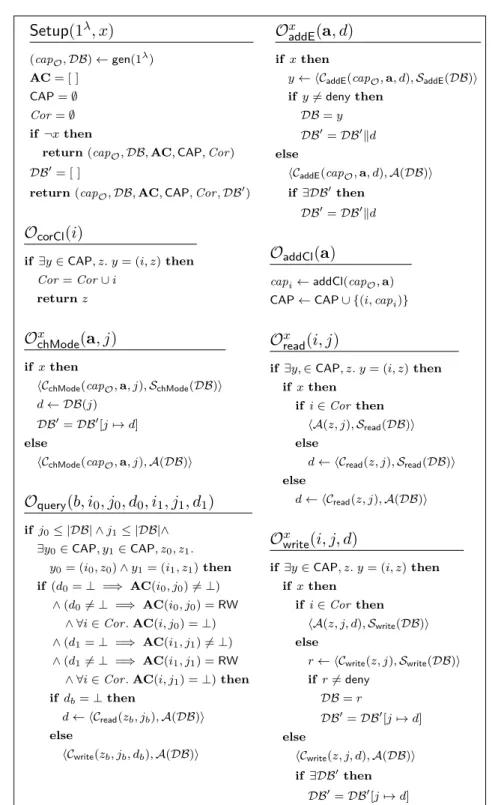
Setup(1λ, x) (capO,DB)←gen(1λ) AC= [ ] CAP=∅ Cor=∅ if¬xthen
return(capO,DB,AC,CAP,Cor)
DB0= [ ]
return(capO,DB,AC,CAP,Cor,DB0)
OcorCl(i) if∃y∈CAP, z. y= (i, z)then Cor=Cor∪i returnz Ox chMode(a, j) ifxthen
hCchMode(capO,a, j),SchMode(DB)i
d← DB(j) DB0=DB0[j7→d] else hCchMode(capO,a, j),A(DB)i Oquery(b, i0, j0, d0, i1, j1, d1) ifj0≤ |DB| ∧j1≤ |DB|∧ ∃y0∈CAP, y1∈CAP, z0, z1. y0= (i0, z0)∧y1= (i1, z1)then if (d0=⊥ =⇒ AC(i0, j0)6=⊥) ∧(d06=⊥ =⇒ AC(i0, j0) =RW ∧ ∀i∈Cor.AC(i, j0) =⊥) ∧(d1=⊥ =⇒ AC(i1, j1)6=⊥) ∧(d16=⊥ =⇒ AC(i1, j1) =RW ∧ ∀i∈Cor.AC(i, j1) =⊥)then ifdb=⊥then d← hCread(zb, jb),A(DB)i else hCwrite(zb, jb, db),A(DB)i Ox addE(a, d) ifxthen
y← hCaddE(capO,a, d),SaddE(DB)i ify6=denythen DB=y DB0=DB0kd else hCaddE(capO,a, d),A(DB)i if∃DB0then DB0=DB0kd OaddCl(a)
capi←addCl(capO,a)
CAP←CAP∪ {(i,capi)}
Ox read(i, j) if∃y,∈CAP, z. y= (i, z)then if xthen ifi∈Cor then hA(z, j),Sread(DB)i else d← hCread(z, j),Sread(DB)i else d← hCread(z, j),A(DB)i Ox write(i, j, d) if∃y∈CAP, z. y= (i, z)then if xthen ifi∈Cor then hA(z, j, d),Swrite(DB)i else r← hCwrite(z, j),Swrite(DB)i ifr6=deny DB=r DB0=DB0[j7→d] else hCwrite(z, j, d),A(DB)i if∃DB0then DB0=DB0[j7→d]
We do that by defining a set of oracles, to a selection of which the adversary has access in every game. That selection is specified in each game separately. The oracles implement the respective functionality with which they are indexed. The flag x, which is present in the oraclesOx
addE(·),OchModex (·),Oreadx (·), and Owritex (·) determines where the database DB
is stored. If the flag is set,DB is controlled by the challenger and the adversary only has access to it via oracles. If it is not set, the adversary controls the database. We use the sets CAPandCor to keep track of issued capabilities and corrupted clients, respectively. Furthermore, in some cases we need an auxiliary database DB0, which is supposed to maintain the correct state of the database, independent of the actions of the adversary. For instance, as we will later see in the definition of integrity, the adversary is supposed to inject a payload into the database DB, which is not reflected in DB0, which means that it is able to manipulate DBwithout holding access permissions. Finally, the oracle Oquery is
required for the obliviousness definitions and contains a quite complex condition, which restricts the possible client and data indices that may be queried. This is necessary so as to rule out trivial attacks based on different access permissions for the challenge indices. The oracles are reported in Figure 2.1.
2.2.3.2. Secrecy
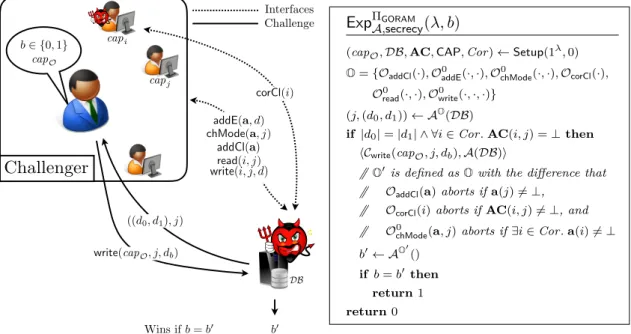
Intuitively, a Group ORAM preserves the secrecy of outsourced data if no party is able to deduce any information about the content of any entry she does not have access to. We formalize this intuition through a cryptographic game in the following definition, which is also illustrated below.
Definition 2.2 (Secrecy). A Group ORAM ΠGORAM preserves secrecy, if
PrhExpΠGORAM
A,secrecy(λ, b) = 1 i
is negligibly (in λ) close to 1/2 for every ppt adversary A,
where ExpΠGORAM
A,secrecy(λ, b) is the following game:
6 M. Maffei et al. / Multi-Client ORAM for Privacy and Access Control in Outsourced Personal Records
b: {0,1}, write(DB, db, j) b’ WIN iff b = b’ capO CHALLENGER ADVERSARY ((d0, d1), j) read, write, chMode, addEntry, addClient DB corruptClient
Figure 1. Game for Secrecy. 2.3. Security and Privacy Properties
2.3.1. Secrecy
Intuitively, a Group ORAM preserves the secrecy of outsourced data if no party is able to deduce any information about the content of any entry she does not have access to. We formalize this intuition through a cryptographic game in the following definition, which is illustrated inFigure 1.
Definition 2(Secrecy).A Group ORAMGORAM= (gen,addCl,addE,chMode,read,write)preserves secrecy, if for everyPPTadversaryAthe following probability is negligible in the security parameter :
Pr⇥ExpSecAGORAM(,1) = 1⇤ Pr⇥ExpSecAGORAM(,0) = 1⇤
whereExpSecA
GORAM(, b)is the following game:
Setup:The challenger runs(capO,DB) gen(1 ), setsAC:= [], and runs a black-box simulation of
Ato which it hands overDB.
Queries:The challenger providesAwith interactive interfacesaddCl,addE,chMode,read,write, and
corClthatAmay query adaptively and in any order. Each roundAcan query exactly one interface. These interfaces are described below:
(1) On inputaddCl(a)byA, the challenger executesaddCl(capO,a)locally and stores the capability capireturned by the algorithm.
(2) On inputaddE(a, d)byA, the challenger executeshCaddE(capO,a, d),SaddE(DB)iin interaction
withA, where the former plays the role of the client while the latter plays the role of the server. (3) On inputchMode(a, j)byA, the challenger executeshCchMode(capO,a, j),SchMode(DB)iin
inter-action withA.
(4) On inputcorCl(i)byA, the challenger hands over the capabilitycapirelated to thei-th client in the
access control matrixAC.
(5) On inputread(i, j)byA, the challenger executeshCread(capi, j),Sread(DB)iin interaction withA.
(6) On inputwrite(i, j, d)byA, the challenger executeshCwrite(capi, j, d),Swrite(DB)iin interaction
withA.
Challenge:Finally,Aoutputs(j,(d0, d1)), wherejis an index denoting the database entry on which
Awants to be challenged and(d0, d1)is a pair of entries such that|d0|=|d1|. The challenger accepts
the request only ifAC(i, j) =?, for everyicorrupted byAin the query phase. Afterwards it invokes
hCwrite(capO, j, db),Swrite(DB)iin interaction withA.
Output:In the output phaseAstill has access to the interfaces except foraddClon inputasuch that
a(j)6=?;corClon inputisuch thatAC(i, j)6=?; andchModeon inputa, iwitha(i)6=?for some b2 {0,1} capO capi capj corCl(i) addCl(a) addE(a, d) chMode(a, j) read(i, j) write(i, j, d) DB ((d0, d1), j) write(capO, j, db) Interfaces Challenge b0 Wins ifb=b0 Challenger
secrecy
ExpΠGORAM A,secrecy(λ, b)(capO,DB,AC,CAP,Cor)←Setup(1λ,0)
O={OaddCl(·),O0addE(·,·),OchMode0 (·,·),OcorCl(·),
O0
read(·,·),Owrite0 (·,·,·)}
(j,(d0, d1))← AO(DB)
if|d0|=|d1| ∧ ∀i∈Cor.AC(i, j) =⊥then
hCwrite(capO, j, db),A(DB)i
//O0 is defined asOwith the difference that // OaddCl(a)aborts ifa(j)6=⊥,
// OcorCl(i)aborts ifAC(i, j)6=⊥, and
// O0
chMode(a, j)aborts if∃i∈Cor.a(i)6=⊥
b0← AO0()
ifb=b0 then return1
2.2.3.3. Integrity
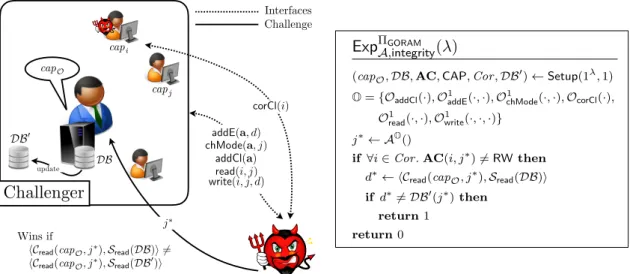
A Group ORAM preserves the integrity of its entries if none of the clients can modify an entry to which she does not have write permissions. The respective cryptographic game is depicted next to the game formalization.
Definition 2.3 (Integrity). A Group ORAM ΠGORAM preserves integrity, if
PrhExpΠGORAM
A,integrity(λ) = 1 i
is negligible inλfor every pptadversary A, whereExpΠGORAM
A,integrity(λ)
is the following game:
M. Maffei et al. / Multi-Client ORAM for Privacy and Access Control in Outsourced Personal Records 7
WIN!iff read(DB,%j*)%≠ read(DB’,%j*)%
CHALLENGER ADVERSARY j* corruptClient! update! DB’ read,!write,!chMode,! addEntry,!addClient! DB capO
Figure 2. Game for Integrity.
Figure 3. Game for Tamper-resistance.
previously corrupted clienti. Eventually,Astops, outputting a bitb0. The challenger outputs 1 if and only ifb=b0.
2.3.2. Integrity
A Group ORAM preserves the integrity of its entries if none of the clients can modify an entry to which she does not have write permissions. The respective cryptographic game is depicted inFigure 2 and we formalize it below.
Definition 3(Integrity).A Group ORAMGORAM= (gen,addCl,addE,chMode,read,write) pre-serves integrity, if for everyPPTadversaryAthe following probability is negligible in the security pa-rameter:
Pr⇥ExpIntAGORAM( ) = 1⇤
whereExpIntAGORAM( )is the following game:
Setup:The challenger runs(capO,DB) gen(1 ), setsAC:= [], and runs a black-box simulation of
A. Furthermore, the challenger initializes a second databaseDB0:= []which is managed locally.
Queries:The challenger providesAwith the same interfaces as inDefinition 2, whichAmay query adaptively and in any order. SinceDBis maintained on the challenger’s side, the queries toaddE,
chMode,readandwriteare locally executed by the challenger. Furthermore, the challenger updatesDB0
locally for all affecting interface calls.
Challenge:Finally, the adversary outputs an indexj⇤which he wants to be challenged on. If there exists a capabilitycapiprovided toAwithAC(i, j⇤) =RW, the challenger aborts. Otherwise it runs
d⇤ hCread(cap
O, j⇤),Sread(DB)ilocally. Output:It outputs1if and only ifd⇤6=DB0(j⇤).
capi
capj
Challenger
capO
Wins if
hCread(capO, j⇤),Sread(DB)i 6=
hCread(capO, j⇤),Sread(DB0)i
integrity
DB DB0 update Interfaces Challenge corCl(i) addCl(a) addE(a, d) chMode(a, j) read(i, j) write(i, j, d) j⇤ ExpΠGORAM A,integrity(λ)(capO,DB,AC,CAP,Cor,DB0)←Setup(1λ,1)
O={OaddCl(·),O1addE(·,·),O 1 chMode(·,·),OcorCl(·), O1read(·,·),O1write(·,·,·)} j∗← AO() if∀i∈Cor.AC(i, j∗)6=RWthen
d∗← hCread(capO, j∗),Sread(DB)i ifd∗6=DB0(j∗)then
return1
return0
2.2.3.4. Tamper-resistance
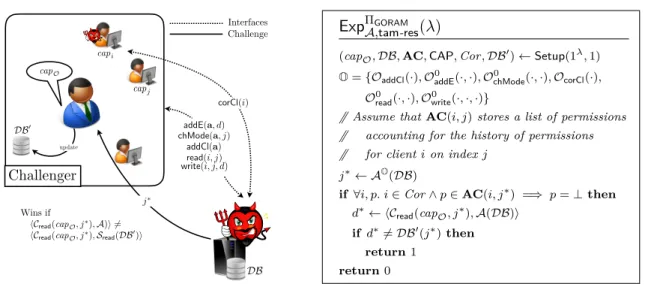
Intuitively, a Group ORAM is tamper-resistant if the server, even colluding with a subset of malicious clients, is not able to convince an honest client about the integrity of some maliciously modified data. Notice that this property refers to a strong adversarial model, where the adversary may arbitrarily misbehave and collude with clients. Naturally, tamper-resistance holds true only for entries which none of the corrupted clients had ever access to. The respective cryptographic game is depicted below next to its formalization.
Definition 2.4 (Tamper resistance). A Group ORAM ΠGORAM is tamper-resistant, if for
all ppt adversaries A, PrhExpΠGORAM
A,tam-res(λ) = 1 i
is negligible in λwhere ExpΠGORAM
A,tam-res(λ) is
2. Group ORAM
WIN!iff read(DB,%j*)%≠read(DB’,%j*)%
CHALLENGER ADVERSARY j* read,!write,!chMode,! addEntry,!addClient! DB update! DB’
Figure 3. Game for Tamper-resistance.
Figure 4. Game for Obliviousness.
parameter: Pr⇥ExpTamResA
GORAM( ) = 1 ⇤
whereExpTamResAGORAM( )is the following game:
Setup:The challenger runs the Setup phase as inDefinition 2. Furthermore, it forwardsDBtoAand initializes a second databaseDB0which is managed locally.
Queries:The challenger providesAwith the same interfaces as inDefinition 2, whichAmay query adaptively and in any order. Furthermore, the challenger updatesDB0locally for all affecting interface calls.
Challenge:Finally, the adversary outputs an indexj⇤which he wants to be challenged on. If there exists a capabilitycapithat has ever been provided toAsuch thatAC(i, j⇤) =RW, then the challenger aborts. The challenger runsd⇤ hCread(capO, j⇤),Sread(DB)iin interaction withA.
Output:It outputs1if and only ifd⇤6=DB0(j⇤). 2.3.4. Obliviousness
Intuitively, a Group ORAM is oblivious if the server cannot distinguish between two arbitrary query sequences which containreadandwriteoperations. The cryptographic game is defined below and illus-trated in inFigure 4.
Definition 5(Obliviousness).A Group ORAMGORAM= (gen,addCl,addE,chMode,read,write)is oblivious, if for everyPPTadversaryAthe following probability is negligible in the security parameter:
Pr⇥ExpObvA
GORAM(,1) = 1⇤ Pr⇥ExpObvAGORAM(,0) = 1⇤
whereExpObvAGORAM(, b)is the following game:
Wins if
hCread(capO, j⇤),A)i 6=
hCread(capO, j⇤),Sread(DB0)i
tamper-resistance
capi capj Challenger capO DB0 update corCl(i) addCl(a) addE(a, d) chMode(a, j) read(i, j) write(i, j, d) j⇤ DB Interfaces Challenge Exp ΠGORAM A,tam-res(λ)(capO,DB,AC,CAP,Cor,DB0)←Setup(1λ,1)
O={OaddCl(·),OaddE0 (·,·),O 0 chMode(·,·),OcorCl(·), O0 read(·,·),O 0 write(·,·,·)}
// Assume thatAC(i, j)stores a list of permissions // accounting for the history of permissions // for cliention indexj
j∗← AO(DB) if ∀i, p. i∈Cor∧p∈AC(i, j∗) =⇒ p=⊥then d∗← hCread(capO, j∗),A(DB)i if d∗6=DB0(j∗)then return1 return0 2.2.3.5. Obliviousness
Intuitively, a Group ORAM is oblivious if the server cannot distinguish between two arbitrary query sequences which contain read and write operations. The cryptographic game is defined below and illustrated right next to the game formalization. We notice that the universally quantified restrictions in the definition of Oquery in Figure 2.1 concerning the corrupted clients have no effect on the if clause. The reason is that the set Cor is always empty due to the missing OcorCl oracle. Hence, any universal quantification over
Cor is true.
Definition 2.5 (Obliviousness). A Group ORAM ΠGORAM is oblivious, if
PrhExpΠGORAM
A,obliv (λ, b) = 1 i
is negligibly (inλ) close to 1/2 for every ppt adversary A, where
ExpΠGORAM
A,obliv (λ, b) is the following game:
8 M. Maffei et al. / Multi-Client ORAM for Privacy and Access Control in Outsourced Personal Records
Figure 3. Game for Tamper-resistance.
CHALLENGER ADVERSARY b: {0,1}, capO b’ WIN!iff b = b’ chMode,!addEntry,!addClient! read,!write! query! DB
Figure 4. Game for Obliviousness.
parameter:
Pr⇥ExpTamResA
GORAM( ) = 1
⇤
whereExpTamResA
GORAM( )is the following game:
Setup:The challenger runs the Setup phase as inDefinition 2. Furthermore, it forwardsDBtoAand initializes a second databaseDB0which is managed locally.
Queries:The challenger providesAwith the same interfaces as inDefinition 2, whichAmay query adaptively and in any order. Furthermore, the challenger updatesDB0locally for all affecting interface
calls.
Challenge:Finally, the adversary outputs an indexj⇤which he wants to be challenged on. If there exists a capabilitycapithat has ever been provided toAsuch thatAC(i, j⇤) =RW, then the challenger aborts.
The challenger runsd⇤ hCread(cap
O, j⇤),Sread(DB)iin interaction withA. Output:It outputs1if and only ifd⇤6=DB0(j⇤).
2.3.4. Obliviousness
Intuitively, a Group ORAM is oblivious if the server cannot distinguish between two arbitrary query sequences which containreadandwriteoperations. The cryptographic game is defined below and illus-trated in inFigure 4.
Definition 5(Obliviousness).A Group ORAMGORAM= (gen,addCl,addE,chMode,read,write)is
oblivious, if for everyPPTadversaryAthe following probability is negligible in the security parameter:
Pr⇥ExpObvA GORAM(,1) = 1 ⇤ Pr⇥ExpObvA GORAM(,0) = 1 ⇤ whereExpObvA
GORAM(, b)is the following game:
Interfaces Challenge b0 Wins ifb=b0 (i0, j0, d0/?),(i1, j1, d1/?) hCread(capib, jb),Aiifdb=?or hCwrite(capib, jb, db),Ai Challenger
obliviousness
b2 {0,1} capO capj addCl(a) addE(a, d) chMode(a, j) read(i, j) write(i, j, d) DB ExpΠGORAM A,obliv (λ, b)(capO,DB,AC,CAP,Cor)←Setup(1λ,0)
O={OaddCl(·),O0addE(·,·),O
0
chMode(·,·),
Oquery(b,·,·,·,·,·,·),Oread0 (·,·),Owrite0 (·,·,·)}
b0← AO(DB)
if b=b0then return1
2.2.3.6. Obliviousness against malicious clients
Intuitively, a Group ORAM is oblivious against malicious clients if the server and an arbitrary subset of clients cannot get any information about the access patterns of honest clients, other than what is trivially leaked by the entries that the corrupted clients have read access to. The following definition, graphically supported by the picture next to the formal game description below, is an extension of the previous one which allows the adversary to corrupt arbitrary clients. However, in order to avoid trivial attacks, we restrict the queries of the adversary to thewrite oracle to indices that the set of corrupted clients cannot read. The query oracle already accounts for the further restriction since it aborts whenever it is called to write on indices to which any corrupted client has access to. Definition 2.6 (Obliviousness against Malicious Clients). A Group ORAM ΠGORAM is
oblivious against malicious clients, ifPrhExpΠGORAM
A,m-obliv(λ, b) = 1 i
is negligibly (in λ) close to
1/2 for all pptadversaries A, where ExpΠGORAM
A,m-obliv(λ, b) is the following game:
Interfaces Challenge
obliviousness against malicious clients
b2 {0,1} capO capi capj Challenger Interfaces Challenge b0 Wins ifb=b0 (i0, j0, d0/?),(i1, j1, d1/?) hCread(capib, jb),Aiifdb=?or hCwrite(capib, jb, db),Ai addCl(a) addE(a, d) chMode(a, j) read(i, j) write(i, j, d) DB corCl(i) Exp ΠGORAM A,m-obliv(λ, b)
(capO,DB,AC,CAP,Cor)←Setup(1λ,0)
O={OaddCl(·),OaddE0 (·,·),OchMode0 (·,·),OcorCl(·),
Oquery(b,·,·,·,·,·,·),O0read(·,·),Owrite0 (·,·,·)}
// IfOqueryis called onda6=⊥fora∈ {0,1}
//OchMode(i, ja)aborts ifi∈Cor and
//OcorCl(i)aborts ifAC(i, ja)6=⊥from now on b0← AO(DB)
if b=b0 then return1
return0
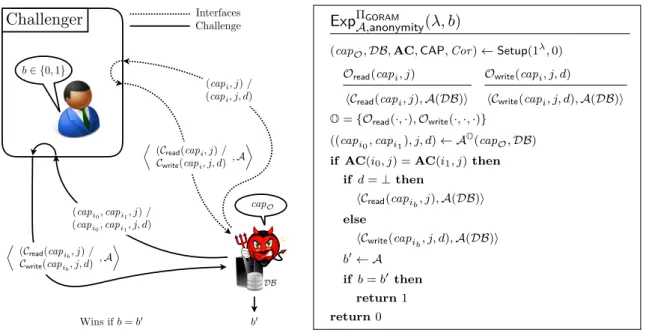
2.2.3.7. Anonymity
A Group ORAM preserves anonymity if the data owner cannot efficiently link a given operation to a client, among the set of clients having access to the queried index. We formalize anonymity as a cryptographic game in the following definition, accompanied by a graphical illustration.
Definition 2.7 (Anonymity). A Group ORAM ΠGORAM preserves anonymity, if
PrhExpΠGORAM
A,anonymity(λ, b) = 1 i
is negligibly (in λ) close to 1/2 for every ppt adversary A,
where ExpΠGORAM