An Example of ‘Character Education’ Course Design in the Light
of ‘Experienced Centred’ Design for Higher Education
Nida Temiz
Department of Primary Education, Başkent University, Ankara, Turkey Abstract
The purpose of this study is to design the course ‘Character Education’ in the light of the ‘experienced centred’ design and to assert an example of ‘Character Education’ course design for higher education students. The research was conducted during the 2015-2016 spring semester as an action research. The participants consisted of 36 higher education students on the basis of the criterion sampling and convenience sampling methods. The data was collected throughout the course via open-ended questionnaire, interviews, and observation. Descriptive and content qualitative analyses were conducted. On the basis of the results of the data analysis, the purposes of the course were gathered under three main goals, the content of the course comprised of theoretical knowledge of and practice in character education, various methods and techniques, especially film and discussion, were used. The results of the assessment and evaluation part indicated that the course was effective and the students attained the goals of the course.
Keywords: character education, experienced centred design, higher education, and course design
1. Introduction
In the world, most of the society has suffered from social degeneration in some sense and so the societies looked for a solution. Lake (2011) imported some events, like increasing violence in schools, acts of violence around, had proposed the term good character for the agenda. In this regard, it has been clear that schools with their teachers, administrators, other personnel and parents, are important one of the solution partners. For contemporary awareness of character education in schools especially primary schools, Lickona (1996) asserted three reasons; (i) we need good character as human being, (ii) schools are convenient settings where character education is actualized, (iii) actualization of character education is vital to construct ethic society.
With the awareness and the reasons, there are various and different approaches and implementations for character education. Moreover, there are many concepts which are used as if their meanings are same with character education. The concepts are ethic education, moral education, value/s education, virtue education etc. Furthermore, Agboola and Tsai (2012) expressed the need of studies about the similarities and differences in character education and moral education. At this juncture, Linkona (1996) stated that character education emerged from the effort to apply the programs in the field of moral, value, ethic and citizenship education at schools, at least for American schools, as a major concept. In this regard, it can be stated that character education is as broad as covering value, moral, ethic, virtue education. In this regard, Lin, Enright and Klatt (2011) also stated that Berkowithz and colleagues indicated a confusion originated from educators’ and researchers’ differently usage of the terms ‘character education, moral education and values clarification.’ Berkowitz touched the confusion by integrative approach and use ‘character education’ as an inclusive term (Lin et al., 2011). At this juncture, it is time to state three important definitions for character education. First, Howard, Berkowitz and Schaeffer (2004) defined character education as an initiative to cultivate individuals to make ethical judgments and to performance on them. Second, Beachum, McCray, Yawn and Obiakor (2013) defined character education as ‘the explicit teaching of positive values by teachers, which is supported by the school’ (p. 470). Final, The Character Education Partnership, one of the prominent new advocacy groups about character education, defined character education as schools’, parents’ and society’s endeavoring to make young to attach importance to values and act the values (Lickona, 1996).
In other words, it can be concluded that the word ‘character’ in ‘character education’ indicates characteristics of well-behaved and ethic person, virtuousness, model citizen. Furthermore, Çubukçu (2012) expressed ‘Character includes individual’s willingness to try doing the best for others, moral reasoning, honest and responsible behaviors, personal and emotional characteristics which provide effective approaches in various situation and social commitment’ (p. 1513). Moreover, Berkowitz and Bier (2004) defined character as ‘Character is the complex set of psychological characteristics that enable an individual to act as a moral agent’ (p.73).
Çubukçu (2012) stated that the society where individual lived in and national, moral values affect the individual’s character forming. Values and characteristics which would be included in character education can be determined according to community and culture; however, there are universal values and characteristics. In this regard, Helterbran and Strahler (2013) stated review of scholarly literature, major world religious and well-known secular organizations cited self-esteem, self-discipline, personal responsibility, respect to others, serving humankind and environmental consciousness as universal value examples.
moral statements but also being polite, kind, generous, straight, and honest. He added that character education was complex, difficult and not easy pedagogic process because of that. Furthermore, he expressed that there was need for references and principles which could be both prescriptive and open to discussion. Besides, he stated that the principles can be relatively cultural and related with religious beliefs.
The Character Education Partnership (CEP- Character.org.) expressed 11 principles called ‘The 11 Principles of Effective Character Education.’ They stated that the principles offered guide for curriculum integration, extra-curricular activities, maximizing character education outcomes. The principles are as follows;
(1) The school community promotes core ethical and performance values as the foundation of good character.
(2) The school defines ‘character’ comprehensively to include thinking, feeling, and doing. (3) The school uses a comprehensive, intentional, and proactive approach to character development. (4) The school creates a caring community.
(5) The school provides students with opportunities for moral action.
(6) The school offers a meaningful and challenging academic curriculum that respects all learners, develops their character, and helps them to succeed.
(7) The school fosters students’ self-motivation.
(8) The school staff is an ethical learning community that shares responsibility for character education and adheres to the same core values that guide the students.
(9) The school fosters shared leadership and long-range support of the character education initiative. (10) The school engages families and community members as partners in the character-building effort.
(11) The school regularly assesses its culture and climate, the functioning of its staff as character educators, and the extent to which its students manifest good character. (http://character.org/more-resources/11-principles/)
The literature review indicated that character education is important and should be taken seriously for healthy individuals and so healthy community. Lickona (1996) emphasized ten worrying youth trends which were seen in large measure to cut across national borders. The trends;
(1) Rising youth violence.
(2) Increasing dishonesty (lying, cheating, and stealing).
(3) Greater disrespect for parents, teachers, and other legitimate authority figures. (4) Increasing peer cruelty.
(5) A rise in bigotry and hate crime. (6) The deterioration of language. (7) A decline in the work ethic.
(8) Increasing self-centeredness, accompanied by declining personal and civic responsibility. (9) A surge of self-destructive behaviors such as premature sexual activity, substance abuse and suicide.
(10)Growing ethical illiteracy, including ignorance of moral knowledge as basic as the Golden Rule and the tendency to engage in behaviors injurious to self or others without thinking it wrong. (p.94) Although there have been the trends and importance of character education, the literature review indicated that studies about character education at higher education level in Turkey are rare or absent. Furthermore, Berkowitz and Bier (2004) emphasized that there has been plenty of character education practices but not research on it. They added that interest in character education was widely disseminated in the middle third of the twentieth century however a little research was conducted. Fortunately, last thirty-five years, researchers had been interested in character education since therefore effectiveness of character education practices has begun to take concerning. Moreover, Beachum et al. (2013) also underlined the lack of research study conducted about pre-service teachers. Therefore, this study has attempted to fulfil the absence in terms of developing an instructional design based on experienced centred design and asserting an example of ‘Character Education’ course design for higher education. 2. Method
2.1 Participants of the Study
The participants of the study consisted of 36 higher education students on the basis of the criterion sampling and convenience sampling of purposeful sampling methods. The criterion was the participants should willingly enrol the elective course ‘Character Education.’ The sampling method could be seen as also convenience sampling because the elective course had been proposed and opened by the researcher. The following table gives information about the participant students of the study.
Table1. Participants of the Study Department
3rd grade 4th grade
Total
Female Male Female Male
Primary Education 24 4 3 - 31
Early Childhood Education - - 5 - 5
2.2 Data Collection Methods and Instruments
In this study, interview and observations were the main data collection methods. In addition, questionnaires were also used as a data collection instrument. The instruments of the methods are explained as following.
Interview instrument
The types of the interview questions being within the structure of the form were semi-structured. Based on the experts’ opinions, the semi-structured interview instruments were prepared and piloted before actual implementation. After that, necessary modifications were made to the interview instrument to improve its readability, meaningfulness, appropriateness and so forth. The semi-structured interviews were administered to the participants after each session as group. Also, informal conversational interviews were conducted throughout the study.
The main focuses of the interviews were constructed in the light of the aspects of the course design for different phases of this study. The focuses were (i) purposes, (ii) content, (iii) methods.
Observation form
Observations had been conducted since 4th week of the academic semester. When was the students performed in character education practices. The researcher focused on following focal points; (i) content [Is it enough or does it need to be improved? Could new needs emerge?] (ii) methods [Whether they work on or not? If not, which solution or improvements could be tried?]
The observation form was developed by the researcher and actually it contained the focal points serving as reminders. The researcher took notes on the forms from the 7th week.
Questionnaire
The questionnaire was prepared by the researcher with one open ended question ‘What is not character education?’ The researcher tried to go deeper and enable the participants to think hard on ‘character education’ by using the reverse question. The questionnaire was applied to the participants before and after the semester.
2.3 Design and Overall Procedure of the Study
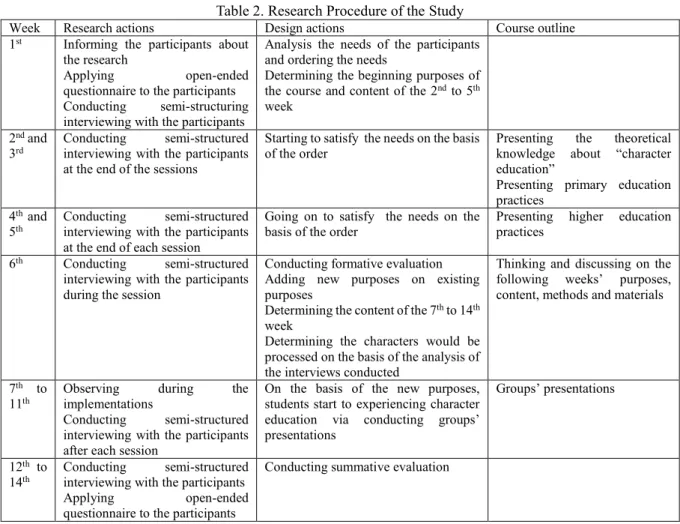
The purpose of the study required exhibition and explanation of how each component of the process contributes to the overall design procedure. Having the purpose of the study and its requirement in mind, an action research, one of the qualitative research types, was conducted. The following figure summarizes the design process of the study.
Table 2. Research Procedure of the Study
Week Research actions Design actions Course outline
1st Informing the participants about the research
Applying open-ended
questionnaire to the participants Conducting semi-structuring interviewing with the participants
Analysis the needs of the participants and ordering the needs
Determining the beginning purposes of the course and content of the 2nd to 5th week
2nd and 3rd
Conducting semi-structured interviewing with the participants at the end of the sessions
Starting to satisfy the needs on the basis of the order
Presenting the theoretical
knowledge about “character education”
Presenting primary education practices
4th and 5th
Conducting semi-structured interviewing with the participants at the end of each session
Going on to satisfy the needs on the basis of the order
Presenting higher education practices
6th Conducting semi-structured
interviewing with the participants during the session
Conducting formative evaluation Adding new purposes on existing purposes
Determining the content of the 7th to 14th week
Determining the characters would be processed on the basis of the analysis of the interviews conducted
Thinking and discussing on the
following weeks’ purposes,
content, methods and materials
7th to 11th
Observing during the
implementations
Conducting semi-structured interviewing with the participants after each session
On the basis of the new purposes, students start to experiencing character
education via conducting groups’
presentations
Groups’ presentations
12th to 14th
Conducting semi-structured interviewing with the participants
Applying open-ended
questionnaire to the participants
Conducting summative evaluation
3. Data Analysis
On the basis of the descriptions stated by Yıldırım and Şimşek (2003) and Strauss and Corbin (1990), the data analysis of the study was actualized at four steps in a qualitative manner. The four steps are (1) data coding, (2) generating categories, (3) organizing data according to codes and categories, (4) conclusion from findings.
In detail, firstly, the researcher reviewed the data gained from the questionnaire applied to the students at the beginning of the course. Then, the code list was formed. Next, the data obtained from the questionnaire, interview and observation about the purposes of the study was analysed in accordance with the code list. Moreover, new codes were added during the analysis process and coded the data with the new code list. Like composing of the code list for the purposes of the course, for all component, composing code list was started with analysing data obtained from first data resource and forming the code list on the basis of the other resources related with the focus component. Secondly, the researcher reviewed the code list all together and found common features among them. The common features generated categories. The data was systematized under the categories. Thirdly, the researcher defined data in accordance with code and categories and arranged quotations and findings. Lastly, the findings were interpreted by the researcher.
3.1 Validity and Reliability of the Study
In qualitative research, one important concept was triangulation to ensure reliability and validity. In the current study, data triangulation was actualized by gathering data through various methods and data sources from the same participants such as interviews, informal conversational interviews, observations, questionnaires.
4. Results
The main purpose of this study was to design the course ‘Character Education’ in the light of the ‘experienced
centred’ design. Thus, the results were presented under the each component of design process; purposes, content,
methods, assessment and evaluation. 4.1 Purposes
On the basis of the experienced design, the instructor and the participant students worked with together for determining the purposes of the course. In this regard, determination of the purposes was encountered two times
during the design process; (i) at the beginning of the semester via open-ended questionnaire with one question ‘What is not character education?’ (ii) during the semester via interviews.
By analysing the students’ answers to the open-ended questionnaire revealed what they knew about the
term ‘character education’ and which misconceptions they had. In this regard the analysis is a part of ongoing needs assessment throughout the design in terms of its’ finding out the gap between ‘what is’ and ‘what should be’. The analysis of the questionnaire showed that most of the students had misconceptions about ‘character
education.’ In this regard, the analysis revealed that most of the students stated that character education was not
education having curriculum and plan. The second most telling answer was that character education was not for students except primary education. The last was that character education was not easy. The following answers as stating frequency were that character education was not ‘old,’ ‘necessary for our society,’ ‘new.’
Furthermore, the students were interviewed about their answers and what they knew and what they wanted to know about the character education. The analysis of the data obtained from the interviews yielded that the students affirmed opinions parallel with their answers to the questionnaire.
Like to the questionnaire, during interview most of the students stated that character education was not education having curriculum and plan. In this regard, 14 of the students said they had never seen any character education curriculum, plan and also course name weekly lesson plan of primary education. In their statements, there was one more point to consider. It was emphasis on primary education. 13 of the students also stated character education was for primary education and it took place in other courses’ curriculum like social sciences, religious culture and moral knowledge etc. instead of having its own curriculum. The following excerpts were taken from the analysis of the interviews with the students indicating the answers ‘Character education is not education having curriculum and plan.’ and ‘Character education is not for students except primary education.’
I think there is no any character education curriculum and plan because I haven’t seen any curriculum or plan yet. (sts1)
I believe character education is an informal education so it hasn’t any curriculum. Besides, I don’t know enough about character education, thus I enrolled the course. (sts33)
I have never heard character education for over 12 years of age. It seems to be for children. (sts24) During the interview, eight students stated that character education was not old. In this respect, the following excerpts were taken from the students’ answers.
I have heard it for two years. I think it is a new approach. (sts17)
Character education, I think, is a new educational slogan especially for private primary school because I have heard it for two-three years however I couldn’t see any detail content except banner on internet sites in Turkey. (sts19)
I didn’t hear it before the elective course so it must have been new education. (sts20)
The analysis of both the questionnaire and the interviews showed that two of the students stated that character education was not urgent for our society. One of them said that ‘Character education, I think, related with being good person and so we are good people. It is not urgent necessity for our society.’ (sts16)
Also, the analysis of both the questionnaire and the interview indicated that there was one opinion not stated to questionnaire. The opinion was that the character education was not new. The student said ‘I think character education is about being good person. Therefore it shouldn’t be new; it looks like moral education, value education. Character education can be another concept for value education.’ (sts31)
The analysis of the interviews also indicated that the students wanted to know theoretical foundation about the character education in terms of ‘what the character education actually is; what are the differences and similarities between the character education and the value education, moral education etc; which country is the origin of the character education; which needs give rise the character education; how character education is actualized; what the character education examples are.’
In this regard, all the students stated they needed to have theoretical foundation of character education. All 36 students stated the need in some way. The following excerpts were taken from the analysis of the interviews. Actually, almost all enrolling the course have needed to know what character education is, how it is conducted to primary education students. (sts2)
I don’t know what literature says about character education because I didn’t find out books, articles about character education. I expect you will give necessary information about character education. (sts4) I want to learn firstly which country is the origin of the character education, secondly why character education is conducted and lastly what character education is. Then I want to think and comment on it. (sts15)
I am most curious about how we conduct character education. I want to learn about the implementations of the character education for primary education. (sts7)
I wonder if character education is new educational approach or not. If it is yes, I want to know what are the differences and similarities among moral education, value education and character education. (sts31) Thus far, the analysis of the questionnaire and the interviews conducted in the first week of the course was
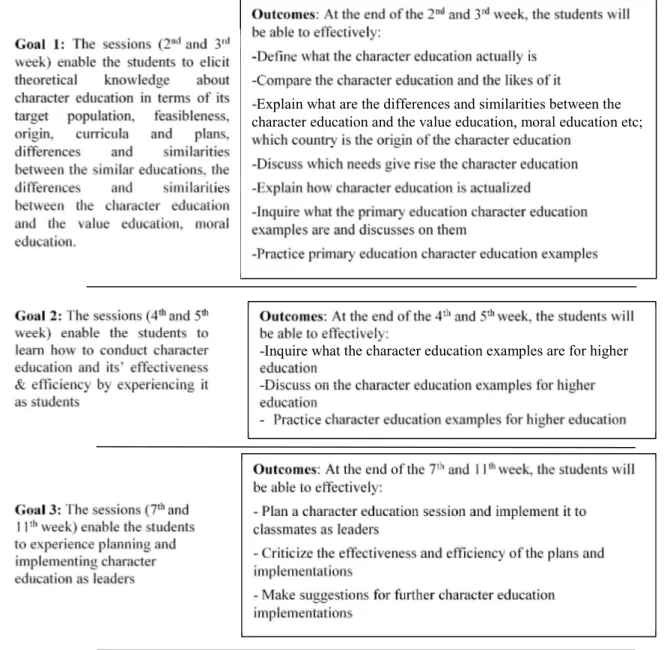
presented. On the basis of the analysis, the beginning purposes of the course and so outline of the 2nd, 3rd, 4th and 5th weeks were determined. The Figure 2 was about the purposes.
Figure 2. Goals and Outcome of the Course Designed
4.2 Content
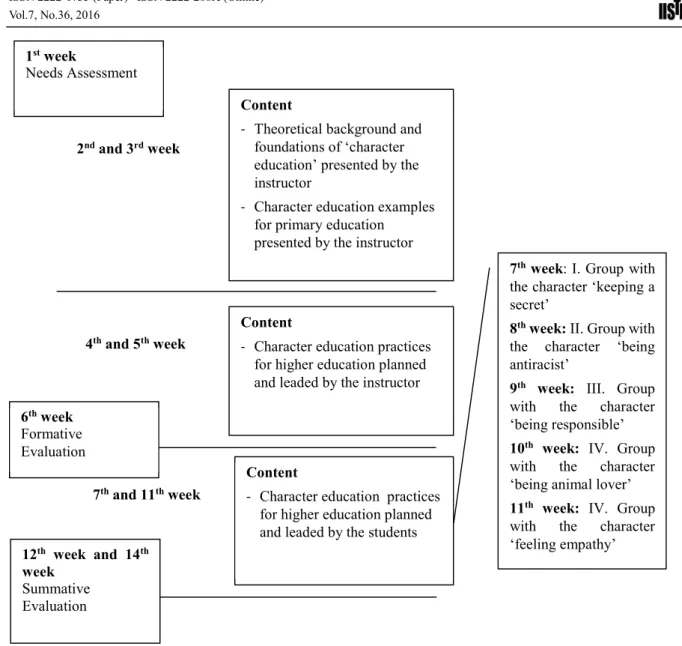
Like determining the purposes, the content of the course was determined by the instructor and students together. The data about the content were gathered throughout the semester via ongoing interviews. Actually, the analysis of the data gathered thorough questionnaire and interviews conducted at 1st week of the course form the content of the 2nd to 5th week of the course. Besides, the interviews were conducted at the end of the each session of the course from 2nd and 5th. In addition, the group interview conducted with the class in 6th week had the question directly related with content.
The analysis of the interviews conducted till 6thweek indicated that the following weeks’ content. All students stated that they wanted to experience character education by being both instructor and learner except one student who wanted to read articles about character education and discuss on it. In this respect, the following excerpts were taken from the interviews.
I thought character education was limited with primary education, now I see it is not only for children but also for adults. It really works with us, I am a little surprised. Thus, I think it is time to experience it as leader. It means that I think the following weeks; we can choice a character and plan, activity for making
a difference in our classmates’ character or touching their soul in some way. (sts6, 4th week)
characters and implementing them to all classmates. (sts10, 5th week)
I stated what I wanted to learn at the beginning of the course and I satisfied with the content of the course so far. I expect to experience character education by implementing it coming weeks. (sts20, 5th week) The analysis of the students’ answers to the question directly related with the content of the group interview conducted with all class in the 6th week yielded same result with the analysis of the interviews conducted previously.
I think I cannot wait to experience character education by planning and implementing myself. Because I liked the examples presented by you, I learned what I need to know character education. (sts27)
I agree with student 27. We should begin to plan and implement character education lessons. (sts34) Yes, I think like my friends. Also, we used to make plan and implement it in other courses and that activity make me learn by doing. (sts30)
In addition to this, the data analysis showed two students who stated they wanted to read and discuss article before the 6th week, agreed on that the content of the next weeks should be composed of experiencing determined characters by students.
I have stated next weeks’ content could be composed of articles about character education. However, I see that experiencing it by planning activities and implementing to our friends is good idea. Thus, I agree with their idea. (sts14)
Besides, the group interview enabled the students discuss on how they determine characters. The analysis of the discussion indicated that five students expressed that the characters should be determined by instructor at the beginning of the discussion. One of them said ‘I think you should determine the characters on which we study. Because we may not determine characters appropriately.’ (sts9) The other four students expressed they agree with
the student’s opinion. However, one group of class object to the opinion by stating the characters should be
determined by themselves because they can know what the character they need best. In this respect, one student stated
Dear friends, the characters should be needed by us and also as convenient as we can feel comfort to study on it. Besides this, we have acquired necessary theoretic knowledge and implementation examples about character education. Therefore, we should determine characters. (sts29)
After the statement, the five students persuadedly agreed on determining characters by themselves.
Then, the class was divided into groups with 5 students. The groups chosen one character as the character they would prepare activities for bringing and implement it to other groups. The groups determined their character and each group spokesman explained why they chosen it to only instructor because students’ did not want to learn the purpose and the character of groups before presentations. The each group spokesman explanation was as follows. We determined ‘keeping secret’ as character because we think that we need to realize the importance of it. (1st group spokesman sts6)
We decided on ‘antiracist’ as character. We chose it because our society needs to see what the danger of racism. (2nd group spokesman sts27)
The character we determined is ‘responsibility.’ It seems to be classic, however we will examine unusual aspect of responsibility as character because we think that we need to realize the importance of it. (3rd group spokesman sts36)
We will study on ‘animal lover’ as character because we are animal lover and so happy. We want to share
our happiness with others and enable them to be animal lover. (4th group spokesman sts5)
We chose ‘empathy’ as character because most of us misunderstand empathy so we need to improve empathy character. (5th group spokesman sts18)
Figure 3. Construction of the Content of the Course Designed
4.3 Methods
Thinking and discussing on method of learning and teaching for the course began at 6th week. The examples of the
character education activities presented by the instructor included various methods namely; case study, question and answer, discussion, problem-solving, brainstorming/mind-map, using audio visual aid and also biographies,
diaries, novels, films were used as materials. The interview conducted at 6th week had one question directly related
with methods ‘What do you think about learning-teaching methods of character education? What methods and materials do you want to use for your students as an instructor and for you as learner?’
The analysis of the interviews showed that all students had thought that they could determine methods when they were preparing the activities. In this respect, one of the students stated that ‘On the basis of my experiences up to now, I think there is no one perfect method for character education because the selection of the method depends on the purpose of the character education.’ (sts3) Another student said that ‘I decided that there can not be one fixed method and material for character education after I experienced it previous week. Actually, there is no any best method for any education, isn’t it?’ (sts7) Besides, they stated that they quite likely tend to use eclectic method including various methods and techniques at the same course. In this regard, one of the students stated ‘I can use all methods I know. In fact, I can use more than one method in the same session. I can say that I
will use eclectic method.’ (sts20) After the studentstatement, all together agree that by saying like ‘Yes.’, ‘Yes, I
think so.’, ‘Yes, yes it is right.’
Although, the analysis of the 6th week interview showed that the students tended to use eclectic method, the analysis of the observation notes taken during the sessions planned and implemented so leaded by the group of students showed that all the groups used one method dominantly. The analysis of the interviews conducted after each session leaded by the groups explained why they had tended to use elected method and used one method dominantly was. The students implied that they had still been supporter of eclectic method and material for
Content
- Theoretical background and foundations of ‘character education’ presented by the instructor
- Character education examples for primary education
presented by the instructor 2nd and 3rd week
Content
- Character education practices for higher education planned and leaded by the instructor 4th and 5th week
Content
- Character education practices for higher education planned and leaded by the students 7th and 11th week
7th week: I. Group with
the character ‘keeping a secret’
8th week: II. Group with
the character ‘being antiracist’
9th week: III. Group
with the character ‘being responsible’ 10th week: IV. Group
with the character ‘being animal lover’ 11th week: IV. Group
with the character ‘feeling empathy’ 6th week Formative Evaluation 1st week Needs Assessment 12th week and 14th week Summative Evaluation
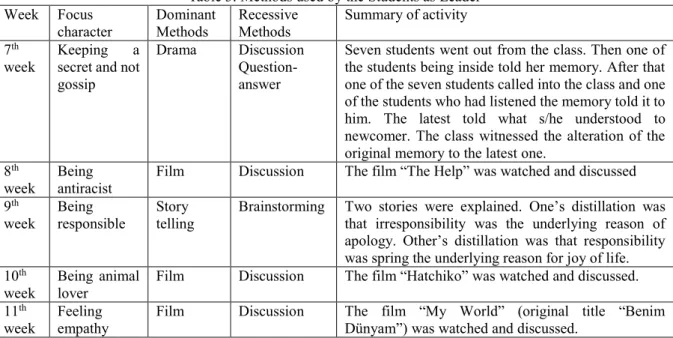
character education however they had one session and they used one method because of insufficient time. Also they added that they thought that the characters about which they prepared plan and implemented it could not be achieved to target population, in this regard, eclectic method should be used naturally if there was not time limitation. The following table prepared on the basis of the analysis of the observation notes.
Table 3. Methods used by the Students as Leader Week Focus character Dominant Methods Recessive Methods Summary of activity 7th week Keeping a secret and not gossip
Drama Discussion Question-answer
Seven students went out from the class. Then one of the students being inside told her memory. After that one of the seven students called into the class and one of the students who had listened the memory told it to him. The latest told what s/he understood to newcomer. The class witnessed the alteration of the original memory to the latest one.
8th week
Being antiracist
Film Discussion The film “The Help” was watched and discussed 9th week Being responsible Story telling
Brainstorming Two stories were explained. One’s distillation was that irresponsibility was the underlying reason of apology. Other’s distillation was that responsibility was spring the underlying reason for joy of life. 10th
week
Being animal lover
Film Discussion The film “Hatchiko” was watched and discussed. 11th
week
Feeling empathy
Film Discussion The film “My World” (original title “Benim Dünyam”) was watched and discussed.
Furthermore, the analysis of the group interviews conducted at the end of each session planned and implemented by the group of students supported the results of the 6th week interviews analysis in terms of eclectic method.
The analysis of the interviews conducted at the end of the 7th week showed that most of the students thought that the method could be named drama and it was fit for the purpose of the session. In this regard, one of the students stated ‘I never thought such a method for the character education, actually the method is not drama, it is planned experience. However, it was perfect for the purpose of the session.’ (sts3)
Like 7th week, the analysis of the interviews conducted at the end of the 8th week indicated that most of the students thought that the method fit for the purpose of the session. Besides, the analysis of the observation notes taken during the discussion indicated that the method of film was effective for the purpose. In this respect five of the students expressed that they impressed with the film in terms of feelings of the minority via feelings of black people. Most of the students said they nearly empathized with the people.
The analysis of the 9th week’s data indicated that all students thought that listening to and trying to make brainstorming on stories was not effective for them. They explained that stories had short-effect which needed to be reinforced by other methods.
Like 8th week, the main method was film in 10th and 11th week and the analysis showed that the method was effective and efficient in terms of the purposes of the sessions. Analysis of the interviews conducted at the end of the sessions showed that all students focused on the purpose of the session. One of the students stated that ‘I like animals, pets however I see what it actually mean via the film.’ (sts8) Another student expressed that ‘This film enable me to feel what disabled people feel.’ (sts13)
4.4 Assessment and evaluation
The final assessment and evaluation of the design was conducted on the basis of the results of final exam, the analysis of the interviews conducted at the 12th to 14th and the comparison of the answers of the students to the open-ended questionnaires which applied to the students at the beginning and end of the study with one question ‘What is not character education?’
Final exam
The final exam had 5 questions attempting to evaluate the theoretical knowledge about character education. The questions were as following;
(1) What is the definition of the term character education on the basis of literature? (20 point) (2) Does character education have specific age range or not? Why? (20 point)
(3) How does character education emerge? Explain giving two examples. (20 point)
(4) What are the difference and similarities between ‘character education’ and similar educations like value education, moral education etc.? (20 point)
Partnership (CEP)? (20 point)
All students had the grade A (95-100). The grades indicated that the students attained the goal1 (Figure1). Comparison of pre-post questionnaires
The analysis of the questionnaire applied at the beginning and end of the course was compared. The result of the comparison indicated that the goal of the course was accomplished. The following table summarizes the comparison.
Table 4. Comparison of the Students’ Answers to the Pre and Post Questionnaire Categories of the answers to the
pre-questionnaire
f Categories of the answers to the post-questionnaire f Character education is not the education
having curriculum and plan. (sts1, sts4, sts5, sts6, sts8, sts9, sts11, sts22, sts24, sts26, sts29, sts32, sts33, sts36)
14 Character education is not education having not curriculum and plan. (sts1, sts2, sts4, sts5, sts6, sts8, sts9, sts11, sts12, sts13, sts14, sts16, sts17, sts18, sts22, sts24, sts26, sts29, sts30, sts32, sts33, sts36)
22
Character education is not for students except primary education level. (sts1, sts4, sts5, sts6, sts7, sts8, sts9, sts11, sts24, sts26, sts27, sts28, sts33)
13 Character education is not limited by age and grade level. (sts1, sts4, sts5, sts6, sts7, sts8, sts9, sts11, sts12, sts13, sts14, sts19, sts23, sts24, sts26, sts27, sts28, sts30, sts33)
19
Character education is not easy. (sts2, sts3, sts6, sts8, sts10, sts12, sts13, sts17, sts18, sts35)
10 Character education is not as difficult as thought. (sts1, sts2, sts3, sts6, sts8, sts9, sts10, sts12, sts13, sts17, sts18, sts35)
12
Character education is not old. (sts14, sts15, sts17, sts19, sts20, sts21,sts23, sts25, sts30)
8 Character education is not old matter. (sts4, sts6, sts14, sts15, sts17, sts19, sts20, sts21, sts23, sts25, sts30)
11 Character education is not urgent for our
society. (sts16, sts34)
2 Character education is not education which can be neglected. (sts9, sts10, sts16, sts17, sts19, sts20, sts23, sts26, sts27, sts34)
10
Character education is not new. (sts31) 1 Character education is not new matter. (sts1, sts4, sts6, sts9, sts20, sts26, sts31)
7 Character education is not free from neither society nor individual. (sts2, sts5, sts6, sts19, sts20, sts28)
6 Character education is not belonging to certain community, discipline, opinion, and course. (sts5, sts6, sts8, sts30, sts31)
5
Character education is not quick-fix education, approach. (sts2, sts3, sts7, sts16, sts17, sts18, sts22, sts24, sts25, sts29, sts36)
11
Character education is not exactly same with value, moral education. (sts2, sts4, sts5, sts6, sts10, sts11, sts17, sts19, sts24, sts26, sts27, sts29, sts30, sts32)
14
Character education is not rule-based, pressure, insistent education. (sts2, sts3, sts7, sts8, sts11, sts16, sts18, sts24, sts33, sts34)
10
Character education is not rote-based education. (sts1, sts3, sts4, sts8, sts11, sts22, sts23, sts24, sts36)
9 As it is seen that there are differences between the answers given to the questionnaires applied at the beginning and end of the course. The differences indicated positive improvement for the goals of the study. In other words, the students’ answers indicating misconceptions were transformed into informed answers about character education. The transformation was explicit that first six categories of the answers given to the pre and post questionnaires. They were one to one transformation. Furthermore, all the students stating misconceptions to the pre-questionnaire were among the students stating informed answers to the post-questionnaire.
Moreover, there were answers given by the students to the post-questionnaire not to the pre-questionnaire. The answers were last seven.
5. Discussion
In this study, open-ended questionnaire with one question ‘What is not character education?’ was applied to the students at the beginning and end of the study. The results were used to determine purposes of the course and also at the end to evaluate the students’ attainment. When we look at the students’ answers given to the 1st application of the questionnaire, it was clear that students had had fallacies about character education. Actually, the fallacies originated from the students’ lack of knowledge in character education. Moreover, their fallacies turned into exact
knowledge about character education. Although in this study, the fallacies resulted from lack of knowledge in character education, the literature showed that there have been skeptical responses, misgivings, misinterpretations for cultivating character and virtue at school such as unclear, redundant, old-fashioned, religious, paternalistic, anti-democratic, conservative, individualistic, relative and situation dependent (Kristjánsson, 2013). At this juncture, the students’ fallacies could be examined in terms of the literature. By this way, why the students’ first answers were named as fallacies is explained. In this regard, the results showed that first fallacy was that the students had thought character education hadn’t any curriculum and plan. The literature indicated that character education has curriculum and plan however the curriculum and plan vary, Russell and Waters (2013) attributed the variety to culture, values, beliefs and countries’ initiatives about character education. In this respect, for country’s initiatives, they gave examples; school-wide standard character education has been carried out in USA, character goals have been integrated into civics and social studies curriculum in UK and Turkey. Also, Karatay (2011) stated that character education initiatives in Turkey has been actualized via the courses such as Social Studies, Turkish, Religious Culture and Moral Knowledge rather than via specific/developed curriculum or course for character education. Therefore, it is clear that the students had not seen any character education curriculum and plan before the course because of Turkey’s initiatives about character education. Moreover, it is clear that character education had had various curriculum and plan around the globe.
On the basis of the results, the second fallacy was that the students had thought character education was for only primary education level. However, the review of literature indicated that character education was lifelong education. In this respect, Russell and Water (2013) said ‘The development of quality character traits is a lifelong journey, for which the foundation is formed from early childhood. A solid character foundation can have a significant impact on a student’s life.’ (p.304). On the basis of the quotation, it can be stated that early years of individual is sensitive and feasible for laying the foundation of good character however it is not limited with the period.
The third fallacy was that students had thought that character education was not necessary for Turkey. However, training students’ character properties has been one of the topics in Turkish Educational System from past to future. In this regard, Katılmış, Ekşi and Öztürk (2011, p.854) said,
In Turkey, National Education Act with number1739 which organizes governments’ task and responsibilities in educational area highlights training people who are academically successful and have rational character properties, when it defines the general aims of Turkish national education (Milli Eğitim Bakanlığı [MEB], 1997). According to this, we can say that the governmental demand is towards young generations’ character development and, research about this issue includes practices in the context of character education. (Lickona, 1991 as cited in Katılmış, Ekşi & Öztürk, 2011, p.854).
The fallacies were taken into consideration when the purposes of the course were being determined and also correspondingly the content of the course were formed. The content of the course designed throughout the study was determined with the students together on the basis of their needs because of the experienced centred design. On the basis of the results obtained from the analysis of the questionnaire and interviews conducted with the students, the 2nd and 3rd weeks’ content was determined as theoretical knowledge including definitions, foundations, various viewpoints and examples of character education. As the parallel with the need of the content, Munson (2000), emphasized that character education should be ingredient of pre-service teacher education programs and the teachers needed to study history of moral education for seeing the changes from past to present. Furthermore, she expressed that pre-service teachers also needed to sense the different philosophical perspectives of moral education.
For character education, various and different methods could be used. In this regard, the literature showed that researchers used various methods and techniques in their study of character education like utilizing literary works and texts (Karatay, 2011), problem solving, cooperative learning, case-studies, discussion techniques (Katılmış et al., 2011), using children’s picture story books (Turan & Ulutas, 2016), as effective method for character education. In this regard, the results of this study showed that students tented to use eclectic method as theoretically but they used one method dominantly, of course time limitation was the main reason for the result. One of the results of the current study about method was that three of five groups chose the ‘film’ as dominant method when they practicing character education via their plan and implementation as leader. Also all three used the method of ‘discussion’ as recessive method for their education. Russell and Waters (2013) expressed using film overlooked approach for teaching character however using film has been one major approach as the basis for moral dilemma discussions. Moreover, they emphasized that teachers did not worried about the students agreeing on every topic; they could provide a comfortable atmosphere in which students could openly discuss on character issues via using film to motivate moral dilemma discussions because of the dialogue itself. Therefore, the student groups using together film and discussion when they practicing their plan in this study could be interpreted on the basis of the nature and majority of the using film.
For assessment and evaluation part of the design process in this study, data was mainly gathered throughout two sources namely; the post-questionnaire and final exam. The analysis of the both sources indicated
the course was successful in somehow. However, the results indicated a limitation of the study. The limitation was that the results only related with the knowing and desiring in terms of students’ attainments. It was limitation because literature indicated character education was as intentional implementations done with the purpose of character education was providing students to know good, to desire it and to do good (Healea, 2006; Lickona, 1991 as cited in Katılmış et al., 2011). In this regard, this study could be seen limited in terms of ‘doing good’. On the other hand, this study was an instructional design study with the primarily aim of designing the course ‘Character Education’ in the light of the ‘experienced centred’ design and asserting an example of ‘Character Education’ course design for higher education students not providing the higher education students to do good in terms of their character.
As a final result, it was clear that there was need to have character education curriculum and instructional designs from kindergarden to higher education level in Turkey. For a beginning firstly we should prepare teachers who will conduct character education in their classes according to the curriculum which is expected to developed. Therefore, this study is important in terms of cultivating future character educationist. The last but not least quotation was from Munson (2000) that
The two overriding goals of education are to help students become intellectually smart and morally good. Neither goal can be neglected. Theodore Rooselvelt said:
To educate a person in mind and not in morals is to educate a menace to society. (Munson, 2000, p.7) References
Agboola, A., & Tsai, C. K. (2012). Bring character education into classroom. European Journal of Educational Research, 1(2), 163-170.
Beachum, F. D., McCray, C. R., Yawn, C. D., Obiakor, F. E. (2013). Support and importance of character education: Pre-service teacher perceptions. Education, 133, 4, 470-480.
Berkowitz , M. W., & Bier , M. C. (2004). Research-based character education. The Annals ofAmerican Academy of Political & Social Science. 591, 72 - 85.
Character.org. (n.d.). The 11 Principles at a Glance. Retrieved August 10, 2016, from http://character.org Çubukçu, Z. (2012). Ilköğretim öğrencilerinin karakter eğitimi sürecinde örtük programın etkisi. Educational
Sciences: Theory & Practice, 12 (2), 1513-1534.
Helterbran, V. R., & Strahler, B. R. (2013). Children as global citizens: a socratic approach to teaching character,
Childhood Education, 89:5, 310-314. doi: 10.1080/00094056.2013.830902
Howard, R. W., Berkowitz, M. W., & Schaeffer, E. F. (2004). Politics of character education. Educational Policy, 18, 188-215.
Jones, C. (2005). Character, virtue and physical education. European Physical Education Review. 11 (2), 139-151. doi: 10.1177/1356336X05052893
Karatay, H. (2011). Using literacy Works in character education. International Periodical For The Languages, Literature and History of Turkish or Turkic, 6/1, 1398-1412.
Katılmış, A., Ekşi, H., & Öztürk, C. (2011). Efficiency of social studies integrated character education program.
Educational Sciences: Theory & Practice, 11(2), 854-859.
Kristjánsson, K. (2013). Ten myths about character, virtue and virtue education – plus three well-founded misgivings. British Journal of Educational Studies, 61:3, 269-287. doi: 10.1080/00071005.2013.778386 Lake, K. (2011). Character education from a children’s rights perspective: an examination of elementary students’
perspectives and experiences. International Journal of Children’s Rights,19(4), 679-690.
Lickona, T. (1996). Eleven principles of effective character education. Journal of Moral Education, 25, 93-100. Lin, W. N., Enrigh, R., & Klatt, J. (2011). Forgiveness ad character education for children and adolescents. Journal
of Moral Education, 40:2, 237-253.
Munson, B. R. (2000). Character education: The missing ingredient of preservice education programs. Paper presented at the 52nd Annual meeting of the An Association of Colleges for Teacher Education on February 26-29 in Chicago, Illinois.
Russell III, W. B. & Waters, S. (2013). “Reel” character education: using film to promote global citizenship,
Childhood Education, 89:5, 303-309. doi: 10.1080/00094056.2013.830901
Strauss, A., & Corbin, J. (1990). Basics of qualitative research. Grounded theory procedures and techniques. Newbury Park, California: Sage.
Turan, F., & Ulutas, I. (2016). Using storybooks as a character education tools, Journal of Education and Practice, 7:15, 169-176.
Yıldırım, A., & Şimşek, H. (2003). Sosyal bilimlerde nitel araştırma yöntemleri.[Qualitative research technique