Chris Piech [email protected]
Jonathan Huang [email protected]
Andy Nguyen [email protected]
Mike Phulsuksombati [email protected]
Mehran Sahami [email protected]
Leonidas Guibas [email protected]
Abstract
Providing feedback, both assessing final work and giving hints to stuck students, is difficult for open-ended assignments in massive online classes which can range from thousands to mil-lions of students. We introduce a neural network method to encode programs as a linear mapping from an embedded precondition space to an em-bedded postcondition space and propose an al-gorithm for feedback at scale using these lin-ear maps as features. We apply our algorithm to assessments from the Code.org Hour of Code and Stanford University’s CS1 course, where we propagate human comments on student assign-ments to orders of magnitude more submissions.
1. Introduction
Online computer science courses can be massive with num-bers ranging from thousands to even millions of students. Though technology has increased our ability to provide content to students at scale, assessing and providing feed-back (both for final work and partial solutions) remains dif-ficult. Currently, giving personalized feedback, a staple of quality education, is costly for small, in-person class-rooms and prohibitively expensive for massive classes. Au-tonomously providing feedback is therefore a central chal-lenge for at scale computer science education.
It can be difficult to apply machine learning directly to data in the form of programs. Program representations such as theAbstract Syntax Tree (AST)are not directly conducive to standard statistical methods and the edit distance met-ric between such trees are not discriminative enough to be used to share feedback accurately since programs with sim-ilar ASTs can behave quite differently and require different comments. Moreover, though unit tests are a useful way to
Proceedings of the32nd International Conference on Machine
Learning, Lille, France, 2015. JMLR: W&CP volume 37.
Copy-right 2015 by the author(s).
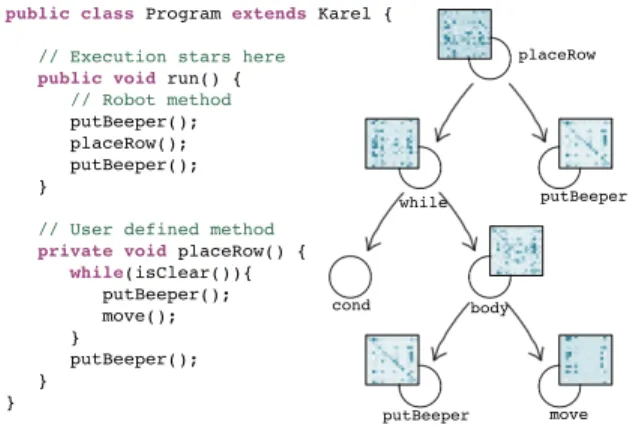
test if final solutions are correct they are not well suited for giving help to students with an intermediate solution and they are not able to give feedback on stylistic elements. There are two major goals of our paper. The first is to au-tomatically learn a feature embedding of student submit-ted programs that captures functional and stylistic elements and can be easily used in typical supervised machine learn-ing systems. The second is to use these features to learn how to give automatic feedback to students. Inspired by recent successes of deep learning for learning features in other domains like NLP and vision, we formulate a novel neural network architecture that allows us to jointly opti-mize an embedding of programs and memory-state in a feature space. See Figure 1for an example program and corresponding matrix embeddings.
To gather data, we exploit the fact that programs are exe-cutable — that we can evaluate any piece of code on an ar-bitrary input (i.e., the precondition), and observe the state after, (the postcondition). For a program and its constituent parts we can thus collect arbitrarily many such precondi-tion/postcondition mappings. This data provides the train-ing set from which we can learn a shared representation for programs. To evaluate our program embeddings we test our ability to amplify teacher feedback. We use real stu-dent data from the Code.org Hour of Code which has been attempted by over 27 million learners making it, to the best of our knowledge, the largest online course to-date. We then show how the same approach can be used for sub-missions in Stanford University’s Programming Method-ologies course which has thousands of students and assign-ments that are substantially more complex. The programs we analyze are written in a Turing-complete language but do not allow for user-defined variables.
Our main contributions are as follows. First, we present a method for computing features of code that capture both functional and stylistic elements. Our model works by si-multaneously embedding precondition and postcondition spaces of a set of programs into a feature space where pro-grams can be viewed as linear maps on this space. Second,
publicclass Program extendsKarel { // Execution stars here
public void run() {
// Robot method
putBeeper(); placeRow();
putBeeper();
}
// User defined method
private void placeRow() {
while(isClear()){ putBeeper(); move(); } putBeeper(); } } placeRow cond body putBeeper putBeeper move while
Figure 1.We learn matrices which capture functionality. Left: a
student partial solution. Right: learned matrices for the syntax trees rooted at each node of placeRow.
we show how our code features can be useful for automati-cally propagating instructor feedback to students in a mas-sive course. Finally, we demonstrate the effectiveness of our methods on large scale datasets. Learning embeddings of programs is fertile ground for machine learning research and if such embeddings can be useful for the propagation of teacher feedback this line of investigation will have a siz-able impact on the future of computer science education.
2. Related Work
The advent of massive online computer science courses has made the problem of automated reasoning with large code collections an important problem. There have been a num-ber of recent papers (Huang et al.,2013;Basu et al.,2013;
Nguyen et al.,2014;Brooks et al.,2014;Lan et al.,2015;
Piech et al., 2015) on using large homework submission
datasets to improve student feedback. The volume of work speaks to the importance of this problem. Despite the re-search efforts, however, providing quality feedback at scale remains an open problem.
A central challenge that a number of papers address is that of measuring similarity between source code. Some au-thors have done this without an explicit featurization of the code — for example, theAST edit distance has been a popular choice (Huang et al.,2013;Rogers et al.,2014).
(Mokbel et al., 2013) explicitly hand engineered a small
collection of features on ASTs that are meant to be domain-independent.
To incorporate functionality, (Nguyen et al., 2014) pro-posed a method that discovers program modifications that do not appear to change the semantic meaning of code. The embedded representations of programs used in this paper also capture semantic similarities and are more amenable to prediction tasks such as propagating feedback. We ran feedback propagation on student data using methods from
Nguyen et al and observe that embeddings enabled notable improvement (see section 6.3).
Embedding programs has many crossovers with embedding natural language artifacts, given the similarity between the AST representation and parse trees. Our models are related to recent work from the NLP and deep learning commu-nities on recursive neural networks, particularly for model-ing semantics in sentences or symbolic expressions (Socher
et al.,2013;2011;Zaremba et al.,2014;Bowman,2013).
Finally, representing a potentially complicated function (which in our case is a program) as a linear operator act-ing on a nonlinear feature space has also been explored in different communities. The computer graphics community have represented pairings of nonlinear geometric shapes as linear maps between shape features, called functional
maps (Ovsjanikov et al., 2012; 2013). From the kernel
methods literature, there has also been recent work on rep-resentations of conditional probability distributions as op-erators on a Hilbert space (Song et al.,2013;2009). From this point of view, our work is novel in that it focuses on the joint optimization of feature embeddings together with a collection of maps so that the maps simultaneously “look linear” with respect to the feature space.
3. Embedding Hoare Triples
Our core problem is to represent a program as a point in a fixed-dimension real-valued space that can then be used directly as input for typical supervised learning algorithms. While there are many dimensions that “characterize” a pro-gram including aspects such as style or time/space com-plexity, we begin by first focussing on capturing the most basic aspect of a program — its function. While captur-ing the function of the program ignores aspects that can be useful in application (such as giving stylistic feedback in CS education), we discuss in later sections how elements of style can be recaptured by modeling the function of sub-programs that correspond to each subtree of an AST. Given a programA(where we consider a program to generally be any executable code whether a full submission or a subtree of a submission), and a preconditionP, we thus would like to learn features ofAthat are useful for predicting the out-come of runningAwhenPholds. In other words, we want to predict a postconditionQout of some space of possible postconditions. Without loss of generality we letP andQ be real-valued vectors encapsulating the “state” of the pro-gram (i.e., the values of all propro-gram variables) at a partic-ular time. For example, in a grid world, this vector would contain the location of the agent, the direction the agent is facing, the status of the board and whether the program has crashed. Figure2visualizes two preconditions, and the corresponding postconditions for a simple program. We propose to learn program features using a training set of
E nc ode r fQ = MA fP P1 fP1 fQ1 Q 1 fPk fQk Pk Qk MA D ec ode r method step() { putBeeper(); move(); } A
Figure 2.Diagram of the model for a programAimplementing a simple “step forward” behavior in a small 1-dimensional gridworld.
Two of thekHoare triples that correspond withAare shown. Typical worlds are larger and programs are more complex.
(P, A, Q)-triples — so-calledHoare triples(Hoare,1969) obtained via historical runs of a collection of programs on a collection of preconditions. We discuss the process by which such a dataset can be obtained in Section 5. The main approach that we espouse in this paper is to simul-taneously find an embedding of states and programs into feature space where pre and postconditions are points in this space and programs are mappings between them. The simple way that we propose to relate preconditions to postconditions is through a linear transformation. Ex-plicitly, given a (P, A, Q)-triple, if fP and fQ are
m-dimensional nonlinear feature representations of the pre and postconditionsP andQ, respectively, then we relate the embeddings via the equation
fQ=MA·fP. (1)
We then take them×mmatrix of coefficientsMAas our
feature representation of the programAand refer to it as theprogram embedding matrix. We will want to learn the mapping into feature spacefas well as the linear mapMA
such that this equality holds for all observed triples and can generalize to predict postconditionQgivenPandA. At first blush, this linear relationship may seem too limiting as programs are not linear nor continuous in general. By learning a nonlinear embedding functionf for the pre and postcondition spaces, however, we can capture a rich fam-ily of nonlinear relationships much in the same way that kernel methods allow for nonlinear decision boundaries. As described so far, there remain a number of modeling choices to be made. In the following, we elaborate further on how we model the feature embeddingsfP, andfQ of
the pre and postconditions, and how to model the program embedding matrixMA.
3.1. Neural network encoding and decoding of states We assume that preconditions have some base encoding as ad-dimensional vector, which we refer to asP. For ex-ample, in image processing courses, the state space could simply be the pixel encoding of an image, whereas in the discrete gridworld-type programming problems that we use in our experiments, we might choose to encode the(x, y)
-coordinate and discretized heading of a robot using a con-catenation of one-hot encodings. Similarly, we assume that there is a base encodingQof the postcondition.
We will focus our exposition in the remainder of our paper on the case where the precondition space and postcondition spaces share a common base encoding. This is particularly appropriate to our experimental setting in which both the preconditions and postconditions are representations of a gridworld. In this case, we can use the same decoder pa-rameters (i.e.,Wdecandbdec) to decode both from
precon-dition space and postconprecon-dition space — a fact that we will exploit in the following section.
Inspired by nonlinear autoencoders, we parameterize a mapping, called theencoderfrom preconditionPto a non-linearm-dimensional feature representationfP. As with
traditional autoencoders, we use an affine mapping com-posed with an elementwise nonlinearity:
fP =φ(Wenc·P+benc), (2)
whereWenc∈Rm×d,benc∈Rm, andφis an elementwise
nonlinear function (such astanh). At this point, we can use the representationfP to decode or reconstruct the original
precondition as a traditional autoencoder would do using:
ˆ
P =ψ(Wdec·fP +bdec), (3)
where Wdec ∈
Rd×m, bdec ∈ Rd, and ψ is some
(po-tentially different) elementwise nonlinear function. More-over, we can push the precondition embeddingfP through
Equation1, and decode the postcondition embeddingfQ =
MA·fP. This mapping which reconstructs the
postcondi-tionQ, thedecoder, takes the form: ˆ
Q=ψ(Wdec·fQ+bdec), (4)
=ψ(Wdec·MA·fP+bdec). (5)
Figure2diagrams our model on a simple program. Note that it is possible to swap in alternative feature represen-tations. We have experimented with using a deep, stacked autoencoder however our results have not shown these to help much in the context of our datasets.
3.2. Nonparametric model of program embedding To encode the program embedding matrix, we propose a simple nonparametric model in which each program in the training set is associated with its own embedding ma-trix. Specifically, if the collection of unique programs is
{A1, . . . , Am}, then for eachAi, we will associate a
ma-trix Mi. The entire parameter set for our
nonparamet-ric matrix model (henceforth abbreviated NPM) is thus:
Θ ={Wdec, Wenc, benc, bdec} ∪ {Mi : i= 1, . . . , m}.
To learn the parameters, we minimize a sum of three terms: (1) a prediction loss `pred which quantifies how well we can predict postcondition of a program given a precondi-tion, (2) an autoencoding loss`auto which quantifies how
good the encoder and decoder parameters are for recon-structing given preconditions, and (3) a regularization term
R. Formally, given training triples{(Pi, Ai, Qi)}ni=1, we
can minimize the following objective function:
L(Θ) = 1 n n X i=1 `pred(Qi,Qˆi(Pi, Ai; Θ)) + 1 n n X i=1 `auto(Pi,Pˆi(Pi,Θ)) + λ 2R(Θ), (6)
whereRis a regularization term on the parameters, andλ a regularization parameter. In our experiments, we useR
to penalize the sum of theL2norms of the weight matrices
(excluding the bias termsbencandbdec).
Any differentiable loss can conceptually be used for`pred
and`auto. For example, when the top level predictions,Pˆ orQ, can be interpreted as probabilities (e.g., whenˆ φis the Softmax function), we use a cross-entropy loss function. Informally speaking, one can think of our optimization problem (Equation6) as trying to find a goodshared rep-resentation of the state space — shared in the sense that even though programs are clearly not linear maps over the original state space, the hope is that we can discover some nonlinear encoding of the pre and postconditions such that most programs simultaneously “look” linear in this new projected feature space. As we empirically show in Sec-tion6, such a representation is indeed discoverable. We run joint optimization using minibatch stochastic gra-dient descent without momentum, using ordinary back-propagation to calculate the gradient. We use random search (Bergstra & Bengio,2012) to optimize over hyper-parameters (e.g, regularization hyper-parameters, matrix dimen-sions, and minibatch size). Learning rates are set using Adagrad (Duchi et al.,2011). We seed our parameters us-ing a “smart” initialization in which we first learn an au-toencoder on the state space, and perform a vector-valued ridge regression for each unique program to extract a ma-trix mapping the features of the precondition to the features
of the postcondition. The encoder and decoder parameters and the program matrices are then jointly optimized. 3.3. Triple Extraction
For a given programSwe extract Hoare triples by execut-ing it on an exemplar set of unit tests. These tests span a variety of reasonable starting conditions. We instrument the execution of the program such that each time a subtree A⊂Sis executed, we record the value,P, of all variables before execution, and the value,Q, of all variables after ex-ecution and save the triple (P,A,Q). We run all programs on unit tests, collecting triples forallsubtrees. Doing so results in a large dataset{(Pi, Ai, Qi)}ni=1from which we
collapse equivalent triples. In practice, some subtrees, es-pecially the body of loops, generate a large (potentially in-finite) number of triples. To prevent any subtree from hav-ing undue influence on our model we limit the number of triples for any subtree.
Collecting triples on subtrees, as opposed to just collecting triples on complete programs, is critical since it allows us to learn embeddings not just for the root of a program AST but also for the constituent parts. As a result, we retain data on how a program was implemented, and not just on its overall functionality, which is important for student feed-back as we discuss in the next section. Collecting triples on subtrees also means we are able to optimize our embed-dings with substantially more data.
4. Feedback Propagation
The result of jointly learning to embed states and a corpus of programs is a fixed dimensional, real-valued matrixMA
for each subtreeAof any program in our corpus. These ma-trices can be cooperative with machine learning algorithms that can perform tasks beyond predicting what a program does. The central application in this paper is the force multiplication of teacher-provided feedback where an ac-tive learning algorithm interacts with human graders such that feedback is given to many more assignments than the grader annotates. We propose a two phase interaction. In the first phase, the algorithm selects a subset of exemplar programs for graders to apply a finite set of annotations. Then in the second phase, the algorithm uses the human provided annotations as supervised labels with which it can learn to predict feedback for unlabelled submissions. Each program is annotated with a setH ⊂ LwhereLis a dis-crete collection ofNpossible annotations. The annotations are meant to cover a range of comments a grader could ap-ply, including feedback on style, strategy and functionality. For each ungraded submission, we must then decide which of theNlabels to apply. As such, we view feedback prop-agation asNbinary classification tasks.
el-ements of the embedding matrix of the root of a program as features and then train a classifier to predict appropri-ate feedback for a given program. However, the matrices we have learned for programs and their subtrees have been trained only to predict functionality. Consequently, any two programs that are functionally indistinguishable would be given the same instructor feedback under this approach, ignoring any strategic or stylistic differences between the programs.
4.1. Incorporating structure via recursive embedding To recapture the elements of program structure and style that are critical for student feedback, our approach to pre-dict feedback uses the embedding matrices learned for the NPM model, but incorporates all constituent subtrees of a given AST. Specifically, using the embedding matrices learned in the NPM model (which we henceforth denote as MAN P M for a subtree A), we now propose a new model based on recursive neural networks (called theNPM-RNN model) in which we parametrize a matrixMAin this new
model with an RNN whose architecture follows the abstract syntax tree (similar to the way in which RNN architec-tures might take the form of a parse tree in an NLP set-ting (Socher et al.,2013)).
In our RNN based model, a subtree of the AST rooted at node j is represented by a matrix which is computed by combining (1) representations of subtrees rooted at the children ofj, and (2) the embedding matrix of the subtree rooted at nodejlearned via the NPM model. By incorpo-rating the embedding matrix from the NPM model, we are able to capture the function of every subtree in the AST. Formally, we will assume each node is associated with sometypein setT = {ω1, ω2, . . .}. Concretely, the type set might be the collection of keywords or built-in func-tions that can be called from a program in the dataset, e.g.,
T ={repeat,while,if, . . .}. A node with typeωis
as-sumed to have a fixed number,aω, of children in the AST
— for example, arepeatnode has two children, with one child holding the body of a repeat loop and the second rep-resenting the number of times the body is to be repeated. The representation of nodejwith typeωis then recursively computed in the NPM-RNN model via:
a(j)=φ aω X i=1 Wiω·a (ci[j])+bω+µMN P M j ! , (7)
where:φis a nonlinearity (such astanh),ci[j]indexes over
theaωchildren of nodej, andMjN P M is the program
em-bedding matrix learned in the NPM model for the subtree rooted at nodej. We remind the reader that the activation a(j)at each node is anm×mmatrix. Leaf nodes of typeω
are simply associated with a single parameter matrixWω.
In the NPM-RNN model, we have parameter matrices
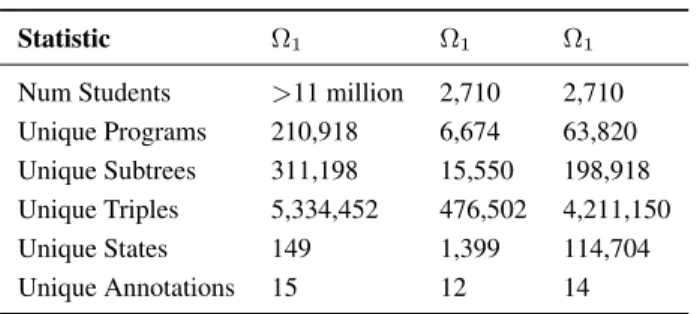
Statistic Ω1 Ω1 Ω1
Num Students >11 million 2,710 2,710
Unique Programs 210,918 6,674 63,820
Unique Subtrees 311,198 15,550 198,918
Unique Triples 5,334,452 476,502 4,211,150
Unique States 149 1,399 114,704
Unique Annotations 15 12 14
Table 1.Dataset summary. Programs are considered identical if
they have equal ASTs. Unique states are different configurations of the gridworld which occur in student programs.
Wω, bω ∈ Rm×m for each possible type ω ∈ T. To
train the parameters, we first use the NPM model to com-pute the embedding matrixMN P M
j for each subtree.
Af-ter fixingMj, we optimize (as with the NPM model) with
minibatch stochastic gradient descent using backpropaga-tion through structure (Goller & Kuchler, 1996) to com-pute gradients. Instead of optimizing for predicting post-condition, for NPM-RNN, we optimize for each of the bi-nary prediction tasks that are used for feedback propaga-tion given the vector embedding at the root of a program. We used hyper-parameters learned in the RNN model op-timization since feedback opop-timization is performed over few examples and without a holdout set.
Finally, feedback propagation has a natural active learning component: intelligently selecting submissions for human annotation can potentially save instructors significant time. We find that in practice, running k-means on the learned embeddings, and selecting the cluster centroids as the set of submissions to be annotated works well and leads to signif-icant improvements in feedback propagation over random subset selection. Surprisingly, having humans annotate the most common programs performs worse than the alterna-tives, which we observe to be due to the fact that the most common submissions are all quite similar to one another.
5. Datasets
We evaluate our model on three assignments from two dif-ferent courses, Code.org’s Hour of Code (HOC) which has submissions from over 27 million students and Stan-fords Programming Methodology course, a first-term intro-ductory programming course, which has collected submis-sions over many years from almost three thousand students. From these two classes, we look at three different assign-ments. As in many introductory programming courses, the first assignments have the students write standard program-ming control flow (if/else statements, loops, methods) but do not introduce user-defined variables. The programs for these assignments operate in maze worlds where an agent can move, turn, and test for conditions of its current loca-tion. In the Stanford assignments, agents can also put down and pick up beepers, making the language Turing complete.
Specifically, we study the following three problems:
Ω1: The 18thproblem in the Hour of Code (HOC). Students
solve a task which requires an if/else block inside of a while loop, the most difficult concept in the Hour of Code.
Ω2: The first assignment in Stanford’s course. Students program an agent to retrieve a beeper in a fixed world.
Ω3: The fourth assignment in Stanford’s course. Students program an agent to find the midpoint of a world with un-known dimension. There are multiple strategies for this problem and many require O(n2) operations wheren is
the size of the world. The task is challenging even for those who already know how to program.
In addition to the final submission to any problem, from each student we also collect partial solutions as they progress from starter code to final answer. Table1 summa-rizes the sizes of each of the datasets. For all three assign-ments studied, students take multiple steps to reach their final answer and as a result most programs in our datasets are intermediate solutions that are not responsive to unit tests that simply evaluate correctness. The code.org dataset is available atcode.org/research.
For all assignments we have both functional and stylistic feedback based on class rubrics which range from observa-tions of solution strategy, to notes on code decomposition, and tests for correctness. The feedback is generated for all submissions (including partial solutions) via a complex script. The script analyzes both the program trees and the series of steps a student took to assign annotations. In gen-eral, a script, no matter how complex, does not provide per-fect feedback. However the ability to recreate these com-plex annotations allows us to rigorously evaluate our meth-ods. An algorithm that is able to propagate such feedback should also be able to propagate human quality labels.
6. Results
We rely on a few baselines against which to evaluate our methods, but the main baseline that we compare to is a sim-plification of the NPM-RNN model (which we will call, simply, RNN) in which we drop the program embedding termsMjfrom each node (cf. Eqn.7).
The RNN model can be trained to predict postconditions as well as to propagate feedback. It has much fewer pa-rameters than the NPM (and thus NPM-RNN) model being a strictly parametric model, and is thus expected to have an advantage in smaller training set regimes. On the other hand, it is also a strictly less expressive model and so the question is: how much does the expressive power of the NPM and NPM-RNN models actually help in practice? We address this question amongst others using two tasks: pre-dicting postcondition and propagating feedback.
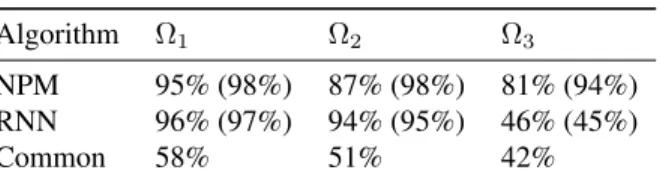
Algorithm Ω1 Ω2 Ω3
NPM 95% (98%) 87% (98%) 81% (94%) RNN 96% (97%) 94% (95%) 46% (45%)
Common 58% 51% 42%
Table 2.Test set postcondition prediction accuracy on the three
programming problems. Training set results in parentheses.
6.1. Prediction of postcondition
To understand how much functionality of a program is cap-tured in our embeddings, we evaluate the accuracy to which we can use the program embedding matrices learned by the NPM model to predict postconditions — note, however, that we are not proposing to use the embeddings to predict post-conditions in practice. We split our observed Hoare triples into training and test sets and learn our NPM model using the training set. Then for each triple (P, A, Q) in the test set we measure how well we can predict the post-conditionQgiven the corresponding programAand pre-conditionP. We evaluate accuracy as the average number of state variables (e.g. row, column, orientation and loca-tion of beepers) that are correctly predicted per triple, and in addition to the RNN model, compare against the base-line method “Common” where we select the most com-mon postcondition for a given precondition observed in the training set. As our results in Table2show, the NPM model achieves the best training accuracy (with 98%, 98% and 94% accuracy respectively, for the three problems). For the two simpler problems, the parametric (RNN) model achieves slightly better test accuracy, especially for prob-lemΩ2where the training set is much smaller. For the most complex programming problem, Ω3, however, the NPM model substantially outperforms other approaches. 6.2. Composability of program embeddings
If we are to represent programs as matrices that act on a feature space, then a natural desiderata is that they “com-pose well”. That is, if programC is functionally equiva-lent to running program B followed by program A, then it should be the case thatMC ≈ MB ·MA. To evaluate
the extent to which our program embedding matrices are composable, we use a corpus of 5000 programs that are composed of a subprogramAfollowed by another subpro-gramB (Compose-2). We then compare the accuracy of postcondition prediction using the embedding of an entire programMCagainst the product of embeddingsMB·MA.
As Table3shows, the accuracy using the NPM model for predicting postcondition is 94% when using the matrix for the root embedding. Using the product of two embedding matrices, we see that accuracy does not fall dramatically, with a decoding accuracy of 92%. When we test programs that are composed of three subprograms,Afollowed byB, thenC(Compose-3), we see accuracy drop only to 83%.
Test Direct NPM NPM-0 RNN Common
Compose-2 94% 92% 87% 42% 39%
Compose-3 94% 83% 72% 28% 39%
Table 3.Evaluation of composability of embedding matrices:
Ac-curacy on 5k random triples with ASTs rooted atblocknodes.
NPM-0 does not jointly optimize.
By comparison, the embeddings computed using the RNN, a more constrained model, do not seem to satisfy com-posability. We also compare against NPM-0, which is the NPM model using just the weights set by the smart initial-ization (see Section 3.2). While NPM-0 outperforms the RNN, the full nonparametric model (NPM) performs much better, suggesting that the joint optimization (of state and program embeddings) allows us to learn an embedding of the state space that is more amenable to composition. 6.3. Prediction of Feedback
We now use our program embedding matrices in the feed-back propagation application described in Section4. The central question is: given a budget ofKhuman annotated programs (we setK= 500), what fraction of unannotated programs can we propagate these annotations to using the labelled programs, and at what precision? Alternatively, we are interested in the “force multiplication factor” — the ratio of students who receive feedback via propagation to students to receive human feedback.
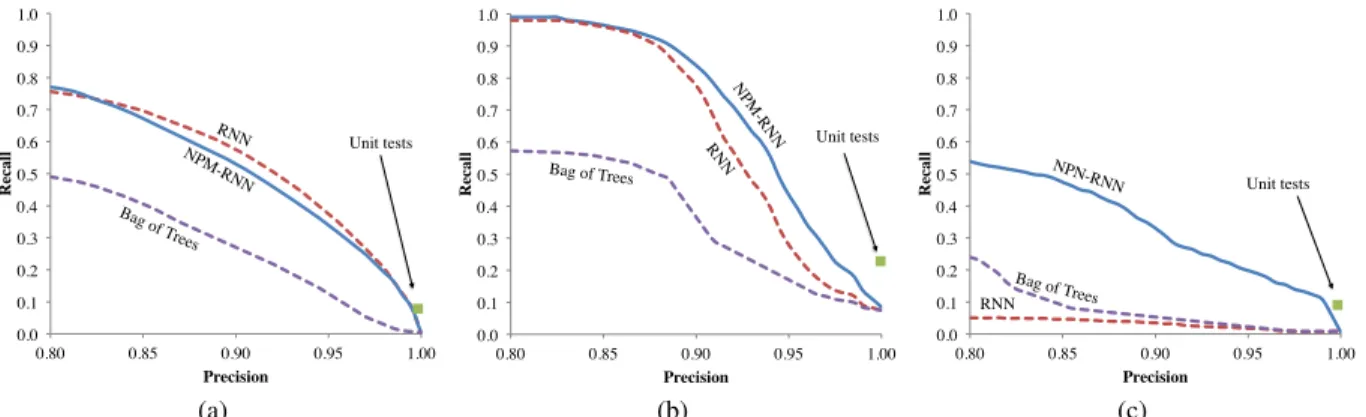
Figure3visualizes recall and precision of our experiment on each of the three problems. The results translate to 214×, 12×and 45×force multiplication factors of teacher effort for Ω1, Ω2 andΩ3 respectively while maintaining 90% precision. The amount to which we can force multi-ply feedback depends both on the recall of our model and the size of the corpus to which we are propagating feed-back. For example, though Ω2 had substantially higher
recall thanΩ1, inΩ2 the grading task was much smaller.
There were only 6,700 unique programs to propagate feed-back to, compared toΩ1which had over 210,000. As with
the previous experiment, we observe that for bothΩ1 and
Ω2, the NPM-RNN and RNN models perform similarly. However forΩ3, the NPM-RNN model substantially out-performs all alternatives.
In addition to the RNN, we compare our results to three other baselines: (1) Running unit tests, (2) a “Bag-of-Trees” approach and (3) k-nearest neighbor (KNN) with AST edit distances. The unit tests unsurprisingly are per-fect at recognizing correct solutions. However, since our dataset is largely composed of intermediate solutions and not final submissions (especially forΩ1andΩ3), unit tests
are not a particularly effective way to propagate annota-tions. The Bag-of-Trees approach, where we trained a Na¨ıve Bayes model to predict feedback conditioned on the
set of subtrees in a program, is useful for feedback prop-agation but we observe that it underperforms the embed-ding solutions on each problem. Moreover, we extended this baseline by amalgamating functionally equivalent code
(Nguyen et al.,2014). Using equivalences found using
sim-ilar amount of effort as in previous work, we are able to achieve 90% precision with recall of 39%, 48% and 13%, for the three problems respectively. While this improves the baseline, NPM-RNN obtains almost twice as much re-call on all problems. Finally, we find KNN with AST edit distances to be computationally expensive to run and highly ineffective at propagating feedback — calculating edit dis-tance between all trees requires 20 billion comparisons for
Ω1and 1.5 billion comparisons forΩ3. Moreover, the
high-est precision achieved by KNN forΩ3is only 43% (note
that the cut-off for the x-axis in Figure3 is 80%) and at that precision only has a recall of 1.3%.
The feedback that we propagate covers a range of stylis-tic and functional annotations. To further understand the strengths and weaknesses of our solution, we explore the performance of the NPM-RNN model on each of the nine possible annotations forΩ3. As we see in Figure4(c), our model performs best on functional feedback with an av-erage 44% recall at 90% precision, followed by strategic feedback and performs worst at propagating purely stylis-tic annotations with averages of 31% and 8% respectively. Overall propagation forΩ3is 33% recall at 90% precision.
6.4. Code complexity and performance
The results from the above experiments are suggestive that the nonparametric models perform better on more complex code while the parametric (RNN) model performs better on simpler code. To dig deeper, we now look specifically into how our performance depends on the complexity of programs in our corpus — a question that is also central to understanding how our models might apply to other as-signments. We focus on submissions forΩ3, which cover a range of complexities, from simple programs to ones with over 50 decision points (loops and if statements). The dis-tribution ofcyclomatic complexity(McCabe,1976), a mea-sure of code structure, reflects this wide range (shown in gray in Figures4(a),(b)). We first sort and bin all submis-sions toΩ3 by cyclomatic complexity into ten groups of
equal size. Figures 4(a),(b) plot the results of the post-condition prediction and force multiplication experiments run individually on these smaller bins (still using a holdout set, and a budget of 500 graded submissions). While the RNN model performs better for simple programs (with cy-clomatic complexity≤6), both train and test accuracies for the RNN degrade dramatically as programs become more complicated. On the other hand, while the NPM model overfits, it maintains steady (and better) performance in test accuracy as complexity increases. This pattern may help to
0.0 0.1 0.2 0.3 0.4 0.5 0.6 0.7 0.8 0.9 1.0 0.80 0.85 0.90 0.95 1.00 R ec al l Precision Unit tests (a) 0.0 0.1 0.2 0.3 0.4 0.5 0.6 0.7 0.8 0.9 1.0 0.80 0.85 0.90 0.95 1.00 R ec al l Precision Bag of Trees Unit tests (b) 0.0 0.1 0.2 0.3 0.4 0.5 0.6 0.7 0.8 0.9 1.0 0.80 0.85 0.90 0.95 1.00 R ec al l Precision RNN NPN-RNN Bag of Trees Unit tests (c)
Figure 3.Recall of feedback propagation as a function of precision for three programming problems: (a)Ω1,(b)Ω2, and(c)Ω3. On
each, we compare our NPM-RNN against the RNN method and two other baselines (bag of trees and unit tests).
0.0 0.1 0.2 0.3 0.4 0.5 0.6 0.7 0.8 0.9 1.0 0 5 10 15 20 25 30 P os tc on d iti on P re d ic ti on A cc u rac y Cyclomatic Complexity NPM (train) NPM (test) RNN (train) RNN (test) (a) 0.0 0.1 0.2 0.3 0.4 0.5 0.6 0.7 0.8 0.9 1.0 0 5 10 15 20 25 30 F or ce M u lti p li cati on R ec al l Cyclomatic Complexity NPM-RNN RNN (b) 0 10 20 30 40 50
# submissions with annotation (thousands)
0 0.1 0.2 0.3 0.4 0.5 0.6 Redefines Method Decomposed Line Strategy Diagonal Strategy Corners Strategy Milestone Reached One by One Correct Odd World Correct Even World Correct
Recall at 90% precision F unc ti ona l S tra te gi c S tyl is ti c (c)
Figure 4.(a)NPM and RNN postcondition prediction accuracy as a function of cyclomatic complexity of submitted programs;(b)
NPM-RNN and NPM-RNN feedback propagation recall (at 90% precision). Note that the ratio of human graded assignments to number of programs
is much higher in this experiment than Figure3;(c)A breakdown of the accuracy of the nonparametric model by feedback type forΩ3
(black dots). The gray bars histogram the feedback types by frequency.
explain our observations that the RNN is more accurate for force multiplying feedback on simple problems.
7. Discussion
In this paper we have presented a method for finding simul-taneous embeddings of preconditions and postconditions into points in shared Euclidean space where a program can be viewed as a linear mapping between these points. These embeddings are predictive of the function of a program, and as we have shown, can be applied to the the tasks of propagating teacher feedback. The courses we evaluate our model on are compelling case studies for different reasons. Tens of millions of students are expected to use Code.org next year, meaning that the ability to autonomously provide feedback could impact an enormous number of people. The Stanford course, though much smaller, highlights the com-plexity of the code that our method can handle.
There remains much work towards making these embed-dings more generally applicable, particularly for domains where we do not have tens of thousands of submissions per problem or the programs are more complex. For settings where users can define their own variables it would be
nec-essary to find a novel method for mapping program mem-ory into vector space. An interesting future direction might be to jointly find embeddings across multiple homeworks from the same course, and ultimately, to even learn using arbitrary code outside of a classroom environment. To do so may require more expressive models. From the stand-point of purely predicting program output, the approaches described in this paper are not capable of representing ar-bitrary computation in the sense of the Church-Turing the-sis. However, there has been recent progress in the deep learning community towards models capable of simulating Turing machines (Graves et al.,2014). While this “Neural Turing Machines” line of work approaches quite a differ-ent problem than our own, we remark that such expressive representations may indeed be important for statistical rea-soning with arbitrary code databases.
For the time being, feature embeddings of code can at least be learned using the massive online education datasets that have only recently become available. And we believe that these features will be useful in a variety of ways — not just in propagating feedback, but also in tasks such as predict-ing future struggles and even student dropout.
Acknowledgments
We would like to thank Kevin Murphy, John Mitchell, Vova Kim, Roland Angst, Steve Cooper and Justin Solomon for their critical feedback and useful discussions. We appreci-ate the generosity of the Code.Org team, especially Nan Li and Ellen Spertus, who providing data and support. Chris is supported by NSF-GRFP grant number DGE-114747.
References
Basu, Sumit, Jacobs, Chuck, and Vanderwende, Lucy. Powergrading: a clustering approach to amplify human effort for short answer grading.Transactions of the Asso-ciation for Computational Linguistics, 1:391–402, 2013. Bergstra, James and Bengio, Yoshua. Random search for hyper-parameter optimization. The Journal of Machine Learning Research, 13(1):281–305, 2012.
Bowman, Samuel R. Can recursive neural tensor net-works learn logical reasoning? arXiv preprint arXiv:1312.6192, 2013.
Brooks, Michael, Basu, Sumit, Jacobs, Charles, and Van-derwende, Lucy. Divide and correct: Using clusters to grade short answers at scale. InProceedings of the first ACM conference on Learning@ scale conference, pp. 89–98. ACM, 2014.
Duchi, John, Hazan, Elad, and Singer, Yoram. Adaptive subgradient methods for online learning and stochastic optimization. The Journal of Machine Learning Re-search, 12:2121–2159, 2011.
Goller, Christoph and Kuchler, Andreas. Learning task-dependent distributed representations by backpropaga-tion through structure. InNeural Networks, 1996., IEEE International Conference on, volume 1, pp. 347–352. IEEE, 1996.
Graves, Alex, Wayne, Greg, and Danihelka, Ivo. Neural turing machines. arXiv preprint arXiv:1410.5401, 2014. Hoare, Charles Antony Richard. An axiomatic basis for computer programming. Communications of the ACM, 12(10):576–580, 1969.
Huang, Jonathan, Piech, Chris, Nguyen, Andy, and Guibas, Leonidas J. Syntactic and functional variability of a mil-lion code submissions in a machine learning mooc. In The 16th International Conference on Artificial Intelli-gence in Education (AIED 2013) Workshop on Massive Open Online Courses (MOOCshop), 2013.
Lan, Andrew S, Vats, Divyanshu, Waters, Andrew E, and Baraniuk, Richard G. Mathematical language pro-cessing: Automatic grading and feedback for open
response mathematical questions. arXiv preprint arXiv:1501.04346, 2015.
McCabe, Thomas J. A complexity measure. Software En-gineering, IEEE Transactions on, (4):308–320, 1976. Mokbel, Bassam, Gross, Sebastian, Paassen, Benjamin,
Pinkwart, Niels, and Hammer, Barbara. Domain-independent proximity measures in intelligent tutoring systems. InProceedings of the 6th International Confer-ence on Educational Data Mining (EDM), 2013. Nguyen, Andy, Piech, Christopher, Huang, Jonathan, and
Guibas, Leonidas. Codewebs: Scalable homework search for massive open online programming courses. In Proceedings of the 23rd International World Wide Web Conference (WWW 2014), Seoul, Korea, 2014.
Ovsjanikov, Maks, Ben-Chen, Mirela, Solomon, Justin, Butscher, Adrian, and Guibas, Leonidas. Functional maps: a flexible representation of maps between shapes. ACM Transactions on Graphics (TOG), 31(4):30, 2012. Ovsjanikov, Maks, Ben-Chen, Mirela, Chazal, and Guibas,
Leonidas. Analysis and visualization of maps between shapes. In Computer Graphics Forum, volume 32, pp. 135–145. Wiley Online Library, 2013.
Piech, Chris, Sahami, Mehran, Huang, Jonathan, and Guibas, Leonidas. Autonomously generating hints by in-ferring problem solving policies. InProceedings of the Second (2015) ACM Conference on Learning @ Scale, L@S ’15, pp. 195–204. ACM, 2015.
Rogers, Stephanie, Garcia, Dan, Canny, John F, Tang, Steven, and Kang, Daniel. ACES: Automatic evaluation of coding style. PhD thesis, Masters thesis, EECS De-partment, University of California, Berkeley, 2014. Socher, Richard, Pennington, Jeffrey, Huang, Eric H,
Ng, Andrew Y, and Manning, Christopher D. Semi-supervised recursive autoencoders for predicting senti-ment distributions. In Proceedings of the Conference on Empirical Methods in Natural Language Processing, pp. 151–161. Association for Computational Linguistics, 2011.
Socher, Richard, Perelygin, Alex, Wu, Jean Y, Chuang, Ja-son, Manning, Christopher D, Ng, Andrew Y, and Potts, Christopher. Recursive deep models for semantic com-positionality over a sentiment treebank. InProceedings of the Conference on Empirical Methods in Natural Lan-guage Processing (EMNLP), pp. 1631–1642. Citeseer, 2013.
Song, Le, Huang, Jonathan, Smola, Alex, and Fukumizu, Kenji. Hilbert space embeddings of conditional distri-butions with applications to dynamical systems. In Pro-ceedings of the 26th Annual International Conference on Machine Learning, pp. 961–968. ACM, 2009.
Song, Le, Fukumizu, Kenji, and Gretton, Arthur. Kernel embeddings of conditional distributions: A unified ker-nel framework for nonparametric inference in graphical models. Signal Processing Magazine, IEEE, 30(4):98– 111, 2013.
Zaremba, Wojciech, Kurach, Karol, and Fergus, Rob. Learning to discover efficient mathematical identities. In Advances in Neural Information Processing Systems, pp. 1278–1286, 2014.