Design Frames: A Narrative and Network Approach
by
Babak Soleimani
A dissertation submitted in partial fulfillment of the requirements for the degree of
Doctor of Philosophy (Architecture)
in the University of Michigan 2020
Doctoral Committee:
Professor Emerita Jean Wineman, Co-Chair Professor Linda Groat, Co-Chair
Associate Professor Shanna Daly Associate Professor Lionel Robert
Babak Soleimani [email protected] ORCID iD: 0000-0002-2220-2151 © Babak Soleimani 2020
Acknowledgements
This dissertation could not have been possible without many people who helped me during this 6-year journey. First of all, I would like to express my sincere gratitude towards my committee- Jean Wineman, Linda Groat, Lionel Robert, and Shanna Daly. To Jean, I will be forever grateful for your support and mentorship. You gave me the freedom to explore different paths during my doctoral studies and always challenged me to think harder. To Linda, every conversation with you made me want to become a better researcher. You showed me what it means to be an academic and always brought rigor and balance to my research. To Lionel, thank you for being my mentor in the information science, a field that I came to with very little
knowledge and left with a lot to think about. To Shanna, thank you for your thoughtful feedback and guidance. Because of your attention to detail, I know my work is more robust.
Thank you to all students that I crossed paths with during my studies at the University of Michigan. To my cohort at the school of architecture and the school of information, thank you for the great conversations in the hallways of Taubman College and North Quad. I am
particularly grateful to Amit, Omid, Alaa, Christine, Hyensoo, Bader, Jay, Azadeh, Jatin, Tushar, Sina, Seda, Maja, Irene, Deokoh, Niloufar, Anahita, and Dicle. Your friendship has been a source of comfort and growth over the years. To my friends in the Iranian community in the Greater Detroit area, you made this journey memorable and an experience to cherish.
To my parents, Showkat and Heshmatollah, if it weren’t for your sacrifice, I would have never been able to pursue my dreams. To my mom, your compassion and kindness always make me want to become a better person. To my dad, you have been my role model and inspire me to work harder. To my sisters, Bahareh, Ghazaleh, and Gelareh, words cannot describe what you mean to me. And finally, to my beloved Zahra, who compassionately stood up by me and supported me through the thick and thin of my doctoral studies. If it wasn’t for you, I could not have been here.
Table of Contents
Acknowledgements ii
List of Tables v
List of Figures vi
List of Appendices viii
Abstract ix
Introduction 1
A Narrative and Network Approach for Representing Design Frames 10
Managing Frame Multiplicity in the Design Process 32
Reflections, Juncture Points and Reframing 61
Temporal Analysis of Semantic Network 82
Conclusion 111
Appendices 122
List of Tables
Table 3.1. A comparison of stories and frame-narratives ... 42
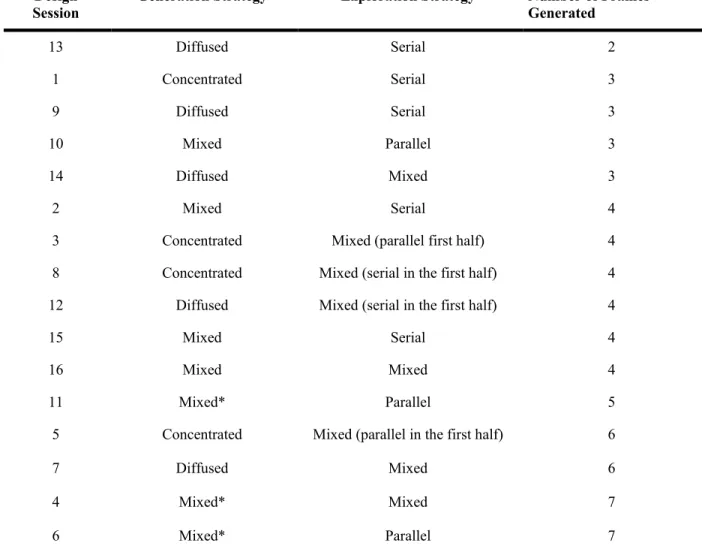
Table 3.2. Frame generation and exploration strategies (mixed generation strategies are concentrated at the beginning and diffused towards the end of the process) ... 51
Table 3.3. First five frames generated in the design session #6 ... 55
Table 3.4. First two frames generated in the design session #9 ... 58
4.1. Activity-oriented coding scheme ... 67
Table 4.2. The quantity and ratio of moves in each category in two episodes ... 68
Table 5.1. Measures for evaluating the network representations of knowledge structure ... 86
Table 5.2. Coding scheme for the analysis of design moves ... 95
Table 5.3. The ratio of convergent and divergent moves and the number of generated ideas ... 100
Table 5.4. The regression results for divergence values in the 16 design sessions ... 104
Table 5.5. The ratio of each designer’s divergent and convergent moves ... 105
List of Figures
Figure 1.1. The Structure of Dissertation ... 6
Figure 2.1. A decomposition perspective of the design process ... 12
Figure 2.2. The reflective practice perspective of the design process ... 17
Figure 2.3. A Narrative model of the design process ... 25
Figure 3.1. Frame generation and exploration model (Adopted and modified from Valkenburg & Dorst (1998) ... 36
Figure 3.2. Design frames used in each design move ... 45
Figure 3.3. Number of frames generated in each session ... 45
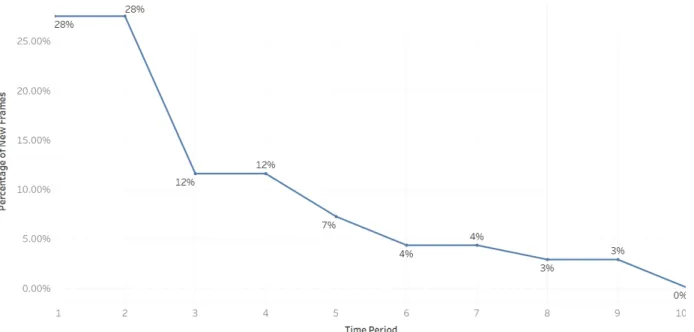
Figure 3.4. Number of frames generated over time ... 46
Figure 3.5. Number of frames generated over time per team ... 48
Figure 3.6. Percentage of frame-shifts during the design process ... 49
Figure 4.1. Three levels of distinction in the design model ... 66
Figure 4.2. Diagram of a reframing scenario ... 80
Figure 5.1. Concepts constituting the analysis framework ... 90
Figure 5.2 . An example of building a graph from a design conversation ... 93
Figure 5.3. d-values plotted over the move index ... 102
Figure 5.4. - Moves with positive hub value and d-values ... 106
List of Appendices
Appendix A Design Session Problem Brief ... 122 Appendix B Frame Analysis of All Design Sessions ... 125
Abstract
In today's increasingly interconnected world, we are facing challenges that are
unprecedented in complexity and scale. At the same time, there is a growing awareness about the inadequacy and obsolescence of old and "best practice" strategies for solving these vexing challenges. The inadequacy of solutions that work within existing frames of thought has generated a renewed interest in research on problem-solving and creativity. While originally initiated in cognitive psychology, cognitive science, and artificial intelligence, research on the mechanisms underlying the creative process has become a central topic in a variety of other disciplines, such as management, business, and healthcare. As a result, public and private organizations are increasingly turning to designers to bring a fresh perspective to the challenges they are facing.
As designers become more engaged in solving large-scale and intricate questions, the need for developing systematic approaches to design and their deployment in both design education and practice becomes more evident. Developing methods that function successfully within design environments requires a thorough understanding of problem-solving approaches in design. In recent years, a growing number of studies have addressed this question by
investigating designers' working practices in the lab or in the field. One of the most influential concepts in studying the design process is the constructivist notion of "framing" (Schön, 1983)
or a point of view that allows the designers to tackle a problem in a vague and indefinite design situation. While the frame's concept has been central in studying the design process, its formal definition remains vague and unclear.
This dissertation aims to shed new light on the concept of frame by proposing two models for systematically describing their structure. These models can be used to make the frames constructed during the design process more explicit by following their development throughout the design process. Building upon two language-based representation modes (stories and semantic networks), the models employed in this dissertation facilitate the description of frames and the analysis of the design process by tracking the shifts in the content and structure of frames. These models were utilized in three verbal protocol studies to investigate different aspects of framing in design. In these studies, we explored the strategies for managing the multiplicity of the frames (chapter 2), reframing process (chapter 3), and divergent and convergent patterns (chapter 4) during the design process.
The contributions of this dissertation are both theoretical and practical. Models and results presented in this dissertation open up new paths future research on the use of framing in design, thereby informing design education and practice. Models presented in this work address the gap in the formal description of frames in the existing literature. The concepts of narrative and network show a flexible way to describe frames that can be utilized to identify and describe frames both qualitatively and quantitatively. On the other hand, the description of frames as a system of stories (narrative model) and concepts (network model) allows the frame to be analyzed on both meta-level (network and narratives) and the component level (concepts and
stories). This systematic perspective suggests an interactive analysis of frames in which shifts in the frame level can be traced to the constituent elements of the design process and vice versa.
Introduction
In an increasingly interconnected world, we are facing challenges that are unprecedented in complexity and scale. To meet these challenges, a new appreciation has emerged of designers’ ability to imagine creative solutions. The need for innovative solutions has renewed interest in exploring the processes through which new and creative ideas are generated. While initiated within the discourse of psychology and cognitive science, research on the mechanisms underlying the creative process have become a topic of interest for a variety of disciplines including but not limited to management, business, and healthcare. A growing number of books and articles have been published in the past few years to foster creativity in individuals and in organizations.
Designers are known for their capacity to create innovative solutions to unique problems. Hence, the methods used by designers has been studied as an epistemological approach for creativity and innovation across many fields. This interest in design has been manifested in two interconnected discourses. While the designerly thinking discourse is concerned with
understanding the skills and competencies of designers, the design thinking discourse promotes the use of design skills for solving problems by involving designers in contexts outside the conventional boundaries of the design practice and teaching design methods to practitioners
business, as a promising model for finding innovative approaches that go beyond the established strategic models (Martin, 2009).
Design thinking aims to expand the notion of design from making physical products to a model for approaching social and organizational problems (Norman, 2010). While job titles in the previous discourse referred to the medium of design (e.g. architect, industrial designer, graphic designers, interior designer), the new titles describe the broader context of design (e.g. user experience designer, service designer, interaction designer). Design companies such as IDEO and Frog Design Inc. that were originally founded as industrial design companies have rebranded themselves as innovation companies and became involved in large-scale and systemic problems ranging from redefining the voting system in Los Angeles County to cutting food waste in restaurants. More recently, large architecture firms have started embracing the approach by defining the environment as the context for experience and interaction.
This expanded interest in design has opened new opportunities for designers. However, educators and practitioners are nevertheless concerned that designers are not typically trained to deal with large-scale systems that entail social and technological complexities (Norman, 2010). While designers are well experienced in organizing objects and shapes, they may not be as adept in dealing with complex systems consisting of people, machines, and environments that are interconnected on multiple levels. Working with such systems poses a challenge to the existing design methods that are often based on the intuition and experience of designers.
In the past few years, design researchers and educators have attempted to address this issue in different ways. First, to deal with these complex situations, designers must be able to gain a deeper knowledge of human behavior, society, technology, and business. On one hand, architecture and design schools are adding social science, psychology, business, and technology courses to supplement the conventional design education that relies normally on design studio training and technical courses. One the other hand, design practices are integrating
anthropologists, social and behavioral scientists, and business leaders into their design teams to diversify their skills for dealing with complex socio-technical challenges.
Finally, new methods and models have been developed to help designers in dealing with complex design situations. Tackling socio-technical problems requires using a variety of models that allow designers to organize the facts of the situation. The goal is not to find and apply the right model but to shed light on the phenomenon from different perspectives (Page, 2018). Design educators and practitioners have developed a variety of models and methods to structure and facilitate this process (Vijay, 2012; Hanington, 2012).
A number of these methods are aimed at facilitating the processes by which designers make sense of the situation. This initial interaction between the designer and the design situation is described with terms such as problem structuring, definition, construction, and framing based on epistemological assumptions of the study. The positivist paradigm1 (mainly represented by
constructivist paradigm2 (mainly represented with Schön’s theory of reflective practice) uses the
term framing. In the positivist model, the design is a process of rational problem-solving (Dorst & Dijkuis, 1995) in which designers structure ill-structured problems by decomposing them into smaller components and searching within the solution space to find optimized solutions for these
well-structured problems. Taking a constructivist perspective, the theory of reflective practice proposed that designers construct problems by framing the situation. Problems are not
objectively presented to the designer but constructed through a process of action and reflection with the situation which results in the creation of a frame.
Framing of a situation determines the direction of design solutions. Consider the following example. Millions of birds get killed every year by flying into building windows (Machtans, Wedeles & Bayne, 2013). One way to look at the situation is to focus on the transparent window's invisibility to birds. In this framing, the goal of design is to create a bird-proof window that prevents the collision by making the glass visible to the bird. Instead of avoiding the crash, one can focus on creating a bird-safe window that minimizes the collision's damage. The first framing directs the design process to develop strategies that make the glass surface visible to birds (e.g., adding visible patterns to the window). The second one leads to solutions that make the collision between the bird and the window less harmful (e.g., installing a mesh on the window).
The ability to frame a problem from a situation has been recognized as a core competency of experienced and effective designers (Dorst, 2011), a key component of the
problem-solving process (Schön, 1984) and central to creativity and innovation (Norman & Verganti, 2013; Dorst, 2015). The existing research into framing has investigated the role of framing in the design process (Valkenburg & Dorst, 1998; Gao & Kvan, 2004; Dorst & Cross, 2001), the strategies and tools to support the framing process (Paton & Dorst, 2011; Kokotovich, 2014; Lloyd & Oak, 2018) and the tensions between frames held by different stakeholders and the ways in which such differences are resolved (Stumpff & McDonnell, 2012; Stompff, Smulders & Henze, 2016; McDonnell, 2018; Hey, Joyce & Beckman, 2007).
The existing research has addressed the significance of framing in the design process. However, the concept of the frame itself seems to be vaguely defined, and the systematic presentation of the content and structure of frames is missing. While the frame is described as a perspective or a point of view that allows the designers to tackle the problem, models for describing them have remained rather undeveloped. While notions of point-of-view (Kolko, 2010) or metaphor (Schön, 1979; Pee, Dorst & van der Bijl-Brouwer, 2015) are useful ways for communicating the concept of frame, they are too broad and ambiguous to allow any particular and concrete definition to be obtained. This dissertation is an attempt to fill this gap by proposing formal models which allow the identification and presentation of frames. Such specificity allows new ways of describing and understanding the design process that will be explored throughout the following chapters.
Dissertation Overview
The purpose of this dissertation is two-fold: 1) to present models that make it possible to describe and analyze frames in a design process and 2) to utilize these frameworks in a series of empirical studies to gain insight into the design process (Figure 1.1).
Chapter 2 starts with an overview of the existing research on defining and modeling frames in design. This review suggests that while a theoretical basis for framing exists in the literature, a concrete understanding of the concept of frame is missing from the constructivist perspective of design. To address this issue, we adopt the notion of a frame as a representation of the designer’s knowledge of the situation and propose narratives and networks as two models of describing frames. Both narratives and networks models represent knowledge as a system of elements and relations: network as a system of concepts and narrative as a system of stories.
In the following chapters, these models are used to conduct a series of empirical studies of the design process. These studies rely on protocol analysis, a widely used observational
method for recording and examining behavior, sketches, and verbalizations that designers generate during the design process to gain insight into the process.
The details of these studies will be described in greater detail in the following chapters: a brief overview is provided here. Data for the protocol analysis were collected from 16 ideation sessions with 32 graduate students from four design disciplines (architecture, human-computer interaction, integrative design, and urban design). In each design session, two participants from different disciplines were given a design brief regarding the safety lights on campus and were asked to generate as many ideas as possible in 45 minutes. Each ideation session was voice-recorded, transcribed, and analyzed using a mixed-method approach based on the narrative model (chapters 3 and 4) and the network approach (chapter 5) to explore questions regarding different aspects of framing.
Chapter 3 starts with a review of the literature related to the use of multiple frames in the design process as a mechanism to deal with the complexity of the designs. While the existing studies emphasize the non-linearity of the framing process, and the multiplicity of frames in the design process, the strategies that designers utilize to manage frames during the design process have not been explored. In this chapter, we build a coding scheme based on the narrative model, which is used to identify frames and their development over the course of the design process. Using the results of this analysis, we identified parallel and serial strategies for frame
In chapter 4, we will specifically focus on the process of reframing during the design process. Reframing is the process of replacing existing ways of understanding a situation with new ones. Existing literature on reframing suggests surprise, frame conflict, and dissatisfaction as the underlying processes that trigger reframing. In this chapter, we use the narrative approach to look at reframing through a new lens: dismantling of an old narrative and coming up with a new narrative. To investigate this process, design activities in two reframing episodes were analyzed using a coding scheme that identified different modes of reflections in the reframing process and the ways in which they contribute to creating a crisis for the narrative and driving designers to initiate a new narrative.
In Chapter 5, we move to the network model to study the divergent and convergent processes in design. This chapter begins with an overview of the literature of dual-process models of cognition3 and their relevance to the design process. Using the network model, we
present an approach for constructing semantic networks from the conversation between designers. Design protocols were analyzed using this approach to identify divergence and convergence processes in design.
In the last chapter, we translate these insights into implications for design educators and professionals. The contributions of this dissertation are both theoretical and practical. While the constructivist notion of framing has deepened our understanding of the design process, models for describing frames are absent in the literature. Such models enable us to concretely
this project aims to apply the specificity of cognitivist models of describing knowledge to the description of the problem frame. Through empirical studies, we apply these new lenses to offer insights into the design process.
A Narrative and Network Approach for Representing Design Frames
In the past decades, design researchers have analyzed the design process from a variety of perspectives.One of the perspectives with an established history for analyzing the design process is that of framing. Schön (1983) introduced the notion of framing as the process of structuring the design situation by searching for relevant elements and conjecturing a set of relationships between them to construct a frame. In this sense, the design process is not only to generate ideas but also to construct problems from indeterminate situations.
Despite the emphasis on the role of framing in design research, very few studies have offered a formal characterization of the structure and content of frames. This description enables us to identify frames and trace their transformation over the course of the design process. In this chapter, two interlinked models are presented for representing design frames: narrative and network. The narrative model builds upon the storytelling perspective of design (Erickson, 1996; Lloyd, 2000; Parrish, 2006; Lloyd & Oak, 2018), however, a distinction is made between the concept of a story and a narrative. The story is the structure that designers construct to make sense and to externalize their understanding of the situation. The narrative is an overarching structure that connects these stories into a coherent, open-ended, and actionable problem. Within the narrative, designers can generate new stories to move towards a solution. On one hand, this model offers a framework for identifying frames and tracking their evolution during the design
reflective practice. Next, we discuss the network model presents stories as a series of
interconnected concepts. Building upon Actor-Network Theory, these networks describe stories using four elements: actors, actions, affordances, and attributes.
Background
Donald Schön’s theory of reflective practice (1983) offered an alternative to the technical rationality perspective of design dominant in the 60s and 70s. Schön (1983) described the design as a conversation between the designer and the materials of the situation. The designer is in an interactive relationship with the situation: he acts upon the situation, allows the situation to talk back to him/her, and reflects on this backtalk which allows "him to see things in a new way to construct new meanings and intentions" (Schön, 1984, p. 132).
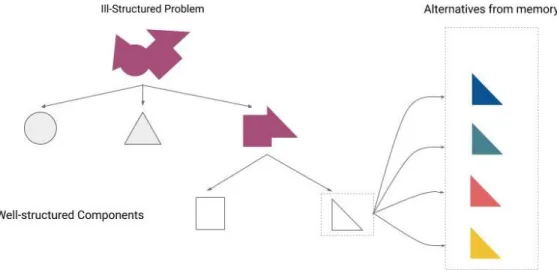
One of the main distinctions between the reflective practitioner and technical rationality perspective is their conceptions of the design problem and the designer’s approach to problem-solving. The technical rationality perspective - as presented by Herbert Simon (1973, p.181) - describes design problems as ill-structured problems that "lack definition in some respect". Solving an ill-structured problem starts with establishing some general constraints and specifications that originate from external sources or the designer’s long-term memory. For instance, architects start designing a house by considering external constraints (e.g. budget, codes) and related attributes that they select from memory (e.g. structural systems, materials) (Simon, 1973). Designers then decompose each attribute into their constituting components and each of these components can be further decomposed into subcomponents. For instance, the structural system of a house can be decomposed into walls, roofs, and foundation systems and a
roof system can be decomposed into subcomponents such as a support system, roofing, sheathing, and utilities (Simon, 1977). At the appropriate moments during the design process, design alternatives are evoked from memory or other sources "in component-by-component fashion" (Simon, 1973, p. 190). Designers consider different design alternatives for each
component and options that fit their purposes. For instance, the problem of a roof support system may be a choice between a truss system or a beam structure.
Simon takes a Cartesian inquiry approach to solving ill-structured problems (Bamford, 2002). Similar to a machine, a problem can be disassembled to its components, each component is altered or replaced by a new component and finally, they are reassembled to a solution. In the process of analysis, the problem is divided "into as many parts as possible, and as might be necessary for its adequate solution" (Descartes, 1850, p. 18). While designing a house is an ill-structured problem at large, problems of component design are well-ill-structured (Figure 2.1). Design is, therefore, a matter of choosing different variables within the boundaries and constraints of the problem space (Simon, 1988).
In contrast to Simon’s emphasis on the decomposition of ill-structured problems, Hillier, Musgrove & O'Sullivan (1972) proposed a vision of design as a matter of conjecturing solutions and testing them against the constraints of the situation. Conjectures become possible by the knowledge of problem and solution types or presetructures that designers bring to the problem. Prestructures are highly stable patterns, generated and transmitted by cultures over long periods of time, which embody objects and relationships, and instructions and rules for using these objects. Prestructures enable designers to interpret the problem and project possible solutions, a process referred to as prestructuring. While the technical rationality perspective emphasizes the removal of a priori hypothesis from design, Hillier et al. (1972) place prestructures, as the essential units of design knowledge stored in the mental models of designers, at the core of the design process. Prestructures are models that can then be evoked in corresponding situations and the designer’s understanding of the situation is constructed by the prestructures that he holds. The design process is to use these mental representations of the world to recognize problems, and to test these hypothetical solutions against constraints imposed by the real world. If such a test fails, designers cognitively transform or elaborate the prestructure to continue the test cycle.
Hillier et al.’s approach to design knowledge resonates with the concepts developed in the information-processing tradition of cognitive science. The basic premise of this perspective is the idea that the brain encodes and stores information from past experiences into mental
structures that are retained, and which can be later recalled based on the situation. These internal symbolic representations of the external reality (objects, relationships, procedure) are referred to as mental models (Johnson-Laird, 1983). Craik defines a mental model as a small-scale model of
1943). Mental models reside in the working memory and function as reasoning mechanisms. Individuals invoke different mental models depending on the situation they are facing and may change their mental models over time.
The notion of the frame - as described by Minsky - refers to a similar structure (Minsky, 1974). Minsky defines a frame as a "data-structure for representing a stereotyped situation" whose characteristics may "be adapted to fit reality by changing details as necessary" (Minsky, 1974, p. 111). Minsky’s notion of frames resonates with Hillier’s notion of prestructures that unfold and adapt to the specific conditions of the situation. Minsky illustrates frame as a top-down tree-shaped structure for frames in which "top levels" of the frame are fixed "and represent things that are always true about the supposed situation" while the "low level" terminals/slots can be filled with new data from the specific situation (Minsky, 1974, p .1). Frames are
interconnected structures that together shape frame-systems.
A similar notion of the frame was adopted by Klein, Moon, and Hoffman (2006) in their theory of sensemaking. The term sensemaking refers to the attempt for understanding
"connections [among people, places, and events] in order to anticipate their trajectories and act effectively" (Klein et al., 2006, p. 71). Klein et al. describe a frame as a perspective or a
viewpoint that people use to start making sense of the situation (Klein et al., 2006). Frames can be described in different forms including "stories, maps, organizational diagrams, or scripts" (Klein et al., 2006, p. 88). When encountering a new situation, an existing frame is used to make "a hypothesis about the connections among data" in order to explain what is going on (Klein et al., 2006, p. 88). If the data doesn’t fit into the frame, the person elaborates the frame by "adding
and filling slots, seeking and inferring data, discovering new data [and] relationships" or discarding the data that doesn’t fit the frame (Klein et al., 2006, p. 89). However, as the
inconsistencies between the data and the fame accumulate, the person might question the quality of data or, alternatively, replace the frame with a new one that can fit the data (Klein et al., 2006).
The notions of frame and framing were adopted by Schön in his constructivist theory of design. Like Hillier, Schön emphasis the active role of the designer’s knowledge in structuring
the design situation. Schön suggests that designers build their knowledge through active engagement with the material of the situation and by reflecting upon it (Schön, 1992). This knowledge is organized in "design worlds" that are constructed "through the shaping of
materials" and "interlocking processes of perception, cognition, and notation" (Schön, 1988, p. 183). Design worlds are the structures holding this design knowledge that designers enter and inhabit to frame the situation. Design worlds contain "particular configurations of things, relations, and qualities" which direct attention to specific elements in a situation and establish order among these elements (Schön, 1988, p. 182). Designers use these design worlds to impose their vision on a situation by structuring "in it a version of a more or less familiar design world" (Schön, 1988, p. 183). In this sense, "the reality of a design situation" is constructed rather than discovered by a designer (Schön, 1992, p. 9). Schön (1988, p. 183) suggests a transactional relationship between the designer and design situations "in which a designer both transforms a design situation and enriches the repertoire of types available to him for further design".
This constructivist perspective is echoed in the work of Akrich who identifies design as a process of projecting and hypothesizing "about the entities that make up the world into which the [designed] object is to be inserted" (Akrich, 1992, p. 207). Design is a back and forth "between the world inscribed in the object and the world described by its displacement" (Akrich, 1992, p. 209). Designers construct the reality of the situation where their products are going to be used. Akrich suggests that this "vision of the world" is defined by a set of heterogeneous actors "with specific tastes, competences, motives, aspirations, political prejudices" that live in a world where "morality, technology, science, and the economy will evolve in particular ways" (Akrich, 1992, p. 208). These visions of the world are not static rules in the designers’ minds projected into the world but dynamic systems of words and objects that designers constantly re-define through their interactions with the situation.
Notions of the design world (Schön, 1991) or vision of the world (Akrich, 1992) also share similarities with Goodman’s constructivist notion of worlds and worldmaking. According to Goodman (1978), our knowledge of the world is generated and structured inter-subjectively into world versions: ways of interpreting and describing a reality that is organized in symbolic systems of words, shapes, objects, or sounds. In this constructivist perspective, knowledge is constructed through the interactions between the individuals and the environment (Kinsella, 2002). The mind is not a passive reflector of the outside world but an active creator of knowledge by giving order and meaning to reality.
What distinguishes Schön’s theory of design is its focus on the framing, the process of shaping frames for understanding unique and novel situations. Schön offers a dynamic and
interacts with the environment. This dynamic understanding of the design world directed
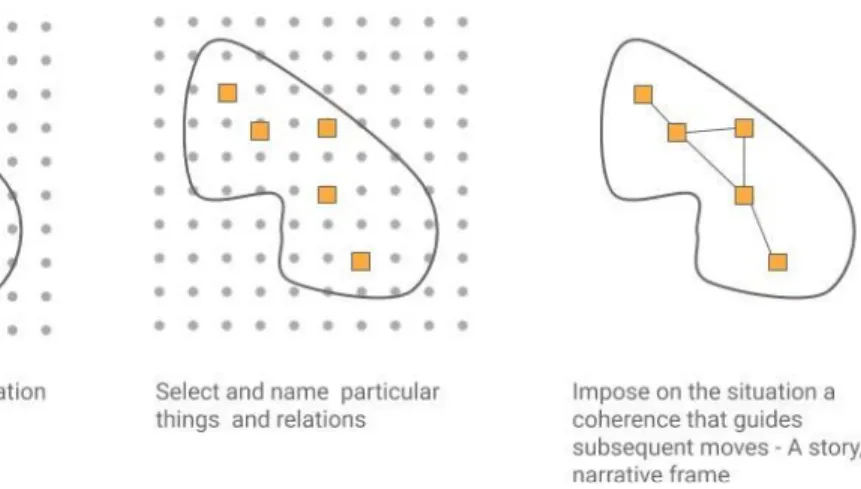
Schön’s attention to the interactive relationship between the designer and the situation which he refers to as reflective practice. This is due to Schön’s approach to design in which knowledge is constructed through the interaction between cognitive structures and the experiences of the environment. In this perspective, the designer engages in a conversation with the material of the situation: he acts upon the situation, allows the situation to 'talk back' to him, and reflects on the results of his action (Schön, 1984). Through this conversation between the design worlds and the design situation, the designer frames the situation: he sets the boundaries of the design situation, selects and names the elements that are relevant to his problem, and imposes a coherent structure to guide further moves (Schön, 1988). This process results in the formation of an understanding of the situation i.e. a frame (Figure 2.2) . A situated frame is not a predefined category but the result of an interaction between a designer and a specific situation (Van Hulst & Yanow, 2016). It is within this frame that a designer’s action (design move) starts moving towards a solution. As Kolko puts it "a frame is an active prospect that both describes and perceptually changes a given situation" (Kolko, 2010, p. 1).
This interactive perspective suggests a reciprocal relationship between the problem and solution in which "designing triggers awareness of new criteria for design [and] problem-solving triggers problem setting" (Schön, 1988, p. 182). Similarly, Dorst and Cross (2001) suggest that during the design process the problem and solution spaces co-evolve. Their empirical study of the design process of nine experienced designers showed that to start the search for a solution, creative designers do not fix the problem space at the beginning of the design process (Dorst & Cross, 2001). In contrast, the design is a matter of evolving problem and solution spaces through the cyclic processes of analysis, synthesis, and evaluation (Dorst & Cross, 2001). Solutions proposed by designers constantly restructure the formulation of the design problems; and designers proceed to resolve the new problems (Dorst & Cross, 2001). As designers engage in this reflective interaction with the situation, they reflect on the frames they hold which can lead designers to see the situation in new ways - to reframe. At some point, a designer might find the existing frame to be obsolete and to replace it with a new frame or transform it to be compatible with the situation. Two consequences of taking a constructivist approach to designing are:
1. Frames and framing are at the core of the design process. The designer draws upon frames to make sense of the existing situation and to imagine new situations. These frames are not objective reflections of the outside world, but they are structures shaped through
assigning meaning and order to the elements of the world.
2. Design frames are constantly being restructured as designers interact with the materials of the situation. Therefore, framing is a dynamic process that is shaped through the interactions between the design world and the design situation.
Framing and Reframing in Design
A growing body of research has emerged out of the constructivist approach to the study of the design process. Researchers have explored the potential of framing as a lens to analyze the design process. These studies often utilize protocol analysis, a method that relies on the analysis of verbal communications between designers during the design process. Design team members express their understanding of the design situation and discuss their ideas by engaging in a conversation with each other. Therefore, analyzing design conversations can open a window into the underlying cognitive and social processes of design.
Valkenburg and Dorst (1998) built upon Schön's theory of the reflective practitioner to offer a model for the analysis of the conversations of design teams. This model consists of four activities: the naming of the elements in the design situation, the framing of the problem, moving towards a solution, and reflection on moves and frames (Valkenburg & Dorst, 1998).
Stumpff and McDonnell (2002) introduced an argumentative/rhetorical approach to the study of framing. In this perspective, framing is a social process and frames are established through negotiations between designers. Through these negotiations, designers restructure or link elements of the situation that are already accepted by designers (associations based on the
structure of reality) or link existing and new elements of the design situation (association to establish the structure of reality). Designers resolve the conflict between different frames by shifting their conceptual models and making a creative change in their perception of reality (dissociation) (Stumpf & McDonnell, 2002).
Hey et al. (2007) adopted this argumentative approach to framing in teams. Design starts with setting pseudo-frames or the "initial understanding of the design situation". However, as these pseudo-frames become more explicit, they reveal their differences. These conflicts between frames are resolved through a process of negotiation, argumentation, and persuasion which results in the construction of common frames. Reflection and negotiation of frames can result in changing design actions (or moves) or reframing of the situation. The authors’ model of framing accommodates frame negotiation as an integral part of the design process in teams (Hey et al., 2007).
To explain reframing and the adoption of new frames during the design process, Stompff et al. introduced the concept of surprise into the Valkenburg-Dorst model (Stompff et al., 2016). They proposed an iterative model of the design process during which designers develop a frame of the existing situations and move towards a solution using this frame. As they reflect upon these moves and frames, an unexpected situation might emerge either because of a mismatch between the frame and situation or presentation of new opportunities in the situation. Faced with this situation, designers might change their moves or introduce a new frame.
The Gap
While framing has been a central topic in the study of the design process, less work has been done building frameworks for formally describing the structure of frames. Therefore, attempts for mapping frames and investigating the transformation of their structure during the design process have remained rather limited. Making frames explicit can help us to improve the design process in two ways. First, the framing of the design problem is central to creativity in
(Verganti & Norman, 2014; Dorst, 2011). It is through reframing that a designer sees a situation in new ways and imagines solutions that couldn’t be achieved in the old framework. However, frames are embedded within design material and conversations and can remain hidden from the designer’s conscious perspective. Making frames explicit, and understanding how they enter the design space, will open a new way for designers to reimagine their understanding of the situation and explore new design environments.
Second, frames are strategic tools in the design process that can create a shared vision among different members of the design team. As Kolko (2012) points out, the increasing complexity of design problems, the growing interdisciplinarity of design teams, and the invisibility of design artifacts have raised the importance of making the design process more explicit. Making design frames more explicit can improve the shared understanding of the complex and unique problems of design.
To build formal ways of mapping the generation and transformation of frames during the design process, we build upon two existing approaches in cognitive science and artificial
intelligence to represent knowledge: narratives and networks. This chapter starts with an
overview of the existing narrative approaches to the design process followed by a description of our narrative model for representing design frames. Next, network approaches for representing knowledge will be discussed. Finally, we’ll present a network approach for presenting design frames. This chapter provides a general framework for these approaches and a more detailed description of the methods will be offered in the following chapters.
Narrative Representation of Frames
Narrative representation of knowledge has been adopted by researchers in both
cognitivist and constructivist traditions. Minsky (2007, p. 281) suggests that stories and scripts are the "most familiar ways to represent an incident" which "depicts a sequence of events in time". The story is an episodic structure for knowledge which represents a series of events in a sequential format. Humans start developing these stories from an early age which guides their understanding of the events, how they should respond to these events and the outcome of those actions. Brunner (1991) proposed that human experience and memory are mainly organized as narratives that "represent a version of reality" (p.4). Stories influence human experience by structuring the way we think about how things have been in the past and how they might be in the future. Knowledge and memory are constructed by stories from personal or social experience which in turn allows a person to interpret new experiences (Abelson & Schank, 1977).
Narratives and stories have been utilized as a lens to study the design process (Akrich, 1992; Rein & Schön, 1996; Lloyd, 2000; Lloyd & Oak, 2018). The storytelling perspective suggests that the design process in general and frames, in particular, are structured in a story-like format. We make sense of the existing situation and imagine future ones through narrative structures. At its core, this approach conceives design as the process of telling stories and connecting the existing reality of the situation (what is going on) with the imagined possibilities for the future (what can be).
Akrich (1992) proposed that design involves creating a script or scenario that describes the actors and their expected interactions with the design object in the world conceived by the
designer. A scenario narrates a series of events in which actors interact in certain ways and it is expected that characteristics of the design object elicit certain interactions from the actors. In the storytelling model proposed by Lloyd and Oak (2018) designing is to create, negotiate and connect two sets of stories: past particulars and imagined particulars. While the former structures existing experiences and behaviors, the latter "place(s) specific actors, objects, and relations into an imagined context" (Lloyd & Oak, 2018, p. 109). By taking a constructivist approach, the storytelling perspective conceives framing as the process of co-constructing "verbal stories" which allow designers to discuss and negotiate "opposing values without the need to resolve them" (Lloyd & Oak, 2018, p. 94).
Rein and Schön (1996, p. 89) suggest that frames are "narratives that guide both analysis and action in practiced situations". These narratives are at the same time framing devices that direct the way one thinks about an issue and "reasoning devices which shape what should be done about the issue" (Rein and Schön, 1996, p. 89). In this sense, Schön and Rein suggest that framing is, in fact, a work of storytelling in which designers bring seemingly unrelated elements together. Naming and selecting is followed by storytelling: connecting elements to shape a coherent narrative of the situation. Such situational stories help designers to structure and communicate their understanding of a problem. Stories frame and communicate to others "what has been going on [and] what needs to be done” (Van Hulst & Yanow, 2016, p. 100). When compared with the reflective practitioner framework, the first process resembles naming
(elements of the situation) and the latter shares similarities with moving (towards the solution).
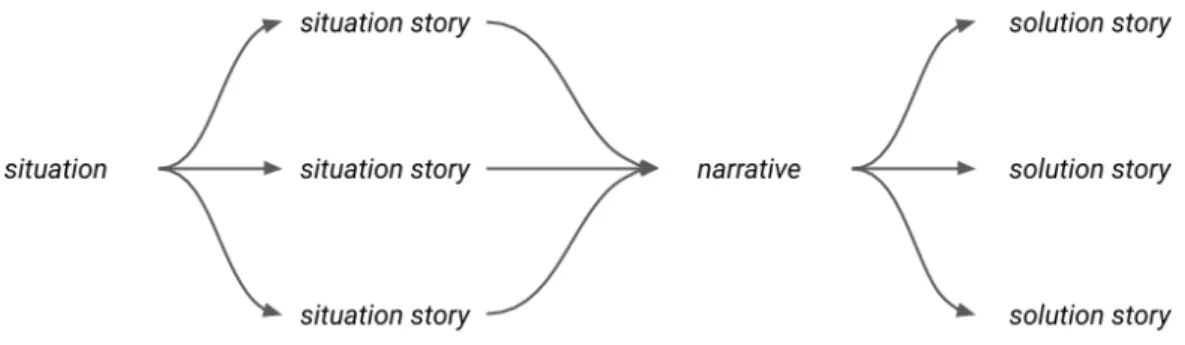
We propose that a design frame can be regarded as a narrative that connects the stories constructed from the situation and allows the designer to generate solutions. Stories represent the
who, where, when and how of the events of a situation. They recognize actors and establish a coherent set of connections between them through actions and associations. Designers might generate several stories from a situation before initiating a narrative. Each of these stories might represent a different situation with a different set of actors and actions. Narratives connect these stories to create an overarching structure that presents an actionable problem. ِ
As it can be noticed, at the core of this model is a distinction between stories and
narratives in design. A narrative is different from a story in at least two ways. First, a narrative is a system of interconnected stories "that work together" (Halverson, 2011). A well-known
example of such a narrative is global warming which simply states the temperature of the earth is rising due to human activities. Every day multiple stories are being published by news
organizations or academic institutions which get connected to the narrative of global warming ranging from the wildfires in California to the melting of an iceberg threatening a small village in Greenland. A narrative creates a structure that connects all these seemingly disconnected stories to shape an overarching message. Narratives are at the same time a basis for the interpretation of the situation and a source of action.
The second distinction is that stories are closed while narratives are open-ended (Hagel, 2016). Carmen points out that the open-ended nature of the narrative is the result of their systemness. The narrative provides a framework in which "new stories can always develop and relate to other stories in the system" (Carmen, 2013). Therefore, the narrative presents an ongoing matter which calls for participation and brings forth unresolved situations in which the
audience can act. Narratives offer a structure for interpreting the situation and also present a problem that calls for action and resolution.
By making a distinction between stories and narratives, we can draw a direct line between the narrative model and the theory of reflective practice. Valkenburg and Dorst (1998) formulate the steps involved in reflective practice as the following: "naming the relevant factors in the situation, framing a problem in a certain way, making moves toward a solution and, evaluating those moves". With the narrative model in mind, these steps can be reinterpreted as follows: 1. Naming: interpreting the situation through the construction of stories; 2. Framing: creating an overarching narrative frame based on these stories; 3. Moving: creating stories to imagine a solution within these narrative frames.
The fourth element of Schön’s model (reflection) is present in all stages of the design process as designers constantly reflect on the stories and narratives they construct during the design process. It should be noted that the relationship between stories and narratives is
reciprocal. While narratives structure stories they also act as an attractor for new stories that can reinforce or challenge them. New moves will respond to the narrative through reinforcing or
challenging. Designers constantly move between narratives to create new stories or modify the existing ones.
This model situates the narrative at the core of the design process. The distinction between narrative and story creates a hierarchical relationship in the analysis of the design process. Narratives are located at the top level of this hierarchy, and stories are connected to these narratives. The narrative becomes the structural unit for describing frames that brings dispersed stories into a coherent and meaningful structure. We can use the following criteria for extracting frames in the design process: frames are narrative structures which present the
problem within a situation. Designers constantly elaborate and modify narratives by adding new stories or removing the existing ones. The narrative model allows us to identify frames and follow their evolution during the design process. These elements are constantly being negotiated, augmented, and revised through the interactions between the designers. Similar to narratives, stories are dynamic, and they evolve as designers reflect upon their internal coherence, think about new relevant situations, and come up with new solutions.
Network Representation of Frames
A second approach for representing knowledge is the semantic network. While a story organizes knowledge in a temporal structure, semantic network arranges knowledge as concepts and their connections. The network is a generic structure that can accept any entities as nodes. While these characteristics of networks make them capable of showing a variety of structures but at the same time networks don’t guide us for the kind of elements that we should look for.
question is what elements should be extracted to best represent the design world as constructed by designers?
A theoretical approach that provides a framework for connecting the narrative and network representation of design is the Actor-Network-Theory. As a conceptual framework, Actor-Network Theory offers useful concepts for describing the design world and the role that artifacts play in mediating action (Latour, 2005). While other theoretical frameworks have discussed similar ideas, Actor-Network Theory offers a synthesis to explain the structure and dynamics of socio-technical systems (Latour, 1990; Akrich, 1992; Yaneva, 2009). To build this taxonomy, we adopted four concepts from Actor-Network Theory: actors, actions, affordances, and attributes.
Actor-Network Theory situates scripts or scenarios at the core of the design activity. Animated by the actions of an organized and connected collective of human and non-human actors (Callon, 2004), scripts illustrate how designers imagine the events in the world to unfold given their object of design (Akrich, 1992). Design is the process of creating a script or scenario and inscribing it in "the technical content of the new object" (Akrich, 1992, p. 208). Design stories describe situations that involve interaction between human and non-human elements. Following the actor-network theory, we refer to the elements that carry agency in the situation as actors. While the term actor is often reserved for human characters in a story, actor-network theory proposes that objects and environments are not merely tools external to the human subject. In contrast, they have an active role in shaping the processes that are being studied. Therefore, human subjects and non-human objects are situated within a broader ecosystem
connected to other objects and subjects, which together shape a socio-technical system. The script is actualized through the actions of a network of human and non-human actors. The agency of actions is, therefore, distributed within this network. When used for non-humans, the agency doesn't refer to the capacity for intentional action but to how the "the material world pushes back on people because of its physical structure and design" (Latour, 1992). The material structure of the environment enables different modes of action, reconfigures the human agency, and mediates actions (Callon, 2004).
This active role of environment in shaping actions can be traced back to the work of ecological psychologist James Gibson who asserted that actions must be conceptualized within the "dynamic coupling between the animal and its environment" (Hutchins, 2010, p. 705). He defines affordance as what an environment "offers the animal, what it provides or furnishes, either for good or ill" (Gibson, 1979, p. 56). Affordance is not an inherent physical quality of the environment nor a mere subjective perception. Instead, it's a hybrid concept that offers an
alternative to the subject-object dualities and suggests a complementary relationship between humans and the environment (Gibson, 1979). Similarly, in the Actor-Network Theory, the concept of promission has been used to refer to what an artifact allows (permission) and what it suggests (promise) (Callon, 2004). Affordance or promission is necessary to action since "no unmediated action is possible" (Latour, 1994). Affordance is not an inherent physical quality of the environment neither a mere subjective perception but a hybrid concept that offers an
alternative to the subject-object dualities and suggests a complementary relationship between the animal and the environment (Gibson, 1979). Affordances of an environment are specific and relational.
Affordances of an environment enable actors to perform specific actions and specifies its active role in shaping actions. Finally, actors have specific attributes that enable them to offer affordances to other actors. The scenario or script defines actors (human and non-human) that act in specific ways or make the actions of other actors possible through the affordances defined by their attributes (Yaneva, 2009). A person (actor) moving up (action) a ladder (actor) is made possible by the affordance (climbability) of the ladder, which is actualized by the width, material strength, and height (attributes) of the ladder's steps. The semantic space can be presented as a network of words representing the elements of design stories (actors and their actions,
affordances, and attributes) and their relations.
In summary, our framework will use these four main elements to describe the design situation as imagined by the designers:
1. Actors: These are entities named by designers in the situation. Following the
definition of an actor in Actor-Network theory, no distinction is made between human or non-human actors.
2. Attributes: These are visual, physical, or categorical properties of an actor. These
properties can be described independently from other actors.
3. Affordance: The concept of affordance is adopted from ecological psychology
and specifically the work of Gibson. For Gibson, affordances are the action possibilities offered by an environment to a human. It is important to note that affordance is defined relative to the actor and environments; artifacts offer different affordances to different actors.
4. Actions: These are what an actor performs using the affordances of other actors.
collection of possibilities. A chair with a high "sit-ability" affordance and a tired person connect when the person performs the act of sitting.
Discussion
This chapter introduced a narrative model for representing design frames. This model is based on the idea that designers discuss their ideas using stories and those stories can be
analyzed on two different levels. Our model expands the storytelling model by adding two levels of analysis. The first level of analysis is based on the notion that stories are not isolated
components but connected to each other through underlying themes. Therefore, the design process can be studied in terms of these themes that connect stories into one or multiple overarching structures. We refer to these overarching structures as narratives.
Second, stories can be broken down to their constituting elements (i.e. actors, attributes) and their interactions. Designers constantly adding new elements to these stories or modify existing ones. Stories can be analyzed on the level of these constituting elements and their interactions. Designers use new words to describe these new stories or story elements of the situation. In our approach, no limitation is set on the connections between entities, and all entities can potentially connect.
Stories are structured around narratives that connect them and bring coherence to their structure. These narratives describe an understanding of the problem constructed through the interactions between the designers and the situation. On the other hand, stories can be broken
down to their constituent elements. We propose that stories are made from actors, actions, affordances, and attributes.
Managing Frame Multiplicity in the Design Process
Design starts with the structuring of the ambiguous and complex situation to construct a problem. Schön (1983) uses the term framing to refer to this process. Framing involves
determining the boundaries of a situation, naming its relevant elements and structuring them into a coherent problem. The result of this process is a frame,an understanding of the situation which guides the actions of the designer and allows them to look for a solution in a structured and purposeful environment.
Framing is not a linear process that results in the generation of a single frame (Dorst & Cross, 2001). Instead, designers construct multiple frames especially during the ideation phase of the design process before arriving at a final frame. Design is a multidimensional process in which designers “think along parallel lines [to] deliberately maintain a sense of ambiguity and uncertainty” (Lawson & Dorst, 2013, p. 60). Similar to a painter or a cinematographer who walks back and forth between viewpoints to find the right frame, a designer moves between frames to evaluate their correspondence to the situation and explore their potential for solving a problem. Designers shift their focus of attention to different elements in a situation to explore it from different perspectives.
of the challenge are not known”. By generating multiple frames during the ideation process, designers create potential environments for generating ideas. However, this potential is not released until these frames are explored to create ideas for resolving the issues of the problematic situation. Therefore, designers often strike a balance between generating new frames and
exploring them in the process of creating ideas.
Frames are not parts of a larger function but parallel understandings of the situation. Multiple frames can co-exist within a design process and designers can switch between frames without necessarily replacing one with the other. If managed effectively, the multiplicity of frames allows the designer to look at the problem from a variety of perspectives before
committing to a direction. The existing research has established the importance of framing in the design process. The ability to frame the design situation in new ways has been found to be a key characteristic of creative designers (Beckman & Barry, 2007; Paton & Dorst, 2011; Norman & Verganti, 2014; Dorst, 2015). However, less attention has been paid to the strategies utilized by designers to manage the multiplicity of frames in the design process. The purpose of this chapter is to study these strategies by studying the temporal distribution patterns of frame generation and exploration activities over the course of the design process. We specifically focus on the ideation phase of the design process because designers are still not committed to any frames or ideas and are open to exploring different viewpoints. The following research questions guided the research:
1. What are the different strategies utilized by designers to generate and explore frames in the design process?
2. What strategies are associated with design teams that generate more frames and ideas?
Research Approach
To answer these questions, we present a protocol analysis (Ericsson & Simon, 1993) of 16 ideation sessions. Protocol analysis is a popular method for investigating the design process through the analysis of verbal communications between designers in controlled design sessions. Protocol analysis conceives the design process as a sequence of events unfolding over time to analyze the temporal dimensions of the design process. Ideation sessions are often short-term design activities. However, they are suitable for studying the framing process since they contain both elements of the problem-solving process: constructing problems or frames and generating ideas within them.
In the next section, we will present a model for analyzing frame generation and
exploration strategies in design using the narrative approach to frames introduced in chapter 2. This perspective treats frames as narrative structures that offer a diagnosis of the problematic situation and a vision towards the solution. Rein and Schön (1996) refer to these structures which are concerned with the why of the situation as frame-narrative. Next, we will describe our data collection and analysis methods, followed by the results. Two strategies for frame generation (concentrated and diffused) and exploration (parallel and serial) were identified. The results show that most design teams used a mix of both strategies. Also, design teams who used the parallel frame development strategy generated a higher number of frames and ideas.
Method
The frame is the environment and the context in which design activities take place. The design process can be modeled as a series of moves that are situated within frames (Valkenburg
& Dorst, 1998). Designers also can shift between frames to change their perspective. In their model, Valkenburg and Dorst visualize “frames as a box in which other activities occur”
(Valkenburg & Dorst, 1998, p.255). Designers generate frames and use them to further advance the design process. It should be noted that frames are not discussed in this chapter as
subproblems or partial solutions but different viable understandings of the situation which can run in parallel to each other. The design process can be modeled as a series of moves progressing over time within these frames.
We conceive design as the interaction between two major processes: generation (construction of new frames) and exploration (interpretation and development of frames to explore their potential for creating solutions). This bimodal conception of the design process can also be seen in cognitive models such as geneplore (Finke, Ward & Smith, 1992) and
divergence-convergence model (Liu, Chakrabarti & Bligh, 2003). Frame generation sets the narrative for the following moves and allows designers to respond to it. As mentioned earlier, designers move back and forth between these frames to shift their perspective of the situation. In this study, we look at the patterns of frame generation and exploration by categorizing design moves into three events (figure 3.1):
1. Frame-Generation: Design moves in which designers define a new frame. 2. Frame-Exploration: Design moves situated within a frame after the initial frame
3. Frame-Shift: Design moves in which frame exploration shifts between two already-defined frame.
Identifying these three events for every ideation session allows us to answer questions such as:
1. How many and when in the process are frames were generated? 2. How many moves have been dedicated to exploring each frame? 3. How many times have designers shifted between frames?
Answering such questions then allows the identification of strategies utilized by
designers to manage frames. The approach we take in this chapter builds upon the breadth/depth-first model, a well-known model in problem-solving literature which similarly approaches design exploration from a temporal perspective. This model is rooted in the problem decomposition perspective of the design process (Simon, 1973) in which ill-structured problems can be solved by being decomposed into small and well-defined problems (Simon, 1973) that are “more transparent and less-complex” and “can be solved separately” (Liikkanen, 2009, p. 40). Problem decomposition is an inherently hierarchical conception of the design process in which each
Figure 3.1. Frame generation and exploration model (Adopted and modified from Valkenburg & Dorst (1998)
problem needs to be decomposed into smaller and smaller components until it can be solved. Designers decompose the main function into solution types, subfunctions, and principles (Liikkanen, 2009).
Ball and Ormerod (1995) proposed that designers utilize two strategies to decompose a problem: a depth-first strategy in which one sub-goal is developed in detail before moving to the next one; and a breadth-first strategy in which each sub-goal is developed until a level of detail is achieved before getting to the next level of detail. This model conceives of the design space as a tree-like structure. Design steps can explore branches of this tree (problem sub-components) one by one (i.e. depth-first) or simultaneously (i.e. breadth-first).
While this study is mainly concerned with frame construction, and not the level of design development, the breadth-first/depth-first model of problem decomposition provides a useful framework for modeling frame exploration strategies. Frame generation and exploration can be similarly modeled as a series of events unfolding over time. We take the temporal density of these events as a measure for identifying frame generation strategies. Based on the concentration of their occurrence over time, these events can be categorized as concentrated (multiple frames are generated within a short time span) or diffused (frames are generated over an extended period of time). In the concentrated approach, designers focus on the frame generation and then utilize the rest of their time to explore these narrative-frames. In the diffused approach, frame
We defined the frame exploration strategies based on the density of frame-shifts. In a
parallel exploration strategy, designers constantly move back and forth between different frames. In a serial exploration, designers focus on a frame and develop it before moving to the next frame. During this focus period, designers might elaborate or challenge the frame and explore its potential for generating solutions. While in a serial frame exploration, designers rarely switch between frames they have generated, a parallel explorationis marked by the constant switch between frames. Designers start exploring a frame and before reaching its full potential switch to a new one. These shifts allow the designers to expand their understanding of the situation and to look at it from different perspectives.
When designers revisit a frame, they bring with them a new perspective which enriches their understanding of the other frame. The ideas and situations constructed in the old frame guide the ideation in the new frame, and new elements and ideas allow the designers to look at the problem in new ways. In this sense, switching between frames blends the boundaries between frames and connects their structure.
Model
To identify the strategies used in each session we need a formal definition of each strategy. The frame generation strategies differ based on the density of the frame generation moves. While in the concentrated strategy frames are generated in close proximity, in the
diffused pattern considerable gaps exist between the frame generation events. To formally define each strategy, a threshold value (𝑇𝑇) should be set to differentiate between the two patterns. Frame generation pattern𝐺𝐺 consists of frame generation moves {𝑔𝑔,𝑔𝑔 , . . . }. Consider 𝑔𝑔 to be
the frame generation move within G with the closest index value to move 𝑔𝑔𝑥𝑥. G is concentrated if:
|𝑥𝑥 − 𝑦𝑦| < 𝑇𝑇
G is a diffused frame generation pattern if for all frame generation moves within G (𝑔𝑔𝑥𝑥) and their closest frame generation move (𝑔𝑔𝑦𝑦):
|𝑥𝑥 − 𝑦𝑦|≥ 𝑇𝑇
Similar to the definition of the exploration strategy we need to define a threshold value for the density of frame-shift moves. Frame exploration pattern𝐹𝐹 consists of frame-shift moves
{𝑓𝑓𝑖𝑖,𝑓𝑓𝑗𝑗, . . . }. Consider 𝑓𝑓𝑦𝑦 to be the frame generation move within F with the closest index value to
move 𝑓𝑓𝑥𝑥. F is parallel if:
|𝑥𝑥 − 𝑦𝑦| < 𝑇𝑇
F is a serial frame generation pattern if for all frame generation moves within F (𝑓𝑓𝑥𝑥) and their closest frame generation move (𝑓𝑓𝑦𝑦):
|𝑥𝑥 − 𝑦𝑦|≥ 𝑇𝑇
In the next section, we will describe the empirical study of ideation sessions of graduate students in design where we used this model in our method of analysis.
Empirical Study
In the following section, the process of data collection and analysis is presented.32 graduate students from four design disciplines (architecture, human-computer interaction,
integrative design, and urban design) were recruited through an open online call for participation at a Midwestern university. Recruited students were pursuing a master’s (n=32) or a Ph.D.
professional settings. Each participant was paired with another participant from a different disciplinary background. Participants were selected from different disciplines to diversify the perspectives and consequently frames generated in the design process. Prior to the session, participants signed a consent form to be voice recorded. All participants received a $20 incentive after completing the task
Study Design
Initially, two different design briefs were generated and tested with a pilot group. These briefs were evaluated based on their potential for being interpreted in different ways and generating multiple frames. We selected the brief which showed a higher capacity for being approached from multiple perspectives and creating different frames.
All participants received the same design brief and instructions at the beginning of the ideation session. The brief described a problem involving student safety at the university where participants were recruited. Since the context of the problem was familiar to students, they could draw on their personal experience and prior knowledge of the situation. To enhance options for ideation, the brief clarifies that