Implementing Communicative
Language
Teaching Method in Saudi Arabia:
Challenges Faced by Formative Year
Teachers in State Schools
By
Majed Othman Abahussain
January 2016
A thesis submitted in fulfilment for the degree of
Doctor of Philosophy in Education
The School of Education
University of Stirling
i
Abstract
The demand for using the English language as a means of communication has increased substantially around the world because of its status as the language of globalisation, international communication, trade, media, and research (Flowerdew and Peacock 2001). The Saudi Ministry of Education (MoE) has considered this demand and taken significant steps to reform the teaching of English as a Foreign Language (TEFL) in the Kingdom of Saudi Arabia (KSA). For example, the aims of and documentation for the TEFL curriculum have been modified to focus on the four basic language skills and to promote students‘ communicative competence. However, despite all these efforts, there has been little progress in the area of TEFL in KSA. Classroom teaching practices are still devoted to secondary purposes, such as teaching grammar, translating literary texts, memorisation, rote learning, and preparing for summative exams. This reality may indicate an incompatibility between the government‘s efforts to develop TEFL and the practices used by English language teachers in their classes. This incompatibility, however, may also suggest that English language teachers have their own reasons for not teaching English for communicative purposes and are incapable of implementing innovative teaching methods, such as the Communicative Language Teaching approach (CLT).
This study therefore explores the challenges faced by Saudi English teachers (SETs) in their teaching practice that might prevent them from teaching for communicative purposes and implementing CLT in their classes. In order to meet this objective, data obtained from interviews, questionnaires and documents were analysed and classified into various categories. The key findings revealed that the current methodological
ii
practices of SETs are traditional teaching methods that stress the dominant role of teachers, marginalise students‘ interactions, focus on discrete skills, and encourage competitive rather than cooperative learning. Furthermore, by using CHAT theory as a framework, the study explored a range of challenges that SETs face when the implementing CLT. These challenges stem from the individual and contextual levels of SETs‘ teaching practice. At the individual level, it emerged that SETs had some misconceptions about some of the main features of CLT, and were not sufficiently confident to run communicative classes and adopt CLT in their teaching practice. The data, moreover, suggested that these shortcomings were a result of the SETs‘ pedagogical and linguistic preparation in their pre-service programmes. At the contextual level, the study data suggested that there were two main types of constraint that challenge SETs in terms of teaching for communicative purposes and applying CLT in their teaching practice. Firstly, there were institutional and situational factors (for example the quality of the in-service training programme, examination purposes and classroom structure), and, secondly, socio-cultural factors (such as the traditional view of education, and the status of the English language in the Saudi context) that seemed to be incompatible with teaching English for communicative purposes.
The study concludes with recommendations that aim to help improve the current situation of TEFL in KSA. For example, ending the isolation between the key parties involved in EFL teaching and learning in the Saudi context is very important, and changes to pre-service and in-service programmes, as well as at the contextual levels, are also essential.
iii
Acknowledgements
My first and foremost gratitude goes to Almighty Allah, for bestowing the ability, strength and means to complete my research throughout this four year doctoral journey. Afterward, I would like to express my sincere thanks and appreciation to all those who helped make this study possible, including but certainly not limited to the following.
My sincere thanks go to my supportive parents who have always prayed for me. Next, my heartfelt thanks go to my family: my wife (Bashair) and my daughters (Seba, Farah, and Haya); you have been unconditionally supportive throughout this long journey. I look back on how much you had to sacrifice so I could complete my doctorate, and am so grateful for your love and unwavering support. Without your support, my doctoral study in Stirling, U.K. would not be possible.
My special appreciation goes to the government of Saudi Arabia (Almaja‘ah University) for granting me the doctoral scholarship which provided me great financial support for four years of my doctoral study.
My genuine appreciation goes to my supervisors:. Dr. Anne Stokes, Dr. David Bowker, and Dr. Alison Fox who made me realise my own strengths in
conceptualising unanticipated knowledge through their critical comments on my work. Thank you, for helping me, guiding me, and encouraging me at unexpectedly difficult times throughout this long journey. My final thanks go to all of my brothers, friends, colleagues and the participants of my study for making this project possible.
iv
Table of Contents
Abstract... i Acknowledgements... iii Table of contents... iv List of tables... ix List of figures... x List of acronyms xi Chapter 1... 1 The study ………... 1 1. 1. Introduction... 11. 2. Aims of the study... 5
1. 3. Research Questions... 6
1. 4. Significance of the study... 9
1. 5. Outline of the thesis... 9
Chapter 2 ……… 11
The Context of the study... 11
2. 1. The Educational System in Saudi Arabia... 11
2. 1. 1. Historical background... 11
2. 1. 2. Characteristics of Saudi education... 15
2. 1. 2. 1. Islamic identity... 16
2. 1. 2. 2. Centralised educational system... 17
2. 1. 2. 3. Single-gender education... 19
2. 1. 2. 4. Governmental financial support... 20
2. 2. Teachers‘ status in Saudi context... 22
2. 3. Introduction of English in Saudi Arabia... 23
2. 3. 1. Teaching English inelementary schools in Saudi Arabia... 24
2. 4. The nature of the examination system... 26
2. 5. Pathways of teacher training forEnglish teachers in KSA... 27
2. 5. 1. English Language and Literature Departments in the Faculties of Arts.. 28
2. 5. 2. English Language and & Translation Faculties... 31
2. 5. 3. Teachers Colleges or Education Colleges... 34
2. 6. In-service teacher training provision in Saudi Arabia... 37
2. 7. Novice teachers‘ experiences and challenges……….. 39
2. 8. My place in the study context... 41
Chapter 3... 42
Literature Review... 42
3. 1. Introduction... 42
3. 2. Historical developments in EFL teaching and learning in Saudi context... 43
3. 2. 1. The introductory phase... 43
3. 2. 2. The reformative phase... 44
3. 2. 3. The communicative phase... 46
3. 3. What is meant by Communicative Language Teaching Approach... 49
3. 3. 1. Communicative Competence... 49
3. 3. 2. CLT versions……… 51
3. 3. 3. CLT principles... 54
3. 3. 4. Teachers‘ and learners' roles... 56
v
3. 3. 4. 2.Learners' roles... 57
3. 3. 5. Classroom activities in CLT... 57
3 . 4. Appropriate pedagogy………. 60
3. 5. Implementation of CLT... 63
3. 5. 1. Challenges for implementation of CLT in EFL contexts... 63
3. 5. 1. 1. Conceptual constraints... 65
3. 5. 1. 2. Teachers‘ preparation and training... 66
3. 5. 1. 3. Classroom-level constraints... 68
3. 5. 1. 4. Societal-institutional level constraints... 70
3. 5. 2. Challenges for the implementation of CLT in modern foreign languages (MFL) contexts... 71 3. 5. 3. Challenges in CLT implementationin Saudi context... 72
3. 5. 4. Comment on the previous studies... 73
3. 5. 5. The gap... 74 3. 6. Conclusion... 76 Chapter 4... 77 RESEARCH METHODS... 77 4. 1. Introduction... 77 4. 2. Research inquiry... 78
4. 2. 1. Research Methodology (the tools of Grounded Theory methods)... 79
4. 2. 1. 2.Grounded Theory and my study... 80
4. 2. 2. Population... 81
4. 2. 3. Data gathering... 82
4. 2. 3. 1. Interview... 85
4. 2. 3. 1. 1. Types of interviews... 86
4. 2. 3. 1. 2. The interview sample... 87
4. 2. 3. 1. 3. Planning and conducting the interviews... 88
4. 2. 3. 1. 4. Co-construction………. 94
4. 2. 3. 2. Questionnaire... 97
4. 2. 3. 2. 1. Strengths and limitations of the questionnaire... 98
4. 2. 3. 2. 2. Operationalising the questionnaire... 99
4. 2. 3. 2. 3. Type of questionnaire... 100
4. 2. 3. 2. 4. Type of questionnaire items... 100
4. 2. 3. 2. 5. Questionnaire sample... 102
4. 2. 3. 2. 6. Covering letter... 103
4. 2. 3. 2. 7. Reliability of the questionnaire... 103
4. 2. 3. 2. 8. Validity and piloting of the questionnaires... 103
4. 2. 3. 2. Documentary sources... 104
4. 2. 4. Data Analysis... 106
4. 2. 4. 1. Qualitative data analysis... 106
4. 2. 4. 2. Quantitative data analysis... 110
4. 2. 4. 3. Presenting the findings... 110
4. 2. 4. 4. Applying CHAT theory in presentingand discussion of the data... 111
4. 2. 4. 4. 1. Characteristics of CHAT... 112
a. The concept of activity... 112
b. Mediation... 113
c. Contradictions, conflicts and resistance... 115
4. 2. 4. Study limitations... 116
4. 2. 4. Ethical considerations and access to data... 117
4. 2. 4. Role of the researcher... 118
4. 3. Conclusion... 119
vi
Chapter 5...
The SETs' Current Methodological Practices... 120
5. 1. Findings... 121
5. 1. 1. SETs‘ roles... 121
5. 1. 1. 1.Knowledge transmitter... 121
5. 1. 1. 2.Lecturer Role... 122
5. 1. 1. 3.The authoritative role... 123
5. 1. 1. 4.Facilitator... 125
5. 1. 2. Current SETs' Teaching Methods... 125
5. 2. Discussion... 133
5. 3. Conclusion... 139
Chapter 6... 141
Influential factors at the individual level... 141
6. 1. Introduction... 141
6. 2. Influential factors at the individual level... 142
6. 2. 1. SETs' knowledge of CLT... 142
6. 2. 1. 1. SETs‘ misconceptions of CLT... 145
6. 2. 1. 1. 1. CLT relies heavily on oral skills... 145
6. 2. 1. 1. 2. Using CLT involves no grammar teaching... 148
6. 2. 1. 1. 3. CLT can only be used in pair and group work... 150
6. 2. 2. SETs' initial preparation... 151
6. 2. 2. 1.SETs' limited teaching repertoire... 151
6. 2. 2. 1. 1. Pedagogical preparation during pre-service training... 153
a .The provision of educational courses... 154
b. The model of teaching and the practical aspect... 159
6. 2. 2. 2.SETs' linguistic preparation... 160
6. 2. 2. 2. 1. Lack of proficiency in the English language... 161
a). Leniency and increase in student admission... 163
b). Gaps in the preparatory year... 166
c). Student language exposure in English departments... 168
6. 3. Discussion... 172
6. 3. 1. SETs‘ limited teaching repertoire... 173
6. 3. 2. SETs limited linguistic repertoire... 176
6. 3. 3. SETs' misconceptions about CLT... 179
6. 3. 3. 1.CLT relies heavily on oral skills... 180
6. 3. 3. 2.Using CLT involves no grammar teaching... 182
6. 3. 3. 3.CLT can only be used with pair and group works... 183
6. 4. Conclusion... 184
Chapter 7... 190
Influential factors (Contextual Level)... 190
7. 1. Institutional and situational factors... 190
7. 1. 1. In-service training in the Saudi context... 190
7. 1. 1. 1. The planning stage for in-service training courses... 192
7. 1. 1. 2. The execution stage of in-service training courses... 193
a. Qualification of the trainers... 193
b. The nature of the content of the training courses... 193
c. Method of presentation in the training courses... 194
7. 1. 1. 2. The follow-up monitoring and transfer of training stage... 194
7. 1. 2. Examination system... 197
7. 1. 2. 1. The potential impact of the writtenexamination on SETs‘ teaching practice... 199 7. 1. 2. 1. 1. Participants (stake-holders)... 199
vii
a .Teaching content... 202
b. Teaching methods... 203
7. 1. 2. 1. 3. Product... 204
7. 1. 3. School level constraints... 205
7. 1. 3. 1. Large classes... 205
7. 1. 3. 2. Teaching load... 206
7. 1. 3. 3. The availability and appropriateness of teaching materials... 207
7. 2. The socio-cultural factors... 208
7. 2. 1. Traditional view of education... 208
7. 2. 1. 1. Traditional teachers' role... 210
a .Knowledge transmitter and source of knowledge... 210
b .Authority role... 211
7. 2. 1. 2. Teaching style... 213
7. 2. 1. 3. Culture of learning and students' roles... 214
7. 2. 2. Status of English in the Saudi community... 215
7. 3. Discussion... 217
7. 3. 1. Institutional and situational factors... 217
7. 3. 1. 1. Limited in-service training... 218
7. 3. 1. 1. 1. The planning stage... 219
a. Induction programme... 221
b. Pedagogic training... 222
c. Initial training... 223
d. Linguistic training... 224
7. 3. 1. 1. 2. The execution stage of in-service training courses... 225
7. 3. 1. 1. 3. Follow up monitoring and transfer of training stage... 227
a. Decontextualisation and isolation of teachers' training... 228
b. The lack of follow up monitoring... 228
c. Discomfort with change... 229
7. 3. 1. 2. Exam washback... 229
7. 3. 1. 2. 1. Dimensions of the complexity of washbackeffect in the Saudi context... 232 a. Specificity... 232
b. Intensity... 233
c. Value... 233
7. 3. 1. 2. 2. Contradition between assumed aim and the evaluation tools…… 236
7. 3. 1. 3. School level constraints... 237
7. 3. 1. 3. 1.Large classes... 237
7. 3. 1. 3. 2.Teaching load... 238
7. 3. 1. 3. 3.Limited communicative materials... 238
7. 3. 1. 3. 4. Contradiction between the nature of the textbook activities and teaching aids……….. 239
7. 3. 2. Socio-cultural factors... 241
7. 3. 2. 1.The effect of the cultural view of education on adopting CLT... 242
7. 3.2.1.1. The effect of the cultural view on the purpose of EFL teaching in S.A 242 7. 3.2.1.2. The effect on teachers and students' roles... 245
7. 3.2.1.3 The effect on teaching and learning styles and teaching materials... 248
7. 3. 2. 2.Social status of English in the Saudi context... 249
7. 4. The isolated state of EFL institutions in S.A……… 250
7. 5. Conclusion... 252
Chapter 8………. 254
Conclusion………. 254
8. 1. Introduction………. 254
viii
8. 2. 1. Research question 1……… 256
8. 2. 2. Research question 2……….. 257
8. 2. 2. 1. The influential factors thatare related to SETs (the individual level)…... 258
8. 2. 2. 2. The influential factors thatare related to the contextual level…………. 258
a . The institutional and situational factors………. 258
b. The socio-cultural factors………. 259
8. 2. 2. 3. The interactions between the two levels of SETs‘ teaching practice…… 259
8. 3. Suggestions and recommendations……… 261
8. 3. 1. Bridging the isolation between the keyparties involved in EFL teaching and learning in the Saudi context………. 262
8. 3. 2. Adjustment in English language departments (pre-service programmes)….. 265
8. 3. 2. 1. Suggestions for boosting the language ability……….. 265
8. 3. 2. 2. Suggestions for improving the teaching repertoire………... 266
8. 3. 3. Adjustments in in-service training programmes……….. 269
8. 3. 4. Adjustments in the contextual level………. 271
8. 4. Contributions of the thesis……….. 273
8. 4. 1. Contribution to theSaudi Arabian context……….. 273
8. 4. 2. Contribution to theeducational research field………. 275
8. 5. Limitations and further study………. 275
References………. 278
Appendices……….. 299
Appendix 1 BA plan(English department, Arts school, KSU)………. 299
Appendix 2 BA plan (English deprtment, Languges and transaltion department)……. 300
Appendix 3 BA plan(English department, Teacher College, KSU)………. 301
Appendix 4 BA plan(English department, Arts school, KAU)……….. 303
Appendix 5 In-service training plan………. 304
Appendix 6 The Distribution of the English Language Marks for Intermediate and Secondary Stages… 307 Appendix 7 A sample of Final examination paper for English... 309
Appendix 8 Teachers‘ interview... 312
Appendix 9 Samples of data analysis by using MAXqda software... 316
Appendix 10MoE‘s approval letter for conducting the study... 318
Appendix 11BA plan for English language and Translation College at KSU... 319
Appendix 12Teachers' Questionnaire……… 321
Appendix 13: supervisors‘ interview……….. 327
Appendix 14: University lecturers Interview... 331
Appendix 15: Samples of questionnaire responses……… 333
Appendix 16: Information letter and Consent form (interviews)... 334
ix
List of Tables
Table 2.1 A comparison of numbers of students in higher education in
Saudi Arabia from 1983 to 2015……… 15
Table 2.2 Summary of the educational budget in Saudi Arabia……… 21
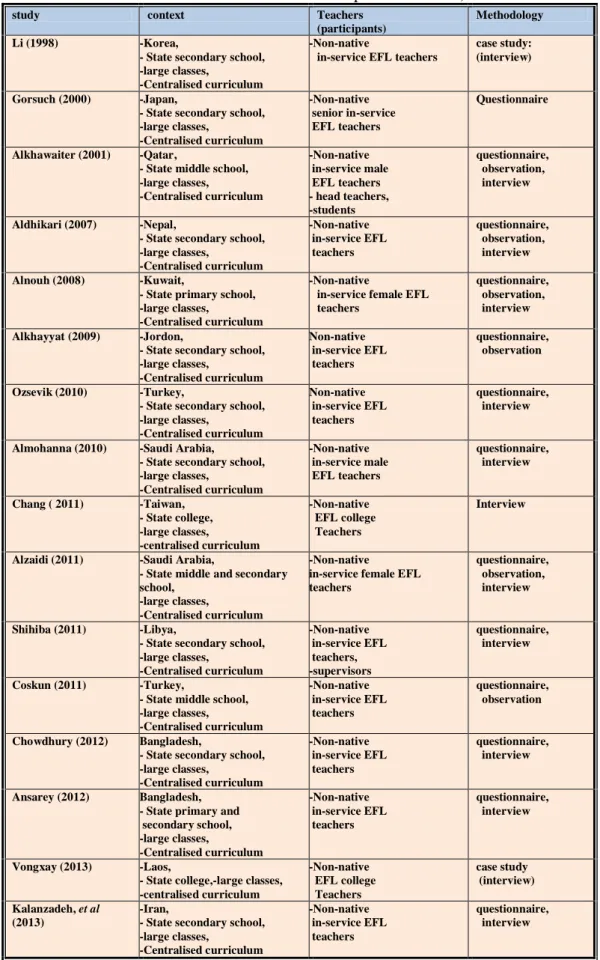
Table 3.1 Contexts of the previous studies……… 63
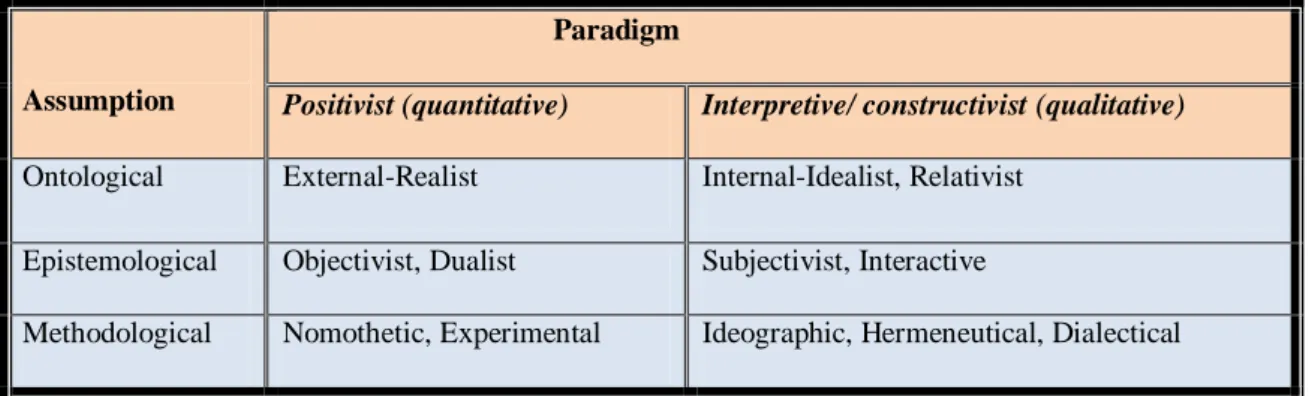
Table 4.1 Paradigms……….. 79
Table 4.2. Data collection schedule 84 Table 5.1 Dominant teaching practice……….. 126
Table 6.1 What is involved in CLT methodology in SETs‘ views?... 144
Table 6.2 Teachers' misconceptions about CLT……… 155
Table 6.3 Foundation programmes for English students: Schools of Arts & Education………... 166
Table 6.4 Foundation programmes for English students: Schools of Languages & Translation………. 167
Table 7.1 Analysis of the test items in a sample of the final exam paper for English in Saudi schools………. 199
Table 7.2 Comparison between CLT principles and the view of education in the Saudi context………... 241
x
List of Figures
Figure 1.1: Teaching practice as a human activity……… 8
Figure 2.1: Number of students enrolled in general education in KSA……… 21
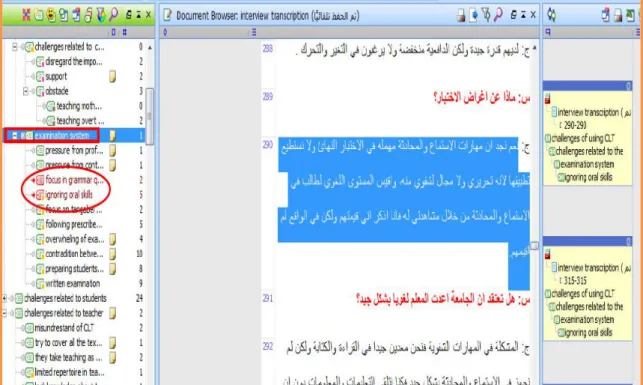
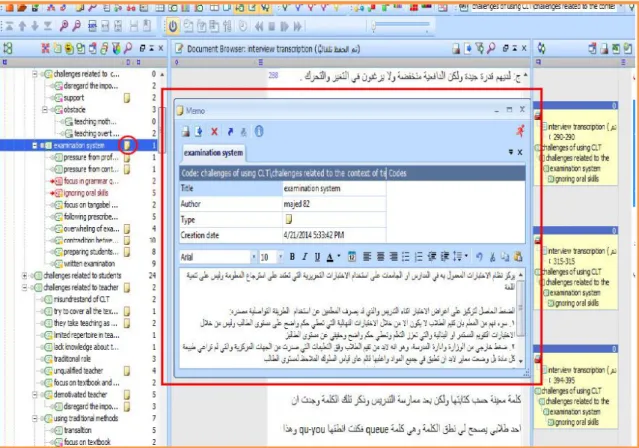
Figure 4.1: Open (initial) coding………... 107
Figure 4.2: Axial coding……… 108
Figure 4.3: Writing memo………. 109
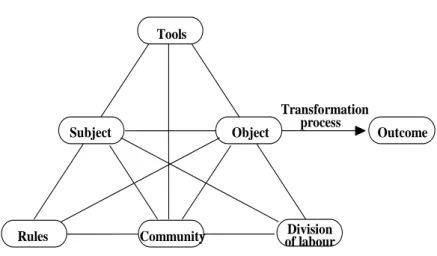
Figure 4.4: Vygotsky's triangle………. 113
Figure 4.5: An activity system………. 114
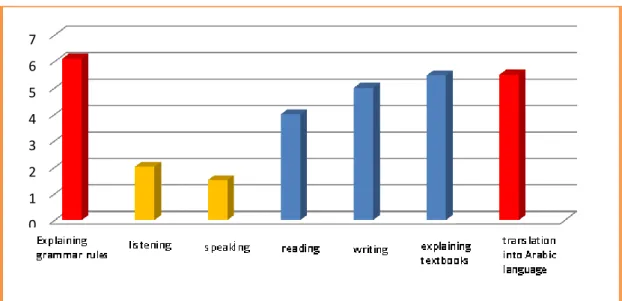
Figure 5.1: The emphasised skill in SETs‘ teaching practice……….. 128
Figure 5.2: The current SETs‘ teaching practice……….. 135
Figure 6.1: Have SETs tried out CLT in the classes?... 143
Figure 6.2: The skill focus of SETs (oral skills)………. 147
Figure 6.3: The skill emphasis of SETs (grammar)……….. 149
Figure 6.4: Knowledge base in the English department, School of Arts, KSU 155 Figure 6.5: Knowledge base in the English department, School of Languages and Translation, Imam University……….. 156
Figure 6.6: Knowledge base in the English department, School of Education, KSU………. 157
Figure 6.7: Challenges in spoken English………. 162
Figure 6.8: The individual level of SETs‘ teaching practice………. 172
Figure 6.9: The contradiction between SETs‘ teaching beliefs and the aims of EFL in the Saudi context……….. 185
Figure 7.1: The SETs‘ skill focus (oral skills)………..…... 202
Figure 7.2: Number of students in the classrooms……… 205
Figure 7.3: The contextual level of SETs‘ teaching practice……… 217
Figure 7.4: The relation between the three curricular contents……… 231
Figure 7.5: The relation between the three curricular contents in SETs‘ teaching practice………. 231
Figure 7.6: Contradiction between EFL aims and evaluation tools………….. 236
Figure 7.7: Contradiction between teaching aids and textbook activities…… 240
Figure 7.8: Contradiction in the aim of EFL teaching in S.A………. 244
Figure 7.9: Contradiction between roles………... 248
xi
List of Acronyms
CLT Communicative Language Teaching EFL English as a Foreign Language
ELDP English Language Development Project (in KSA) KAU King Abdulaziz University
KSU King Saud University KSA Kingdom of Saudi Arabia MFL Modern Foreign Languages
MHE The Ministry of Higher Education (in KSA) MoE The Ministry of Education (in KSA)
SAMA Saudi Arabian Monetary Agency
SETs Saudi English Teachers (in the formative year) TEFL Teaching English as a Foreign Language
1
Chapter 1
The study
This introductory chapter consists of two parts. The first part introduces the research by concentrating on the rationale behind the topic choice, the research aims, the research questions, the research significance, and the outline of the thesis. The second part introduces the study context. It begins by giving a general picture of the context in which the study took place. It addresses the Saudi education system in terms of its characteristics and its cultural and historical background because these issues are important in understanding how Saudi English teachers implement CLT in their teaching practice. The second part also covers the introduction of the English language in the Saudi context and the pathways of English teachers' preparations in Saudi universities.
1. 1. Introduction
The demand for using English language as a means of communication has increased exponentially around the world, particularly in the developing countries. This demand results from the fact that English is the language of globalisation, international
communication, trade, media, research and publication (Flowerdew and Peacock 2001). Among the countries which show an increasing interest in the English language is the Kingdom of Saudi Arabia (KSA). Teaching and learning English in KSA was adopted as a major policy imperative in 1932, and by 1958 English had
2
become a separate subject in the curriculum (Alsubahi 2001). Since then the teaching of English has been developing rapidly.
The growing desire to learn English in the Saudi context is reflected in the financial incentives offered by the government. Both Altammamy (2011) and Shabbir (2006) point out that teaching and learning English in KSA receives political, economic and legislative support from the government. In the last national budget in KSA, for instance, the educational sectors were allocated 25% of the budget (which amounts to more than $49.8 billion) to support their plans, in which the teaching and learning of English receives a high priority (SAMA 2015).
Despite all the support that teaching English receives in KSA, however, learning outcomes are still below the expectations. For example, some educators have ascribed the weakness in English teaching and learning in the Saudi context to various factors, including teachers‘ performance in the classroom, pupils' motivation, inappropriate educational environments, curricula or syllabi, and inadequate in-service training programmes (Alsubahi's 2001; Alhazimi 2008; Almarshad 2009). Alabdualkarem (2007) and Aljarf (2009), for example, both undertook separate studies to investigate these issues. They each noted that during visits to public schools in KSA, supervisors of the English subject observed that some pupils had difficulty with listening
comprehension, and in responding to very simple questions in English. Their written English was also poor, and their results in the school leaving examination were lower in English than in other subjects.
In addition to students' English language performance being considered under par, it has also been noted that English teachers in some public Saudi schools are also considered to be performing below the level expected of those who hold a degree in
3
teaching a foreign language (Alsubahi 2001; Almarshad 2009; Alseghayer 2011a). Almarshad (2009), for example, finds that English teachers in some Saudi schools were unable to conduct a whole class in English. They had limited control over their classes, and adhered to traditional teaching methods.
The Saudi Ministry of Education (MoE) has considered these challenges and has taken significant steps in order to reform the teaching of English as a foreign language (TEFL) in KSA. For example, the TEFL curriculum document, which had been prepared in 1987 by the Department of English of the MoE‘s Directorate of Curriculum, was modified in 2000 in order to update the textbooks to focus on the four basic skills (listening, speaking, reading and writing) and to promote Saudi school students' communicative competence. This step was aligned to the general aim and objectives of TEFL in KSA (Alhajailan 2006). According to Article No. 50 of Saudi Arabian education policy, the purpose of teaching foreign language to students in Saudi Arabia is:
Furnishing the students with at least one of the living languages, in addition to their native language, to enable them to acquire the knowledge and sciences of other communities and to participate in the service of Islam and humanity (MoE 2015a)
Alhajailan (2006) also adds that the new textbooks have been based on using the Communicative Language Teaching method (CLT) as a prescribed teaching method. In addition, the MoE has sent hundreds of English language supervisors and teachers abroad, particularly to the UK, to attend short advanced training programmes on the latest development in the field of TEFL (Alhazmi 2003). Moreover, the MoE in KSA has launched on 2007 a programme called the English Language Development Project (ELDP) to raise the level of teaching and learning of English in Saudi schools. ELDP
4
is a joint initiative between the Ministry of Education and the publishers of major British and American EFL/ESL textbooks and materials, such as the Oxford
University Press, Pearson Longman, Macmillan, and McGraw Hill (Alabdualkarem 2007). This project also aims to acquaint Saudi English teachers with current teaching methods through short training programmes (for example, a 3-day English training programme) around the kingdom. The MoE is also currently equipping schools with some technological devices such as smart boards to facilitate teaching and learning English inside classrooms; it has also arranged seminars and conferences to discuss the inadequacy of TEFL in the Saudi context and drawn up some policies to improve it (Mahibur Rahman 2011).
In spite of all these efforts, however, the situation of TEFL in KSA appears to show little progress. According to Liton and Ali (2011) and Mahibur Rahman (2011), one of the fundamental shortcomings in teaching and learning English in Saudi schools which still needs more development lies in the promotion of communicative competence among students.
The aforementioned incentives indicate that the Saudi MoE, in its redesigning of curriculum and syllabi for English language, has moved from a structural syllabus focussing on teaching grammar and translation, to a communicative syllabus focussing on fostering actual communication. These new curriculum and syllabi concentrate on activities that are designed to be delivered by innovative teaching methods such as Communicative Language Teaching (CLT). However, the reality of English teaching in Saudi schools shows, as the aforementioned studies have
displayed, that English language teachers in the Saudi context continue to use traditional teaching methods which do not support the recent efforts for improving TEFL. This reality may indicate an incompatibility between the governmental efforts
5
to develop TEFL in schools and the English language teachers' practice in their classes. This incompatibility, however, suggests that English language teachers might have their own reasons for not teaching to serve communicative purposes and
implementing CLT in their classes. It would therefore be worthwhile to explore these challenges. Though I believe that there are many reasons which contribute to the current situation of TEFL in the Saudi context and need more investigation, I think teachers' teaching practice is a fundamental issue which needs immediate
investigation. This is because teachers and their teaching practice in general are the link between all the parts of teaching and learning processes such as students, the curriculum, the syllabus and the teaching environment, and teacher education. Gulanz et al. (2015) argue that the role of the teacher seems to be important in any teaching-learning situation, because it is central to the situation in which the classroom environment develops.
1. 2. Aim of the study
According to Alhajailan (2006), the main aim of teaching and learning the English language in KSA is to use English in meaningful communication, which includes oral communication with people, or reading or writing. Consequently, the recent
curriculum and syllabi in KSA are based on communication-based activities which reinforce communicative competence. To achieve this competence, however, the classroom practice should also help students fulfil communication purposes inside and outside classrooms; this might be achieved through using innovative methods such as CLT (Savignon 2002; Farooq 2015). The actual situation indicates that classroom teaching practices are still devoted to secondary purposes such as teaching grammar,
6
translating literary texts, memorisation, rote learning, and preparing for summative exams (Alsubahi 2001; Almarshad 2009;Alseghayer 2011a). However, there are a number of factors which challenge the classroom teaching practice of English teachers in the Saudi context and contribute to limit their implementation of
communicative activities and CLT; these factors are related to the teachers, students, the educational system, the teaching environment, the syllabi, and pre/in-service training (Alseghayer 2011a).
Therefore, in order to contribute to the improvement of the current situation of
classroom teaching English in the Saudi context, this study aims to explore the factors that influence English teachers in their teaching practices and hinder their teaching for communicative purposes and their implementation of CLT as teaching method in their classes. In addition, this study also aims to explore the roots of these challenges in order to understand where they have stemmed from; the study will also propose some suggestions that may improve the current situation of TEFL in Saudi schools.
1. 3. Research Questions
In order to build a comprehensive picture of this issue whose factors may stem from various situations such as from the place of the work (schools) or places of
preparation (such as pre-service and in-service training programmes), the study targets the English language teachers (SETs) in their formative year in state schools for two reasons. Firstly, they are the immediate product of English language teacher pre-service programmes and their teaching experience is entirely dependent on their initial preparation, i.e. their performance and practice are a mirror that may reflect a part of what goes on their preparation programmes; therefore, it could be helpful to
7
explore any influential factors present in the initial preparation programmes. Secondly, since these teachers teach in state schools and have access to in-service training programmes, they may be able to describe the situations in both places (schools and in-service training centres).
In order to fulfill the aim of the study, the thesis will address the following research questions:
1- Which methodological practices do Saudi English Language teachers in their formative year in state schools say that they currently use in their
classrooms?
2- What factors influence English teachers' choice of teaching Methods in their formative year?
3- How might ELT education in the Saudi context be altered in order to close any identified gap(s) between the methodology informing the syllabus (CLT) and the current teaching methods used by the English teachers in their formative year?
It is worth mentioning here that the study investigates an issue (the challenges faced when implementing CLT) that takes place in a context or a system (classroom) in which events do not occur in a linear way, but rather a context in which plenty of factors interact in complex ways and create changes that are partly predictable and partly unpredictable (Van Lier 1996). Consequently, the interactions within a system (classroom) to a large extent determine its characteristics and influence its dynamics. Hence, in order to examine the teaching practice that takes place within SETs‘ classrooms, it is necessary to explore it in its context, and to describe the interactions that take place in the teachers‘ surroundings (Finch 2003).
8
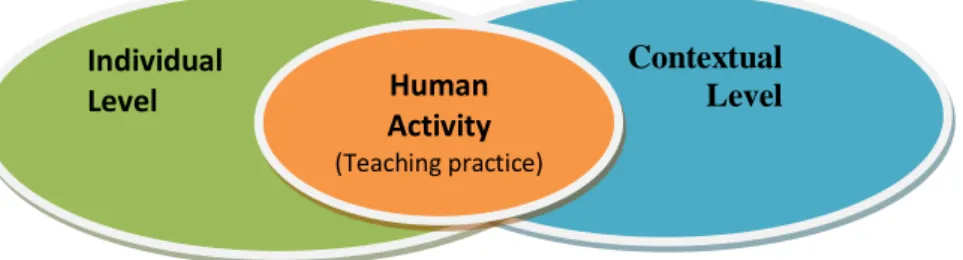
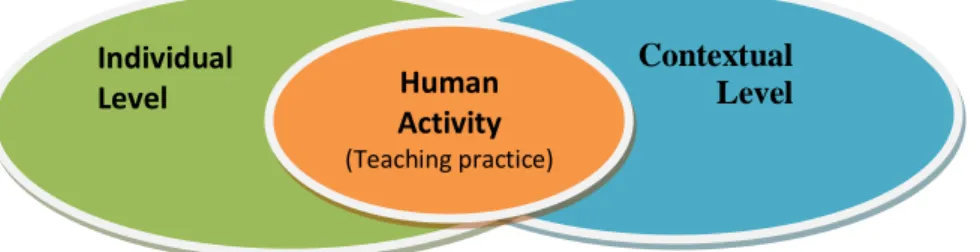
The idea of studying an issue or activity within its context is, of course, a core concept of Activity Theory or Cultural-Historical Activity Theory (CHAT) (Engestrom 2001; Phillips 2006; Lantolf and Thorne, 2006; Edwards 2011). Moreover, another characteristic of CHAT theory is that it treats human actions, such as teaching practice, as activity in a system. This activity is, according to CHAT theory, the outcome of individuals‘ interactions with their environments. This view maintains that human activity includes two inseparable levels or contexts, namely the cognitive and socio-cultural. This idea thus considers studying or examining one context as isolated from another to be an unproductive task that may not produce achieve an understanding of the holistic picture regarding the issue under investigation (Phillips 2006).
The study thus uses CHAT theory as its theoretical framework because it allows me to investigate a range of factors and provides me with an opportunity to exercise my reflexivity in the process of analysing my findings. CHAT theory aids the examination of the relationship between human beliefs and activities. Rather than seeing the relationship between belief and acting in a linear way, this connection could instead be regarded in a circular way, in which human belief influences the activity and the activity influences human belief (Capper 2004, cited in Phillips 2006). See Figure 1.1
Figure 1.1 Teaching practice as a human activity Contextual Level Individual Level Human Activity (Teaching practice)
9
1. 4. Significance of the study
This study may help provide a better understanding of the main challenges that the English teachers in the Saudi context face in teaching for communicative purposes and implementing CLT. Besides this, since the study also aims to explore the roots of the probable challenges, it may contribute in providing a better insight into English language teaching (ELT) programmes (pre/in-service programmes) by displaying some of their strengths and weaknesses in preparing English teachers. Such investigations may help in identifying any existing gap between the government policy in syllabus design, the methodological practices of the Saudi English teachers, and teachers' preparation programmes. Furthermore, the study may provide practical suggestions to bridge any identified gaps between the government policy for TEFL and the methodological practice of English teachers in Saudi schools. Consequently, it may help the responsible body, be it the MoE (responsible for planning and designing the EFL curriculum) or the local universities (responsible for initial teacher
preparation) or the in-service training centres (responsible for ongoing training for English teachers), to make appropriate decisions to reform its plans. Finally, it may provide an insight into the challenges to implementing CLT in EFL contexts.
1. 5. Outline of the thesis
Chapter 1, as the previous pages have shown, includes two parts; part one comprises the introduction to the research, highlights the rationale behind the choice of the research topic, the research aims, questions and significance forms the first part. While, the introduction to the study context forms the second part of Chapter 1. Chapter 2 reviews literature relating to the implementation of communicative
10
language teaching (CLT) in the context of English as a Foreign Language (EFL) in general and the Saudi context in particular. Chapter 3 introduces the research
methodology that has been used in data collection. In Chapter 4, the data that relates to the first research question have been presented, analysed, and discussed, while the data relating to the second research question are addressed in three chapters, i.e. chapters 5, 6, and 7. Chapter 5 sheds light on the influential factors that stem from the SETs at the individual level. Chapter 6 highlights the influential factors at the social level (e.g. institutional, situational, and socio-cultural factors) existing within the Saudi context, with the potential to influence SETs‘ teaching practice. Chapter 7 discusses the interactions and contradictions between these influential factors, in order to demonstrate the ways in which they influence each other, along with their general influence on SETs' decision to adopt (or not adopt) CLT in their teaching practice. In Chapter 8, the data that relate to the third research question are presented, analysed, and discussed as proposed suggestions and recommendations to improve the current practice of EFL teaching and learning in KSA. Chapter 8 also includes a conclusion section of the thesis, which includes summaries of the findings and presents the main contribution and implications of the study.
11
Chapter 2
The context of the study
Chapter two gives a general picture of the context in which the study took place.
2. 1. The Educational System in Saudi Arabia
2. 1. 1. Historical background
The roots of formal education in Saudi Arabia can be traced back to the late the eighteenth century when the first State of Saudi Arabia1 came into being. Education at that time was limited to the teaching and learning of basics such as reading and writing, in addition to the recitation of the religious books. This kind of teaching was provided through traditional schools which were called Kuttabs (Metz 1992). This kind of school was a single classroom school for young children, specialising in teaching Religious subjects. It was run by religious people, who were specialists in teaching the Holy Book [the Quran] (Dasen and Akkari 2008). Kuttabs were attached to mosques and were for male students while female students were taught at home under the supervision of female teachers (Metz 1992; Alsalloum 1995). This kind of schooling was dominant in the Arabian Peninsula till the late nineteenth century (Groiss 2003). The end of the nineteenth century witnessed the beginning of what could be considered as formal modern education in the Arabian Peninsula when the
1
. Historically, Saudi Arabia had passed through three states. The 1st state was from 1744-1818, the 2nd state was from 1824-1891; the 3rd started in 1902 and is ongoing.
12
Ottoman State introduced the beginnings of formal education in the provinces of Hejaz and al-Ahsa, which were under Ottoman control at that time2 (Groiss 2003). At the beginning of the twentieth century there were only four elementary private schools in the whole Arabian Peninsula. Most of these were in Hejaz (western part of KSA), offering boys limited teaching of other subjects besides religion (Metz 1992; Rugh 2002)
Shortly after the unification of most of the Arabian Peninsula as the Kingdom of Saudi Arabia in the first quarter of the 20th century, however, the late king Abdul-Aziz, the founder of this modern state, realised that education was a means of strengthening national unity and educating the Saudi people (Alsalloum 1995; StateUniversity 2012). Therefore, in 1925 the Directorate of Education was established and a centralised educational policy was entrusted to it. The main
objectives of that policy were to observe the teaching of Islam, to spread knowledge and to establish schools. As a result, government-sponsored education began and it was accompanied by the establishment of new elementary schools in big cities. In 1938, the Directorate of Education was given control over all educational matters in Saudi Arabia except in the case of military schools (Alsalloum 1995; Rugh 2002; StateUniversity 2012).
Though in 1952 the number of the elementary schools in Saudi Arabia exceeded 300, illiteracy was still too high. Thus, in 1953 the Directorate of Education became the Ministry of Education under the leadership of Prince (later King) Fahad bin Abdul-Aziz. With the establishment of the Ministry of Education, more schools were opened
2
Ottoman Empire or Turkish Empire, which lasted from 1299-1923, controlled most of the Islamic world at that time.
13
and public education started to spread throughout the country. This development in education was so rapid that, in 1971, the Ministry of Education found it necessary to create educational directorates in different parts of the country and to delegate some of the Ministry‘s responsibilities to them, with some success. For example, the male to female percentage of students in schools witnessed a remarkable change. In 1981 the school enrolments showed that boys formed 81% of the student body while girls formed 43% (Alsalloum 1995; StateUniversity 2012). In 1989 the number of girls enrolled was very close to that of the boys enrolled - of a total of 2.6 million students, there were within 1.2 million girls and 1.4 million boys. Furthermore, the Saudi Arabian Monetary Agency (SAMA) indicates that in 2000 the numbers of boys and girls in public schools were 2.16 million and 1.95 million respectively, out of a total of 4.11 million students. In 2015 the numbers of boys and girls in public schools were 3.48 million and 3.06 million respectively out of a total of 6.309 million students (SAMA 2015).
In addition, formal education was not limited to general education; in 1982 a Directorate General for Educational Technology was founded. This directorate is responsible for providing vocational and technical education to Saudi students. In addition to this, special education programmes were developed for students with special needs; this involved the construction of special educational facilities and establishing a special education degree in teacher training colleges (StateUniversity 2012).
Higher education in Saudi Arabia prospered after the establishment of the Ministry of Higher Education (MHE) in 1975. The main responsibilities of this Ministry were:
Proposing the establishment of higher educational institutions and authorizing them to offer special programs in accordance with the
14
country‘s needs. Creating and administering universities and colleges in the Kingdom. Raising the level of communication and coordination between institutions of higher learning and coordinating with other governmental ministries and agencies in terms of their interests and needs in higher education. Representing the government abroad in all educational and cultural affairs, through various cultural and educational offices
distributed over 32 countries (SACM 2006, p5-6).
There are many examples of developments in higher education in Saudi Arabia resulting from this. For example, the number of the Saudi universities and colleges rose from 7 universities with 90 affiliated colleges in the 1960s and 1970s to 35 universities with 596 affiliated colleges in 2015 (SAMA 2015). The majority of these universities provide religious and secular education for both male and female
students. The government funding for higher education has been very generous and has led to the construction of many new university campuses around the kingdom such as those in King Saud University, King Abduaziz University, Umm Alqura University and Imam Mohammed University. This expansion in higher education has led to a gradual increase in the number of students enrolled in higher education. For instance, as shown in Table 2.1, between 1983 and 1989, the number of male students in higher education increased from approximately 58,000 to about 113,000, the number of female students increased from 20,300 to 47,000 (Metz 1992; SAMA 2015). In 2004, the number of students enrolled in universities reached approximately 571,813 (236,996 men and 334,817 women). In 2015 these numbers show a further increase; there are around 1,511,094 students (with 744,927 men and 766,167 women) while the graduates among them are around 110,885 in number (SAMA 2015).
15
Table 2.1
A comparison of numbers of students in higher education in Saudi Arabia from 1983 to 2015
Year Male Female Graduate male Graduate female Total
1983 58,000 20,300 7,000 7,000 92,300
1989 113,000 47,000 15,000 14,300 189,300
2004 200,896 300,817 36,100 34,000 571,813
2010 405,724 543,980 40,047 61,294 1,051,045
2015 669,629 681,570 75,298 84,587 1,511,094
2. 1. 2. Characteristics of Saudi education
The Saudi education system is based on principles formulated by the Higher Committee of Educational Policy. These principles were derived mainly from the sources of the country‘s constitution, i.e. the Holy Quran and Prophet Mohammed traditions (MoE 2015a).Some of these principles require (MoE 2015a; StateUniversity 2012):
a) strengthening faith in Allah (God) and Islam and in Mohammed as a messenger of Allah;
b) encouraging a holistic and Islamic concept of the universe;
c) ensuring the right of the individual to seek education and the duty of the government (within its capacity and resources) to provide education at various stages;
d) ensuring a good equality of education for boys and girls in accordance with the Islamic instructions;
16
f) integrating Islamic orientation in the sciences and in the knowledge of the curricula and teaching,
g) stimulating human knowledge through Islam to raise the nation's standard of living;
h) -using Arabic as the official and teaching language at all educational stages; i) teaching the importance of Saudi history and the preservation of the Islamic
religion.
A thorough reading of the different principles and aims of the Saudi educational policy indicates that the main characteristics of the Saudi education system are: Islamic identity, centralised educational system, single-gender education, and governmental financial support. The following paragraphs will address each one in turn.
2. 1. 2. 1. Islamic identity
This identity is emphasised in the education system right from the beginning. At the time its foundation, the Saudi state was declared as an Islamic state, and it derives its constitution from Islamic law (Sharia) and from the teachings of Prophet Mohammed (Rugh 2002). Many of the principles of the Saudi educational policy (e.g. the
aforementioned ones) emphasise the importance of Islam. Rugh (2002, p 43) states: 'Islam is not only integral to Saudi education but also serves as the very essence of its Curriculum'. Metz (1992, p 2) adds that 'public education, at both the university and secondary-school level, has never been fully separated from its Islamic roots‘. Rreligious education is emphasised at all levels of education in Saudi Arabia with nine hours per week (30% of the total number of hours) at the elementary state and eight hours per week (24% of the total number of hours) at the intermediate and
17
secondary stages dedicated to it. Religious education includes the teaching of subjects such as the Qur'an, the tradition, jurisprudence and theology of Islam (Rugh 2002; MoE 2015b). In addition, the teaching of religious subjects also continues at the higher levels of education; the percentage of religious education taught varies
according to the nature of the degree in each university. For example, in the Colleges of Art or Social studies it may be as high as 40% while it may be as low as 15% in the Colleges of Medicine, Sciences, and Languages (Prokop 2003). However,
although the number of religious subjects is high in school timetables, there are also a good number of hours devoted to other subjects such as Math, Science, Art, Social studies, Physical education, and Arabic language (MoE 2015b). Alrasheed (2010) also says that teaching religious subjects should not considered as a constraint on secular education, and the former should indeed support the latter since Islam encourages the learning and teaching of language as well as other branches of knowledge (e.g. Science, Math, Social studies, etc).
2. 1. 2. 2. Centralised educational system
The education system in Saudi Arabia is administered centrally by three
governmental bodies; the Ministry of Education, the Ministry of Higher Education, and the General Organisation for Technical Education and Vocational Training
The Ministry of Education, which was established in 1953, supervises general education through schools for boys and girls which have grades 1 through 12. In addition there are kindergartens, pre-schools, special education and adult education (in public and private schools in Saudi Arabia and in Saudi schools abroad). Before 2002, girls‘ education was overseen by The General Presidency of Girls Education, which was created in 1960, but it was merged with the Ministry of Education in 2002.
18
All schools at all levels of general education use the same methods of instruction, textbooks, evaluation techniques, curricula, and educational policy. Thus the responsibilities of the Ministry of Education include policy-making, planning, recruiting teaching staff, providing teaching materials and supplies to elementary, intermediate, and secondary schools, and organising teacher training programmes. The sole exception in general education is the schools affiliated to the military and run by the Ministry of Defense, which follows the same regulations and curricula as the Ministry of Education (Alsalloum 1995; Rugh 2002; StateUniversity 2012; MoE 2015b).
The Ministry of Higher Education, which was established in 1975, supervises the higher education. It supervises thirty five state and private universities around the kingdom. The Ministry of Higher Education‘s responsibilities include coordinating, supervising, and following-up undergraduate and postgraduate programmes related to national development in a variety of fields. It reviews applications for study abroad and has 27 overseas educational and cultural missions in different countries. The Minister of Higher Education heads the University Council for each university in Saudi Arabia.
It is worth noting here that, in the Saudi context, the key parties that are responsible for general education (the MoE and schools) and higher education (universities and colleges) are isolated from each other as regards their operations. There are no communication channels between these parties regarding the planning and design of the national curriculum or in the planning and design of teacher preparation programmes. The only link between them is that student teachers can undertake work
19
experience in state schools under the supervision of their university lecturers without any involvement from cooperative school teachers (Abahussain 2006).
The third governmental body is the General Organisation for Technical Education and Vocational Training, established in 1980, which supervises the vocational and technical education in the kingdom. It was founded to meet the country‘s increasing demand for specialised technical training. There are three levels of vocational training institutions: prevocational training centers, vocational and commercial secondary schools and higher (postsecondary) technical institutes (Alsalloum 1995; Rugh 2002; SACM 2006; MoHE 2012; StateUniversity 2012).
2. 1. 2. 3.Single-gender education.
In accordance with the instruction of Islam, educational policy in Saudi Arabia assures in one of its articles that there is strict separation of the genders at all levels of education with the exception of kindergarten, nursery, some private elementary schools and some medical schools. The segregation of the genders is related to the respected social status of women accorded them by Islam (Alsalloum 1995;
StateUniversity 2012). Rugh (2002) states that separation of the sexes has also been a consistent feature of Saudi education.Although there is segregation in the education system, both genders have the same level of support from the government and the same curricula with the exception of physical education being provided only for boys and home economics only for girls (Alsalloum 1995; Alrasheed 2010). The
educational policy also recognises ‗women's right to obtain suitable education on equal footing with men in light of Islamic laws' (Metz 1992, p.2; Alrasheed 2010).
20
2. 1. 2. 4.Governmental financial support
The Saudi government has put education at the top of its priorities. Under the universal slogan "Education for all", it has allocated considerable financial resources for education. Thus, education is free for all citizens and residents in Saudi Arabia in all of the state schools and universities. The government provides free tuition and transportation for all students in general education. It also supports university
students with monthly stipends in the state universities (Alsalloum 1995; Rugh 2002; StateUniversity 2012). Every year a grand budget is allocated to the educational sectors, which in the last two decades has been equal to a quarter of the national budget. For example, as shown in Table 2.2, the educational budget in 1947-48 was $3.1 million, but by 1954-55 it became $21.6 million and by 1966-67 it reached $92 million. In 1974-75 the government spent approximately $1 billion on education; by 1983-84 this figure was $7.31 billion. In the 1990s it allocated more than $25 billion to education, which was about 18 percent of the national budget. In the last budget (2015) it was more than $57.6 billion. All of the sources of these budgets come from the government funds since the Saudi citizens pay no tax (SAMA 2015). As a result of this subsidy, Saudi education has grown very rapidly. For example, as shown in Figure 2.1, by the year 2015, the total number of male and female students enrolled in Grade 1 through 12 had reached 6,309,502. The total number of schools for boys and girls had reached 31,421. The number of teachers had reached 519,334 in state schools only. While the number of students enrolled in higher education in 2015 was approximately 1,512,134 (SAMA 2015).
21
Table 2.2
Summary of the educational budget in Saudi Arabia (source SAMA, 2015) Financial year Amount in American dollars
1947-1948 3.1 million 1954-1955 21.6 million 1958-1959 50 million 1962-1963 78 million 1966-1967 92 million 1974-1975 1 billion 1983-1984 7.31 billion 1990s 25 billion 2014-2015 57.6 billion Figure:2.1
Number of students enrolled in general education (source SAMA 2015)
0 1,000,000 2,000,000 3,000,000 4,000,000 5,000,000 6,000,000 7,000,000
year 2007 year 2008 year 2009 year 2015
male female total
22
2. 2. Teachers’ status in the Saudi context:
The term "status" as defined by Chataa (2010, p.1) refers 'to one's position in
comparison with other people's positions in a social context and the reference or
prestige granted by others within that context'. It is believed that one of the
fundamental indicators of the importance of education in every milieu is teacher‘s status (particularly social status) in that milieu (Fwu and Wang 2002; Alrasheed 2010). Thus, teachers‘ status nowadays is a heated issue in educational literature. In order to understand teachers‘ status in the Saudi context, it would be useful to tackle it from two perspectives as suggested by Fwu and Wang (2002): (i) the professional prestige of teaching, which may reflect the outsider's view of the amount of respect that the community give to teaching as a profession, and (ii) the work perceptions of teachers, which may reflect the insider‘s view (self-view) as to what it is like to be a teacher in a given context. In the 1970 and 1980s, the Arab public viewed teaching as one of the top ranking professions and this led to teaching jobs attracting a large portion of the university graduates. This perception reflected the community‘s gratitude to teachers for to their great efforts in eradicating illiteracy and educating people. However, in the late 1990s and in 2000s, due to the political and economical change in our materialistic world, the teaching profession began to be ranked at the bottom, below occupations including medicine, dentistry, accounting and the work of police officers (Almaely 2006; Farghaly 2010). These views concur with Hoyle's study (1995), which included comprehensive surveys conducted in 53 developed and developing countries and concluded that the teaching profession is not attractive. Furthermore, looking at the insider's view (teachers' views), some studies reveal that teaching as a profession lost its popularity in the Saudi context and the job
23
Almaely (2006) and Farghaly (2010) indicate in their studies that teachers struggle from an increase of workload including administrative work, compounded by
insufficient income, lack of training and health care insurance, increasing community criticism and a poor public image of teaching. In addition, the teacher attrition, which is so high [8,000 teachers in the last decades according to Aleqtisadiah (2011)], is another indicator of the job dissatisfaction among Saudi teachers (Almaely 2006).
2. 3. Introduction of English in Saudi Arabia
The English language was chosen to be the first, and in most cases the only, foreign language in the Arab world because it is the 'Lingua Franca' of the world and since the world's knowledge is usually preserved in English (Khan 2010), and also due to business transactions between Arab countries and most other nations in the world being conducted in English. Thus, there is a real and growing need for more foreign language speakers to be proficient in both spoken and written English in the Arab world (Alseghayer 2011b). As a result, many Arabic speaking countries, such as the Kingdom of Saudi Arabia, have recognised the importance of creating a context for teaching English language to the local people. Hence, teaching English as a foreign language in Saudi Arabia had been adopted as a major policy imperative since 1927 (Al-Abdulkader 1978 cited in Al-Seghayer 2011). It has developed rapidly in schools, colleges and universities. The main aims of teaching the English language, as stated by the Saudi Ministry of Education, are to provide students with proficiency in at least one of the living languages in addition to their mother tongue, to help students gain knowledge about the sciences and of other nations available only in English, to transmit the knowledge and science of Saudi Arabia to other nations, and participate in spreading Islam and serving humanity (MoE 2015b). Altammamy (2011) indicates
24
that English is taught in public and private schools, colleges, universities and
institutes in KSA. Till 2006, English was taught in state schools only to intermediate and secondary sections, but after 2006 English began to be taught from Grade 6 in primary schools (from 2009 English teaching has began to be from Grade Four and this continues to date) to Grade 12 in secondary schools as part of the school curriculum3.
While English is taught from grade 1 to grade 12 in private and international schools, Alshammri (2005) indicates that English is taught for general and specific purposes (English for Specific Purposes or ESP) and academic purposes (English for Academic Purposes or EAP) in Saudi institutions such as the Institute of Health Sciences,
Colleges of Technology, the Institute of Banking and Financial Studies, and in most local universities.
2. 3. 1. Teaching English in elementary schools in Saudi Arabia
In the late 1990s, the Ministry of Education in Saudi Arabia faced a great deal of criticism from various sections of Saudi Arabia. This criticism mainly focused on poor students' learning outcomes in some subjects such as English in the public schools, in which students usually spend about six years to learn English from grade 7 to grade 12. For example, both Alabdualkarem (1998) and Aljarf (1999) show in their studies that in spite of all the support that teaching English received in Saudi schools, the students learning outcomes were still modest.
3
A detailed discussion about the introduction of English into the primary sector will be included in section 1. 2.3.1
25
In 2002, as a result of criticism and to reform the situation regarding the learning of English language in Saudi Schools, the Ministry of Education made a decision to introduce English in elementary schools in order to help solve part of the problem. However, as Alabdualkarem (2007) argues, this decision did not take into
consideration the characteristics of the Saudi context. Consequently, this decision met with great opposition from some Saudi educators and the local media. Their opposition was based on the assumption that the introduction of a foreign language from the early stages may affect the learning of the mother tongue as well as the culture of the
country. As a result, the Saudi Cabinet issued a circular to suspend teaching English at the elementary stage for some time and conducted many studies from different parts of the Saudi context. After a while, many studies emerged. A majority of them supported the idea of not teaching and learning English until intermediate (or at least until the upper elementary stage. Aljarf (2004) and Aljamhor (2003) concluded from their studies that learning ability does not decline with age. These studies also indicated that the ability to communicate in a new language may actually be easier and more rapid for the adult than for the child that because adults may use some learning techniques which link their linguistic abilities with their environments. Also Aljarf (2004) ; Aljamhor (2003); and later Almtaoa (2010), claim in their studies that learning a new language is not limited to learning its vocabulary only. Indeed learning a foreign language also accompanied by learning the culture of the region where the language is used. This fact, it was thought, may also leave a negative impact on young learners and cause them to lose their national identity.
As a consequence, in 2005, the Saudi cabinet issued a circular to delay teaching English at the elementary stage till grade 6, and allowed four years as a trial period for
26
that. In 2009 another decision issued by the Saudi cabinet resulted in state schools starting English teaching for two hours a week from grade 4.
2. 4. The nature of the examination system
The students in the Saudi schools are assessed in each subject annually with 100 marks, which are divided into 50 marks for each term. For example, in English language, the 50 marks each term are divided into 30 marks for the final written examinations, 20 marks for course work [10 for the written mid-term exam and 10 marks for participation], as shown in Appendix 6, p. 307 (Alqassim General Directorate, 2014) .
In addition, students in the final year of the secondary stage also have to sit to the General Aptitude Test (which is known as: Qiyas) as a requirement for the university admission. This test consists of two parts; a verbal section to check the students' linguistic competence, comprising questions such as reading comprehension, and sentence completion and matching questions. The second section, the quantitative one, measures the mathematical competence (National Center for Assessment in Higher Education 2014).
Furthermore, the constructions of the written examination papers, final and mid-term exams for English language in the Saudi schools, as shown in Appendix 6 (p 307), are based on a format or a pattern that has been circulated by the General Directorate of Curricula, English language department at the Ministry of Education. This circular shows the main items that a written exam should cover, as well as the marks distribution for the English subject at the intermediate and secondary stages (Alqassim General Directorate 2014).
27
2. 5. Pathways of teacher training for English teachers in KSA
Since English was introduced as a subject in the school curriculum, the ministry of education has hired a number of English teachers to teach English in public schools; these teachers include native speakers (in very limited numbers) and non-native speakers (in large numbers, mostly from Arabic-speaking countries). Also, the number of local universities and colleges has increased and foreign language departments have been established to meet the massive demand for foreign (specifically English) language specialists and teachers in Saudi Arabia.
Many educators believe that a language teacher requires both knowledge of the subject matter (i.e. content knowledge), and generic teaching strategies, e.g. classroom management; motivational and organisational skills (i.e. pedagogic knowledge); and specialised knowledge of ways of delivering the subject matter, including language teaching methods in general and skills for teaching and evaluating language skills in particular (i.e. pedagogic content knowledge). In addition, a teacher also requires skills in sociolinguistics and the acquisition of a second language (Day and Conklin 1992; Rubio 2009). Kasule (2003) also argues that the role of teacher as a facilitator of the learning process requires the teacher to acquire some specific foreign language teaching skills, along with a good command of the target language, particularly when the language of instruction is not the native language. Hence, the language teacher‘s repertoire will be enhanced by the acquisition of knowledge and skills in pedagogy, pedagogic content, and support knowledge, as well as assisting in the delivery of the subject matter in an effective and efficient manner. However, a lack (or deficiency) in such knowledge and skills may limit a language teacher‘s teaching repertoire, and consequently the effectiveness and efficiency of the teaching and learning process.
28
However, English language teaching education in Saudi Arabia has been introduced mainly in three different kinds of colleges: Arts Collages, Languages and Translation Colleges and Education Colleges. This leads to the question concerning the extent to which the three pathways of EFL teacher preparation in the Saudi context support their graduates to be effective EFL teachers.
2. 5. 1. English Language and Literature Departments in the Faculties of Arts (see Appendices 1 and 4, p:299, 303)
A large proportion of student-teachers in Saudi Arabia are graduates from English Language and Literature departments in the Faculties of Arts. This is because English Language and Literature departments can be found in most of the 25 Saudi state universities (MoHE 2015).
a) Main aim: These departments mainly serve the specific purpose of providing progressively sequenced instruction in both English language and literature to students enrolled with them. Their programmes are geared to provide virtual, vocational and professional training to students expected to serve later as translators and linguists. They also provide students with a broad theoretical and practical knowledge and a deep understanding of English language, literature, and linguistics. They develop students' language and communication skills by employing a theory and technology enhanced teaching approach to listening, speaking, reading, grammar, and writing. Therefore, these departments offer multiple courses in composition,
grammar, linguistics, translation, language, and British/American literature (KSU 2015).