DOCUMENT RESUME
ED 411 848 IR 056 675
AUTHOR
Delcroix, Jean-Claude
TITLE
The Telecommunications Stranglehold on Europe's Information
Use: Practical Constraints for SMEs and Economic Assessment
Based on Cost Models.PUB DATE 1996-00-00
NOTE
10p.; In: Online Information 96. Proceedings of the
International Online Information Meeting (20th, Olympia 2,
London, England, United Kingdom, December 3-5, 1996); see IR
056 631.PUB TYPE Reports Descriptive (141) Speeches/Meeting Papers (150)
EDRS PRICE MF01/PC01 Plus Postage.
DESCRIPTORS
Communications; *Computer Networks; Costs; Electronic
Publishing; Foreign Countries; Information Networks;
*Information Services; Internet; *Online Systems; Publishing
Industry; *Telecommunications; User Needs (Information);
World Wide Web
IDENTIFIERS
*Europe; Intranets; Japan; United States
ABSTRACT
There is a general feeling that European telecommunications
are delaying the introduction of new information services. This paper
responds to some of the questions concerning online information. The views
result from research work at DECADE (Belgium) on the requirements of smaller
organizations on the one hand and on telecommunications costs on the other.
In the new information age, competition is forcing all companies and
increasingly also SMEs (small and medium enterprises) to get and handle a lot
of information. Speed and costs are two key competitive factors as SMEs
operate with rather short term constraints and have very low purchasing
budgets. Traditional online services appear far too expensive to use and very
difficult to learn. The World Wide Web matches the knowedge acquisition
paradigm of end-users and SMEs much better than traditional online services.
From this perspective, in most European countries the current offer of online
information services and related telecommunications methods is seriously
lagging behind compared to the United States. This paper compares the network
costs and the Internet-based services in Europe and in the United States;
data is also provided about Japan. Graphics are shown with price comparison
for leased lines and for Internet access. The paper then investigates
shortcomings and looks at the likely evolution towards TCP/IP data networks
and bandwidth costs per user. In the conclusion, key economic issues are
addressed regarding information publishers, Internet/intranet service
providers and of what European users might do.
(Contains 10 references.)(Author/AEF)
********************************************************************************
Reproductions supplied by EDRS are the best that can be made
from the original document.
0
The Telecommunications Stranglehold on Europe's
Information Use: Practical Constraints for SMEs and
Economic Assessment Based on Cost Models
"PERMISSION TO REPRODUCE THIS MATERIAL HAS BEEN GRANTED BY
TO THE EDUCATIONALRESOURCES INFORMATION CENTER(ERIC)."
By:
Jean-Claude Delcroix
2
U.S. DEPARTMENT OFEDUCATION Office of Educational Research
and Improvement
EDUCATIONAL RESOURCES
INFORMATION CENTER (ERIC)
This document has beenreproduced as received from the person or organization originating it.
Minor changes have
been made to improve reproductionquality.
Points of view or opinionsstated in this document do not necessarily represent official OERI positionor policy.
The telecommunications
stranglehold on Europe's
information use: practical
constraints for SMEs and economic
assessment based on cost models
Jean-Claude Delcroix
DECADE sa, Belgium
Abstract: This paper starts from research we did at DECADE on the requirements of smaller organisa-tions on the one hand and on telecommunicaorganisa-tions costs on the other. In the new information age, competition is forcing all companies and increasingly also SMEs to get and handle a lot of information. Speed and costs are two key competitive factors as SMEs operate with rather short term constraints and have very low purchasing budgets. Traditional online services appear far too expensive to use and very difficult to learn. The World Wide Web matches the knowledge acquisition paradigm of end-users and SMEs much better than traditional online services. From this perspective, in most European countries the current offer of online information services and related telecommunications methods is seriously lagging behind compared to the US. In the paper we compare the network costs and the Internet-based services in Europe and in the US. We also provide some data about Japan. We show graphics with price comparison for leased lines and for Internet access. We investigate what are the current shortcomings: is it the distance that matters (cost per kilometre or mile)? Is it the cost of bandwidth? We also have a look at the likely evolution towards TCP/IP data networks and bandwidth costs per user. In our conclusion we address key economic issues regarding information publishers, Intemet/intranet service providers and of course what European users might do.
Keywords: telecommunications costs, SME requirements, online services, Internet, Europe, USA
1.
Introduction
There is a general feeling that European telecommunications are delaying the introduction of new information
services. Is that right? How do European costs and bandwidth supply compare with the US? What is the impact of the current status on European firms and SMEs in particular? Are bandwidth constraints hampering multimedia technology? These are some of the many questions that are currently arising about online information. This paper tries to provide some answers and to show the way ahead in our fast changing world.
Our views result from research work at DECADE on the requirements of smaller organisations. We have inves-tigated how they search information and what are affordable costs. We complemented these findings by making a cost comparison for telecommunications services and Internet access, using a model.
2.
Information searching by end-users and SMEs
In the new information age, competition is forcing all companies and increasingly also SMEs to get and handle a
lot of information. Speed and costs are two key competitive factors as SME operate with rather short term constraints and have very low information purchasing budgets. Traditionally end-users and SMEs do not use
online information services. They search information mainly by having personal contacts and by reading articles.
They are used to 'browse' through manuals and periodicals without always knowing exactly what they want to
find: it is a discovery process. When they know what to search, they have difficulties in expressing their needs in online terms.
Most of the SME's information budget is made of people's time. A medium-sized company may spend as
much as 125,000 ECU a year in human time for information gathering versus 12,000 ECU in information sources, of which 5000 ECU is for trade associations fees.
Traditional online services appear far too expensive to use and very difficult to learn. The less the user
under-3
Online Information 96 Proceedings
stands the command language and the database content the higher the resulting cost. Downloading large amounts of documents to browse through may costs several thousands of dollars per search. Also, it is not realistic for a company with, say, 40 office workers to have one person that can be trained to use a variety of online databases every week. Therefore it is no surprise the World Wide Web appears to match the
knowledge acquisition paradigm of end-users and SMEs much better: that is, how they get information from other people, how they 'browse' the world of the unknown in search of ideas or products or whatever. With the Internet they get full text, images and the full world with the same protocol and user interface.
Unfortunately online information services are slow to adapt. There are many obstacles between SME require-ments and online services which can be summarised in Figure 1.
Service Cost
TARGET
1. Learning to use
browsing,
hypermedia
and Internet
content
2. Showing
the value
4.
Promoting
low price
strategies
3. Servers migrating
to Internet browsing
Search Technology
Paper/Oral
Easy Electronic
Figure 1: Filling the gap between SME requirements and online services.
Advanced/Complex
Of course, awareness raising and training of SMEs as well as end-users is a must. No product like can be
sold without marketing. However three other steps are required from the supply side: (1) migrating to the Internet; (2) lowering the price for browsing of information and (3) lowering the communication costs.
In the next paragraphs we shall focus on the last aspect.
3. Telecommunications means and costs
3.1. Bandwidth requirements
Ten years ago, a 300 bit/s connection was not unusual. Now most modems have at least 14,400 to 28,800 bit/s. Internet browsing is prompting a new demand for ever more bandwidth as downloading of images and full text articles is now common practice. Low speed access to Internet often results in wasting of time and every minute of work costs a company about one US dollar. So it is necessary to provide employees with high speed access to the Internet to save money. For a group of users on a LAN a 64 KB/s connection becomes a minimum for two simultaneous users. That means 24 users using the Internet half an hour a day. As one can see, a medium sized company will very soon need to have a multiple 64 KB/s connection (fractional T1). For this reason it is common to have US firms using T1 connections of 1.536 Mb/s.
Bandwidth is not cheap. In particular in Europe only very large companies are using 2 Mb/s lines
interna-tionally. Many Internet service providers (ISPs) have only a few Mb lines to the US and only sub-Mb lines to other European countries. The cost and possibly the shortage of bandwidth in Europe is what can be seen as the stran-glehold of telecommunications. Let us try to understand why.
3.2.
Leased lines costs
In most European countries, the current offer of online services and related telecommunications methods appears to be lagging behind seriously compared to the US. The basic costs of the telecommunications
infra-structure in Europe are still priced much higher than in the US. Traditionally online services used packet switching
Online Information 96 Proceedings
(X25) or PSTN to connect their clients. The cost of bandwidth on X25 networks is very high. With the Internet, access providers use leased lines (digital telecommunications lines) to connect to the Internet backbone. As a
result the cost of leased lines becomes a major issue.
In the US, leased lines are now increasingly digital. There are three main categories: DS-0, DS-1 and DS-3. A DS-0 offers 64 Kb/s, a DS-1 (or T1) brings 1.536 Mb/s and a DS-3 (or T3) runs at 45 Mb/s. A DS-1 is made upof
24 DS-0 circuits and DS-3 is made up of 28 DS-1s or 672 DS-Os. There are variations build up in 64-Kb/s incre-ments.
In Europe, telecommunications operators offer generally 64 Kb/s, 2 Mb/s, 34 Mb/s and sometimes 140 or 155 Mb/s lines.
Telecommunications operators typically price leased circuits on the basis of bandwidth and distance. There
is an installation charge (1-10 months of rental), a base amount per month and a distance-based charge per
month. There are no additional fees for usage. In the US the mileage portion of the pricing typically breaks down into mileage zones, such as 0-100 miles, 101-500 miles and over 500 miles. However, a single line is mostly made
of several segments from two to three telecommunications operators: the long distance operator and the local
telephone companies at both ends. On top of the long distance charges there are access charges that may nearly double the cost of the line (see for instance Heywood & Gronert 1996).
In Europe the price structure varies from one country to the other. International lines are priced higher. Price
information is also difficult to find. There is one exception: Deutche Telekom has its rates on the Internet. For Belgium we could use the model provided by Belgacom. We found also some information in the Tarifa study
which was made available to us by the European Commission. Eurodata Foundation in London is a PTT organi-sation that specialises in tariff studies and is cited by many authors.
Figure 2 provides a tariff comparison for the lowest 2 Mb/s lines inside a country. The cost of bandwidth in
Italy is 15 times higher then in Sweden. Belgium is four times more expensive then the US. France or Germany are over two times more expensive. The US prices presented here are lower than those cited previously. Prices in Japan are also at a high level.
Italy Japan Spain Austria Switzerland Belgium Netherland.; Germany France Greece UK USA Finland Sweden
2 1413/s lines over 100 km
I0 Price ECU kno
0
2000
4000
6000
Cost i
8Q00
n
[Cu
10000
12000
14000
16000
Figure 2: Monthly costs of 100 km, 2 Mb/s national leased lines in several countries.
BEST COPY MARLA
Online Information 96 Proceedings
International leased lines in Europe are even more expensive. According to BTG, the telecom user group in the Netherlands, in 1995 a 2 Mb/s leased line that crosses a border between the Netherlands and Belgium was 3.24 times the cost of a leased line with same capacity and same distance within the Netherlands (see interna-tional leased lines pricing overview of Eurodata foundation). The Tarifa study shows that a 250 km 2 Mb/s line in
France costs 6897 ECU (inclusive taxes) whereas a connection to Belgium which is 300 km away from Paris
would cost 22,115 ECU, or 2.67 times more per kilometre.
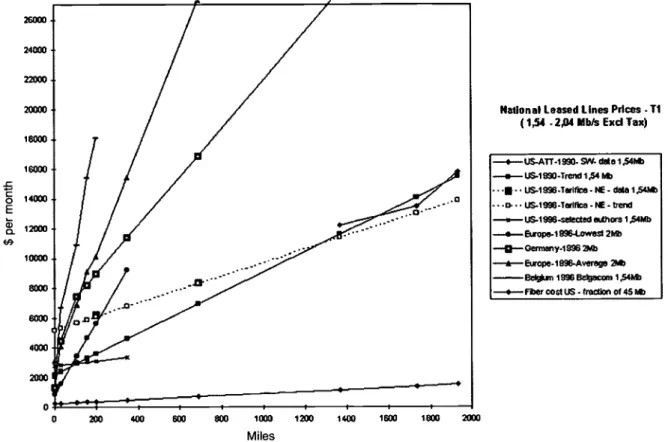
To understand the determining factor better one has to study the distance based charges. This is done in Figure 3. The prices of many connections in the US and in Europe have been assembled into a single picture
where the cost is related to the distance. Only national leased lines are considered in this case. Figure 3 presents prices for different connections coming from different sources that have been extrapolated to identify the under-lying distance charge.
0 200 400 600 800 1000
Miles
1200 1400 1600 1800 2000
National Leased Lines Prices .11
(1,54 -2,04 MIbls Exd Tax)
4-- US-ATT-1990- SW- data 1,54A6
aUS -1890 -Trend 1,54 bb
1111 1S-1996-Tarifica - NE - data 1,54Mb
D. US-1996-Tadfica - trend US-19i36-sat eat SUM= I Agib --a-- Europe-1996-Lowest 2k5 ----DGerrnany4996 21.03 ---,*--Europe-1896-Average 2ab
Belgium 1996 Etelgacom 1,54Mb
Fifer cost US - fraction of 45 alb
Figure 3: Comparison of leased lines costs in Europe and in the USA in relation to distance.
As appears in the figure, several authors and studies present very different price levels. The prices given for
California seem to be lower than the one for the Northeast. 'For example, a DS-3 circuit between Los Angeles
and San Francisco (approximately 350 miles) would typically cost about $350 per month for a DS-0, $3300 per
month for a DS-1 and $32,000 per month for a DS-3' (Henderson 1996). In a study by Tarifa for the European Commission, the price of a 200 miles 2 Mb/s connection between Washington and New York is priced at ECU
4901 ($3,860), a lot more than the price given before for 350 miles. The differences can be explained partly by taxes ( the Tarifa study includes taxes), different bandwidth (T1 is 1.536 Mb/s whereas in Europe the standard is 2 Mb/s), long distance operator tariffs, and access charges depending on local operators at both ends of the line.
At the bottom of the figure we have included the prices of a T3 line given by Brian Kahin in 1994. That cost is
reduced to its T1 equivalent by dividing it by 28. This is approximately the cost of the fibre in the ground. The
bandwidth price on a T1 appears to be 3 to 60 times higher than on a T3.
Another conclusion is that the distance charge is much lower in the US. The German prices, for instance, are 2.5 times more expensive for 1000 miles. If it would be an international line in Europe the price would be 7.5 times higher with the German prices. These are nevertheless below the average prices in Europe.
The distance charge for a T1 was $6.8 per mile and per month in the US in 1989 for the South and the West. In the Tarifa study, which already presents high US prices, the cost per mile comes down to $ 4.5. Kahin (1995) refers to a distance charge of $1.6.
In Europe, according to our calculation, the average price per mile and per month is $35. Belgium manages to have $69.6 whereas Germany has $16. Mercury has one of the lowest tariffs in Europe due to a low base cost but the distance charge results in $24 per mile.
The distance charges and the interconnection cost for leased lines in Europe put the bandwidth for
pan-European services at a very high level.
Online Information 96 Proceedings
Page 308
3.3. Internet access costs
Using the costs of leased lines we could calculate the cost of Internet bandwidth. With different connections in Europe and in the US we can model the cost of the Internet, or at least part of it. This allows us to calculate what should be the cost of the bandwidth for the users. We distinguish two kind of users: a corporate LAN with many users pumping from the Internet and a small server providing information to the Web.
Connecting a LAN with a 64 Kb/s access costs 2.5 time more then in the US. In the longer term, with
decreasing costs of 2 Mb/s lines the European cost may come down below the current US price. If one looks at
a 2 Mb/s access even with decreasing costs, the European costs remain much higher then current US prices. This is due to the fact that we do not expect a significant drop in the international 34 Mb/s lines in Europe and
because ISP are slow to move to such capacities.
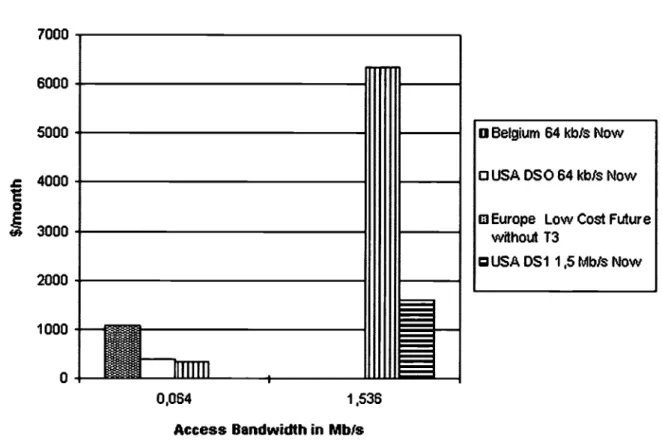
In Figure 4 we compare the connection costs for a small server which could be set up by a SME for its clients.
This server connects to the ISP with a 64 Kb/s line. We analyse the cost of the bandwidth in relation to the
capacity used by that ISP: 64 Kb/s lines, 1.5 Mb/s or 45 Mb/s (not including the leased line to the ISP).
7000 6000 5000 ,c 4000 (ft 3000 2000 1000 0
Internet Access Costs
.
0,064 1,536
Access Bandwidth in Mb/8
fliOw//1
Figure 4: Comparison of Internet access costs in Europe and the US.
O Belgium 64 kbls Now
0 USA DSO 64 kbls Now
0 Europe Low Cost Future without T3
O USA DS1 1,5 Mb /s Now
BEST COPY
AVAILABLE
Online Information 96 Proceedings
Page 309
2000 1500 ,c
E
0 E ,-w 1000 CL 4f) 500Small Server Bandwidth Connection Costs (64 Kb/s access)
r
o
s
0,064 1,536 45
0 $knonthlserver - USA
a $11mordhiserver - Europe - Cross-boarder
ISP Own Bandwith Category Mb!s Figure 5: Impact of leased line costs charged to ISP on server access costs.
The US figures shows how a cheap T3 infrastructure allows cheap access by servers to the Internet. European prices come down to $1000 a month as ISPs move to 2 Mb/s lines. They are kept high due to the international access charges and to the distance charges. Also a European ISP must have access to the US part of the Internet with much more transatlantic capacity then his US counterpart needs. For a 64 Kb/s connection, the European
costs are still 25 times higher then the US for the same capacity. US small companies can implement a small
server on a T1 for a much lower price then European firms.
3.4. The future
In the future telecommunications will depend increasingly on the availability of TCP/IP networks with enough
bandwidth at low prices. This may be achieved through competition after 1997. New operators such as Hermes,
the company set up by the railways, offer an opportunity. Prices are already expected to decrease by 30% in
1997. However more is needed. The cost of 2 Mb/s lines on long distances over Europe should drop by almost 90%. The cost of fibre networks in the ground shows that this should be possible.
4.
Impact on business
4.1. Business users
Less bandwidth and higher costs results in slower Internet access. For instance, downloading a document of say 100 KB (text and a few images) may take half a minute or even over a minute with a slow connection. In the US for the same cost per user in a company connected with a T1 it could take 1.25 seconds. It may thus take at least 2 to 3 times longer in Europe to use the Internet at the same cost. No wonder that many users complain that it is too slow.
Online Information 96 Proceedings
Costs per user are high in Europe. For instance a company with 240 Internet users in Belgium would typically
have a cost of $47 per month per user. It can now be as low as $5.5 in the US with a T1 for 288 employees connected. This shows why leased line costs should drop by 90% in Europe.
Similarly it is much more expensive to bring an Internet or an intranet server online in Europe, so they will be
connected with slower lines and provide users with lower access quality. Most non-dedicated SMEs will find it too expensive to jump into the multimedia information age. All European service providers are put in a weak
competitive position.
To cope with this situation, in the near future sharing of infrastructure (2 Mb/s access) seems to be the only way to have cheap access to fast Internet for the end-user, the SMEs and the small online services. Therefore the concept of small and large teleports may soon become more attractive. Local authorities may find new ways to attract business.
4.2. Multimedia technology
The status of the telecommunications system in Europe, in particular the cost of bandwidth on long distances, delays the rapid take-off of multimedia technology by European business. It is therefore not surprising that innovation and new products appear first in the US. Europe has spent large amounts of money on information
technology but failed so far to provide business and citizens with cheap bandwidth to use that new technology.
It is time to make sure the new policy fosters not only the technology but mainly its use. Telecommunications
regulations and competition can play a role. In particular it is necessary to bring prices in line with costs and to limit access charges to reasonable amounts. Strong political will is needed to enforce these regulations properly.
4.3. Online publishing and service providers
The European environment that we have analysed involves many issues regarding information providers and
Internet/intranet service providers. Information providers must embrace the Internet fast. No other infrastructure is likely to offer global bandwidth at a low price in the coming years. However in Europe they should join forces
to stimulate the creation of a pan-European TCP/IP infrastructure with enough bandwidth and low, globally
competitive prices.
Information providers will also have to adapt content and pricing, strategies but this is not in the scope of this paper.
Internet service providers are clearly at the core of the problem. However, as they do not own the lines, they have little power to bring T3 prices down. It is even likely that telecommunications operators (existing and new ones) would become the major Internet bandwidth providers as they own the bandwidth and know how to send millions of invoices. Internet service providers may have a strategic strength if the bandwidth is supplied by large operators with little local presence and invoicing power, such as Hermes.
5. Conclusion
Browsing information on a network like the Web is the best way for end-users and SMEs to access information. However in Europe the current high cost of leased lines is a stranglehold on the way to the information age. Costs of Internet access per user can be up to 10 times higher in Europe than in the US for the same capacity. As we have seen this results mainly from the high cost of bandwidth on long distances, in particular when cross-border connections are needed such as for Internet.
There is some hope on the horizon however: competition might bring what is needed. New pan-European
networks such as Hermes from the railways and the interconnection of cable TV networks are interesting
oppor-tunities. Telecommunications regulations must bring prices in line with costs and limit access charges to
reasonable amounts. Strong political will is certainly needed to enforce such regulations widely in Europe. Jean-Claude Delcroix President DECADE SA/NV Franz Merjay 117 B 1050 Brussels Tel: +32 2 3490190 Fax: +32 2 3490199
Bibliography
Belgacom, Manuel d'utilisation du programme Lignes louees 1994, and programme update 1/1/96,
Deutche Telekom, ISDN In Germany, February 1996
Eurodata Foundation (1996) Comparison between international leased line tariffs, Public Network Europe, February. Henderson, L. (1996) The price of WAN connectivity choosing the right WAN service for your business typically
comes down to pricing, Byte, http://www.byte.com/art/9605/sec8 lart3.htm.
9
Online Information 96 Proceedings
Page 311
Heywood, P. and E. Gronert (1996) High speed data services, Data Communications, March.
Heywood, P. and To Chee Eng (1995) Global supernets: big pipes, big promises...and one big problem, Data Communications, 21 September.
Kahin, B. (1995) The Internet and the national information infrastructure, Harvard University 3/1995,
http://ksgwww.harvard.eduliip/KAHINPA.ASC.txt.
Stuck, B. (1990) Telecommunications Equipment And Service Trends: 1990-1994, William K. Woodruff & Company Inc., Dallas, TX.
Tariff Data 01.01.96, prepared by Tarifa, a division of PBI Ltd, Stevenage, for the European Commission DG XIII. van den Broek, F.G.H. and Maarten Looijen (1996) Cost-effective management of international networks,
http:///www.ctr.columbia.edu/vi/papers/art_2.htm.
t®
Online Information 96 Proceedings
,
a.
(9/92)
U.S. DEPARTMENT OF EDUCATION
Office of Educational Research and improvement (OERI) Educational Resources information Center (ERIC)
NOTICE
REPRODUCTION BASIS
I