C A S E R E P O R T
Open Access
Prostatic stromal sarcoma with neuroectodermal
differentiation
Hitoshi Yamazaki
1*, Teppei Ohyama
2, Toshiki Tsuboi
2, Yoshinori Taoka
2, Dai Kohguchi
2, Hiroyoshi Iguchi
3and Teruaki Ao
2Abstract:Prostatic stromal sarcoma is a fairly rare tumor that constitutes approximately 0.1–0.2% of all prostatic cancers. Detailed characteristics of the tumor are still unclear due to its rarity.
We describe a case of prostatic stromal sarcoma in a 63 year-old man who suffered from urinary obstructive symptoms. Palliative transuterine resection was performed and the preliminary histopathological diagnosis was neuroendocrine carcinoma. After chemotherapy, total pelvic exenteration was performed. Histopathologically, the tumor was composed of monotonously proliferating small to medium-sized round cells, which existed in compact islands with loose or dense fibrovascular networks. Immunohistochemically, the tumor cells were widely positive for vimentin, CD56, CD99 and focally positive for synaptophysin, CD10, progesterone receptor, desmin and CD34, but negative for EMA, cytokeratin, estrogen receptor, S-100 and myoglobin. Most of the previously reported tumors exhibited positive stainability for CD10 and progesterone receptor. In addition to these markers, expressions of CD56, CD99 and synaptophysin were characteristically detected in our case. To the best of our knowledge, we present the first case of prostatic stromal sarcoma with characteristic immunohistochemical staining properties. Although the biological characteristics of this rare tumor have not yet been elucidated, these findings suggest prostatic stromal sarcoma can potentially show neuroectodermal differentiation.
Virtual slide:The virtual slide(s) for this article can be found here: http://www.diagnosticpathology.diagnomx.eu/vs/ 7291874028051262
Keywords:Prostatic stromal sarcoma, STUMP, Immunohistochemistry, CD99, CD56, Synaptophysin, Neuroectodermal differentiation
Background
Prostatic stromal sarcoma (PSS) is a fairly rare tumor, constituting approximately 0.1% of all prostatic cancers [1,2]. Prostatic sarcoma and related proliferative lesions, including prostatic phyllodes tumors, have been classi-fied as prostatic stromal tumors of uncertain malignant potential (STUMP) and prostatic stromal sarcoma (PSS) based on cellularity, mitotic index, cellular atypia and necrosis (WHO 2004) [3]. Some STUMP cases were reported as malignant transformation into PSS [4]. There has not yet been a clear differentiation between PSS and STUMP due to the rarity of these tumors. In this article, prostatic stromal sarcoma has potentially neuroectodermal characteristics.
Case presentation
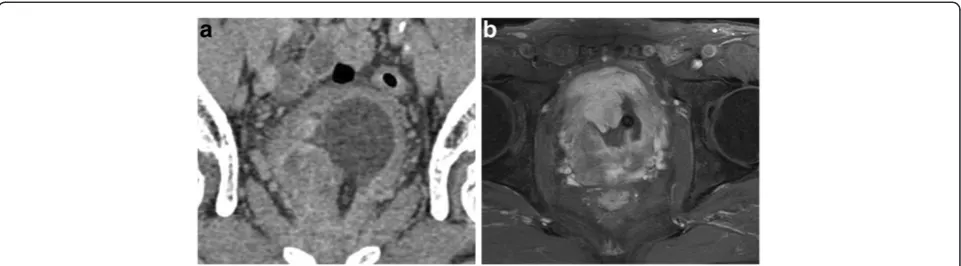
The patient was a 63 year-old man who presented to the urologist with a one week history of dysuria, pollakiuria and an unrelieved feeling after urination. He had a previ-ous history of diabetes mellitus and asymptomatic mul-tiple brain infarction. He habitually drank alcohol and smoked and his mother died of gastric cancer. Abdom-inal ultrasonography revealed 343 ml of residual urine volume. Computed tomography revealed a prostatic mass lesion which protruded into the bladder space (Figure 1a). Gadrinium-enhanced T1 weighted magnetic resonance imaging also revealed the prostatic mass le-sion had irregularly high signals (Figure 1b). Based on our clinical diagnosis of benign prostatic hypertrophy, palliative transurethral resection was performed. The specimen consisted of 20 grams of piecemealed prostate that was totally embedded in paraffin and histologically analyzed. Sections showed monotonously proliferating * Correspondence:[email protected]
1
Department of Pathology, Medical center hospital, Kitasato Institute, Kitasato University, Saitama, Japan
Full list of author information is available at the end of the article
small to medium-sized round cells invading the edema-tous stroma with coarseness and fineness and sparse or dense patterns. The residual prostatic glands were iden-tified. Immunohistochemically, the tumor cells were positive for vimentin, CD56, synaptophysin (focal) but negative for EMA, cytokeratin, S-100. The preliminary histopathological diagnosis to decide the strategy for fur-ther fur-therapy was neuroendocrine carcinoma. He took one series of chemotherapy, a combination of cisplatin and irinotecan. Ten days after the last day of the chemo-therapy, suprapubital radical cystprostatectomy with rethrotectomy was performed. During the operation, the urinary bladder could be detached from the rectum with difficulty. Finally, low anterior rectal resection was add-itionally performed, resulting in total pelvic exenteration. When the urethra was cut, a part of the tumor was pressed down from the urethral cavity. The gross fea-tures of the tumor were elastic soft and translucently whitish in color. After fixation in 10% formaldehyde the prostate weighed 125 g and contained an ill-defined gray whitish mass lesion, which focally exhibited necrosis (Figure 2). The bladder and the retroperitoneal cavity
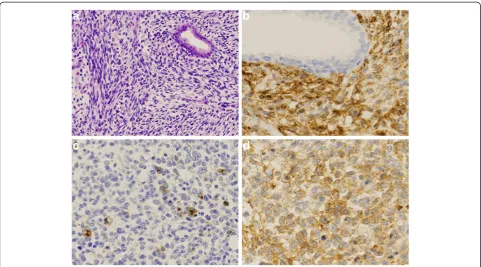
were diffusely infiltrated by the whitish tumor, which was directly connected to the prostatic tumor. Although the rectum was attached to the tumor mass, the rectal parenchyma was free from tumor invasion. The bladder space was occupied by the tumor and narrowed, result-ing in a slit-like space. Serial sections were analyzed and revealed a round cell sarcomatous tumor with occasional higher cellularity than that in the previous transuterine resection. Tumor necrosis was occasionally identified. The N/C ratio of the tumor cells was a relatively high grade. Mitotic activity was measured as 12/10 HPF in the higher cellularity area. The residual prostatic glands were compressed to the periphery (Figure 3a). No lymph nodal metastasis was observed. Immunohistochemically, the tumor cells were widely positive for vimentin, CD56, CD99 and focally positive for synaptophysin, CD10, pro-gesterone receptor, desmin and CD34, but negative for EMA, cytokeratin, estrogen receptor, S-100, GFAP and myoglobin (Figure 3b,c,d). The Ki-67 index was about 70%. We finally diagnosed the tumor as prostatic stro-mal sarcoma. Sixteen months later, the patient is alive without local recurrence or distant metastasis.
Discussion
Prostatic stromal sarcoma is a rare tumor that constitu-tes approximately 0.1–0.2% of all prostatic cancers [1,2]. Prostatic mesenchymal tumors sometimes cannot be clearly classified as histological entities due to their rar-ity [5]. Except for prostatic mesenchymal tumors with specialized differentiation, a histologically characteristic classification involves prostatic stromal sarcoma and prostatic stromal proliferation of uncertain malignant potential (STUMP) [6-8]. These tumors have been described on the basis of the histological similarity to phyllodes tumors and have to be differentially diagnosed as other specialized types of tumor, such as GIST, leio-myosarcoma, rhabdomyosarcoma(RMS), and fibrosar-coma [3]. RMS is the most common sarfibrosar-coma of the prostate, but is rarely reported in adult patients [9]. Figure 1Image analysis. a) Computed tomography shows a prostatic non-homogenous mass lesion irregularly protrudingd into the bladder space.b) Gadrinium-enhanced T1 weighted magnetic resonance imaging shows a heterogeneous hyperintense mass.
Figure 2Cut surface of the tumor.The prostate and the bladder space are widely occupied by the tumor tissue, which exhibited a whitish-yellow multinodular appearance with focal necrosis.
Yamazakiet al. Diagnostic Pathology2012,7:173 Page 2 of 5
Prostatic stromal sarcoma and STUMP express female hormone receptors, especially progesterone receptor. These tumors seem to be derived from female hormone-dependent stromal cells [10]. Depending on the cellularity, mitosis and necrosis, these two tumors are histologically evaluated. An acceptable histological grading of stromal sarcoma has not yet been proposed due to the rarity of the tumor. Hasegawa reported that the ki-67 index was related to the prognosis of the tumor [4].
Recent immunohistochemical analysis revealed that both prostatic stromal sarcoma and STUMP usually ex-press CD10, CD34 and the progesterone receptor [3,7,8,10-12]. This tumor sometimes positively reacts with smooth muscle actin. However, the detailed histo-pathological characteristics of the tumor cells have not yet been clearly elucidated. Kim reported a case of pros-tatic stromal sarcoma with rhabdoid features [13]. The tumor in our case was positive for CD56, CD99 (to our knowledge the second reported case) [14], synaptophysin and negative for EMA and cytokeratin. This is the first description of prostatic stromal sarcoma with immuno-histochemically positive stainability for synaptophysin. There are other prostatic non-epithelial malignancies with potential neuroectodermal differentiation such as carcino-sarcoma, ectomesenchymoma and primitive neuroecto-dermal tumor (PNET), which have to be distinguished
from our case of prostatic stromal sarcoma. Patient age is a useful marker for differential diagnosis, although PNET and malignant ectomesenchymoma are rarely reported in young adult prostate cancer patients [15-18]. Most PNET cases reveal positive immunoreactivity for CD99, but are negative for progesterone receptor. Carcinosarcoma con-tains elements of epithelial malignancy which exhibit some types of cytokeratins.
authentic molecules which directly cause prostatic stro-mal tumorigenesis. Fibroblast growth factor 8 (FGF8), the eighth member of the fibroblast growth factor family contains alternatively spliced mRNA isoforms. Fibroblast growth factor 8b(FGF8b) is an androgen-induced growth factor with potent oncogenic activity [25-27]. Elo reported the results of prostate-targeted fibroblast growth factor 8b transgenic mice [28]. These mice showed progressive changes in prostatic stroma, as well as the prostatic epithelium. Furthermore, FGF8b is the predominant FGF8 spliceform necessary for proper pos-terior neural formation in Xenopus [29]. Amsterdam reported the relationship between fgf8 misregulation and neuronal tumors in Zebrafish [30]. This knowledge suggests FBF8b is related to potential neuroectodermal differentiation in prostatic stromal tumorigenesis. Some hormonal imbalances, including androgen imbalance, may cause prostatic stromal progression, which could lead to prostatic stromal neoplasia. We hereby point
out that PSS may also possess neuroectodermal
characteristics.
Conclusions
We describe a rare case of prostatic stromal sarcoma (PSS) presenting with characteristic immunohistochem-ical staining properties. To our knowledge, this case is the first case of PSS with positive stainability for synap-tophysin, as well as CD99 and CD56.
Consent
Written informed consent was obtained from the patient for publication of this case report and accompanying images. A copy of the written consent is available for re-view by the Editor-in-Chief of Diagnostic Pathology.
Competing interests
We do not have any competing interests for our manuscript.
Authors’contribution
HY was responsible for data collection and drafted the manuscript. TO, TT, YT, DK and TA made contributions to acquisition of clinical data and performed surgical procedure. HI performed radiological interpretation and helped drafting the manuscript. All authors read and approved the final manuscript.
Author details
1
Department of Pathology, Medical center hospital, Kitasato Institute, Kitasato University, Saitama, Japan.2Department of Urology, Medical center hospital, Kitasato Institute, Kitasato University, Saitama, Japan.3Department of Radiology, Medical center hospital, Kitasato Institute, Kitasato University, Saitama, Japan.
Received: 13 September 2012 Accepted: 14 October 2012 Published: 7 December 2012
References
1. Bernard T, John RS, Bostwick DG:Soft tissue tumors. InPathology of the Prostate. Edited by Bostwick GB. New York: Churchill Livingstone; 1990:117–135.
2. Bostwick DG, Eble JN:Neoplasms of the prostate. InUrologic Surgical Pathology. Edited by Bostwick DG, Eble JN. Philadelphia: Mosby; 1997:399–401.
3. Cheville J, Cheng L, Algaba F, Boccon-Gibod L, Furusato M, Billis A, Lopez-Beltran A:Mesenchymal tumours. InPathology and Genetics of Tumours of the Urinary System and Male Genital Organs. Edited by Eble JN, Sauter G, Epstein JI, Sesterhenn IA. Lyon: IARC Press; 2004:209–211 [World Health Organization Classification of Tumours].
4. Hasegawa S, Yoshikawa M, Konomoto T, Andou S, Inoue M, Nagashima A, Omiya K, Ushijima M:Prostatic stromal sarcoma: a case report.
Nishinihonhinyokika2002,64:619–626.
5. Herawi M, Epstein JI:Specialized stromal tumors of the prostate: a clinicopathologic study of 50 cases.Am J Surg Pathol2006,30:694–704. 6. Gaudin PB, Rosai J, Epstein JI:Sarcomas and related proliferative lesions of
specialized prostatic stroma: a clinicopathologic study of 22 cases.Am J Surg Pathol1998,22:148–162.
7. De Berardinis E, Busetto GM, Antonini G, Giovannone R, Di Placido M, Magliocca FM, Di Silverio A, Gentile V:Incidental prostatic stromal tumor of uncertain malignant potential (STUMP): histopathological and immunohistochemical findings.Urologia2012,79:65–68.
8. Brolin J, Skoog L, Ekman P:Immunohistochemistry and biochemistry in detection of androgen, progesterone, and estrogen receptors in benign and malignant human prostatic tissue.Prostate1992,20:281–295. 9. Waring PM, Newland RC:Prostatic embryonal rhabdomyosarcoma in
adults. A clinicopathologic review.Cancer1992,69:755–762.
10. Stoll LM, Johnson MW, Rosenthal DL:High-grade prostatic sarcoma seen in a catheterized urine specimen: case report and differential diagnosis.
Diagn Cytopathol2011,39:762–766.
11. Colombo P, Ceresoli GL, Boiocchi L, Taverna G, Grizzi F, Bertuzzi A, Santoro A, Roncalli M:Prostatic stromal tumor with fatal outcome in a young man: histopathological and immunohistochemical case presentation.
Rare Tumors2010,31;2(4):e57.
12. Osaki M, Osaki M, Takahashi C, Miyagawa T, Adachi H, Ito H:Prostatic stromal sarcoma: case report and review of the literature.Pathol Int2003,
53:407–411.
13. Kim JY, Cho YM, Ro JY:Prostatic stromal sarcoma with rhabdoid features.
Ann Diagn Pathol2010,14:453–456.
14. Segawa N, Hamada S, Takahara K, Azuma H, Tsuji M, Katsuoka Y:Prostatic stromal sarcoma: a case report.Hinyokika Kiyo2008,54:29–34. 15. Kumar V, Khurana N, Rathi AK, Malhotra A, Sharma K, Abhishek A, Bahadur
AK:Primitive neuroectodermal tumor of prostate.Indian J Pathol Microbiol
2008,51:386–388.
16. Funahashi Y, Yoshino Y, Hattori R:Ewing’s sarcoma/primitive neuroectodermal tumor of the prostate.Int J Urol2009,16:769. 17. Paramelle O, Croué A, Dupré F, Rialland X, Saint-André JP:Pelvic malignant
ectomesenchymoma: a case report.Ann Pathol2001,21:344–347. 18. Colecchia M, Dagrada G, Poliani PL, Messina A, Pilotti S:Primary primitive
peripheral neuroectodermal tumor of the prostate. Immunophenotypic and molecular study of a case.Arch Pathol Lab Med2003,127:e190–193. 19. Watanabe M, Yamada Y, Kato H, Imai H, Nakano H, Araki T, Shiraishi T:
Malignant phyllodes tumor of the prostate: retrospective review of specimens obtained by sequential transurethral resection.Pathol Int
2002,52:777–783.
20. Arva NC, Das K:Diagnostic dilemmas of squamous differentiation in prostate carcinoma case report and review of the literature.Diagn Pathol
2011,6:46.
21. Hossain D, Meiers I, Qian J, MacLennan GT, Bostwick DG:Prostatic stromal hyperplasia with atypia: follow-up study of 18 cases.Arch Pathol Lab Med
2008,132:1729–1733.
22. Bostwick DG, Egbert BM, Fajardo LF:Radiation injury of the normal and neoplastic prostate.Am J Surg Pathol1982,6:541–551.
23. BabarovićE, Zamolo G, MustaćE, StrčićM:High grade angiosarcoma arising in fibroadenoma.Diagn Pathol2011,6:125.
24. Takenaka M, Tanaka M, Isobe M, Yamaguchi R, Kojiro M, Shirouzu K:
Angiosarcoma of the Breast with Silicone Granuloma: A Case Report.
Kurume Med J2009,56:33–37.
25. Tanaka A, Miyamoto K, Minamino N, Takeda M, Sato B, Matsuo H, Matsumoto K:Cloning and characterization of an androgen-induced growth factor essential for the androgen-dependent growth of mouse mammary carcinoma cells.Proc Natl Acad Sci USA1992,
89:8928–8932.
Yamazakiet al. Diagnostic Pathology2012,7:173 Page 4 of 5
26. Ghosh AK, Shankar DB, Shackleford GM, Wu K, T'Ang A, Miller GJ, Zheng J, Roy-Burman P:Molecular cloning and characterization of human FGF8 alternative messenger RNA forms.Cell Growth & Differentiation1996,
7:1425–1434.
27. Kouhara H, Koga M, Kasayama S, Tanaka A, Kishimoto T, Sato B:
Transforming activity of a newly cloned androgen-induced growth factor.Oncogene1994,9:455–462.
28. Elo TD, Valve EM, Seppänen JA, Vuorikoski HJ, Mäkelä SI, Poutanen M, Kujala PM, Härkönen PL:Stromal activation associated with development of prostate cancer in prostate-targeted fibroblast growth factor 8b transgenic mice.Neoplasia2010,12:915–927.
29. Fletcher RB, Baker JC, Harland RM:FGF8 spliceforms mediate early mesoderm and posterior neural tissue formation in Xenopus.
Development2006,133:1703–1714.
30. Amsterdam A, Lai K, Komisarczuk AZ, Becker TS, Bronson RT, Hopkins N, Lees JA:Zebrafish Hagoromo mutants up-regulate fgf8
postembryonically and develop neuroblastoma.Mol Cancer Res2009,
7:841–850.
doi:10.1186/1746-1596-7-173
Cite this article as:Yamazakiet al.:Prostatic stromal sarcoma with neuroectodermal differentiation.Diagnostic Pathology20127:173.
Submit your next manuscript to BioMed Central and take full advantage of:
• Convenient online submission
• Thorough peer review
• No space constraints or color figure charges
• Immediate publication on acceptance
• Inclusion in PubMed, CAS, Scopus and Google Scholar
• Research which is freely available for redistribution