Failure of Special Relativity as a Theory Applied to
More Than One of Spatial Dimensions
Maciej Rybicki
Sas-Zubrzyckiego 8/27 Kraków, Poland
Abstract
A thought experiment concerning specific case of length contraction demonstrates inconsistency of the Special Theory of Relativity (STR). When two extended objects in the mutual relative motion occupy the same area in spacetime (e.g. elevator moving in the elevator shaft; here considered in 2D representation), then Lorentz transformation appears generally unable to handle this situation in a self-consistent way. Namely, transformation from either elevator or shaft rest frames to the observer’s rest frame, non-collinear with the direction of relative motion between the said objects, leads to a contradiction. This happens because the elevator and shaft are subject to the Lorentz length contraction along two different directions in 𝑥𝑥𝑥𝑥 plane, due to different directions of their motion in the observer’s frame. In result, they no longer match each other in this frame. A direct cause of this contradiction is the resulting from the principle of relativity concept of relative motion, regarded as the source of “relativistic” effects. The revealed inconsistency, to which the name “elevator-shaft paradox” is assigned, makes necessary replacing STR by a different theory based on the postulate of preferred frame of reference and the related concepts of absolute rest and absolute motion. The relevant Preferred Frame Theory (PFT) is discussed, with the particular focus on partial experimental equivalence between PFT and STR. The proposed theory predicts an invariant hierarchy of energy, which opens up new prospects for the sought theory of quantum gravity.Keywords Length contraction, Lorentz transformation, Preferred frame of reference, Spacetime, Special relativity,
Tangherlini transformation1. Introduction
All the textbooks on Special Relativity are full of rockets, twins, clocks, trains, platforms, etc. This may suggest that STR has been thoroughly verified as a consistent description of the real three-dimensional world with time taken as the fourth dimension. Meanwhile, the more careful insight shows that nearly all the considered cases exploit a single spatial dimension, namely the one parallel to the relative motion between two inertial frames, conventionally identified with 𝑥𝑥 -axis. Even when two spatial dimensions are taken into account (as e.g. in the Sagnac effect), the respective transformations between selected frames are always considered in separation, i.e. as connecting consecutive inertial frames, all linked to the single (curved) course of motion. This general observation applies both to the algebraical description of theory, in particular to Lorentz transformation, and to respective geometrical representation expressed by Minkowski or Loedel spacetime diagrams. In
* Corresponding author:
[email protected] (Maciej Rybicki) Published online at http://journal.sapub.org/ijtmp
Copyright©2019The Author(s).PublishedbyScientific&AcademicPublishing This work is licensed under the Creative Commons Attribution International License (CC BY). http://creativecommons.org/licenses/by/4.0/
contrast to that, our goal is to examine Special Relativity in application to the “real” two-dimensional case, i.e. the one in which the action takes place so to say simultaneously in two spatial dimensions in 𝑥𝑥𝑥𝑥 plane. Anticipating the final result of that examination (which is the fundamental revision of STR, followed by an indication of its due replacement), let us precede the main body of this paper by a brief glance at the origin of Special Relativity and its potential preferred frame alternative.
Larmor [3]), subsequently developed by Lorentz in his theory of electron, also known as Lorentz ether theory (LET) [4]. The failures in detecting absolute motion had been elevated by Poincare [5] to the rank of universal law of nature, called by him the principle of relativity, which paved the way to Special Relativity.
In this pivotal moment of physics development, the basic principles once again hang in the balance. The postulated unity of nature (and consequently of physics) required new model of transformation, under which all phenomena would behave uniformly. Logically, the main alternative was: either extension of the Galilean principle of relativity to electrodynamics and other domains, or its opposition, a theory related to the notions of absolute space and absolute motion, with the Galilean relativity “emerging” as an approximation in the limit of small velocities. Each of these options involved different type of transformation and different conversion of Newtonian mechanics to a new adequate form. However, due to specific “state of excitement” featured by the abundance of competitive hypotheses, only the first of mentioned two possibilities had been developed to the stage of complete theory, namely STR. Once it already happened, the “natural selection” did its work eliminating the second option.
As shown in Einstein’s seminal paper [6], Lorentz transformation did not need any physical “content” to appear except the two fundamental postulates: the principle of relativity and the constancy (isotropy) of the velocity of light. Due to the radical simplicity of these postulates, STR evinced itself as a “spacetime physics” [7], which means it basically refers to geometry. This became clearly visible owing to Minkowski geometrical interpretation of Special Relativity [8]. The relevant Minkowski spacetime (or space) provides a fusion of the Euclidean three-dimensional space with time interpreted as the fourth dimension of space (with opposite sign) into a single inseparable four-dimensional continuum otherwise called the Lorentzian manifold. An invariant element of Minkowski space is the “spacetime interval” - the Pythagorean-like construct connecting two timelike (i.e. causally connectible) “events” in spacetime, in analogy to distance in Euclidean space obtainable from the Pythagorean theorem. The pseudo-Euclidean geometry of the (flat) “hyperbolic” Minkowski space determines all kinematical properties of any physical object connected with its motion relative to a freely chosen inertial observer. The fact that STR can be interpreted as a purely geometrical model is widely considered to ensure “by definition” its internal coherence. It could be therefore surprising that careful examination of a certain specific class of cases reveals fallacy hidden behind the symmetry. As a result, Special Relativity, along with Minkowski space, turns out to be an inadequate description of nature. Although quoting Einstein against himself may seem a bit unfair; yet his ingenious remark perfectly matches this case: “As far as the laws of mathematics refer to reality, they are not certain, and as far as they are certain, they do not refer to reality” [9].
Part I includes a thought experiment demonstrating the
STR inconsistency as a theory applied to more than one of spatial dimensions. Instead, in Part II we outline a theory alternative to STR (the second option, mentioned above), mathematically consistent, compatible with all known experiments and predicting new subtle effects so far undiscovered.
2. Part I
An evidence of the geometrical inconsistency of Special Relativity
1. Description of the elevator-shaft thought-experiment and its preliminary analysis
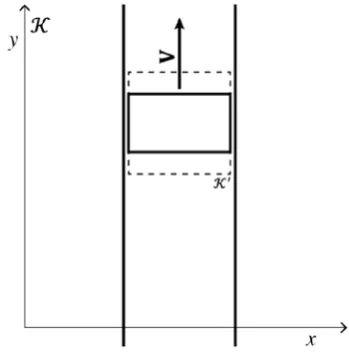
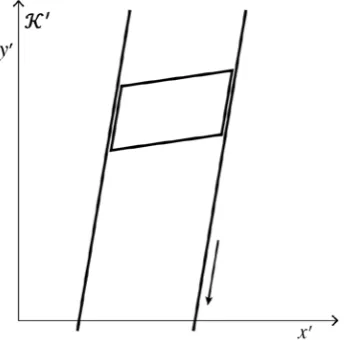
In the following reasoning we shall strictly adhere to the STR rules implemented to 3-dimensional spacetime 𝑐𝑐𝑐𝑐, 𝑥𝑥, 𝑥𝑥 (all the time 𝑧𝑧= 0). Assume the 2D “elevator” moving uniformly, say, upward, with the relativistic velocity 𝐕𝐕 relative to the 2D vertical elevator shaft, hereinafter referred to as “rails”. Let 𝒦𝒦′ be the rest frame for the elevator, and 𝒦𝒦 the rest frame for the rails. To get a better insight, assume that in 𝒦𝒦′ the elevator is square shaped. The spacing between the rails is assumed to be equal to the width of elevator, while the rails length is treated as infinite. In 𝒦𝒦 the moving elevator is contracted by the Lorentz factor 𝛾𝛾(𝑉𝑉)= (1− 𝑉𝑉2⁄𝑐𝑐2)−1 2⁄ from square to the horizontal
rectangle (Fig. 1).
Figure 1. Elevator moving upwards in 𝓚𝓚 becomes contracted by the Lorentz factor 𝜸𝜸(𝑽𝑽), from the square to rectangle. The dashed line depicts the square shape of elevator in its rest frame 𝓚𝓚′. Both in frames 𝓚𝓚′ and 𝓚𝓚 elevator tightly adheres to the rails
a different problem. To formulate it, let us assume that elevator and rails are observed from the train moving relative to 𝒦𝒦 with the relativistic velocity 𝐮𝐮 in 𝑥𝑥 positive direction. Let 𝒦𝒦′′ be the rest frame for the train observer (Fig. 2).
Figure 2. The rails at rest in frame 𝓚𝓚, elevator (at rest in 𝓚𝓚′) moving uniformly upwards, and the train-frame 𝓚𝓚′′ moving uniformly to the right; all three as observed from the rail-frame 𝓚𝓚
As far as the train (𝒦𝒦′′) moves to the right relative to vertical rails (𝒦𝒦), the rails move to the left relative to 𝒦𝒦′′ with the velocity −𝐮𝐮 (or 𝐮𝐮, provided we revert the sense of 𝑥𝑥𝑥𝑥′′-axes). Same as in 𝒦𝒦, the vector 𝐮𝐮 is perpendicular to
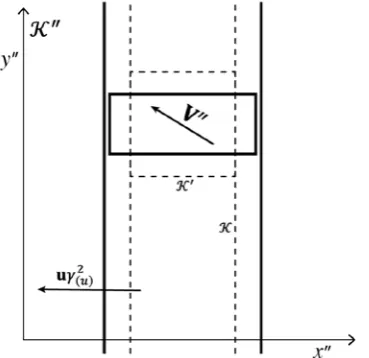
the rails in 𝒦𝒦′′ . Consequently, the rails described as “vertical” in 𝒦𝒦 (parallel to 𝑥𝑥-axis) are, regardless of their motion, also vertical in 𝒦𝒦′′ (parallel to 𝑥𝑥′′-axis). Compared with respective spacing in 𝒦𝒦, in 𝒦𝒦′′ the rails get closer to each other due to the length contraction by the Lorentz factor 𝛾𝛾(𝑢𝑢)= (1− 𝑢𝑢2⁄𝑐𝑐2)−1 2⁄ (Fig. 3).
Figure 3. The rails contracted in frame 𝓚𝓚′′. The dashed lines show the respective spacing in frame 𝓚𝓚
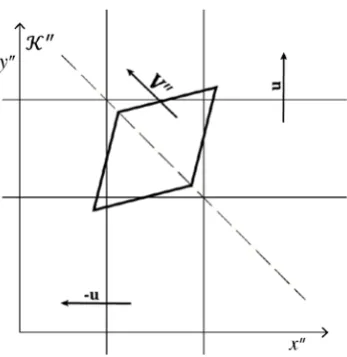
In turn, the elevator travels in 𝒦𝒦′′ with the velocity 𝐕𝐕′′ along the diagonal direction in 𝑥𝑥′′𝑥𝑥′′ plane, from bottom right to top left. Both the exact value and the direction of vector 𝐕𝐕′′ follow from the STR velocity addition in the general configuration:
𝐕𝐕′′ =𝐕𝐕
∥′′ ⊕ 𝐕𝐕⊥′′ =1+𝐮𝐮+𝑢𝑢 𝑉𝑉∥𝐕𝐕∥ 𝑐𝑐2
+𝛾𝛾(−𝑢𝑢1)𝐕𝐕⊥
1+𝑢𝑢 𝑉𝑉∥𝑐𝑐2 (1)
where 𝐕𝐕∥′′ and 𝐕𝐕⊥′′ are, respectively, the parallel (𝑥𝑥′′) and perpendicular (𝑥𝑥′′) components of 𝐕𝐕′′, and 𝐕𝐕∥ and 𝐕𝐕⊥ are, respectively, 𝑥𝑥 and 𝑥𝑥 components of 𝐕𝐕. Since in 𝒦𝒦 the elevator travels in 𝑥𝑥 direction, so respective components are: 𝐕𝐕∥= 0 and 𝐕𝐕⊥≡ 𝐕𝐕. Consequently Eq. (1) reduces to:
𝐕𝐕′′ =𝐮𝐮+𝛾𝛾
(−𝑢𝑢1)𝐕𝐕⊥ (2)
It follows that the elevator moves in 𝒦𝒦′′ in the direction determined by the components: 𝐕𝐕∥′′ =𝐮𝐮 and 𝐕𝐕⊥′′ =𝛾𝛾(−𝑢𝑢1)𝐕𝐕⊥, with the value of 𝐕𝐕′′ being:
𝑉𝑉′′ =�𝑢𝑢2+�𝑉𝑉 𝛾𝛾 (𝑢𝑢)
⁄ �2 (3)
In any case different from 𝐕𝐕∥′′ = 0, and/or 𝐕𝐕⊥′′ = 0, the elevator is contracted in 𝒦𝒦′′ by the Lorentz factor 𝛾𝛾�𝑉𝑉′′�=�1− 𝑉𝑉′′2⁄ �𝑐𝑐2 −1 2⁄ in the direction diagonal to
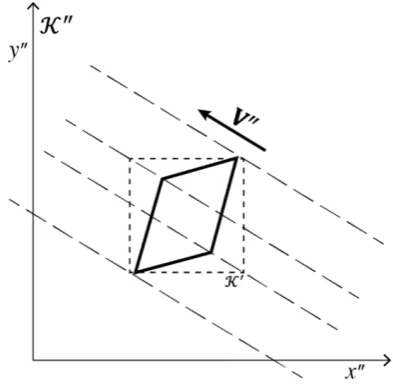
both of its horizontal and vertical sides. Hence, all four sides are tilted towards the direction transverse to vector 𝐕𝐕′′. In result, the elevator reshapes in 𝒦𝒦′′ from the square to the rhomboid, with all its sides diagonal in 𝑥𝑥′′𝑥𝑥′′ plane (Fig. 4).
Figure 4. Elevator observed in frame 𝓚𝓚′′. Due to the length contraction, the elevator reshapes from the square to rhomboid. Both horizontal and vertical sides are skewed in 𝓚𝓚′′
Figure 5. Square elevator contracted along the diagonal direction and vertical rails contracted along the horizontal direction do not match each other in the frame 𝓚𝓚′′. This contradicts respective fit in frames 𝓚𝓚 and 𝓚𝓚′
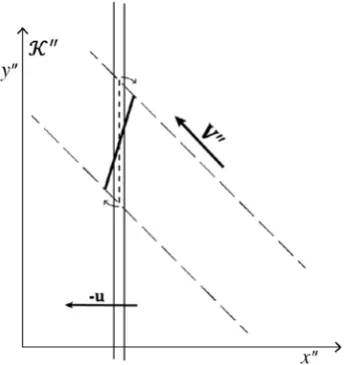
Let us consider now a simplified version of the above experiment, reduced to the basically one-dimensional objects embedded in the 3D spacetime. Let only one rail be left (we shall call it “pipe”), as well as only one vertical side of the elevator (we shall call it “rod”). Beside this difference (in fact coming down to assumption that elevator and shaft are both infinitely thin), the whole previous arrangement remains unchanged (Fig. 6).
Figure 6. The rod sliding in the vertical pipe at rest in 𝒦𝒦, observed in frame 𝓚𝓚′′. Due to the diagonal direction of contraction in 𝓚𝓚′′ the rod deviates from vertical direction, hence can no longer slide inside the pipe
In frame 𝒦𝒦′′, considering respective shapes, the pipe moves perpendicularly to vector −𝐮𝐮, while the rod moves diagonally to vector 𝐕𝐕′′. Due to the length contraction along vector 𝐕𝐕′′ the rod skews in 𝒦𝒦′′ towards the transverse direction to this vector. This is an obvious geometrical consequence of length contraction, considering e.g. how does behave the diagonal of the rectangle contracted along its sides. Hence, in result of contraction in 𝒦𝒦′′, the direction of rod differs from the direction of pipe that itself remains vertical. Consequently, according to observer 𝒦𝒦′′, the rod and pipe do not match each other, so that the rod can no longer slide inside the pipe. This ridiculous prediction is at
odds with the perfect fit in frames 𝒦𝒦 and 𝒦𝒦′, hence, as previously, indicates an inconsistency of STR.
Concluding, the reasoning contained in this section, if thoroughly considered, provides a wholly adequate evidence of the inconsistency of Special Relativity. Nevertheless, the two counter-arguments have been presented to the author in response to the “working” version of the present paper; the one in private correspondence [10] and the other one [11] aimed at justifying the rejection of the submitted manuscript. Regardless of the fundamental disagreement with these arguments, the author is truly grateful to both prominent proponents of Einstein’s theory for their stimulating contribution in improving this paper. All the more so that typical reaction in this case is no reaction. In short, these two counter-arguments are, respectively, the following: 1) Elevator cannot match the rails in one frame and not match in the other one. Lorentz transformation certainly cannot lead to such nonsensical result. In particular, a single spacetime point in one frame cannot split into the two separate points in another frame; 2) The composition of two non-collinear Lorentz boosts does not give a pure Lorentz boost along the resultant velocity, but Lorentz boost and rotation. It is this rotation that matches the contracted elevator to the rails in observer’s frame.
The following two sections are devoted to the analysis of these arguments. We shall consider them separately, although it is clear that they interconnect with each other to a certain degree. In particular, the second argument might be regarded as validating the first one.
2. Argument from the “singleness” of four-position of adjacent points
difference in determining the simultaneity of distanced events in 𝒦𝒦 and 𝒦𝒦′′ along the 𝑥𝑥𝑥𝑥′′ direction. Similarly, transformation from 𝒦𝒦′ to 𝒦𝒦′′ , specified as 𝑐𝑐𝑐𝑐′, 𝑥𝑥′, 𝑥𝑥′ ⟶ 𝑐𝑐′′ , 𝑥𝑥′′ , 𝑥𝑥′′ must also preserve the singleness of
respective “composite points”.
Let us recap: the elevator indeed reshapes in 𝒦𝒦′′ from the square to rhomboid due to the diagonal direction of length contraction in 𝑥𝑥′′𝑥𝑥′′ plane; nevertheless, its vertical (in 𝒦𝒦
and in 𝒦𝒦′) side-edges remain vertical in 𝒦𝒦′′. In that way,
the singleness of the four-positions of respective “composite points” is preserved.
The above argument seems to be conclusive by the strength of pure logic rather than by the rules specific to Special Relativity. Beyond any doubt, the property of “contacting” cannot be frame-dependent. A single set of spacetime coordinates cannot split into the two separated sets of coordinates (one for the vertex and one for the rail-point) in result of the Lorentz (or any other) transformation from one frame to another. This is a “mathematically trivial fact”, while its negation is “really absurd” [10].
In reply to this argument, we shall also use logic rather than physics. Let us call, just for our present purpose, the above-mentioned property of Lorentz transformation the “conservation of the singleness of four-position”. The respective demand is indeed trivial and obvious. The point is, however, that along with this one, another demand should also be made and fulfilled. Namely, the right transformation must give (predict) the correct length contraction. Note that unlike the “ordinary” point, i.e. the one fixed to a single object, e.g. elevator or rail as taken separately, each “composite point” here considered does not trace out a single trajectory (worldline) in spacetime. This is because any particular “composite point”, although defined by a single position 4-vector, is however represented by two
different velocity 4-vectors. In frame 𝒦𝒦′′ these vectors are different both as to the value and the direction. This fact determines the way that “composite object” (i.e. the one formed in 𝒦𝒦 by the set of four “composite points”) is contracted in 𝒦𝒦′′. According to STR, contraction always takes place along the direction of relative motion, hence along respective relative velocity vector. In the here considered case, this means that rails are transformed from 𝒦𝒦 to 𝒦𝒦′′ along vector 𝐮𝐮; instead, the elevator is transformed from 𝒦𝒦′ to 𝒦𝒦′′ along vector 𝐕𝐕′′. These two different directions of motion in one reference frame (𝑥𝑥′′𝑥𝑥′′ plane), applied to the Lorentz transformation of any single “composite point” determine two different directions along which the said objects are contracted. As a result, we obtain an apparent split of particular “composite points” followed by the resultant decoherence of shapes (despite their compatibility in 𝒦𝒦 and 𝒦𝒦′, elevator and rails no longer match each other in 𝒦𝒦′′). An alternative to this, from somewhere else nonsensical result, is preserving (in one way or another) the singleness of four-positions to satisfy the demand of logic, which is however achieved at the expense of breaking the rules of length contraction.
Let us recap this section. Provided that elevator and rails
match each other in the elevator frame and in the rails frame, they must also match each other in any other frame. The property of contacting, connected with the demand of the singleness of four-positions, cannot be frame-depended. Indeed, it must be not, and really, it is not! However, this is an argument from nature, not from theory. Nature is always internally coherent, or self-consistent, but its description (theory) does not automatically possess this vital property. What we really claim in our rebuttal is not denying the “conservation of the singleness of four-position”, but denying the ability of Lorentz transformation to fulfil both demands together, i.e. to predict the correct length contraction and to preserve the integrity of “composite points” due to the “singleness” of four-positions. The right theory should certainly satisfy both demands, namely preserve the singleness of four-positions in transformations and predict the correct length contraction. However, as crazy as it sounds, STR fails in this regard.
3. Argument from the Thomas-Wigner rotation
A specific prediction connected with STR states that composition of two (or more) non-collinear Lorentz boosts does not give a pure Lorentz boost along the final velocity as observed in the observer’s (initial) frame, but a composition of Lorentz boost and rotation, known as the Thomas-Wigner rotation (TWR). In the case of orbital motion, we deal with the sequence of (infinitesimal) TWRs, resulting in a periodic change of the spatial orientation of orbiting object, known as Thomas precession (TP) [12]. This effect explains the otherwise unexplainable observation in quantum physics, namely relativistic correction to the spin-orbit interaction. A typical example is the precession of spin of electron orbiting around the nucleus. Within STR, Thomas precession is a direct consequence of the relativity of simultaneity associated with each participating TWR. As a result, TP is absent in cases when direction of spin is perpendicular to the plane of rotation, i.e. parallel to 𝑥𝑥-axis (see e.g. comprehensive explanation by Taylor & Wheeler [7]).
According to the above description as applied to the elevator case, the composition of two Lorentz boosts: from 𝒦𝒦′ to 𝒦𝒦, and from 𝒦𝒦 to 𝒦𝒦′′, is thought to give the Lorentz
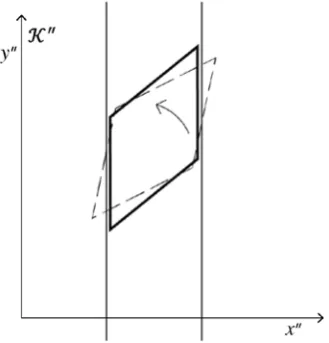
boost between 𝒦𝒦′ and 𝒦𝒦′′, complemented by TWR of the elevator together with frame 𝒦𝒦′. Specifically, this would mean that Lorentz boost along velocity 𝐕𝐕′′ is followed by the rotation of elevator through a definite angle, namely just the one needed to “verticalize” the contracted elevator, thereby matching it to the rails. Consequently, despite diagonal direction of the elevator contraction in 𝑥𝑥′′𝑥𝑥′′ plane, no incompatibility between elevator and rails is expected (Fig. 7).
the elevator case. A fundamental difference between the case of orbiting body, or generally, a body changing direction of its motion (due to the forces acting on it) and the here considered motion of elevator, is that motion in the first case is non-inertial, while it is doubtlessly inertial in the present (elevator) case. Namely, in opposition to a body moving along the curvilinear path (smooth curve or polygonal chain), thereby changing (constantly or occasionally) inertial frames, the elevator moves
rectilinearly, hence occupies all the time the same inertial frame 𝒦𝒦′. Consequently, the Lorentz boost between the elevator frame 𝒦𝒦′ and the observer’s frame 𝒦𝒦′′ should not be considered as a composition of Lorentz boosts between 𝒦𝒦′ and 𝒦𝒦, and 𝒦𝒦 and 𝒦𝒦′′ in the sense corresponding to TWR. It is pretty clear that Thomas-Wigner rotation pertains solely and exclusively to the composition of mutually non-collinear inertial frames (at least three of them, including observer’s frame)
participating in motion, i.e. to the frames contributing to the curvilinear trajectory of a given body in spacetime. With no doubt, the frame 𝒦𝒦, despite its specific role in the elevator-shaft paradox, does not participate in the elevator motion. The elevator is not even for a moment at rest with respect to the rails, that is to frame 𝒦𝒦.
Figure 7. Thomas-Wigner rotation as the putative solution to the elevator-shaft paradox. Rotation of frame 𝓚𝓚′ “verticalizes” the side-edges of contracted elevator (dashed line), matching them to the rails (solid line)
To better realize the problem, consider the motion of a body along the curvilinear path, e.g. the orbital motion. The real trajectory of orbiting body between two given points laid on the circumference (say, distanced of less than half of it) is neither physically equivalent to the “shortcut” charted along the chord connecting these points, nor to the “shortcut” comprehended as a “jump” between observer’s rest frame and the final inertial frame, both tangent to the orbit in said points. In contrast to this, the elevator trajectory is itself a “shortcut”, i.e. makes the straight line in spacetime, no matter what (inertial) frame it is observed from. In other words, the straight diagonal path of the elevator motion in 𝑥𝑥′′𝑥𝑥′′ plane constitutes real trajectory in 𝒦𝒦′′, and not the imaginary one. The frames 𝒦𝒦′ (at rest to the elevator) and 𝒦𝒦′′ (at rest to the train) are, at least from the viewpoint of
the principle of relativity, physically identical to each other,
as well as to all remaining inertial frames. It would be therefore illegitimate to assume that transformation between these very frames should involve the Thomas-Wigner rotation. Hence, what we really deal with in the elevator-shaft paradox is not the composition of two
consecutive Lorentz boosts resulting in the Thomas-Wigner rotation (of elevator), but the pair of two concurrent Lorentz boosts: from 𝒦𝒦 to 𝒦𝒦′′ and from 𝒦𝒦′ to 𝒦𝒦′′, applying respectively to the rails and to the elevator, both these objects contributing to a one “composite object”, i.e. to the elevator “framed” by the rails.
In order to avoid confusion, we should bear in mind an elementary distinction between the two notions: inertial frame (of reference) - physical entity of the properties defined by the laws of motion, and coordinate system - geometrical construct imposing a definite order on given inertial frame. According to this distinction, a single inertial frame is represented by infinitely many coordinate systems, differing by locations of the origin and orientation of axes. The rails and elevator are contracted in one and the same inertial frame 𝒦𝒦′′ along two different directions, corresponding to different directions of respective Lorentz boosts. Consequently, the frame 𝒦𝒦′′ is represented here by the two coordinate systems, each of them collinear with one of the mentioned directions.
4. A “symmetrical” version of the elevator-shaft thought experiment
Figure 8. Elevator moving in 𝓚𝓚′′ along the direction inclined at the angle 𝟏𝟏𝟏𝟏𝟏𝟏° in 𝒙𝒙′′𝒚𝒚′′ plane. This motion can be alternatively described as 1) directed upwards relative to vertical rails moving to the left; or 2) directed to the left relative to horizontal rails moving upwards. The contracted elevator does not match the rails in 𝓚𝓚′′ regardless of the “factual” scenario
The above case evidently shows that neither of directions connected with the shape of elevator can be treated as privileged. Although the “argument from symmetry” adds nothing really substantial to that already has been said, yet this example is particularly expressive.
5. Conclusion to Part I
Let us take a glance at the elevator-shaft thought experiment describing it in a slightly different way, so to say, in the “reverse order”, i.e. starting from the observer’s frame. Assume that in the 2-dimensional observer’s frame, the two extended objects: the rectangular elevator and the parallel rails (2-dimensional elevator shaft) travel with the uniform rectilinear motion, each one along different path; both forming the acute angle. With reference to the mentioned objects, the respective directions of motion are defined as: perpendicular to the rails and diagonal to the elevator, e.g. parallel to the diagonal of rectangle. All the time, these objects remain in a close mutual spatial relationship, namely elevator moves along (inside) the rails, while both in the rails and elevator rest frames the vertical side-edges of elevator adhere to the rails. However, in the observer’s frame, each of these objects is subject to the length contraction along direction of its motion in this frame. In result, the rails get closer to each other without changing their direction, while the elevator reshapes from rectangle to rhomboid, therefore changing direction of all its sides. In consequence, elevator and rails do not match each other in the observer’s frame. Considering the perfect fit between elevator and rails in both their rest frames, this means a contradiction indicating an inconsistency of STR.
In order to find out a way from the above puzzle so as to overcome this purely negative result, one has to take into account the crucial (though persistently ignored) fact, namely that Lorentz transformation is not the only transformation predicting the length contraction and time dilation. We shall examine this question in details in Part II.
In particular, in Sec.10 we’ll demonstrate how the introduced theory (and respective transformation) deals with the presented elevator case in various configurations. For now, let us only mention that the difference between the Lorentz transformation and its competitive equivalent consists (in this regard) in the distinction between relative and absolute
motion, each one assumed as the source of “relativistic” effects.
3. Part II
Alternative to Special Relativity: theory based on the assumption of preferred frame
1. Transformation regarding the postulate of preferred frame
The demonstrated inconsistency of Special Relativity entails the need of introducing an alternative theory, mathematically consistent and compatible with all known experiments. In the following sections we shall present and discuss the Preferred Frame Theory (PFT) in this regard.
In contrast to STR founded on the principle of relativity (first postulate), PFT is founded on assumption that the so-called “relativistic effects” are in fact “absolute”, ergo detectable (directly or indirectly) in any inertial frame, including the rest frame of the observed object. Consequently, these effects are thought to be caused by the absolute motion, defined as the motion with respect to a certain physically preferred frame (absolute space). In a close link to that assumption (and in opposition to the second STR postulate) the velocity of light is assumed to be constant (isotropic) in the preferred frame only, while in any other inertial frame it is thought to depend on the observer’s absolute velocity and the direction of emission, due to the real distortion of clocks and measuring rods at rest in the observer’s frame. If consequently applied, these assumptions do not lead to the Lorentz transformation (LT), but to a different transformation formulated only some half-century later by Tangherlini [13], hereinafter called the Tangherlini transformation (TT):
𝑥𝑥′=𝑥𝑥𝛾𝛾 − 𝑣𝑣𝑐𝑐𝛾𝛾 𝑥𝑥=𝑥𝑥′⁄𝛾𝛾+𝑣𝑣𝑐𝑐′𝛾𝛾
𝑥𝑥′ =𝑥𝑥 𝑥𝑥=𝑥𝑥′
𝑧𝑧′ =𝑧𝑧 𝑧𝑧=𝑧𝑧′
𝑐𝑐′ =𝑐𝑐 𝛾𝛾⁄ 𝑐𝑐=𝑐𝑐′𝛾𝛾 (4)
general, Reichenbach’s parameter admits free value of 𝜀𝜀 such that 0 <𝜀𝜀< 1, wherein 𝜀𝜀= 1 2⁄ corresponds with the one-way velocity of light equal to 𝑐𝑐, in agreement with the STR second postulate. In fact, as far as we can judge, the case 0 <𝜀𝜀< 1 (opposing 𝜀𝜀= 1 2⁄ ) does not refer to a hypothetical set of “in-between” transformations, but applies specifically to TT, whereas the “freedom” of coefficient 𝜀𝜀 corresponds with the differences in values of absolute velocity of different frames, combined with different angles of emission in each particular frame (see Sec.3 for details).
In some respects, TT reminds the Galilean transformation as opposed to the Lorentz transformation. Namely, unlike in LT, the time coordinate does not depend on space coordinates; hence simultaneity is defined as absolute. On the other hand, TT is not symmetrical due to the principle of relativity (i.e. does not comply neither with Lorentz nor Galilean symmetry), which distinguishes it from both Galilean and Lorentz transformations. It forms instead a sort of axial symmetry with the preferred frame acting as “axis of symmetry”. From the viewpoint of TT, the principle of relativity is a pure Galilean property connected with Galilean transformation, “emerging” at the limit 𝑣𝑣 →0 . Understandably enough, Tangherlini transformation did not receive broad attention so far. According to the prevailing opinion (e.g. [17]), TT is wholly equivalent in experiments to the Lorentz transformation. Meanwhile, it is admittedly equivalent to it in a wide class of cases, but not totally [18a, 18b]. We shall develop this point in Ss. 4 and 5.
The above form of Tangherlini transformation does not exhaust all possibilities resulting from PFT; hence in this regard it is more “specific” than Lorentz transformation and even the Lorentz boost. While in Eq. (4) the non-primed coordinates are the preferred ones, in the general case, both frames may differ from the preferred frame; consequently, they may remain in a free relationship as to their individual absolute velocities (including symmetrical case with equal absolute velocities) and to the direction of respective absolute velocity vectors. This all makes the general form of TT more complicated, nevertheless reducible to simpler cases according to the principle of correspondence [19]. Anyhow, for our present purposes the above form (TT) is fully sufficient and adequate.
2. “Corresponding” velocities between two frames vs. single relative velocity
Unlike in LT, the velocity 𝑣𝑣 present in TT is not a unique “relative” velocity between the frames 𝒦𝒦 and 𝒦𝒦′. Instead, it stands solely for the velocity of 𝒦𝒦′ measured in the preferred frame 𝒦𝒦, i.e. the absolute velocity of 𝒦𝒦′. Likewise, the Lorentz factor relates to 𝒦𝒦, being the function of absolute velocity 𝑣𝑣. Because the effects of length contraction and time dilation are asymmetrical with respect to 𝒦𝒦 and 𝒦𝒦′ (they primarily affect objects at rest in 𝒦𝒦′ only), so mutual velocities of 𝒦𝒦 and 𝒦𝒦′ cannot be equal. The measured in 𝒦𝒦′ velocity of𝒦𝒦 is determined, apart from the absolute velocity of 𝒦𝒦′, also by “distortion” of measuring rods and clocks at rest in this frame. The respective effects accumulate, in result of which the
measured in 𝒦𝒦′ velocity of the preferred frame 𝒦𝒦 relates to 𝑣𝑣 as:
𝑣𝑣′=𝑣𝑣𝑐𝑐𝛾𝛾
𝑐𝑐 𝛾𝛾⁄ =𝑣𝑣𝛾𝛾2 (5)
We call 𝑣𝑣 and 𝑣𝑣′ the “corresponding” velocities.
3. Velocity of light according to PFT
The velocity of light undergoes basically the same rules as any other absolute velocity. In the preferred frame 𝒦𝒦, the light signal travels with the velocity c regardless of the motion of the source and the direction of emission (is isotropic). Provided Galilean transformation, the velocities of light traveling along 𝑥𝑥′-axis in frame 𝒦𝒦′ would be 𝑐𝑐 − 𝑣𝑣, in positive direction (i.e. direction of motion of 𝒦𝒦′ relative to 𝒦𝒦) and 𝑐𝑐+𝑣𝑣 in negative direction. However, in accordance with TT, length contraction and time dilation affecting standards of length and time in 𝒦𝒦′ contribute to respective velocities, yielding:
𝑐𝑐1′ = (𝑐𝑐 − 𝑣𝑣)𝛾𝛾2𝑐𝑐2′ = (𝑐𝑐+𝑣𝑣)𝛾𝛾2 (6)
where 𝑐𝑐 stands for the velocity of light in the preferred frame. For the so-defined velocities, one can prove:
0.5𝑐𝑐<𝑐𝑐1′ ≤ 𝑐𝑐𝑐𝑐 ≤ 𝑐𝑐2′ <∞ (7)
In the general case, i.e. for arbitrary angle 𝜑𝜑 of propagation of the ray in relation to 𝑥𝑥′ positive direction, as observed in 𝒦𝒦′, the velocity of light is:
𝑐𝑐′= 𝑐𝑐−𝑣𝑣cos𝜑𝜑
1−�𝑣𝑣𝑐𝑐�2cos2𝜑𝜑 (8)
The light front determined by this equation forms the prolate spheroid (reducible to sphere in 𝒦𝒦), with the source of emission placed in the “frontal” focus. In this regard, difference between STR and PFT reminds the one between the circular orbits (as they were thought to be up to Galileo) and Kepler’s ellipses (Fig. 9).
Figure 9. Velocity of light in the absolutely moving inertial frame. The light front forms the prolate spheroid (ellipse in 2D depiction), with the source of emission located in the “frontal” focus
Because cos𝜑𝜑=−cos(𝜑𝜑+ 180∘), so the time of a round trip along the straight path 2𝐿𝐿′ in frame 𝒦𝒦′ equals:
𝑇𝑇′=𝐿𝐿′�1−�𝑣𝑣𝑐𝑐� 2
cos2𝜑𝜑�
(𝑐𝑐−𝑣𝑣cos𝜑𝜑) +
𝐿𝐿′�1−�𝑣𝑣 𝑐𝑐�
2 cos2𝜑𝜑� (𝑐𝑐+𝑣𝑣cos𝜑𝜑)
=2𝐿𝐿′�1−�
𝑣𝑣 𝑐𝑐�
2 cos2𝜑𝜑�𝑐𝑐
𝑐𝑐2−𝑣𝑣2cos2𝜑𝜑 =
2𝐿𝐿′�𝑐𝑐−𝑣𝑣2 𝑐𝑐cos2𝜑𝜑�
𝑐𝑐2−𝑣𝑣2cos2𝜑𝜑 =2𝐿𝐿 ′
Hence the averaged velocity on distance 2𝐿𝐿′ is 𝑐𝑐. Generally, the averaged velocity of light traveling along any closed path demarcated in any inertial frame equals 𝑐𝑐. A mathematical basis for this property is a theorem according to which an integral over free (smooth) closed curve in relation to an arbitrary straight line equals zero.
4. STR vs. PFT: empirical equivalence in the area of kinematics
a) Transformations of distance and time according to LT and TT
In order to describe the motion of an object in kinematical terms, one needs reliable measures of space and time, as referred to the observer’s frame. This demand does not present any difficulties in the case of Galilean transformation (hence in the range of small velocities in the real world) in which the mentioned measures are invariant. Instead, for the velocities comparable with 𝑐𝑐 it gets more complicated since the definition of “measurement” depends on the choice of transformation. In a given reference frame there are available, as obtained directly, only the readings of a single clock at rest and the distance measured by stationary measuring rod. We call these quantities “independent”. The remaining quantities have to be obtained indirectly and depend on transformation; hence we call them “dependent”. In other words, “dependent” means that respective quantity varies due to the choice of transformation (here alternatively LT and TT), while “independent” means the opposite.
Let 𝒦𝒦′ be the observer’s rest frame and 𝒦𝒦 the observed frame. According to PFT/TT (and to our formerly introduced notation), 𝒦𝒦′ is absolutely moving and 𝒦𝒦 determines absolute rest. Instead, according to STR/LT, both frames are entirely equivalent in agreement with the principle of relativity. In this subsection we shall test the uniform motion using transformation of time and of length (distance) from 𝒦𝒦 to 𝒦𝒦′ alternatively according to LT and TT, as well as defining the velocity due to each transformation. In that way we shall infer “dependent” values straight from transformation, treating respective values in 𝒦𝒦 as known data.
In the case of point-object at rest in 𝒦𝒦, defining its uniform motion in 𝒦𝒦′ means juxtaposing two “dependent” quantities (velocity and time) with one “independent” (distance), measured in 𝒦𝒦′. Instead, in the case of extended object (measuring rod) at rest in 𝒦𝒦, the “dependent” quantities are its length and velocity as referred to 𝒦𝒦′, while the “independent” quantity is time, comprehended as the time-difference between two indications of a single clock at rest in 𝒦𝒦′. Hence, the criterion of equivalence consists in satisfying the following condition: two “dependent” quantities should give (respectively: in product and in quotient) a definite “independent” quantity, the same for each transformation. Below we shall test LT and TT according to these two arrangements.
Case 1. Consider the motion of a point-object (clock) at
rest in 𝒦𝒦, on distance 𝐿𝐿′ marked out in frame 𝒦𝒦′. Let the moving clock measure the proper time during its motion along 𝐿𝐿′. Let this time, defined as the difference of clock
indications between the moments of passing the front and rear ends of 𝐿𝐿′ be 𝑇𝑇. Assuming that velocity of 𝒦𝒦′ in 𝒦𝒦 is 𝑣𝑣, the velocity of clock relative to 𝒦𝒦′ would be, in accordance with LT: 𝑣𝑣′ =𝑣𝑣, and according to TT: 𝑣𝑣′ = 𝑣𝑣𝛾𝛾2. In turn, the travel time of the clock along distance 𝐿𝐿′, as
determined in 𝒦𝒦′ is, according to LT: 𝑇𝑇′ =𝑇𝑇𝛾𝛾, and according to TT: 𝑇𝑇′ =𝑇𝑇 𝛾𝛾⁄ . Hence STR predicts:
𝐿𝐿′ =𝑣𝑣′𝑇𝑇′ =𝑣𝑣𝑇𝑇𝛾𝛾 (10)
Instead, according to PFT we have:
𝐿𝐿′ =𝑣𝑣′𝑇𝑇′ =𝑣𝑣𝛾𝛾2𝑇𝑇 𝛾𝛾⁄ =𝑣𝑣𝑇𝑇𝛾𝛾 (11)
It follows that despite the difference in predictions as to the velocity of clock and the time of its travel along the measuring rod (“dependent” quantities in 𝒦𝒦′) the effective result (“independent” quantity 𝐿𝐿′) is identical, which means empirical equivalence of STR and PFT in this case.
Case 2. Consider the motion in 𝒦𝒦′ of the measuring rod
at rest in 𝒦𝒦, whose length as measured in 𝒦𝒦 equals 𝐿𝐿. Let the rod, oriented in line with 𝑥𝑥𝑥𝑥′-axes, pass a single clock at rest in 𝒦𝒦′. We ask for the time 𝑇𝑇′ indicated by this clock between passing it by the front and rear ends of the rod. As for the point-object formerly considered, the velocity of rod in 𝒦𝒦′ is, according to LT: 𝑣𝑣′ =𝑣𝑣, and according to TT:𝑣𝑣′ =𝑣𝑣𝛾𝛾2. The length of the rod in 𝒦𝒦′ is, according to LT: 𝐿𝐿′ =𝐿𝐿 𝛾𝛾⁄ , and according to TT: 𝐿𝐿′=𝐿𝐿𝛾𝛾. Hence, in accord with STR we have:
𝑇𝑇′ =𝐿𝐿′⁄𝑣𝑣′=𝐿𝐿 𝑣𝑣𝛾𝛾⁄ (12)
Instead, PFT predicts:
𝑇𝑇′ =𝐿𝐿′⁄𝑣𝑣′ =𝐿𝐿𝛾𝛾 𝑣𝑣𝛾𝛾⁄ 2=𝐿𝐿 𝑣𝑣𝛾𝛾⁄ (13)
As before, in spite of differences in predictions as to the length and velocity taken separately (“dependent” quantities in 𝒦𝒦′), the effective result (“independent” quantity 𝑇𝑇′) is identical, which, as previously, means empirical equivalence of both transformations in this case.
b) Equivalence of synchronization conventions
In this subsection we shall take virtual measurement of the velocity of a point-object using the readings of two distanced clocks at rest in 𝒦𝒦′. This task requires defining simultaneity in the observer’s frame, which in turn involves the necessity of choice of a definite synchronizing convention related to given transformation. In particular, we shall test whether the velocity defined according to STR, combined with respective synchronization, is equivalent to the velocity defined according to PFT, also combined with respective synchronization.
Consider the motion in 𝒦𝒦′ of a point-object (particle) at rest in 𝒦𝒦, along distance 𝐿𝐿′ (measuring rod at rest in 𝒦𝒦′) with two clocks 𝐶𝐶1 and 𝐶𝐶2 on its both ends. As before, velocity of 𝒦𝒦′ relative to 𝒦𝒦 is 𝑣𝑣. We synchronize these clocks by the light ray, having regard to the velocity of light defined alternatively by LT and TT. Likewise, alternatively, we determine velocity of the particle traveling along distance 𝐿𝐿′ from 𝐶𝐶
2 to 𝐶𝐶1. An ultimate criterion of equivalence and
Synchronization according to STR means the Einstein convention (EC) based on the STR light postulate. Hence, while sending the ray from the clock 𝐶𝐶1 indicating time 𝑐𝑐1′ to the clock 𝐶𝐶2 distanced of 𝐿𝐿′, we should set it in the moment of reaching it by the ray for the time:
𝑐𝑐2′ =𝑐𝑐1′+𝐿𝐿′⁄𝑐𝑐 (14)
Still according to LT, the velocity of a particle along the distance 𝐿𝐿′ from 𝐶𝐶2 to 𝐶𝐶1 is 𝑣𝑣; hence, the (denoted by 𝑐𝑐3′) indication of clock 𝐶𝐶1 in the moment of passing it by the particle is:
𝑐𝑐3′ =𝑐𝑐1′ +𝐿𝐿′⁄𝑐𝑐+𝐿𝐿′⁄𝑣𝑣=𝑐𝑐1′+𝐿𝐿′(𝑣𝑣+𝑐𝑐)⁄𝑣𝑣𝑐𝑐 (15)
Instead, according to TT, the light synchronization in the direction from 𝐶𝐶1 to 𝐶𝐶2 means that (due to Eq. (6)) one has to set the clock 𝐶𝐶2 in the moment of reaching it by the ray for:
𝑐𝑐2′ =𝑐𝑐1′ +𝐿𝐿′⁄(𝑐𝑐 − 𝑣𝑣)𝛾𝛾2 (16)
Because, according to TT, the velocity of particle traveling along 𝐿𝐿′, from 𝐶𝐶2 to 𝐶𝐶1 is 𝑣𝑣𝛾𝛾2, so the clock 𝐶𝐶1 will indicate in the moment of passing it by the particle the time:
𝑐𝑐3′ =𝑐𝑐1′+𝐿𝐿′⁄(𝑐𝑐 − 𝑣𝑣)𝛾𝛾2+𝐿𝐿′⁄𝑣𝑣𝛾𝛾2
=𝑐𝑐1′ +𝐿𝐿
′(1− 𝑣𝑣2⁄𝑐𝑐2) (𝑐𝑐 − 𝑣𝑣) +
𝐿𝐿′(1− 𝑣𝑣2⁄𝑐𝑐2) 𝑣𝑣
=𝑐𝑐1′ +𝐿𝐿
′(𝑣𝑣 − 𝑣𝑣3⁄𝑐𝑐2+𝑐𝑐 − 𝑣𝑣 − 𝑣𝑣2⁄𝑐𝑐+𝑣𝑣3⁄𝑐𝑐2) 𝑣𝑣𝑐𝑐 − 𝑣𝑣2
=𝑐𝑐1′ +𝐿𝐿 ′�𝑐𝑐−𝑣𝑣2⁄ �𝑐𝑐
𝑣𝑣𝑐𝑐−𝑣𝑣2 =𝑐𝑐1′+ 𝐿𝐿′(𝑣𝑣+𝑐𝑐)
𝑣𝑣𝑐𝑐 (17)
This result is identical with that obtained in Eq. (15), which signifies empirical equivalence between STR and PFT in this case. In general, we may take for granted (and thus formulate as a rule) that relative simultaneity combined with constant velocity of light due to STR always gives identical results to these obtained from absolute simultaneity combined with inconstant velocity of light due to PFT. The so-defined equivalence covers large experimental area, which provides an explanation of why STR has not been questioned in experiments (or disproved by thought experiments) for more than a hundred years.
However, for the reasons of geometrical inconsistency of STR demonstrated in Part I; and also considering departure from empirical equivalence in dynamics (discussed in Part II, Sec. 6), synchronization according to Einstein convention is applicable in the preferred frame only. In any other inertial frame, synchronization utilizing velocities of light defined according to Eq. (8) will confirm (will be identical with) the synchronization obtained from EC in the preferred frame. Concluding: synchronization performed according to EC in the preferred frame determines absolute simultaneity. As is known, Einstein convention considered as applicable in any inertial frame is inseparable from the postulate of relative simultaneity; consequently, synchronization according to PFT is inseparable from the postulate of absolute simultaneity.
c) Empirical equivalence of the velocity addition formulae
Let the frame 𝒦𝒦′ move relative to frame 𝒦𝒦 with the velocity𝑣𝑣. Let the particle at rest in another frame 𝒦𝒦′′ move with respect to 𝒦𝒦′ with the velocity 𝑉𝑉 in the direction parallel to the motion of 𝒦𝒦′ relative to 𝒦𝒦. According to the Galilean transformation, the resultant velocity of this particle in 𝒦𝒦 would be:
𝜎𝜎=𝑣𝑣+𝑉𝑉 (18) Instead, the respective velocity derived from LT is:
𝜎𝜎=1+𝑣𝑣𝑣𝑣𝑉𝑉 𝑐𝑐+𝑉𝑉⁄2 (19)
Let us find an analogous formula for PFT/TT. Since we consider the result of summation as referred to 𝒦𝒦 that is assumed to be the preferred frame, so velocities 𝑣𝑣 and 𝜎𝜎, as absolute velocities of 𝒦𝒦′ and 𝒦𝒦′′ respectively, will not change in the PFT scenario. However, the question of velocity𝑉𝑉 looks different. This velocity refers to frame 𝒦𝒦′ that according to STR is equivalent (physically identical) with 𝒦𝒦, whereas according to PFT differs from 𝒦𝒦.
From the fact that 𝜎𝜎 and 𝑣𝑣 remain unchanged in PFT (compared to respective values in STR) it follows that velocity of the particle relative to 𝒦𝒦′, as referred to 𝒦𝒦, equals:
𝑉𝑉𝒦𝒦=𝜎𝜎 − 𝑣𝑣 (20)
Because the measuring rods are contracted in 𝒦𝒦′ and the clocks are retarded by the Lorentz factor (respectively: 𝑙𝑙′=𝑙𝑙 𝛾𝛾
(𝑣𝑣)
⁄ , 𝑐𝑐′ =𝑐𝑐𝛾𝛾(𝑣𝑣)), hence in frame 𝒦𝒦′ the velocity of the particle is:
𝑉𝑉𝒦𝒦′ =𝛾𝛾(2𝑣𝑣)𝑉𝑉𝒦𝒦 (21) (We use symbol 𝛾𝛾(𝑣𝑣) instead of simply 𝛾𝛾, since, in the following equations, we shall use the Lorentz factor also as a function of other than 𝑣𝑣 velocities, measured in 𝒦𝒦). Eventually, the PFT velocity addition formula applied to summation in the preferred frame 𝒦𝒦 has the form:
𝜎𝜎=𝑣𝑣+𝑉𝑉𝒦𝒦′⁄𝛾𝛾(2𝑣𝑣) (22) Let us compare this formula with the STR velocity addition (Eq. (19)). Our goal is to test whether velocity 𝑉𝑉, defined according to LT, is empirically equivalent to velocity 𝑉𝑉𝒦𝒦′, defined according to TT. Let us convert Eq. (19) to the form:
𝜎𝜎=𝑣𝑣+𝑉𝑉 �1+1−𝑣𝑣𝑣𝑣𝑉𝑉 𝑐𝑐2⁄⁄𝑐𝑐22�=𝑣𝑣+(1+𝑣𝑣𝑉𝑉 𝑐𝑐⁄𝑉𝑉2)𝛾𝛾
(2𝑣𝑣) (23)
Now, the STR velocity addition reminds respective PFT formula (i.e. Eq. (22)); moreover, both formulae will totally coincide if we define velocity 𝑉𝑉𝒦𝒦′ as:
𝑉𝑉𝒦𝒦′ = 𝑉𝑉
(1+𝑣𝑣𝑉𝑉 𝑐𝑐⁄ 2) (24)
clock at rest in 𝒦𝒦′. As it was in Case 2, the criterion of empirical equivalence between LT and TT are the readings (equal or not) of the clock in the moment of passing it by the rear end of the rod. To fulfil the criterion of equivalence, respective readings should be identical despite different (due to LT and TT) values of the rod length and its velocity, both inserted to the equation for time. We assume that clock, when passed by the front end of the rod, in both scenarios indicates identical time 𝑐𝑐0= 0. According to LT, the length of rod in 𝒦𝒦′ is 𝐿𝐿′=𝐿𝐿 𝛾𝛾⁄ (𝑉𝑉). Instead, according to TT, the length of rod results from the mutual relation of observer’s frame and the rod rest frame (expressed by the quotient of respective Lorentz factors), both referred to the preferred frame 𝒦𝒦:
𝐿𝐿′ =𝐿𝐿𝛾𝛾
(𝑣𝑣)⁄𝛾𝛾(𝜎𝜎) (25)
The requirement of identical clock indications is tantamount to the requirement of equality between respective times. Hence, we have to settle if:
𝐿𝐿 𝛾𝛾(𝑉𝑉)𝑉𝑉=
? 𝐿𝐿𝛾𝛾(𝑣𝑣)
𝛾𝛾(𝜎𝜎)𝑉𝑉𝒦𝒦′ (26)
Because:
𝑉𝑉=𝑉𝑉𝒦𝒦′(1 +𝑣𝑣𝑉𝑉 𝑐𝑐⁄ 2) (27) so, Eq. (23) takes the form:
𝐿𝐿
𝛾𝛾(𝑉𝑉)𝑉𝑉𝒦𝒦′(1+𝑣𝑣𝑉𝑉 𝑐𝑐⁄2)=
𝐿𝐿𝛾𝛾(𝑣𝑣)
𝛾𝛾(𝜎𝜎)𝑉𝑉𝒦𝒦′ (28)
Simplifying and rearranging gives:
𝛾𝛾(𝑣𝑣)�1+𝑣𝑣𝑉𝑉 𝑐𝑐⁄ �2
𝛾𝛾(𝜎𝜎) =
1
𝛾𝛾(𝑉𝑉) (29)
After rewriting Lorentz factors, we obtain (for 𝑐𝑐= 1):
1
√1− 𝑣𝑣2�1− �
𝑣𝑣+𝑉𝑉
1 +𝑣𝑣𝑉𝑉�
2
(1 +𝑣𝑣𝑉𝑉) =�(1 +𝑣𝑣𝑉𝑉)2−(𝑣𝑣+𝑉𝑉)2
1− 𝑣𝑣2
=�1+(𝑣𝑣𝑉𝑉1)−𝑣𝑣2−𝑣𝑣22−𝑉𝑉2=�(1−𝑣𝑣12−𝑣𝑣)(12−𝑉𝑉2)=𝛾𝛾1
(𝑉𝑉) (30)
which confirms empirical equivalence between Eq. (19) and Eq. (22).
Eq. (22) is however not the general PFT formula for the velocity addition since (first of all) it applies exclusively to summation in the preferred system 𝒦𝒦. This in particular means that final velocity (here denoted 𝜎𝜎) is identical for STR and PFT. Meanwhile, in a more general case of summation in 𝑥𝑥 positive direction, performed in a frame different from the preferred one (here denoted 𝒦𝒦′′), the final velocities derived alternatively from LT and TT might be different. Apart from regarding the absolute Lorentz factor for the “intermediate” frame (𝒦𝒦′ in Eq. (22)) we must also take into account the absolute Lorentz factor for 𝒦𝒦′′, i.e. the one in which summation is performed. In other words, Eq. (22) refers to the particular case in which the Lorentz factor for the observer equals 1, while in the general case it may differ from 1. The generalized “collinear” velocity addition formula reads:
𝜎𝜎=𝛾𝛾(2𝑂𝑂)�𝑉𝑉1+𝑉𝑉2⁄𝛾𝛾(2𝑉𝑉1)� (31)
where 𝛾𝛾(𝑂𝑂) denotes the absolute Lorentz factor for the observer’s frame 𝒦𝒦′′, 𝛾𝛾(𝑉𝑉1) - absolute Lorentz factor for “intermediate” frame 𝒦𝒦′, 𝑉𝑉1 - velocity of “intermediate” frame 𝒦𝒦′ relative to 𝒦𝒦′′, as measured in the preferred frame 𝒦𝒦. Velocity 𝑉𝑉1 corresponds to velocity 𝑣𝑣 in Eq. (22). Instead, 𝑉𝑉2 denotes velocity of the particle in “intermediate” frame 𝒦𝒦′, namely:
𝑉𝑉2= (𝜎𝜎 − 𝑉𝑉1)𝛾𝛾(2𝑉𝑉1) (32)
corresponding to velocity 𝑉𝑉𝒦𝒦′ in Eq. (22).
5. STR vs. PFT: identical predictions concerning momentum
Assume that an object (particle) at rest in 𝒦𝒦′ falls apart into two parts (here called “forward” and “backward” particles, denoted respectively ℱ and ℬ) receding in opposite directions along 𝑥𝑥′-axis so that net momentum in 𝒦𝒦′ amounts to zero. Let “forward” means the direction
compatible with the motion of 𝒦𝒦′ relative to 𝒦𝒦, while “backward” - the opposite direction. Let the rest mass of each particle be 𝑚𝑚0 . In accordance with STR, the momentum of each particle in 𝒦𝒦′ (for 𝑐𝑐= 1) is:
𝑝𝑝=𝑚𝑚0 𝑉𝑉𝛾𝛾(𝑉𝑉)=𝑚𝑚0𝑉𝑉⁄(1− 𝑉𝑉2)1 2⁄ (33)
where 𝑉𝑉 is the relative velocity between each of the considered particles and frame 𝒦𝒦′. Instead, in accordance with PFT, the respective momentum is:
𝑝𝑝′ =𝑚𝑚
0(𝛾𝛾𝐵𝐵⁄𝛾𝛾𝐴𝐴)𝑣𝑣(diff )𝛾𝛾𝐴𝐴2 (34)
The term 𝑚𝑚0(𝛾𝛾𝐵𝐵⁄𝛾𝛾𝐴𝐴) denotes the mass of a given particle as measured in 𝒦𝒦′ , where 𝛾𝛾𝐴𝐴= (1− 𝑣𝑣2)−1 2⁄ is the Lorentz factor for the observer’s frame 𝒦𝒦′, and 𝛾𝛾𝐵𝐵=
(1− 𝜎𝜎2)−1 2⁄ the Lorentz factor for the particle, both related
to the preferred frame 𝒦𝒦. Instead, 𝑣𝑣(diff ) denotes the measured in 𝒦𝒦 relative velocity between each of (alternatively considered) particles: ℱ or ℬ and frame 𝒦𝒦′ (precisely: the absolute value of the vector difference between velocity of given particle and velocity of 𝒦𝒦′, each case measured in 𝒦𝒦; hence 𝑣𝑣(diff )= |𝛔𝛔 − 𝐯𝐯|). Because both the mass and velocity of ℱ and ℬ depend on the direction of their motion in 𝒦𝒦′, hence 𝛾𝛾𝐵𝐵 and 𝑣𝑣(diff ) are defined separately for each particle, henceforth respectively denoted: 𝛾𝛾(ℱ), 𝛾𝛾(ℬ) and 𝑣𝑣(ℱ), 𝑣𝑣(ℬ). Instead, Lorentz factor 𝛾𝛾𝐴𝐴
remains unchanged in both cases.
Our goal is to check whether the momenta of ℱ and ℬ equal each other, and whether they equal the momentum defined according to STR. Before entering to analysis, let’s make an obvious simplification of Eq. (34) reducing its “explanatory” form to:
𝑝𝑝′=𝑚𝑚
0𝛾𝛾𝐴𝐴𝛾𝛾𝐵𝐵𝑣𝑣(diff ) (35)
Taking advantage of the equivalence of addition formulae according to STR (19) and PFT (22), we define the particles velocity in 𝒦𝒦 as:
𝜎𝜎(ℱ,ℬ) =1±𝑣𝑣±𝑣𝑣𝑉𝑉𝑉𝑉 (36)
𝛾𝛾(ℱ) =�1− �1+𝑣𝑣+𝑣𝑣𝑉𝑉𝑉𝑉� 2
(37)
and
𝛾𝛾(ℬ) =�1− �1𝑣𝑣−𝑉𝑉−𝑣𝑣𝑉𝑉� 2
(38)
After substituting to Eq. (35) we obtain the momentum 𝑝𝑝1′ for particleℱ:
𝑝𝑝1′ =𝑚𝑚0𝛾𝛾𝐴𝐴𝛾𝛾(ℱ)𝑣𝑣(ℱ) =
𝑚𝑚0� 𝑣𝑣1 ++𝑣𝑣𝑉𝑉 − 𝑣𝑣�𝑉𝑉
��1− � 𝑣𝑣1 ++𝑣𝑣𝑉𝑉�𝑉𝑉 2�(1− 𝑣𝑣2) =
= 𝑚𝑚0𝑉𝑉(1− 𝑣𝑣2)
��1− � 𝑣𝑣1 ++𝑣𝑣𝑉𝑉�𝑉𝑉 2�(1 +𝑣𝑣𝑉𝑉)2(1− 𝑣𝑣2) =
= 𝑚𝑚0𝑉𝑉�1−𝑣𝑣2�
�(1−𝑉𝑉2)(1−𝑣𝑣2)2 =
𝑚𝑚0𝑉𝑉
√1−𝑉𝑉2 =𝑚𝑚0𝑉𝑉𝛾𝛾(𝑉𝑉) (39)
Similarly, we derive the momentum 𝑝𝑝2′ for particle ℬ:
𝑝𝑝2′ =𝑚𝑚0𝛾𝛾𝐴𝐴𝛾𝛾(ℬ)𝑣𝑣(ℬ)=
𝑚𝑚0� 𝑣𝑣 − 𝑉𝑉1− 𝑣𝑣𝑉𝑉�
��1− � 𝑣𝑣 − 𝑉𝑉1− 𝑣𝑣𝑉𝑉�2�(1− 𝑣𝑣2) =
= 𝑚𝑚0𝑉𝑉(1− 𝑣𝑣2)
��1− � 𝑣𝑣 − 𝑉𝑉1− 𝑣𝑣𝑉𝑉�2�(1− 𝑣𝑣𝑉𝑉)2(1− 𝑣𝑣2) =
= 𝑚𝑚0𝑉𝑉(1−𝑣𝑣2)
�(1+𝑣𝑣2𝑉𝑉2−𝑣𝑣2−𝑉𝑉2)(1−𝑣𝑣2)=𝑚𝑚0𝑉𝑉𝛾𝛾(𝑉𝑉) (40)
This means equality of momenta of the particles ℱ and ℬ, as well as equality of respective momenta with the momentum defined according to STR.
6. PFT: disparity between energy and momentum in the absolutely moving frames (asymmetry of energy distribution)
Before rewriting Eq. (31), we have reduced it to Eq. (35); now however, we’ll turn back to the original form since we need separate expressions for mass in frame 𝒦𝒦′. The mass of particle ℱ is:
𝑚𝑚′1=𝑚𝑚0𝛾𝛾𝛾𝛾(𝐴𝐴ℱ)= 𝑚𝑚0�1−𝑣𝑣 2
�1−�1+𝑣𝑣+𝑣𝑣𝑉𝑉𝑉𝑉�2
(41)
Instead, the mass of particleℬ is:
𝑚𝑚′2=𝑚𝑚0𝛾𝛾𝛾𝛾(𝐴𝐴ℬ)= 𝑚𝑚0�1−𝑣𝑣 2
�1−�𝑣𝑣−𝑉𝑉 1−𝑣𝑣𝑉𝑉�
2 (42)
It follows that 𝑚𝑚1′ ≠ 𝑚𝑚2′ . Provided the mass-energy equivalence, this implies different total energies of particles ℱ and ℬ, despite equality of their momenta. Let us write this result:
𝑝𝑝(ℱ)=𝑝𝑝(ℬ) (43) 𝐸𝐸(ℱ)≠ 𝐸𝐸(ℬ) (44)
We call this effect “energy-momentum disparity” - a phenomenon expected to take place in any absolutely moving frame. The “energy-momentum disparity” has (among others) the following properties. Independently of the absolute velocity of inertial observer, the momenta of moving particles are the same as they are in STR. Besides, for equal momenta of particles moving in opposite directions, their averaged energy is for all angles identical with that defined by STR. In this specific sense, we may call the averaged energy isotropic.
7. PFT: energy of massive body
Let us replace the “working” symbols 𝛾𝛾(ℱ), 𝛾𝛾(ℬ) and 𝛾𝛾𝐴𝐴 used in previous sections by the “general” ones: 𝛾𝛾 and Γ, where 𝛾𝛾 will denote the absolute Lorentz factor for the observed object and Γ - the absolute Lorentz factor for observer. According to PFT, in an arbitrary, absolutely moving inertial frame (here represented by 𝒦𝒦′) total energy of the observed object is given by formula:
𝐸𝐸′ =𝑚𝑚0𝛾𝛾
Γ 𝑐𝑐2 (45)
For the object at rest in 𝒦𝒦′ one has 𝛾𝛾 Γ⁄ = 1; consequently, the above equation reduces to 𝐸𝐸 =𝑚𝑚0𝑐𝑐2, which coincides with STR formula for the body at rest. Instead, in the preferred frame 𝒦𝒦 (i.e. for Γ= 1) for an arbitrary value of 𝑣𝑣: (0 <𝑣𝑣<𝑐𝑐) Eq. (45) reduces to:
𝐸𝐸=𝑚𝑚0𝛾𝛾𝑐𝑐2 (46)
which coincides with the STR formula for the moving body. In turn, in the case of an object at rest in the preferred frame 𝒦𝒦, observed in the moving frame 𝒦𝒦′ (i.e., for 𝛾𝛾= 1, Γ> 1) Eq. (45) reduces to:
𝐸𝐸′=𝑚𝑚0𝑐𝑐2
Γ (47)
meaning that in this case total energy is smaller than rest energy - the result only apparently paradoxical.
Let us express energy in terms of energy-momentum disparity and, generally, in terms of energy-momentum relation. The respective STR equation is:
𝐸𝐸 =�(𝑝𝑝𝑐𝑐)2+ (𝑚𝑚
0𝑐𝑐2)2 (48)
According to PFT, in the general case related to an arbitrary absolutely moving observer’s frame 𝒦𝒦′, energy depends on the magnitude of energy-momentum disparity that, in turn, depends on the direction of motion of the particle in 𝒦𝒦′. The respective formula reads:
𝐸𝐸′=�(𝑝𝑝′𝑐𝑐)2+ (𝑚𝑚0𝑐𝑐2)2�1− �𝑣𝑣 𝑐𝑐�
2
cos𝜑𝜑� (49)
where 𝑣𝑣is the velocity of 𝒦𝒦′measured in preferred frame 𝒦𝒦, and 𝜑𝜑 - the measured in 𝒦𝒦′ angle between the velocity vector of the motion of 𝒦𝒦 relative to 𝒦𝒦′ and the velocity vector for the observed particle (hence, the case 𝜑𝜑= 0∘,
8. PFT: energy and momentum of photon
According to STR, energy of photon is given by the formula:
𝐸𝐸=ℎ𝑓𝑓=ℎ𝑐𝑐 𝜆𝜆⁄ (50) Instead, the photon momentum defined by STR is:
𝑝𝑝=ℎ𝜆𝜆 =ℎ𝑓𝑓𝑐𝑐 (51) (ℎ - Planck constant, 𝑓𝑓 - frequency, 𝑐𝑐 - speed of light, 𝜆𝜆 - photon wavelength) Let the source of emission be at rest in the absolutely moving frame 𝒦𝒦′. According to PFT, the velocity of light in 𝒦𝒦′ depends on absolute velocity of 𝒦𝒦′ and on direction of emission, in accordance with Eq. (8). For the source of emission at rest in 𝒦𝒦′ the frequency observed in 𝒦𝒦′ is identical in all directions (is isotropic), which is a consequence of the homogeneity of time in any inertial frame. More specifically, for any particular absolute velocity of 𝒦𝒦′ combined with any arbitrary frequency of the source (𝑓𝑓0) and the angle of emission (𝜑𝜑), one has:
𝑐𝑐(′𝜑𝜑)
𝜆𝜆(′𝜑𝜑)=𝑓𝑓(𝜑𝜑)=𝑓𝑓0=𝑐𝑐𝑐𝑐𝑐𝑐𝑐𝑐𝑐𝑐. (52)
where 𝜑𝜑 denotes the angle of emission, and 𝑓𝑓0 - frequency of the source. This explains the negative results of Michelson-Morley and Kennedy-Thorndike experiments, despite the predicted by PFT inconstant (anisotropic) velocity of light and anisotropic wavelength. Rearranging and implementing the Planck constant gives:
𝐸𝐸′ = ℎ𝑐𝑐 𝜆𝜆(′𝜑𝜑)=ℎ𝑓𝑓0
𝑐𝑐
𝑐𝑐(′𝜑𝜑) (53)
It follows that, for a given frequency 𝑓𝑓0 of the source, the observed energy of photon depends on the direction of emission, being inversely proportional to the wavelength (and to velocity), while the observed frequency remains constant, regardless of the direction of mission. This differentiates PFT from the respective STR description, according to which “inversely proportional to wavelength” is tantamount with “proportional to frequency”. The latter holds (exactly) in PFT in the preferred frame only. From Eq. (53) one derives the momentum of photon:
𝑝𝑝′= 𝐸𝐸
𝑐𝑐2𝑐𝑐(′𝜑𝜑)=ℎ𝑓𝑓𝑐𝑐 𝑐𝑐 (′𝜑𝜑)𝑐𝑐2𝑐𝑐(𝜑𝜑)
′ =ℎ𝑓𝑓
𝑐𝑐 (54)
identical with that predicted by STR. It turns out that, unlike energy, momentum does not depend on the direction of emission (is isotropic). Concluding: As in the case with massive particles, the photon is subject to the “energy-momentum disparity” and the relevant “asymmetry of energy distribution”. In general, PFT is not exactly equivalent to STR in the predictions regarding energy.
9. Difference between the STR and PFT predictions as to energy “in practice”
It is a matter of reasonable presumption (at least until better arguments for or against are provided) that physically preferred frame coincides with the cosmologically preferred frame, i.e. the one described by the exactly isotropic radiation of the cosmic microwave background (CMB). In
the theoretically more general but observationally less helpful terms, the preferred frame is the one described by the FLRW metric. Eventually, one could identify the preferred frame with a hypothetic ubiquitous field endowed with fundamental properties, possibly connected with gravity.
As is known from the relevant Doppler effect (known as “dipole pattern”), the velocity of Earth (taken together with Solar System) with respect to isotropic CMB amounts to ca. 370 km/s in a certain definite direction, which gives the value of absolute Lorentz factor 𝛾𝛾~1 + 10−7. Apart from this main source of absolute motion we should take into account the orbital motion of Earth with the relative velocity
±30 km/s, yielding the difference in absolute Lorentz factors ∆𝛾𝛾~10−9, and the rotational motion of Earth, on the average
much less than 1km/s, yielding respective difference ∆𝛾𝛾~10−12. These values, combined with each other, as well
as with different orientation in space of experimental devices (e.g. linacs), should be compared with the “basic” Lorentz factors gained by the particles accelerated in experiments. They depend on the type of matter particle and on the power and size of accelerator; yet we may assume that extreme values vary between 𝛾𝛾~103 (for protons) and 𝛾𝛾~105 (for electrons). This shows difficulties, or even impossibility, in settling between STR and PFT in “usual” experiments concerning energy. Fortunately, at least in the part concerning the question of validity of STR, this goal can be achieved by pure logic, as shown in Part I. However, as it many times happened in the past, even very faint effects may not surpass the capability of experiments specially aimed for that purpose.
10. Back to the elevator: description according to PFT
The case discussed in Part I may have various options when described according to PFT, due to different location of rails, elevator and observer with respect to the preferred frame. However, there is no need to consider them in large number; few characteristic examples will do just fine. More important are the general rules concerning length contraction, different from those appropriate for STR. The main difference is the fact that the primal source of length contraction and time dilation is the absolute (hence not relative) motion. Specifically the PFT rules are: 1) length contraction of an object in absolute motion is a real physical effect; it occurs always in line of this motion; 2) Inertial, absolutely moving observer (inertial frame) equipped with measuring rods undergoes the length contraction on the same footing as the observed object; 3) Contraction of the observer’s measuring rods superimposes on contraction of the observed object yielding the final effect in the observer’s reference frame. In particular, contraction of the measuring rod at rest in observer’s frame results in an adequate elongation of the observed object in the direction of the absolute motion of observer. (The same pertains to clocks and time dilation.) Below, we shall adhere to these rules.