1
Balanced parts for the ideal whole
Ragavendran Abbai1*, Vikas K. Singh2, Rod J. Snowdon3, Arvind Kumar4, Thorsten Schnurbusch1,5*†
1Independent HEISENBERG Research Group Plant Architecture, Leibniz Institute of Plant
Genetics and Crop Plant Research (IPK), Gatersleben, Germany
2International Rice Research Institute (IRRI), South Asia Hub, Hyderabad, India
3Department of Plant Breeding, IFZ Research Centre for Biosystems, Land Use and Nutrition,
Justus Liebig University, Giessen, Germany
4IRRI-South Asia Regional Centre (ISARC), Varanasi, India
5Institute of Agricultural and Nutritional Sciences, Faculty of Natural Sciences III, Martin
Luther University Halle-Wittenberg, Halle, Germany
*Correspondence:
Abbai, R. ([email protected]); Schnurbusch, T. ([email protected])
†Lab link:
https://www.ipk-gatersleben.de/en/independent-research-groups/plant-architecture/
Key words: Ideal plant architecture, Food-nutritional security, Climate change
2 Abstract
Crop domestication and breeding considerably increased productivity over centuries, but simultaneously involved unconscious selection against ‘selfish plant behavior’. Paradoxically,
modern-day crop breeding largely enhances individual plant-fitness. As agriculture relies on community performance, embracing an “Agroecological Genetics and Genomics” viewpoint
3 Enhancing yield potential has always been the cornerstone of crop improvement. In a changing climate its relevance for ensuring food-nutritional security is now higher than ever before. Over the years, timely technological developments [1] enabled functional characterization and rapid deployment of key genes in crop breeding.Despite these advances, developing ideal plant architecture based on target environment(s) and management practices is still largely unexplored. In fact, although proposed more than half a century ago, the ideotype concept (for favorable environment) that defined key attributes of a “communal plant” for a balanced
4 ‘Selfish’ behavior relates to plant traits that promise to confer an advantage when grown in natural habitats, increasing fitness; whereas the absence of ‘selfishness’ in a high-density
population increases the overall community performance by cooperative use of available resources. Interestingly, and counterintuitively, the loss of ‘selfishness’ in crop plants is often
associated with reduced individual plant fitness, as seen for example in the selection of the tough rachis, or semi-dwarf wheat and rice crops during the Green-Revolution [5, 6]. So, selection can reap benefits by improving productivity while unconsciously reducing individual plant fitness. Perhaps, that’s why the advantages breeding could achieve through selection for
yield based on single plant (e.g. from F2 families) has plateaued over time. Hence, it is very
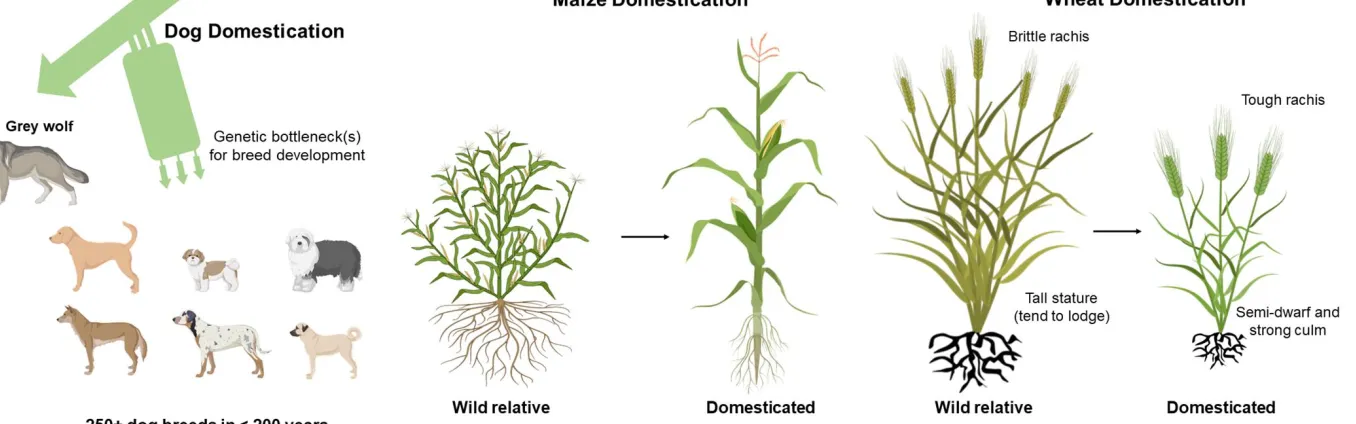
clear that the agricultural plot as a selection environment behaves quite differently from habitats under natural selection [1]; many native ‘selfish’ plant traits are therefore sub-optimal or even disadvantageous in a community context. In the past, however, selection of less fit individuals improved genetic adaptation to this human-customized environment [5, 6]. In a similar way as humans have domesticated wolves (Canis lupus) to a highly diverse range of dog breeds from cooperative companions and helpers to cuddly wimps, one might assume that domesticated plants have undergone similar drastic changes. In contrast, however, the overwhelming majority of today’s staple crops do not look fundamentally different from their
wild ancestors, implicating that selection was most likely not strong enough or incorrectly placed [5], or perhaps most plant species are more resilient to radical changes (Box 1).
5 exterior or interior. Exterior characters, already well described by C. M. Donald [2] for high-planting densities as well as well-fed growth conditions, reduce plant-plant competition while more efficiently utilizing common resources such as nutrients and light. They relate predominantly to plant architectural traits, such as a less neighbor-invasive root system, sturdy and short culm, low-tillering, erect leaves and a highly-fertile inflorescence. Although exterior characters are inherently measurable, surprisingly little research has been undertaken to create such ‘idealized’ genotypes for thorough hypothesis testing. Interior characters, on the other
hand, are considerably less obvious features of crop plants and hence far less amenable to track, e.g. water and nutrient uptake and translocation efficiency, source-sink and growth allometric relationships, root-to-shoot or organ-to-organ signaling, or radiation use efficiency in a canopy context. All of these interior characters are genetically highly complex (quantitative) and have not been resolved in any crop or model plant to date, mainly because this kind of trait behaves like a mechanistic or genetic ‘black box’. Recombining exterior and interior characters in a
balanced way while selecting under relevant agroecological growth conditions may be the key to high-yielding crop communities.
Despite grand progress in recent decades, specifically through basic insights from model plants, we are still only scratching the surface of what repertoire of complex performance and response traits might be considered essential or desirable in crop plants. Nevertheless, first cautious attempts in model plants have demonstrated that ‘selfish’ plant behavior indeed has a genetic
6 To this end, multi-omics systems analyses (genome, transcriptome, proteome, metabolome, epigenome, microbiome etc.) of diverse germplasm across critical developmental stages and large-scale phenotyping for both exterior and interior traits in relevant agroecological contexts can possibly empower research at crop community resolution (Figure 1). Trait-responsive network hubs, associated genes and favorable haplotypes might support computational design of adapted, customized crop genomes [8] and assist in tailoring multiple traits. The significance of using adapted haplotypes to increase yield was reported in wheat [9] and rice [10], among others. In principle, genome engineering by multiplexed gene/haplotype editing or synthetic biology routes [1] might facilitate more rapid development of ideal crop plants in future. Another promising strategy is establishment of trait-specific donor panels harboring adapted genomic signatures (Figure 1). A ‘First-Generation Ideal Plant Type’ (iGen-IPT) could then
be developed by combining superior trait-specific near isogenic lines (NILs) through genomics-based breeding [11]. Multi-omics analyses of these iGen-IPTs could redefine molecular networks and regulators, gene-gene interactions, background effects, high-resolution computational genome and thus an improved iiGen-IPT. Similarly, such recurrent systems analyses might result in better-adapted ‘next-generation Ideal Plant Types’ (nxIPTs) for optimized community performance. It is important to emphasize that these nxIPTs are not universally applicable, but must vary with target-environment and management practices. However, initial investigations of germplasm in ‘hotspots’ representing existing environmental
diversity could support rapid and effective generation of multi-omics datasets for simulating customized crop genomes suiting any target-environment, including predicted future climate scenarios; as exemplified from CGIAR’s “Global Rice Array” initiative (see:
7 Finally, establishment of a large multi-disciplinary “International Crop Ideotype Consortium (IC2)” (see: http://ic2.ipk-gatersleben.de) comprising experts from various domains including ecology, plant biology, genetics and breeding, systems and synthetic biology, genome engineering, crop modelling, remote sensing, etc., may trigger a much-needed breakthrough in the research arena of ideal crop plant architecture. IC2 is designed to overcome existing yield barriers while narrowing the gap between potential and actual yield in a community setup. Such human-customized plant communities where caring and sharing is favored over competing may not only provide more resource-efficient, high-yielding, biofortified crop plants; it simultaneously may herald the prospect of more sustainable solutions to future agricultural production systems in a changing climate.
Box 1: Can lessons from dog breeding help in customizing crops?
8 an organism’s genetic make-up to human-customized environments. Similarly, strong group
selection in crop plants under genuine agroecological growth conditions may provide useful genotypes with lowered ‘selfishness’.
Acknowledgements
We would like to thank all members of the research group plant architecture at IPK, colleagues from IRRI for useful discussions while conceptualizing the basic ideas for this article; and Dr. Guy Golan for critically reading a previous version of the manuscript. Apologies to those colleagues whose work was not cited due to space limitations.
Funding: R.A. was funded through the European Fund for Regional Development (EFRE) and the State of Saxony-Anhalt within the ALIVE project, grant no. ZS/2018/09/94616; A.K. and V.K.S. thank the Department of Biotechnology (DBT), Government of India for supporting haplotype research in rice; research in the Schnurbusch lab received financial support from the European Research Council (ERC), grant agreement 681686 “LUSH SPIKE”, ERC-2015-CoG;
HEISENBERG Program of the German Research Foundation (DFG), grant no. SCHN 768/15-1 and the IPK core budget.
Competing interests: The authors declare no conflict of interest.
ORCID IDs: 0000-0002-5712-910X (RA); 0000-0002-1560-1648 (VKS); 0000-0001-5577-7616 (RJS); 0000-0002-5488-9410 (AK); 0000-0002-5267-0677 (TS)
References
1. Wallace, J.G. et al. (2018) On the road to breeding 4.0: unraveling the good, the bad, and the boring of crop quantitative genomics. Annu. Rev. Genet. 52, 421-444.
9 3. Sakuma, S. and Schnurbusch, T. (2020) Of floral fortune: tinkering with the grain yield
potential of cereal crops. New. Phytol. 225 (5), 1873-1882.
4. Springer, N. (2010) Shaping a better rice plant. Nat. Genet. 42 (6), 475-476.
5. Weiner, J. (2019) Looking in the Wrong Direction for Higher-Yielding Crop Genotypes.
Trends. Plant. Sci. 24 (10), 927-933.
6. Denison, R.F. (2012) Darwinian agriculture: how understanding evolution can improve agriculture, Princeton University Press.
7. Wuest, S.E. and Niklaus, P.A. (2018) A plant biodiversity effect resolved to a single chromosomal region. Nat. Ecol. Evol. 2 (12), 1933-1939.
8. Benes, B. et al. (2020) Multiscale computational models can guide experimentation and targeted measurements for crop improvement. Plant. J. 10.1111/tpj.14722.
9. Sakuma, S. et al. (2019) Unleashing floret fertility in wheat through the mutation of a homeobox gene. Proc. Natl. Acad. Sci. U.S.A. 116 (11), 5182-5187.
10. Abbai, R. et al. (2019) Haplotype analysis of key genes governing grain yield and quality traits across 3K RG panel reveals scope for the development of tailor-made rice with enhanced genetic gains. Plant Biotechnol. J. 17 (8), 1612-1622.
11. Varshney, R.K. et al. (2020) 5Gs for crop genetic improvement. Curr. Opin. Plant. Biol.
(10.1016/j.pbi.2019.12.004).
10 Figure legends
Figure 1. Agroecological genetics and genomics for ideal crop plant community
Agriculture, being a function of community performance requires silencing of ‘selfish plant behavior’. Therefore, largely practiced single-plant selection becomes less relevant and it is more expedient to avoid or minimize ‘selfish’ plant behavior through group selection in crop breeding. In this context, embracing an “Agroecological Genetics and Genomics” viewpoint,
combining genetic principles with evolution and ecology, might pave the way to unravel key molecular factors that regulate not only well-studied “exterior” traits but also elusive “interior” plant architectural traits at community resolution. Multi-disciplinary research efforts are urgently required in this direction to silence ‘selfish’ traits and maximize communal yield by
matching crop genotypes to target environments and management practices. One size doesn’t fit all; for instance, (i.) in water scarce ecosystem drought responsive genes should also be deployed, (ii.) like-wise for biotic stress resistance, (iii.) appropriate intercropping to tackle soil nutrient deficiency, (iv.) biofortification to address malnutrition etc. Note: Superscript indicate reference number. This figure was created partly by using BioRender (https://biorender.com/).