ISSN: 2334-2323 (Print), 2334-2331 (Online) Copyright © The Author(s). All Rights Reserved. Published by American Research Institute for Policy Development DOI: 10.15640/aijb.v4n2a4 URL: https://doi.org/10.15640/aijb.v4n2a4
Detecting Predators by Kinetic Dialogs in Schooling Fish
L. Levin1, kineticdialogs
Abstract
When a potential prey perceives a movement in its environment, it may flee, hide, or freeze, with different costs in energy time and danger in relation to a would-be predator. After some time with no new stimulus, by and by, the potential prey may risk a probe- movement: the animal moves on out of its refuge exploring the area. If a predator is there it will probably react by orienting to the stimulus in preparation for an attack. This increases his own exposure to the interact or in a very short time after the probe-movement. The reciprocal situation occurs when the initiator is the predator. This sequence, occurring in a very short time, together with the relative direction of the movements (approach/withdrawal) we call “kinetic dialogs (DK)”. The rules of kinetic dialogs are based on the temporal correlation (temporal contiguity or contingency) of the reactor’s movements with those of the actor, and on the relative direction of those movements. A period of increased sensitivity would follow the probe-movement during which even a very subtle moving away or approaching object will elicit attack or escape reactions. Thus the KD system would be a two- component discriminator formed by contingency and sign, which aid the individual in discriminating hidden predators or preys. In this work we test the case of detecting predators by KD in the following way. We arranged a computer-driven tracking system which directed a small ball to any fish in a school of 12 palometas (Mettynisluna) which appeared over a black screen (a probe-movement). This contingent group showed a propagated hiding reaction not demonstrated by a similar group of fish which saw the same, yoked stimulus whose movements were independent of those of the fish. This result gives support to the idea that during predator-prey recognition kinetic dialogs, based on coupled interactions, operate. Keywords: DHDDS, retina, photoreceptors, mitochondria, TEM, zebra fish,31 and 104 hPF,
1. Introduction
The survival of many animals depends on their ability to discriminate between
prey, predators, and irrelevant entities. This discrimination should be followed either
by chase and attack (predator action), withdrawal and avoidance (prey action), or by
ignoring the stimuli, if irrelevant. Extensive work on predator-prey discrimination has
been based on the physical or chemical aspects of the stimulus, and on the interactor's
relevant perceptual abilities. The dimensions of the stimuli studied are especially
related to the visual appearance of the animal (Curio 1976; Welch & Colgan 1990);
contrast, size, shape, orientation, color, texture and velocity (Galbraith 1967; Coates
1980; Roth 1986; Tulley & Huntingford 1987; Huntingford & Coulter 1989; Kiltie&
Laine 1992; Gerlai 1993) the presence of eyes and gaze direction (Ristau 1991).
Hereupon we'll argue that these attributes are poor indicators in predator-prey
recognition since they are susceptible to cryptic adaptations in the evolutionary "arms
race" (Dawkins &Krebs 1979; Krebs & Davies 1981) which may operate in
predator-prey interactions. Any cue involved in predator-predator-prey recognition tends to be
eliminated by selection exerted upon its polar partner.
So there are two compulsory and universal attributes in the P/p interaction
that cannot be concealed by natural selection. The first is, that to grasp a prey the
predator must approach it; and conversely, that to avoid a predator; the prey must
withdraw from it. And the second, that any movement occurring after a very short
time after a movement of its own, is of vital importance, since it is a good predictor of
an attack. Without dismissing the significant incidence of the formal appearance of
the stimulus (including shape, size, color and odor)in distinguishing a prey from a
predator, here it is stated that this discrimination rely strongly on the time-correlation
between the actors movements and their relative direction (approach/withdrawal) in a
In a previous work I studied the behavior of a fish (Brachydaniorerio) in
response to a simple stimulus that approached or withdrew contingently with the
fish’s movements (Levin 1997, Levin 1999). This was accomplished by means of a
closed-loop electro-mechanic system. When the fish moved, a small clay ballwas
moved either towards the fish (predator program), or away from it (prey program).
The two measurements of antipredator behavior - the frequency of turns of more
than 120º after the stimulus, and the number of halts per stimulus, were both
significantly greater under the approaching condition than under the withdrawing
condition. These results suggested that specific predator-prey signaling channels,
which I called “kinetic dialogs”, were being manipulated by means of the method
employed. However, such method offered no allowance for a control situation in
regarding a similar sequence of stimuli, though not directed toward any particular fish
(no sign) and not time-correlated (not contingent) with any target behavior.
Thus, the role of time contiguity could not be abstracted from movement
(approach or withdrawal) per se. Here it was proposed that in early steps of mutual
recognition predators and prey engage in “kinetic dialogs” which define their
reciprocal role. In kinetic dialogs, movements in the surroundings are evaluated by the
perceiving animal according to what it was doing immediately prior to the perception of the
stimulus. Kinetic dialogs are defined by the temporal correlation (temporal contiguity,
or contingency) of the stimulus movements with those of the actor, and the direction
(approach/withdrawal) of the object in relation to the actor’s position. In short, the
decision rules for kinetic dialogs are: after remaining hidden or still for some time, the
animal moves or shows itself, which constitutes a “probe-movement”. If something
moves within a brief time after the probe-movement, that is a “revealing-response”. If
this movement is an approach, the prober would flee. However, if after the probe, the
object withdraws, the prober would attack. This three step cycle may iterate and
In the current study we tested whether a simple stimulus, that approaches one
or more fish of a group immediately after they appear over a refuge, results in an
alarm reaction of the group of fish, i.e. they descend to the substrate(Helfman 1989,
Brown et al. 1999). Three groups of schooling fish were used in the experiments using
a yoked design. While the contingent group was coupled with the triggering device,
the stimulus was independent from the movements of the non-contingent group. In
other words, while the stimulus was only made contingent with the specified behavior
of the contingent group, the same stimulation was delivered to both groups.
2. Methods
Fish used in these experiments were 72 Metynnisluna "palometas" measuring 4
- 4.5 cm in total length, obtained from a local dealer and housed in a 80 L glass tank at
22-25 ºC. Fish were fed daily with commercial fish food and were exposed to a 12:12
h light:dark cycle. This tropical schooling characid lives in rivers and in the flood
plains of Venezuelan savannahs. Each experiment was done with 12 fish in the
contingent tank and 12 fish in the yoked, non-contingent tank, both juxtaposed to
one another. The tanks made of glass measured 45 x 30 x 10 cm (L x H x W, Fig. 1).
Both tanks were visually separated by a plastic black plate. Fish were assorted
randomly to each group. The lower third of the frontal glass of both tanks was
covered with an opaque screen of black cardboard in order to prevent the fish below
this level from viewing the stimulus (and the optic sensor from sensing the fish, see
below).
The apparatus simulated a punctual organism that engages in kinetic dialogs
with an individual of the contingent group, while a similar stimulus reproduces the
same movements in front of the control group. Camera, computer, stimulus and fish
formed a closed loop in which the emergence of an experimental group fish over the
Stimuli were two 4 mm brown-clay spheres which could be moved on a plane
parallel to the front panel at 5 mm in front of the glass tanks. Stimuli were attached to
nylon lines and a pulley device mechanism operated by two pairs of opposing motors.
Each pair consisted of a stepping-motor controlled by the computer and a DC motor
that maintained a constant tension in the lines. The two pairs of motors were arranged
orthogonally and moved the stimuli in front of the tanks in a two-dimensional
coordinate system. An aluminum frame fixed to the floor and roof of the room
supported the motors and the pulleys. Four zenithal 75 W reflectors (dichroic 38º),
provided illumination to each tank. A variable transformer fed these lamps. A small
external to the aquarium and inconspicuous stimulus was chosen to evaluate the effect
of “contingent approach” against “independent movement”, minimizing other
This is the caption for Fig1:
Figure 1: (1) Contingent and (2) non-contingent (yoked) tanks. (3) Refuge: a
cardboard screen covered the inferior third of the front wall of both tanks. (4)
High-speed camera of the closed interactive loop. (5) Computer. (6 and 6’) Two stepping
motors pulled the lines which hold the stimuli (7 and 7’) while two DC motors (8 and
8’) maintained tension in the lines. (9) A second handicam camera recording the
position of fish in both tanks. During the experimental period, each time a fish of the
contingent group peeped over the black screen, the stimulus approached it.
Simultaneously, an equivalent movement was made by the yoked stimulus in front of
the non-contingent aquarium.
When a fish of the contingent group appeared above the opaque screen, the
computer received x,y data of its position at a rate of 80 frames/s, by means of an
optic sensor (CCD TC211, Texas Instruments) and solid state circuitry, and the
stimulus was then moved towards the fish (reaction time: 0.06 s, maximum speed: 2
m/s). The second, yoked stimulus moved jointly in front of the non-contingent tank.
If new x,y data was generated by the same or a different fish from the contingent
group, the stimulus moved to the new position. This stimulation might cause a
response by the fish that, in turn, if visible over the refuge, would trigger a new
movement of the stimulus. If more than one fish appeared above the refuge, the
stimulus would rapidly and in succession move towards the highest fish visible to the
camera.
The position of the fish and the movements of the stimulus were recorded
with a handycam camera framing both tanks from behind. The videos were analyzed
by drawing an horizontal lines on the monitor screen, thus dividing the tank image in
zones of equal size, and the number of fish at the upper level was counted in a
Procedure
Fish were placed in the tanks three days prior to the experiments and were fed
fish flakes daily. Before the session began, the zenithal lamp voltage was manually
increased until the standard voltage was obtained (in about 20 s). In this way, the
intense illumination needed by the tracking system was achieved. After five minutes,
the video filming was started and 5 min later, the tracking system was activated. The
stimuli, initially at the center of the tanks, began the approach movements toward the
contingent fish. After approximately 10 min, the stimulus was deactivated, and the
recording camera continued to film for 5 additional minutes. Three replicate
experiments were carried out.
3. Results
The fish schooled during the entire session, showing orderly increases and
decreases in the number of fish in the upper level throughout the sessions (Fig.2).
GroupG3contingent, climbed in two opportunities to the upper level, and the max
0 2 4 6 8 10 12
100 150 200 250
G1
0 2 4 6 8 10 12
100 150 200 250
G2
0 2 4 6 8 10 12
100 150 200 250
G3
exper dummy cum. stimuli
This is the caption for Fig 2:
Figure 2: Number of fish in the upper level of the water column for the paired
replicates G1, G2 and G3 for the contingent (exper) and non-contingent (dummy)
groups. Each point represents the number of fish in the upper level counted in a
video frame; at intervals of 5 s (each group was composed of 12 fish). The cumulative
curve shows the first 12 stimuli and also indicates when stimulation began. It can be
seen that during the pre-stimulation period, the three contingent as well as the three
yoked groups visited abundantly the upper level with no difference between the two
conditions (G1 p> 0.1, G2 p>0.1 and G3 p> 0.1). As soon as stimulation began
(where cumulative curve begins) the contingent group remained under the screen
level while the yoked group visited abundantly the upper level (G1 p<0.05, G2
p<0.01 and G3 p< 0.05).
When comparing “during stimulation” vs“ pre-stimulation”, the three
experimental groups showed a significant decrease in the number of fish in the upper
level (G1 p < 0.001, G2 p<0.05, G3 p< 0.001), while the “dummy group” did not
(G1, G2 and G3< 0.05). During the stimulation period, the dummy (non-contingent)
groups showed a decrease in the number of fish in the upper level (significant only for
replicates G1 and G3). All three contingent groups, however, decreased their numbers
as compared to the pre-stimulation period, and the three of them showed a lower
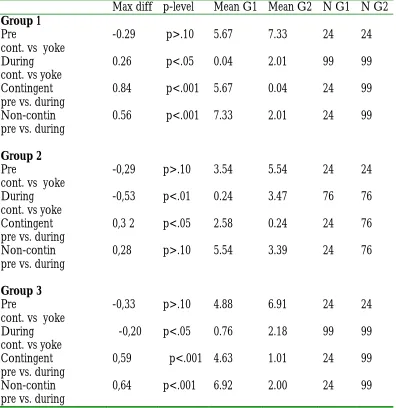
number of fish than the non-contingent groups during this period (Fig. 2, and Table
1).
A closer look at the moment in which stimulation began (see cumulative
stimuli curve) shows that for the three replicates both contingent and yoked groups
responded immediately to stimulation. Soon, while the contingent group remained at
Except for G1, the upward movement of the non-contingent group began
before 12 stimuli were delivered, suggesting that not all the fish had been directly
stimulated in order for the discrimination of contingency to be acquired by the group.
Table 1: Comparisons of the number of fish in the upper level of the
tank under different conditions (Kolmogorov-Smirnov)
Max diff p-level Mean G1 Mean G2 N G1 N G2
Group 1
Pre
cont. vs yoke
-0.29 p>.10 5.67 7.33 24 24
During cont. vs yoke
0.26 p<.05 0.04 2.01 99 99
Contingent pre vs. during
0.84 p<.001 5.67 0.04 24 99
Non-contin pre vs. during
0.56 p<.001 7.33 2.01 24 99
Group 2
Pre
cont. vs yoke
-0,29 p>.10 3.54 5.54 24 24
During cont. vs yoke
-0,53 p<.01 0.24 3.47 76 76
Contingent pre vs. during
0,3 2 p<.05 2.58 0.24 24 76
Non-contin pre vs. during
0,28 p>.10 5.54 3.39 24 76
Group 3
Pre
cont. vs yoke
-0,33 p>.10 4.88 6.91 24 24
During cont. vs yoke
-0,20 p<.05 0.76 2.18 99 99
Contingent pre vs. during
0,59 p<.001 4.63 1.01 24 99
Non-contin pre vs. during
4. Discussion
When frightened, a fish descends in the water column and approaches the
substrate (Helfman 1989, Brown et al. 1999); and, if possible seeks refuge,
maneuvering until a stone or other object is interposed between itself and the
frightening stimulus. The fish will eventually peep over the obstacle to explore the
stimulus area. The hypothesis of this study is that, in addition to inspection, such
behavior also serves a probe function. We give the name "probe movement" to a
sudden action made by an animal, which increases its exposure to a potential
predator, and then is followed by a brief period of increased attention to movements
in the surroundings. Even a very slight movement perceived by the subject during
that period will reveal an "interested" interactor; a reply that either reveals the
proximity of a predator if it approaches, or of a prey if it withdraws. If there is no
predator response, the fish can proceed with some other high-exposure behavior,
such as feeding or exploring farther. Thus, this three step loop, the kinetic dialog, may
aid in detecting predators.
From the predator’s point of view, the prey probe-movement results in a
sudden increase in its visibility and attractiveness, which may trigger either finely
tuned orientation or attack-defense responses or clumsy and not programed reactions,
such as startle responses (Carlson 1986, Greenwald et al 1998, Schlenoff 1985), which
may happen when the actor is ready to attack or to flee. These responses
unintentionally give away revealing information that could be used by the prober to
assess the imperilment–attractiveness of whatever is out-there. Thus, for the prey, this
revealing-response confirms the proximity of a predator right there, and accordingly it
In the present study we tested the prey-side of the hypothesis by arranging a
closed-loop tracking device which approached any fish of the experimental
(contingent) group whenever it appeared above the black screen. In this way the
device would administer an approaching revealing-response once a probe-movement
was produced by the actor.
Upon commencing stimulation, all the fish of both tanks submerged to the
deep level, hiding behind the screen. From then on, each time a fish of the contingent
group appeared over the screen, the small sphere, immediately moved towards it; and
few stimuli of this sort sufficed for the whole group to remain in the refuge. The fish
of the independent group, with which the stimulus movements were not contingent
upon any particular behavior of the subjects, soon reoccupied the higher level of the
tank. This strongly suggests that contiguity of the stimulus with a specified behavior is
an important contingency in inducing an effective alarm reaction.
Stimulus approaches may initially have occurred fortuitously towards some of
the twelve fish of the non-contingent group. However, except for a short initial
reaction, the hiding response rapidly habituates. This indicates that the downward
moving reaction throughout the duration of stimulation was produced by the
contingent approaches of the stimulus to individual fish when they exhibited the
specified response.
Kinetic dialogs may occur in encounters of stationary-camouflaged prey
(Kiltie & Laine 1992) and ambushing or stalking predators (Grier &Burk, 1992). In
these cases, both parties hide during a preparation period which ends quite suddenly
with a sequence of explosive attack-counterattack maneuvers. Any anticipated
The probe-movement may be considered as a manipulation instrument (Wiley
1983). It not only renders information concerning interests of the interactor on the
prober itself, but it also increases its response time for a next possible flight or attack
providing it with some extra time for salvation (Bildstein 1983, Caro 1995).
Probe-movements involve risks (at least disseconomies) for the prober. It can be detected
and either evaded or attacked; but for the prey, these risks are diminished if the
probe-movement is displayed only when the prober is adequately oriented and ready
to flee as happens during inspection visits shown by many animals (Hountingford &
Coulter 1989) and during the mobbing behavior of birds (Curio 1978). Inspection
visits of fish to the predator have been interpreted as a signal of their alertness and
escape ability, thereby possibly deterring predator pursuit (Magurran 1990; Godin &
Davis 1995; Brown & Godin 1999). Also, it could serve to assess the predator’s
motivation (Licht 1989). In the light of present analyses, inspection visits could also
be probe-movements.
Deceptions (Krebs & Davis 1981) are possible in kinetic dialogs: by playing
the predator´s role (i.e., approaching the interactor), the prober may induce a prey
reaction in the predator, thus increasing its own chance of survival. This may explain
why predators leave the immediate vicinity of the prey after an inspection visit
(Pettifor 1990, Fitzgibbon 1994). The concept of kinetic dialogs may help to explain
several previously unanswered questions as to why the eyespots of many
lepidopterans and other taxa, when at rest are hidden by the front wings and they are
suddenly shown only when the animal is disturbed by a bird predator (Cott, 1940,
Schlenoff, 1985, Oloffson et al, 2012). The butterfly is manipulating the fragility of
the probe system of the predator, by providing him at the right moment with the
correct revealing-response of a stalking predator encountered face to face: two, big,
brightly colored eyes appearing after its approach.
It may also help us to understand why preys, which never habituate to a real
predator, do so to otherwise realistic models which are static or whose movements are
not contingent with prey’s movements (Wolfgang et al, 1983). In the same way
scarecrows are successful only when recently installed, but soon cease to be so (Marsh
et al, 1992). Knowledge of kinetic dialogs may also help bird watchers to get nearer to
their shy friends, by following these rules: “When hearing a bird vocalization or noisy
movements, refrain from displaying the predators revealing-response, that is: don’t
startle or orient the head, arms or hands indicating the direction of the source during
the first following seconds. Avoid turning around and don’t shout a message to your
partners like: “Look, there!” (Caula & Levin, 1999).
Notwithstanding there’s an information intercourse flowing between the
parties involved, kinetic dialogs do not easily qualify as communication. (Bradbury &
Vehrencamp 1998, Frings & Frings 1964, Marler 1977). Accordingly, Levin (1999)
proposed the special category Negencommunication, as embracing the information
exchange between kinetic interactors with vital but opposite interests in a possible
encounter, as is the case in predator/prey encounters.
Movement is perhaps the most important ability of animals over plants. It
allows the subject to position itself in different places and orientations thus
enrichening its relation with the environment. But movement has an unavoidable
consequence: It makes the subject more visible by other observers. This bond, as seen
in this work, has unavoidable consequences in the structures and behavioral
mechanism that can evolve in predator-prey relations. In kinetic dialogs, the
moving-static condition of the observer determines the value of a perceived stimulus.
Surprisingly, the actors own movements constitute an important part of the
A final comment on the pros and cons of using groups in this experiment.
Opting for groups instead of individuals as experimental subjects hampers us in
following the detailed dynamics of the individual movements within the group. But it
brings about two important benefits: (1) schooling fish seem to enjoy a more natural
situation within a group of co-specifics than isolated; and (2) there are behaviors
which are only apparent in the group, such as (rather obviously) schooling. For
instance, when the school is alarmed, an increase in cohesion and grouping at the
bottom of the tank occurs (Magurran & Girling 1986, Levin 1997). Finally, as
suggested here, movements of an undetermined entity perceived by a few fish may
result in an alarm reaction by the entire group, all the more so if said movements are
contingent with the fishes’ movements.
Acknowledgments
This research could not have been performed if not for the talented and
perseverant collaboration of Eduardo Paglialunga who designed and constructed the
experimental apparatus, the animal-instrumentloop including hardware and software. I
would additionally like to thank Pablo Levín for his clever revision of the manuscript.
Thanks also to Zaida Tárano for her helpful comments, and also to L. Bulla for his
statistics advice.
Keywords: predator prey interactions, startle response, probe behavior,
evidencing response, schooling fish, Negencommuniction, probe-movement.
References
Marsh, R E. Erickson, W, A . &Terrell P. S. (1992)Scarecrows and predator models for frightening birds from specific areas. Proceedings of the Fifteenth Vertebrate Pest Conference 1992 Digital Commons@University of Nebraska – Lincoln. Vertebrate
Pest Conference Proceedings collection 3-1-1992
Ristau, C. A. (1991). Aspects of the cognitive ethology of an injury-feigning bird, the piping plover. In Ristau, C. A., Ed., Cognitive Ethology: The Minds of Other
Animals.Hillside, NJ: Erlbaum, pp. 91-126.
Brown, G.E., Godin, J.-G. J. & Pederson, J. (1999). Fin flicking behaviour: a visual antipredator alarm signal in a characin fish, Hemigrammuserythrozonus. Animal Behaviour, 58: 469-475.
Brown, G.E. & Godin, J-G. J. (1999). Who dares, learns: chemical inspection behaviour and acquired predator recognition in a characin fish. Animal Behaviour, 57, 475-481.
Bradbury, J.W. & Vehrencamp, S.L. 1998. Principles of Animal Communication. Sinauer, Sunderland, Massachusetts.
Carlson, N. R.(1986). Physiology of behavior. Allyn and Bacon, Inc. Boston.
Bildstein, K.L. (1982). Responses of northern harriers to mobbing passerines. Journal of Field Ornitology. 53:7-14.
Brown, G.E., Godin, J.-G. J. & Pederson, J. (1999). Fin flicking behaviour: a visual antipredator alarm signal in a characin fish, Hemigrammuserythrozonus. Animal Behaviour, 58: 469-475.
Caro, T.M. (1995). Pursuit-deterrence revisited. Trends in Ecology and Evolution. 10:500-503.
Caula, S. y Levin, L. (1999). How to attract and photograph tropical city birds. Journal of Biological Photography, 68 (4): 99-102.
Cott, H.B. (1940) Adaptive Coloration in Animals Methuen, London.
Coates, D. (1980). The discrimination of and reaction towards predatory and non-predatory species of fish by humbug damselfish Dascyllusaruanus (Pisces, Pomacentridae). Zeitschriftfür Tierpsychologie, 52, 347-354.
Curio, E. (1976). The ethology of predation. Berlin: Springer.
Curio, E. (1978) The adaptive significance of avian mobbing I. Teleonomic Hypotheses and predictions. Zeitschriftfür Tierpsychologie, 48, 175-183. Fitzgibbon, C.D.1994. The costs and benefits of predator inspection behaviour in
Thompson´s gazelles. Behavioral Ecology and Sociobiology, 34, 139-148. Frings, H. y Frings, M. (1964). Animal communication. New York: Blaisdell.
Galbraith, M.G. Jr. (1967). Size-selective predation on Daphnia by rainbow trout, and yellow perch. Transactions of the American Fish Society, 96, 1-10.
Gerlai, R. (1993). Can paradise fish Macropodusopercularis (Anabantidae) recognize a natural predator? An ethological analysis. Ethology, 4, 127-136.
Greenwald, M.K. Bradley, M.M., Cuthbert B.N. & Lang, P. J. (1998). Startle potentiation: shock sensitization, aversive learning, and affective picture modulation. Behavioral Neuroscience, 112, 1069-1079.
Grier, J.W.& Burk, T. (1992)Biology of Animal Behavior. (Second edition). St. Louis. Mosby Year Book, inc.
Helfman, G. S. (1989). Threat-sensitive predator avoidance in damselfish-trumpetfish interactions. Behavioral Ecology and Sociobiology, 24, 47-58.
Huntingford, F. A.&Coulter, R. M. (1989). Habituation of predator inspection in the three-spinedstikelback, Gasterosteusaculeatus L. Journal of Fish Biology, 35, 153-154.
Kiltie, R. A.&Laine, A. F. (1992). Visual textures, machine vision and camouflage. Trends in Ecology and Evolution, 7, 163-166.
Krebs, J.R. & Davis, N.B. (1981). An Introduction to Bhavioural Ecology. Blackwell. Oxford.
Levin, L.E. (1996). Passage order through different pathways in groups of schooling fish, and the Diversified Leadership hypothesis. Behavioural Processes, 37, 1-8.
Levin, L.E. (1997). Kinetic dialogs in predator-prey recognition.Behavioural Processes, 40, 113-120.
Levin, L.E. (1999). Diálogos Kinéticos: reglas de interacción en relaciones conflictivas. Ph.D. thesis, Universidad Central de Venezuela.
Licht, T. (1989). Discriminating between hungry and satiated predators: the response of guppies (Poeciliareticulata). From high and low predation sites. Ethology, 82, 255-302.
Magurran, A.E. (1990). The adaptive significance of schooling as an anti-predator defense in fish. Ann Zool. Fennici. 27, 51-66.
Magurran, A.E. &Girling, S.L. (1986). Predator Model recognition and response habituatiohn in shoaling minnows. Animal Behaviour, 34: 510-518.
Marler,P. (1977). The evolution of communication. In How Animals Communicate (Ed. by T. A. Sebeoc) pp. 45-70. Bloomington, IN: IndianaUniv. Press.
Marsh, R E. Erickson, W, A . &Terrell P. S. (1992) Scarecrows and predator models for frightening birds from specific areas. Proceedings of the Fifteenth Vertebrate Pest
Conference 1992 Digital Commons@ University of Nebraska – Lincoln. Vertebrate Pest Conference Proceedings collection 3-1-1992
M. Olofsson, H. Løvlie, J Tibblin, S. Jacobsson and C., Behavioral Ecology Wiclund. Behavioral Ecology 24, 305-310. 2012.
Eyespot display in the peacock butterfly triggers antipredator behaviors in naïve adult fowl
Roth, G. (1986). Neural Mechanisms of Prey Recognition: an example in amphibians. In: Predator-prey relationship (Ed. by M. Feder, & G. Lauder) pp. 42-68. Chicago: The University of Chicago Press.
Schleidt, Wolfgang M, Michael D. Shalter, Talmage C. Carawan (1983)The Effect of Spatial Context on Habituation to a Predator Model Zeitschriftfür Tierpsychologie Volume 61, Issue 1, pages 67–70, January-December 1983 Schlenoff, D.H. (1985). The startle response of blue jays to Catocala (Lepidoptera:
Noctuidae) prey models. Animal Behaviour,33, 1057-1067.
Tulley, J. J. & Huntingford, F. A. (1987). Parental care and development of adaptative variation in anti-predator responses in sticklebacks. Animal Behaviour, 35, 1570-1572.
Welch, C. & Colgan, P. (1990). The effects of contrast and position on habituation to models of predators in eastern banded killifish (Fundulusdiaphanus). Behavioural Processes, 22, 61-71.