E
ff
ect of Parallel Di
ff
usion of Equilibrium Pressure on Interaction
between Interchange Mode and Static Magnetic Island
∗
)
Kinya SAITO
1), Katsuji ICHIGUCHI
1,2)and Ryuichi ISHIZAKI
1,2) 1)The Graduate University for Advanced Studies, Toki 509-5292, Japan
2)National Institute for Fusion Science, Toki 509-5292, Japan
(Received 6 December 2010/Accepted 18 April 2011)
The effect of equilibrium pressure diffusion parallel to the magnetic field on the interaction between a re-sistive interchange mode and a static magnetic island is studied by means of a nonlinear numerical simulation based on the reduced magnetohydrodynamics equations. Previous work for the case without the parallel diffusion of the equilibrium pressure [K. Saitoet al., Phys. Plasmas17, 062504 (2010)] showed that two solutions exist for a given error magnetic field: one indicates the increase of the island width in the nonlinear evolution of the interchange mode and the other indicates the decrease of the width. For the case with parallel diffusion of the equilibrium pressure, our present study shows that only the solution indicating the increase of the width exists; we discuss the causes for this.
c
2011 The Japan Society of Plasma Science and Nuclear Fusion Research
Keywords: static magnetic island, interchange mode, parallel diffusion of equilibrium pressure DOI: 10.1585/pfr.6.2403072
1. Introduction
In the magnetic confinement of fusion plasmas, nested flux surfaces are desirable. However, error magnetic fields caused by the misalignment of the field coils and terres-trial magnetism can induce static magnetic islands. Such static islands can affect the plasma confinement. In the large helical device (LHD), it is able to control the static islands by using the local island diverter coils [1]. Change of the island size and the influence on the confinement are extensively studied in the experiments by utilizing the coils [2–4].
On the other hand, resistive interchange modes can be unstable in a heliotron device such as LHD because of the existence of a magnetic hill in the confinement region. Be-cause the interchange mode also degrades the plasma con-finement, it is crucial to study the linear stability and non-linear dynamics of the mode. However, only a few stud-ies [5–7] have performed direct numerical simulations of the static islands and interchange modes. Therefore, the interaction between static islands and interchange modes has not been studied adequately.
In this study, we analyze the direct interaction be-tween a static island and an interchange mode, both of which have the same mode number, by following the non-linear time evolution. A previous study [8] showed that two solutions exist for a given error field depending on the sign of the initial perturbations in the nonlinear saturation phase of the interchange mode. One solution corresponds to an increase in the island width and the other corresponds author’s e-mail: [email protected]
∗)This article is based on the presentation at the 20th International Toki
Conference (ITC20).
to a decrease in the island width. The study included the effect of the diffusion parallel to the magnetic field only for the perturbed pressure. To consider a more realistic situation, we include the effect of diffusion parallel to the magnetic field for the equilibrium pressure in this study. In this case, the term of the parallel diffusion of the equilib-rium pressure in the equation of state automatically gen-erates an initial perturbation. Therefore, the solution can be uniquely determined, and it corresponds to the increase or decrease of the island width. Hence, we focus on the change in the island width due to the nonlinear evolution of the interchange mode.
2. Model Equations and Calculation
Conditions
The interaction between the interchange mode with (m,n) = (1,1) and the static island with the same mode number is studied using the reduced magnetohydrodynam-ics (MHD) equations [9]. These equations are suitable for the analysis of such low mode number physics. The re-duced MHD equations are composed of Ohm’s law, the vorticity equation and the equation of state for the poloidal fluxΨ, the stream functionΦand the pressureP. The nor-malized equations are given by
∂Ψ˜
∂t =−B· ∇Φ˜ +
1
S J˜z, (1)
d ˜U
dt =−(B· ∇J˜z+B˜ · ∇Jzeq)
+β0
22∇Ωeq× ∇P˜·zˆ+ν∇ 2
⊥U˜, (2)
and
c
d ˜P
dt =(ˆz× ∇Φ˜)· ∇Peq+κ⊥∇
2
⊥P˜
+κ(B· ∇)(B· ∇)(Peq+P˜), (3) respectively in the cylindrical coordinates (r, θ,z). The par-allel diffusion term of equilibrium pressure,
Q=κ(B· ∇)(B· ∇)Peq, (4) is involved in Eq. (3). These equations are solved using the NORM code [10]. The subscript ‘eq’ refers to the equilib-rium quantity, and the tilde refers to the perturbed quantity. The magnetic fieldBis written asB=Beq+B, where˜ Beq and ˜Bare defined asBeq=zˆ+zˆ× ∇Ψeqand ˜B=zˆ× ∇Ψ˜. Here, ˆzdenotes the unit vector in thezdirection. The con-vective time derivative is given by d/dt=∂/∂t+v˜⊥·∇, and the velocity ˜v⊥is given by ˜v⊥=∇⊥Φ˜ ×zˆ.The operator∇⊥
is defined as∇⊥=∇−zˆ(∂/∂z). In addition, the current den-sity in thezdirection ˜Jzand the vorticity in thezdirection
˜
Uare expressed as ˜Jz=∇2
⊥Ψ˜ and ˜U =∇2⊥Φ˜, where∇2⊥is
given by∇2
⊥ = (1/r)(∂/∂r)(r∂/∂r)+(1/r2)(∂2/∂θ2). The
dissipation parameters ofS, ν, κ⊥, andκare the magnetic
Reynolds number, viscosity coefficient, perpendicular heat conductivity coefficient, and parallel heat conductivity co-efficient, respectively. This analysis uses a large resistiv-ity ofS =104to enhance the influence of the interchange mode. Other parameters ofν=1.5×10⁻⁴,κ
⊥=1.0×10⁻⁵,
andκ=1.0 are used so that the (m,n)=(1,1) component dominates.
Because we focus on the interaction between the inter-change mode with (m,n)=(1,1) and the static island with the same mode number, we assume that the perturbations have a single helicity withn/m=1/1 as follows:
˜
Ψ(r, θ,z)=
N
n=0,m=n
˜
Ψm,n, Ψ˜m,n=Ψm,n(r) cos(mθ−nz), (5)
˜
Φ(r, θ,z)=
N
n=0,m=n
˜
Φm,n, Φ˜m,n =Φm,n(r) sin(mθ−nz), (6)
˜
P(r, θ,z)=
N
n=0,m=n
˜
Pm,n, P˜m,n=Pm,n(r) cos(mθ−nz). (7)
We employ N = 30 as the highest mode number. In this case, the kinetic energy EK and the magnetic energy EM
are given by
EK= N
n=0,m=n
Em,nK , EKm,n=1
2
|∇⊥Φm,nsin(mθ−nz)|2dV,
(8)
EM= N
n=0,m=n
Em,nM , Em,nM =1
2
|∇⊥Ψm,ncos(mθ−nz)|2dV.
(9) The static magnetic island with (m,n)=(1,1) is intro-duced by assuming thatΨ1,1has a finite value at the plasma boundary (r=1) [5–7],
Ψ1,1(r=1)=Ψb, (10)
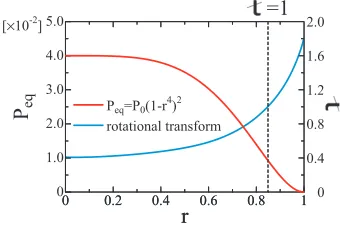
Fig. 1 Profiles of equilibrium pressure and rotational transform.
whereΨbis the external poloidal flux at the plasma
bound-ary. Because the external field does not induce any cur-rent, the external poloidal flux satisfies the no-current con-dition∇2
⊥Ψ˜1,1 =0. The solution of this condition with the boundary condition given by Eq. (10) shows that the ex-ternal poloidal flux corresponding to the static island with (m,n)=(1,1) is given byΨ1,1=Ψbr.
We use a straight heliotron equilibrium corresponding to the LHD configuration with the vacuum magnetic axis located at 3.6 m [11]. The equilibrium is constructed by utilizing a three-dimensional equilibrium, which is calcu-lated with the VMEC code [12] under the no-net-current and free-boundary conditions. We employ the equilibrium pressure profile ofPeq=P0(1−r4)2with a beta value at the axis ofβ0=4%. Figure 1 shows the profiles of the equilib-rium pressurePeqand the rotational transformι. The ratio-nal surface ofι=1 is located atr=0.85, where a substan-tial pressure gradient exists to drive the interchange mode. The averaged field line curvatureΩeqis calculated from the three-dimensional equilibrium magnetic field [13].
3. Island Evolution due to
Inter-change Mode
We follow the nonlinear evolution of the interchange mode with the static island by introducing finiteΨb. In this
case, at the first time step oft = Δt, the parallel diffusion of the equilibrium pressureQgives an initial perturbation of pressurePbas given by
Pb=QΔt|t=0 =−κ(1−ι)Ψb
dPeq
dr Δt. (11)
Therefore, any explicit external initial perturbation is not given.
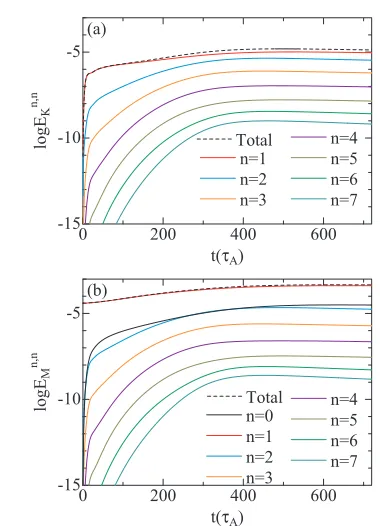
Figure 2 shows the time evolution of the kinetic and magnetic energies of the interchange mode forΨb=2.0×
10−3. A steady state is obtained after the nonlinear satura-tion of the interchange mode. As mensatura-tioned in Sec. 2, the
Fig. 2 Time evolution of (a) kinetic energy and (b) magnetic en-ergy forΨb=2.0×10⁻³.
|Ψb|. It is obtained that the linearly growing phase becomes
seen explicitly as|Ψb|is decreased.
To observe the change in the island due to the nonlin-ear saturation of the interchange mode, we plot the con-tours of the magnetic helical flux Ψh in Fig. 3, which is
given by
Ψh(r, θ,z)=Ψeq(r)−
1 2
n mr
2+Ψ˜
(r, θ,z). (12) Figure 3 shows the flux surfaces att=0 (before the growth of the interchange mode) andt=720τA(after the nonlin-ear saturation of the mode). The island width is 0.105 at
t=0 and 0.153 att=720τA. Figure 4 shows the
depen-dence of the island width onΨb. The sign of the island
width indicates the island phase. A positive sign corre-sponds to islands with X-point at θ = 0 and O-point at θ=π. A negative sign corresponds to islands with X-point atθ = πand O-point atθ = 0. The blue line shows the island width att = 0, which is obtained by the analytical expression
wB =4Ψm,n
1
mr|Ψm,n|ι
r=r
s
, (13)
wherersdenotes the position of the resonant surface. The
agreement betweenwBand the island width determined by
theΨhcontour was confirmed in Ref. [8]. The red circles show the island width after saturation of the interchange mode for eachΨb. For finite Ψb, the island width after saturation is always larger than that att =0. That is, the island width increases because of the nonlinear evolution
(a)
(b)
Fig. 3 Contours of the helical magnetic flux on the z = 0 poloidal cross section forΨb =2.0×10⁻³ at (a)t = 0
and (b)t=720τA.
Fig. 4 Dependence of the island width onΨb. The blue line
shows the width att=0 evaluated with the analytic ex-pression in Eq. (13). The triangles and circles show the width in the saturation of interchange mode forΨb =0
and finite values ofΨb, respectively.
of the interchange mode. The phase of the island is not changed by the mode. This property is independent of the sign ofΨb.
with|Ψb|. However, the increment of the island width due
to the interchange mode is almost independent of|Ψb|. This
is attributed to the fact that the increase of the island width after saturation is mainly caused by the increase of the static island width.
4. Mechanism of Increase of Island
Width
Here, we discuss the reason why the island width in-creases due to the interchange mode for the case with par-allel diffusion of equilibrium pressure. For this purpose, we consider the properties of the mode structures of the interchange mode for the case with Ψb = 0 at first. In
this case,Pb given by Eq. (11) is zero. Therefore, in the
case without external initial perturbations, nothing hap-pens. Thus, we employ a pressure perturbation given by
Pini=σf(r), (14)
as the initial perturbation for the calculation. Here, f(r) is a function with a very small absolute value defined as
f(r)=β010−181−4
r−1
2 2
2
, (15)
andσdenotes the sign of the initial perturbation(σ =−1 or+1). In this case, two solutions exist with the same ab-solute value and a different sign depending on the value of σ, as shown in Figs. 4 and 5.
Equation (14) and Fig. 5 show that the signs of the ini-tial and saturation values ofP1,1(rm), wherermdenotes the
position where the saturatedP1,1 has the maximum abso-lute value, are positive forσ= +1 and negative forσ=−1. That is, the sign of the saturatedP1,1(rm) is determined by
that ofPini. This is because the function ofPiniinvolves a component that grows to the saturatedP1,1, and therefore the sign of the component is succeeded to the saturated
P1,1. Even in the case of Ψb = 0, Ψ1,1 has a significant value atr = rs, because a large resistivity of S = 104
and the cylindrical geometry are employed. Figure 5 also shows that the signs ofΨ1,1(rs) andP1,1(rm) are the same
in the saturation of the interchange mode for either value ofσ. Note thatrm<rs.
We use this property of the interchange mode to ana-lyze the case of finiteΨb. In this case,Piniis given byPb
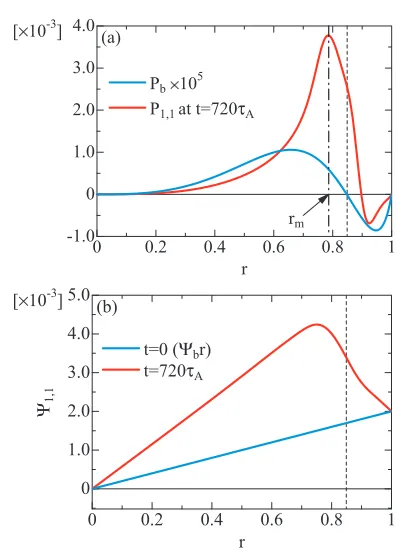
instead of Eq. (14). Figure 6 (a) shows the profile ofPband
the saturatedP1,1forΨb=2.0×10⁻³. The profile ofPbis
positive forr<rs. Therefore,P1,1 grows so as to be pos-itive atr=rm. Figure 6(b) shows the initial and saturated
profiles ofΨ1,1. Att=0,Ψ1,1already has a positive value atr=rsbecauseΨ1,1is given byΨbrsfor positiveΨb. The
change ofΨ1,1(rs) due to the interchange mode is also
pos-itive becauseP1,1(rm)>0. As a result, the absolute value
ofΨ1,1(rs) increases as the mode grows. This implies that
the island width increases because it is proportional to the square root of|Ψ1,1(rs)|. The same result is obtained for the
case of negativeΨb.
Fig. 5 Profiles ofP1,1andΨ1,1forΨb=0 in the saturation phase
of the interchange mode. The dashed and dot-dashed lines indicate the positions ofr=rsandr=rm,
respec-tively.
Fig. 6 Profiles of (a)Pb×105andP1,1att=720τAand (b)Ψ1,1
att=0 andt=720τA. The dashed and dot-dashed lines
indicate the positions ofr=rs, andr=rm, respectively.
5. Conclusions
The effect of equilibrium pressure diffusion parallel to the magnetic field on the interaction between a static island and an interchange mode is studied by following the nonlinear time evolution of the interchange mode in the straight LHD configuration.
the case without. This results from the fact that the par-allel diffusion term generating a pressure component that increases the poloidal flux at the resonant surface.
We use single helicity perturbations because we fo-cus on the direct interaction between the interchange mode with (m,n) = (1,1) and the static island with the same mode number. When multiple helicity perturbations are employed, the excitations of the interchange modes at ra-tional surfaces different from the island surface must be considered. If such modes grow substantially, they can in-teract with the island indirectly through the change in the structure of the magnetic field and the pressure profile. In-corporating this effect is beyond the scope of the present study, but it would be treated in a future work.
Acknowledgments
This work is partly supported by budget NIFS10 KLDT005 of the National Institute for Fusion Science and
by a Grant-in-Aid for Scientific Research (C) 22560822 from JSPS, Japan.
[1] N. Ohyabuet al., J. Nucl. Mater.266-269, 302 (1999). [2] N. Ohyabu et al., Plasma Phys. Control. Fusion 47, 1431
(2005).
[3] Y. Narushimaet al., Nucl. Fusion48, 075010 (2008). [4] F. Watanabeet al., Nucl. Fusion48, 024010 (2008). [5] T. Unemuraet al., Phys. Plasmas11, 1545 (2004). [6] L. Garciaet al., Phys. Plasma8, 4111 (2001). [7] L. Garciaet al., Nucl. Fusion43, 553 (2003). [8] K. Saitoet al., Phys. Plasmas17, 062504 (2010). [9] H. Strauss, Plasma Phys.22, 733 (1980).
[10] K. Ichiguchiet al., Nucl. Fusion43, 1101 (2003).
[11] A. Komoriet al., Proc. 22th Fusion Energy Conf. OV/2-4
(2008).
[12] S. P. Hirshman et al., Comput. Phys. Commun. 43, 143 (1986).