Danielle Laraque, MD
Mount Sinai School of Medicine One Gustave L. Levy Place New York, NY 10029-6574
Howard Spivak, MD
Tufts University School of Medicine Boston, MA 02111
Marilyn Bull, MD
Department of Pediatrics
James Whitcomb Riley Hospital for Children Indianapolis, IN 46202
REFERENCES
1. American Academy of Pediatrics, Committee on Injury and Poison Prevention. Firearm-related injuries affecting the pediatric population.
Pediatrics. 2000;105:888 – 895
2. Office of Disease Prevention and Health Promotion.Healthy People 2010.
Washington, DC: US Department of Health and Human Services; 2000 3. Satcher D. Eliminating racial and ethnic disparities in health: the role of
the ten leading health indicators.J Natl Med Assoc. 2000;92:315–318 4. American Academy of Pediatrics, Committee on Practice and
Ambula-tory Medicine. Recommendations for preventive pediatric health care.
Pediatrics. 2000;105:645– 646
5. Laraque D, Barlow B, Durkin M. Prevention of youth injuries.J Natl Med Assoc. 1999;91:557–571
6. Wintemute GJ, Parham CA, Beaumont JJ, Wright M, Drake C. Mortality among recent purchasers of handguns. N Engl J Med. 1999;341: 1583–1589
7. Kellermann AL, Rivara FP, Rushforth NB, et al. Gun ownership as a risk factor for homicide in the home.N Engl J Med. 1993;329:1084 –1091 8. Bailey JE, Kellermann AL, Somes GW, Banton JG, Rivara FP, Rushforth
NP. Risk factors for violent death of women in the home.Arch Intern Med. 1997;157:777–782
9. Kellemann AL, Rivara FP, Somes G, et al. Suicide in the home in relation to gun ownership.N Engl J Med. 1992;327:467– 472
10. Olson LM, Christoffel KK, O’Connor KG. Pediatricians’ experience with and attitudes toward firearms. Results of a national survey.Arch Pediatr Adolesc Med. 1997;151:352–359
11. Bass JL, Christoffel KK, Widome M, et al. Childhood injury prevention counseling in primary care settings: a critical review of the literature.
Pediatrics. 1993;92:544 –550
12. Schuster MA, Franke TM, Bastian AM, Sor S, Halfon M. Firearm storage patterns in US homes with children.Am J Public Health. 2000;90:588 –594 13. Azrael D, Miller M, Hemenway D. Are household firearms stored safely? It depends on whom you ask.Pediatrics.2000;106(3). Available at: URL: http://www.pediatrics.org/cgi/content/full/106/3/e31. Ac-cessed October 26, 2000, 2000
14. Farah, MM, Simon HK, Kellermann AL. Firearms in the home: parental perceptions.Pediatrics. 1999;104:1059 –1063
15. Stennies G, Ikeda R, Leadbetter S, Houston B, Sacks J. Firearm storage practices and children in the home, United States 1994.Arch Pediatr Adolesc Med. 1999;153:586 –590
16. Webster DW, Wilson ME, Duggan AK, Pakula LC. Firearm injury prevention counseling: a study of pediatricians’ beliefs and practices.
Pediatrics. 1992;89:902–907
17. Haught K, Grossman D, Connell F. Parents’ attitudes toward firearm injury prevention counseling in urban pediatric clinics.Pediatrics. 1995; 96:649 – 653
18. Grossman DC, Mang K, Rivara FP. Firearm injury prevention counsel-ing by pediatricians and family physicians. Practices and beliefs.Arch Pediatr Adolesc Med. 1995;149:973–977
19. Milne JS, Hargarten SW. Handgun safety features: a review for physi-cians.J Trauma. 1999;47:145–150
20. Open Society Institute.Gun Control in the United States. A Comparative Survey of State Firearm Laws. New York, NY: Open Society Institute; 2000 21. Teret SP, Webster DW, Vernick JS, et al. Support for new policies to regulate firearms. Results of two national surveys.N Engl J Med. 1998; 339:813– 818
22. Vernick JS, Webster DW, Hepburn LM. Effects of Maryland’s law banning Saturday night special handguns on crime guns. Inj Prev. 1999;5:259 –263
23. Knitzer JE. Child advocacy: a perspective.Am J Orthopsychiatry. 1976; 46:200 –216
24. Laraque D, Barlow B, Durkin M, Heagarty M. Injury prevention in an urban setting: challenges and successes.Bull N Y Acad Med. 1995;72: 16 –30
25. Christoffel KK. Public health advocacy: process and product.Am J Public Health. 2000;90:722–726
Is There an Epidemic of Autism?
ABBREVIATIONS. DSM-IV, Diagnostic and Statistical Manual of Mental Disorders, IV; PDD, pervasive developmental disorder; PDD-NOS, pervasive developmental disorder-not otherwise spec-ified.
T
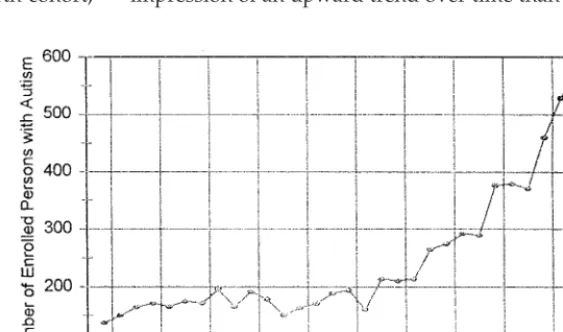
he debate on the hypothesis of a secular in-crease in rates of autism would benefit from a clear recognition of the methodologic limita-tions of existing data. No psychiatric case register study has ever allowed for estimating and monitor-ing the incidence of autistic conditions over time.1 Cross-sectional surveys hugely differ in their case definition and case identification methods that ac-count for large variations in prevalence estimates both over time and across areas, precluding a mean-ingful analysis of time trends. That rates in recent surveys are substantially higher than 30 years ago merely reflects the adoption of a much broader con-cept of autism, a recognition of autism among nor-mally intelligent subjects, changes in diagnostic cri-teria, and an improved identification of persons with autism attributable to better services.1,2The only ep-idemiologic study where case definition and identi-fication could be held constant failed to detect an increase in rates of autism in successive birth cohorts from 1972 to 1985.3Most of the claims about the ‘epidemic’ of autism are therefore based on referral statistics from various centers. The report of the Department of Develop-mental Services from California has been, and still is, widely quoted as evidence for an epidemic of au-tism.4The key data of this report (Table 1 and Fig 1) need a critical examination.
First, the figures apply to numbers rather than rates and fail to account for changes in the size and composition of the underlying population. Between 1987 and 1999, the population of California rose from 27 777 158 to 33 145 121 persons (⫹19.3%) and that of the 0- to 14-year-olds (the age group where most of the increase was reported) increased from 6 009 165 to 7 557 886 children (⫹25.8%). Positive migration fluxes to California both from within the United States and from abroad might also be differentially related to the presence of an autistic child in a family. None of these basic epidemiologic concerns were taken up in the report.
Received for publication Nov 20, 2000; accepted Nov 20, 2000.
Address correspondence to Eric Fombonne, MD, FRCPsych, MRC Child Psychiatry Unit/Institute of Psychiatry, Denmark Hill, De Crespigny Park, London SE5 8AF, United Kingdom. E-mail: [email protected] PEDIATRICS (ISSN 0031 4005). Copyright © 2001 by the American Acad-emy of Pediatrics.
COMMENTARIES 411
at Viet Nam:AAP Sponsored on August 30, 2020 www.aappublications.org/news
Second, no attempt was made to control for changes in diagnostic concepts and definitions. The report refers to definitions in theDiagnostic and Sta-tistical Manual of the Mental Disorders, IV (DSM-IV) but completely ignores that, in view of the wide age range of the sample and study period (1987–1998), multiple diagnostic systems were in fact used over the years producing heterogeneity in diagnoses in successive birth cohorts. In 1980, DSM-III introduced the terminology of pervasive developmental disor-der (PDD) widening the previous concept of infantile autism. The change from DSM-III to DSM-III-R in 1987 was associated with an additional broadening of the concept of PDD at the expense of its specificity. In 1994, the diagnostic categories of Asperger syndrome, Rett syndrome and childhood disintegrative disorder were introduced for the first time in DSM-IV as subcatego-ries of PDDs; moreover, the diagnostic boundasubcatego-ries of pervasive developmental disorders not otherwise spec-ified (PDD-NOS) were inadvertently widely broad-ened because of editorial changes in the layout of the diagnostic criteria.5Not surprisingly, these 4 categories account for the largest increase in the California report (Table 1, Other PDD).
Third, in California and elsewhere, autistic chil-dren are now diagnosed at a much earlier age. A decreasing mean age at diagnosis will necessarily result in an increased number of reported cases, even assuming a stable prevalence or incidence. Thus, age-specific rates among older children are required to test time trends.
Fourth, the only comparison made in the report with an epidemiologic estimate was inaccurate. The report stated that the number (N ⫽ 1685) of new persons (of all ages) entering their database in 1998 exceeds that expected from one annual birth cohort;
however, this comparison is nonsensical because it is confounded by age differences. More meaningful comparisons tell a very different story. Using a con-servative estimate of 22.125/10 000 for all types of PDDs deriving from a recent review1and the Janu-ary 1999 census estimates (http://www.census.gov) for California for the whole population (N ⫽
33 145 121) and subjects aged 0 to 19 (N⫽9 916 162), the expected numbers of subjects with a PDD in California in 1998 are 73 334 and 21 940 persons, respectively. Furthermore, as of July 2000, the total number of persons with autism registered to Califor-nia Developmental Services was 13 054. Thus, as one would predict with routine administrative statistics, the California reports seriously underestimate the size of the problem (Table 1); and surely our calcu-lations provide no basis for the claim of an epidemic based on the reports’ figures.
Fifth, far from being specific to autism, upward trends were also reported for other disorders (such as cerebral palsy, epilepsy, or mental retardation) for which there is no epidemiologic evidence for a sec-ular increase. This points towards a general method-ologic and recording artifact at the source of the reported increases.
Yet, the most worrying aspect of the California report lies in the distortion of data graphically por-trayed in Fig 1. The report states that Fig 1 derives from the “. . . 1991 population of persons (7915) with autism,” therefore clearly indicating the cross-sec-tional nature of the sample. Instead of age, the report plots year of birth on the horizontal axis thereby artificially creating the impression of a prospective data collection. The note of caution in the text (‘Data points in Fig 1 do not show how many persons enter the system in a given year, but how many already in the system were born in a given year’) has been obviously overlooked by most commentators. This graphical display deliberately transforms what is an age effect into what seems a cohort effect, although the latter cannot be tested with such cross-sectional data. By analogy, any sample with a marked skewed age-distribution (for example, take a survey of Army personnel) could be misleadingly portrayed by re-placing age by year of birth and giving the same impression of an upward trend over time than in Fig
Fig 1. Distribution of birth dates of regional center eligible persons with autism (California).
TABLE 1. Autism and Other PDDs Registered in California (1987–1998)
1987 1998 % Change
Autism
(Full syndrome and residual state)
2778 10 360 272.9%
Other PDD 38 785 1965.8%
Autism suspected (Not diagnosed)
1086 1635 50.6%
1 (but nobody would interpret the transformed per-sonnel Army data as indicative of rising numbers of militaries!). The point is that, in both examples, there was no passage of time allowing inferences to be made on trends over time.
The misuse of these data by some investigators6is another tribute to their poor research methodology. To date, the epidemiologic evidence for a secular increase in the incidence of PDDs is both meager and negative.1We simply lack good data to test hypoth-eses on secular changes in the incidence of autism. Because of specific methodologic limitations, the high prevalence rates reported in recent autism sur-veys cannot be used to derive conclusions on this issue.1,2 Prevalence data nevertheless point to the magnitude of the problem, which had clearly been underestimated in the past. But there is no need to raise false alarms on putative epidemics nor to prac-tice poor science to draw the attention to the unmet needs of large numbers of seriously impaired chil-dren and adults. More complex monitoring systems than those currently in place are needed to address the issue of secular changes in the incidence of PDDs. Maintaining case definition and identification con-stant, focusing on children in the upper range of school age years, controlling for changes in the pop-ulation (ie, differential migration, etc. . . ) and relying on adequate sample sizes are required for future epidemiologic efforts in this area.
Eric Fombonne, MD, FRCPsych
MRC Child Psychiatry Unit/Institute of Psychiatry Denmark Hill
De Crespigny Park
London SE5 8AF, United Kingdom
REFERENCES
1. Fombonne E. The epidemiology of autism and related pervasive devel-opmental disorders. In: Lord C, ed.Educating Children With Autism.
Washington, DC: National Academy of Sciences Press; 2001. In press 2. Fombonne E. Epidemiological surveys of autism: a review.Psychol Med.
1999;29:769 –786
3. Fombonne E, du Mazaubrun C, Cans C, Grandjean H. Autism and associated medical disorders in a large French epidemiological sample.
J Am Acad Child Adolesc Psychiatry. 1997;36:1561–1569
4. Department of Developmental Services.Changes in the Population of Persons With Autism and Pervasive Developmental Disorders in California’s Developmental Services System: 1987 Through 1998. Report to the Legisla-ture, March 1, 1999.Available at: http://www.dds.ca.gov
5. Volkmar F, Shaffer D, First M. PDD-NOS in DSM IV.J Autism Dev Disord. 2000;30:74 –75. Letter
6. Wakefield A. MMR vaccination and autism.Lancet. 1999;354:949 –950. Letter
Postnatal Glucocorticoids in Very
Preterm Infants: “The Good, the
Bad, and the Ugly”?
ABBREVIATIONS. BPD, bronchopulmonary dysplasia; DXM, dexamethasone.
P
remature births represent 7% to 10% of all births, but account for ⬎85% of all perinatal complications and death. Survival of extremely premature newborns (⬍28 weeks’ gestation) has in-creased because of the widespread use of surfactant treatment for respiratory distress syndrome, together with antenatal glucocorticoids and new ventilator strategies.1 However, these infants are at high risk for long-term injury of both the lungs and the brain. Bronchopulmonary dysplasia (BPD) is one of the most frequent sequelae in extremely premature in-fants and results in increased health care costs, pro-longed hospital stays with frequent rehospitaliza-tions, and deleterious effects on subsequent growth and neurodevelopment.2Periventricular leukomala-cia, the most severe form of white matter brain dam-age, is a frequent cause of cerebral palsy in children surviving preterm birth, with lifelong consequences.3 Recent data suggest that a common treatment for one, dexamethasone for BPD, may have deleterious effects on both sequelae.Northway et al4first described BPD as severe lung injury resulting from mechanical ventilation and ox-ygen exposure. With improved prenatal and postna-tal care, preterm infants developing BPD now are generally very immature, and have antenatal and postnatal histories that differ from those of preterm infants in previous eras. The “new BPD,” as de-scribed by Jobe,5is characterized by an arrest of lung development and interference with alveolarization. This more complex view of the pathogenesis of BPD includes prenatal lung inflammation in response to proinflammatory cytokine exposure in utero, to-gether with postnatal exposure to proinflammatory stimuli, such as ventilation and oxygen. Jobe5 postu-lates that these stimuli, together with glucocorticoid exposure and inadequate nutrition, can result in inhibition of alveolar and vascular development. Therein lies the irony: the postnatal dexamethasone (DXM) widely used for the treatment or prevention of BPD may suppress inflammation, but also may impair alveolarization and interfere with lung devel-opment.
Initial trials of DXM, a potent and long-acting glu-cocorticoid, in preterm infants with BPD showed short-term improvement in pulmonary function and weaning from the ventilator.6,7 Over time, with in-creased survival of extremely premature infants, there has been a shift toward earlier use of DXM in newborns of lower and lower gestational ages.8,9The plethora of trials conducted over the past 2 decades have recently been evaluated in 3 meta-analyses ac-cording to the onset of treatment: 1) early postnatal (⬍96 hours of life),10 2) moderately early postnatal (7–14 days),11and 3) delayed (⬎3 weeks).12Although moderately early treatment decreased mortality and
Received for publication Nov 17, 2000; accepted Dec 27 2000.
Address correspondence to Thierry Lacaze-Masmonteil, MD, PhD, Service de Pediatrie et Reanimation Neonatale, Hopital Antoine Beclere, 157, rue de la Porte de Trivaux 92141 Clamart Cedex France. E-mail: [email protected]
PEDIATRICS (ISSN 0031 4005). Copyright © 2001 by the American Acad-emy of Pediatrics.
COMMENTARIES 413
at Viet Nam:AAP Sponsored on August 30, 2020 www.aappublications.org/news
DOI: 10.1542/peds.107.2.411
2001;107;411
Pediatrics
Eric Fombonne
Is There an Epidemic of Autism?
Services
Updated Information &
http://pediatrics.aappublications.org/content/107/2/411 including high resolution figures, can be found at:
References
http://pediatrics.aappublications.org/content/107/2/411#BIBL This article cites 4 articles, 0 of which you can access for free at:
Subspecialty Collections
http://www.aappublications.org/cgi/collection/cardiology_sub Cardiology
following collection(s):
This article, along with others on similar topics, appears in the
Permissions & Licensing
http://www.aappublications.org/site/misc/Permissions.xhtml in its entirety can be found online at:
Information about reproducing this article in parts (figures, tables) or
Reprints
http://www.aappublications.org/site/misc/reprints.xhtml Information about ordering reprints can be found online:
at Viet Nam:AAP Sponsored on August 30, 2020 www.aappublications.org/news
DOI: 10.1542/peds.107.2.411
2001;107;411
Pediatrics
Eric Fombonne
Is There an Epidemic of Autism?
http://pediatrics.aappublications.org/content/107/2/411
located on the World Wide Web at:
The online version of this article, along with updated information and services, is
by the American Academy of Pediatrics. All rights reserved. Print ISSN: 1073-0397.
the American Academy of Pediatrics, 345 Park Avenue, Itasca, Illinois, 60143. Copyright © 2001 has been published continuously since 1948. Pediatrics is owned, published, and trademarked by Pediatrics is the official journal of the American Academy of Pediatrics. A monthly publication, it
at Viet Nam:AAP Sponsored on August 30, 2020 www.aappublications.org/news