AMERICAN ACADEMY OF PEDIATRICS
Committee on Sports Medicine and Fitness
Strength Training by Children and Adolescents
ABSTRACT. Pediatricians are often asked to give ad-vice on the safety and efficacy of strength training pro-grams for children and adolescents. This review, a revi-sion of a previous American Academy of Pediatrics policy statement, defines relevant terminology and pro-vides current information on risks and benefits of strength training for children and adolescents.
ABBREVIATION. NEISS, National Electronic Injury Surveillance System.
INTRODUCTION
S
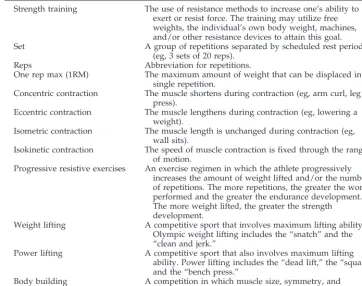
trength training (also known as resistance train-ing) is a common component of sports and physical fitness programs for young people. Some adolescents and preadolescents may use strength training as a means to enhance muscle size and definition or to simply improve appearance.Strength training programs may include the use of free weights, weight machines, elastic tubing, or body weight. The amount and form of resistance used as well as the frequency of resistance exercises is determined by specific program goals. Table 1 defines common terms used in strength training.
BENEFITS OF RESISTANCE TRAINING In addition to the obvious goal of getting stronger, strength training programs may be undertaken to improve sports performance, rehabilitate injuries, prevent injuries, and/or enhance long-term health. Studies have shown that strength training, when properly structured with regard to frequency, mode (type of lifting), intensity, and duration of program, can increase strength in preadolescents and adoles-cents.1– 4Gains in strength, muscle size, or power are
lost after 6 weeks if resistance training is discontin-ued.5Maintenance exercises may offset these losses,
but specific recommendations for maintaining strength gains have not been defined for preadoles-cents and adolespreadoles-cents.
In preadolescents, proper resistance training can enhance strength without concomitant muscle hy-pertrophy. Such gains in strength can be attributed to neuromuscular “learning,” in which training in-creases the number of motor neurons that will fire with each muscle contraction.2,6,7 This mechanism
helps explain strength gains from resistance training in populations with low androgen levels, including
females and preadolescent males. Strength training can also augment the muscle enlargement that nor-mally occurs with pubertal growth in males and females.3,6,8,9
Strength training can improve an adolescent ath-lete’s performance in weight lifting and power lift-ing. Strength training is a common practice in sports like football in which size and strength are desirable. Despite theoretical benefits, scientific studies have failed to consistently show that improved strength enhances running speed, jumping ability, or overall sports performance.6,10
Evidence that strength training programs help vent sports-related musculoskeletal injuries in pre-adolescents and pre-adolescents is inconclusive.11
Fur-thermore, there is no evidence that strength training will reduce the incidence of catastrophic sports-re-lated injuries.
RISKS OF STRENGTH TRAINING
The US Consumer Product Safety Commission, through its National Electronic Injury Surveillance System (NEISS), has estimated the number of injuries that are associated with strength training equipment. The NEISS data neither specifies cause of injury nor separates recreational from competitive weight lift-ing injuries. From 1991 to 1996, an estimated 20 940 to 26 120 injuries occurred each year in individuals under 21 years old.12 According to NEISS data and
other studies,13 muscle strains account for 40% to
70% of all injuries. The lumbar back is the most commonly injured area.11,14
A limited number of case reports have raised con-cern about epiphyseal injuries in the wrist and apophyseal injuries in the spine from weight lifting in skeletally immature individuals. Such injuries are uncommon and are believed to be largely prevent-able by avoiding improper lifting techniques, maxi-mal lifts, and improperly supervised lifts.12,15,16
Strength training programs do not seem to ad-versely affect linear growth and do not seem to have any long-term detrimental effect on cardiovascular health.2,4,17–19Young athletes with hypertension may
experience further elevation of blood pressure from the isometric demands of strength training.8
STRENGTH TRAINING GUIDELINES
A medical evaluation before commencing a formal strength training program can identify possible risk factors for injury and provide an opportunity to dis-cuss training goals, techniques, and expectations. Risks involved with use of anabolic steroids and other body-building supplements are appropriate The recommendations in this statement do not indicate an exclusive course
of treatment or serve as a standard of medical care. Variations, taking into account individual circumstances, may be appropriate.
PEDIATRICS (ISSN 0031 4005). Copyright © 2001 by the American Acad-emy of Pediatrics.
topics for discussion with any adolescent interested in getting bigger and stronger.20,21
If children or adolescents undertake a strength training program, they should begin with low-resis-tance exercises until proper technique is learned. When 8 to 15 repetitions can be performed, it is reasonable to add weight in small increments. Exer-cises should include all muscle groups and be per-formed through the full range of motion at each joint. To achieve gains in strength, workouts need to be at least 20 to 30 minutes long, take place a minimum of 2 to 3 times per week, and continue to add weight or repetitions as strength improves. There is no addi-tional benefit to strength training more than 4 times per week.5
Young people who want to improve sports perfor-mance will generally benefit more from practicing and perfecting skills of the sport than from resistance training. If long-term health benefits are the goal, strength training should be combined with an aero-bic training program.
RECOMMENDATIONS
1. Strength training programs for preadolescents and adolescents can be safe and effective if proper resistance training techniques and safety precau-tions are followed.
2. Preadolescents and adolescents should avoid competitive weight lifting, power lifting, body building, and maximal lifts until they reach phys-ical and skeletal maturity.
3. When pediatricians are asked to recommend or evaluate strength training programs for children
and adolescents, the following issues should be considered:
a. Before beginning a formal strength training program, a medical evaluation should be per-formed by a pediatrician. If indicated, a referral may be made to a sports medicine physician who is familiar with various strength training methods as well as risks and benefits in pread-olescents and adpread-olescents.
b. Aerobic conditioning should be coupled with resistance training if general health benefits are the goal.
c. Strength training programs should include a warm-up and cool-down component.
d. Specific strength training exercises should be learned initially with no load (resistance). Once the exercise skill has been mastered, incremen-tal loads can be added.
e. Progressive resistance exercise requires suc-cessful completion of 8 to 15 repetitions in good form before increasing weight or resis-tance.
f. A general strengthening program should ad-dress all major muscle groups and exercise through the complete range of motion. g. Any sign of injury or illness from strength
training should be evaluated before continuing the exercise in question.
Committee on Sports Medicine and Fitness, 2000 –2001
Reginald L. Washington, MD, Chairperson David T. Bernhardt, MD
TABLE 1. Definition of Terms
Term Definition
Strength training The use of resistance methods to increase one’s ability to exert or resist force. The training may utilize free weights, the individual’s own body weight, machines, and/or other resistance devices to attain this goal. Set A group of repetitions separated by scheduled rest periods
(eg, 3 sets of 20 reps).
Reps Abbreviation for repetitions.
One rep max (1RM) The maximum amount of weight that can be displaced in a single repetition.
Concentric contraction The muscle shortens during contraction (eg, arm curl, leg press).
Eccentric contraction The muscle lengthens during contraction (eg, lowering a weight).
Isometric contraction The muscle length is unchanged during contraction (eg, wall sits).
Isokinetic contraction The speed of muscle contraction is fixed through the range of motion.
Progressive resistive exercises An exercise regimen in which the athlete progressively increases the amount of weight lifted and/or the number of repetitions. The more repetitions, the greater the work performed and the greater the endurance development. The more weight lifted, the greater the strength development.
Weight lifting A competitive sport that involves maximum lifting ability. Olympic weight lifting includes the “snatch” and the “clean and jerk.”
Power lifting A competitive sport that also involves maximum lifting ability. Power lifting includes the “dead lift,” the “squat,” and the “bench press.”
Body building A competition in which muscle size, symmetry, and definition are judged.
AMERICAN ACADEMY OF PEDIATRICS 1471 at Viet Nam:AAP Sponsored on August 30, 2020
www.aappublications.org/news
Jorge Gomez, MD Miriam D. Johnson, MD Thomas J. Martin, MD Thomas W. Rowland, MD Eric Small, MD
Liaisons
Claire LeBlanc, MD
Canadian Pediatric Society Robert Malina, PhD
Institute for the Study of Youth Sports Carl Krein, AT, PT
National Athletic Trainers Association Judith C. Young, PhD
National Association for Sport and Physical Education
Section Liaison
Frederick E. Reed, MD Section on Orthopedics
Consultants
Steven J. Anderson, MD Bernard A. Griesemer, MD Oded Bar-Or, MD
Staff
Heather Newland
REFERENCES
1. Falk B, Tenenbaum G. The effectiveness of resistance training in chil-dren. A meta-analysis.Sports Med. 1996;3:176 –186
2. Ramsay JA, Blimkie CJ, Smith K, Garner S, MacDougall J, Sale DG. Strength training effects in prepubescent boys. Issues and controversies.
Med Sci Sports Exerc. 1990;22:605– 614
3. Blimkie CJ. Resistance training during preadolescence.Sports Med. 1993; 15:389 – 407
4. Faigenbaum AD, Zaichkowsky LD, Westcott WL, Micheli LJ, Fehlandt AF. The effects of a twice-a-week strength training program on children.
Pediatr Exerc Sci. 1993;5:339 –346
5. Faigenbaum AD, Wescott WL, Micheli LJ, et al. The effects of strength training and detraining on children.J Strength Cond. 1996;10:109 –114 6. Kraemer WJ, Fry AC, Frykman PN, Conroy B, Hoffman J. Resistance
training and youth.Pediatr Exerc Sci. 1989;1:336 –350
7. Ozmun JC, Mikesky AE, Surburg PR. Neuromuscular adaptations fol-lowing prepubescent strength training.Med Sci Sports Exerc. 1994;26: 510 –514
8. Fleck SJ, Kraemer WJ.Designing Resistance Training Programs. 2nd ed. Champaign, IL: Human Kinetics Books; 1997
9. Webb Dr. Strength training in children and adolescents.Pediatr Clin North Am. 1990;37:1187–1210
10. Hakkinen K, Mero A, Kauhanen H. Specificity of endurance, sprint, and strength training on physical performance capacity in young athletes.
J Sports Med Phys Fitness. 1989;29:27–35
11. Cahill BR, Griffith EH. Effect of preseason conditioning on the incidence and severity of high school football knee injuries. Am J Sports Med. 1978;6:180 –184
12. National Electronic Injury Surveillance System. Washington, DC: Con-sumer Products Safety Commission
13. Risser WL, Risser JM, Preston D. Weight-training injuries in adoles-cents.Am J Dis Child. 1990;144:1015–1017
14. Brown EW, Kimball RG. Medical history associated with adolescent powerlifting.Pediatrics. 1983;72:636 – 644
15. Brady TA, Cahill BR, Bodnar LM. Weight training-related injuries in the high school athlete.Am J Sports Med. 1982;10:1–5
16. Ryan JR, Salciccioli GG. Fractures of the distal radial epiphysis in adolescent weight lifters.Am J Sports Med. 1976;4:26 –27
17. Weltman A, Janney C, Rians CB, Strand K, Katch FT. The effects of hydraulic-resistance strength training on serum lipid levels in prepu-bertal boys.Am J Dis Child. 1987;141:777–780
18. Weltman A, Janney C, Rians CB, et al. The effects of hydraulic resistance strength training in pre-pubertal males.Med Sci Sports Exerc. 1986;18: 629 – 638
19. Bailey DA, Martin AD. Physical activity and skeletal health in adoles-cents.Pediatr Exerc Sci. 1994;6:330 –347
20. American Academy of Pediatrics, Committee on Sports Medicine and Fitness. Adolescents and anabolic steroids: a subject review.Pediatrics. 1997;99:904 –908
21. American Academy of Pediatrics, Committee on Sports Medicine. An-abolic steroids and the adolescent athlete.Pediatrics. 1989;83:127–128
DOI: 10.1542/peds.107.6.1470
2001;107;1470
Pediatrics
Committee on Sports Medicine and Fitness
Strength Training by Children and Adolescents
Services
Updated Information &
http://pediatrics.aappublications.org/content/107/6/1470
including high resolution figures, can be found at:
References
http://pediatrics.aappublications.org/content/107/6/1470#BIBL
This article cites 19 articles, 3 of which you can access for free at:
Subspecialty Collections
cal_fitness_sub
http://www.aappublications.org/cgi/collection/sports_medicine:physi Sports Medicine/Physical Fitness
following collection(s):
This article, along with others on similar topics, appears in the
Permissions & Licensing
http://www.aappublications.org/site/misc/Permissions.xhtml
in its entirety can be found online at:
Information about reproducing this article in parts (figures, tables) or
Reprints
http://www.aappublications.org/site/misc/reprints.xhtml
Information about ordering reprints can be found online:
at Viet Nam:AAP Sponsored on August 30, 2020
www.aappublications.org/news
DOI: 10.1542/peds.107.6.1470
2001;107;1470
Pediatrics
Committee on Sports Medicine and Fitness
Strength Training by Children and Adolescents
http://pediatrics.aappublications.org/content/107/6/1470
located on the World Wide Web at:
The online version of this article, along with updated information and services, is
by the American Academy of Pediatrics. All rights reserved. Print ISSN: 1073-0397.
the American Academy of Pediatrics, 345 Park Avenue, Itasca, Illinois, 60143. Copyright © 2001 has been published continuously since 1948. Pediatrics is owned, published, and trademarked by Pediatrics is the official journal of the American Academy of Pediatrics. A monthly publication, it
at Viet Nam:AAP Sponsored on August 30, 2020
www.aappublications.org/news