© 2016 IJSRSET | Volume 2 | Issue 3 | Print ISSN : 2395-1990 | Online ISSN : 2394-4099 Themed Section: Engineering and Technology
Testing and Evaluation of Modified Dynamic threshold Energy Detection
Algorithm for CR Sensing Applications
T. Srinivas , B. Jagadeesh Babu, G.Bheemeswara Rao
Department of ECE, Aditya college of Engineering, Surampalem, Andhra Pradesh, India
ABSTRACT
Nowadays Energy detection via threshold is a complex and multifaceted issue in Cognitive Radio sensing applications. A Cognitive radio (CR) is all time monitoring smart radio which detects available channels in wireless spectrum. The important features of CR are Spectrum mobility, Spectrum sharing, Sensing-based Spectrum sharing and spectrum reuse. CR sensing is used to detect and locate unused area of spectrum and sharing it among many users by following the protocols of EMI & EMC (if possible also senses empty spectrum.). Hence Primary users (PU) detection is Vital for proper spectrum usage. The widely used Spectrum-sensing method is Transmitter detection. It may be of three kinds. It may be usually matched filter detection, sometimes Energy detection and in special cases it is Cyclo stationary featured detection. Among them Matched filter configuration is provided by maximizing peak signal to mean noise ratio but it results many demerits whereas energy detection is the best alternative. The conventional energy detection technique uses fixed threshold. Measurement of RSS (Received Signal strength) in terms of power indicates whether signal is present or not. So Threshold indicates the optimum (minimum) level of signal power for detection. Noise variance information is required to design the proposed energy detector. This is the simple process involved in energy detection. If we don’t know noise power then SNR (Signal to Noise ratio) walls problem comes into picture due to noise uncertainty. This uncertainty obtains poor and un-optimized performance in several cases.
The main Objective of this paper is to address the above discussed problem by implementing a new efficient energy detector to provide best performance in CR sensing applications. i.e. it uses dynamic threshold which uses two threshold levels. The required two threshold values are determined by noise uncertainty factor (NUF). The Receiver operating characteristic (ROC), Monte-Carlo simulation provided the promising results. This algorithm can be suited for various sensing applications with minute modifications. Its main merit is it does not need any information of the signal, estimation of noise and channel powers.
Keywords: CR, Energy Detection, Noise Uncertainty factor, Probability of detection, Probability of false alarm, Primary user, ROC curve, SNR-wall, Spectrum sensing, Threshold.
I.
INTRODUCTION
Cognitive radio is a continuously monitoring system that facilitates concurrent wireless communications in a given spectrum band by varying the transmission or reception characteristics in one specified place. It is the easy method for best spectrum management [1]. It is a form of wireless communication which distinguishes idle and non-idle channels and then instantly transceiver move into empty communication channels while avoiding non-idle ones.
The most traditional, simple and easy method is energy detection. In this technique If RSS is above threshold then Energy is detected otherwise not. But this method fails due to more noise immunity even for minute signal changes due to SNR walls. This reduces the overall performance of the detector [14], [15], [16]. Noise is the unwanted energy that lies in the same band of spectrum where desired signal is present. Hence Noise estimation is necessary. There are several sources for noise and interference among secondary users and primary users. The main sources include aliasing noise by LPF (Low pass filters) quantization noise, thermal noise and so on. Aliasing noise by front end LPF’s due to failure of application of nyquist rate. This is also known as ISI (Inter Symbol interference). Hence LPF is also called as anti-aliasing filter. The quantization occurs during rounding off of samples to closest discrete value. Thermal noise arises due to conduction of electrons via thermal agitation in ohmic portions of the receiver. This is also known as thermal Johnson noise. There is one more important contributor of noise which due to signal leakage. But many times several energy detection methods case studies assume noise power is not varying [5],[9] .Therefore, it is non-practical that the average noise power keeps constant in the detection duration; hence the noise uncertainty is unavoidable. Energy detection (ED) [8],[12],[13] is a popular spectrum sensing technique as it does not require any apriori knowledge about primary signals, and due to its low complexity, it is easy to implement.
The conventional energy detection technique is based upon fixed threshold. To implement this energy detector, noise variance information [8] is required.
Usually inadequate knowledge of noise uncertainty gives problem of SNR wall criterion viz. energy detector cannot detect any transmitted signal even though by rising the observation time [11]. One more main reason for SNR wall is insufficient refinement of the noise power estimation during increase in observation time [1], [14], [16].The SNR wall problem can be solved by usage of two different thresholds [15].
Two threshold dynamic energy detection algorithms [14], [15] for CR applications are modified to provide optimal response. With proper prediction of primary user absence/presence we gain new modified energy detector.
The two thresholds are evaluated using an NUF’s expected value. The computation of NUF is based on noise variance and procedure is explained in [8]. Obviously small threshold is used for improvement of the probability of detection (Pd) whereas on the other side large threshold is used to degrade the probability of false alarm (Pfa) [3].
The organization of the coming sections of the paper is as follows: Section II provides further study in the form of a survey by relating CR opportunities, challenges, future directions, tools and software for CR network analysis. Section III covers the review of Conventional fixed threshold energy detectors. Section IV describes the modified dynamic threshold energy detector. Section V shows numerical simulation results and discussions of the modified detector followed by ROC analysis and the conclusion and future scope are discussed in Section VI.
II.
METHODS AND MATERIAL
1. Cognitive Radio Networks Recent Opportunities, Future Directions, Challenges and Simulation Tools
Software defined radio (SDR) is the key technology for cognitive wireless sensor networks. Dynamic spectrum access (DSA) is representative of the first wave of R&D and commercial activity on cognitive radios. In the longer run, adaptive wireless network are provided by programmable SDR technology. Adaptive wireless network is one in which both the radio waveform and networking protocols can be dynamically selected to deal with current operational requirements. These also achieve higher spectrum efficiency and performance through the use of distributed cognitive algorithms to control adaptation and cooperation.
There are many tools or softwares which are designed as network simulators for Cognitive Radio Networks. For example MATLAB, NS2, NS3, NET sim, QualNet, OMNet++ etc [1].
MATLAB is the most general tool used for many applications. This can also be widely adopted tool for CR Network and CR Sensing applications. MATLAB is the acronym for matrix laboratories.
NS-2 is an open source simulator. It one benefit is that you will have all the code available and you will have full freedom to modify what you want. But its limitations are that (a) it does not have good GUI support, so you will have to analyze through trace file and filter your required data using AWK scripts and (b) there is no good support of debugging in NS-2, so you will have to debug using print/cout statements which is more time consuming.
QualNet is commercial software, so (a) one of its limitations is that it hides the source code of some files (e.g., channel propagation) files. So, you cannot do modification for such files. (b) Its another limitation is that since it is a commercial software, therefore it is paid and is much expensive. Its advantages are (a) very good debugging support as it is integrated with Microsoft Visual Studio, so you can debug line by line (through breakpoints) and (b) good GUI support and you can even modify GUI as well by yourself and can add your own menus/protocols using XML.
In NET sim, the source codes are in C and easy to modify using MS Visual Studio. GUI is also excellent with packet animations which enable you to visualize the working of your code.
OMNeT++/MiXiM was chosen as the developing platform, mainly due to its open source nature, its well-organized modular architecture, the existing documentation, and the provided IDE (Integrated Development Environment).
CRE-NS3 extension is written to add cognitive radio (CR) capabilities to the Network Simulator-3. It will cover the installation process, the documentation of such an extension and provide examples to get you started. We call this extension module CRE-NS3. It provides the basic blocks that are necessary to provide such
functionality in Network Simulator 3 (ns-3). CRE-NS3 adhers to the ns-3 standards when it comes to documentations by using Doxygen. The details for implementing the simulator, examples, information about source file downloads and documentation is available in web.
2. The Conventional Threshold Energy Detectors
This section describes the different sensing techniques such as classical detector, auto correlation detection and cross correlation methods, Maximum-Minimum Eigenvalue Detection etc. [8], [10]. In conventional threshold detector threshold is static (fixed). Spectrum sensing problem can be modeled as the binary hypothesis testing problem.
PU state is defined by the following two hypotheses: H0 ⇒y (n) = w (n) (PU absent) (1)
H1 ⇒y (n) = x (n) + w (n) (PU present) (2)
Where n is different lengths of primary user observing period and n=1,…, N where N is the total length of the PU observing period. Hypothesis H0 implies PU absence and hypothesis H1 implies PU presence in the sensed channel. y (n) is the samples of the received signal, and w (n)is the samples of the noise process, by assuming additive white Gaussian noise (AWGN) with a typical noise variance σn2. A missed detection occurs when a primary signal is present in the sensed band which causes interference to PU’s whereas a false alarm occurs when the sensed spectrum band is idle. Algorithm chooses hypothesis H1, which results in missed transmission opportunities.
Even a small fluctuation in σn2
varies calculated threshold which drastically increases the value of N leads to SNR wall [14]. This situation causes unfaithful detection of primary user.
The formulae for the probability of detection and the probability of false alarm are as below [12], [13].
Pd=Pr(H1/H1) (3) Pfa = Pr(H1/H0) (4)
Conventional/traditional energy detector and vice versa i.e. if the measured energy is greater than a properly set predefined fixed threshold, the channel state is said to be idle and given by hypothesis H0 [9].
There are two important energy detectors based on correlation concept. Autocorrelation based Energy detector requires no knowledge of the signal to be detected but demerit is SNR wall due to noise uncertainty [4]. Next kind of detector is Cross correlation based detector. It is based on two paths which processes the same input signal i.e. the noise added in one path is uncorrelated with the noise in another path. This is combined with a passive attenuator to make receiver Noise Factor linear. Hence detection of weak signals even in the presence of much stronger signals is made easy [16].
Another important method is Eigen value based detector. It is based on the eigenvalues of the covariance matrix of the received signal [1]. Signal presence/ absence can be detected via the ratio of the maximum eigen value to minimum eigen value.
Another important method is RMT. The Acronym for RMT random matrix theories. Here we can quantize the ratio and find the threshold and finally Pfa also. This method is free from the problem of the noise uncertainty.
3. Modified Dynamic Energy detection technique
Here we elaborated the modified energy detection algorithm which that can be configured dynamically to select two threshold levels. For this it uses NUF. In this scheme, two threshold levels are computed to check and predict the noise power estimation in order to reduce noise uncertainty problem. Hence we have a great flexibility to maximize or minimize the values of ratio of probability of detection and probability of false alarm as per our requirement to obtain better sensing.
Hence it is the best CR spectrum sensing dynamic threshold energy detection algorithm based on PU prediction. The simple logic behind this algorithm is in the current observation period it will check and predict the presence or absence of the Primary user.
We can highly increase/ decrease the values of Pd /Pfa by dynamically decreasing /increasing the used
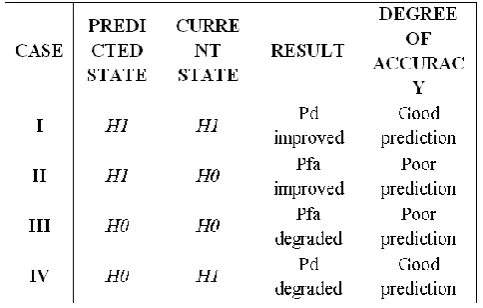
threshold levels, respectively. Viz. a simple and precise predictive logic is to be maintained based on past and current events history with in smallest possible observation times. The on status of PU using smaller threshold indicates improvement in Pd whereas off status using larger thresholds indicates degradation in Pfa. The overall activity can be explained using below tabular column1 assuming H0 as PU absent and H1as PU present. The mathematical background is discussed in [5],[7], [9].
Table 1: Case study of PU activity with different state selection and resultant probability variation
III.
RESULTS AND DISCUSSION
Numerical Simulation Results and Discussions (With AWGN)
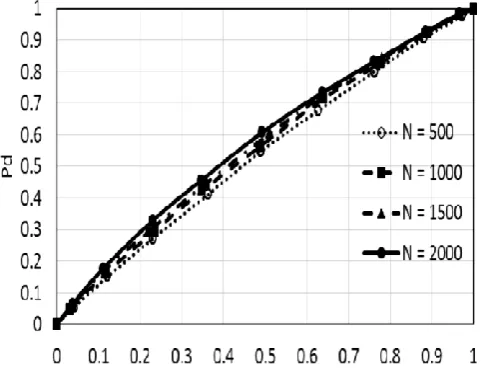
The results are simulated for the Primary User using a Digital modulation scheme O-QPSK (orthogonal phase shift keying) based real communication environment by assuming presence of additive white Gaussian noise (AWGN) channel. Mont-Carlo simulations are used to analyze via ROC curves for different L values. ROC stands for Receiver operating characteristics. This curve is the graph between Probabilities of detection versus Probability of false alarm.
Usually find Average of the received energy of the PU activity during L consecutive N periods of observations for analysis.
Monte-carlo simulations are plotted under various L values by assuming various Signals to Noise Power Ratios. Also consider N various samples for analysis. All Tests are given promising results over fixed threshold conventional energy detector. Only two sample test simulations are shown in fig 1 and fig 2.
Figure 1: Case study (testing) of ROC Curve for different N Samples
Figure 2: Performance analysis by adopting various values of L through ROC CURVE
The computational complexity of the Modified
energy detector is higher than the conventional for
same
L
as conventional detector requires N-1
additions and N multiplications whereas modified
dynamic algorithm additions and multiplications are
multiplied by a factor L. i.e. L(N-1) additions and
L.N multiplications.
IV.
CONCLUSION AND FUTURE SCOPE
The Modified algorithm is used here for CR sensing is based upon predetermining the current activity of primary user such that two dynamic thresholds are calculated to rise or fall values of the Pd/Pfa. Hence from simulation results we can conclude that it improves probability of detection and probability of false alarm. We optimized the performance of this algorithm in solving the SNR wall problem in comparison to the conventional fixed threshold energy detector. In future trying to modify this algorithm as good as blind spectrum sensing method/algorithm which does not need any information of primary users and the noise power for reliable detection. Also trying to reduce the no of sum and products required and thereby reducing complexity of implementation.
V.
REFERENCES
[1] K. Milne, “Theoretical performance of a complex
cross-correlator with gaussian signals,” IEEE Proceedings F Radar and Signal Processing, vol.140, no. 1, pp. 81–88, 1993..
[2] A. Papoulis, Probability, Random Variables and
Stochastic Processes. McGraw-Hill, 3 ed.1991.
[3] M. Naraghi-Pour and T. Ikuma,
“Autocorrelation-based spectrum sensing for cognitive radios,” IEEE Trans. Veh. Technol., vol.59, no. 2, pp. 718–733, feb. 2010. .
[4] F. F. Digham, M. S. Alouini, and M. K. Simon,”
On the energy detection of unknown Signals over fading channels,” Proceedings of IEEE, pp. 3575-3579, May 2003.
[5] 2013A. Sahai, N. Hoven, R. Tandra, “Some
fundamental limits in cognitive radio,” Allerton Conference on communication, control and computing, Oct. 2004.
[6] W. Jouini, “Energy detection limits under
Log-Normal approximated noise uncertainty,” IEEE Signal Processing Letters, vol. 18, pp. 423–426, July 2011.
[7] S. M. Kay, “Fundamentals of Statistical Signal
Processing, Volume II: Detection Theory”. Prentice Hall, 1998.
[8] A. Bagwari, and G. Singh Tomar, “Improved
Energy Detectors for Cognitive Radio Networks,” International Journal of Computer Applications (0975–8887), Vol. 62, pp. 11-21, Jan..
[9] X. Hue, X. Xie, T. Song and W. Lei, “An
Algorithm for Energy Detection Based on Noise Variance Estimation under Noise Uncertainty,” IEEE International Conference on Communication and Technology, pp. 1-5, Nov. 2012.
[10] Z. Pei, Q. Tong, L. Wang, and J. Zhang, “A
Median Filter Method for Image Noise Variance
Estimation”, International Conference on
Information Technology and Computer Science (ITCS 2010), July 2010.
[11] H. Urkowitz, “Energy detection of unknown
deterministic signals,” Proc. IEEE, vol. 55, pp. 523–531, Apr. 1967.
[12] F. Digham, M. Alouini, and M. Simon, “On the
energy detection of unknown signals over fading
channels,” IEEE Transactions on
Communications, vol. 55, pp. 21–24, Jan. 2007.
[13] G. Yu, C. and W. Xi, “A Novel Energy Detection
Scheme Based on Dynamic Threshold in
Cognitive Radio Systems,” Journal of
Computational Information Systems, Vol. 8, pp.2245- 2252, Mar. 2012.
[14] R. Tandra and A. Sahai, “SNR Walls for Signal
Detection”, IEEE Journal of Selected Topics in Signal Processing, Vol.2, pp. 4-17, Feb. 2008.
[15] T. Yücek and H. Arslan, “A survey of spectrum
sensing algorithms for cognitive radio
applications,” IEEE Communications Surveys and Tutorials, vol. 11, pp. 116–130, First Quarter 2009