Original Research Article
A study to assess feedback of patients who received benefit of Rajeev
Gandhi Jeevandayi Arogya Yojana during first year of phase I in a
private tertiary care network hospital in Maharashtra
Praveen H. Katke
1, Rishikesh A. Wadke
2*, Prasad J. Waigankar
2INTRODUCTION
World Health Assembly urges all member states to establish health care financing system for affordable universal coverage and access on basis of equity and solidarity, so that out of pocket expenditures or direct payments do not hinder the poor for accessing health services.1 With limited resources at primary care level
and focus of disease burden shifting to non communicable diseases in future, the importance of providing affordable adequate secondary and tertiary level care will be a challenge. The poorest of population has to rely on their assets or borrowings for availing health care.2 In the eleventh five year plan (2007-12), the government of India sought to prevent the indebtedness due to cost incurred on health care among poor through
ABSTRACT
Background: Rajeev Gandhi Jeevandayi Arogya Yojana (RGJAY) is a government initiated cashless Health
Insurance Scheme. The scheme’s objective is to improve health care access through an identified network of health care providers. MGM Medical College is one of the network hospitals in Raigad District of Maharashtra, India. This study is aimed at assessing feedback of patients who received benefit of this scheme.
Methods: A total of 884 pre-authorizations were approved during the study period. As a 10 percent random sample,
feedback letters received were analyzed for 91 patients. The responses obtained were in local language. Telephonic validations were done wherever needed. Response categories were standardized and coded. Analysis was done using Epi-info software.
Results: Complete improvement in ailment was felt by 76 (83.5%) respondents while 12 (13.2%) mentioned partial
improvement. Though all patients felt that scheme should continue, 37 (40.7%) said they had faced issues related to scheme. If free treatment would not have been received under the scheme, a majority of patients (56%) felt they would have succumbed to their illness while 32 (35.2%) patient had thought of selling their assets or taking loan for covering treatment expenses. Only 5 (5.5%) patients said they would have gone to Government or Charitable hospital in absence of the scheme.
Conclusions: The scheme acts as an important social security measure as many poor patients would not have sought
medical treatment in absence of this scheme. However there is a scope for improvement to reduce the hurdles for better scheme utilization.
Keywords: Health insurance, Social security, Government scheme
1
Navi Mumbai Municipal Corporation, Navi Mumbai, India
2
Department of Community Medicine, Mahatma Gandhi Medical College, Kamothe, Navi Mumbai, Maharashtra, India
Received: 25 March 2018
Revised: 03 May 2018
Accepted: 05 May 2018
*Correspondence:
Dr. Rishikesh A. Wadke, E-mail: [email protected]
Copyright: © the author(s), publisher and licensee Medip Academy. This is an open-access article distributed under
the terms of the Creative Commons Attribution Non-Commercial License, which permits unrestricted non-commercial use, distribution, and reproduction in any medium, provided the original work is properly cited.
health insurances schemes.3 The Twelfth Five Year Plan (2012–2017) mentions Government of India’s aims for increase in health care expenditure to 2.5% of GDP and Planning Commission’s High Level Expert Committee recommends for introducing national health insurance plan through general taxation along the lines of Rashtriya Swastha Bhima Yojana (RSBY).4 In India health is primarily a State responsibility rather than being a National subject. Yeshasvini Co-operative Farmers Health Care Scheme of Karnataka is one of the longest state supported health scheme. Various other state sponsored schemes have been established over past few years such as Rajiv Arogyashri Community Health Insurance Scheme in Andhra Pradesh and RSBY offered in 30 States and Union Territories of India.5 Very few studies have been conducted in the past regarding the feedback of the end-users of these health insurance schemes, hence this study is conducted with an objective of analyzing the feedback responses from the clients of the insurance health schemes sponsored by the States in order to promote their better utilization.
Rajiv Gandhi Jeevandayee Arogya Yojana (RGJAY) is one such health insurance scheme launched by Government of Maharashtra in July 2012. The scheme was implemented basically to improve medical access facility for both Below Poverty Line (BPL-Yellow ration card holders) and Above Poverty Line (APL-Orange card ration holders) families. RGJAY is now implemented throughout the state of Maharashtra in phased manner. During July 2012 – November 2013 phase 1 was implemented in eight districts: Gadchiroli, Amravati, Nanded, Solapur, Dhule, Raigad, Mumbai and its suburbs, currently scheme is extended in all districts of Maharashtra and is renamed as Mahatma Jyotiba Phule Jan Aarogya Yojana (MJPJAY) Premium of Rs 333/- per family per year is paid by government for families having earnings less than Rs 1 lakh per year. RGJAY is a cashless facility for the registered beneficiaries for hospitalization under 972 surgeries/therapies/procedures along with121 follow up packages in 30 identified specialized categories. Beneficiaries can avail the scheme in the hospitals (public and private) empanelled under the RGJAY where it covers the hospitalization cost and transport cost. There is the systematic online procedure followed under the scheme and claims are settled as soon within 7 working days on the receipt of the documents to the insurer. For smooth functioning of the RGJAY the empanelled hospital has specialized team consisting of Medical coordinator, Aarogyamitras, Data Entry Operators and Accountant. Feedback form of the responses from the beneficiaries during availing the scheme are taken and are uploaded on the webportal of RGJAY.6,7
METHODS
The study design selected for our research was a cross sectional design based on the secondary data. The study was conducted at MGM Hospital, Kamothe, Navi
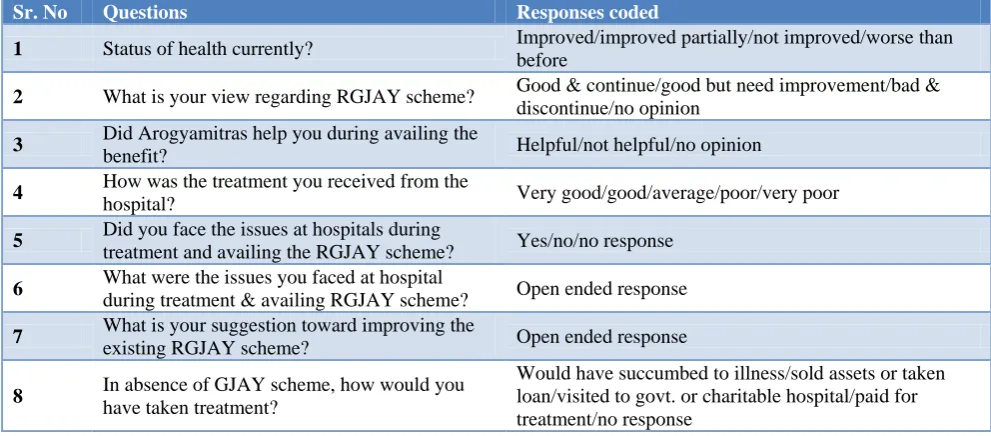
Mumbai in Maharashtra state of India, which is one of an empaneled network group of hospital under RGJAY. For the purpose of study samples 10% random sample were taken from the total of 884 pre-authorizations approved during the study period of 1 year; a total of 91 samples were included in the study for analyzing the responses (Table 1). The study period selected was from July 2012 to June 2013, similar methodology of analyzing and monitoring feedbacks was implemented in the subsequent years. Study tool used for our research was uploaded feedback letters of patients who had availed the scheme from MGM hospital during the study period. Feedback letter included open ended questions in the local language that is Marathi. The responses obtained were validated from the beneficiaries by telephonic calls. These responses were then coded and analyzed (Table 2).
Statistical analysis
Statistical analysis of data generated was done using appropriate statistical test by using Epi-info Software.
RESULTS
Figure 1: Current health status of the participants. Figure 2: Issues faced by the respondents.
Table 1: Quarter wise Sample size estimation proportionate to approved preauthorization.
Sr. No Quarter Total approved
preauthorization Sample size % of sample size
1 Quarter 1 (July–September) 147 21 14.29
2 Quarter 2 (October–November) 213 23 10.80
3 Quarter 3 (January–March) 274 28 10.22
4 Quarter 4 (April–June) 250 19 7.60
Table 2: Designed coded responses for the questions in the feedback form.
Sr. No Questions Responses coded
1 Status of health currently? Improved/improved partially/not improved/worse than
before
2 What is your view regarding RGJAY scheme? Good & continue/good but need improvement/bad & discontinue/no opinion
3 Did Arogyamitras help you during availing the
benefit? Helpful/not helpful/no opinion
4 How was the treatment you received from the
hospital? Very good/good/average/poor/very poor
5 Did you face the issues at hospitals during
treatment and availing the RGJAY scheme? Yes/no/no response
6 What were the issues you faced at hospital
during treatment & availing RGJAY scheme? Open ended response
7 What is your suggestion toward improving the
existing RGJAY scheme? Open ended response
8 In absence of GJAY scheme, how would you
have taken treatment?
Would have succumbed to illness/sold assets or taken loan/visited to govt. or charitable hospital/paid for treatment/no response
Table 3: District wise distribution of beneficiaries
Sr. No Name of district Numbers Percentage (%)
1 Mumbai & Mumbai Suburban 7 7.6
2 Nanded 20 22.3
3 Raigad 63 69
4 Solapur 1 1.1
Table 4: Feedback responses regarding RGJAY scheme.
Sr. No. Feedback response Percentage (%)
1 RGJAY scheme is good and should continue 100 (n=91)
2 Helpful behavior of Aarogyamitra 100 (n=91)
3 Treatment quality received from hospital as very good 87 (n=79)
84%
13% 3% 0%
Current Health Status
Table 5: Cross table for assessing association between hospital stay and issues faced.
Hospital stay Issues faced No issues faced Total
<2 weeks 22 33 55
>2 weeks 15 19 34
Total 37 52 89*
* 2 No Responses p>0.05, not significant.
Figure 3: Alternatives in the absence of RGJAY scheme.
DISCUSSION
Various health schemes are implemented by various state governments covering the poor population. Generally such schemes provide secondary and tertiary healthcare services through public as well as private hospitals under the group of Network Hospitals. Thus quality of treatment provided in the network group of hospitals should be maintained uniformly at the minimum certain acceptable level throughout. The latest initiative of National Accreditation Broad for Hospitals (NABH) grading of hospitals and linking the percentage of payments with hospital NABH grading is a step in the right direction. Patients undergoing treatment therapies in these network hospitals should be satisfied with the treatment they receive and can thus avail the scheme in a hassle free manner. To ensure the uniformity in the quality of treatment the monitoring mechanism and feedback from the end users is essential. This study takes into account of the feedback responses from the patients who availed the scheme who had grievances during availing scheme. The feedback responses were telephonically validated and it was found that despite of grievances, patients were of opinion that the scheme is good and should be continued. Awareness has to be increased and more hospitals have to be included so that more population can avail the scheme. Patients were satisfied with the quality of treatment in the scheme.
The scheme has increased the accessibility of the healthcare services for the poor. Such findings have been showed by the study conducted by Rao et al.8 This study also suggests that the accessibility to the health care services is improved due to the scheme and out of pocket expenditure is reduced. Such findings are similar to the study by Rao et al.5 In present study sample 44% of all
treatments administered were cardiac, cancer & neurological interventions, compared to 65% in Rajiv Aarogyasri in Andhra Pradesh, India.9,10 Expenses before registration in the network hospital for availing RGJAY benefit for OPD treatment is not covered which can cause out of pocket expenditure for the poor population. A significant proportion of population may have had to sell their assets (productive) for inpatient care in the absence of a social insurance scheme provided by state governments. In our study 51 (56%) patients said that there would have been no choice and they would have succumbed to illness while 32 (35.2%) patient have thought of selling their assets or taking loan for covering the treatment expenses. Only 5 (5.5%) patients said that they would have gone to Government or Charitable hospital in the absence of the scheme. Similar findings were noted in the PHFI report 2011.11 Thus the study finds that a significant proportion of population may have had to forgo treatment all together due to scarcity of financial resources. Poor patients are thus benefitted due to increase in affordability and accessibility to network group of hospitals covered under the health insurance scheme. The main hurdles identified include out of pocket expenditures in spite of the scheme, delays in availing of scheme due to personal lack of knowledge about the scheme and administrative procedures and some issues related to quality including comfort of stay. Thus the RGJAY Scheme acts as an important social security measure. Many poor patients would not have sought the treatment in absence of scheme. There is a however a scope for improvement to reduce the hurdles like out of pockect expenditure and quality of patient care for better scheme utilization.
CONCLUSION
To achieve universal health care, publicly financed health insurance scheme are of vital importance. The main aim of these schemes should be to reduce the out of pocket expenditure on health and thus increasing health care accessibility. Along with health insurance scheme there should be efforts made by government to strengthen the basic primary health care delivery system of India. One of the important hurdles is improving the quality of hospital services. NABH accreditation of hospitals as a pre-requisite for network hospitals to enrol in the scheme can thus be considered as a step in the right direction. All said and done, the RGJAY scheme acts as an important social security measure as many poor patients would not have sought medical treatment in absence of this scheme. However there is a scope for improvement to reduce the hurdles for better scheme utilization.
56 35.2 5.5
Succumbed to Illness Sold Assests or Taken loan Treatment from Charitable /
Government Hospital
ACKNOWLEDGEMENTS
The authors are thankful for technical staff working in the Rajiv Gandhi Jeevandayee Yojana department of Mahatma Gandhi Medical College, Kamothe Navi Mumbai.
Funding: No funding sources Conflict of interest: None declared
Ethical approval: The study was approved by the Institutional Ethics Committee
REFERENCES
1. Resolution WHA64.9. Sustainable health financing structures and universal coverage. In Sixty-fourth World Health Assembly, Geneva, 24th March 2011. Geneva: World Health Organization; 2011.
2. Report of the National Commission on Macroeconomics and Health. New Delhi: Ministry of Health & Family Welfare, Government of India; 2005: 192.
3. Eleventh Five Year Plan (2007–2012) Social Sector Volume II. New Delhi: Government of India Planning Commission; 2008.
4. Faster, Sustainable and more Inclusive Growth An approach to the Twelfth Five Year Plan. New Delhi: Government of India Planning Commission; October 2011.
5. Rao M, Katyal A, Singh PV, Samarth A, Bergkvist S, Kancharla M, et al. Changes in addressing inequalities in access to hospital care in Andhra Pradesh and Maharashtra states of India: a difference-in-differences study using repeated cross-sectional surveys. BMJ Open. 2014;4:2.
6. Rajiv Gandhi Jeevandayee Arogya Yojana (RGJAY). Operational guidelines; 2013.
7. Available at: www.mahaarogya.gov.in/projectand schemes/Jeevandaiaarogya/default.htm. Accessed on 3 March 2018.
8. Rao M, Ramachandra SS, Bandyopadhyay S, Chandran A, Shidhaye R, Tamisettynarayana S, et al. Addressing healthcare needs of people living below the poverty line: a rapid assessment of the Andhra Pradesh health insurance scheme. Natl Med J India 2011;24(6):335-41.
9. Rao M, Kadam S, Sathyanarayana TN, Shidhaye R, Shukla R, Ramachandra SS, et al. A rapid evaluation of the Rajiv Aarogyasri community health insurance scheme in Andhra Pradesh, India. BMC Proceedings. 2012;6(1):4.
10. Devadasan N1, Criel B, Van Damme W, Manoharan S, Sarma PS, Van der Stuyft P. Community health insurance in Gudalur, India, increases access to hospital care. Health Policy Plan. 2010;25:145-54. 11. Reddy KS, Selvaraj S, Rao KD, Chokshi M, Kumar
P. A critical assessment of the existing health insurance models in India. A Report Submitted to Planning Commission of India, Government of India. Public Health Foundation of India Report, 2011.
Cite this article as: Katke PH, Wadke RA,