Comparative Analysis of Face Recognition
using Extended LBP and PCA
Shashi Kant Sharma1, Maitreyee Dutaa2, Kota Solomon Raju3
1,
Assistant Professor, Department of Electronics & Communication Engineering, BKBIET, Pilani, Raj., India 1.
M.E. Scholar, Department of Electronics & Communication Engineering, NITTTR, Chandigarh, India. 2.
Professor, Department of Computer Science & Engineering, NITTTR, Chandigarh, India 3,
Principal Scientist, Digital System Group, CSIR-CEERI, Pilani, Rajasthan, India 1
Abstract: Face recognition has achieved considerable attraction due to its various applications in number of important areas such as: security, surveillance etc. For the realization of face recognition systems in the static as well as in the real time frame, numerous techniques such as principal component analysis (PCA), linear discriminate analysis (LDA), local binary pattern (LBP), independent component analysis (ICA), elastic bunch graph matching (EBGM) etc. are being used. In this paper combination of extended local binary pattern and PCA is used for feature extraction as well as dimensionality reduction. The projections of the sample and model images are calculated and compared by Euclidean distance. The combination of extended local binary pattern and Principal Component Analysis (ELBP+PCA) improves the accuracy of the recognition rate and also diminish the evaluation complexity. For comparison of proposed face recognition approach with existing methods a series of tests are performed on AT&T and Yale face databases and recognition rate is calculated for each training set. The results show that the proposed hybrid approach produce higher recognition rate as compared to conventional methods such as LBP and PCA.
Keywords— AT&T, Face Recognition, Extended LBP, LBP, LDA, ICA, PCA, Yale.
I. INTRODUCTION
In recent years, methods based on biometric have considered as the most powerful methods for the identification of individuals. These approaches evaluate an individual’s behavioural and emotional characteristics to determine the identity of person instead of recognizing the people by issuing them to access passwords, PINs, smart cards, tokens or keys. As passwords and PINs are tuff to remember and can be guessed and stolen easily; tokens, key and cards can be forgotten, replicated or stolen. But person’s biological characteristics cannot be duplicated, stolen, misplaced or faked [1]. In biometric system physiological characteristics such as fingerprint, retina, iris, palms of hand and face or behavioural characteristics such as voice, handwriting, etc. are used to authenticate a person’s identity [2]. Among all biometric identification techniques face recognition system is one of the most important methods used for the authentication and identification of the persons by their face features.
The human face conveys a lot of information about the identity and expressional state of the person. A face is the most notable and distinctive feature of the person providing an identity in the society. A person can also be identified by his voice, clothing, gait, body shape but the level of information retrieval is very high in case of the face. Face recognition is a key aspect related to image processing generally categorized as verification (or authentication) and identification (or recognition). Face recognition can be realized as identification of a person from his facial features that can be accomplished by the application of various computational algorithms. Face recognition system is one of the most cost-effective methods for the use of computing resources in comparison to the authentication and identification. Eyeglasses, hair style, aging effects, beards are some common distractions to human appearance becoming the pitfall for the face recognition system.
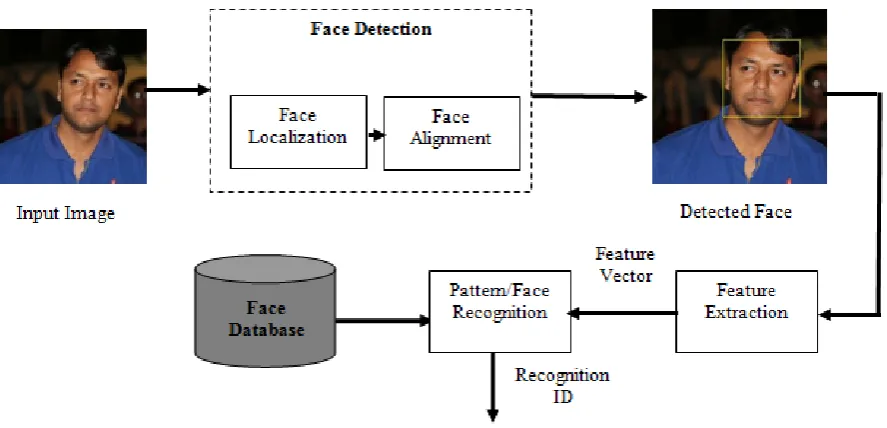
The process of matching the identity of person using face recognition can be divided into three major steps. These are face detection/ representation, feature extraction of the detected faces and classification or pattern/face recognition. A model consisting major components for face recognition is represented in Fig. 1. The first step in the process is face detection/ representation, which takes image as an input and detect the face region. The face detection is a two-step process, in which face localization is followed by face alignment. Face localization is used when there is only face in the image or frame. Alignment of faces is required only when the localization step provide the rough segmentation of faces. The purpose of face detection to locate facial features, such as eyes, nose, mouth or chin, in order to normalize the face region.
image to form feature vectors. The input face is then matched with target face using these feature vectors. To increase the recognition rate a robust feature extraction method must be employed in the process.
Based on how the features are extracted from face image, these methods are divided into three categories i.e. Global (holistic), Local (patch) and Hybrid [3]. In holistic method the features are extracted from the whole image considering each pixel from the image. On the contrary the local feature extraction methods use neighbourhood, region, facial point or patches to derive the required features from the image. The Hybrid method employs global method after extracting the features from patch method. The well-known local feature extraction methods are: Local Binary pattern (LBP) [4], Local Derivative patterns (LDP) [5], Local Derivative Ternary Patterns (LDTP) [6], Elastic Bunch Graph Method (EBGM) [7] etc. and PCA, LDA, ICA etc. are the holistic methods.
Pattern recognition is the process of matching extracted features of the face images with test image features. A test image is matched against every extracted feature vector representing the database images, which gives a distance describing the similarity between the test image and the database image. A label is assigned by the system to the image, which is most similar to the template of the trained data. Using these features, image is compared with the database images, which is done in classification step. The classification unit provides the best match of image with database images.
Fig. 1: Stages of Face Recognition System
II. PREVIOUS WORK
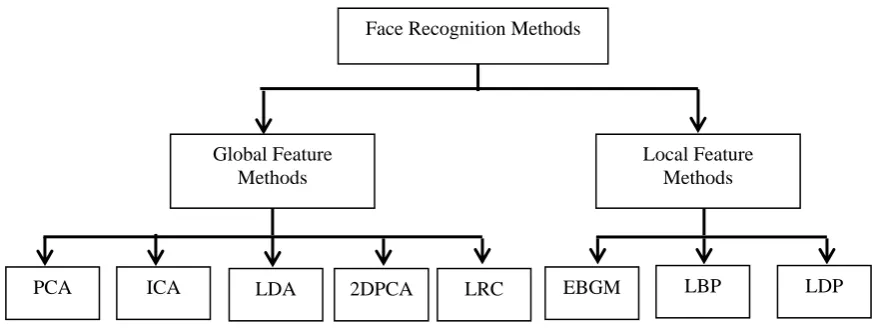
Face recognition has always been a very difficult and challenging task. Designing a system which automatically recognizes the faces from stored images with the efficiency closer to a human is true challenge. When dealing with large amount of unknown faces human recognition ability is limited. Hence, an automatic face recognition system with almost limitless memory and high speed is required. Most of the research work has been done to develop and implement efficient and reliable face recognition methods. These methods are divide into two categories i.e. global feature and local feature approaches as shown in Fig.2. First category includes principal component analysis (PCA) [8], linear discriminate analysis (LDA) [9], independent component analysis (ICA)
Fig. 2: Classification of Face Recognition Technique
Fig. 2: Classification of Face Recognition TechniquePrincipal component analysis (PCA) one of the most popular methods used for image recognition with dimensionality reduction, which is known as Karhunen-Loeve Transform or Hotelling Transform [12]. The objective of PCA is to lower down the dimensionality of data into reduced dimensional feature space that describe the data efficiently. In face recognition with PCA, all the training database images are projected on to eigenspace. Likewise each test image is also projected on to eigenspace. Then test image is compared by the training images using either similarity metric or distance metric. The training image which is most similar to the test image is considered to match the testing image.
LDA is also one of the global feature based face recognition techniques, which is known as fisherfaces method. The purpose of this method to overcome the limitations of PCA, which attempts to optimize the ratio of determinant of between class to the determinant of with-in class scatter matrix of projection. In this technique the images of same class are grouped while images of different class are separated. Hence the projection on fisherspace is of C-dimensional (C: number of classes of images) rather than N2-dimensional space. The LDA approach is similar to the PCA as it also uses the projection of training images onto subspace. The LDA method discriminates the different face classes to obtain the subspace while PCA extract the facial features [13]. PCA is computationally efficient as compared to LDA but less sensitive to different class of training set. Hence combination of PCA and LDA is used to exploit the advantages of both methods.
In case of PCA images are considered as random variables with Gaussian distribution and minimized second-order statistics. For non-Gaussian distribution, the variances with higher values would not correspond to PCA basis vectors. Moreover, Independent Component Analysis method lower down both second-order and higher order dependencies in the input data and try to evaluate the basis along which the data are statistically independent. Hence, higher order statistics are taken into account in independent component analysis. ICA provides better reconstruction result than PCA in case of noisy environment. Although, PCA, LDA and LRC project face onto a linear subspace and are of same category but LRC is slightly different from PCA and LDA. The main difference between them is LRC focuses in the local structure of the manifold while other focus on the global structure of the Euclidean space.
Above discuss global feature methods have several limitations in case of variations in illumination, expression and occlusion. The local feature methods produces better results as compared to holistic methods against the local changes such as occlusion, illumination and expression. Elastic Bunch Graph Matching (EBGM) is one of local feature methods in which a face is represented by topological graph. Every node of the graph contains a group of Gabor coefficients which is known as jet. Later on Local binary pattern (LBP) method was proposed to enhance the recognition rate. Local binary patterns (LBP) method is majorly designed for texture analysis and texture description. It demonstrate the neighboring changes around the centre pixel in effective and simple way. It is mainly used because of its excellent light invariance property and low computational complexity. The neighboring relationship is established by LBP in spatial, frequency and orientation domain. This method achieves a better performance in face recognition as compared eigenfaces, EBGM and so on. To improve the performance of original LBP Number of LBP variants such as uniform LBP, multi block-LBP, histogram of Gabor phase patterns etc.
Researchers have also proposed the higher order local features methods such as: local derivative pattern (LDP), local ternary pattern (LTP) and local derivative ternary patterns (LDTP). Zhang et al. has implemented LDP as robust face recognition technique which encodes distinct spatial relationship. Since LDP is a higher order operator as compared to LBP thus it can provide more detailed description for faces. Likewise local ternary
Face Recognition Methods
Global Feature Methods
Local Feature Methods
pattern (LTP) which was proposed by Suruliandi and Ramar [16] also extract the local information in more details than LBP.
III. PROPOSED WORK
Literature review states that human face recognition attain great interest in many research areas and various different approaches have been investigated and implemented on several standard databases to achieve higher recognition rate and it has been found that the texture based feature extraction methods are robust and provides high recognition rate with the variations in lighting, illumination and facial pose. But still lot of enhancement is to be made in order to increase the accuracy of recognition in face recognition systems. Combination of local feature extraction method and global feature extraction method may improve the accuracy of results.
In this paper, we explain and compare the hybrid face recognition approach which uses Extended LBP for local feature extraction and PCA for dimension reduction of feature vector. The test results are obtained for two standard face databases i.e.: AT&T and Yale Finally, the recognition rate of proposed method is compared with existing method such as LBP and PCA. The block diagram of proposed work has been shown in fig.3.
Fig.3: Flow Diagram for Proposed Face Recognition Approach
The prime objectives of this proposed work are:
• To explore the various face recognition approaches and identify the suitable algorithm for efficient face recognition.
• To improve the recognition rate of face recognition approach by combining local feature extraction with global feature extraction.
• To analyze the performance of the proposed technique with existing techniques for AT&T and Yale database.
existing techniques. The face recognition is performed on AT&T and Yale database by ELBP and PCA separately for training database. Recognition rate is improved by performing PCA after extraction of ELBP features. Finally, the comparison is made in terms of the accuracy/ recognition rate.
IV. RESULTS AND DISCUSSION
We have conducted a comprehensive experimental analysis on various training sets. In this paper we considered hybrid feature extraction method which includes Extended LBP followed by PCA for face recognition. The implemented approaches were tested on different training sets of AT &T, YALE databases containing the variety of face images relevant for face recognition. For experimentation purpose, we prepared three datasets for training and testing considering 25%, 50% and 75% of total images in training and remaining images in test dataset. The recognition rate (RR) is evaluated by:
RR (%) = ∗ 100 (1)
As far as testing of the face recognition method is concerned, selection of the appropriate standard database becomes very vital. In this paper two standard face database i.e.: AT&T and Yale image databases are chosen to validate the implemented techniques. Description of both databases is presented in brief.
The AT&T Face Database
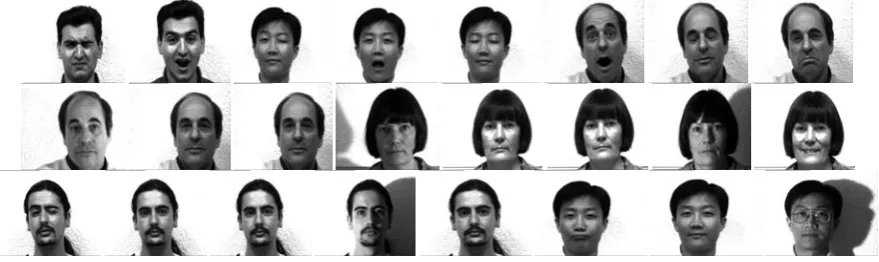
AT&T face database [20] which was formerly known as the ORL face database includes a set of face images acquired during April 1992 and April 1994 at the lab. It comprises of total 400 images with ten different images of each of 40 distinct persons. The size of each image is 92x112 pixels, with 256 grey levels per pixel stored in PGM format. The preview of images is displayed in Fig. 4.
Fig.4: Sample Images from AT&T Face Database
The Yale Face Database
The Yale face database [21] comprises of 165 images of 15 different individuals with 11 images per subject. The size of each image is 320x243 pixels, with 256 grey levels per pixel stored in GIF format. The sample images are shown in Fig.5.
Fig. 5: Sample Images from Yale Face Database
Comparative Analysis
TABLE I. COMPARATIVE ANALYSIS OF PRESENT STATE-OF-ART Face Recognition Method ORL YALE 25% Training Samples 50% Training Samples
25 % Training Samples
50 % Training Samples
PCA [17][18] 85.42% 90.5% 78% 87.8%
LBP [19] 87% 92% 95% 96%
Proposed (ELBP+PCA) 91.42% 97% 88.75% 97.33%
The proposed approach for face recognition produces better results as compared to PCA and LBP in terms of recognition rate. It shows 7% improvement in results of PCA when face recognition method is applied on AT&T database and 11% improvement in case of Yale database. Comparing the efficiency with LBP methods, our proposed approach shows 5% and 2% enhancement in recognition rate for AT& T and Yale database respectively.
Fig.6. Comparision of present state-of-art
Fig. 6 illustrates the comparison of proposed approach with PCA and LBP for 25 % and 50% training samples of both standard databases.
V. CONCLUSIONS &FUTURE SCOPE
There were four main objectives of this work: To discuss and summarize the face detection and recognition process, review at currently available face recognition approaches, to design and develop an improved approach for efficient face recognition and finally an implementation of the proposed combination of ELBP and PCA. For efficient and accurate face recognition, our results show that the proposed ELBP followed by PCA delivers improved recognition rate of 97% and 97.33% respectively for AT &T and Yale face databases as compared to conventional approaches such as PCA and LBP. Similarly, the performance of the approach is further boosted while increasing the training sample size.
The results describe that the achieved face recognition rate (FRR) is better compared to some other traditional methods but still there is scope for improvement for faces with different posture, illumination, occlusion and expression. Further improvements can be executed in future like: The neural networks concept can be combined with the proposed method and can be applied on robots for better communication between them. The proposed method can also be examined and implemented for video files to get an efficient FRR system which vanquish the constraints of a complete face classification/recognition. Various other pre-processing or other feature extraction techniques can be embedded with the proposed method to get improved results on real and standard databases. Proposed approach can be extended to be used in high speed vision environment, where image/video is captured at higher frame rates.
ACKNOWLEDGEMENT
Author would like to thank Dr. P.S. Bhatnagar, Director B.K.B.I.E.T, Dr. Shyam Sunder Pattnaik, Director NITTTR, Dr. L. Solanki, Principal B.K.B.I.E.T without their support & valuable guidance things would not
0 20 40 60 80 100 120 25% Training Sample 50% Training Sample 25% Training Sample 50% Training Sample ORL Yale Recognition Rate --->
Comparison of Present State-of-Art
PCA
LBP
have been practically implemented. Last we would thank our colleagues Mr. Buddhi Prakash Sharma, Mr. Gauttam Jangid & Mr. Gopal Krishan Prajapat for giving their endless support.
REFERENCES
[1] M. Hassaballah and Saleh Aly, “Face Recognition: Challenges, Achievements and Future Directions”, IET Journals of Computer Vision, Vol. 9, No. 4, pp. 614-626, 2015.
[2] A. Tofighi, N. Khairdoost, S. A. Monadjemi and K. Jamshidi, “A Robust Face Recognition System in Image and Video”, I. J. Image, Graphics and Signal Processing, Vol. 8, pp. 1-11, 2014.
[3] A. S. Tolba, A. H. El-Baz, and A. A. El-Harby, “ Face Recognition: A Literature Review”, International Journal of Computer , Electrical, Automation, Control and Information Engineering, Vol. 2, No. 7, pp. 2556-2571, 2008.
[4] Md. A. Rahim, Md. N. Hossain, T. Wahid, and Md. S. Azam, “ Face Recognition using Local Binary Patterns (LBP)”, Global Journal of Computer Science and Technology, Vol. 13, Issue 4, pp.1-7, 2013.
[5] B. Zhang, Y. Gao, S. Zhao, and J. Liu, “Local Derivative Pattern Versus Local Binary Pattern: Face Recognition with High-Order Local Pattern Descriptor”, IEEE Transaction On Image Processing, Vol. 19, No. 2, pp. 533-544, Feb. 2010.
[6] K. Meena , A. Suruliandi, and R. Reena Rose ,“ Face Recognition Based on Local Derivative Ternary Pattern”, IETE Journal of Research, Vol. 60, No. 1, pp. 20-32, Feb. 2014.
[7] Wiskott, L., Fellous, J. M., Kuiger, N. and Von Der Malsburg, C., “Face recognition by Elastic Bunch Graph Matching,” Pattern Analysis and Machine Intelligence, IEEE Transaction on, 19(7), pp. 775-779, 1997.
[8] M. Turk and A. Pentland, “Face Recognition using Eigenfaces”, Proceedings of the IEEE Computer Society Conference on Computer Vision and Pattern Recognition, Maui, Hawaii, pp. 586-591, 1991b.
[9] A. M. Martinez and A. C. Kak, “ PCA versus LDA”, IEEE Transaction on Pattern Analysis and Machine Intelligence, Vol. 23, No. 2, pp. 228-233, Feb. 2001.
[10] M. S. Bartlett, H. M. Lades, and T. J. Sejnowski, “Independent Component Representations for Face Recognition,” Proceedings of the SPIE Symposium on Electronic Imaging: Science and Technology Conference on Human Vision and Electronic Imaging III, San Jose California, pp. 528-539, Jan. 1998.
[11] M. S. Bartlett, J. R. Movellanand T. J. Sejnowski, “Face Recognition by Independent Component Analysis”, IEEE Transactions on Neural Networks, Vol. 13, No. 6, pp. 1450-1464, Nov. 2002.
[12] Kirby, M. and Sirovich, L. “Application of the Karhunen-LoeveProcedure for the Characterization of Human Faces,” Pattern Anaysis and Machine Intelligence, IEEE Transaction on, 12(1), pp. 103-108, 1990.
[13] P. N. Belhumeur, J. P. Hespanha, and D. J. Kriegman, “Eigenfaces vs. Fisherfaces: Recognition Using Class Specific Linear Projection,” IEEE Transaction on Pattern Analysis and Machine Intelligence, Vol. 19, No. 7, pp. 711-720, July 1997.
[14] G. N. Girish, C.L.N. Shrivivasa and P.K. Das, “Face Recognition using MB-LBP and PCA: A Comparative Study”, International Conference on Computer Communication and Informatics (ICCCI) © IEEE, Jan. 2014.
[15] U S N Raju, A. S. Kumar, B. Mahesh and B. E. Reddy, “Texture Classification with High Order Local Pattern Descriptor: Local Derivative Pattern”, Global Journal of Computer Science and Technology, Vol. 10, No. 8, pp. 72-76, Sept. 2010.
[16] A. Suruliandi and K. Ramar, “Local Texture Patterns- A Univariate Model for Classification of Images”, International Conference on ADCOM2008, Chennai, pp. 32-39, Dec. 2008.
[17] M. Abuzneid and A. Mahmood, "Performance improvement for 2-D face recognition using multi-classifier and BPN," 2016 IEEE Long Island Systems, Applications and Technology Conference (LISAT), Farmingdale, NY, pp. 1-7, 2016.
[18] A.Timo, H.Abdenour and P.Matti, “Face Recognition with Local Binary Patterns”, European Conference on Computer Vision, pp. 469-481, 2004.
[19] J. Zhang, and X. Xiao,“ Face Recognition Algorithm Based On Multi-layer Weighted LBP”, 8th IEEE International Symposium on
Computational Intelligence and Design, pp. 196-199, 2015. [20] AT&T database: http://www.camorl.co.uk.
[21] Yale Face Database: http://vision.ucsd.edu/datasets/yale_face_dataset_original/yalefaces.zip.
BIOGRAPHY
Shashi Kant Sharma has been working as an Assistant Professor in Electronics & Communication department at B. K. Birla Institute of Engineering & Technology, Pilani. He received the Bachelor of Technology degree in Electronics and Communication Engineering from ICFAI UNIVERSITY, Dehradun, India in 2009. He is pursuing M. E. in Electronics & Communication at National Institute of Technical Teachers Training & Research (NITTTR), Chandigarh, India. His current research interests focus on Signal Processing, Image Processing, and Reconfigurable System Designing. He is author and co-author of around 8 scientific papers, published in international journals and conferences. He is an associate member of IEI.