Research Article
Application and effect of plant growth
promoting bacteria isolated from
medicinal plants on root development in
maize
Syed Sikandar Habib
1*, Saira Naz
1, Asad Mehmood
2, Riaz Khan
2and
Imran Badshah
21. Department of Biological Sciences, University of Sargodha Sub Campus Mianwali Punjab-Pakistan 2. Department of Botany, Pir Mehr Ali Shah, Arid Agriculture University Rawalpindi Punjab-Pakistan
*Corresponding author’s email: [email protected]
Citation
Syed Sikandar Habib, Saira Naz, Asad Mehmood, Riaz Khan and Imran Badshah. Application and effect of plant growth promoting bacteria isolated from medicinal plants on root development in maize. Pure and Applied Biology.
Vol. 8, Issue 4, pp2277-2285. http://dx.doi.org/10.19045/bspab.2019.80174
Received: 27/05/2019 Revised: 15/07/2019 Accepted: 22/07/2019 Online First: 03/08/2019
Abstract
Agriculture sectors are facing various threats that hinder plant growth globally. In order to improve plant growth the use of beneficial microbes play very important role. The purpose of the current study was to analyze the root development by the application of Plant growth promoting bacteria (PGPB). The importance of this study was to enhance the root development of maize plant which in turn increases its overall growth and production by using PGPB. The experiment was conducted under complete randomized design (CRD). Two varieties of Cereal crop maize were selected to check the effects of PGPB on development of roots. Initially seeds were inoculated with eight different bacterial strains that were isolated previously in Plant microbe interaction lab. Out of which two bacterial strains R7 and R8 found to be more efficient in promoting different activities of plants which affect the root development. Plants were grown in pots after inoculation. Five different treatments were applied and the six one was control and after harvesting parameters of roots to be analyzed were taken. Five different parameters of roots were observed after harvesting. These parameters include Average root width, Network depth, maximum number of roots, specific root length and network area. Estimation of root parameters was done with the help of GiA root software. GiA software is a new technique to analyze Root System Architecture (RSA) traits. Results were variable after the inoculation of bacterial strains which prove that the PGPB have positive effects on root development and hence all over the plant growth.
Keywords: Bacterial strains; GiA software; Maize; PGPB
Introduction
Crop production had been improved by using soil microbes from many years. In recent times, mineralization of organic pollutants
that is called as bioremediation of polluted soil [1].
order to increase plant growth and yield of crops in an incorporated plant nutrient system. In this contest PGPB (Plant growth promoting bacteria) has gain a vital part in building maintainable systems for crop production [2]. A wide range of non-symbiotic bacteria that include Azospirillum, Azotobacter, Klebsiellasp and Bacillus etc. Also the symbiotic bacteria including species of Rhizobium are applied all over the world in order to achieve increased plant growth and production rate [3].
Plant growth promoting bacteria are the type of bacteria which can increase growth of plants by a range of procedures e.g. phosphatesolubilization, biological nitrogen fixation, siderophore production, rhizosphere etc. Studies prove that there are some bacteria that remain attached to plants have the capability to boost plant growth [4]. These microorganisms have got attention for the reason that now a day most remarkable need is to decrease the practice of chemicals especially when seeing the condition of maintainable cultivation and environmental protection [5]. Plant growth promoting bacteria have the capability to help in the development and growth of maintainable agricultural systems [6].
Main objectives of the current study was the application of already isolated PGP (Plant growth promoting bacteria) strains to check their root growth promotion activities and understand effects of PGP bacteria on root architecture of maize plants.
Materials and methods
The current experiment was performed in the laboratory of Plant Sciences, University of Sargodha Sub Campus Mianwali. Previously isolated strains from the medicinal plants in the Plant Microbe Interaction were used in the study. Bacterial strains were used to evaluate their influence on plant root development.
Preparation of Inoculum and soil sterilization
Two previously isolated bacterial strains (R7 and R8) were used for inoculum preparation. Luria Bertani (LB) was used in quantity of 100ml to inoculate both strains separately at 120 rpm for time of 48 hours and temperature given was 30 for the purpose of incubation. After incubation, centrifugation of broth culture was performed at 3000 rpm for 10 minutes. After this, pallets were collected and distilled water was used to re-suspend these pallets in order to obtain optical density equal to 1 at 600 nm. This suspension was then used to soak seeds before their sowing [7].
Ethanol (95%) was used for the purpose of surface sterilization by dipping them in it for few seconds after that seeds were dipped in 0.2% solution of HgCl2 for three minutes and
then carefully rinsed off with distilled water
[8]. After surface sterilization of seeds, they were soaked in already prepared bacterial inoculum for time period of 3 - 4 hours prior to sowing whereas seeds for application of control treatment were soaked only in distilled water. Autoclaved soil was filled in pots with the capacity of 5 kg for sowing two varieties of two maize seeds whereas ratio of autoclaved soil, sand, vermin compost was kept (1:1:1) in pots.
Pot experiment
Design used for pot experiment was complete
randomized design (CRD) and the
arrangement was kept factorial and number of replicates was three. Two varieties of maize seeds that were used during this experiment named as TP-1217 (Variety 1) and TP-1221 (Variety 2) were gained from NARC, Crop Research Institute as this experiment was carried out National Agriculture Research Centre (NARC)
Treatments application
The schedule of treatments for both varieties (TP-1217=V 1) and (TP-1221=V 2) was kept
same and the conditions applied were also same in below (Table 1).
After the time period of 60 days of germination and 15 days of disease
application plant were harvested.
Immediately after harvesting different physiological parameters was taken. These physiological parameters include average root width (diameter), network depth, maximum number of roots, specific root length and network area.
Table 1. Experimental treatments
Abbreviations Treatments
C Control
T1 Bacteria R7 (B1) was applied
T2 Bacteria R8 (B2) was applied
T3 Bacteria R7+disease was applied (B1D)
T4 Bacteria R8+disease was applied (B2D)
T5 Only disease was applied (D)
Estimated parameters of roots
Different parameters can be estimated by using GiA software. But here in this study five parameters were observed that are Average root width also called as diameter was taken of freshly harvested plants. The scale used was in cm and measuring tape was used to take diameter [9]. Second parameter taken was network depth. It was also taken of freshly harvested plants in centimeter. Number of roots was noted immediately after harvesting of plants. Maximum number of roots was taken in (n).The 4th parameter was
specific length of roots. Length of roots was measured by using measuring tape and the scale used to take specific root length was centimeters [10]. Network area is the last parameter which was measured by using freshly harvested plants and the scales used were square of cm (cm2).
Statistical analysis
All the data obtained from experiments was
ANOVA was used for this purpose. Least significance difference test (LSD) was used to test significance of treatments mean which was p≤0.05.
Results
Estimation of roots using GiA roots software
discovered many prime phenotypic
Average root width (Diameter)
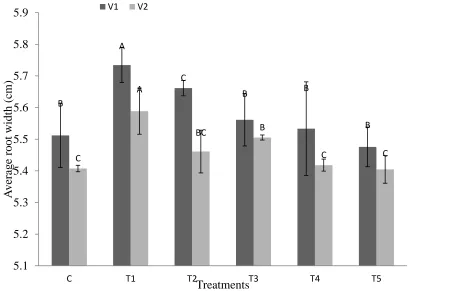
Results show that there is an increase in root width of both maize varieties V1 (TP-1217) and V2 (TP-1221) in below (Figure 1). When treatment was given with bacterial strains R7 and R8. On the other hand, when the plants
were inoculated with bacterial strains along with disease application, the rate of increase in average root width of both analysis of traits of roots leads to the formation of new paths for the development.
Figure 1. Average increase in root width a width after treatment with bacteria
Network depth
Results for network depth are different. Treatment with bacterial strain R7 (B1) cause a slight decrease in network depth in roots of both varieties of maize but when treated with bacterial strain R8 there was an increase in
network depth of both varieties. Afterward in treatments T3, T4 and T5 in plants of maize network depth of roots continuously increase as a result increasing the growth rate of these plants in (Figure 2).
B
A
C
B B
B
C
A
BC B
C C
5.1 5.2 5.3 5.4 5.5 5.6 5.7 5.8 5.9
C T1 T2 T3 T4 T5
A
ve
ra
g
e
root w
idt
h (c
m)
Treatments
Figure 2. Network depth of roots by treatments with different bacterial strain
Maximum number of roots
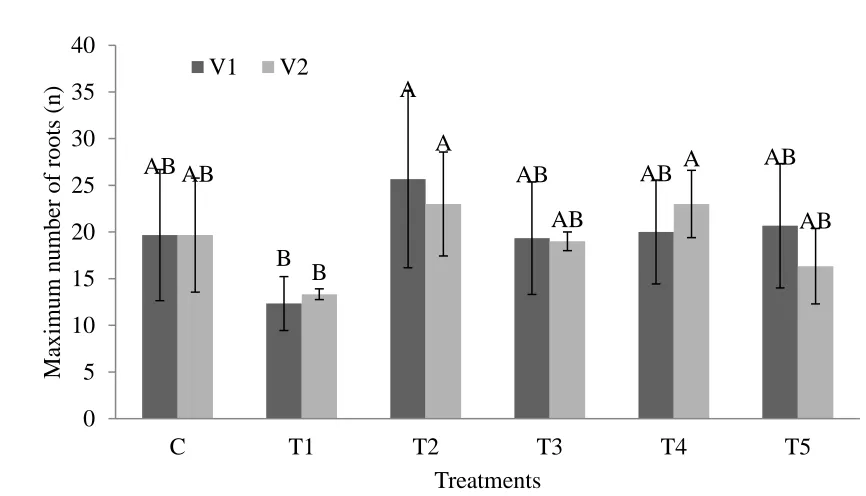
Numbers of roots were only increased in treatment named as T2 in both varieties (TP-1217) and (TP-1221) so in this case the growth of plants was better than the other plants. Control, T3, T4and T5 have almost
same development of roots but plants treated with T4 and T5 have almost same development of roots but plants treated with bacterial isolate R7 have shown decrease in number of roots in (Figure 3).
AB
AB
A AB
B AB
AB B AB AB A
AB
0 1000 2000 3000 4000 5000 6000 7000 8000
C T1 T2 T3 T4 T5
Ne
twork
de
pth (c
m)
Treatments
V1 V2
AB
B
A
AB
AB
AB
AB B A AB A B
0 0.005 0.01 0.015 0.02 0.025 0.03 0.035 0.04
C T1 T2 T3 T4 T5
S
pe
cific
root leng
th
(
cm/
cm
3 )
Treatments
Specific root length
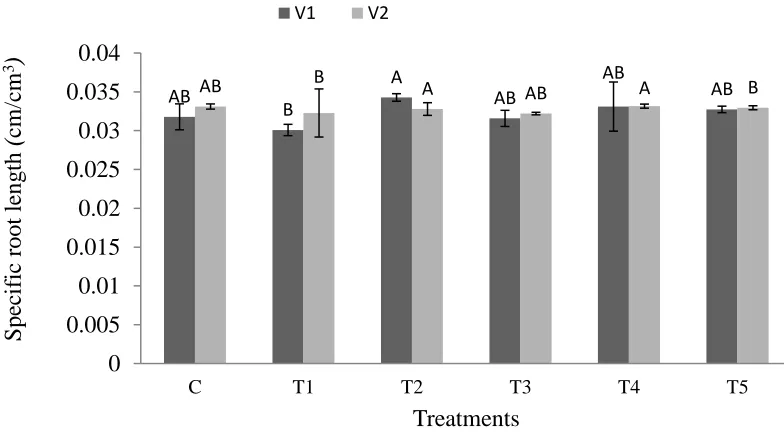
A massive increase in root length was observed in all plants of variety V1 (TP-1217) and variety V2 (TP-1221). Graph shows that change in length of roots of all plants was almost same. In all cases of bacterial strain application, the length of
roots almost remains consistent. This is proved that both bacterial strains R7 and R8 help the maize plants to increase their length of roots in treatment T1, T2, T3, T4 and T5 as well as to maintain their root length that helps the plants to increase their mineral uptake in below (Figure 4).
Figure 4. Specific root length of plants by treatment with bacteria
Network Area
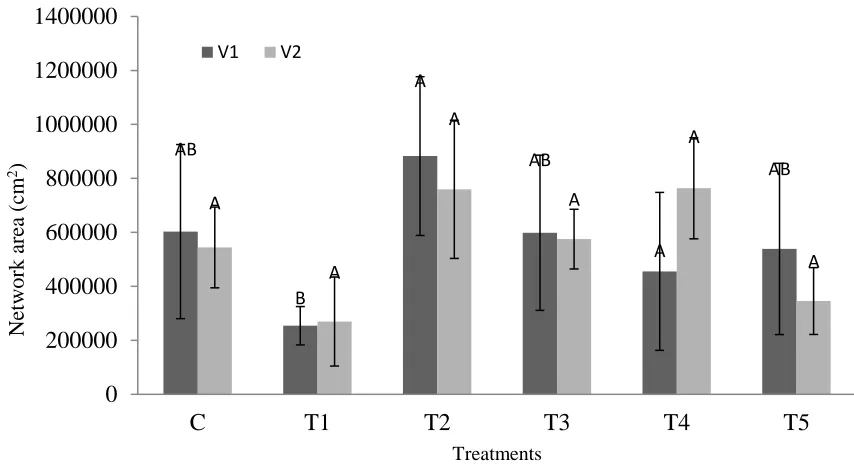
Bacterial strain R8 (B2) only cause positive effects in network area. But R7 that is bacteria strain named as B1 showed negative effects in development of network area of roots as network area of plants of T1 was greatly decreased when treated with bacterial
strain B1 in both varieties. After that in case of bacterial strain R8 network area of roots of maize increased greatly in two varieties (TP-1217) titled as V1 and (TP-1221) named as V2. But network area decreased after the application of bacterial strains along with disease in (Figure 5).
AB
B
A
AB AB AB
AB
B
A
AB
A
AB
0 5 10 15 20 25 30 35 40
C T1 T2 T3 T4 T5
Ma
x
im
um
number
of r
oots (n)
Treatments
Figure 5. Network area of plant root by treatment with different bacterial strains
Trait description
All the traits used for estimation were described in their measurement scale. Their estimation was described with the help of graphical explanations. In graphs the growth rate of roots of maize were described in the form of bars. These bars clearly show the
developmental changes of all the parameters of roots of maize in both varieties V1 (TP-1217) and V2 (TP-1221). As the roots showed developmental changes that’s why with the help of two colored bars these changes were explained in below (Table 2).
Table 2. Description of traits
Traits Description Units
Average root width
This trait is parallel to the diameter of roots. In whole root system, the
mean value of root width for all the pixels of medial axis is estimated. Cm
Maximum number of roots
The maximum number is measured as 1 standard deviation (84th -percentile value), after concluding the number of roots intersecting a
horizontal line from smallest to largest. It is denoted by (MaxR).
N
Discussion
Result analysis of the present study showed that R7 and R8 have the ability to produce siderophore, as well as R3, R7 and R8 are capable of produce ammonia. Bacterial strains R1, R2, R4, R7 and R8 are found to be involved in Phosphate solubilization whereas R2, R4, R5, R7 and R8 have IAA production ability. Among all bacterial strains only R7 and R8
along with R7, R8, R3 is also involved in amylase production. Zinc solubilization ability is shown by R1, R2, R3, R4, R5, R6 and R7. Bacterial strains R4, R7 and R8 played their role in pectinase production and R1, R4, R5, R6, R7 and R8 in protease production. All the bacterial strains represented bubble formation illustrating that they are also capable of catalase production. Cellulose production is performed AB
B
A
AB
A
AB
A
A
A
A
A
A
0 200000 400000 600000 800000 1000000 1200000 1400000
C T1 T2 T3 T4 T5
N
et
w
or
k
ar
ea
(
cm
2)
Treatments
Many previous studies showed that PGPB strains have the ability to produce plant hormones and are capable to stimulate cell division as well as elongation of plant cells and
also alters activity of bacterial
1-aminocyclopropane-1-carboxylate (ACC)
deaminase, that stop the ethylene, a plant growth inhibiting hormone to be produced [11, 12]. As bacteria are present in rhizosphere of plant in high number are of great importance in reference to change inorganic and organic substances into accessible plant nutrients that were previously unavailable and can influence the vegetative growth of different trees e.g. apple that’s why one of the mechanisms used by PGPB to increase the growth of plants could be to increase the amount of available nutrients to plant and to increase the production of plant growth regulators [13]. Many previous studies acknowledged different bacterial strains with the ability to produce different plant growth regulators in rhizosphere of plant and these regulators include IAA, cytokinin and others and these regulators have positive effects in promoting plant growth and increase in yield [14-16]. On the other hand, oxogenous IAA has played its part in making survival of PGPB on host plant possible, increase efficiency and growth as well as proved its contribution in colonization [17].
Previous studies on PGPBs have proved the practical application of inoculation of these bacteria on commercial basis for improving production rate of vegetables that are having peat substrates with the aim to enhance vigor of plants and increased yield rate as well as helpful in controlling several diseases of roots [18, 19]. Many previous researches have reported that PGPB can also be a reason of causing the change in metabolism of plants as a result of their inoculation in plants, hence it was proved by interpreting the metabolic rate of these plant roots and different parts of roots like tissues and exudates of roots, it was also observed that not only roots but also metabolism of shoots both in control and normal conditions get effected by the inoculation of plant growth promoting bacteria.
Conclusion
It was concluded that the members of many PGPB functional groups can perform all together in the form of consortia or with their positive and contrary effects on plant growth and development. These positive effects can be achieved by application of different inoculation methods comprising of several kinds of microorganisms proved to be beneficial for plants in form of combination. On the other hand, the interactions between different bacterial strains being inoculated and the microorganisms that are present already in the rhizosphere or other parts of the plants also have great importance in this matter. Among eight strains two were used in this study that was inoculated in two varieties of maize to check their effect on roots of maize. These two bacterial strains R7 and R8 showed remarkable effects on different physiological parameters of maize plant roots. Five parameters of roots were estimated in this study. Bacterial strain
showed noticeable effects on the
developmental rate of roots like plants treated with R7 and R8 had an increase in their average root width and length was also increased after inoculation of bacteria.
Authors’ contributions
Conceived and designed the experiments: SS Habib, Performed the experiments: S Naz & A Mehmood, Analyzed the data: R Khan, Contributed materials/ analysis/ tools: I Badshah, Wrote the paper: SS Habib & S Naz.
References
1. Middledrop PJM, Briglia M & Salkinoja-Salonen M (1990). Biodegradation of pentachlorophenol in natural polluted soil
by inoculated Rhodococcus
chlorophenolicus. Microb Ecol 20: 123– 139.
2. Sturz AV, Christie BR & Novak J (2000). Bacterial endophytes: potential role in developing sustainable system of crop production. Crit Rev Plant Sci 19: 1–30. 3. Burd G, Dixon DG & Glick BR (2000).
Plant growth promoting bacteria that decrease heavy metal toxicity in plants.
4. Compant S, Clement C & Sessitch A (2010). Plant growth promoting bacteria in the rhizobacteria and endosphere of plants: their role, colonization, mechanisms involved and prospects for utilization. Soil Biol Biochem 42: 669-678.
5. Vale M, Seldin L, Araujo FF & Lima R
(2010). Plant growth promoting
rhizobacteria: fundamentals and
applications. In: Maheshwari DK Ed. Plant growth and health promoting bacteria. Springer Berlin, pp 21-43. 6. Schippers B, Scheffer RJ, Lugtenberg JJ &
Weisbek PJ (1995). Biocoating of seed with plant growth promoting rhizobacteria to improve plant establishment. Outlook Agric 24: 179–18.
7. Naseem H & Bano A (2014). Role of plant-growth promoting rhizobacteria and
their exopolysaccharide in drought
tolerance of maize. J Plant Interactions 9: 689-701.
8. Ahmad MZ, Zahir A, Asghar HN &
Asghar M (2011). Inducing salt tolerance in mung bean through coinoculation with rhizobia and plant growth-promoting
rhizobacteria containing
1-aminocyclopropane-1-carboxylate
deaminase. Can J Microbiol 57: 578-589. 9. Bano A & Muqarab R (2017). Plant
defense induced by PGPR against Spodoptera litura in tomato (Solanum lycopersicum L.) Plant Biol 19(3): 406– 412.
10. Singh P, Mohanta Tk & Sinha AK (2015).
Unraveling the intricate nexus of
molecular mechanisms governing rice root development. OsMPK3/6 and auxin cytokinin interplay. Plos One 10: Steel RG and Torrie J (1960). Principles and procedures of statistics. Megraw-Hill Book Company, Inc New York Toronto London.
11. Patten CL & Glick BR (2002). Role of Pseudomonas putida indoleacetic acid in development of the host plant root system.
Appl Environ Microbiol 68: 3795-3801.
12. Penrose DM, Moffatt BA & Glick BR
(2001). Determination of
1-aminocycopropane-1-carboxylic acid
(ACC) to assess the effects of ACC deaminase-containing bacteria on roots of canola seedlings. Can J Microbiol 47: 77– 80.
13. Watanabe M, SuzukiA, Komori S &
Bessho H (2004). Comparison of
endogenous IAA and cytokinins in shoots of columnar and normal type apple trees.
JJPn Soc Hort Sci 73: 19-24.
14. Bent E, Tuzun S, Chanway CP & Enebak S (2001). Alterations in plant growth and in hormone levels of lodgepole pines inoculated with rhizobacteria. Can J Microbiol 47: 793-800.
15. Cook NC, Bellstedt DU & Jacob G (2001).
Endogenous cytokinin distribution
patterns at budburst in Granny Smith and Braeburn apple shoots in relation to bud growth. Sci Hort 87: 53-63.
16. Gadagi RS, Krishnaraj PU, Kulkarni JH & Sa T (2004). The effect of combined
azospirillum inoculation and nitrogen fertilizer on plant growth promotion and yield response of the blanket flower Gaillardia pulchella. Sci. Hort 100: 573-581.
17. Vandeputte O, Oden S, Mol A, Vereecke
D, Goethals K, El Jaziri M & Prinsen E (2005). Biosynthesis of auxin by the gram
positive phytopathogen Rhodococcus
fascians is controlled by compounds specific to infected plant tissues. Appl Environ Microb 71: 1169-1177.
18. Kokalis-Burelle N, Kloepper JW & Reddy MS (2006). Plant growth promoting rhizobacteria as transplant amendments
and their effects on indigenous
rhizosphere microorganisms. Appl Soil Ecol 31(1–2): 91–100.
19. Kloepper JW, Ryu CM & Zhang S (2004).
Induced systemic resistance and
promotion of plant growth by bacillus spp.