© Global Society of Scientific Research and Researchers
http://ijcjournal.org/
Machine Learning Technique and Normalization Cross Correlation Model Applied for
Face Recognition
Miriam Amos
a*, Ngene C U
b,
Manga I
c, Opatoye K I
da,b,cAdamawa State University, Mubi, Nigeria dFederal University of Technology Akure, Nigeria
a
Email: [email protected]
Abstract
Face recognition systems just like any other biometric systems have continued to stand the test of time as a
reliable means of human verification and identification. The high rate of fraud, crime, and terrorism in Nigeria
and the world at large makes it increasingly necessary to have recognition systems that will be compatible with
security devices currently deployed. However, the accuracy of facial recognition system is dependent on the
adequacy of the model applied. This work applies a combination of Support Vector Machine (SVM) and
Normalization Cross Correlation (NCC) starting with a preprocessing stage that involves filtering, cropping,
normalization as well as histogram equalization of the face images. The facial images were trained and
classified using Support Vector Machine then verified by NCC. The experimental study of the model with
benchmarked face images showed that the model is very suitable for obtaining a better accuracy level. The
False Acceptance Rate (FAR), False Rejection Rate (FRR), Genuine Acceptance Rate (GAR) and Total Error
Rate (TER) values established the superiority of the proposed model over some related ones.
Keywords: Linear Discriminant Analysis (LDA); Open Source Computer Vision (OpenCV); Principal
Component Analysis (PCA); Support Vector Machine (SVM); Normalization Cross Correlation (NCC); Region
of Interest (ROI).
1. Introduction
Biometrics is the science of measuring and analysing human physiological characteristics (such as face, ear, iris,
fingerprint and so on) and behavioural characteristics (such as voice, gait, signature, typing pattern and so on.)
It involves the comparison of an extracted individual feature set against the template set in the database [12, 19,
21].
---
Any of the human physiological or behavioural characteristics is termed as biometric provided it meets the
following criteria such as universality, uniqueness, permanence, collectability, performance, acceptability and
circumvention [1]. Biometric systems automatically recognize a person as individual and unique through a
combination of hardware and pattern recognition algorithms based on certain physiological or behavioral
characteristics that are inherent to that person [8, 19]. Biometric system is meant for the following purpose [4,
14]:
• Human verification: This involves matching an individual’s enrollment template against the database
template. This is also referred to as one-to-one comparison.
• Human identification: This involves the matching of an enrolment template against multiple biometric
templates in the database. Thus this process is termed one-to-many comparison.
Face recognition is a pattern recognition task that involves the classification of a face image as either genuine or
impostor after matching it with trained faces in the database. Computational models for face recognition must
be able to represent face image in such a way that best maximizes the available information to distinguish a
particular face from others. Faces are complex, redundant and multidimensional. Therefore an adequate model
should be able to recognize and identify a single image out several other images regardless of the varying facial
expressions or lighting conditions [3].
2. Related works
In [7], a real-time face recognition system using Principal Component Analysis (PCA) and various distance
classifiers was proposed. It uses PCA to generate eigenfaces and then various distance classifiers such as the
Euclidean distance, the Manhattan distance and the Mahalanobis distance for training and classification. The
work applied PCA as a means of effective feature extraction that involves generating the eigenfaces then
projecting training data into face-space to be used with a predetermined classification method and evaluation of
a projected test element by projecting it into face space and comparing it to training data. The distances between
the test images and training images are measured using the three different classifiers on a “AT & T” Database
of faces to obtained results.The results clearly show that a recognition system based on Mahalanobis distance
classifier performs far better than the conventional Euclidian distance based classifier in terms of accuracy.
However, Distance Classifiers are computationally intensive and the accuracy level was affected by complex
circumstances like face position, luminance variation and poses. [9] carried out a comparative study based on
an image-based face detection and recognition system. The authors were motivated by the need to evaluate
which recognition and detection face method was better between AdaBoost classifier used with Haar and Local
Binary Pattern (LBP) features and Support Vector Machine (SVM) classifier used with Histogram of Oriented
Gradients (HOG) features for face detection and recognition. Haar-like features were evaluated through the use
of a new image representation that generates a large set of features and uses the AdaBoost to reduce
degenerative tree of the boosted classifiers for robust and fast interferences while The LBP operator labels the
pixels of an image by a threshold of 3-by-3 neighborhood of each pixel with the center pixel value and
considering the result as a binary number. For HOG features extracted, the SVM is trained by formulating the
obtained were evaluated and compared. The recognition model provided a better accuracy level for video
surveillance but then reported more false detection with haar-like feature extraction. In [22], human face
detection and recognition was proposed. The authors used PCA (principal component analysis), MPCA
(Multilinear Principal Component Analysis) and LDA (Linear Discriminant Analysis) for face recognition then
evaluate the hybridized model by trying to recognize an unknown test image by comparing it with the known
training images stored in the database. The accuracy of face recognition system was improved through a robust
algorithm Multi-linear Principal Component Analysis and Linear Discriminant Analysis (MPCALDA) but give
different rates of accuracy under different conditions as experimentally observed and only specified fair
complexion faces were considered for the implementation of the system. In [18], a face recognition system
based on eigenfaces method was proposed to improve recognition rate. In the recognition process, an eigenface
is formed for the given face image and then Euclidian distances between this eigenface and the previously
stored eigenfaces are calculated. The eigenface with the smallest Euclidian distance is considered as the genuine
person. Simulation was carried out using the Matlab program. The success rate for the large database used is
found to be 94.74% accurate. However, a comparison on the basis of the Euclidian distance of the eigenvectors
of the eigenfaces and the eigenface of the image under question shows that sometimes failure occurs. To
increase the success rate, the eigenfaces method can be fortified with the use of additional information such as
the face triangle. [3] Proposed a face recognition system using neural network. The simulation of the model was
carried out using face images obtained from AT & T Laboratories, Cambridge and the recognition system was
designed using Neural Network in MATLAB software. The model begins with image pre-processing and then
the output image is trained using back propagation algorithm. By training the inputs, calculating the error
between the real output and target output and propagates back the error to the network to modify the weights
until the desired output is obtained. The system was able to detect face images and their pattern respectively by
declaring matches of the same facial features for the recognition but the recognition approach is complex, costly
while the throughput and recognition rate is dependent on the training of the neural network. In [5], interactive
embedded face recognition was proposed to achieve a high classification performance. A skin color approach in
the YCbCr color space for fast and accurate skin detection was applied then the image was processed using a
combination of morphological operators and elliptical shape of faces to segment faces from the other skin
colored regions in the entire face image. The YCbCr color model belongs to the family of television
transmission color models. The luminance component is separated from the color components. The luminance
and chrominance information denoted as Component (Y) is stored as two color-difference components. Color
component Cb represent the difference between the blue component and a reference value. The color
component Cr represents the difference between the red component and a reference value. The image was
converted from RGB color model to the YCbCr color model to remove the influence of luminance during image
processing. Only the Cb and Cr components were used to perform skin detection. A combination of
morphological operators and elliptical shape of faces was then used to segment faces from the other skin
colored regions in the image. A PCA based eigenface algorithm processes the segmented faces and then
matches it to the trained face database. The algorithm works fairly well in detecting faces only at about 75%.
The accuracy level shows that there is need for further improvement of the proposed model. In [13], LDA
algorithm for face recognition was designed to eliminate the possibility of losing principal information on the
eliminates the possibility of losing discriminative information due to a separate PCA step. It uses the PCA to
project an image into a lower dimensional space or face space then perform LDA to maximize the
discriminatory power. For face extraction, the real-time face tracking technology developed at the Interactive
Systems Lab at Carnegie Mellon University was used. It uses an adaptive skin color model to extract what is in
high likelihood a face from an image. The implemented real-time recognition system inputs the image from a
video camera. The system consists of a real-time face tracker and a face recognition system. These two parts
exchange information through a socket. This is to allow the two units to work at different rates. That is, tracking
unit continually updates the location of a person face for coherency reasons. The more the time taken before the
tracking program is allowed to track a person’s face, the more likely the face will be in a different location.
However, there is a need for significant improvement in the new algorithm if more dimensions are used. [11]
Proposed face recognition using eigenfaces for a real time face detection and recognition system using an
appearance-based approach. PCA based algorithm was used to generate eigenfaces while the face detection was
carried out using “Viola-Jones” algorithm. The proposed model works in the following steps:
• Take a primary set of face images, whose pixels are same (𝑁𝑁𝑥𝑥𝑁𝑁) and each person has 5 samples
(Five images of each person were taken as a data set) denoted as training set.
• Generate Eigenfaces from the training set, keeping only the 𝑀𝑀 images corresponding to the highest
eigenvalues. Face spaces are defined by these 𝑀𝑀 images.
• The distribution in the images (𝑀𝑀 dimensional weight space) is calculated for each known persons and
then the face images are projected on to the face space.
• A set of weight depending on the input image is calculated while on each of the eigenfaces, the 𝑀𝑀
eigenfaces projects the input image
• A face image is determined by it closeness to another face through matching
The most challenging part for face recognition using eigenface is the changes in the details like, background,
illumination, facial expression, pose, and scale sensitivity that decrease the level of efficiency. In [2], a real
time video base face recognition system using OpenCV was developed. Principal Component Analysis and
Linear Discrete Analysis based face recognition algorithm with feature extraction using Haar Discrete Wavelet
Transform and Discrete Cosine Transform was used. PCA method was used for reduction of redundant
information due to directional vectors while the complexity due to reduction of redundant information was
reduced using Linear Discriminant Analysis (LDA). For the proposed work, Euclidean distance measurement
was applied. The matching score between the test face image and the training image is calculated as the distance
between their coefficients vectors. A smaller distance score refers to a better match. The proposed recognition
method was evaluated using database of students of College of Engineering Pune (in form of video). 6 frames
per video were taken for training and 2 frames per video for testing recognition accuracy. The face recognition
is being done on OpenCV 2.4. The computer used to carry out these tests is an Intel I-3 with 2.2 GHZ and 2 of
RAM. The algorithm produce an accuracy level with recognition of 77.5% for DWT and 75% for DCT which
can still be improve further.[20] proposed face recognition system for time and attendance management for
corporate organizations. PCA was used to recognize the faces detected while correctly matched face is then
displays no information about the face. This prompts the system to open a new page where the details of the
face along with the registration details are then stored in the database for subsequent access and recognition as a
genuine employee.The smart attendance system was able to handle day to day activities of employees using real
time face recognition and detection solution with a better response rate but a staff that the system fails to detect
as a result changes in facial appearance(especially under lighting condition) will be wrongly denied attendance
for the day.
3. Proposed Model
The preprocessing stage and conceptualization of the proposed model is illustrated Figure 1 and 2 respectively.
Figure1: Proposed Preprocessing Stage for the Face Images
Figure 2: conceptualization of the proposed system
4. Preprocessing of the face images
This is carried out to eliminate irrelevant and redundant information and strengthening of useful information. It Input: Face Image
Image Preprocessing Histogram Equalization
Detection of ROI
Cropping & Normalization
Gaussian Filtering
Matching
Face Image Acquired
Face Preprocessing
Classification Training Set
Decision: Accept/ Rejection
Face Image
Databaseis in the following phases:
4.1. Gray-scaling
This was applied to transform the image to digital form for computer manipulation. A color pixel is described
by a triple (R, G, B) of intensities that stands for red, green and blue. The lightness method averages the most
prominent and least prominent colors given as [16]:
(𝑀𝑀𝑀𝑀𝑥𝑥(𝑅𝑅,𝐺𝐺,𝐵𝐵) + 𝑚𝑚𝑚𝑚𝑚𝑚(𝑅𝑅,𝐺𝐺,𝐵𝐵)) / 2 (1)
4.2. Histogram Equalization
Several of the images are poorly contrasted with contaminants in form of noise and artifacts which make them
unsuitable for any serious visual analysis. Histogram equalization is therefore used to raise the dynamic range
of the image intensities (gray levels) thus provide improved visual contrast and constant histogram for all
brightness values. Given image I(x, y) with discrete k gray values, the histogram is defined by the probability
𝑝𝑝(𝑚𝑚) of the occurrence of the gray level I as follows:
𝑝𝑝(𝑚𝑚) =𝑛𝑛𝑖𝑖
𝑁𝑁 (2)
𝑚𝑚= 0, 1, … ,𝑘𝑘 −1, 𝑚𝑚𝑖𝑖 is the grey level value for pixel i and 𝑁𝑁 is the sum of all pixels in the image. The values for the output image 𝑂𝑂𝑣𝑣 are in the range [0,1] and derived from:
𝑂𝑂=∑𝑘𝑘−1𝑃𝑃(𝑚𝑚)
𝑖𝑖=0 (3)
4.3. Detection of Region of Interest (ROI) in Face Images
The ROI is defined as the given boundaries on the image and its detection is by creating a binary mask which is
of the same size as the original image. The pixels defined by the ROI are set to 1 and all other pixels set to 0.
4.4. Cropping and Normalization in Face Images
The noticeable variation in size and shape of face images constitutes considerable treats to the design of a
multimodal biometric system and it is addressed by cropping the images into minimum rectangles of same
height (𝑦𝑦′) and width (𝑥𝑥′). This is based on the equations:
𝑥𝑥′=𝑀𝑀
0𝑥𝑥+𝑀𝑀1𝑦𝑦+𝑀𝑀2 (4)
𝑦𝑦′=𝑏𝑏
0𝑥𝑥+𝑏𝑏1𝑦𝑦+𝑏𝑏2 (5)
𝑥𝑥 and 𝑦𝑦 are the pixel coordinates and 𝑀𝑀1,𝑀𝑀2,𝑀𝑀3,𝑏𝑏0,𝑏𝑏1𝑀𝑀𝑚𝑚𝑎𝑎𝑏𝑏2are real-valued parameters.
The biometric images were acquired using photo electronic-based digital camera which make them susceptible
to spurious noises and small gaps in curves or lines [6, 10]. To eliminate these effects, a one-dimensional
Gaussian filter is applied on the (x, y) pixel point in the ear and face images as follows:
𝐺𝐺(𝑥𝑥,𝑦𝑦) = (1/2𝜋𝜋𝜋𝜋2) 𝑒𝑒𝑥𝑥𝑝𝑝−�𝑥𝑥2+𝑦𝑦2�/2𝜎𝜎2 (6)
𝜋𝜋 is the standard deviation of the image pixel values.
5. Experimental Study
The experimental study of the proposed model was carried out on Personal Computer with Intel (R), Core i3
CPU 2.53 GHz processor and 4GB Random Access Memory (RAM) with Microsoft Windows 7 ultimate
operating system. Matrix Laboratory version R2015a and MySQL provided the frontend and backend supports
respectively. The Federal Executive Institute (FEI) face database formed the datasets for the study. The FEI
database is a standard and benchmarked face database that contains a set of face images taken between June
2005 and March 2006 at the Artificial Intelligence Laboratory of FEI in São Paulo, Brazil. It comprises 2800
colourful and homogeneous background facial images obtained from fourteen (14) snaps of each of the two
hundred (200) individuals using photo electronic-based digital camera. The scale varies for about 10% and the
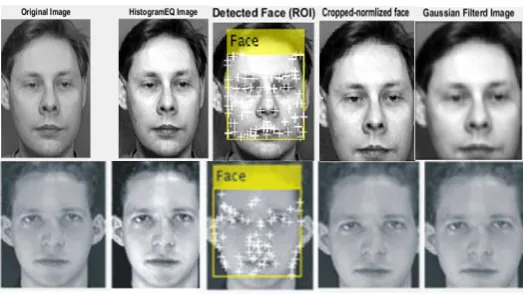
original size of each image is 640 x 480 pixels. The Figure 3 reveals the positive impact of equalization,
cropping and filtering face image.
Figure 3: Sample of a face image preprocessed stages
6. Support Vector Machine (SVM) Classification
Face recognition is a 𝐺𝐺 class problem with 𝐺𝐺 denoted as the number of known individuals. The classes are:
dissimilarities between faces of the same person and dissimilarities between faces of different persons. With 10
samples per class, the model classifies samples not initially in the database by interpolating among the trained
samples and recognizes faces by extrapolating from the training samples in the database. They perform pattern
recognition between two classes by finding a decision surface that has maximum distance to the closest points
in the training set refered to as support vectors. The training set is given as:
Each point 𝑀𝑀𝑖𝑖 belongs to one of the two classes identiftied by the label 𝑁𝑁𝑖𝑖∈{−1, 1}. Classifcation is a function
of maximum margin used to separate the two classes by a hyperplane such that the distance to the support
vectors is optimised[15]. Intuitively, the farther away a point is from the decision surface the larger the distance
𝑎𝑎, the more reliable the classification results will be.
7. Matching by Normalized Cross Correlation
The Normalized Cross Correlation between the test image and the trained image is given as:
NCC = ∑mi=1∑nj=1(Eij∗Tij)
∑ ∑n (Eij)2
j=1 m
i=1 (8)
𝐸𝐸 is the test image, 𝑇𝑇 is the trained image to be assessed, i is pixel row index, j is pixel column index and m, n are the number of rows and columns.In the matching operation, the NCC as a function compares the pixel
values of features that make up the trained image to that of the test image in order to establish resemblance or
disimilarities and the final correlation value is scaled to [−1, 1] range, such that the NCC of two completely
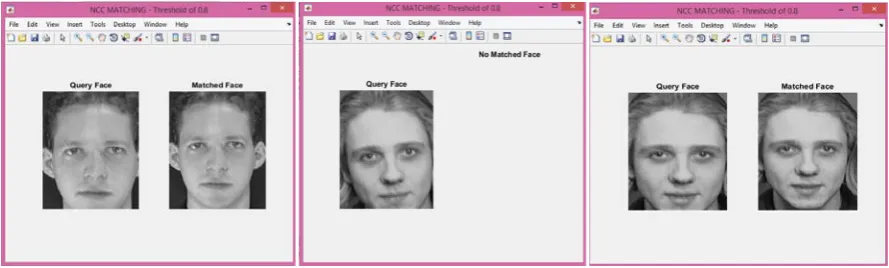
alike images is equal to 1 and completely unlike images is equal to – 1.Samples of the NCC matching with
threshold of 0.8 are shown in Figure 4 below:
Figure 4: match and no match faces.
8. System Evaluation
The following performance metrics were used for the evaluation of the systems:
8.1. False Acceptance Rate (FAR)
It measures the percent of invalid inputs that are incorrectly accepted. In case of similarity scale, if the person is
an imposter in reality, but the matching score is higher than the threshold, then he/she is treated as genuine user.
It is can be express as:
𝑆𝑆 is the total number of impostors with score exceeding the set threshold and 𝑇𝑇 is the total number of impostor and genuine users.
8.2. False Rejection Rate (FRR)
It is the probability that the system fails to detect a match between a genuine input pattern and a matching
template in the database. It measures the percentage of valid inputs that are incorrectly rejected. This is
expressed as:
FRR = GT × 100% (10)
G is the number of genuine score falling short of the set threshold
8.3. 𝑮𝑮𝑮𝑮𝑮𝑮𝑮𝑮𝑮𝑮𝑮𝑮𝑮𝑮𝑨𝑨𝑨𝑨𝑨𝑨𝑮𝑮𝑨𝑨𝑨𝑨𝑨𝑨𝑮𝑮𝑨𝑨𝑮𝑮𝑹𝑹𝑨𝑨𝑨𝑨𝑮𝑮
(𝐺𝐺𝐺𝐺𝑅𝑅%) = 100−FRR(%) (11)
8.4. 𝑻𝑻𝑻𝑻𝑨𝑨𝑨𝑨𝑻𝑻𝑬𝑬𝑬𝑬𝑬𝑬𝑻𝑻𝑬𝑬𝑹𝑹𝑨𝑨𝑨𝑨𝑮𝑮
(TER%) = FAR(%) + FRR(%) (12)
8.5. Results
NCC Matching was carried out by verification (one-to-one comparison) of enrolment faces (test images) against
the trained database templates in order to obtain the FAR, FRR, GAR and TER values respectively. Each of the
test face image is matched against the trained database templates to obtain N matching score with a set
threshold of 0.8. Firstly, 10 test images where matched against a trained database of 10 templates to obtain
genuine scores and impostor scores. This same procedure was repeated for 20, 30, 40 and 50 images
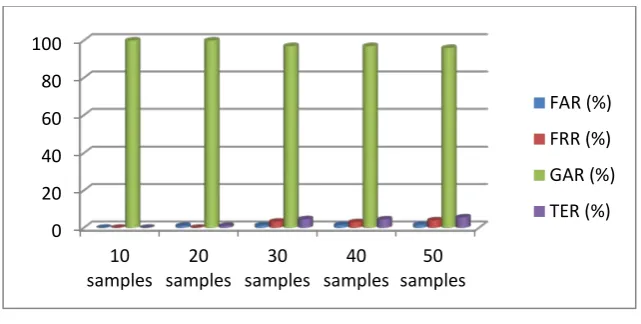
respectively. For 10, 20, 30, 40 and 50 face images the values shown in Table 1 and Figure 5 were obtained:
Table 1: Shows Matching Results
Facial Recognition system FAR (%) FRR (%) GAR (%) TER (%)
10 samples 0 0 100 0
20 samples 1.1 0 100 1.1
30 samples 1.3 3.3 97 4.6
40 samples 1.5 3 97 4.5
Figure 5: FAR, FRR, GAR and TER Values obtained
9. Conclusion and Recommendation
The work proposed SVM and NCC based biometric model for human recognition. The model requires the
extraction of enhanced face images for recognition accuracy. Experimental results showed the superior
performance of the model over some existing and related face recognition systems. However, the accuracy of
the proposed model becomes susceptible to degrading performances as samples increases. This is due to some
inaccessible information in the processed image affected by noise. This implies that further research will focus
on improving the signal-to-noise ratio and processing time to enhance performance for larger samples and then
the application of the proposed face model to create a robust and efficient multimodal biometric system with a
fusion of ear, fingerprint or both.
References
[1] Anil, J., Ling, H., and Yatin, K., A multimodal Biometric System using Fingerprint, Face and Speech.
International Journal of Computer Applications, (2010)
[2] Aditya Gupta, Madhuri Joshi and Shilpa Metkar,Video Based Real Time Face Recognition System, 2014
[3] Alfatihah, B., A., Face Recognition Using Neural Network, (2010): 14-24
[4] Bolle, R. M., Connell, J. H., Pankanti, S., Ratha, N. K., and Senior, A. W., Guide to biometrics, New
York: Springer-Verlag, NewYork, 2004
[5] Douglas Lyon and Nishanth Vincent, Interactive embedded face recognition, Journal of object
technology, Online at http://www.jot.fm, Vol. 8, No. 1, January-February, 2009, 1-31
[6] Chanda, B., and Majunmder, D., D., Digital Image Processing and Applications, 1st ed., Prentice Hall of
India, (2000).
[7] Deepash Raj Roll, A Realtime Face Recognition system using PCA and various Distance Classfiers, 0
20 40 60 80 100
10
samples samples20 samples30 samples40 samples50
2011: 1-11
[8] Dunstone, T., and Yager, N., Biometric system and data analysis: Design, evaluation, and data mining.
New York: Springer, 2006
[9] Faizan, A., Aaima, N., and Ahmed, Z., Image-based Face Detection and Recognition International
Journal of Computer Science Issues, Vol. 9, Issue 6, No 1, November (2012) ISSN (Online):
1694-0814.
[10] Gonzales, R., C. and Woods, R., E., Digital Image Processing. 2nd Edition, Prentice Hall, (2002).
[11] Imran, M., A, Miah, M., S U, and Rahman, H., a face recognition using eigenfaces, 2015
[12] Jain, A. K., Ross A., and Prabhakar, S., An introduction to biometric recognition. IEEE Transactions on
Circuits and Systems for Video Technology, (2004): vol. 14, pp. 4–20.
[13] Jie Yang, Hua Yu,William Kunz,An Efficient LDA Algorithm for Face Recognition,School of Computer
Science Interactive Systems Laboratories Carnegie Mellon University Pittsburgh, PA 1521,3 1-6
[14] Jain, A. K., Flynn, P., and Ross, A. (2007). Handbook of biometrics, l New York: Springer
[15] Jonathon Phillips, Support Vector Machines Applied to Face Recognition, National Institute of Standards
and Technology, [email protected]
[16] John D Cook,https://www.johndcook.com/blog/2009/08/24/algorithms-convert-color-grayscale/, 2009
[17] Jain AK, Lu X, Wang Y, Combining Classifiers for Face Recognition, Proceedings of IEEE
International Conference on Multimedia and Expo (ICME), Baltimore, MD, 2003, 3:13–16
[18] Müge, C., and Figen Özen, A Face Recognition System Based on Eigen faces Method, (2012): 118 –
123, 2212-0173 pp 1-6
[19] Monwar MD, A Multimodal Biometric System Based on Rank Level Fusion, 2012
[20] Prakash, M., Face Recognition System for Time and Attendance Management in Corporate, Karpagam
College of Engineering, Coimbatore, Tamil Nadu, 2018
[21] Panchal, T., and Singh, A., Multimodal Biometric system, International Journal of Advanced Research in
Computer Science and Software Engineering Research Paper Available online at: www.ijarcsse.com,
(2013): Volume 3, Issue 5.
[22] Subudhi, K., K and Mishra, R., Human Face Detection and Recognition, Department of Electronics and