(PLATES XL-,IX) INTRODUCTION
THIS
paper presents the results of work done chiefly at the Agora Excavations
on material which can give us some notion of the racial composition of ancient inhabitants of Attica. Through the help of a number of archaeologists and anthro- pologists 1 I have studied the unavoidably scanty groups of Attic skulls and skeletons
listed in Tables I-IV. These tables make clear the key position in this mnaterial of the Agora crania, which dominate the Neolithic and Geometric periods and provide important continuity from Neolithic to Med'ieval times. All together there are 69 dateable males, 42 females, and 8 children from Attica, compared with the total for mainland Greece of 255 dateable ancient males, 132 females, and 28 children,2 dis- tributed chiefly around the Corinthian isthmus but including scattered individtuals from Arcadia, Acarnania, Leukas, Thessaly, and small series from Chalcidice,3 and from Cephallenia.' Most of the total series comes from the geologically riven isthmian
1 Professor T. L. Shear put my project on a firm foundation in giving me access to the cranial
material he has excavated at Athens and Corinth and in providing me with laboratory space at the Agora excavations. The chance to sttudy remains of ancient Greeks came to me through the fore- sight of Professor E. A. Hooton. And the work was supported bv travelling-fellowships from the Departments of Anthropology and of Classics of Harvard University, fellowships granted through the good offices of Dr. Hooton, of Dr. G. H. Chase, and of Professor C. N. Jackson. Too many others have helped me in different stages of this -investigation for me to be able to thank each adequately. I should like to thank especially Dr. C. H. Morgan and Dr. H. L. Crosby, former Di- rectors of the American School of Classical Studies at Athens, and Mr. Lincoln MacVeagh, American Ambassador to Greece, and Mrs. MacVeagh for many kindnesses to myself and my wife. I am pecu- liarly indebted to Professor John Koumaris, Curator of the Greek Anthropological Museum, for access to the large collection of skeletal material in his care. For help in the work for this report I am most grateful to the following: J. B. Birdsell, C. W. Blegen, 0. Broneer, A. Brues, E.
Breitinger, C. S. Coon, M. Crosby, W. B. Dinsmoor, S. Dow, iMI. Farnsworth, A. Frantz, H. O'N.
Hencken, B. Hl. Hill, C. K. M. Kluckhohn, K. Kourouniotis, A. L. Kroeber, K. Kiibler, Dr. Lorandos, S. Marinatos, T. D. McCown, G. Mvlonas, G. P. Oikonomos, A. W. Parsons, A. Philadelpheus, D. M. Robinson, C. C. Seltzer. H. L. Shapiro, M. H. Swindler, L. Talcott, D. B. Thonmpson, H. A. Thompson, J. Travlos, E. Vanderpool, W. D. Wallis, G. Davidson Weinberg, S. S. Weinberg, R. Young, J3. Young. For statistical assistance I am deeply grateful to the staff of the Peabody Museum Statistical Laboratory under Dr. Hooton and Mrs. C. M. Kidd. And for unflagging help as field-recorder and in copying the original statistical tables I am deeply grateful to mv wife.
2 J. L. Angel, " A Racial Analysis of the Ancient Greeks: an Essay on the Use of Morphological
Types," Am1. Journ. of Phys. Anthrop., N. S., II, 1944, pp. 329-376.
3J. L. Angel, " Classical Olynthians," in D. M. Robinson, Excavations at Olynthus, XI,
Necrolynthia (Baltimore, 1942), pp. 211-240.
4J. L. Angel, "Ancient Cephallenians," AHn. Journ. of Phys. Anthrop., N. S., I! 1943, pp.
229-260.
Hesperia, XIV, 4
American School of Classical Studies at Athens is collaborating with JSTOR to digitize, preserve, and extend access to
Hesperia
area, with its zigzag formation and sharp environmental contrasts, and fits into a square with eighty-five mile sides. Even the total area is small enough to treat as a unit at any one chronological period. And in spite of regional diversity apparent in the racial separation of the insular Cephallenians from the Greeks to the east of thenm 5 at a
period of rapid change and cultural confusion, we need not expect the population of Attica as represented by the Agora crania to differ very markedly from the total series. The clearest way to show the value of the skeletal remains from the Agora is to outline the aims and methods of Physical Anthropology, the science which studies the evolution, growth, and physical variety of human social groups.6 The chief aim is to add to knowledge of inheritance in man (both as it affects large groups and family lines) and eventually to define the mutually inseparable actions of genes and of environment in producing the multiplicity of human phaenotypes. A corollary aim is to discover how far either genic linkage or multiple effects of a single gene may connect mental with physical traits or temperament with body build. Neither aim is likely to be achieved for several generations. But we know enough to state that man's present variety does not derive from mixture of pure breeds which existed in the remote past,7 and that any connection between temperament and physique must be of a general and overlapping nature 8 so intricately complicated by social selection
and gene shift that ethnic group associations of inherited 1nental and physical traits may never be demonstrable and can have little or no social significance.
Since Physical Anthropology has scarcely reached the positive stage in study of which bodily characters are inherited, its methods tend to be elaborate. In general we measure head and body as objectively as possible, determine blood group if possible, and make carefully standardized observations 10 of those features which do not fit
5 Loc. cit., pp. 235-239.
6 M. F. Ashley Montagu, " Physical Anthropology," in Medical Physics, edited by Otto Glasser
(Chicago, 1944), pp. 1014-1036.
7 M. F. Ashley Montagu, Man's imnost Dangerous Myth: the Fallacy of Race (New York,
1942), pp. 47-50. Compare T. D. McCown and A. Keith, The Stone Age of M'ount Carnel, II (Oxford, 1939), for data supporting hybridisation and general physical variability of Neanderthal man; especially p. 17. Compare T. Dobzhansky, Genetics and the Origin of Species (New York, 1937), pp. 185-191 for discussion of roles of isolation and selection.
8 W. H. Sheldon and S. S. Stevens, The Varieties of Temperamcent (New York, 1942).
9 E. A. Hooton, Crime and the Man (Cambridge, 1939), pp. 205-252, shows striking average physical differences between criminals committing different types of crime, an example where hereditary as well as social diff:erences appear to be involved.
into millimetres or degrees. And we use arithmetical means, parameters indicating
spread around the mean, and sometimes more analytic methods (such as grouping
similar individuals into arbitrary types) in describing a population. Almost all the
features we measure (such as skull length or facial angle) or observe (such as
occipital curvature or form of orbital opening) are determined by many genes and
are a functional expression of heredity plus environment. Hence in a comparison of
two groups inhabiting similar environments degree of phaenotypic similarity is
assumed to reflect closeness of genetic relationship. On this basis even now study of
skeletal remains and of the living descendants of ancient populations gives valuable
evidence on the general relationships between and origins of various geographically
or chronologically separated populations," even without precise genetic knowledge
which would shed light on the genetic makeup of single individuals.
Although archaeology, linguistics, and tradition may suggest migrations or in-
vasions which are not matters of historical record, the ultimate test of the reality and
effect of any such hypothetical movement of people is study of their physical remains.
This is probably the main contribution which Physical Anthropology can make to
the archaeologist.
The following general problems can be partly illuminated by study of the present
skeletal remains from the Agora: ( 1 ) What racial changes took place chronologically,
whether from invasions, environmental factors, or selective migrations. (2) How
the Athenians compare craniologically with Greeks as a whole, how definite a tendencv
on the upper edge of the nasal spine; dakryon, the point where frontal, maxillary, and lacrimal bones meet, is used as the medial point in orbital breadth; horizontal circumference is measured just above the browridges. The measurements listed in the tables are mainly self-explanatory in meaning, but certain measuring points and regions do need explanation. " Basion" is the midpoint of the anterior rim of the foramen magnum. " Nasion" is where frontal and nasal bones meet just above the nose root. " Prosthion " is a point on the alveolar border (bony gums) between the upper median incisor teeth; it varies somewhat, like basion, according to the direction of particular measurements. " Gonion " is the most lateral point at the angle of the jaw. Frontal, parietal, occipital, and temporal regions refer to areas occupied by the bones of the front, sides, back, and lower corners of the braincase respectively. " Norma verticalis" is the top of the skull seen from above, perpendicular to the Frankfort plane. Characters studied include in general: (1) Size, proportions, and general shape of braincase or vault; whether it is linear (dolichocrane), short and compact (brachycrane), or intermediate; high or low; well-filled as if the ballooning brain had stretched the membrane bones around it or ill-filled as if there were a superfluity of bone, producing respectively ellipsoid, ovoid, byrsoid, or spheroid normae verticales as opposed to rhomboid, pentagonoid, or sphenoid forms. (2) Similar characters for the face, including its massiveness relative to the vault, its relative linearity or squatness, its outline in front view, and degree of protrusion (prognathism) of various parts of the mouth region relative to a perpendicular from nasion to eye-ear plane. (3) Similar characters of nose, orbits, palate, and jaw. (4) Many detailed skull features, such as the shape of the ear hole. (5) Lengths, thicknesses, proportions, and morphological peculiarities of the other bones of the skeleton when available as clues to stature, body build, posture, and gait, also for sex and age characteristics supplementing those of the skull. Further definitions: cranium, the complete skull with jaw; calvarium, braincase plus upper face; calvaria, braincase alone; calva, skull-cap alone.
there was toward a characteristic Athenian physical appearance, and whether artists represented the average Athenian or a selected type. (3) What degree of racial heterogeneity was characteristic of Athenians, important in considering for example the supposed purity of type of Classical Athenians as suggested by their exclusion of metics and slaves from citizenship (though not of course from the total population) 12
or on the other hand the effects of hybrid vigour and social stimulation which may be expected to result from racial and ethnic mixture.13 (4) The incidence of diseases which affect bone, medical skill shown in setting fractures, age at death, data on posture and gait, and on some social practices.
Man is not only a social animal but also a partially domesticated one, hence even more heterogeneous than wild species even if not subdivided clearly into a number of breeds.14 This greatly complicates interpretation of data on physical type, since we must allow for the effects of selective migrations 15 as well as more obvious environ-
mental factors such as diet and public health. Full solution of the problems outlined above with full allowance for social factors will require many times the number of skeletons now available from the Agora or elsewhere. But simply because of the numerical paucity of material from this root area of our Western civilization the importance of each individual skull is proportionately increased and each deserves the fullest possible description.
DESCRIPTIVE BACKGROUND
The usual method of describing a population of potentially interbreeding in- dividuals is to use the stereotype of the " average individual " created from the arith- metic means of all measurements and to show the degree of variation around him. Though convenient and objective with an adequate sample, this stereotype corresponds with a mathematical rather than a genetic or a social reality. And with small samples the average individual means little. In the present study, therefore, six contrasting morphological types which have been statistically validated for Ancient Greeks as a whole " will serve in analytic description of the Agora crania against the background of the synthetic average Ancient Greek male compiled from the total series of skulls. Such types have many disadvantages. They are inflexible and artificial. They are less real than either the actual individuals or the gene frequencies in a population. But in so far as they can be made to suit those tendencies toward individual variety
12 F. Hertz, Rasse und Kulttr (Leipzig, 1925), p. 192.
13
Op. Cit., pp. 191-195. M. F. Ashley Montagu, The Fallacy of Race, pp. 97-130. F. H. Hankins, The Racial Basis of Civilimation (New York, 1926), pp. 271-286, 344.
14 Discussed in C. S. Coon, op. cit., pp. 3-12.
15 H. L. Shapiro, Migration and Environment (New York: Oxford University Press, 1939),
pp. 187-202.
which correspond mnost closely to the most frequently occurring genic linkages in the population they carry more reality than does the stereotype average individual.
The types were selected by careful comparison and matching of mounted photo- graphs of each skull until 23 " mutual resemblance subgroups " each containing closely similar skulls had been achieved.7 By an extension of the same process, with con- sideration of extremes to find out where the greatest discontinuities occurred, the subgroups were combined into six morphological types 18 listed in order of importance
as follows: Type A, Basic White, 24%; Type B, Classic Mediterranean, 23.5%; Type C, Alpine, 16.5%c; Type D, Nordic-Iranian, 17%; Type E, Mixed Alpine, 1107o:
Type F, Dinaric-Mediterranean, 8%. The percentage frequencies are those for the total series of both sexes, since, although the types have been validated only for males,"9 the combined percentages are almost identical with those for males alone.
As a basis of contrast for the six type groups and of comparison for ancient inhabitants of Attica we can use the skull and skeleton of the average Ancient Greek male.20 He had a skull vault of medium-small size compared to modern N. W. Euro- peans or Americans, and of median proportions on the linear side of intermediate, with a cranial index of 76.0. Greek browridges are well marked and set off a rela- tively low, broad, and smooth forehead which slopes back only slightly. The parietal bones are smooth and well filled out, rounded on top, with widely separated but smooth bosses and rather flat sidewalls. In profile a consistent but slight flattening in the hinder quarter of the parietals (obelion-lambda region) leads down to the evenly rounded occiput whose unimpressive neck muscle impressions contrast with big mas- toid processes and well-developed supra-mastoid crests. The base of the skull follows the sharply cut relief of the temporals.
The face is more characteristic than the vault because of striking lowness. especially i-n the subnasal region where it is emphasized by squareness of jaws. Like- wise the orbits are lowv, angular, and less drooping than in N. W. Europeans, and the cheekbones are robust without the compression which sometimes goes with orbital droop. The nose is mesorrhine and hence might have had roomy rather than pinched nostrils. But the bony nose is high and narrow at root and bridge, leaving the forehead with relatively slight depression at nasion and with slightly less angular
17 This method combines the type selection from actual skulls devised by E. A. Hooton, Indians
of Pecos (New Haven, 1930), especially pp. 185-186, with the standardized photograph technique
suggested separately by WV. Wright, " Skulls from the Danes' Graves, Driffield," Journ. of the Royal
Anthrop. Inst., XXXIII, 1903, pp. 66-73, especially pp. 69-70, and by C. M. Fiirst, " Zur Anthro- pologie der p-rThistorischen Griechen in Argolis," Lutnds Univ. Arsskrift, N. F., Avd. 2. XXVI, No. 8, 1930, and ",Zur Kenntnis der Anthropologie der prahistorischen Bev6lkerung der Insel Cypern," L.U.A., N. F., Avd. 2, XXIX, No. 6, 1933.
18 A few published skulls were tvped from measurements alone, since R. Virchow did not
publish illustrations of all crania.
284 J. LAWRENCE ANGEL
saliency than in N. W. Europeans, so that nose profile tends to continue that of the
forehead in as many as 23.5% of males. The mouth seldom protrudes. The palate
is both broad and high-arched, and the jaw is correspondingly broad, shallow, and
robust posteriorly rather than in the chin region. Here occurs the most striking
feature of the face: an excessive breadth at the angles emnphasizing
the squareness
of jowl which still marks Greeks. Ancient teeth were good, with medium degree of
wear at death, little crowding, relatively few caries or abscesses, and often a mill-like
type of bite in which the incisor teeth meet edge to edge instead of overlapping. The
younger age at death of the Ancient Greeks
21is not adequate to explain their contrast
to the dental degeneration of modern times.22
Sex differences are about average for Europeans both in size and morphology,23
and are greater than among Egyptians or Palestinians. Females are shorter-headed
as well as smaller, with more bulging foreheads, weaker browridges and muscle
attachments, less prominent noses, and narrow faces and jaws relative to cranial
breadths. Female facial constriction goes with large and high orbits, narrower mouths,
and greater prognathism. But the leptoprosopic tendency of the females, resulting
from their marked facial height, is an unexpected sex difference sharpening the facial
contrast. The average Ancient Greek male combines a well-filled vault of inter-
mediate size and proportions with a low and square face whose broad and strong jowls
contrast with the high and narrow nasal skeleton: a striking face compared to the
more triangtular and conventional face of the Ancient Greek female.
From this summary it is obvious that the Ancient Greeks must show a combina-
tion of Alpine with generalized Mediterranean characters, and that analysis of this
combination's dynamics among the Agora skulls will be the chief function of the
types. Type contrast partly explains the colossal variability of the total series, a
chronological comnposite
spanning 4500 years, since the period groups are likew'ise
unexpectedly variable as shown by W. W. Howells' Sigma Ratio
24and Coefficients
of Variation. Such high variability certainly suggests diversity of origin for Greeks
in general.
Though comparable heterogeneity should occur also in body build the data barely
suffice to define the average Ancient (reek. Mean male stature of 162.2 cm. (5 feet
21 Between 35 and 40 for males and abont 30 years for females, omitting children and adoles-
cents from consideration: life expectancy at 18.
See 'A. KptKoS, 'H kEte$vX TNS r epr8OYvo iiv 080'vTwv E'v TEXa8t '&r rzo Jv aJpxatoraTwv lExptw rwv Ka
As xpo'v(w 'EXX. 'AvOp. 'Er., TpaKTtKa, XII, 1935 pp. 3-18. Confirmed by J. L. Angel, " A Racial
Analysis of the Ancient Greeks," Table 9.
23 L. Borovansky, " Pohlavnli rozdily na lebce cloveka," Czech Academy of Arts and Sciences,
Prague, 1936. D. I. Risdon, " A Study of the Cranial and Other Human Remains from Palestine Excavated at Tell DuWeir (Lachish)," B iometrika, XXXI, 1939, pp. 99-166.
24"' The Early Christian Irish: the Skeletons at Gallen Priory," Proc. of the Royal Irish Acad.,
3% inches) and female stature of 153.35 cm. (5 feet
7/16inches) are both short.25
Limb-bones appear small-jointed, short, but thick, with rugged muscle markings. The
forearm is medium to long compared to the upper arm (not approaching ancient
Egyptian or negroid elongation), and arm and shin are of medium length compared
to leg and to thigh respectively. The clavicle is long relative to the upper arm, and
the relatively broad scapula also suggests broad shoulders. Hip breadth is greater
than usual among taller groups, and this completes the indications of a stocky Euro-
pean type of body build. Low grade platymeria and mesocnemia suggest that growth
economy of bone probably typical of extreme flattening of femur and tibia
26is less
important than functional factors. Mean age at death deduced from phases of the
pubic symphysis is 35 vears for 22 males and 27 years for 16 females. Pelvic sex
differences are well-marked, with the usual amount of overlap.
A convex lumbar curve (especially in the females) indicating a good degree of
pelvic tilt, medium development of torsion of the neck of the femur,27 platymeria witlh
strongly developed gluteal crest, marked retroversion of the tibial head,28 high fre-
quency of " squatting facets " or joint surface extensions on tibia and talus, and strong
femoral, tibial, and calcanear attachments for calf muscles, all combine to suggest a
"bent-knee gait." A good balance at the hips correlates with hypertrophy of glutei
and other abductors, external rotators, and extensors of the thigh to control sidesway,
toeing in, and bent-knee posture, and hyperdorsiflexion at the ankle joint and con-
sequent squatting facets go with opposition of strong calf muscles. The whole com-
plex of posture traits appears an adaptation to the steep and rocky paths normal in
Greece through development of posture and gait like those of a skier."
Detailed validation of the six morphological types is unnecessary here, since in a
previous publication the types have been shown to be significantly divergent from the
average Ancient Greek male in the directions of outside series representing various
racial tendencies within the white stock, and to be much more homogeneous than the
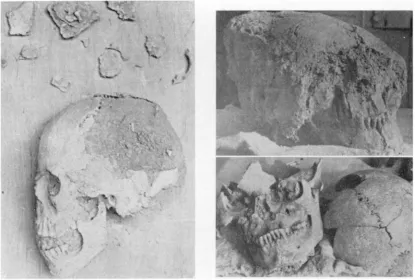
Greeks in general.30 The Plates, especially Plate XL, illustrate the following de-
scriptions.
Basic Whites
(TypeA: Plate XL, u-y) are sturdy. They have large and long
25 Just below the norm for modern Spaniards, Portuguese, or South Italians, and based on
61 males and 43 females.
26 Hypothesis advanced as general explanation by L. H. D. Buxton, " Platymeria and Platyc-
nemia," Joutrnal of Anatomy, LXXIII, 1938, pp. 31-36.
27 Especially in the males. Cf. WI. W. Howells, " The Early Christian Irish," p. 162.
28 op. cit., pp. 167-173, for comparative discussion.
29 Ascent or especially descent of slippery talus slopes in Greece in various postures will
convince anyone of the efficiency of the bent-knee position, wlhich of course need not be used on level ground.
30 J. L. Angel, " A Racial Analysis of the Ancient Greeks," Tables 3-7. See this publication
286 J. LAWRENCE ANGEL
heads with somewhat low and receding bony foreheads, massive browridges, and a
generally angular and ill-filled appearance emphasized in slight 1midline gabling of
parietals and latmbdoid flattening just above the projecting occiput. Their almost
trapezoid faces lack height, and show rectangular orbits, short, straight, coarse noses,
angular profile, and strong chin and teeth. They were probably above mediunm
stature,
strong, dark-brown haired, and swarthy. They show noteworthy similarity to Chalco-
lithic Palestinians, Siculans, Chalcolithic Sardinians, and Neolithic type British, and
are obviously also comparable to Atlanto-1V[editerraneans
in Mesopotamia. They
are less homogeneous as a group than the other types, covering the range from a
linear and high-skulled " Megalithic "
"'variant with high, thin-nosed hatchet-face
(A 1 and A 2: Cephallenian and Athenian in Plate XL, v, w), to a low-headed and
squat-faced extreme with wide nose and low orbits (A 4: S. C. Macedonian in Plate
XL, u), with a central group (A 3 and A 5: Corinthian of Argive parentage and
Lemnian in Plate XL, x and y) connecting these divergent tendencies.
Classic Mediterraneans (Type B: Mytilenean, W. Cretan, and Corinthian of
Argive parentage in Plate XL, r, s, and t) are light-boned, almost fragile. They have
small, barely dolichocrane heads, pentagonoid in outline in both vertical and occipital
views, contracted neck muscle area, and low and almost vertical rounded foreheads.
Their slender, fine-featured faces have square orbits, thin noses smooth and low in
the nasion region, and a triangular taper down to pinched jaws with shallow and
pointed chin, weak prognathism, and an overbite linked with subnormal degree of
teeth wear. They were probably just below miedium stature, gracile, slender-necked,
brtinet, with black or dark hair. They are virtually identical with ancient Libyans and
with modern Sicilians, and similar to Upper Egyptians of prehistoric and Early
Dynastic dates, and to modern Spanish. Type B is the most homogeneous one, with
only slight tendencies in longer-headed, linear-faced and smaller, more squat-faced
directions.
Throughout the Mediterranean.region Type B occurs in various proportion.s
with the Basic White type, and a composite made up of Types A and B in equal pro-
portions is very close to Minoan Cretans and somewhat resembles Lower Egyptians
of XXVI to XXX Dynasties and Iron Age South Palestinians.
Nordic-Iranians (Type D: Plate XL, m-q) have long and high heads with pecu-
liarly deep occiputs, smnooth
ovoid-ellipsoid contour, sharply-cut muscle impressions,
strong browvridges, and tilted and capacious foreheads. Marked facial height and
narrowness of cheeks compared to wide forehead and jowls makes a rectangular,
horse-faced impression. Large but slightly retreating cheekbones enclose drooping
orbits, and big, salient, and aquiline noses, long-arched palates, muscular jaws wide
at the angles, and cleft chins lacking prominence all add to the same effect. Nordic-
Iranians were tall and muscular, strong-necked, and probably included tawny-
haired blue- or green-eyed blonds as well as brunets. Approximate identity with
Bajuvars, and noteworthy resemblances to North Iranian Bronze Age Proto-Nordics,
to Anglo-Saxons, and to medieval Irish Monks show the divided eastern and north-
wATestern
relations of this Greek type. And though Type D has a low variability, it
includes four slightly different tendencies: a cylindrical-skulled, slab-faced Iron Age
Nordic one (D 1: Chalcidian and E. Thracian, in Plate XL, n and o), a high-skulled,
ellipsoid, " Corded " tendency (D 2: Chalcidian in Plate XL, p, slightly " dinari-
cised "),32 a long byrsoid, deep-skulled, huge-nosed, convex-profiled Iranian trend
(D 4: Athenian of Arcadian parentage, in Plate XL, m), 3 and a small-faced Iranian-
Mediterranean divergence approaching Coon's Cappadocian and Danubian types (D 3:
Athenian in Plate XL,
q).34Dinaric-Mediterraneans (Type F: Chalcidian, Corinthian, and E. Thessalian in
Plate XL, j, k, and 1) are the least Alpine of two intermediate, hybrid, Alpinoid forms.
Their short (high mesocrane) and relatively high byrsoid heads have pinched and
flatly sloping foreheads and non-projecting occiputs. They have big and drooping,
houndlike, faces with an elongated hexagonal outline stemming from striking (though
variable) flare of the cheek region. Face height is emphasized in their long and thin
noses pulled down almost parallel with their foreheads, in high palates, and in long,
deep jaws. Dinaric-MAlediterraneans
are medium tall, long-necked, and presumably
mainly brunet. They resemble both dinaricised Mediterraneans
?from Lower Egypt
in the third and second millennia
B.C.and dinaricised Alpines including inhabitants
of the Roman Troad, modern Greeks of Anatolia and European Turkey, Serbs and
Croats, and Slovenes. Type F is homogeneous but does show divergences toward
linearity on the one hand and toward true brachycrane Dinaric makeup on the other.
Mlixed Alpines (Type E: Plate XL, f-h) are closer to Alpines morphologically
than in their proportions. Their large mesocrane heads are well-filled, with peculiarly
large and wide foreheads with little slope and smooth parietals with a long flat plane
in the obelion-lambda region. The massive foreheads dwarf their low faces which
have an inverted trapezoid outline and a retreating profile, high-rooted but insignificant
noses, and shallow and relatively delicate jaws despite respectable size. They were not
especially short but probably heavy-bodied, probably with some mixed blonds among
a brunet majority. Their approximations to Etrusco-Roman Tarquinians and Mero-
32 Op. cit., p. 85 and Table 12.
3 'W. M. Krogman, " Racial Types from Tepe Hissar, Iran," Verhandel. der kon. Neder-
landsche Akad. vant Wetensch., Afd. Natuurkunde, Tweede Sectie, XXXIX, No. 2, Amsterdam, 1940. H. V. Vallois, " Les ossements humains de Sialk," in R. Girshman, " Fouilles de Sialk, 1933, 1934, 1937," II, Louvre Dept. Ant. Orient., Serie Arch., V, 1939, pp. 113-192, for earlier Proto- Iranian type.
34 C. S. Coon, op. cit., pp. 85, 137-139.
vingian Franks are both good, and they resemble adequately Bessarabian Scythians, Carniola Illyrians, Basques, and Teneriffe Guanche. This parallelism stresses their hybrid origin. Trype E is homogeneous, but with some inner divergences including Nordic-Alpine (E 2: W. Macedonian and E. Arcadian, in Plate XL, g and h) as opposed to Mediterranean-Alpine (E 1, E 3: N. W. Macedonian in Plate XL, f) tendencies.
Alpines (Type C: Plate XL, a-e, and i) have shortened and laterally bulging heads, with weakly-curved occiputs equipped with strong torus for neck muscles, broad and full foreheads (narrow relative to bulging parietals), and a short ovoid to sphenoid or spheroid outline in normna verticalis. Their heads as a whole range from " square " to globular. The Alpine face is low and orthognathous with square to hexagonal outline rounded at the angles. Non-retreating cheekbones and dominantly short, low-rooted, non-salient and concave nose combine to give the face a certain flatness emphasized further by alveolar retraction with short and low palate, and by a prominent chin linked with an edge bite and much worn and somewhat poor teeth. Alpines were notably short and probably stocky, and dominantly brunet. They re- semble significantly both recent Carinthian villagers and medieval citizens of Hythe in Kent, with good approximations to Foothill Bavarians and to Bronze Age Eastern Cypriotes. This suggestion of divided resemblance is confirmed fully by Type C's s'lightly elevated variability. And various divergent tendencies are appreciable: C 1, C 2, and C 3 (Maniote, E. Thracian, and Athenian in Plate XL, a, b, and c) tend respectively toward the globular Central European Alpine, its paedomorphic extreme, and a rugged, slab-faced Borreby-like type; 36 an Eastern Alpine trend (C 4: Ithacan
and Athenian in Plate XL, d and e) toward a high, sphenoid vault with flat occiput and high-nosed, square-jowled face,37 and a squat Eastern Alpine tendency (C 5: S. E. Messenian in Plate XL, i) toward sphenoid-byrsoid and broad-based vault with short face and puffy nose 38 both have obvious Near Eastern rather than European
appearances.
Basic Whites and Mediterraneans dominate the series as a whole. Dinaric- Mediterranean, Nordic-Iranian, and Basic White types are nearest to the average metrically, with the small-headed Mediterraneans particularly close in proportions. But Alpine and Alpine hybrid types are closest to the average Ancient Greek in mor-
36 C. S. Coon, op. cit., p. 291, for definitions of both Borreby and Central European Alpines.
37 C. M. Fiirst, " Prahistorische Bevolkerung der Insel Cypern," for many examples of this
tendency which Fiirst mistakenly calls Armenoid. It may contribute to the later Armenoid type.
38 W. M. Krogman, " The Cranial Types," in E. F. Schmidt, " The Alishar Hiiyiik, 1928 and
phological details. Thus the Ancient Greeks as a whole combined linear and lateral
type tendencies in such a way that the former dominate measurements and the latter
dominate the general form. This conclusion and the extent of contrast between types
are both of importance in the following descriptions of individual skulls from the
Athenian Agora and other sites in Attica.
CRANIA ATTICA
With the exception of the Submycenaean skeletons fromn the Kerameikos and
the previously published material not measured by the author, every skull studied had
first to be cleaned and mended or restored. These operations might take either a few
minutes or several weeks, depending on the importance as well as condition of the
individual skull or skeleton. As seen in Figures 5 and 8, Greek skeletal material is
usually poorly preserved, being dissolved, warped, crushed, and cracked by the alter-
nate winter soaking of limey, clayey soil and summer baking and dry contraction of
the soil. In sarcophagi the skeleton may be either dissolved or incrusted, and in the
communal ossuary rite basic in the Aegean the disarranged skeletons are usually in
still worse condition. Likewise rock-cut or earth burials under a marketplace are put
under many disturbing pressures. Yet in any one of these situations bone is well
preserved if resting under fixed conditions: in the wet mud of shaft graves or wells,
or in either wet or dry sand in chamber tombs or ossuaries. In the same cemetery,
graves at sea level and continually wet produce better skeletons than those in loamy
soil farther from the sea.39 Normally, therefore, fragments of a skull must be
hardened after cleaning and drying by impregnation with a plastic, such as Alvar,
either by long soaking or preferably under negative pressure in a vacuum jar. If all
fragments of a skull were recovered from the ground the mending process is a simple
three-dimnensional
jigsaw puzzle: Alvar is sufficiently slow-drying so that a whole
skull may be put together with all joints still flexible, and warping may thus be cor-
rected without repeated trials
40by lining up all sagittal points of the skull into a single
plane. Vault and lower jaw are mended first, and the jaw used as a check in placing
temporal bones. The mended face is adjusted with all upper teeth in perfect occlusion
with the lowers, and face and jaw are then attached to the vault with careful adjust-
ment of nasals, malars, and sphenoids and attention to proper position of the condyles
of the jaw. Usually an archaeological skull is incomplete and restoration of missing
parts may be desirable if the individual skull is important and the restorationl reasona-
bly certain.
39Noted from material from Hagios Kosmas excavated by G. E. Mylonas, "Excavations at
Hagios Kosmas," A.J.A., XXXVIII, 1934, pp. 258-279, and paralleling the contrast between
material fromn wells and from earth graves in the Athenian Agora.
290 J. LAWRENCE ANGEL
In addition to the measurements and observations listed in Table I, from four
to eight Leica photographs were taken of each skull; pelvis, and lonig bones were also
photographed; and these picttures were later enlarged to a standard scale for study.
A good many hours must therefore be spent on every skull examined, apart from the
time spent later in visual and statistical comparative analysis of the whole material.4"
And I thank my wife for an inestimable amount of help in this labor.
In publishing Greek skeletal material I have used the numbering system started
by C. M. Fiirst. A key to the site abbreviations follows:
AA
Athens, Agora
AK
Athens, Kerameikos
AP
Athens, Polis
Ant
Antiparos
Ast
Astakos
Ba
Babak6y
C
Corinth
Ce
Cephallenia
Di
Dimnini
El
Eleusis
Eu
Eutresis
FA
Fuirst, Asine
FD
FTirst, Dendra
FH
Fiirst, Heraeum
FM
FTirst, Mycenae
FCE
Fiirst, Cyprus, Enkomi
FCL
FTirst, Cyprts, Lapithos
FCM
FTirst, Cyprus, Melia
H
Argive Heraeum
Hag
Hageorgitika
HaK
Hagios Kosmas
Hal
Halae
K
Kouvara
Le
Leukas
Ma
Markopoulos
Mar
Marathon
Men
Menildi
M\lyC Mycenae
Ne
Nemea
01
Olynthtis
Rh
Rhitsona
S
Sounion
Sal
Salamis
Ser
Servia
Sk
Skopelos
Sp
Spata
Tan
Tanagra
Th
Thebes
The
Thermi
Ths
Thespiae
Tr
Troyland
Ts
Tsangli
41 Field technique is something which cannot be overlooked, since on its scientific perfection
NEOLITHIC PERIOD
Of the twelve skulls of this date from Greece five come from the Athenian Agora excava- tions, including one with a complete skeleton.42
1, 1 AA. Section OA, Well 5, 1937 (Hesperia, Vi, 1938, p. 336). Calvarium of a child about 7 years old, in good preservation (Plate XLI). Rhomlboid headform with wide-spaced parietal bosses, a steep forehead, and a relatively low face mark this skull, in which the second molars and permanent incisors are just visible in their crypts. Typing immature skulls is hazardous, but 1 AA combines relative shortness of skull
with marked lateral bulging, and hence its obvious Mediterranean character seems to be modified into a Mixed Alpine one. Similar Alpine characters in a Mediterranean context occur equally early in the Choirospilia skull
from Leukas 43 and in skulls from Kum Tepe
in the Troad and from Trov 1.44
From the same well come a gracile but un- measurable adult humerus and the right tem- poral of an adult male. This hone is marked by a flat squamous portion, a long mastoid pro- cess, and a ridged and rather sharply flaring zygomatic process. The whole bone is reminis- cent of a Type B 4 Mediterranean skull from Neolithic Astakos which I studied in the Athens Anthropological Museum, but its consequent attribution to a small but rugged longhead with a relatively wide face is guesswork
2, 27 AA. Section E, Shaft Grave 2 m. east of Metro6n, 1935 (Hesperia, V, 1935, pp. 20-21). Almost complete skeleton of a young adult male, probably between 30 and 35 at death (Plate XLI), and of tall stature for the period
in which he lived (5' 534"). Postural indica-
tions include platymneria' and platycnemia, as-
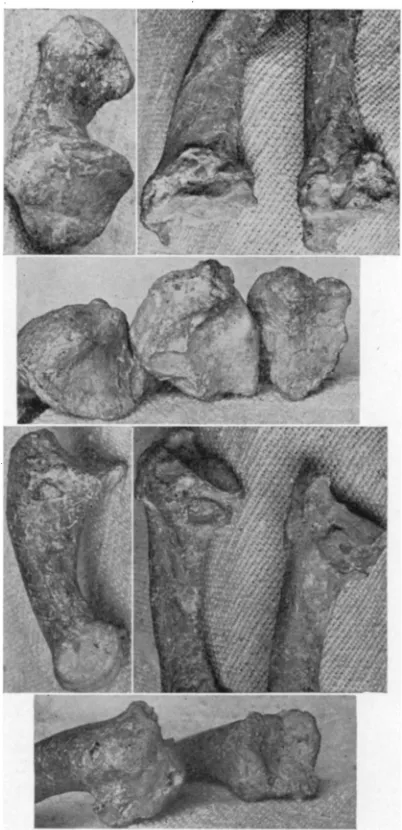
tragalar squatting facets, strong gluteal in- sertions on the femora and possibly a compara- tively straight lumbar section of the vertebral column. Of more interest is a mushrooming of the body (anterior portion) of the 5th cervical vertebra, thinning of the arch, with anterior hyperostosis of the 3rd and 4th cervicals and lateral affection of the 6th cervical. This might result from a partial dislocation followed by chronic arthritis or possibly from a retro- pharyngeal abscess; there is no direct sign of any neck wound. It is illustrated in Figure 1 together with an eroded and cribriform fossa formed on the anterior surface of the femaoral neck just below the rim of the head and thus within the joint capsule. This area, known as Poirier's empreinte or Allen's cervical fossa, has been attributed to pressure or constriction by the circular fibres of the capsule of the hip joint and less plausibly to rubbing by the ilio- psoas tendon.45 It occurs a number of times on later skeletons from Attica.
The well-preserved cranium lacks some parts, notably a large section of the occipital plate which has been restored as carefully as possible.
42
For other Neolithic skulls see J. L. Angel in D. M. Robinson, op. cit., pp. 215-217, Plate LXX (Servia); W. L. H. Duckworth, " Report on a Human Skull from Thessaly," Man, XI, 1911, pp. 49-50 (Tsangli skull); C. M. Fuirst, " tGber einen neolithischen Schadel aus Arkadien," Lunds
Uni. Arsskrift, N. F., avd. 2, XXVIII, No. 13, 1932 (Hageorgitika skull); 'I.
Kov,6apq3, > tw/in
aVOpw7roXoyLK0 v z7rapaTrqp'rwf(v, 'EXA. 'AvOpozr. 'ET., lIpaKTLKa, XII, 1935, pp. 26-27 (Astakos skulls);
and S. Benton, " The Ionian Islands," B.S.A., XXXII, 1931-32, pp. 213-246. All except the Tsangli skull were remeasured by the writer.
43 G. Velde, " Anthropologische Untersuchungen und Grabung in einer H6hle der jiungeren
Steinzeit auf Leukas," Zeitschr. fiur Ethn., XLIV, 1912, pp. 845-865. Velde gives almost no measurements (though photographs) of a number of E. H. skulls as well as the neolithic skull none of which the writer remeasured.
44 Unpublished observations of the writer, and S. A. Kansu, "I-tude anthropologique sur les
ossements de Kumtepe," Tirk Tarih Kururu, Belleten, I, 1937, pp. 570-590.
45 P. N. B. Odgers, " Two Details about the Neck of the Femur, (1) the. Eminentia, (2) the
Figure 1. 27 AA's cervical vertebrae (anterior surface) and right femoral neck (antero- superior surface). Neck vertebrae show flattening and bone absorption of bodies with arthritic
lipping and exostoses. Femoral neck shows " erosion " patch where outer table of bone is
removed, probably through rubbing by portions of the joint capsule (zona orbicularis and ilio- f emoral ligament) in certain positions. Inner trabeculae show through. Neolithic period.
The skull is of medium proportions, and com- bines an ovoid (-byrsoid) headform with a sloping forehead, flat lambda region, and " rising " vertex profile. The face is big, ro- bust, and somewhat crude, mesorrhine, with low and sloping orbits, a strong and deep- chinned though relatively compressed jaw, and a big palate linked with alveolar fullness. No caries were found, and only one tooth was lost in life, though a large alveolar abscess is present, and there is a very slight tendency toward crowding of teeth. Definite skull and face broadening and other Alpine traits modify
the basically Type A 1 (Megalithic) tendencies of this skull in a Dinaric-Mediterranean (Type F 1) direction, because of linkage of a high face with a relatively short skull vault together with the total morphological impression. As in the case of the Neolithic B skull (Type F 1) from Servia in S. Macedonia, and the Tsangli skull from Thessaly, 27 AA's Dinaric-Medi- terranean traits are not adequate proof of a strong Alpine element in Greece at this time.48
3, 31 AA. Section OA, Well 18, skull a, 1939 (Hesperia, VIII, 1939, p. 298). Calva of young
adult, apparently female (Plate XLI). The vault is brachycrane and well-filled, with a rhomboid form seen from above, and an im- pression of relatively great height in profile, a forehead of medium height and slope, and a rather flat occiput. Alpine fullness and short- lness are sufficiently modified by Basic White f rontal region and Mediterranean rhomboid headform to group this skull with the Mixed Alpines.
4, 32 AA. Same provenience, skull b. Calva of young adult male (Plate XLI), of relatively small size, with mesocrane and ovoid headform and an apparently broad f orehead. Marked browridges, a fairly sloping forehead, definite postorbital constriction, and non-projecting oc- ciput complete the description. An unusually large osteoma projects from the left side of the occipital bone, just under the middle of the left lambdoid suture. Here again an incipient Al- pine fullness is perceptible in an obviously Mediterranean, Type B 1, skull quite compara- ble to the Neolithic skulls f rom Astaka in Acarnania. And similar Mediterranean skulls modified in Mixed Alpine or Dinaric-Medi- terranean direction occur in Early Helladic Corinth.47
5, 33 AA. Same provenience, skull c. Calva of child of indeterminate age, short, but probably not brachycrane, and with pentagonoid head- form and a generally Mediterranean appearance.
EARLY HELLADIC TO ca. 2000 B.c.
Nineteen of the fifty-two skulls and frag- ments of Early Bronze Age date come from Attica, from the 1930-31 excavations of G. E. Mylonas at Hagios Kosmas on a promontory near Phaleron and within a few miles of the Athenian Agora. Most of these skulls (1 HaK-
12 HaK) have been carefully published by J.
Koumaris 48 in Greek, and he generously al- lowed me to use his measurements and original photographs of three skulls (7 9 10 HaK) which were subsequently damaged beyond re- pair and not available to me.
BASIC W H ITE
6, 2 HaK (Plate XLII) is a Type A 4 calvaria with facial fragments. The dolichocrane vault is a low and well-filled long ovoid with strong browridges and some constriction of the base in rear view. The face is low and probably broad, with low, rectangular, and sloping orbits, and nmassive cheekbones.
7, 4 HaK, Type A 3 (Plate XLII), is a notably large and rugged calvarium. Except for its expanded vault and " Mephistophelean " gla- bella and nose formation (cf. Iranian Nose), it is typical. Very long mastoids and flat sweep of the cerebellar region down to them are note- worthy. Teeth are excellent, with wisdom teeth suppressed.
8, 5 HaK, Type A 5, female (Plate X,II), is
a rhomboid calvaria, high, with narrowing of both steep forehead and skull base, and a wide inter-orbital distance.
9, 6 HaK, untyped since not a complete enough skull, is a broad-jowled lower jaw suiting 2 HaK.
10, 12 HaK, Type A 3, female (Plate XLII), is a long and high, sphenoid-byrsoid calvarium, with narrow base, long mastoids, and some postorbital constriction. The face was probably low, but contains a narrow nose, compressed cheek-bones, and square but sloping orbits. Very slight trend toward Dinaric-Mediterranean.
47'J. Kov,ua'pq, op. cit., and unpublished material examined in the Smithsonian Institution and American Museum of Natural History.
48K'v* KOlavpV, 'AVOp7roOXyLKa' 7rapaTh)p?TEV ErA (V&yV KpavULW rs ev wA7tz Kouy*4 avaUKWs, 'EAR.
'AvOpQn7r. 'Er., llpaTr6a, VIII, 1931, pp. 45-53. Condensed by J. Koumaris, Revue Anthrop. (Paris),
11, 16 HaK, Type A 4 (Plate XLII), is a slightly warped calva, rugged, long and proba- bly low. It is rounded pentagonoid in form, with capacious forehead and massive brow- ridges, depressed nasion, and probably slightly narrowed skull base.
MEDITERRANEAN
12, 13 HaK, Type B 2, female (Plate XLIII), is a large brachycrane but pentagonoid cal-
variumn, with marked bosses, steep and metopic
forehead, pentagonoid rear view with narrow base and long mastoids. The narrow face has square and sloping orbits, pyorrhea, and 4 teeth lost in life.
13, 20 HaK, Type B 2, is a warped calva, cer- tainly long-headed and pentagonoid, probably narrow-based.
14, 21 HaK, Type B 2, female, is a large and rhomboid calvaria.
NORDIC-IRANIAN
15, 7 HaK, Type D 4 Iranian, is a very large and well-filled dolichocrane with elongated byr- soid headform, heavy browridges, sloping and constricted forehead, well-curved, deep occiput,
and pointed mastoids. The atypically low face 49
has a narrow and high aquiline nose, rhomboicl orbits, strong, drooping cheekbones, and deep canine fossa.
16, 11 HlaK, Type D 2 (Plate XLIII) is be- tween Coon's Corded and Danubian types. The ovoid vault is rugged, although small, high, well-filled, with marked browridges and inion, and elongated mastoids springing from a flatly descendinlg cerebellar region. The long rect- angular face has a narrow and probably high nose, high rhomboid orbits, a high and hyper- bolic palate, well-worn and excellent teeth, and oblique impaction of the lower wisdom teeth with consequent bevelled wear.
17, 15 HaK, Type D 2, is a long and ellipsoid calvaria, muscular, with sloping forehead and
projecting nasalia, a trace of lamnbdoid flatten-
ing and thick mastoids. Indefinite Type A 3 suggestions.
DINARIC-MEDITERRANEAN
18, 10 HaK, Type F 1, female, has a brachy- crane and sphenoid vault, relatively high, with slight forehead slope. The narrow face has a pinched but not prominent nose, compressed cheekbones, and square and tilted orbits.
ALPINE
19, 1 HaK, Type C 1, female (Plate XLIII), has a short and rounded sphenoid braincase, relatively high, with a low, straight forehead. The face is short and rounded, with big palate, excellent teeth, with a minimum of caries, ab- scesses, and teeth lost before death.
20, 3 HaK, Type C 4, subadult male high- headed Eastern Alpine (Plate XLIII), has a short and high puffed-out braincase which is almost spheroid, with high and steep forehead, weak browridges, and long mastoids. The small and narrow triangular face has a pinched nose, rhomboid orbits, conapressed cheekbones, a light jaw, probably suppressed wisdom teeth, and excellent teeth quality.
21, 8 HaK, untyped since only part of a skull, is a broad and shallow jaw with pyorrhea an(l six teeth lost before death.
22, 9 HaK, Type C 3, is a broad and high, mas- sive calvaria, with strong occipital muscle mark- ings and long mastoids, below a deep occiput.
23, 17 HaK, Type C 2, female, is a squat ovoid calva, with low vertical forehead and short occiput.
24, 19 HaK, Type C 5, is the posterior two- thirds and fragments of a brachycrane calvaria. It has a short occiput with strong torus.
49 It seems possible that Koumaris' upper face height underestimates because of breakage at
Long bones from the ossuary tombs at Hagios Kosmas indicate a short stature.
MIDDLE HELLADIC ca. 2000-1600 B.C.
Conmpared to 24 skulls of definitely Middle
Helladic date from Greece, eight or more skulls from Eleusis excavated by D. Philios are either M. H. or Geometric, or possibly later in date. Some of these may be M. H. in date and in- dicate the presence of Mediterranean and Basic White as well as a very long-faced smooth-
vaulted version of Coon's Corded type,50 COM-
parable to 1 FA, 4 FA, and 21 FA from Asine.51
Excavation photographs of four Middle Hel- ladic skulls from Eleusis published by Kourou- niotes and Mylonas show this same Type D 2 almost unequivocally. The vault fullness of these skulls is enough to suggest a Mixed Alpine, E 2, trend, found not only in the L. H. I Shaft Grave skulls from Mycenae but also in a Middle Hfelladic Boeotian from ELtresis.52 H3owever, conclusions based on the Eleusis data are mere speculation.58
LATE HELLADIC II ca. 1500-1400 B.C.
Out of fourteen skulls from L. H. I-II tombs from Greece, one individual comes from Attica, excavated by V. Stais in 1893 from one of the two Thorikos beehive tombs and dated by L. H. lI vases preserved with it in the Greek Na- tional Museunm.
25, 1 Tho, is the complete skeleton of a middle- aged adult male ( ?), probably over fifty when he died (Plate XLIV). The 157 cm. stature is short (5' 134") according to the Pearson for- mula, and the long bones are slender and sm-all-
jointed enough to be f emale, especially when small feet and small scapulae are added. Muscle attachments are rugose, however, clavicles are long compared to the arms, and lumbar verte- brae are large: a stocky and broad-shouldered build is implied, with long shins. Postural in- dications include a sharply bent lumbar region with coincident lack of femoral torsion, strong gluteal insertion on the femur, nmedium retro- version of the tibial head and definite squatting facets: this is much the same combination as occurs in the " average Ancient Greek " already described, except for greater pelvic tilt in the Thorikos skeleton. The pelvis shows more male than female characters, though the pre-auricular sulcus is of medium size. Ilia tend to flare and iscliia to converge, the sacro-sciatic notch is medium or almost narrow, and the pelvic inlet is heart-shaped. The short and sharply curved hyperbasal sacrum includes six vertebrae and is intermediate in sex characters. Slight arth-- ritic exostoses on the pelvis and on tendon in- sertions of long bones are the only signs of pathology on this probably male skeleton.
The cranium is notably heavy and not small. The smooth and well-filled vault is mesocrane and ovoid, with weak browridges, high, steep forehead, som-lewhat flat lambda region, and average or weak neck muscle attachments. The very orthognathous face is rather small and of median proportions, with broad nose root, rhomboid orbits, and a broad and shallow jaw with high coronoid process, pointed chin, and a slight overbite. Five teeth were lost before death, the teeth show a little more than average wear, and caries and an abscess are present. The combination of a low and unimpressive face with large mesocrane vault labels this skul'
50 Skulls which I handled in the Athens Anthropological Museum but was not able to measure.
Cf. C. S. Coon, The Races of Europe, pp. 85, 107, Table 12. 51
C. M. Fiirst, " Zur Anthropologie der prThistorischen Griechen in Argolis," pp. 12-13, 16, 30-31, and plates I, III, and IX. Material re-examined by the writer.
52
Unpublished youth's skull measured in the Thebes museumn.
53 A. ItXtosn 'AVt WXa3 'Yxatwv rc/v ev 'EXEv vt, 'E3 ps
'Ap XcoX7, 1889 pp. 171-177.
Mixed Alpine, Type E 1, since it is somewhat less rugged than the two Nordic-Alpine skulls from the Mycenaean Shaft Graves.
LATE HELLADIC III ca. 1400-1150 B.C.
Remains of twenty-one Late Bronze inhabi- tants of Attica have been preserved out of sixty-nine from all Greece. The Attic material includes a complete skeleton from the Agora excavations, a skull fragment from the North Slope of the Acropolis excavated by 0. Broneer in 1938, two skulls and fragments discovered by Stamatakis in 1877 in a chamber tomb at Spata, and seventeen skulls from Markopotlos chamber tombs excavated by V. Stais in 1894.
BASIC WHITE
26, 1 Ma, Type A 1, female, from Markopoulos, is a long calvaria with low and steep forehead and prominent occiput.
27, 2 Ma, Type A 3 (Plate XLIV), is a rugged and pentagonoid-ellipsoid calvarium, not es- pecially large. Except for size and relative vault height it is typical of the modal Basic White. As in other Mycenaean skulls vault fulness and some face details suggest minor Nordic influence.
28, 4 Ma, Type A 3 (Plate XLIV), is a larger and more robust version of the same thing, with broader nose and some slight alveolar progna- thism. It is reminiscent of Upper Paleolithic rather than minor Nordic trends.
29, 5 Ma, Type A 3 (Plate XLIV), duplicates the preceding two except f or greater profile angularity of the ellipsoid vault and a much longer face, both trends in a Megalithic type
(A 1) direction.
30, 6 Ma, Type A 3, female, is an angular do- lichocrane calvaria likewise approaching the Megalithic subtype.
31, 9 Ma, Type A 3, subadult female (Plate XLIV), is a very similar calvarium, slightly better filled out, with small face, rhomboid orbits, and non-projecting nose.
32, 10 M\/a, Type A 3 (Plate XLV), is a large ovoid-ellipsoid calvaria, notably high, with low and wide f orehead, slight lambdoid flat- tening, and a deep occiput. The nasalia are not salient and upper orbital borders are horizontal. Smoothness and muscularity also suggest a Type D 2 Corded Nordic strain.
MEDITERRANEAN
33. 3 Ma, Type B 1, female (Plate XLV), is a small and narrow cranium, gracile, but with some forehead slope and flattening at lambda. The face has horizontal, oblong orbits, a pointed chin, and slight overbite, with alveolar abscesses also present.
34, 7 Ma, Type B 2, is a comparatively large pentagonoid calvaria and mandible, with low vertical forehead, and well-curved occiput with weak torus. The orbital border slopes con- siderably, the low nose root is hardly depressed at all behind the forehead, and the chin is sur- prisingly deep and strong.
35, 11 Ma, Type B 2, is a fairly small, meso- crane and pentagoid calvaria, with low f ore- head, some lambdoid flattening and a deeply curved occiput.
36, 12 Ma, Type B 1 (Plate XLV), is a very similar calvaria, but is ovoid in form and con- siderably higher, with more bulging temporal regions, and a suggestion of the Dinaric-Medi- terranean.
NORDIC-IRANIAN