On Energy Web
Research Article
1
Sizing, modelling and simulation for Hybrid Central
PV/wind turbine/diesel generator for feeding rural village
in South Algeria
Chouaib.A
1,*, Messaoud.H.
2and Salim.M
31Faculty of science and technology, University Ahmed Draya-Adrar
2Renewable Energy Research Unit in Saharan Area, URERMS, Reenewable Energy Development Center, CDER, 01000,
Adrar, Algeria
3LEESI Laboratory, University Ahmed Draya-Adrar
Abstract
In this study, a hybrid system has been modulate and simulated, this system is composed with three generators, two on renewable energy (solar and wind power) and one on combustible energy (diesel generator). This central distributes energy to a small village in southwest of Algeria named “Timiaouine”, this central has been sized using mathematic parameter and repartition of consumption for 24 hours in both seasons; winter and summer. The simulation has been done using Matlab/Simulink. Results show that hybrid central produces energy from renewable resources more than fossil resource (diesel) and the whole consumption of the village has been covered.
Keywords: hybrid central, HOMER PRO, renewable energy, solar energy, wind energy, diesel generator.
*Corresponding author. Email:[email protected]
1. Introduction
The energy demand growths exponentially every day due to the increase in industry and population, for this reason the world bank and international energy agency estimate doubling in installing capacity of energy over the 4 following decades [1].
Renewable energy sources are powerless to meet energy demand because some sources richness with season like solar and wind energy, or depend on the location like hydroelectric, However the drawbacks of renewable energy sources can be limited by using solar energy in a hybrid system [2].
Electric energy system made up of one renewable source and another conventional sources named Hybrid Renewable Energy Systems (HRES) [3], that system can work in off-grid (standalone) or off-grid connected mode.
The hybrid energy systems composed essentially from renewable energy generators (AC/DC sources), non-renewable generators (AC/DC sources), power conditioning unit, storage, load (AC/DC) and sometimes may include grid. [4]
HRES can use one or both of the renewable sources (solar photovoltaic and wind turbine) in combination with storage system like fuel cell, batteries or ultra-capacitor. This back up energy devices (or named also secondary sources) are introduced into the system to supply the shortage power and to cover the pic consumption. [5]
In some cases, the system can be 100% on renewables source by eliminating the diesel generators and replace via large storage capacity, but this has a strong impact on overall system cost. [6]
There are many combinations for hybrid energy systems such as solar, wind, hydroelectric, or geothermal with
Received on 13 August 2017, accepted on 10 December 2017, published on 13 December 2017
Copyright © 2017 Chouaib A. et al., licensed to EAI. This is an open access article distributed under the terms of theCreative Commons Attribution licence (http://creativecommons.org/licenses/by/3.0/), which permits unlimited use, distribution and reproduction in any medium so long as the original work is properly cited.
doi: 10.4108/eai.13-12-2017.153470
EAI Endorsed Transactions on Energy Web and Information Technology
Chouaib.A, Messaoud.H and Salim.M
2
conventional sources like diesel generator and storage device (battery or fuel cell). [7]
We can classify HRES by capacity installed, these systems vary from few kW to hundreds of kW, with a capacity less than 5 kW can be treated as the small systems, this kind of systems is generally used to serve the loads of a remotely located home or a telecommunication relay system. Then the systems with the capacity more than 5 kW and less than 100 kW can be treated as the medium systems, these are used to power remotely located community which contains several homes another required amenities. The medium systems in most cases work in stand-alone mode and sometimes may be connected to utility grid, if it is nearby.
The other type of the system is able to cover the energy of a region, with the capacity of more than 100 kW can be called as the large system. These systems are generally connected to grid, to enable the power exchange between the grid and the system in case of surplus or deficiency [8].
In order to find the optimal sizing and operational strategy for a hybrid renewable energy system, HOMER PRO software is one of the best program work in hybrid system. This software based on three principal tasks which are simulation, optimization and sensitivity analysis. [9]
The future of HRES is to combine two or more renewable power generation technologies to make best use of energy available in the site to obtain the greatest efficiencies that could be found from a single power source.
2. System description
Hybrid renewable energy system uses in this study combined from three generator:
1-Solar photovoltaic 2-Wind turbine 3-Diesel generator
The goal for this systems is cover consumption of rural village cited in isolated area in southwest Algeria called ‘Timiaouine’, on summarize description of this rural village in table below:
Table1 Description of Timiaouine city
Numbers installed in the city
House 450
Primary school 4
Secondary School 1
Masjid 1
administrative
Centre 3
Polyclinic 1
‘Timiaouine’ situated 1 820 km from capital in frontier with Malian, 4,493 people live in this village with very low percentage in education (0,4% has a tertiary education). [10,11].
Climate in this site has a hot desert climate with low wind speed and high temperature (in 2015, 35°C maximum temperature and 4,8m/s maximum wind speed).
2.1. Load consumption:
The load profile is an important step to find whether the energy produced by the central is matching the load demand [8], Arabali and al. [12] propose a method for the hourly load variation by using Gaussian distribution with specific limits. The statistical methods are also generally used for the estimation of the residential energy consumption [13-15]. The HOMER PRO program filed loads according to their type (home, commercial, industrial or city) and proposed model for each type.
In our case, the load is consumption of Timiaouine city. We will describe in this part just the consumption for houses and schools, because it presents 98% from global consumption of Timiaouine city.
A- Housing consumption:
On classified the consumption in two seasons; a season when consumption is low (winter), and a season when consumption is high (summer).
In winter season, we noticed that most consumption of houses is in the refrigerator and light (45%), the other consumption divided between the rest devices, the consumption rest low and equal 16,17 kWh/day
In the high season consumption, the air- conditioner presents more than 60% from the global house load, the daily consumption is 46,9 kWh.Fig1 illustrate consumption in booth season.
B- Primary and secondary school:
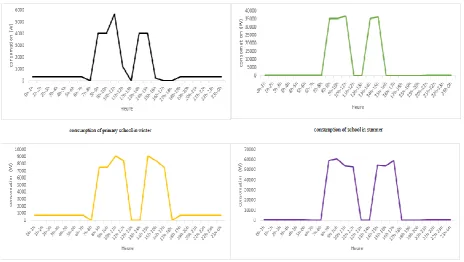
Figure 2 represents the consumption of primary school with 400 students. School are composed from:
• 20 classrooms
• 1 staffroom
• 2 offices
• 1 bathroom
The capacity of secondary school is over 900 students; it are composed from:
• 30 classes
• 1 staffroom
• 4 offices
• 2 bathrooms
• 2 laboratories
• Computer lab.
C- Global village consumption:
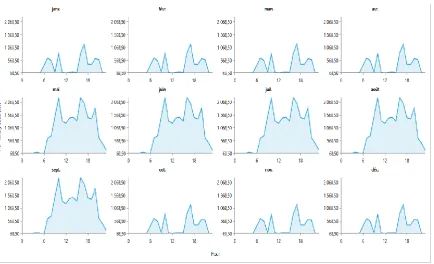
Timiaouine town consumes 7,52 MWh every day in winter and23 MWh/day in summer, the household presents 93% from global consumption, the second most consumption is
EAI Endorsed Transactions on Energy Web and Information Technology
On Energy Web
Research Article
3
the schools by 5% (secondary and primary).Figure3 illustrate monthly consumption of this rural village.
On note in this figure, consumption grow with temperature and exactly in summer when note also high temperature.
Usage of air conditioner in summer make consumption in summer grow too much compared consumption in winter.
Figure 1. Consumption of house in two seasons
Figure 2. Consumption of primary and secondary schools in two seasons
EAI Endorsed Transactions on Energy Web and Information Technology
Chouaib.A, Messaoud.H and Salim.M
4
Figure 3: monthly consumption of load profile
2.2 Weather data:
The climatic conditions play a major role as the entire power generation is dependent on this. For every different location the weather conditions will be different. So, for a feasibility study or for optimal sizing of the hybrid systems, weather data is a very important tool for analyzing the climatic conditions thoroughly before setting up a plant. Such data is mostly available at the local meteorological stations, for some potential sites the space research agencies like national aeronautics and space administration (NASA) have made the data available through the web resources. [16]
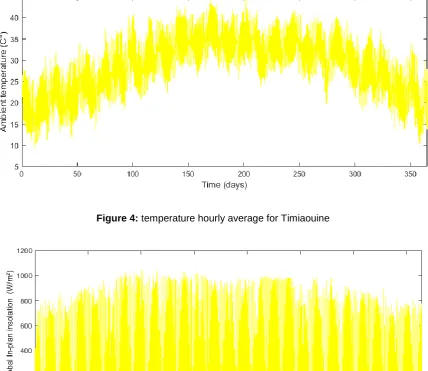
Fig.4,5 and 6 present the temperature, irradiation and wind speed respectively in Timiaouine city reload from
METEONORM program.
3. Mathematical modelling
3.1 Solar photovoltaic model:
The model “four parameters” is the most model used, this model equivalent photovoltaic cell like source current connected in series with resistance Rs and in parallel with diode (Fig.2) [17], the four parameter is module photocurrent at reference conditions (IL), diode reverse saturation current at reference conditions (I0), empirical diode PV curve fitting factor (γ), and module series
resistance (Rs). The total current (I) is calculated as follows Eq. (1), (2) [18]:
(1) We can simplify the equation (1) to another when we use the parameter taken from constructer:
(2) With:
, I_sc : short circuit current V_oc : open circuit voltage
I_mp : Maximum power point current V_mp : Maximum power point voltage
Figure 2: model four parameters for solar cell [17]
The last equation can modify to adapted with variation of solar radiation and temperature:
solar radiation and temperature:
EAI Endorsed Transactions on Energy Web and Information Technology
5
Figure 5: irradiation hourly average for Timiaouine
Figure 6: wind speed hourly average for Timiaouine
EAI Endorsed Transactions on Energy Web and Information Technology
Sizing and Optimization for Hybrid Central in South Algeria Based on Three Different Generators
6
α and β are temperature coefficient of current and voltage respectively (α=0,04 et β=-0,0033 datasheet condor)
3.2 Wind turbine [19]:
the power of wind turbine is defined by next equation (3): puissance
(3) with:
: air density (equal approximate 1,22 kg/ ) S: circular Surface brushed by the turbine [m2]
V: wind speed.
The aerodynamic torque defined by the next equation (4): (4) with:
: power coefficient and represent the aerodynamic performance for the wind turbine
: orientation angle for blade.
𝜆: speed report and defined like report between blade linear speed and wind speed
: turbine speed.
Permanent magnetic synchronic generator [20]:
the mathematic model of PMSG defined by different electrcal equation, magnetic and mecanical as show in the floowed Eq. (5), (6) and (7):
(5)
(6)
(7) motor torque.
coefficient of viscous rubbing. Couple of viscous rubbing. moment of inertia.
3.3 Diesel generator [11,12]:
(8) With:
TDM: mechanical torque
TD1: the electrohydraulic actuator time constant
TD2: time constant present delay of torque change
z(s): The fuel rack position : The transportation delay;
4. Results:
One from the objective of this study is produce clean energy, for this reason, hybrid central has been sized to base on the renewable resource more than combustible (in this study diesel generator present combustible source).
Bloc of simulation are showed in figure.7, when note use comparator to choice between different generator and compared between production for each generator and consumption.
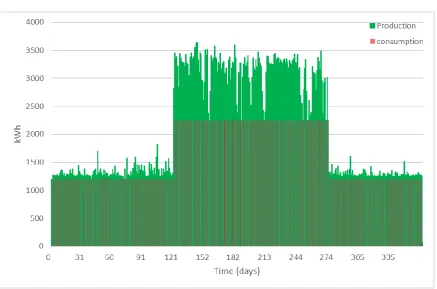
After simulation, hybrid central cover all consumption through year as showed in figure 8 when compared total production with consumption and note always production grow than consumption, that make proposition to introduce battery in this systems to minimized usage of fuel and reduce dioxide carbon emission.
Four strategy used in comparator to choice generator: 1st strategy: use solar photovoltaic and wind turbine to
cover consumption.
2nd strategy: if renewable generator can not cover
consumption, on use diesel generator to combined with renewable resource to meet consumption.
3rd strategy: use all generator using maximum production
for each generator.
Because capacity of photovoltaic installed great than wind turbine a cause solar potential are too much effective and power than wind potential and this what showed in Fig9. Figure 10 illustrate reparation for each generator when note solar photovoltaic present most production with 60% and when this last cannot cover consumption on time when no sun shine or in pic consumption, on use diesel generator, this is why diesel generator have 32%.
Last generator is wind turbine with 8%, just one wind turbine used to combine with solar photovoltaic to cover load profile and minimized usage of diesel generator. The results of sizing are summarized in next table:
Table2 Description of generators for hybrid central
PV array 2250(kW)
Annual PV production 3,85 (GWh)
Wind turbine 600kW
Annual wind turbine production 0,54 GWh
Diesel generator 1850 kW
Annual diesel generator production 2,03 GWh Annual fuel consumption 446423 L/year
Unmet electrical load 0 kW
Total production 6,43GWh
Percentage production from source
renewable 68,33%
production from renewable energy 4,39 GWh
EAI Endorsed Transactions on Energy Web and Information Technology
7
Figure 8: comparison between annual total production and consumption
EAI Endorsed Transactions on Energy Web and Information Technology
Chouaib.A, Messaoud.H and Salim.M
8
Figure 9: comparison between renewable generator production and consumption
Figure 10: reparation of global generator production
EAI Endorsed Transactions on Energy Web and Information Technology
9
5. Conclusion
On this study, has presented modeling and simulation of hybrid central based on three different generators. Load profile used is rural village in southwest Algeria.
The best configuration ecologically and economically is the usage of 2250 kW solar photovoltaic, 650 kW wind turbine and 1850 kW diesel generator. The production of the central is more based on renewable energy (68% from global production), from other part. The production from renewable source is sometimes greater than consumption, for that on propose install storage system to store this excess of production and to minimize the usage of diesel generator
References
[1] Türkay BE, Telli AY. Economic analysis of standalone and grid connected hybrid energy systems. Renewable Energy 2011;36(7):1931–43.
[2] Ijumba N.M., Wekesah C.W. Application potential of solar and mini-hydro energy sources in rural electrification. In: 1996, IEEE AFRICON 4th AFRICON; 1996.
[3] Bajpai P, Dash V. Hybrid renewable energy systems for power generation in stand-alone applications: A review. Renew Sustain Energy Rev 2012;16:2926–39.
[4] Subho Upadhyay n, M.P. Sharma. A review on configurations, control and sizing methodologies of hybrid energy systems, Renewable and Sustainable Energy Reviews 38 (2014) 47–63
[5] Prabodh Bajpai ,Vaishalee Dash ,Hybrid renewable energy systems for power generation in stand-alone applications: A review, Renewable and Sustainable Energy Reviews 16 (2012) 2926–2939
[6] Andre Malheiro , Pedro M. Castro, Ricardo M. Lima, Ana Estanqueiro. Integrated sizing and scheduling of wind/PV/diesel/battery isolated systems, Renewable Energy 83 (2015) 646-57
[7] Díaz P, Arias CA, Peña R, Sandoval D. FAR from the grid: a rural electrification field study. Renewable Energy 2010;35(12):2829–34.
[8] Aeidapu Mahesh, Kanwarjit Singh Sandhu, Hybrid wind/photovoltaic energy system developments: Critical review and findings, Renewable and Sustainable Energy Reviews 52 (2015) 1135–1147
[9] Nurul Arinabte Abdull Razak, Muhammad Murtadha bin Othman, Ismail Musir, Optimal Sizing and Operational Strategy of Hybrid Renewable Energy System Using HOMER, The 4th International Power Engineering and Optimization Conference/ MALAYSIA: 23-24 juin 2010 [10] "Population: Wilaya d'Adrar" (in French). Office National
des Statistiques Algérie. Retrieved 1 July 2013.( http://www.ons.dz/collections/w01_p1.pdf)
[11] Ammari, C., Hamouda, M. and Makhloufi, S. (2017) Sizing and Optimization for Hybrid Central in South Algeria Based on Three Different Generators, 6(3), 263-272. Int. Journal of Renewable Energy Development, 6(3), 263-272
[12] Arabali A, Ghofrani M, Etezadi-Amoli M, Fadali MS, Baghzouz Y. Genetic algorithm-based optimization approach for energy management. IEEE TransPower Delivery 2013;28(1):162–70 Jan.
[13] Fumo Nelson, Rafe Biswas MA. Regression analysis for prediction of residential energy consumption. Renewable Sustainable Energy Rev 2015;47(0):332–43.
[14] AsadiSomayeh, Shams AmiriShideh, Mottahedi Mohammad. On the development of multilinear regression analysis to assess energy consumption in the early stages of building design. Energy Build 2014;85(0):246–55. [15] Braun MR, Altan H, Beck SBM. Using regression analysis
to predict the future energy consumption of a supermarket in the fUKg. Appl Energy 2014;130(0):305–13.
[16] Ludmil Stoyanov / Etude de différentes structures de systèmes hybrides à sources d’énergie renouvelables/mémoire doctorat /UNIVERSITE TECHNIQUE DE SOFIA/ 2011.
[17] S. Makhloufi Comparative study between classical methods and genetic algorithms for sizing remote PV systems. Int J Energy Environ Eng (2015) 6:221–231 [18] Alleg Yacine. Dimensionnement d’un système hybride
photovoltaïque-éolien autonome. Thèses masters. University Batna. June 2013
[19] D. REKIOUA, Z. ROUMILA et T. REKIOUA, « Etude d’une centrale hybride photovoltaïque - éolien – diesel », Revue des Energies Renouvelables Vol. 11 N°4, pp. 623 – 633, 2008.
[20] Rachid ABDESSEMED/ Modélisation et simulation des machines électriques / ISBN 978-7298-6495-8/ Ellipses Edition 2011
EAI Endorsed Transactions on Energy Web and Information Technology