R E S E A R C H A R T I C L E
Open Access
Genome-wide meta-analysis identifies
novel loci associated with parathyroid
hormone level
Antonela Matana
1, Dubravka Brdar
2, Vesela Torlak
2, Thibaud Boutin
3, Marijana Popovi
ć
1, Ivana Gunja
č
a
1,
Ivana Kol
č
i
ć
4, Vesna Boraska Perica
1, Ante Punda
2, Ozren Pola
š
ek
4, Maja Barbali
ć
1, Caroline Hayward
3and Tatijana Zemunik
1*Abstract
Background:Parathyroid hormone (PTH) is one of the principal regulators of calcium homeostasis. Although serum PTH level is mostly accounted by genetic factors, genetic background underlying PTH level is insufficiently known. Therefore, the aim of this study was to identify novel genetic variants associated with PTH levels.
Methods:We performed GWAS meta-analysis within two genetically isolated Croatian populations followed by replication analysis in a Croatian mainland population and we also combined results across all three analyzed populations. The analyses included 2596 individuals. A total of 7,411,206 variants, imputed using the 1000 Genomes reference panel, were analysed for the association. In addition, a sex-specific GWAS meta-analyses were performed. Results:Polymorphisms with the lowestP-values were located on chromosome 4 approximately 84 kb of the 5′of
RASGEF1Bgene. The most significant SNP was rs11099476 (P= 1.15 × 10⁻⁸). Sex-specific analysis identified genome-wide significant association of the variant rs77178854, located withinDPP10gene in females only (P= 2.21 × 10⁻⁹). There were no genome-wide significant findings in the meta-analysis of males.
Conclusions:We identified two biologically plausible novel loci associated with PTH levels, providing us with further insights into the genetics of this complex trait.
Keywords:Parathyroid hormone, Genome-wide association analysis, Meta-analysis
Background
Parathyroid hormone (PTH) plays a critical role in the regulation of bone mineral metabolism and calcium homeostasis (DeLuca, 1986). PTH regulates serum cal-cium levels by stimulating osteoclast activity within bone in order to release calcium. Circulating PTH enhances the reabsorption of calcium in distal nephrons and in-duces the synthesis of the vitamin D active metabolite 1,25-dihydroxyvitamin D (1,25(OH)2D3) within the kid-ney (Kumar & Thompson, 2011; Kumar et al., 1991; Khundmiri et al.,2016). The 1,25(OH)2D3stimulates in-testinal calcium absorption and moreover, has a
syner-gistic effect with PTH in bone resorption by stimulating proliferation of osteoclasts (Kumar & Thompson, 2011; Kumar et al.,1991; Khundmiri et al.,2016).
Variations in PTH synthesis and secretion are regu-lated by serum levels of calcium and phosphate, as well as by 1,25(OH)2D3 (Kumar & Thompson, 2011; Gago et al., 2005). Decreases in serum levels of calcium and increases in serum levels of phosphate stimulate the se-cretion of PTH, while 1,25(OH)2D3decreases PTH se-cretion (Silver & Levi, 2005). Regulation of PTH secretion in response to variations in serum calcium is mediated by the calcium-sensing receptors on the mem-brane of parathyroid cells (Kumar & Thompson, 2011; Brent et al.,1988). 1,25(OH)2D3associates with the vita-min D receptor and thus represses the transcription of PTH. The secretion of PTH is also indirectly altered by * Correspondence:[email protected]
1Department of Medical Biology, University of Split, School of Medicine,
Šoltanska 2, Split, Croatia
Full list of author information is available at the end of the article
1,25(OH)2D3 and its regulation of calcium-sensing re-ceptor expression (Kumar & Thompson, 2011). Serum phosphate regulates PTH mRNA and serum PTH levels independently of changes in either serum calcium or 1,25(OH)2D3levels (Kilav et al.,1995).
The most common pathological condition of excessive secretion of parathyroid hormone is hyperparathyroidism. Primary hyperparathyroidism is due to hypersecretion of the parathyroid gland, while secondary hyperparathyroid-ism can result from conditions that lead to hypocalcemia, especially observed in patients with chronic kidney disease (Fraser,2009). Hypoparathyroidism, parathyroid hormone deficiency, is an uncommon condition that occurs mostly due to surgical removal of the parathyroid gland (Abate & Clarke,2017).
Both environmental and genetic factors influence serum PTH levels. It is estimated that 60% of the vari-ation in PTH concentrvari-ations is genetically determined. (Hunter et al., 2001). However, the genetic background underlying PTH level is not yet well understood.
Only one high-density genome-wide association study (GWAS) of PTH concentration has been reported to date (Robinson-Cohen et al., 2017). Robinson-Cohen et al. identified five significantly associated loci, including the strongest associated SNP rs6127099 located up-stream of CYP24A1, a gene that encodes the primary catabolic enzyme for 1.25 (OH)2D (Robinson-Cohen et al.,2017). The other significantly associated loci were in-tronic variant rs4074995 within RGS14 (regulator of G-protein signaling 14), rs219779 adjacent to CLDN14 (Claudin 14), rs4443100 located near RTDR1 (RSPH14, radial spoke head 14 homolog) and rs73186030 located near CASR (calcium-sensing receptor) gene (Robinson-Cohen et al.,2017). However, only three of these five loci (rs6127099, rs4074995 and rs219779) were replicated within an independent sample. Altogether, the five re-ported loci explained only 4.2% of the variance in circu-lating PTH, suggesting that additional genetic variants remain undiscovered.
The aim of our study is identification of novel loci as-sociated with the parathyroid function, by performing a GWAS meta-analysis of plasma PTH levels within two
genetically isolated Croatian populations (Korcula and Vis) following by replication analysis in the urban popu-lation of Split. To maximize the power of the study, we additionally performed meta-analysis for PTH plasma levels in all three Croatian populations. We also con-ducted gender-specific GWAS meta-analyses.
Methods
Study cohorts
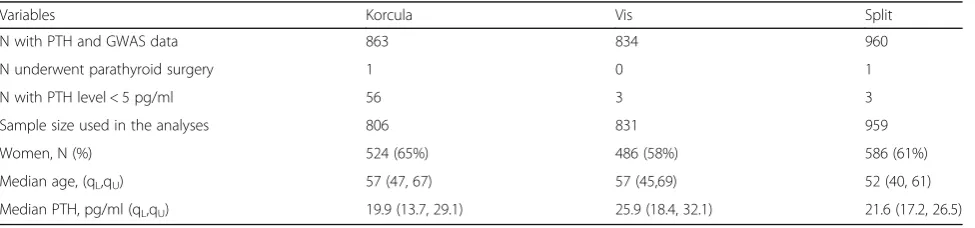
This study was performed on samples from three Croatian populations: from the Dalmatian islands of Korcula and Vis and the mainland city of Split, within the large-scale project of “10,001 Dalmatians” (Rudan et al., 2009). A detailed description of the cohorts is provided in Table 1. The Korcula population is genet-ically isolated from Croatian Mainland, while Vis population is genetically isolated from Croatian Main-land and surrounding isMain-lands (Vitart et al., 2008). For all study populations, we excluded participants who underwent parathyroid surgery, as well as individuals who had PTH level < 5 pg/ml, which is near the mini-mum PTH assay detection limit (4.3 pg/ml). After these exclusions, the number of individuals available with PTH level and genotype data was 806 in Kor-cula, 831 in Vis and 959 in Split. In all three cohorts there were no participants who reported serious renal disease that could affect PTH concentration. The study was approved by the Research Ethics Commit-tees in Croatia and Scotland and all participants pro-vided informed consent. All analyses were in
accordance with the relevant guidelines and
regulations.
Genotyping and imputation
Additional file1: Table S1 shows cohort-summary infor-mation on genotyping, imputation and quality control procedures. The final numbers of single nucleotide poly-morphisms (SNPs) included in analyses were 9,182,797 for the Korcula sample, 8,865,173 for the Vis sample and 8,777,560 for the Split sample. The number of overlap-ping SNPs present in all three cohorts was 7,411,206.
Table 1Characteristics of study participants
Variables Korcula Vis Split
N with PTH and GWAS data 863 834 960
N underwent parathyroid surgery 1 0 1
N with PTH level < 5 pg/ml 56 3 3
Sample size used in the analyses 806 831 959
Women, N (%) 524 (65%) 486 (58%) 586 (61%)
Median age, (qL,qU) 57 (47, 67) 57 (45,69) 52 (40, 61)
Median PTH, pg/ml (qL,qU) 19.9 (13.7, 29.1) 25.9 (18.4, 32.1) 21.6 (17.2, 26.5)
Measurement of PTH
Plasma PTH levels were determined by
radio-immunoassay method (RIA) in the Laboratory of Bio-chemistry, Department of Nuclear Medicine, University Hospital Split. RIA ran on the Scintillation counter li-quid samples, Capintec, and 125I served as a marker. The concentrations of PTH in the plasma were
deter-mined using commercial kits (DIAsource hPTH
-120 min-IRMA Kit, DIAsource ImmunoAssays S.A, Belgium). The reference range of plasma PTH levels is 12.26–35.50 pg/ml.
Statistical analyses
We performed genome-wide association analysis within each data set and then conducted a meta-analysis of two genetically isolated cohorts (Korcula and Vis) followed by replication analysis in the cohort of the mainland city of Split. To maximize the study power, we also per-formed a further meta-analysis of all three cohorts.
Genome-wide association analyses
Association analysis for the Split sample was carried out using a combination of R-package GenABEL and SNPTEST software, while for the Korcula and Vis samples analyses were conducted using R-packages GenABEL and VariABEL (Aulchenko et al., 2007; Marchini et al.,2007; Struchalin et al.,2012).
PTH levels were adjusted for age and sex using linear regression analysis and the calculated residuals were inverse-Gaussian transformed to achieve a normal distri-bution. GWAS was performed on transformed residuals using linear mixed model which accounts for population structure and relatedness. Association statistics for each SNP, including effect size estimates (β-estimates), stand-ard errors and p-values were calculated under an addi-tive genetic model.
Prior to performing the meta-analysis we calculated genomic inflation factors (lambdas) in individual data sets. No adjustments were necessary (λKorcula= 1.026, λVis= 1.001,λSplit= 0.99).
Meta-analysis
Meta-analysis was carried out using the R-package MetABEL (R: A Language and Environment for Statis-tical Computing, 2018). Meta-analysis was conducted using the inverse-variance fixed-effects method on over-lapping SNPs based on the β-estimates and standard er-rors from each study. Meta-analyses showed no significant evidence for inflated statistics (both λKorcula−Vis and λKorcula−Vis−Split were 1.01), thus no genomic correc-tion was applied. To visualize results of the meta-analysis, Manhattan and quantile-quantile (QQ) plots were created using R-package qqman (Turner, 2014). Regional association plots for loci of interest
(±400 kb) were produced using Locus Zoom based on hg19 genome build and 1000 genomes EUR popula-tion as the linkage disequilibrium (LD) populapopula-tion (Pruim et al., 2010). Forest plots for the most associ-ated SNP were creassoci-ated using R-package MetABEL. To confirm the genotyping quality for the most associ-ated SNPs in the regions, cluster plots were visually inspected using the Illumina GenomeStudio software package. If the SNP of interest was not directly geno-typed, but imputed, then cluster plots were examined for directly genotyped SNPs in high LD with the SNP of interest (r2> 0.8), located on the same chromosome and less than 400 kb apart. A genome-wide significance of association was defined as p−value≤5 × 10⁻⁸. Power calculations were performed using Quanto version 1.2.4 for quantitative traits (WJ MJ,2006).
Sex-specific analyses
In order to identify sex-specific effects we performed GWAS analyzing males and females separately in each cohort. We used the same procedures as in the primary analyses with the exception of the gender covariate. As-sociation results were meta-analyzed using the inverse-variance fixed-effects method. The total sample sizes were 1596 in women and 1000 in men.
Results
Meta-analyses
In each population, a separate genome-wide associ-ation study of PTH levels was conducted. We meta-analyzed two genetically isolated cohorts, Korcula and Vis (Additional file 1: Figure S1), and then replicated results in the Split population. A total of 1637 indi-viduals were included in the meta-analysis and 959 in the replication analysis (Table 1). The most associated SNP was rs4616742 (reference allele C, β= 0.18, SE= 0.04, P= 4.42 × 10⁻⁷). The SNP is located near protein
coding gene RASGEF1B (RASGEF Domain Family
Member 1B). All top SNPs, located on the
chromosome 4 near RASGEF1B gene with P< 10−6 from meta-analysis of ‘genetically isolated populations’ reached P< 0.05 in the Split population.
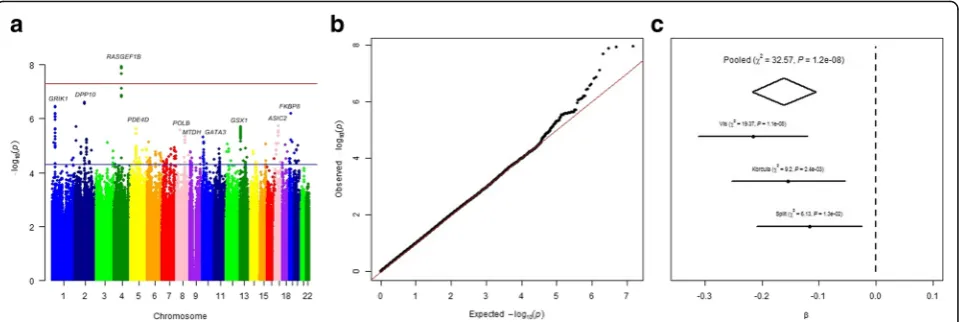
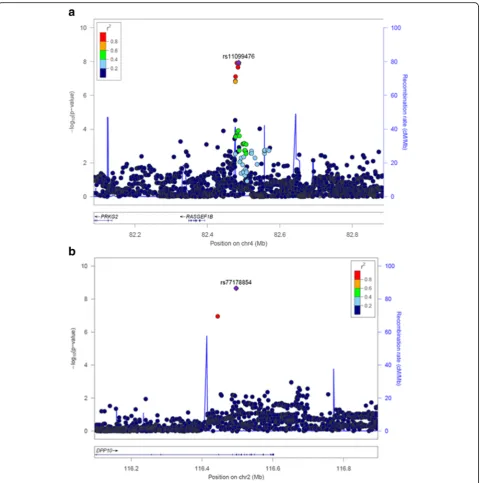
with higher PTH level (β= 0.16,SE= 0.03). Effect sizes were in the same direction across all three cohorts (Fig.1c). The regional association plot for rs11099476 is given in Fig.2a. The identified SNP, rs11099476, is in high LD with the top SNP from meta-analysis of ‘genetically isolated populations’, rs4616742 (r2= 0.9). These results indicated that associated locus is becoming more significant as the sample size increases and confirmed the consistency of our top finding.
Analysis also revealed several suggestive loci (P< 5 × 10⁻⁶), including rs77178854 in the DPP10 gene (P= 2. 46 × 10−7), rs481121 near the GRIK3 gene (P= 3.58 × 10⁻⁷), rs76615278 in the FKBP8 gene (P= 6.34 × 10⁻⁷), rs1875872 near the ASIC2 gene (P= 1.94 × 10⁻⁶), rs9512841 near the GSX1 gene (P= 2.01 × 10⁻⁶), rs191686630 in the PDE4D gene, rs3136797 in the
POLB gene (P= 2.68 × 10⁻⁶), rs499177 near the MTDH gene and rs58726672 near the GATA3 gene (P= 4.77 × 10⁻⁶) (Table2).
Sex-specific analyses
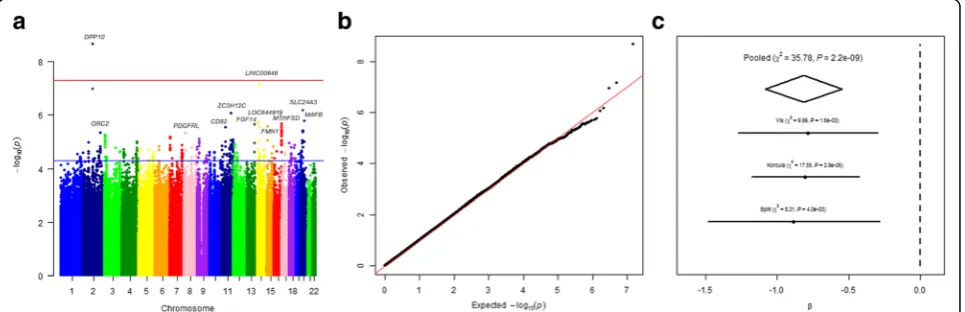
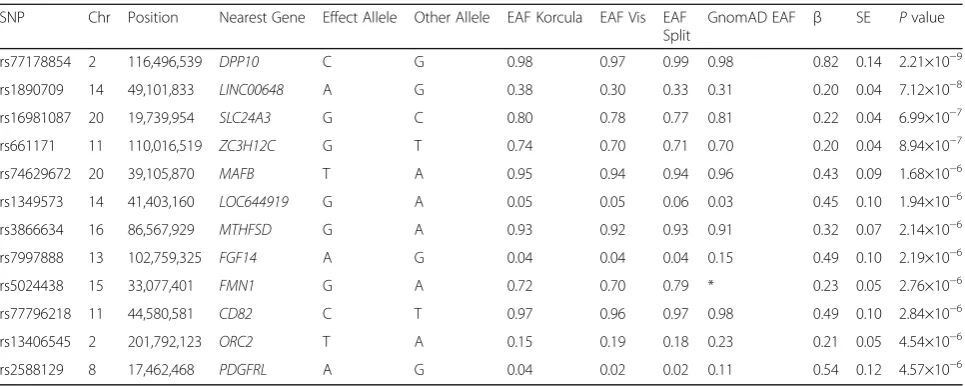
We searched for gender-specific loci by performing sex-specific GWAS meta-analysis, analyzing females and males separately in each cohort. The results for females are shown in Fig. 3. The top hit detected in the meta-analysis of all three cohorts, rs77178854, lo-cated within DPP10 gene, reached genome-wide sig-nificance (reference allele C, β= 0.82, SE= 0.14, P= 2. 21 × 10−9) in females (Table 3). Effect sizes were in the same direction across all three cohorts (Fig. 3c). Regional association plot of the identified SNP is shown in Fig. 2b. No single locus reaching genome wide significance was identified in males (Additional file 1: Table S2).
Discussion
In this GWAS meta-analysis of three Croatian popula-tions we identified a novel genome-wide significant locus associated with plasma PTH level near gene RASGEF1B on chromosome 4. We also identified a sex-specific sig-nificant association in females in theDPP10gene.
The significance of the identified polymorphism rs11099476 was most influenced by the Vis population, which is isolated from the Croatian Mainland and sur-rounding islands, then by the Korcula population which is isolated from the Croatian Mainland and the least contributed by the mainland city of Split population (Fig. 2c). However, although the locus significance was most affected by the isolated populations, significance has been amplified in the meta-analysis of all three co-horts compared to meta-analysis of ‘genetically isolated populations’.
The identified common variant rs11099476 accounts for 1.14% of population variance in plasma PTH.
RAS-GEF1B is the guanine nucleotide exchange factor with
specificity for Rap2A, a member of Rap subfamily of Ras-like G proteins (Yaman et al.,2009). Rap2 subfamily contains Rap2A and Rap2B, which share about 90% se-quence homology (Paganini et al., 2006). Rap2A protein binds GDP to GTP and exhibits a low intrinsic GTPase activity in the presence of Mg2+ (Lerosey et al., 1991), while Rap2B increases intracellular calcium level and phosphorylation level of extracellular signal-related kin-ase (ERK) 1/2 (Di et al., 2015). Variations near
RAS-GEF1Bgene have been associated with height (He et al., 2015; Allen et al., 2010). Height is positively correlated with calcium absorption efficiency which is important determinant of calcium balance (Abrams et al., 2005). Some evidence of association was also found for varia-tions in this gene and bone density, hip, and cystatin C
Fig. 1aManhattan plot of SNPs for PTH levels in the meta-analysis of three cohorts. Theyaxis shows the−log10Pvalues of 7,411,206 SNPs, and
thexaxis shows their chromosomal positions. The blue line indicates the threshold for suggestive hits (P= 5 × 10⁻⁵), and the red line represents
the threshold for genome-wide significance (P= 5 × 10⁻⁸).bQuantile-quantile plot in the meta-analysis of three cohorts.cForest plot of rs11099476
in serum (Kiel et al.,2007; Kottgen et al.,2010). PTH is a significant negative predictor of bone mineral density at the hip (Sneve et al., 2008). Cystatin C in serum is a biomarker of kidney function, and chronic kidney dis-ease (Kottgen et al., 2010). Disturbed kidney function can influence PTH stimulated calcium reabsorption and synthesis of 1,25(OH)2D3 (Kumar & Thompson, 2011; Kumar et al., 1991; Khundmiri et al.,2016). However, to understand the mechanism underlying the observed
association further functional studies ofRASGEF1B will be needed.
Although no signals other than rs11099476 reached genome-wide significance, several candidate loci showed suggestive evidence of association. Particularly interesting is the variant near GATA3 gene since mutations in this gene are the cause of hypoparathyroidism with sensori-neural deafness and renal dysplasia (Van Esch et al.,2000). Of note, in a previous large GWA meta-analysis, variant
nearGATA3gene was found to be associated with serum calcium (O'Seaghdha et al.,2013).
Given the reported differences in PTH level be-tween males and females, we performed sex-specific analyses (Wei et al., 2015; Serdar et al., 2017). Our study supports the sex-specificity underlying PTH level. Sex-stratified analysis in women identified a novel locus associated with PTH. The identified locus is the intron variant rs77178854, located within
DPP10 gene. DPP10 encodes a membrane protein
that is a member of the serine proteases family, which binds specific voltage-gated potassium channels and alters their expression and biophysical properties. It is highly expressed in brain, pancreas, spinal cord and adrenal gland (Allen et al., 2003), and may serve as a prognostic marker in colorectal cancer (Park et al., 2013). It is interesting to note that Aigner et al. showed that high serum PTH concentrations were
associated with distal colorectal cancer in women but not in men (Aigner et al., 2015). The existence of
DPP10 in endocrine cells indicate that the protein
might also have an additional role in the regulation of hormone secretion (Bezerra et al., 2015), which also supports our finding. Further studies of DPP10 will be needed to clarify this result.
The only previously published high-density GWAS for PTH levels did not identify RASGEF1B or DPP10 at a genome-wide significant level, despite having a sample size of over 29,155 participants (22, 653 in discovery stage and 6502 in replication analysis) (Robinson-Cohen et al., 2017). The possible explan-ation could be an increased relative effect of these loci in our populations due to the reduced genetic and environmental heterogeneity found in two out of three cohorts (i.e., Korcula and Vis) (Rudan et al., 2008) compared to the urban populations used in the Table 2Associations of top single nucleotide polymorphisms(P< 5 × 10⁻⁶) with PTH concentrations
SNP Chr Position Nearest Gene Effect Allele Other Allele EAF Korcula EAF Vis EAF Split GnomAD EAF β SE Pvalue
rs11099476 4 82,486,056 RASGEF1B T A 0.57 0.55 0.54 0.59 0.16 0.03 1.15×10⁻⁸
rs77178854 2 116,496,539 DPP10 C G 0.97 0.98 0.99 0.98 0.58 0.11 2.46×10⁻⁷
rs481121 1 37,203,485 GRIK1 A G 0.56 0.56 0.58 0.49 0.14 0.03 3.58×10⁻⁷
rs76615278 19 18,654,588 FKBP8 G A 0.84 0.83 0.82 * 0.20 0.04 6.34×10⁻⁷
rs1875872 17 31,795,716 ASIC2 A G 0.62 0.65 0.65 0.65 0.14 0.03 1.94×10⁻⁶
rs9512841 13 28,309,646 GSX1 G A 0.51 0.52 0.53 0.58 0.13 0.03 2.01×10⁻⁶
rs191686630 5 58,477,398 PDE4D A T 0.11 0.16 0.21 * 0.19 0.04 2.36×10⁻⁶
rs3136797 8 42,226,805 POLB C G 0.98 0.99 0.98 0.99 0.57 0.12 2.68×10⁻⁶
rs499177 8 98,472,201 MTDH T C 0.46 0.57 0.45 0.44 0.13 0.03 4.66×10⁻⁶
rs58726672 10 8,407,822 GATA3 C T 0.98 0.98 0.98 0.98 0.57 0.13 4.77×10⁻⁶
Top SNPs were defined as the SNP with lowest P value within a 500 kb window
Chr: chromosome; EAF: effect allele frequency; GnomAD EAF: effect allele frequency from Genome Aggregation Database;β: effect size; SE: standard error *variants without frequency information in Genome Aggregation Database
Fig. 3aManhattan plot of SNPs for PTH levels in the sex-stratified meta-analysis of three cohorts among females. Theyaxis shows the−log10P
values of 7,411,206 SNPs, and thexaxis shows their chromosomal positions. The blue line indicates threshold for suggestive hits (P= 5 × 10⁻⁵),
and red line represents the threshold for genome-wide significance (P= 5 × 10⁻⁸).bQuantile-quantile plot in the sex-stratified meta-analysis of
analysis of Robinson-Cohen et al. (Robinson-Cohen et
al., 2017). Previously reported CYP24A1, RGS14 and
CLDN14 variants associated with PTH level
(Robin-son-Cohen et al., 2017) had the same directions of ef-fect in our study as originally reported but did not show significant associations, probably due to limited sample size of our study or specificity of isolated pop-ulations (Additional file 1: Table S3).
The greatest strengths of our study include a com-prehensive set of genetic variants examined and eth-nically homogeneous sample. We had sufficient data to confidently detect an association for the identified
RASGEF1B locus, since our meta-analysis had 92%
power to detect associated SNP with an effect size of 0.19 and minor allele frequency of 0.45 at the genome-wide level of significance. Furthermore, meta-analysis performed in females only had 86% power to detect DPP10 locus with an effect size of 0.82 and minor allele frequency of 0.02 at the genome-wide level of significance. Meta-analysis performed in males only had 84% power to detect SNPs with an effect size of 0.35 and minor allele frequency of 0.3 at the genome-wide level of significance. The main limita-tion of our study is the modest sample size used in the analysis, reducing statistical power for detecting additional associations with smaller effect sizes or minor allele frequencies. Nevertheless, we have identi-fied novel, previously unsuspected and biological plausible associations with PTH variation. Further replication analysis would be required to confirm our findings and to discover additional genetic variants underlying PTH levels in order to explain more of the variability in PTH variations.
Conclusions
In summary, in a GWA meta-analysis of PTH levels we identified a novel significant locus rs11099476 located near a guanine nucleotide exchange factor RASGEF1B. The finding appears to be consistent based on analyses of meta-GWAS across all three analyzed cohorts and meta-GWAS across two isolated populations followed by replication analysis in the mainland cohort. Our work also includes the first gender-specific GWAS performed to date and revealed significant association for an intron variant rs77178854 located within the DPP10 gene in women, indicating the possibility that sex-specificity is underlying PTH level. To conclude, findings from this study improve the current knowledge of the genetic fac-tors regulating PTH levels and their validation in inde-pendent populations would be beneficial.
Additional file
Additional file 1:Supporting Information. (XLSX 54 kb)
Abbreviations
GWAS:genome-wide association study; PTH: Parathyroid hormone; RIA: radio-immunoassay method; SNP: single nucleotide polymorphism
Acknowledgments
We would like to thank all participants of this study and acknowledge invaluable support of the local teams in Zagreb and Split, especially that of the Institute for Anthropological Research, Zagreb, Croatia.
Funding
The Croatian Science Foundation funded this work under the project
“Identification of new genetic loci implicated in regulation of thyroid and parathyroid function”(grant no. 1498).
The“10 001 Dalmatians”project was funded by grants from the Medical Research Council (UK), European Commission Framework 6 project
Table 3Associations of top single nucleotide polymorphisms(P< 5 × 10⁻⁶) with PTH concentrations among females
SNP Chr Position Nearest Gene Effect Allele Other Allele EAF Korcula EAF Vis EAF Split
GnomAD EAF β SE Pvalue
rs77178854 2 116,496,539 DPP10 C G 0.98 0.97 0.99 0.98 0.82 0.14 2.21×10⁻⁹
rs1890709 14 49,101,833 LINC00648 A G 0.38 0.30 0.33 0.31 0.20 0.04 7.12×10⁻⁸
rs16981087 20 19,739,954 SLC24A3 G C 0.80 0.78 0.77 0.81 0.22 0.04 6.99×10⁻⁷
rs661171 11 110,016,519 ZC3H12C G T 0.74 0.70 0.71 0.70 0.20 0.04 8.94×10⁻⁷
rs74629672 20 39,105,870 MAFB T A 0.95 0.94 0.94 0.96 0.43 0.09 1.68×10⁻⁶
rs1349573 14 41,403,160 LOC644919 G A 0.05 0.05 0.06 0.03 0.45 0.10 1.94×10⁻⁶
rs3866634 16 86,567,929 MTHFSD G A 0.93 0.92 0.93 0.91 0.32 0.07 2.14×10⁻⁶
rs7997888 13 102,759,325 FGF14 A G 0.04 0.04 0.04 0.15 0.49 0.10 2.19×10⁻⁶
rs5024438 15 33,077,401 FMN1 G A 0.72 0.70 0.79 * 0.23 0.05 2.76×10⁻⁶
rs77796218 11 44,580,581 CD82 C T 0.97 0.96 0.97 0.98 0.49 0.10 2.84×10⁻⁶
rs13406545 2 201,792,123 ORC2 T A 0.15 0.19 0.18 0.23 0.21 0.05 4.54×10⁻⁶
rs2588129 8 17,462,468 PDGFRL A G 0.04 0.02 0.02 0.11 0.54 0.12 4.57×10⁻⁶
Top SNPs were defined as the SNP with lowest P value within a 500 kb window
EUROSPAN (Contract No.LSHG-CT-2006-018947), the Republic of Croatia Ministry of Science, Education and Sports research grant (216–1080315-0302), the Croatian Science Foundation (grant 8875), CEKOM (Ministry of Economy, Entrepreneurship and Crafts) and the Research Centre of Excellence in Personalized Medicine (Ministry of Science and Education).
Availability of data and materials
The datasets generated during the current study are available from the corresponding author on reasonable request.
Authors’contributions
TZ conceived the study idea; OP, CH, TZ, VBP, IK and MB formed the biobank
“10 001 Dalmatians”; VT, DB and AP performed the measurements of parathyroid hormones and verified the relevance of the results; TB performed imputation of the data; AM, MP, IG researched the data; AM performed the statistical analysis and drafted the manuscript; TZ, CH, MB, MP, IG, VBP and OP contributed to the discussion, review and editing of the manuscript; all authors approved the final version of the manuscript.
Ethics approval and consent to participate
The study was approved by the Research Ethics Committees in Croatia and Scotland and all participants provided informed consent.
Competing interests
The authors declare that they have no competing interests.
Publisher’s Note
Springer Nature remains neutral with regard to jurisdictional claims in published maps and institutional affiliations.
Author details
1
Department of Medical Biology, University of Split, School of Medicine,
Šoltanska 2, Split, Croatia.2Department of Nuclear Medicine, University
Hospital Split, Spinciceva 1, Split, Croatia.3MRC Human Genetics Unit,
University of Edinburgh, Western General Hospital, Crewe Road, Edinburgh, UK.4Department of Public Health, University of Split, School of Medicine Split,Šoltanska 2, Split, Croatia.
Received: 22 February 2018 Accepted: 2 April 2018
References
Abate EG, Clarke BL. Review of hypoparathyroidism. Front Endocrinol. 2017;7 Abrams SA, Griffin IJ, Hawthorne KM, Liang LL. Height and height Z-score are
related to calcium absorption in five- to fifteen-year-old girls. Journal of Clinical Endocrinology & Metabolism. 2005;90:5077–81.
Aigner E, Stadlmayr A, Huber-Schonauer U, Zwerina J, Husar-Memmer E, Niederseer D, Eder SK, Stickel F, Pirich C, Schett G, et al. Parathyroid hormone is related to dysplasia and a higher rate of distal colorectal adenoma in women but not men. Hormones & Cancer. 2015;6:153–60.
Allen HL, Estrada K, Lettre G, Berndt SI, Weedon MN, Rivadeneira F, Willer CJ, Jackson AU, Vedantam S, Raychaudhuri S, et al. Hundreds of variants clustered in genomic loci and biological pathways affect human height. Nature. 2010;467:832–8.
Allen M, Heinzmann A, Noguchi E, Abecasis G, Broxholme J, Ponting CP, Bhattacharyya S, Tinsley J, Zhang YM, Holt R, et al. Positional cloning of a novel gene influencing asthma from chromosome 2q14. Nat Genet. 2003;35: 258–63.
Aulchenko YS, Ripke S, Isaacs A, Van Duijn CM. GenABEL: an R library for genome-wide association analysis. Bioinformatics. 2007;23:1294–6. Bezerra GA, Dobrovetsky E, Seitova A, Fedosyuk S, Dhe-Paganon S, Gruber K.
Structure of human dipeptidyl peptidase 10 (DPPY): a modulator of neuronal Kv4 channels. Sci Rep. 2015;5
Brent GA, Leboff MS, Seely EW, Conlin PR, Brown EM. Relationship between the concentration and rate of change of calcium and serum intact parathyroid-hormone levels in normal humans. Journal of Clinical Endocrinology & Metabolism. 1988;67:944–50.
DeLuca HF. The metabolism and functions of vitamin D. Adv Exp Med Biol. 1986; 196:361–75.
Di JH, Huang H, Qu DB, Tang JJ, Cao WJ, Lu Z, Cheng Q, Yang J, Bai J, Zhang YP, Zheng JN. Rap2B promotes proliferation, migration, and invasion of human
breast cancer through calcium-related ERK1/2 signaling pathway. Sci Rep. 2015;5
Fraser WD. Hyperparathyroidism. Lancet. 2009;374:145–58.
Gago EV, Cadarso-Suarez C, Perez-Fernandez R, Burgos RR, Mugica JD, Iglesias CS. Association between vitamin D receptor Fokl polymorphism and serum parathyroid hormone level in patients with chronic renal failure. J Endocrinol Investig. 2005;28:117–21.
He MA, Xu M, Zhang B, Liang J, Chen P, Lee JY, Johnson TA, Li HX, Yang XB, Dai JC, et al. Meta-analysis of genome-wide association studies of adult height in east Asians identifies 17 novel loci. Hum Mol Genet. 2015;24:1791–800. Hunter D, De Lange M, Snieder H, MacGregor AJ, Swaminathan R, Thakker RV,
Spector TD. Genetic contribution to bone metabolism, calcium excretion, and vitamin D and parathyroid hormone regulation. J Bone Miner Res. 2001; 16:371–8.
Khundmiri SJ, Murray RD, Lederer E. PTH and vitamin D. Comprehensive Physiology. 2016;6:561–601.
Kiel DP, Demissie S, Dupuis J, Lunetta KL, Murabito JM, Karasik D. Genome-wide association with bone mass and geometry in the Framingham heart study. Bmc Medical Genetics. 2007;8
Kilav R, Silver J, Navehmany T. Parathyroid-hormone gene-expression in Hypophosphatemic rats. J Clin Investig. 1995;96:327–33.
Kottgen A, Pattaro C, Boger CA, Fuchsberger C, Olden M, Glazer NL, Parsa A, Gao XY, Yang Q, Smith AV, et al. New loci associated with kidney function and chronic kidney disease. Nat Genet. 2010;42:376–U334.
Kumar R, Cahan DH, Madias NE, Harrington JT, Kurtin P, Dawsonhughes BF. Vitamin-D and calcium-transport. Kidney Int. 1991;40:1177–89.
Kumar R, Thompson JR. The regulation of parathyroid hormone secretion and synthesis. J Am Soc Nephrol. 2011;22:216–24.
Lerosey I, Chardin P, Degunzburg J, Tavitian A. The product of the Rap2 gene, member of the Ras superfamily - biochemical-characterization and site-directed mutagenesis. J Biol Chem. 1991;266:4315–21.
Marchini J, Howie B, Myers S, McVean G, Donnelly P. A new multipoint method for genome-wide association studies by imputation of genotypes. Nat Genet. 2007;39:906–13.
O'Seaghdha CM, Wu HS, Yang Q, Kapur K, Guessous I, Zuber AM, Kottgen A, Stoudmann C, Teumer A, Kutalik Z, et al. Meta-analysis of genome-wide association studies identifies six new loci for serum calcium concentrations. PLoS Genet. 2013;9
Paganini S, Guidetti GF, Catricala S, Trionfini P, Panelli S, Balduini C, Torti M. Identification and biochemical characterization of Rap2C, a new member of the rap family of small GTP-binding proteins. Biochimie. 2006;88:285–95. Park HS, Yeo HY, Chang HJ, Kim KH, Park JW, Kim BC, Baek JY, Kim SY, Kim DY.
Dipeptidyl peptidase 10, a novel prognostic marker in colorectal Cancer. Yonsei Med J. 2013;54:1362–9.
Pruim RJ, Welch RP, Sanna S, Teslovich TM, Chines PS, Gliedt TP, Boehnke M, Abecasis GR, Willer CJ. LocusZoom: regional visualization of genome-wide association scan results. Bioinformatics. 2010;26:2336–7.
R: A Language and Environment for Statistical Computing 2018 [http://www. R-project.org/].
Robinson-Cohen C, Lutsey PL, Kleber ME, Nielson CM, Mitchell BD, Bis JC, Eny KM, Portas L, Eriksson J, Lorentzon M, et al. Genetic variants associated with circulating parathyroid hormone. J Am Soc Nephrol. 2017;28:1553–65. Rudan I, Carothers AD, Polasek O, Hayward C, Vitart V, Biloglav Z, Kolcic I, Zgaga L,
Ivankovic D, Vorko-Jovic A, et al. Quantifying the increase in average human heterozygosity due to urbanisation. Eur J Hum Genet. 2008;16:1097–102. Rudan I, Marusic A, Jankovic S, Rotim K, Boban M, Lauc G, Grkovic I, Dogas Z,
Zemunik T, Vatavuk Z, et al. "10 001 Dalmatians:" Croatia launches its National Biobank. Croatian Medical Journal. 2009;50:4–6.
Serdar MA, Can BB, Kilercik M, Durer ZA, Aksungar FB, Serteser M, Coskun A, Ozpinar A, Unsal I. Analysis of changes in parathyroid hormone and 25 (oh) vitamin D levels with respect to age, gender and season: a data mining study. Journal of Medical Biochemistry. 2017;36:73–83.
Silver J, Levi R. Regulation of PTH synthesis and secretion relevant to the management of secondary hyperparathyroidism in chronic kidney disease. Kidney Int. 2005;67:S8–S12.
Sneve M, Emaus N, Joakimsen RM, Jorde R. The association between serum parathyroid hormone and bone mineral density, and the impact of smoking: the Tromso study. Eur J Endocrinol. 2008;158:401–9.
Turner SD: qqman: an R package for visualizing GWAS results using Q-Q and manhattan plots.biorXivDOI:101101/0051652014.
Van Esch H, Groenen P, Nesbit MA, Schuffenhauer S, Lichtner P, Vanderlinden G, Harding B, Beetz R, Bilous RW, Holdaway I, et al. GATA3 haplo-insufficiency causes human HDR syndrome. Nature. 2000;406:419–22.
Vitart V, Rudan I, Hayward C, Gray NK, Floyd J, Palmer CN, Knott SA, Kolcic I, Polasek O, Graessler J, et al. SLC2A9 is a newly identified urate transporter influencing serum urate concentration, urate excretion and gout. Nat Genet. 2008;40:437–42.
Wei QS, Chen ZQ, Tan X, Su HR, Chen XX, He W, Deng WM. Relation of age, sex and bone mineral density to serum 25-Hydroxyvitamin D levels in Chinese women and men. Orthop Surg. 2015;7:343–9.
Gauderman WJ MJ: QUANTO 1.1: a computer program for power and sample size calculations for genetic-epidemiology studies.: University of Southern California; 2006.