with Multiple Exponential Vacation and
-Policy
K.V. Vijayashree
Department of Mathematics
College of Engineering, Anna University, Chennai [email protected]
B. Janani
Department of Mathematics
Central Institute of Plastics Engineering and Technology, Chennai [email protected]
Abstract
A single server Markovian queueing model is considered. The arrivals are allowed to join the queue according to a Poisson distribution and the service takes place according to an exponential distribution. Whenever the system is empty, the server goes for a vacation and return back to the system after N or more customers are found in the system. If the number of customers in the system is less than „ ‟ then the server takes another vacation. In this paper, we obtain explicit expressions for the time dependent system size probabilities of such a model using Laplace transform and generating function techniques. Numerical illustrations are added to support the theoretical results obtained.
Keywords: System Size Probabilities – Transient Analysis - Laplace Transform – Generating Function – Multiple Vacation.
1. Introduction
Queueing systems with server vacations have been well investigated due to their wide applications in many areas like computer systems, communication networks, manufacturing system and so on. There are different types of vacation policies like single vacation, multiple vacation, working vacation, to mention a few.
In the single vacation policy, the server takes a vacation of a random duration when there are no customers in the system. The server returns to the system at the end of the vacation and starts providing service to the waiting customer, if any, otherwise the server will wait to complete the busy period. In multiple vacation policy, if the server returns from a vacation and finds the queue empty, he immediately takes another vacation. In the working vacation policy, the server works at a slower rate rather than completely stopping the service during a vacation period.
vacations. Liu et al (2007) established a stochastic decomposition result in the queue with working vacation.
Further, Xu et al (2007) studied a batch arrival queue with single working vacation and derived the probability generating function (PGF) of the stationary system length distribution using matrix analytic method. Baba (2012) studied a batch arrival queue with multiple working vacations and obtained the PGF of the stationary system length distribution and the stochastic decomposition structure of system length that indicates the relationship with that of queue without vacation. Selvaraju et al (2013) analyzed an queue for two different working vacation termination policies namely a multiple working vacation policy and a single working vacation policy. Closed form solution and various performance measures like mean queue length and mean waiting times are derived.
Although queueing models subject to vacation are extensively dealt in the literature, most of them analyse the system under steady state. Steady state results are inappropriate in situations where the time horizon of operation is finite. In many practical applications steady state measures of system performance simply do not make sense when we need to know how the system will operate upto some specified time. There are very few papers which deals with transient analysis of a queueing model subject to vacation. Sudhesh (2012) discussed the single server queueing model subject to working vacation in both stationary and transient regime. Recently, Kalidass and Ramnath (2014) obtained the time dependent probabilities for the queue subject to multiple vacation with arbitrary boundary condition. This paper presents an explicit expression for the time dependent state probabilities during the functional state and the vacation state of the server in terms of modified Bessel function of first kind.
The paper is organised as follows. Section 2 presents the description of the model under consideration, Section 3 and Section 4 presents the explicit expression for the stationary and transient probabilities respectively. Section 5 depicts the numerical illustrations of the behaviour of state probabilities for varying values of the parameters and are shown to converge to their corresponding steady state probabilities. Section 6 briefly gives the conclusion and scope for further research.
2. Model Description
Consider a single server queueing model in which arrivals are allowed to join the system according to a Poisson distribution with parameter and service takes place according to an exponential distribution with parameter The server goes for a vacation, if the system becomes empty and returns back when or more customers are found to be waiting for service. The vacation times of the server are assumed to follow exponential distribution with parameter .
*( ) + The state transition diagram for the model is given in Figure 1.
Let ( ) denote the time dependent probabilities for the system to be in state with customers at time . Mathematically
( ) ( ( ) ( ) ) and
( ) ( ( ) ( ) )
By standard methods, the system of Kolmogorov differential difference equations governing the process are given by
( ) ( ) ( ) ( )
( ) ( ) ( ) ( )
( ) ( ) ( ) ( ) ( )
( ) ( ) ( ) ( ) ( )
( ) ( ) ( ) ( ) ( ) ( )
and
( ) ( ) ( ) ( ) ( ) ( ) ( )
subject to the conditions ( ) and ( ) for and
3. Stationary Probabilities
This section presents the steady state probabilities of the queue with multiple exponential vacation and -policy. Let
denotes the corresponding steady state probabilities for the system to be in state ( ). Under steady state
( )
and hence equations ( ) to ( ) becomes
( ) ( ) ( ) ( ) ( ) ( ) ( ) ( ) ( ) ( ) ( ) ( ) ( ) ( ) ( ) ( ) ( ) and
( ) ( ) ( ) ( ) ( ) ( )
Equations ( ) ( ) and ( ) can be written as
and
( )
where Similarly equations ( ) ( ) and ( ) gives
(∑
) (
) and
∑ ( )
∑
Therefore all the steady state probabilities are expressed in terms of Using the normalization condition,
∑
∑
we obtain
{ ∑ ( )
∑ ∑ ∑ { ∑ (
)
∑
}
}
which on simplification leads to
( )
Hence all the stationary probabilities are explicitly determined.
4. Transient Probabilities
This section presents the transient solution of the above described model using the generating functions technique. Time dependent analysis helps us to understand the behaviour of a system, when the parameters are perturbed. In addition, transient analysis is very useful in obtaining an optimal solution which leads to the control of the system.
Define
( ) ∑ ( )
∑ ( )
∑ ( )
Then,
( )
∑ ( )
∑ ( )
∑ ( )
From ( ) and ( ), after some algebra, we have
( )
( ( ) ) ( ) ∑ ( ) ( )
Integrating with respect to „ ‟ yields
( ) ∫ (∑ ( )
) ( )( ) ( )( )
∫ ( ) ( )( ) ( )( ) ( )
It is well known that if √ and √ , then
( ) ∑ ( ) ( )
where ( ) is the modified Bessel function of the first kind.
Comparing the coefficients of in ( ) for leads to
( ) ∫ ∑ ( )
( ( )) ( )( )
Using ( ) ( ) and comparing the coefficients of in ( ) yields
∫ ∑ ( ) ( ( )) ( )( )
∫ ( ) ( )( ) ( (
)) ( )
From ( ) and ( ) for we get
( ) ∫ ∑ ( ) * ( ( ))
( (
))+ ( )( ) ( )
Hence ( ) for are expressed in terms of ( ), which are determined below.
Evaluation of ( )
Let ̂ ( ) be the Laplace transform of ( ) Taking Laplace transform of ( ), ( ) and ( ) leads to
̂ ( ) ̂ ( ) ( )
̂ ( ) (
) ̂ ( ) ( ) and
̂ ( ) ( )
( ) (
)
̂ ( ) ( )
Inverting ( ) and ( ) leads to
( )
( ) ( ) ( ) and
( )
( ) ( )
( ) ( ) ( )
Substituting in ( ) yields
( ) ∫ ∑ ( ) * ( ( )) ( ( ))+ ( )( )
and its corresponding Laplace transform is given by
̂ ( )
(
)
( )
∑ (
) (
√ )
̂ ( ) ( )
where Substituting ( ) in (4.5) leads to
̂ ( ) ∑ ( ) ( ) ( ∑ ( ) (
√ )
)
which on inversion yields
( ) ∑ ∑ (
( ) )
( )
( ∑ ( ) ( ) ( )
( ) ( ) )
The other time dependent probabilities are given in terms of ( ) in ( ) ( ) and ( ). Therefore, all the time dependent probabilities are explicitly expressed in terms of modified Bessel function of first kind.
Special Case
When the model reduces to that of an queue with multiple exponential vacation wherein,
( ) ( ) ( ) ( ) ,
( ) ∫ ∑ ( ) ( )( )( ( ( ) ( ( )))
and
( ) ∑
{∑(
)
( ) ( ( )
( )) ( ) }
The above expressions for the probabilities are seen to coincide with the results obtained by Sudhesh ( ) with .
5. Numerical Illustrations
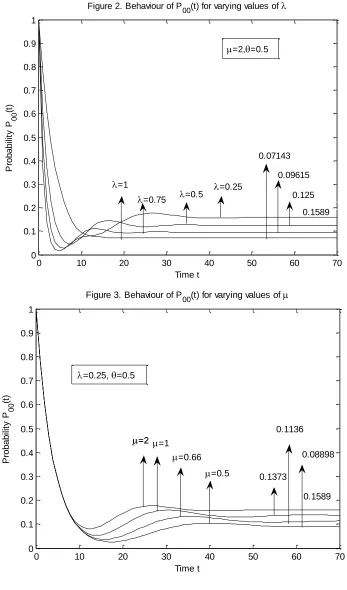
Figure 2. depicts the variation of ( ) against time for and varying values of , namely and . Since the system is assumed to be initially in functional state, the curve for ( ) begins at 0. The value of ( ) increases with increase in and decrease in (as shown in Figure 3.). It is seen that ( ) converges to the corresponding steady state probabilities as tends to infinity.
0 10 20 30 40 50 60 70
0 0.1 0.2 0.3 0.4 0.5 0.6 0.7 0.8 0.9 1
Time t
P
ro
b
a
b
ili
ty
P
00
(t
)
Figure 2. Behaviour of P00(t) for varying values of
=1
=0.75 =0.5
=0.25
0.07143
0.09615
0.125
0.1589
=2,=0.5
0 10 20 30 40 50 60 70
0 0.1 0.2 0.3 0.4 0.5 0.6 0.7 0.8 0.9 1
P
ro
b
a
b
ili
ty
P
00
(t
)
Figure 3. Behaviour of P00(t) for varying values of
=2 =1
=2
=0.66
=0.5
0.1589 0.1373
0.1136
0.08898
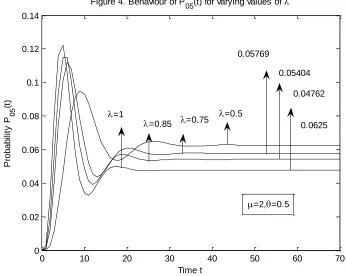
Figure 4. depicts the variation of ( ) against time for and varying values of and The value of ( ) increases as increases upto a maximum value after which it decreases and attains a steady state.
Figure 5. depicts the variation of ( ) against time for and varying values of and The value of ( ) increases as decreases upto maximum level after which it decreases and attains a steady state.
0 10 20 30 40 50 60 70
0 0.02 0.04 0.06 0.08 0.1 0.12 0.14 Time t P ro b a b ili ty P 05 (t )
Figure 4. Behaviour of P
05(t) for varying values of
=1
=0.85 =0.75
=0.5
0.0625 0.05769
0.05404
0.04762
=2,=0.5
0 10 20 30 40 50 60 70
0 0.01 0.02 0.03 0.04 0.05 0.06 0.07
0 10 20 30 40 50 60 70
0 0.01 0.02 0.03 0.04 0.05 0.06 0.07 Time t P ro b a b ili ty P 05 (t )
Figure 5. Behaviour of P05(t) for varying values of
0.03568 0.04505 0.053
= 2
= 1
= 0.6
= 0.5
Figure 6. depicts the variation of ( ) against time for and varying values of and The value of ( ) increases as increases upto a maximum value after which it decreases and attains a steady state.
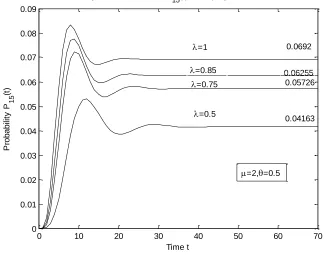
Figure 7. depicts the variation of ( ) against time for and varying values of and The value of ( ) increases as increases upto a maximum value after which it decreases and attains a steady state.
0 10 20 30 40 50 60 70 0
0.01 0.02 0.03 0.04 0.05 0.06 0.07 0.08 0.09 0.1
Time t
P
ro
b
a
b
ili
ty
P
05
(t
)
Figure 6. Behaviour of P05(t) for varying values of
0.05302 0.05976 0.06801 0.07268
= 0.25
= 0.4
= 0.5
= 0.3
= 0.25, = 2
0 10 20 30 40 50 60 70 0
0.01 0.02 0.03 0.04 0.05 0.06 0.07 0.08 0.09
Time t
P
ro
b
a
b
ili
ty
P
15
(t
)
Figure 7. Behaviour of P15(t) for varying values of
=0.5
=0.75
=0.85
=1
=2,=0.5 0.0692
0.06255 0.05726
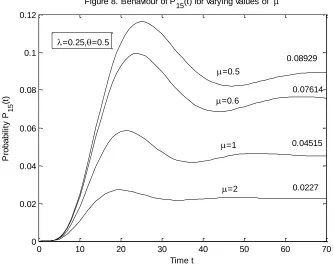
Figure 8. depicts the variation of ( ) against time for and varying values of and The value of ( ) increases as decreases upto a maximum level after which it decreases and attains a steady state.
Figure 9. depicts the variation of ( ) against time for and varying values of and The value of ( ) increases upto a maximum value as increases after which it decreases and attains a steady state.
0 10 20 30 40 50 60 70 0
0.02 0.04 0.06 0.08 0.1 0.12
Time t
P
ro
b
a
b
ili
ty
P
15
(t
)
Figure 8. Behaviour of P15(t) for varying values of
=0.5
=0.6
=1
=2
=0.25,=0.5
0.08929
0.07614
0.04515
0.0227
0 10 20 30 40 50 60 70
0 0.005 0.01 0.015 0.02 0.025 0.03
Time t
P
ro
b
a
b
ili
ty
P
15
(t
)
Figure 9. Behaviour of P15(t) for varying values of
=0.3
=0.05
=0.15
=0.75
=0.25,=2 0.02344
0.02138
0.01875
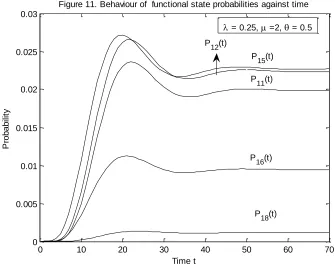
Figure 10. and Figure 11 depicts the variation of vacation state and functional state probabilities against time for and
.
0 10 20 30 40 50 60 70
0 0.1 0.2 0.3 0.4 0.5 0.6 0.7 0.8 0.9 1
Time t
P
ro
b
a
b
ili
ty
Figure 10. Behaviour of vacation state probabilities against time
P00(t) P02(t)
P
04(t)
P05(t) P06(t) P08(t)
= 0.25, = 2, = 0.5
0 10 20 30 40 50 60 70
0 0.005 0.01 0.015 0.02 0.025 0.03
Time t
P
ro
b
a
b
ili
ty
Figure 11. Behaviour of functional state probabilities against time
P
15(t)
P
16(t)
P
18(t)
P
11(t)
P
12(t)
6. Conclusion and Future Scope
A single server queueing model with Poisson arrival and exponentially distributed service time is analyzed in transient regime. The server is subject to multiple vacation wherein the service is resumed where there are „ ‟ or more customers in the system. Explicit analytical expressions for the state probabilities are obtained in term of modified Bessel function of first kind. As a special case, when , the results are deduced for an queue with multiple exponential vacation. Further, numerical illustrations are included to present the behaviour of various state probabilities against different values of the parameter. The model can be further extended to analyse a multi server queueing model under various vacation strategies.
References
1. Baba .Y., “Analysis of a queue with multiple working vacations,”
Performance Evaluation, vol. 63, no.2, pp. 201-209, 2005.
2. Baba .Y., “The queue with multiple working vacation,” American Journal of Operations Research, vol. 2, no. 2, pp. 217-224, 2012.
3. Banik .A. D., Gupta .U. C., and Pathak .S. S., “On the queue with multiple working vacations-analytic analysis and computation,” Applied Mathematical Modelling, vol. 31, no.9, pp. 1701-1710, 2007.
4. Doshi .B. T., “Queuing systems with vacations – a survey,” Queueing Systems: Theory and Applications, vol. 1, no. 1, pp. 29-66, 1986.
5. Doshi .B.T., “Single server queues with vacations”, in Stochastic Analysis of Computer and Communication systems, H. TakagEd., pp.217-265, Elsevier, 1990.
6. Kaliappan Kalidass and Kasturi Ramanath, “Transient Analysis of an Queue with Multiple Vacations”, in Pakistan journal of Statistics and Operations research, vol.10, no.1, pp. 121-130, 2014.
7. Levy .Y and Yechiali .U., “Utilization of idle time in an M/G/1 queueing system,”
Management Science, vol. 22, no. 2, pp.202-211, 1975.
8. Liu.W, Xu .X, and Tian .N., “Stochastic decompositions in the queue with working vacations,” Operations Research Letters, vol. 35, no. 5, pp. 595-600, 2007.
9. Selvaraju .N, Cosmika Goswami, “Impatient customers in an queue with single and multiple vcations,” Computers and Industrial Engineering, vol. 65, pp. 207-215, 2013.
10. Servi. L.D. and Finn S. G., “ queues with working vacations ( ),” Performance Evaluation, vol. 50, no. 1, pp. 41-52, 2002.
11. Sudhesh .R. and Francis Raj .L, “Computational analysis of Stationary and
12. Takagi H., Queueing Analysis: A Foundation of Performance Evaluation, vol. 1of Vacation and Priority systems, part 1, Elsevier Science Publishers B.V., Amsterdam, The Netherland 1991.
13. Tian N. and Zhang Z. G., Vacation Queueing Models: Theory and Applications, Springer, New York, Ny, USA, 2006.
14. Wu .D. and Takagi .H., “ queue with multiple working vacations,” Performance Evaluation, vol.63, no. 7, pp. 654-681, 2006.