R E V I E W
Open Access
Advanced model systems and tools for
basic and translational human immunology
Lisa E. Wagar
1, Robert M. DiFazio
2and Mark M. Davis
1,2,3*Abstract
There are fundamental differences between humans and the animals we typically use to study the immune system. We have learned much from genetically manipulated and inbred animal models, but instances in which these findings have been successfully translated to human immunity have been rare. Embracing the genetic and environmental diversity of humans can tell us about the fundamental biology of immune cell types and the elasticity of the immune system. Although people are much more immunologically diverse than conventionally housed animal models, tools and technologies are now available that permit high-throughput analysis of human samples, including both blood and tissues, which will give us deep insights into human immunity in health and disease. As we gain a more detailed picture of the human immune system, we can build more sophisticated models to better reflect this complexity, both enabling the discovery of new immunological mechanisms and facilitating translation into the clinic.
Background
Technological and reagent advances have accelerated our ability to perform human immunology research in a rigorous, ethical, and high-throughput manner. The goal of this review is to bring attention to the variety of tech-niques and options available for studying the human im-mune system directly and indirectly through judicious use of appropriate models, in vitro assays, and in vivo studies to improve the translatable potential of immun-ology research. Choosing the right model system for a given immunological question is essential. Much of what
* Correspondence:[email protected] 1
Department of Microbiology and Immunology, Stanford University School of Medicine, Stanford, CA 94305, USA
2Institute for Immunity, Transplantation, and Infection, Stanford University
School of Medicine, Stanford, CA 94305, USA
Full list of author information is available at the end of the article
we currently know is derived from studies in inbred mice, and while they seem very similar to humans in many basic aspects, it appears likely that the much greater breadth of pathogen exposure experienced by human beings, together with their genetic heterogeneity, will result in many disparities. Intensive efforts over the past 30 years have seen the creation of ‘humanized’mice with varying degrees of fidelity in accurately modeling human immune responses [1–5]. But the use of these animals presents a daunting problem for translation to humans because of the many incompatibilities between cytokines and cytokine receptors between species.
Although animal models certainly have a place in im-munology research, it’s important to recognize their lim-itations in various aspects of recapitulating human immunity. Some human diseases have no appropriate animal model, and others are hampered by models that incompletely recapitulate key features of a human dis-ease. Striking differences in the T cell responses of in-bred mice cohabited with pet store mice have shown clearly that at least some of the differences between in-bred mice and humans are due to environmental expos-ure [6], and even nonhuman primate models (NHP) have failed to predict human immune responses [7, 8]. Mice live one to two years, a miniscule amount of time compared to the average human lifespan. Not only is it virtually impossible to mimic a human lifetime’s worth of antigenic exposure in such a short period of time, but cell turnover is regulated in different ways in different species [9]. Most animal models are based around fixed genetic diversity (e.g., in major histocompatibility loci) and their distributions of immune-relevant receptors and ligands are quite distinct from those of humans (su-perbly summarized in [10]). If we seek to extend animal model findings to human immunity, it is important to get these genetic and cellular distributions right. Indeed, pre-clinical studies have often been poorly predictive of response in humans [11–17]. The combination of so-phisticated animal models that are more relevant for studying human disease and our ability to perform direct
ex vivo and in vitro high-throughput assays from human cohort samples suggests a bright future for understanding human immunity. Here, we discuss these new tools and systems that are available to better reflect the complexities of human immunity.
Improved animal models
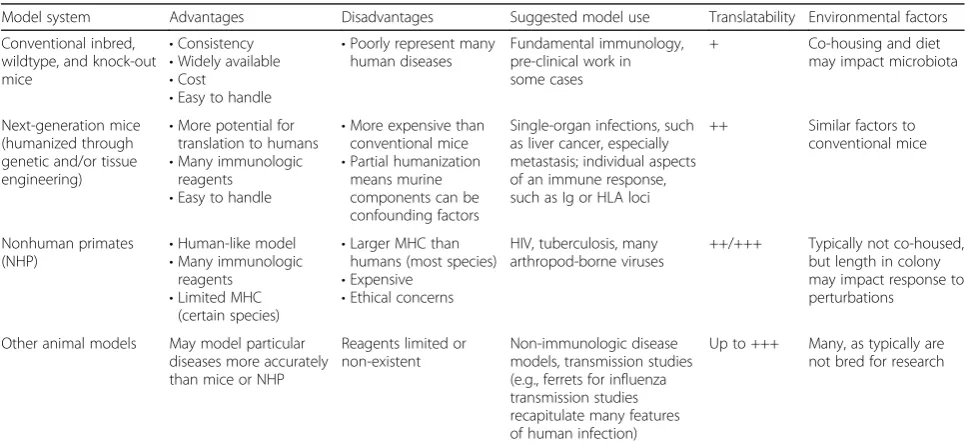
Owing to logistical and ethical considerations, experi-mental research in humans has limitations. This is espe-cially the case for the testing of completely novel interventions and for mechanistic immunology research, although the tools that will overcome these challenges are being developed rapidly, as we discuss below. There-fore, animal models still have a place in the translational pipeline due to their ability to overcome these chal-lenges. Myriad models are used for pre-clinical assess-ments, though generally speaking, the murine and NHP models are best for immunologic studies because of the availability of reagents and tools (Table 1). From small models (mice, guinea pigs, hamsters, zebra fish, and fer-rets, among others) to large models (nonhuman primates, pigs, cows, sheep, and more), each model has its own set of advantages and disadvantages, and when choosing them, careful consideration should be made as to how they fit the research question. Here, we focus on the mur-ine and NHP models and the recent advances in, and broad applications to, human translational immunology.
Murine models
The advantages of mice are universally understood: they are small, tractable, inexpensive, and have many reagents
readily available. Their tractability has led to many in-sights in basic immunology; many of the key inin-sights gained in basic human immunology (such as lymphocyte receptor function, tissue homing, costimulation, and cytokine/chemokine signaling) were first elucidated in murine models. However, the inability of mice to mimic the human immune response means that they can be problematic in studies involving translation to the hu-man system [11, 12, 18–21]. Many diseases that are of human relevance either do not exist or present differ-ently in mice. For example, many viruses that cause dis-ease in humans do not replicate in mice, and when they do, the pathology that results is often different to that observed in humans [22,23]. Small molecules and other therapeutics can be species-specific and exert effects in humans that are different from those in animal models. Currently, the main tool to bridge this gap is the use of humanized mice.
Three of the most common types of murine models used for pre-clinical research are: genetically engineered mouse models; xenograft models, engrafted with either cell-line-derived (CDX) or patient-derived (PDX) tissue; and humanized models, which incorporate orthotopic implantations or injections and use tissue engineering and/or regenerative medicine approaches [24]. Human-ized mice have been used for decades to model human immunity [25–28]. A breakthrough occurred in the early 2000s with IL2Rγnull mice, which after engraftment are considered the most human-like model to date and en-compass three main strains of mouse (detailed in [29]). There are a few approaches to engraft human immune
Table 1An overview of animal models for translational studies for human immunology
Model system Advantages Disadvantages Suggested model use Translatability Environmental factors
Conventional inbred, wildtype, and knock-out mice
•Consistency
•Widely available
•Cost
•Easy to handle
•Poorly represent many human diseases
Fundamental immunology, pre-clinical work in some cases
+ Co-housing and diet
may impact microbiota
Next-generation mice (humanized through genetic and/or tissue engineering)
•More potential for translation to humans
•Many immunologic reagents
•Easy to handle
•More expensive than conventional mice
•Partial humanization means murine components can be confounding factors
Single-organ infections, such as liver cancer, especially metastasis; individual aspects of an immune response, such as Ig or HLA loci
++ Similar factors to conventional mice
Nonhuman primates
(NHP) •
Human-like model
•Many immunologic reagents
•Limited MHC (certain species)
•Larger MHC than humans (most species)
•Expensive
•Ethical concerns
HIV, tuberculosis, many arthropod-borne viruses
++/+++ Typically not co-housed, but length in colony may impact response to perturbations
Other animal models May model particular diseases more accurately than mice or NHP
Reagents limited or non-existent
Non-immunologic disease models, transmission studies (e.g., ferrets for influenza transmission studies recapitulate many features of human infection)
Up to +++ Many, as typically are not bred for research
Translatability (from weak (+) to strong (+++)) refers to the relative frequency of successfully identifying an immune phenomenon in the model system that closely mimics the relevant disease or condition in humans
cells into mice: using peripheral blood leukocytes (PBL); injection of severe combined immunodeficiency (SCID) reconstituting cells (SRC), also known as CD34+ hema-topoietic stem cells (HSC); and the bone marrow/liver/ thymus (BLT) model, established by transplantation of fetal liver and thymus and injection of autologous fetal liver HSCs [29]. The method of immune system engraft-ment [29] is important in relation to the research ques-tion being asked; for example, the BLT model would be most appropriate for human immunodeficiency virus (HIV)-related studies because it provides a higher level of engraftment of the human mucosal system [30]. The advantages and limitations of these models have been reviewed exhaustively by others [2,29,31–34]; therefore, in this review, we focus on a few recent advances.
Knock-in (KI) mice have emerged as a powerful tool to engraft whole parts of the human immune system, such as immunoglobulin (Ig) loci [35]. Transgenic human Ig loci were engrafted using bacterial artificial chromosome clones and sequential recombinase-mediated cassette exchange. This model has been utilized to study HIV humoral re-sponses to novel interventions [36,37] and is likely to be useful in any study in which humoral immune response is key (e.g., Zika or Dengue infection and disease). Advantages include being a controlled system and the maintenance of murine constant regions to avoid incompatibility effects, but this model does not reflect the other genetically diverse aspects of humans or their exposure history, nor does it re-flect the immune system as a whole as other leukocyte pop-ulations remain murine. Another approach is to knock-in cytokines to enhance other immune responses, as has been achieved, for example, in IL-6 KI mice [5]. One new type of KI mouse (MISTRG) is developed using HSC engraftment on a background with multiple human cytokine knock-ins and demonstrates superior myeloid and natural killer (NK) cell development and hematopoiesis [3]. Human leukocyte antigen (HLA) transgenic mice have shown the ability to present human antigens in vivo in a model using human cytomegalovirus [38]. Engrafting humanized mice with um-bilical cord blood is technically straightforward and pro-vides T cells and autologous antigen-presenting cells (APCs) that can present cognate antigen [39]. The de novo transformation of B cells with Epstein-Barr virus (EBV) is observed in this model with tumor masses and tumor microenvironment similar to those observed in humans. Human bone marrow niche-forming cells can also be engrafted in the PDX model by either seeding the cells in vitro or by using a previously implanted scaffold. By using tissue engineering approaches to create a humanized microenvironment in addition to simply engrafting cells, one can study both hematopoiesis and malignancies in a more human-like system [40].
To further these ends, a framework has been proposed to generate a platform that would validate new humanized
mice in a standardized manner; this approach merges tis-sue engineering and regenerative medicine techniques with benchmarks validated against human clinical data with known predictive power [24]. Others have proposed the co-engraftment of human tissues, for example, human HSC with human skin, liver, or lymph nodes to enhance effector and memory responses [41]. These murine models have translational potential for single-organ infec-tions (e.g., hepatitis family viruses and human liver). One drawback to this system is that the model is not com-pletely human, and the remaining murine cells and mole-cules may confound the interpretation. This could possibly be overcome by co-engraftment with multiple or-gans or humanization of multiple components, which then would increase the translational potential of this murine system.
NHP models
At first glance, NHP models have several disadvantages compared to mice: they are large, expensive, less tract-able, and involve ethical considerations. However, the immune system of NHPs more closely mimics that of humans, thus making them the most translational model system outside of humans themselves. NHPs have other advantages over mice. Some diseases can only be prop-erly modeled in NHPs: for example, human HIV can only be modeled through simian immunodeficiency virus (SIV) and simian/human immunodeficiency virus (SHIV) because HIV cannot infect mice; and infecting mice with the causative agent of human tuberculosis (TB) disease neither causes clinical TB nor recapitulates TB pathology seen in humans, whereas NHP models (particularly the cynomolgus macaque) fully reflect both clinical TB and the disease pathology seen in humans [42,43]. Although some diseases can be modeled in mice, their immune re-sponse may be totally different to that of NHP or humans, and could use immune mediators that may not exist in NHP or humans. Therefore, NHP have great translational value in pre-clinical studies.
as well as influenza, although clinical influenza disease in NHP is still slightly different from that in humans [47]. Transplantation tolerance can also be modeled in NHP: a pilot in NHP demonstrated similar tolerance mechanisms to humans [48]. Aging and neurodegenerative diseases have been successfully modeled in NHP, which is a new avenue of interest as these diseases have been shown re-cently to have immunologic components and potential causes [49]. NHP grow old like humans: aging NHP and human brain transcriptomes are similar; NHP naturally display Alzheimer’s lesions such as amyloid plaques and aggregated hyperphosphorylated tau protein; and they dis-play similar pathology from prion diseases [50]. As most diseases have some genetic component, the need for gen-etic characterization of NHPs has become apparent [51]. NHP genetics will aid in comparisons between NHP and human genomes, and finding and breeding natural vari-ants will lead to the generation of specific disease models. NHP are outbred, so the impact of genetic background on specific genes or pathways can be measured in this system.
Further development of NHP models through genome editing has been pursued [52,53] but raises serious ethical considerations.
Studying human immunity directly ex vivo and in vitro
Given that there are many differences between the im-mune composition and function of humans and those of other animals, recognizing these disparities early on is crucial for translational purposes. One way to circum-vent inter-species differences is to study human immune cells directly (Fig. 1). Most work has been (understand-ably) limited to blood, though discarded tissues and minimally invasive sampling have also been incredibly informative. Assessing tissues directly can be a resource for understanding cell types that do not circulate at high frequency (including resident memory, tissue-specific stroma, and germinal center populations) and in the study of immune infiltration in diseases with tissue- or organ-specific pathologies.
Blood-based immunoassays
Peripheral blood has been used as a surrogate for the human immune system to study pressing immunological systems ranging from cell signaling to clinical trial out-come prediction. Indeed, peripheral blood studies are valuable due to the relative ease of sample acquisition, the low risk to the participant, and the potential for fu-ture translational applications in diagnostics and immu-notherapeutics. Given that blood is the most frequent sample type used for immunology applications, there are numerous optimized assays for high-throughput analysis (Fig.1). Peripheral blood has been used to provide infor-mation about the fundamental functions of immune cell types in humans [54–58]. Flow and mass cytometry are the tools of choice for establishing immune cell pheno-types and functions directly from ex vivo samples [59–65]. Adaptive immune repertoire analysis [66,67] has also be-come prevalent, as discussed in detail below. Transcrip-tional and epigenetic profiling has revealed fundamental biological information about the regulation of immune genes and their contributions to human variation [68–72]. For example, Qu et al. [69] showed that sex has a strong impact on the regulome of CD4 T cells in healthy adults, and suggest that these differences may play an important modulatory role in autoimmune disease susceptibility. Standardized immunoassays [73–75], as well as more re-cent higher throughput techniques that have the potential to become standard assays [76–78], are widely available to measure circulating cytokines and other immune markers and metabolites in whole blood, plasma, sera, and culture supernatants for immune monitoring. These technologies can also be combined to provide an in-depth analysis of immune health and even to predict clinical outcome. For example, Lakshmikanth and colleagues [79] recently showed in a combination serum protein and mass cytom-etry phenotyping study of leukemia patients receiving allo-geneic stem cell transplants that they could identify early immune features associated with patient outcome.
Whole blood and peripheral blood mononuclear cells (PBMCs) can be manipulated in vitro to study responses to a staggering diversity of self and non-self antigens, in-nate stimuli, and other molecules in health and disease [80, 81]. After in vitro PBMC stimulation with antigens of interest, specific T cells can be identified on the basis of dilution of an intracellular dye, indicating prolifera-tion; cytokine production and capture upon restimula-tion can be measured with relevant peptides; and target cell killing or antigen specificity can be assayed using peptide:major histocompatibility complex (MHC) tetra-mers [82, 83]. Similarly, rare B cells can be detected from blood by staining or capturing cells through their specific B cell receptor using labeled or plate-bound an-tigens, respectively, in flow cytometry and ELISPOT experiments.
In human challenge models (HCMs), healthy people are intentionally infected with a controlled dose of a virus, bacterium, or parasite and then monitored typic-ally through blood sampling (and/or mucosal sampling), sometimes while quarantined, for evidence of immune response and infection progression. These studies are often combined with vaccine efficacy testing or other in-terventions and post-infection treatment where appro-priate. HCMs continue to be used to study human responses to influenza [84,85] and other infectious dis-eases, including malaria [86,87], dengue [88], hookworm [88], and numerous enteric infections such asSalmonella typhi,Vibrio cholerae, and Escherichia coli [89–94]. In a high-dose typhoid challenge model, one group showed that a large pre-infection population of functional, Typhi-responsive CD8 T cells in the blood was a good predictor of progression to typhoid disease. The authors proposed that the additional inflammatory response from a pre-existing pool of Typhi-reactive T cells might be sufficient to promote typhoid fever [89]. Interestingly, only subjects with the highest frequency of reactive CD8 T cells showed delay in disease development, suggesting that CD8 T cells play both a pathogenic and protective role during challenge.
At the same time, these models can tell us much about the immune features that are associated with resistance or susceptibility to infection, as well as the effectiveness of vaccines and treatments. HCMs are valuable because they allow vast quantities of detailed data to be collected from a closely studied cohort in a relatively controlled environment. As the typical population of interest con-sists of healthy adults, HCMs account for many aspects of human immunity that are absent in animal models, such as genetic variation, pre-existing immunological memory, environmental exposure, and the normal aging of the human immune system.
Repertoire analysis
with live attenuated varicella zoster virus (VZV) vaccine had numerous effects on the repertoire diversity of VZV-specific CD4 T cells. Overall, they found that diver-sity increased with immunization (with recruitment from the naïve T cell pool as well) and that although all VZV-specific clones expanded post-vaccination, they did not expand equally. On the basis of these findings, the authors proposed that although broadening the repertoire can have beneficial protective effects, the single im-munization strategy employed here may not boost mem-ory responses adequately.
Single cell sequencing [97] is becoming increasingly popular, as obtaining paired alpha and beta chain se-quence data from TCRs of interest allows for recombin-ant expression and because yeast display libraries can be used to probe candidate ligands for TCRs of unknown specificity [100, 101]. Understanding an individual’s
im-mune history and response to imim-mune perturbation from TCR and B cell receptor (BCR) repertoire sequence alone would be transformative, but the incredible di-versity of these receptors and the limited overlap be-tween individuals even with the same HLAs and antigen exposure history creates a complicated ana-lysis problem. However, recent advancements in TCR repertoire analysis tools that incorporate V gene usage and local motif searching techniques in the context of similar but non-identical (i.e.,‘convergent’) sequences suggest that, in the future, determining a TCR’s speci-ficity from sequence alone could be possible [102, 103]. Similar strategies are being used for BCR repertoire ana-lysis of similar, non-identical sequences to broaden our understanding of vaccine antigen targets for antibody re-sponses [104,105].
Modeling immune tissues
Assays that use human tissues as the starting material are more likely to capture the essence of the immune microenvironment. Immune cells can have a relatively low frequency in the overall cellular composition of a tissue, and so studying relevant non-immune cells in concert with immune cells, particularly with pertinent cellular organization, can provide useful insights. We have started to learn a great deal about the tissue-resident immune distribution in human organs from recent studies of organ donors’tissues [106].
Human PBMCs have also been used to successfully re-flect some aspects of tissue-resident and lymph node biology in response to vaccine antigens. Using a system called human modular immune in vitro construct (MIMIC™), purified human T and B cells are combined with in vitro differentiated and antigen-pulsed dendritic cells to elicit antibody responses against vaccine candi-dates [107–109]. When compared to studies of unma-nipulated PBMC cultures, these kinds of model systems
show promise for improving vaccine efficacy predictions and for adjusting vaccine candidates prior to clinical tri-als. But overall, identifying predictive cellular biomarkers in peripheral blood for human vaccine responses and cancer immunotherapies, among many other areas, has been largely unsuccessful. Here, where the microenvi-ronments and spatial organizations are unique, we be-lieve that studying the relevant tissues can provide a clear advantage.
Tissue-based immunity
For vaccine responses, the B cells responsible for forming a neutralizing antibody response are developed inside ger-minal centers (GCs) within lymphoid organs. Upon anti-gen arrival into a lymph node, T follicular helper cells (TFH) train GC B cells to form humoral responses. TFH and a variety of other cell types of hematopoietic and non-hematopoietic origin interact and deliver signals to GC B cells to promote survival, proliferation, affinity mat-uration, class switch recombination, and differentiation into memory B and plasma cells [110–114]. Most of these cellular processes are only briefly, or not at all, detectable in peripheral blood. Gathering information from human lymph nodes after antigen exposure can be problematic depending on node accessibility, size, and the extent of the response, although there have been some studies in which biopsies have been used to study lymph node-based responses [115, 116]. NHP studies have shown that ana-lysis of lymph node fine needle aspirates can better predict neutralizing HIV env vaccine response [117, 118]. Two human studies, one in immunized healthy volunteers [119] and one in multiple sclerosis patients [120], have also shown that it is conceptually possible to study the ac-cessible draining lymph nodes of immunized people. Given that fine needle aspiration is relatively non-invasive and considered a routine medical procedure for biopsy in cancer diagnoses [121], it seems plausible that future hu-man immunization studies will incorporate this sampling strategy.
and type of immune cells infiltrating the tumor site has been shown to have prognostic value [127, 128], war-ranting further investigation of immune recognition and function at tumor sites.
Organoid-like culture
Organoids are in vitro representations of an organ or tis-sue that recapitulate the functional and structural features of the originating organ [129,130]. Organoid culture has been used to model complex human and murine tissues, including lung, intestine, and brain [130,131]. The use of the term 'organoid' varies substantially by field; although in many instances they are derived from an originating stem cell population, the consistent features of different organoid systems are relevant tissue patterning and reten-tion of in vivo funcreten-tion. The organoid field has made sig-nificant advancements in modeling non-immune organs from mice and humans. Several groups have expanded organoid culture into immune tissues from mice that suc-cessfully support humoral responses [132–138]. Ankur Singh and colleagues extended organoid systems to immune tissues in a fully animal-independent way [132,133]. Using an elegant murine cell-based system, they captured the essence of an immune microenvir-onment in vitro that permits B cell differentiation, promotes germinal center development, and supports antibody production [132, 133]. Although some facets of organoid culture are currently impractical to trans-late to a fully human system (dependence on exogen-ous protein expression from cell lines, re-introduction into living hosts), such methods have great potential to model immune processes. Our group has recently created human immune organoids from primary tonsil tissues that permit in vitro analysis of antigen-specific T and B cell responses. The system we have developed seeks to translate the existing excellent murine orga-noid models to humans and to allow more mechanis-tic immune studies to be performed on human tissues. The organoid field has made substantial progress in modeling the tumor microenvironment and the corre-sponding tumor-infiltrating lymphocytes. A recent study identified features of treatment success or failure in re-sponse to checkpoint blockade using T cell-containing tumor spheroids [139]. These models are promising for providing a better understanding and potentially predict-ing patient response to checkpoint blockade prior to ini-tiation of treatment in vivo.
In vivo studies
The most physiologically relevant model of human im-munity is the study of humans themselves in health and disease. Understanding immune variation among people can also tell us a great deal about how the immune sys-tem functions as a holistic unit during steady state and
immune perturbations. Experiments dating back to just after the 1918 influenza pandemic indicate that people volunteered for infection challenge studies to improve understanding of disease transmission, immune memory, and the clinical course of infection [140–142]. Current human in vivo studies undergo rigorous ethics review and, for human challenge models in particular, health checkups prior to participation are part of the inclusion/ex-clusion assessment [143]. In vivo studies can tell us about the fundamental nature of immune cell functions, such as homeostatic proliferation and memory retention, that previously were almost exclusively studied in mice. For example, in a recent 10-year study of yellow fever vaccine recipients, Akondy et al. [144] determined that long-term persisting vaccine-specific CD8 T cells ori-ginate from early rapid dividers, subsequently divide less than once a year, and maintain a distinct transcrip-tional profile [144].
Natural immune variation
There are insights to be gained from understanding hu-man immune variation and so-called‘experiments of na-ture’. Large-scale efforts have been undertaken in recent years to quantify genetic and environmental (e.g., patho-gen exposure, immunization, chronic infection, micro-biome, or maternal health) factors that contribute to observed immune variation among healthy people. The relative contributions seem to vary by cell type and hu-man populations studied, as innate immune responses have been identified as more genetically controlled com-pared to adaptive responses [145–147]. Understanding immune variation has been a particularly rich area for HIV research too, with progress made in understanding immunological features of resistance against infection despite repeated exposure to the virus, long-term viral control, and non-progression to AIDS even in the ab-sence of anti-retroviral drugs [148,149].
In silico models and bioinformatics
Computational models for translational human immun-ology are often overlooked but useful tools. Computational power is now robust and sophisticated enough to model the complex processes of human immunity. This power is relatively cheap, easily reproducible, transparent, and high throughput, being able to perform hundreds or even thou-sands of ‘experiments’in a single run. There are two main flavors of these tools: in silico models (or mechanistic models of immune processes); and bioinformatics (or data-driven models that link immune processes to clinical outcomes or other endpoints, such as biomarkers and pre-dictive markers) [151].
In silico models incorporate available biological data into systems that can be tractable and high through-put. These biological data can come from small-scale individual studies or large-scale systems immunology projects. In silico models can integrate various types of data, including DNA, RNA, protein, metabolic products, and more. Common approaches to this type of mechanistic modeling include ordinary differential equations (ODE), agent-based models (ABM), and lo-gical models [151]. These models can be deterministic (multiple runs will result in the same conclusion) or stochastic (probabilistic outcomes that may change after repeated runs) [151]. A recent example of the use of these models for translational human immunology is the utilization of molecular dynamics simulations in conjunction with models of affinity maturation to study the development of broadly neutralizing anti-body production against HIV [152]. This study and many others from the same laboratory illustrate the power of integrating laboratory experiments, clinical data, computational inference, and mechanistic im-mune models [153]. Stochastic models have been de-veloped that seek to mimic entire components of the immune system; these models are tunable and include both multi-scale (molecules, up to cells, up to tissues) and multi-compartment (in this case lung, blood, and lymph node) features [154]. These multi-scale, multi-component models have been used successfully to model TB granu-lomas, feature emergent behavior (i.e., placement of the TB causative agent into the lung model leads to granu-loma formation), and are amenable to perturbations that would be impossible biologically (e.g., changes in local drug concentration, or finely tuning cytokine output from particular cells) [155]. In silico models have also been used successfully with cancer applications to model the tumor microenvironment in order to predict optimal anti-angiogenic therapies [156, 157] and to model tu-mors such as triple-negative breast cancer as a whole [158]. Models that simulate individual cells are cur-rently in development [159]. These can then generate hypotheses that can be tested downstream through
mechanistic studies in animal models (although the goal is to test them in human systems).
Bioinformatics relies on a bounty of available public data from a wide variety of sources. This data-driven ap-proach is leveraged to identify biomarkers that can be validated biologically and to generate hypotheses about underlying immune mechanisms; it also serves as a source of carefully curated, publicly available data for comparison purposes [160, 161]. Genomics data, tran-scriptomics data, and many other -omics data that have been leveraged recently using bioinformatics approaches have been heavily reviewed and only brief examples will be given here. Using genomic data, genome-wide associ-ation studies (GWAS) can be performed that link fea-tures in DNA to disease traits. For example, a GWAS in patients with multiple sclerosis elucidated over 60% of genetic variation predicting multiple sclerotic onset, and this pattern largely overlapped with other autoimmune disease signatures [162]. Publicly available transcription data have likewise been used to generate predictive sig-natures for TB [163], systemic sclerosis [164], transplant-ation allograft survival [165], sepsis [166], anti-TNF (anti-tumor necrosis factor) treatment response in in-flammatory bowel disease (IBD) patients [167], and many other conditions. Attention is increasingly turning to the epigenome, due to its role as a bridge between genetic regulation and the environment, and new tech-nologies have recently emerged to probe this system, in-cluding ATAC-seq [69] and epigenetic CyTOF (EpiTOF) [168]. Many individual studies that produce these pub-licly available data are designed to eliminate heterogen-eity, but these efforts can fail to exert predictive power and ignore the biological necessity (and relevance) of heterogeneity. One powerful technique that not only deals with but embraces heterogeneity is meta-analysis, which improves the reproducibility of bioinformatic models by integrating data from multiple studies [169]. Recent studies have also identified a bias toward richly an-notated genes that should be avoided so that understudied genes, which may play key roles in disease, are not ignored [170]. The continued application and success of these -omics methods will generate more data that can be uti-lized in these types of models. Predictive markers can be tested in silico to reveal potential biological mechanisms, and in silico models can be used to identify putative pre-dictive markers that can be validated with other ap-proaches. Further development of these models is key to both expand the use of this technique and to even potentially disintermediate animal models.
Conclusions
translating findings from fundamental biological studies to the clinic. Humanized mice can be a valuable and potentially translational model, but require further de-velopment for reliable and translatable data generation. The publication of negative (and positive) results for benchmarking will aid the development of this model. Developing mice with combined robust human memory B and T cell responses, neutralizing titers, and other im-mune features remains a major challenge [41]. Pet shop mice that are co-housed with inbred mice represent a novel solution to understanding some of the effects of di-verse environmental exposure on immune cell functions [6,171,172]. These studies point to the fact that the im-mune system is finely tuned on the basis of microbial bur-den and that environment should be considered when attempting to model human immunity in the future. To be broadly useful, these environmentally exposed mice
would need to be distributed by a central source. The judi-cious use of NHP to confirm the translational capabilities of studies before moving to people has clear benefits. That being said, some differences between NHP and humans could hamper translation; for example, MHC-I in NHP, which have multiple A loci and more than ten B loci, is much more complex than in humans [173].
A main goal should be to continue to develop tools to close the animal gap, that is, to develop human-based systems that have the advantages of animal models, in-cluding high throughput and the potential for mechanis-tic, well-controlled studies (Fig.2). Strong collaborations between scientists, engineers, and clinicians will help to accelerate this process. Along these lines, new approaches such as 'on-a-chip' assays continue to emerge. Microflui-dics has been used to both capture immune cells for mo-lecular analysis [174] and to model tissue organization
and functions in which immune cells play an important role, including those in the gut, lung, blood vessels, and lymph nodes [175–177]. On-chip-based technologies have been a rich area of study for inflammation research, tumor–immune interactions, and early events of metasta-sis [178–180]. Nevertheless, there continue to be chal-lenges for studying immune interactions with on-chip methods. There is a delicate balance in creating a model that captures the essence of the immune features to be studied that is, at the same time, not too reductive.
We are in an exciting time of human immunology during which high-throughput tools are increasingly ac-cessible to study a wide array of immunological pro-cesses in humans. The growing availability of public data sets means that we should be using them more frequently in the hypothesis-generating process when embarking on new studies. At the same time, as a community we should strive to gather data from as diverse a population as possible so as to avoid over-extension from a single or small cohort.
Abbreviations
ATAC-seq:Assay for transposase-accessible chromatin sequencing; BCR: B cell receptor; BLT: Bone marrow/liver/thymus; EBV: Epstein-Barr virus; GC: Germinal center; GWAS: Genome-wide association study; HCM: Human challenge model; HIV: Human immunodeficiency virus; HLA: Human leukocyte antigen; HSC: Hematopoietic stem cell; Ig: Immunoglobulin; KI: Knock-in; MHC: Major histocompatibility complex; NHP: Nonhuman primate; PBMC: Peripheral blood mononuclear cell; PD-1: programmed death 1; PDX: Patient-derived tissue; TB: Tuberculosis; TCR: T cell receptor; TFH: T follicular helper cell; VZV: Varicella zoster virus
Acknowledgements
We would like to thank Hayley C. Warsinske for helpful discussion.
Funding
The authors are supported by the National Institutes of Health (U19AI057229 to MMD) and the Bill and Melinda Gates Foundation (MMD).
Authors’contributions
LEW and RMD were major contributors in writing the manuscript. All authors read, edited, and approved the final manuscript.
Ethics approval and consent to participate
Not applicable.
Consent for publication
Not applicable.
Competing interests
The authors declare that they have no competing interests.
Publisher’s Note
Springer Nature remains neutral with regard to jurisdictional claims in published maps and institutional affiliations.
Author details
1Department of Microbiology and Immunology, Stanford University School
of Medicine, Stanford, CA 94305, USA.2Institute for Immunity, Transplantation, and Infection, Stanford University School of Medicine, Stanford, CA 94305, USA.3Howard Hughes Medical Institute, Stanford University School of Medicine, Stanford, CA 94305, USA.
Received: 15 June 2018 Accepted: 17 September 2018
References
1. McCune JM, Namikawa R, Kaneshima H, Shultz LD, Lieberman M, Weissman IL. The SCID-hu mouse: murine model for the analysis of human hematolymphoid differentiation and function. Science. 1988;241:1632–9. 2. Shultz LD, Ishikawa F, Greiner DL. Humanized mice in translational
biomedical research. Nat Rev Immunol. 2007;7:118–30.
3. Rongvaux A, Willinger T, Martinek J, Strowig T, Gearty SV, Teichmann LL, et al. Development and function of human innate immune cells in a humanized mouse model. Nat Biotechnol. 2014;32:364–72.
4. Herndler-Brandstetter D, Shan L, Yao Y, Stecher C, Plajer V, Lietzenmayer M, et al. Humanized mouse model supports development, function, and tissue residency of human natural killer cells. Proc Natl Acad Sci U S A. 2017;114: E9626–34.
5. Yu H, Borsotti C, Schickel JN, Zhu S, Strowig T, Eynon EE, et al. A novel humanized mouse model with significant improvement of class-switched, antigen-specific antibody production. Blood. 2017;129:959–69.
6. Beura LK, Hamilton SE, Bi K, Schenkel JM, Odumade OA, Casey KA, et al. Normalizing the environment recapitulates adult human immune traits in laboratory mice. Nature. 2016;532:512–6.
7. Watkins DI, Burton DR, Kallas EG, Moore JP, Koff WC. Nonhuman primate models and the failure of the Merck HIV-1 vaccine in humans. Nat Med. 2008;14:617–21.
8. Attarwala H. TGN1412: from discovery to disaster. J Young Pharm. 2010;2: 332–6.
9. den Braber I, Mugwagwa T, Vrisekoop N, Westera L, Mogling R, de Boer AB, et al. Maintenance of peripheral naive T cells is sustained by thymus output in mice but not humans. Immunity. 2012;36:288–97.
10. Mestas J, Hughes CC. Of mice and not men: differences between mouse and human immunology. J Immunol. 2004;172:2731–8.
11. von Herrath MG, Nepom GT. Lost in translation: barriers to implementing clinical immunotherapeutics for autoimmunity. J Exp Med. 2005;202:1159–62. 12. Ostrand-Rosenberg S. Animal models of tumor immunity, immunotherapy
and cancer vaccines. Curr Opin Immunol. 2004;16:143–50.
13. Suntharalingam G, Perry MR, Ward S, Brett SJ, Castello-Cortes A, Brunner MD, et al. Cytokine storm in a phase 1 trial of the anti-CD28 monoclonal antibody TGN1412. N Engl J Med. 2006;355:1018–28.
14. Eastwood D, Findlay L, Poole S, Bird C, Wadhwa M, Moore M, et al. Monoclonal antibody TGN1412 trial failure explained by species differences in CD28 expression on CD4+ effector memory T-cells. Br J Pharmacol. 2010; 161:512–26.
15. Pallardy M, Hunig T. Primate testing of TGN1412: right target, wrong cell. Br J Pharmacol. 2010;161:509–11.
16. Panitch HS, Hirsch RL, Schindler J, Johnson KP. Treatment of multiple sclerosis with gamma interferon: exacerbations associated with activation of the immune system. Neurology. 1987;37:1097–102.
17. Panitch HS, Hirsch RL, Haley AS, Johnson KP. Exacerbations of multiple sclerosis in patients treated with gamma interferon. Lancet. 1987;1:893–5. 18. Seok J, Warren HS, Cuenca AG, Mindrinos MN, Baker HV, Xu W, et al.
Genomic responses in mouse models poorly mimic human inflammatory diseases. Proc Natl Acad Sci U S A. 2013;110:3507–12.
19. Warren HS, Tompkins RG, Moldawer LL, Seok J, Xu W, Mindrinos MN, et al. Mice are not men. Proc Natl Acad Sci U S A. 2015;112:E345.
20. Mak I, Evaniew N, Ghert M. Lost in translation: animal models and clinical trials in cancer treatment. Am J Transl Res. 2014;6:114–8.
21. Perrin S. Pre-clinical research: make mouse studies work. Nature. 2014;507: 423–5.
22. Estes JD, Wong SW, Brenchley JM. Nonhuman primate models of human viral infections. Nat Rev Immunol. 2018;18:390–404.
23. Grimm D, Staeheli P, Hufbauer M, Koerner I, Martinez-Sobrido L, Solorzano A, et al. Replication fitness determines high virulence of influenza A virus in mice carrying functional Mx1 resistance gene. Proc Natl Acad Sci U S A. 2007;104:6806–11.
24. Landgraf M, McGovern JA, Friedl P, Hutmacher DW. Rational design of mouse models for cancer research. Trends Biotechnol. 2018;36:242–51. 25. Lan P, Tonomura N, Shimizu A, Wang S, Yang YG. Reconstitution of a
26. Ito M, Hiramatsu H, Kobayashi K, Suzue K, Kawahata M, Hioki K, et al. NOD/ SCID/gamma(c)(null) mouse: an excellent recipient mouse model for engraftment of human cells. Blood. 2002;100:3175–82.
27. Traggiai E, Chicha L, Mazzucchelli L, Bronz L, Piffaretti JC, Lanzavecchia A, et al. Development of a human adaptive immune system in cord blood cell-transplanted mice. Science. 2004;304:104–7.
28. Brehm MA, Cuthbert A, Yang C, Miller DM, DiIorio P, Laning J, et al. Parameters for establishing humanized mouse models to study human immunity: analysis of human hematopoietic stem cell engraftment in three immunodeficient strains of mice bearing the IL2rgamma(null) mutation. Clin Immunol. 2010;135:84–98.
29. Walsh NC, Kenney LL, Jangalwe S, Aryee KE, Greiner DL, Brehm MA, et al. Humanized mouse models of clinical disease. Annu Rev Pathol. 2017;12:187–215. 30. Denton PW, Sogaard OS, Tolstrup M. Using animal models to overcome
temporal, spatial and combinatorial challenges in HIV persistence research. J Transl Med. 2016;14:44.
31. Ramer PC, Chijioke O, Meixlsperger S, Leung CS, Munz C. Mice with human immune system components as in vivo models for infections with human pathogens. Immunol Cell Biol. 2011;89:408–16.
32. Shultz LD, Brehm MA, Garcia-Martinez JV, Greiner DL. Humanized mice for immune system investigation: progress, promise and challenges. Nat Rev Immunol. 2012;12:786–98.
33. Hu Z, Yang YG. Human lymphohematopoietic reconstitution and immune function in immunodeficient mice receiving cotransplantation of human thymic tissue and CD34(+) cells. Cell Mol Immunol. 2012;9:232–6. 34. Koo GC, Hasan A, O'Reilly RJ. Use of humanized severe combined immunodeficient mice for human vaccine development. Expert Rev Vaccines. 2009;8:113–20.
35. Lee EC, Liang Q, Ali H, Bayliss L, Beasley A, Bloomfield-Gerdes T, et al. Complete humanization of the mouse immunoglobulin loci enables efficient therapeutic antibody discovery. Nat Biotechnol. 2014;32:356–63. 36. Sok D, Briney B, Jardine JG, Kulp DW, Menis S, Pauthner M, et al. Priming HIV-1 broadly neutralizing antibody precursors in human Ig loci transgenic mice. Science. 2016;353:1557–60.
37. Verkoczy L, Alt FW, Tian M. Human Ig knockin mice to study the development and regulation of HIV-1 broadly neutralizing antibodies. Immunol Rev. 2017;275:89–107.
38. Thomas S, Klobuch S, Podlech J, Plachter B, Hoffmann P, Renzaho A, et al. Evaluating human T-cell therapy of cytomegalovirus organ disease in HLA-transgenic mice. PLoS Pathog. 2015;11:e1005049.
39. Zumwalde NA, Gumperz JE. Modeling human antitumor responses in vivo using umbilical cord blood-engrafted mice. Front Immunol. 2018;9:54. 40. Abarrategi A, Mian SA, Passaro D, Rouault-Pierre K, Grey W, Bonnet D.
Modeling the human bone marrow niche in mice: from host bone marrow engraftment to bioengineering approaches. J Exp Med. 2018;215:729–43. 41. Douam F, Ploss A. The use of humanized mice for studies of viral
pathogenesis and immunity. Curr Opin Virol. 2018;29:62–71.
42. Scanga C, Flynn JL. Modeling tuberculosis in nonhuman primates. Cold Spring Harb Perspect Med. 2014;4:a018564.
43. Flynn JL, Gideon HP, Mattila JT, Lin PL. Immunology studies in non-human primate models of tuberculosis. Immunol Rev. 2015;264:60–73.
44. Del Prete GQ, Lifson JD. Nonhuman primate models for studies of AIDS virus persistence during surpressive combination antiretroviral therapy. Curr Top Microbiol Immunol. 2017.https://doi.org/10.1007/82_2017_73. 45. Mire CE, Matassov D, Geisbert JB, Latham TE, Agans KN, Xu R, et al.
Single-dose attenuated Vesiculovax vaccines protect primates against Ebola Makona virus. Nature. 2015;520:688–91.
46. Marzi A, Halfmann P, Hill-Batorski L, Feldmann F, Shupert WL, Neumann G, et al. Vaccines. An Ebola whole-virus vaccine is protective in nonhuman primates. Science. 2015;348:439–42.
47. Margine I, Krammer F. Animal models for influenza viruses: implications for universal vaccine development. Pathogens. 2014;3:845–74.
48. Kitchens W, Adams A. Nonhuman primate models of transplant tolerance: closer to the holy grail. Curr Opin Organ Transplant. 2016;21:59–65. 49. Wyss-Coray T. Ageing, neurodegeneration and brain rejuvenation. Nature.
2016;539:180–6.
50. Verdier JM, Acquatella I, Lautier C, Devau G, Trouche S, Lasbleiz C, et al. Lessons from the analysis of nonhuman primates for understanding human aging and neurodegenerative diseases. Front Neurosci. 2015;9:64. 51. Harding JD. Genomic tools for the use of nonhuman primates in
translational research. ILAR J. 2017;58:59–68.
52. Chen Y, Niu Y, Ji W. Genome editing in nonhuman primates: approach to generating human disease models. J Intern Med. 2016;280:246–51. 53. Sato K, Sasaki E. Genetic engineering in nonhuman primates for human
disease modeling. J Hum Genet. 2018;63:125–31.
54. Walker MR, Kasprowicz DJ, Gersuk VH, Benard A, Van Landeghen M, Buckner JH, et al. Induction of FoxP3 and acquisition of T regulatory activity by stimulated human CD4+CD25- T cells. J Clin Invest. 2003;112:1437–43. 55. Lopez AF, Williamson DJ, Gamble JR, Begley CG, Harlan JM, Klebanoff SJ,
et al. Recombinant human granulocyte-macrophage colony-stimulating factor stimulates in vitro mature human neutrophil and eosinophil function, surface receptor expression, and survival. J Clin Invest. 1986;78:1220–8. 56. Trinchieri G, Matsumoto-Kobayashi M, Clark SC, Seehra J, London L, Perussia
B. Response of resting human peripheral blood natural killer cells to interleukin 2. J Exp Med. 1984;160:1147–69.
57. Alcantara-Hernandez M, Leylek R, Wagar LE, Engleman EG, Keler T, Marinkovich MP, et al. High-dimensional phenotypic mapping of human dendritic cells reveals interindividual variation and tissue specialization. Immunity. 2017;47:1037–50.
58. De Rosa SC, Herzenberg LA, Herzenberg LA, Roederer M. 11-color, 13-parameter flow cytometry: identification of human naive T cells by phenotype, function, and T-cell receptor diversity. Nat Med. 2001;7:245–8. 59. Finak G, Langweiler M, Jaimes M, Malek M, Taghiyar J, Korin Y, et al.
Standardizing flow cytometry immunophenotyping analysis from the human ImmunoPhenotyping Consortium. Sci Rep. 2016;6:20686. 60. Maecker HT, McCoy JP, Nussenblatt R. Standardizing immunophenotyping
for the Human Immunology Project. Nat Rev Immunol. 2012;12:191–200. 61. Bendall SC, Nolan GP, Roederer M, Chattopadhyay PK. A deep profiler's
guide to cytometry. Trends Immunol. 2012;33:323–32.
62. Maecker HT, McCoy JP Jr, FOCIS Human Immunophenotyping Consortium, Amos M, Elliott J, Gaigalas A, et al. A model for harmonizing flow cytometry in clinical trials. Nat Immunol 2010;11:975–978.
63. Kleinsteuber K, Corleis B, Rashidi N, Nchinda N, Lisanti A, Cho JL, et al. Standardization and quality control for high-dimensional mass cytometry studies of human samples. Cytometry A. 2016;89:903–13.
64. Nicholas KJ, Greenplate AR, Flaherty DK, Matlock BK, Juan JS, Smith RM, et al. Multiparameter analysis of stimulated human peripheral blood mononuclear cells: a comparison of mass and fluorescence cytometry. Cytometry A. 2016;89:271–80.
65. Tanner SD, Baranov VI, Ornatsky OI, Bandura DR, George TC. An introduction to mass cytometry: fundamentals and applications. Cancer Immunol Immunother. 2013;62:955–65.
66. Chaudhary N, Wesemann DR. Analyzing immunoglobulin repertoires. Front Immunol. 2018;9:462.
67. Heather JM, Ismail M, Oakes T, Chain B. High-throughput sequencing of the T-cell receptor repertoire: pitfalls and opportunities. Brief Bioinform. 2018;19: 554–65.
68. Buenrostro JD, Giresi PG, Zaba LC, Chang HY, Greenleaf WJ. Transposition of native chromatin for fast and sensitive epigenomic profiling of open chromatin, DNA-binding proteins and nucleosome position. Nat Methods. 2013;10:1213–8.
69. Qu K, Zaba LC, Giresi PG, Li R, Longmire M, Kim YH, et al. Individuality and variation of personal regulomes in primary human T cells. Cell Syst. 2015;1:51–61. 70. Schmidt D, Wilson MD, Spyrou C, Brown GD, Hadfield J, Odom DT.
ChIP-seq: using high-throughput sequencing to discover protein-DNA interactions. Methods. 2009;48:240–8.
71. Wang Z, Gerstein M, Snyder M. RNA-Seq: a revolutionary tool for transcriptomics. Nat Rev Genet. 2009;10:57–63.
72. Chaussabel D, Pascual V, Banchereau J. Assessing the human immune system through blood transcriptomics. BMC Biol. 2010;8:84. 73. de Jager W, te Velthuis H, Prakken BJ, Kuis W, Rijkers GT. Simultaneous
detection of 15 human cytokines in a single sample of stimulated peripheral blood mononuclear cells. Clin Diagn Lab Immunol. 2003;10:133–9. 74. Mendoza LG, McQuary P, Mongan A, Gangadharan R, Brignac S, Eggers M.
High-throughput microarray-based enzyme-linked immunosorbent assay (ELISA). BioTechniques. 1999;27:778–80 82–6, 88.
75. Chowdhury F, Williams A, Johnson P. Validation and comparison of two multiplex technologies, Luminex and Mesoscale Discovery, for human cytokine profiling. J Immunol Methods. 2009;340:55–64.
77. Frei AP, Bava FA, Zunder ER, Hsieh EW, Chen SY, Nolan GP, et al. Highly multiplexed simultaneous detection of RNAs and proteins in single cells. Nat Methods. 2016;13:269–75.
78. Chen P, Chung MT, McHugh W, Nidetz R, Li Y, Fu J, et al. Multiplex serum cytokine immunoassay using nanoplasmonic biosensor microarrays. ACS Nano. 2015;9:4173–81.
79. Lakshmikanth T, Olin A, Chen Y, Mikes J, Fredlund E, Remberger M, et al. Mass cytometry and topological data analysis reveal immune parameters associated with complications after allogeneic stem cell transplantation. Cell Rep. 2017;20:2238–50.
80. Thurm CW, Halsey JF. Measurement of cytokine production using whole blood. Curr Protoc Immunol. 2005;Chapter 7(Unit 7):18B.
81. Rivoltini L, Kawakami Y, Sakaguchi K, Southwood S, Sette A, Robbins PF, et al. Induction of reactive CTL from peripheral blood and tumor-infiltrating lymphocytes of melanoma patients by in vitro stimulation with an immunodominant peptide of the human melanoma antigen MART-1. J Immunol. 1995;154:2257–65.
82. Lyons AB, Parish CR. Determination of lymphocyte division by flow cytometry. J Immunol Methods. 1994;171:131–7.
83. Altman JD, Moss PA, Goulder PJ, Barouch DH, McHeyzer-Williams MG, Bell JI, et al. Phenotypic analysis of antigen-specific T lymphocytes. Science. 1996; 274:94–6.
84. Carrat F, Vergu E, Ferguson NM, Lemaitre M, Cauchemez S, Leach S, et al. Time lines of infection and disease in human influenza: a review of volunteer challenge studies. Am J Epidemiol. 2008;167:775–85. 85. Memoli MJ, Czajkowski L, Reed S, Athota R, Bristol T, Proudfoot K, et al.
Validation of the wild-type influenza A human challenge model H1N1pdMIST: an A(H1N1)pdm09 dose-finding investigational new drug study. Clin Infect Dis. 2015;60:693–702.
86. Spring M, Polhemus M, Ockenhouse C. Controlled human malaria infection. J Infect Dis. 2014;209(Suppl 2):S40–5.
87. Sauerwein RW, Roestenberg M, Moorthy VS. Experimental human challenge infections can accelerate clinical malaria vaccine development. Nat Rev Immunol. 2011;11:57–64.
88. Diemert D, Campbell D, Brelsford J, Leasure C, Li G, Peng J, et al. Controlled human hookworm infection: accelerating humanhookworm vaccine development. Open Forum Infect Dis. 2018;5:ofy083.
89. Fresnay S, McArthur MA, Magder LS, Darton TC, Jones C, Waddington CS, et al. Importance of Salmonella Typhi-responsive CD8+ T cell immunity in a human typhoid fever challenge model. Front Immunol. 2017;8:208. 90. McArthur MA, Chen WH, Magder L, Levine MM, Sztein MB. Impact of CD4+
T cell responses on clinical outcome following oral administration of wild-type enterotoxigenicEscherichia coliin humans. PLoS Neglect Trop D. 2017; 11:e0005291.
91. Darton TC, Jones C, Blohmke CJ, Waddington CS, Zhou L, Peters A, et al. Using a human challenge model of infection to measure vaccine efficacy: a randomised, controlled trial comparing the typhoid vaccines M01ZH09 with placebo and Ty21a. PLoS Neglect Trop D. 2016;10:e0004926.
92. Chen WH, Cohen MB, Kirkpatrick BD, Brady RC, Galloway D, Gurwith M, et al. Single-dose live oral cholera vaccine CVD 103-HgR protects against human experimental infection withVibrio choleraeO1 El Tor. Clin Infect Dis. 2016;62: 1329–35.
93. Fresnay S, McArthur MA, Magder L, Darton TC, Jones C, Waddington CS, et al. Salmonella Typhi-specific multifunctional CD8+ T cells play a dominant role in protection from typhoid fever in humans. J Transl Med. 2016;14:62. 94. Waddington CS, Darton TC, Jones C, Haworth K, Peters A, John T, et al. An
outpatient, ambulant-design, controlled human infection model using escalating doses of Salmonella Typhi challenge delivered in sodium bicarbonate solution. Clin Infect Dis. 2014;58:1230–40.
95. Satpathy AT, Saligrama N, Buenrostro JD, Wei Y, Wu B, Rubin AJ, et al. Transcript-indexed ATAC-seq for precision immune profiling. Nat Med. 2018;24:580–90. 96. Han A, Newell EW, Glanville J, Fernandez-Becker N, Khosla C, Chien YH, et al.
Dietary gluten triggers concomitant activation of CD4+ and CD8+ alphabeta T cells and gammadelta T cells in celiac disease. Proc Natl Acad Sci U S A. 2013;110:13073–8.
97. Han A, Glanville J, Hansmann L, Davis MM. Linking T-cell receptor sequence to functional phenotype at the single-cell level. Nat Biotechnol. 2014;32:684–92. 98. Dziubianau M, Hecht J, Kuchenbecker L, Sattler A, Stervbo U, Rodelsperger
C, et al. TCR repertoire analysis by next generation sequencing allows complex differential diagnosis of T cell-related pathology. Am J Transplant. 2013;13:2842–54.
99. Qi Q, Cavanagh MM, Le Saux S, NamKoong H, Kim C, Turgano E, et al. Diversification of the antigen-specific T cell receptor repertoire after varicella zoster vaccination. Sci Transl Med. 2016;8:332ra46.
100. Gee MH, Han A, Lofgren SM, Beausang JF, Mendoza JL, Birnbaum ME, et al. Antigen identification for orphan T cell receptors expressed on tumor-infiltrating lymphocytes. Cell. 2018;172:549–63 e16.
101. Birnbaum ME, Mendoza JL, Sethi DK, Dong S, Glanville J, Dobbins J, et al. Deconstructing the peptide-MHC specificity of T cell recognition. Cell. 2014; 157:1073–87.
102. Glanville J, Huang H, Nau A, Hatton O, Wagar LE, Rubelt F, et al. Identifying specificity groups in the T cell receptor repertoire. Nature. 2017;547:94–8. 103. Dash P, Fiore-Gartland AJ, Hertz T, Wang GC, Sharma S, Souquette A, et al.
Quantifiable predictive features define epitope-specific T cell receptor repertoires. Nature. 2017;547:89–93.
104. Truck J, Ramasamy MN, Galson JD, Rance R, Parkhill J, Lunter G, et al. Identification of antigen-specific B cell receptor sequences using public repertoire analysis. J Immunol. 2015;194:252–61.
105. Galson JD, Truck J, Fowler A, Clutterbuck EA, Munz M, Cerundolo V, et al. Analysis of B cell repertoire dynamics following hepatitis B vaccination in humans, and enrichment of vaccine-specific antibody sequences. EBioMedicine. 2015;2:2070–9.
106. Sathaliyawala T, Kubota M, Yudanin N, Turner D, Camp P, Thome JJ, et al. Distribution and compartmentalization of human circulating and tissue-resident memory T cell subsets. Immunity. 2013;38:187–97.
107. Byers AM, Tapia TM, Sassano ER, Wittman V. In vitro antibody response to tetanus in the MIMIC system is a representative measure of vaccine immunogenicity. Biologicals. 2009;37:148–51.
108. Dauner A, Agrawal P, Salvatico J, Tapia T, Dhir V, Shaik SF, et al. The in vitro MIMIC(R) platform reflects age-associated changes in immunological responses after influenza vaccination. Vaccine. 2017;35:5487–94. 109. Drake DR III, Singh I, Nguyen MN, Kachurin A, Wittman V, Parkhill R, et al. In
vitro biomimetic model of the human immune system for predictive vaccine assessments. Disruptive Sci Technol. 2012;1:28–40.
110. Crotty S. Follicular helper CD4 T cells (TFH). Annu Rev Immunol. 2011;29: 621–63.
111. Allen CD, Okada T, Cyster JG. Germinal-center organization and cellular dynamics. Immunity. 2007;27:190–202.
112. Hauser AE, Shlomchik MJ, Haberman AM. In vivo imaging studies shed light on germinal-centre development. Nat Rev Immunol. 2007;7:499–504. 113. Qi H, Kastenmuller W, Germain RN. Spatiotemporal basis of innate and
adaptive immunity in secondary lymphoid tissue. Annu Rev Cell Dev Biol. 2014;30:141–67.
114. Vinuesa CG, Linterman MA, Goodnow CC, Randall KL. T cells and follicular dendritic cells in germinal center B-cell formation and selection. Immunol Rev. 2010;237:72–89.
115. Shukla GS, Olson WC, Pero SC, Sun YJ, Carman CL, Slingluff CL Jr, et al. Vaccine-draining lymph nodes of cancer patients for generating anti-cancer antibodies. J Transl Med. 2017;15:180.
116. Wendel BS, Del Alcazar D, He C, Del Rio-Estrada PM, Aiamkitsumrit B, Ablanedo-Terrazas Y, et al. The receptor repertoire and functional profile of follicular T cells in HIV-infected lymph nodes. Sci Immunol. 2018;3.https://doi.org/10.1126/sciimmunol.aan8884.
117. Havenar-Daughton C, Carnathan DG. Torrents de la Pena A, Pauthner M, Briney B, Reiss SM, et al. Direct probing of germinal center responses reveals immunological features and bottlenecks for neutralizing antibody responses to HIV Env Trimer. Cell Rep. 2016;17:2195–209.
118. Pauthner M, Havenar-Daughton C, Sok D, Nkolola JP, Bastidas R, Boopathy AV, et al. Elicitation of Robust Tier 2 neutralizing antibody responses in nonhuman primates by HIV envelope trimer immunization using optimized approaches. Immunity. 2017;46:1073–88 e6.
119. Tatovic D, Young P, Kochba E, Levin Y, Wong FS, Dayan CM. Fine-needle aspiration biopsy of the lymph node: a novel tool for the monitoring of immune responses after skin antigen delivery. J Immunol. 2015;195:386–92. 120. Jurynczyk M, Walczak A, Jurewicz A, Jesionek-Kupnicka D, Szczepanik M,
Selmaj K. Immune regulation of multiple sclerosis by transdermally applied myelin peptides. Ann Neurol. 2010;68:593–601.
121. Roskell DE, Buley ID. Fine needle aspiration cytology in cancer diagnosis. BMJ. 2004;329:244–5.
123. Gnjatic S, Bronte V, Brunet LR, Butler MO, Disis ML, Galon J, et al. Identifying baseline immune-related biomarkers to predict clinical outcome of immunotherapy. J Immunother Cancer. 2017;5:44.
124. Chen PL, Roh W, Reuben A, Cooper ZA, Spencer CN, Prieto PA, et al. Analysis of immune signatures in longitudinal tumor samples yields insight into biomarkers of response and mechanisms of resistance to immune checkpoint blockade. Cancer Discov. 2016;6:827–37.
125. Smyth MJ, Ngiow SF, Ribas A, Teng MW. Combination cancer
immunotherapies tailored to the tumour microenvironment. Nat Rev Clin Oncol. 2016;13:143–58.
126. Strauss L, Bergmann C, Szczepanski M, Gooding W, Johnson JT, Whiteside TL. A unique subset of CD4+CD25highFoxp3+ T cells secreting interleukin-10 and transforming growth factor-beta1 mediates suppression in the tumor microenvironment. Clin Cancer Res. 2007;13:4345–54.
127. Pages F, Kirilovsky A, Mlecnik B, Asslaber M, Tosolini M, Bindea G, et al. In situ cytotoxic and memory T cells predict outcome in patients with early-stage colorectal cancer. J Clin Oncol. 2009;27:5944–51.
128. Mlecnik B, Bindea G, Angell HK, Maby P, Angelova M, Tougeron D, et al. Integrative analyses of colorectal cancer show immunoscore is a stronger predictor of patient survival than microsatellite instability. Immunity. 2016; 44:698–711.
129. Clevers H. Modeling development and disease with organoids. Cell. 2016; 165:1586–97.
130. Huch M, Koo BK. Modeling mouse and human development using organoid cultures. Development. 2015;142:3113–25.
131. Dutta D, Heo I, Clevers H. Disease modeling in stem cell-derived 3D organoid systems. Trends Mol Med. 2017;23:393–410.
132. Purwada A, Singh A. Immuno-engineered organoids for regulating the kinetics of B-cell development and antibody production. Nat Protoc. 2017; 12:168–82.
133. Purwada A, Jaiswal MK, Ahn H, Nojima T, Kitamura D, Gaharwar AK, et al. Ex vivo engineered immune organoids for controlled germinal center reactions. Biomaterials. 2015;63:24–34.
134. Nosenko MA, Drutskaya MS, Moisenovich MM, Nedospasov SA. Bioengineering of artificial lymphoid organs. Acta Nat. 2016;8:10–23. 135. Tan JK, Watanabe T. Artificial engineering of secondary lymphoid organs.
Adv Immunol. 2010;105:131–57.
136. Grikscheit TC, Sala FG, Ogilvie J, Bower KA, Ochoa ER, Alsberg E, et al. Tissue-engineered spleen protects against overwhelming pneumococcal sepsis in a rodent model. J Surg Res. 2008;149:214–8.
137. Okamoto N, Chihara R, Shimizu C, Nishimoto S, Watanabe T. Artificial lymph nodes induce potent secondary immune responses in naive and immunodeficient mice. J Clin Invest. 2007;117:997–1007.
138. Nojima T, Haniuda K, Moutai T, Matsudaira M, Mizokawa S, Shiratori I, et al. In-vitro derived germinal centre B cells differentially generate memory B or plasma cells in vivo. Nat Commun. 2011;2:465.
139. Jenkins RW, Aref AR, Lizotte PH, Ivanova E, Stinson S, Zhou CW, et al. Ex vivo profiling of PD-1 blockade using organotypic tumor spheroids. Cancer Discov. 2018;8:196–215.
140. Wahl H, White G, Lyall H. Some experiments on the transmission of influenza. J Infect Dis. 1919;25:419–26.
141. Yamanouchi T, Sakakami K, Iwashima S. The infecting agent in influenza: an experimental research. Lancet. 1919;193:971.
142. Oxford JS, Oxford JR. Clinical, scientific and ethnographic studies of influenza in quarantine. Expert Rev Vaccines. 2012;11:929–37.
143. Bambery B, Selgelid M, Weijer C, Savulescu J, Pollard AJ. Ethical criteria for human challenge studies in infectious diseases. Public Health Ethics. 2016;9: 92–103.
144. Akondy RS, Fitch M, Edupuganti S, Yang S, Kissick HT, Li KW, et al. Origin and differentiation of human memory CD8 T cells after vaccination. Nature. 2017;552:362–7.
145. Patin E, Hasan M, Bergstedt J, Rouilly V, Libri V, Urrutia A, et al. Natural variation in the parameters of innate immune cells is preferentially driven by genetic factors. Nat Immunol. 2018;19:302–14.
146. Piasecka B, Duffy D, Urrutia A, Quach H, Patin E, Posseme C, et al. Distinctive roles of age, sex, and genetics in shaping transcriptional variation of human immune responses to microbial challenges. Proc Natl Acad Sci U S A. 2018; 115:E488–97.
147. Brodin P, Jojic V, Gao T, Bhattacharya S, Angel CJ, Furman D, et al. Variation in the human immune system is largely driven by non-heritable influences. Cell. 2015;160:37–47.
148. Okulicz JF, Marconi VC, Landrum ML, Wegner S, Weintrob A, Ganesan A, et al. Clinical outcomes of elite controllers, viremic controllers, and long-term nonprogressors in the US Department of Defense HIV natural history study. J Infect Dis. 2009;200:1714–23.
149. Stranford SA, Skurnick J, Louria D, Osmond D, Chang SY, Sninsky J, et al. Lack of infection in HIV-exposed individuals is associated with a strong CD8(+) cell noncytotoxic anti-HIV response. Proc Natl Acad Sci U S A. 1999; 96:1030–5.
150. Izawa K, Martin E, Soudais C, Bruneau J, Boutboul D, Rodriguez R, et al. Inherited CD70 deficiency in humans reveals a critical role for the CD70-CD27 pathway in immunity to Epstein-Barr virus infection. J Exp Med. 2017; 214:73–89.
151. Vodovotz Y, Xia A, Read EL, Bassaganya-Riera J, Hafler DA, Sontag E, et al. Solving immunology? Trends Immunol. 2017;38:116–27.
152. Ovchinnikov V, Louveau JE, Barton JP, Karplus M, Chakraborty AK. Role of framework mutations and antibody flexibility in the evolution of broadly neutralizing antibodies. elife. 2018;7.https://doi.org/10.7554/eLife.33038. 153. Chakraborty AK. A perspective on the role of computational models in
immunology. Annu Rev Immunol. 2017;35:403–39.
154. Kirschner DE, Hunt CA, Marino S, Fallahi-Sichani M, Linderman JJ. Tuneable resolution as a systems biology approach for scale, multi-compartment computational models. Wiley Interdiscip Rev Syst Biol Med. 2014;6:289–309.
155. Linderman JJ, Kirschner DE. In silico models ofM. tuberculosisinfection provide a route to new therapies. Drug Discov Today Dis Model. 2015;15:37–41. 156. Norton KA, Popel AS. Effects of endothelial cell proliferation and
migration rates in a computational model of sprouting angiogenesis. Sci Rep. 2016;6:36992.
157. Chu LH, Ganta VC, Choi MH, Chen G, Finley SD, Annex BH, et al. A multiscale computational model predicts distribution of anti-angiogenic isoform VEGF165b in peripheral arterial disease in human and mouse. Sci Rep. 2016;6:37030.
158. Norton KA, Wallace T, Pandey NB, Popel AS. An agent-based model of triple-negative breast cancer: the interplay between chemokine receptor CCR5 expression, cancer stem cells, and hypoxia. BMC Syst Biol. 2017;11:68.
159. Carrera J, Covert MW. Why build whole-cell models? Trends Cell Biol. 2015; 25:719–22.
160. Regev A, Teichmann SA, Lander ES, Amit I, Benoist C, Birney E, et al. The Human Cell Atlas. elife. 2017;6.https://doi.org/10.7554/eLife.27041. 161. Shugay M, Bagaev DV, Zvyagin IV, Vroomans RM, Crawford JC, Dolton G,
et al. VDJdb: a curated database of T-cell receptor sequences with known antigen specificity. Nucleic Acids Res. 2018;46:D419–27.
162. Farh KK, Marson A, Zhu J, Kleinewietfeld M, Housley WJ, Beik S, et al. Genetic and epigenetic fine mapping of causal autoimmune disease variants. Nature. 2015;518:337–43.
163. Sweeney TE, Braviak L, Tato CM, Khatri P. Genome-wide expression for diagnosis of pulmonary tuberculosis: a multicohort analysis. Lancet Respir Med. 2016;4:213–24.
164. Lofgren S, Hinchcliff M, Carns M, Wood T, Aren K, Arroyo E, et al. Integrated, multicohort analysis of systemic sclerosis identifies robust transcriptional signature of disease severity. JCI Insight. 2016;1:e89073.
165. Azad TD, Donato M, Heylen L, Liu AB, Shen-Orr SS, Sweeney TE, et al. Inflammatory macrophage-associated 3-gene signature predicts subclinical allograft injury and graft survival. JCI Insight. 2018;3.https://doi.org/10.1172/ jci.insight.95659.
166. Sweeney TE, Perumal TM, Henao R, Nichols M, Howrylak JA, Choi AM, et al. A community approach to mortality prediction in sepsis via gene expression analysis. Nat Commun. 2018;9:694.
167. Gaujoux R, Starosvetsky E, Maimon N, Vallania F, Bar-Yoseph H, Pressman S, et al. Cell-centred meta-analysis reveals baseline predictors of anti-TNFalpha non-response in biopsy and blood of patients with IBD. Gut. 2018.https:// doi.org/10.1136/gutjnl-2017-315494.
168. Cheung P, Vallania F, Warsinske HC, Donato M, Schaffert S, Chang SE, et al. Single-cell chromatin modification profiling reveals increased epigenetic variations with aging. Cell. 2018;173:1385–97.
169. Sweeney TE, Haynes WA, Vallania F, Ioannidis JP, Khatri P. Methods to increase reproducibility in differential gene expression via meta-analysis. Nucleic Acids Res. 2017;45:e1.
171. Abolins S, King EC, Lazarou L, Weldon L, Hughes L, Drescher P, et al. The comparative immunology of wild and laboratory mice,Mus musculus domesticus. Nat Commun. 2017;8:14811.
172. Viney M, Lazarou L, Abolins S. The laboratory mouse and wild immunology. Parasite Immunol. 2015;37:267–73.
173. Maness NJ. The importance of understanding MHC-I diversity in nonhuman primate models of human infectious diseases. Toxicol Pathol. 2017;45:157–60. 174. Kotz KT, Xiao W, Miller-Graziano C, Qian WJ, Russom A, Warner EA, et al.
Clinical microfluidics for neutrophil genomics and proteomics. Nat Med. 2010;16:1042–7.
175. Sackmann EK, Fulton AL, Beebe DJ. The present and future role of microfluidics in biomedical research. Nature. 2014;507:181–9.
176. Moura Rosa P, Gopalakrishnan N, Ibrahim H, Haug M, Halaas O. The intercell dynamics of T cells and dendritic cells in a lymph node-on-a-chip flow device. Lab Chip. 2016;16:3728–40.
177. Rigat-Brugarolas LG, Elizalde-Torrent A, Bernabeu M, De Niz M, Martin-Jaular L, Fernandez-Becerra C, et al. A functional microengineered model of the human splenon-on-a-chip. Lab Chip. 2014;14:1715–24.
178. Boussommier-Calleja A, Li R, Chen MB, Wong SC, Kamm RD. Microfluidics: a new tool for modeling cancer-immune interactions. Trends Cancer. 2016;2:6–19.
179. Zervantonakis IK, Hughes-Alford SK, Charest JL, Condeelis JS, Gertler FB, Kamm RD. Three-dimensional microfluidic model for tumor cell intravasation and endothelial barrier function. Proc Natl Acad Sci U S A. 2012;109:13515–20.