Scholarship@Western
Scholarship@Western
Electronic Thesis and Dissertation Repository
12-14-2018 10:30 AM
Secured Data Masking Framework and Technique for Preserving
Secured Data Masking Framework and Technique for Preserving
Privacy in a Business Intelligence Analytics Platform
Privacy in a Business Intelligence Analytics Platform
Osama Ali
The University of Western Ontario
Supervisor
Dr. Abdelkader Ouda
The University of Western Ontario
Graduate Program in Electrical and Computer Engineering
A thesis submitted in partial fulfillment of the requirements for the degree in Doctor of Philosophy
© Osama Ali 2018
Follow this and additional works at: https://ir.lib.uwo.ca/etd
Part of the Business Analytics Commons, Business Intelligence Commons, Computational Engineering Commons, Computer and Systems Architecture Commons, Databases and Information Systems Commons, Data Storage Systems Commons, Information Security Commons, Management Information Systems Commons, and the Software Engineering Commons
Recommended Citation Recommended Citation
Ali, Osama, "Secured Data Masking Framework and Technique for Preserving Privacy in a Business Intelligence Analytics Platform" (2018). Electronic Thesis and Dissertation Repository. 5995. https://ir.lib.uwo.ca/etd/5995
This Dissertation/Thesis is brought to you for free and open access by Scholarship@Western. It has been accepted for inclusion in Electronic Thesis and Dissertation Repository by an authorized administrator of
The main concept behind business intelligence (BI) is how to use integrated data across
different business systems within an enterprise to make strategic decisions. It is difficult to
map internal and external BI’s users to subsets of the enterprise’s data warehouse (DW),
resulting that protecting the privacy of this data while maintaining its utility is a challenging
task. Today, such DW systems constitute one of the most serious privacy breach threats that
an enterprise might face when many internal users of different security levels have access to
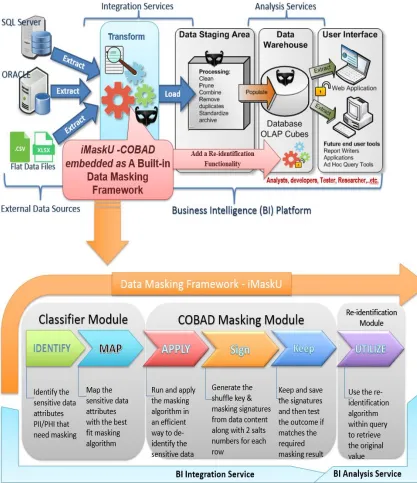
BI components. This thesis proposes a data masking framework (iMaskU: Identify, Map,
Apply, Sign, Keep testing, Utilize) for a BI platform to protect the data at rest, preserve the
data format, and maintain the data utility on-the-fly querying level. A new reversible data
masking technique (COntent BAsed Data masking - COBAD) is developed as an
implementation of iMaskU. The masking algorithm in COBAD is based on the statistical
content of the extracted dataset, so that, the masked data cannot be linked with specific
individuals or be re-identified by any means.
The strength of the re-identification risk factor for the COBAD technique has been computed
using a supercomputer where, three security scheme/attacking methods are considered, a) the
brute force attack, needs, on average, 55 years to crack the key of each record; b) the
dictionary attack, needs 231 days to crack the same key for the entire extracted dataset
(containing 50,000 records), c) a data linkage attack, the re-identification risk is very low
when the common linked attributes are used. The performance validation of COBAD
masking technique has been conducted. A database schema of 1GB is used in TPC-H
decision support benchmark. The performance evaluation for the execution time of the
selected TPC-H queries presented that the COBAD speed results are much better than
AES128 and 3DES encryption. Theoretical and experimental results show that the proposed
solution provides a reasonable trade-off between data security and the utility of re-identified
data.
Keywords
Acknowledgments
First of all, I thank God for giving me the ability to achieve my goals. Secondly, I would like
to thank my lovely mother for her daily supplication for me, wishing me all the best in my
entire life. Thirdly, sincere thanks to my lovely family (my wife and my two sons and
daughter) for their patience, support and encouragement in my life.
I would like to express my deep appreciation to my supervisor Dr. Abdelkader Ouda for his
insightful guidance, invaluable advice, and constructive criticism during my Ph.D. program.
His academic expertise helped me to improve my research skills. His support and motivation
gave me the confidence and the strength to accomplish my goals.
I would like to thank my advisory committee, Prof. Roy Eagleson and Dr. Abderhaman
Quazi for their encouragement and valuable suggestions on tracking my research progress.
Thanks to Electrical and Computer Engineering department at Western Engineering faculty
for their kind supports. Furthermore, I am extending my gratitude to the examiners’ time and
efforts to be part of this journey and make this thesis more reliable and authentic.
I acknowledge my workplace supervisor Mr. Pete Crvenkovski at the Erie St. Clair LHIN
and my colleague at the Decision Support Department for their support and advice during my
Table of Contents
Abstract ... i
Acknowledgments... ii
Table of Contents ... iii
List of Tables ... vi
List of Figures ... vii
List of Appendices ... ix
List of Abbreviations ... x
Chapter 1 ... 1
1 Introduction ... 1
1.1 Motivation and Problem Statement ... 2
1.1.1 Case Study and Analysis ... 5
1.1.2 Research Questions ... 9
1.2 Research Objectives ... 10
1.3 Research Methodology ... 14
1.3.1 Data Classifier Module Design ... 15
1.3.2 COBAD Module Design (Apply, Sign, and Keep)... 15
1.3.3 Re-identification Module ... 16
1.3.4 Utility Validation: Accuracy Measure ... 16
1.3.5 Security Validation: Re-identification Risk Measure ... 17
1.3.6 Performance Validation ... 17
1.4 Main Thesis Contributions ... 17
1.5 Thesis Structure ... 18
2 Background and Literature Review ... 20
2.1 Business Intelligence (BI) Platform ... 20
2.2 Cryptography, Reversible and Irreversible Data Masking ... 23
2.3 Data Masking Techniques... 25
2.3.1 Traditional Data Masking Algorithms (Non-Reversible): ... 26
2.3.2 Reversible Data Masking Algorithm: ... 28
2.4 Static versus Dynamic Data Masking ... 30
2.5 Literature Review... 32
2.5.1 Traditional Data Masking Researches and some Industrial Applications 32 2.5.2 Reversible Data Masking Techniques ... 35
2.5.3 Summary ... 37
Chapter 3 ... 38
3 Data Masking Framework (iMaskU): A Classification Module (Identify & Map) ... 38
3.1 A Data Masking Framework for the BI Platform ... 39
3.2 Classification and Attributes of Sample Data (Health Data) ... 42
3.3 Identify the Sensitive Data Based on Business Rules and Regulation ... 51
3.4 Define Masking Rules Based on the Regulation: ... 54
3.5 Mapping the Sensitive Data ... 56
3.6 Design of A Classification Module for Data Masking Framework ... 57
3.7 Discussion ... 60
Chapter 4 ... 62
4 iMaskU COBAD Module (Apply, Sign, and Keep): COntent BAsed Data-masking Reversible Technique ... 62
4.1 COBAD Data Masking Solution ... 63
4.1.1 What COBAD Does ... 63
4.2 COBAD Masking Algorithm ... 67
4.3 Discussion ... 75
Chapter 5 ... 78
5 Re-identification Process and Security Validation ... 78
5.1 Re-identification Process (Utilize Component) ... 78
5.2 Re-identification Accuracy Measure ... 82
5.3 Security Validation of COBAD (Re-identification Risk Analysis) ... 83
5.3.1 A Brute Force Attack ... 84
5.3.2 A Dictionary Attack ... 86
5.3.3 A Data Linkage Attack ... 87
5.4 COBAD Performance Validation ... 88
5.5 Results ... 92
Chapter 6 ... 94
6 Conclusions and Future Work ... 94
6.1 Summary of Contributions ... 94
6.2 Future Work ... 97
References ... 98
Appendices ... 106
List of Tables
Table 1.1: Simulated aggregated data ... 5
Table 2.1: Common traditional techniques of data masking ... 27
Table 2.2: Literature review summary ... 37
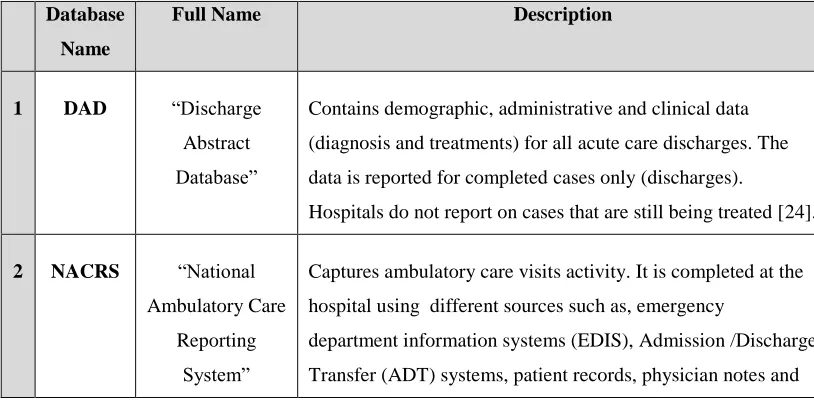
Table 3.1: A list of the most standards healthcare databases in Canada ... 38
Table 3.2: Hypothetical health dataset to illustrate a number of attributes. ... 43
Table 3.3: Data attributes of Discharge Abstract Database (DAD). ... 46
Table 3.4: The Privacy level of Diagnosis Code Attribute (Dx) ... 53
Table 3.5: The Privacy level of CCI Intervention Code Attribute (Tx)... 53
Table 3.6: Summary of applicable irreversible and reversible masking techniques for DAD’s data attributes ... 56
Table 4.1: Statistical functions’ data types and sizes ... 67
Table 4.2: Comparison of different features between our COBAD masking technique and other vendors and stand-alone solutions ... 76
Table 5.1: Accuracy of Re-identification Ratio ... 82
Table 5.2: Key combinations versus Key size ... 84
Table 5.3: Max Time needed to crack Masking Key versus Key combination ... 86
Table 5.4: The re-identification risk rate for data linkage attack using three main common attributes ... 88
Table 5.5: Standard query response time vs. AES128 & 3DES using TPC-H Benchmark (in seconds)... 90
Table 5.6: Table sizes of TPC-H decision support benchmark. ... 90
Table 5.6: TPC-H 1GB LineItem fact’s storage size and data loading. ... 91
List of Figures
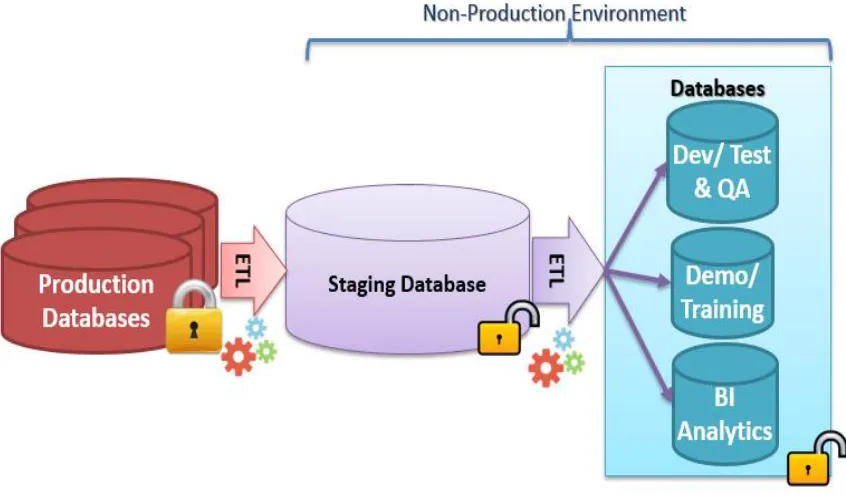
Figure 1.1: Cloning the production databases to non-production environment for different
purposes, using Extract, Transform and Load (ETL) tools ... 2
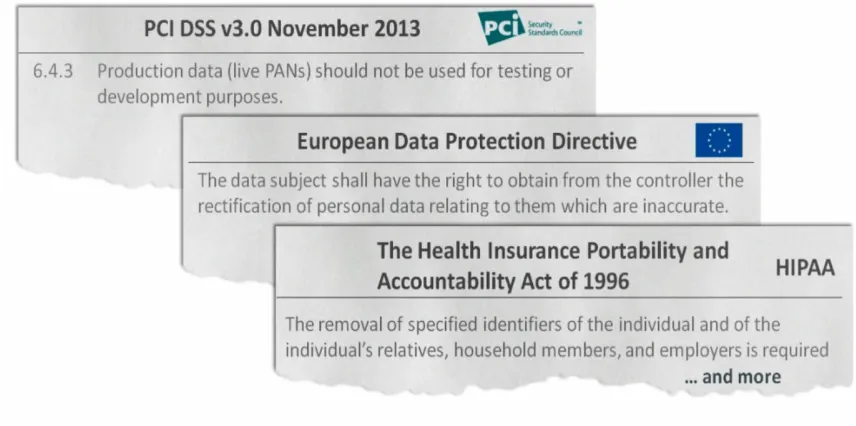
Figure 1.2: Some compliance drivers for using data masking ... 4
Figure 1.3: The main steps of applying traditional masking technique. ... 7
Figure 1.4: Comparison of the Statistical Analysis between the Original Data and Masked Data ... 8
Figure 1.5: Finding a Data Masking Solution based on challenges and objectives. ... 14
Figure 2.1: The main components of BI architecture and the location of PII & PHI sensitive data. ... 21
Figure 2.2: Encryption vs Data Masking ... 25
Figure 2.3: The general idea of the Pseudonymization method... 28
Figure 2.4: Format Preserving Encryption (FPE) ... 29
Figure 2.5: High-Level Architecture of the Static Data Masking ... 30
Figure 2.6: High-Level Architecture of the Dynamic Data Masking ... 31
Figure 2.7: A sampling of the IBM Optim data masking algorithms [68] ... 35
Figure 3.1: General context diagram of the proposed data masking framework iMaskU within the BI platform ... 40
Figure 3.2: Three levels of data classification system ... 42
Figure 3.3: UML Activity Diagram for the Classification component in Data Masking Framework (“Identify and Map”) ... 59
Figure 4.1: iMaskU-COBAD lies above the acceptable trade-off area ... 64
Figure 4.2: iMaskU-COBAD Solution fills the gap of any BI Integration Service’s Toolkit 65 Figure 4.3: iMaskU-COBAD as an embedded Framework within BI platform ... 66
Figure 4.4: COBAD algorithm is determining 8 statistical variables for each group level .... 68
Figure 4.5: Generating Masking Key Signature from derived statistical variables ... 69
Figure 4.7: Pass1) Get Statistical Variables’ algorithm. Pass 2a) Merge extracted data with
the statistical variables’ algorithm ... 72
Figure 4.8: Pass 2b) Apply, Sign, and Keep with Pass2 algorithm ... 73
Figure 4.9: Automation Process of generating the Masking Signature Key KM (n-bit) and associated Shuffle Key KSH (64-bit) ... 74
Figure 5.1: Re-identification (Utilize) Component in iMaskU Framework ... 79
Figure 5.2: UML Activity Diagram of Re-identification “Utilize” component in the iMaskU Framework for BI platform ... 81
Figure 5.3: Accuracy of Re-identification Ratio ... 83
Figure 5.4: Brute Force attack on 4-bit key ... 84
Figure 5.5: TPC-H Schema [73] ... 89
Figure 5.6: TPC-H 1GB LineItem fact’s storage size and data loading ... 91
Figure 5.7: TPC-H 1GB dataset query execution times ... 92
Figure 5.8: Empirical assessment of COBAD’s masking and de-masking algorithms ... 93
Figure A.1: Brute Force attack on 4-bit key ... 106
List of Appendices
Appendix A: The results of the simulation using GreenCloud simulator tool ... 106
Appendix B: Appling random number generation function within SQL ... 107
Appendix C: International Statistical Classification of Diseases and Related Health Problems
10th Revision ... 108
Appendix D: Using SQL to apply data masking on numeric field after extracting the
statistical variables ... 110
Appendix E: Using SQL to measure re-identification risk for the data-linkage attack ... 114
List of Abbreviations
AES Advanced Encryption Standard
API Application Program Interface
BI Business Intelligence
CIHI Canadian Institute for Health Information
COBAD COntent BAsed Data masking
CCI
Classification Code of health-related Interventions
CCRS Continuing Care Reporting System
CSD Census Sub Division
DM Data Masking
DW Data Warehouse
DES Data Encryption Standard
DAD Discharge Abstract Database
DBMS Data Base Management System
DDM Dynamic data masking
ICD-10 International statistical Classification of Diseases - 10th revision
EDW Enterprise Data Warehouse
ETL Extract, Transform, and Load
iMaskU Identify, Map, Apply, Sign, Keep-test, Utilize
HN Health Card Number
KM Masking signature Key
KSH Shuffle Key
FPE Format-preserving Encryption
SIN Social Insurance Number
LHIN Local Health Integration Network
NACRS National Ambulatory Care Reporting System
NRS National Rehabilitation Reporting System
MIPS Million Instructions Per Second
SSIS SQL Server Integration Services
UML Unified Modeling Language
HIPAA Health Insurance Portability and Accountability Act
OLAP On-Line Analytical Processing
PCI DSS Payment Card Industry Data Security Standard
PHI Protected Health Information
PII Personally Identifiable Information
PIPEDA Personal Information Protection and Electronic Documents Act
PHIPA Personal Health Information Protection Act
MOBAT MOdula-BAsed masking Technique
SaaS Software as a Service
SDM Static data masking
Chapter 1
1
Introduction
Nowadays, organizations are undergoing a tremendous change in analytical computing.
The vehicle for this change is the implementation of a Business Intelligence (BI)
platform, which includes On-Line Analytical Processing (OLAP) Cubes, data
visualization tools, and integrated data warehouse (DW).
Extracting sensitive data (Personally Identifiable Information-PII, Protected Health
Information-PHI, Payment card information, Intellectual property) from operational
databases, then saving them into a consolidated central repository to facilitate efficient
analysis is the best solution. However, this huge DW constitutes one of the most serious
privacy breach threats that any organization might face when many internal users of
different security levels have access to BI components. Hence, data security and
reliability are important factors in the analytics platform of BI.
Data masking, also called de-identification, obfuscation, or anonymization, these
techniques are used to minimize the inadvertent disclosure risk of sensitive data as well
as to preserve the proper quality of data analytics (data utility) within test or BI
environment. Using reversible masking is a quite challenge compared to traditional
techniques.
The primary purpose for gathering data within BI platform and storing it in integrated
data warehouse is to obtain information/knowledge from the data to improve business
processes using statistical and data mining tools. The sensitive numerical data are the
most important attributes in the analysis process; they pose the greatest threat as they
offer great benefit to understand business performance and trends. Moreover, taking into
account the importance of some textual data, such as diagnosis, treatment codes in
This chapter discusses the motivation and objectives of this research. It additionally
explains the research methodology and the main contributions. Finally, this chapter
describes the structure of the thesis.
1.1
Motivation and Problem Statement
Business, industries, and healthcare environments are expanding to include not only the
traditional information systems, but also a business intelligence and big data analytic
platforms. For executive leaders, consultants, and analysts, there is no longer a need to
spend hours in designing and developing typical reports or dashboard; the entire solution
can be completed through using Business Intelligence (BI) software.
In many organizations, it is often important to create copies of production databases for
non-production use, such as, application development and testing, personal training,
research, and business analytics modeling as shown in Figure 1.1 below. These multiple
copies of sensitive data increase the potential risk of attacks and unnecessary expose to
employee who are unauthorized to see the data.
Figure 1.1: Cloning the production databases to non-production environment for
Another primary reason to protect the sensitive data in non-production environment is to
comply with the data privacy rules and regulations that focus on safeguarding the most
sensitive data and limit the access to them based on a need-to-know process, see Figure
1.2. For example,
• Personal Information Protection and Electronic Documents Act (PIPEDA), it is
sets the ground rules for how private-sector organizations collect, use, and
disclose personal information in the course of for-profit, commercial activities
across Canada. [44]
• Personal Health Information Protection Act (PHIPA), establish rules for the
collection, use and disclosure of personal health information about individuals
that protect the confidentiality of that information and the privacy of individuals
in Ontario province. [45]
• EU General Data Protection Regulation (GDPR) introduces data minimization
and pseudonymization as key data protection principles organizations must
follow.
• The Payment Card Industry Data Security Standard (PCI DSS) Requirement 6.4.3, specifically prohibit the use of production data for test and development.
[46][58]
• The Health Insurance Portability and Accountability Act (HIPAA), it is US
regulation to remove specific identifiers that lead to recover the individuals’
Figure 1.2: Some compliance drivers for using data masking
Addressing data privacy and its utility for DW and analysis service in BI platforms is a
major challenge that includes the difficulty of masking the sensitive data from internal
and external users as the integrated DW originates from different operational databases
and contains the disclosed sensitive data.
The traditional data masking method is irreversible in that it masks (de-identify) one-way
and fails to maintain the utility of data for analysis, reporting, and research purposes.
Several vendors and researchers have proposed and implemented data masking solutions
for the test environment, however, most of them are third party standalone applications,
whereas others are built-in data masking frameworks based on traditional irreversible
masking algorithms.
Neither the traditional data masking techniques nor the third-party solutions can fulfill the
need of integrated BI analytics environment to deliver the accurate information to clients
while preserving the privacy of the sensitive data within DW and the entire platform.
Thus, it is improbable that the BI platform will benefit from having and external solution
in which needs to be tweaked and customized to fit the integrated platform.
Hence, it is important to protect textual and numerical data from disclosure while also
useful to de-identify sensitive data to maintain the confidentiality and privacy, but the
serious problem is losing the quality of the data analysis.
Also, conventionally, data masking techniques for protecting such sensitive data are
developed manually and implemented independently in an ad-hoc and subjective manner
for each application out of BI platform. Such an ad-hoc data masking approach requires
time-consuming iterative trial of developing and implementing inconsistent
algorithms/techniques on multiple interfacing applications. So to overcome this issue, it’s
more effective to establish a built-in data masking framework within BI platform
encompass the most efficient techniques to be applied directly to the selected sensitive
data that need to be masked in staging area.
1.1.1
Case Study and Analysis
In this section we will show that the quality measure is absent in most traditional data
masking, and specifically with such techniques that deal with numeric data. Hence, we
are in need to have other type of data masking.
A. Empirical Assessment Using Simulated Health Data
To demonstrate the concept of the traditional masking problem, we used simulated data
to illustrate the summary level of Emergency Department’s (ED) daily visits (with no
patient names and health card numbers). The proposed ED data set consists of 11
attributes with observations reflecting last 30 days summarized records (approx. for 3000
patients’ visit), as shown in Table 1.1 below: (see Appendix A for patient flow within at
Emergency Department).
Table 1.1: Simulated aggregated data
Data Attribute (A1..A11) Description Data Type Value or range
A1. VisitDate Visit Date at ED Date 2015-05-30
A2. ED_Visits Number of patients’ visits per day Integer 125 patients
A3. ED_CTAS1 Number of patients with Triage Level 1
(RESUSCITATION – very bad condition) Integer 3 patients
A4. ED_CTAS2 Number of patients with Triage Level 2
A5. ED_CTAS3 Number of patients with Triage Level 3
(EMERGENCY) Integer 48 patients
A6. ED_CTAS4 Number of patients with Triage Level 4
(SEMI-URGENT) Integer 39 patients
A7. ED_CTAS5 Number of patients with Triage Level 5
(NON-URGENT) Integer 2 patients
A8. IP_Admits Number of patients being admitted to
Inpatient units (IP) Integer 16 patients
A9. ED_ALOS_AllDisp
Average Length Of Stay-LOS (Wait Time) to All patients regardless there discharge status
Real 4.178 hours
A10. EDALOS_NonAdmit
Average Length Of Stay-LOS (Wait Time) to All patients who non admitted to
Inpatient’s units
Real 3.851 hours
A11. EDALOS_Admits
Average Length Of Stay-LOS (Wait Time)
to All patients who admitted to Inpatient’s
units
Real 6.096 hours
The general masking techniques used was “Date and Numeric variance” that does not
requires any parameter specifications. We applied random number generation function
within SQL Server on numeric data attributes taking in the considerations the ± range of
each data element. Please see the SQL statement in Appendix B.
B. Visual Result of the statistical analysis of the original and masked data
From the sample data set, we selected the first 9 sensitive numeric attributes and applied
the “Numeric Variance” algorithm as follows, see Figure 1.3:
1. Consider a database D consist of two tuples T (tables): D={T1, T2}.
2. Each tuple T consist of set of attributes:
T1 = {A1, A2, A3, ……, A11} , Original Table
T2 = {A1’, A2’, A3’, …, A9’, A10, A11} , Masked Table
3. Identify the sensitive numeric attributes, in our case study {A1, A2, A3,……,A9}
4. Apply the random number generation function: (for more details see Appendix B)
(± CAST(NEWID() AS binary(6)) % N) to Original T1{A1..A9} as follows: A1’= VisitDate ± 10
A4’= ED_CTAS2 ± 5 A5’= ED_CTAS3 ± 8 A6’= ED_CTAS4 ± 10 A7’= ED_CTAS5 ± 3 A8’= IP_Admits ± 5
A9’= ED_ALOS_AllDisp ± 5
5. Save new generated numeric values into Masked T2 {A1..A9}.
6. Repeat the above three steps (3, 4, and 5) to all rows.
7. Compare the final results by using SUM and AVG function within Chart data
sources
Figure 1.3: The main steps of applying traditional masking technique.
We have some potential results illustrating the statistical analysis of the original data
versus masked data. We applied the SUM and Average functions at query level to get the
final results for past 14 days or 7 days based on the requirements of the chart, as shown in
Figure 1.4: Comparison of the Statistical Analysis between the Original Data and
Masked Data
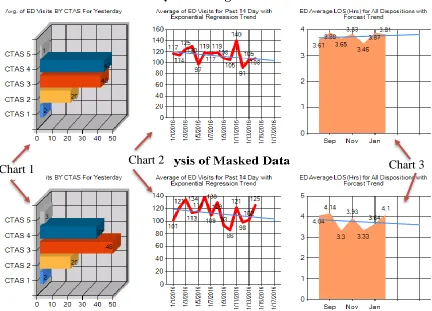
The results show huge discrepancies between the original and masked data sets, which
are not even similar and the masked data did not produce the same outcome as follows:
- Chart 1 depicts the average of Emergency room visits by Triage level
(CTAS-urgency of the case) for one day before of the current date, the visit volume of
masked data is totally changed and not even close to the actual values.
- Chart 2 shows the discrepancies of the average of Emergency room visits for past
14 days with including the exponential regression trend for next 4 days, the
mismatch of numbers will make it unreliable for accurate statistical presentation
- Chart 3 represents the outcome of the average length of stay (LOS) of patients
who left Emergency room to anywhere for the past 7 days. Based on the
development of the diagram and the established hypothesis the original data can
predict the positive trend of LOS. The difference is obvious in which the
forecasting trend declined and get affected negatively by applying the making
formula, which is completely inverse direction of the trend line and it is
unacceptable in BI analytics platform.
The results of the traditional masking techniques is might acceptable in terms of
application testing, improving development functionality, and building a research model,
however, it is totally unacceptable from business intelligence data analytics perspective.
This means the traditional data masking algorithms whether using random number
variance or shuffle the values have a significant negative impact on the data accuracy and
quality.
1.1.2
Research Questions
The goal of this thesis is to propose a novel technique to build a secure utility-enabled
data masking framework for an integrated BI platform. To achieve this goal, the
following research questions have to be addressed:
1. What data masking techniques and approaches can be utilized to build data
masking framework in BI Platform?
The data masking framework should be usable and scalable in order to fulfill the
masking requirements in which can be applied on different types of sensitive data
fields. It might utilize one or both categories of masking techniques as follows:
(In this framework, we are avoiding to use any encryption techniques due to
complex calculation, heavily increase storage space and introduce very large
overheads in query response time.)
• Irreversible traditional masking techniques: such as, substitution, shuffling,
masking out, nulling, date aging, numeric alternation.
• Reversible masking techniques: such as, Pseudonymization (Random Shuffling and Set-Lookup Methods), One way function using Knapsack,
2. What data masking metrics are effective in protecting sensitive data in BI
platform while maintaining its utility and privacy?
Metrics specifications: Since many factors collected were actually related to the
risk, speed, quality metrics, however, in general data to be fit for masking use,
data must possess the following attributes:
• Fitting/Appropriateness: refers to the selection of the proper masking
technique for the sensitive data element
• Quality/Validity: refers to the usefulness of the data or information, accuracy and reliability and is presented in an accurate and clear manner.
• Safety/Privacy: refers to strength of security or protection of data from
unauthorized access and preventing the release of identity of origin data.
• Performance: refers to the execution speed of masking/de-masking algorithm comparing with no masking task whether in ETL stage or querying layer.
• Storage Growth: refers to the change of the size of new masked data table in
compare with the original one
3. How can a data masking model be evaluated and used for BI projects?
• Defining Assessment methodology
• Conducting Case Studies for different type of attacks
• Comparing and interpreting assessment of data in terms of security and
quality metrics
1.2
Research Objectives
The goal of this thesis is to propose a novel technique to build a secure utility-enabled
data masking framework for an integrated BI platform. The following research objectives
will help achieve this goal:
Tasks: • Took research-related courses, such as information security, BI & DW, and Data Mining to develop background on the area of the research
• Explore the advantage of BI Platform
• Examine the existing types of Data Warehouses in traditional BI systems
• Examine the existing online analytical processing OLAP in BI platform
Deliverable: Conference paper had been published to demonstrate that the investigation and analysis have been completed
Objective 2 Highlight the effective data masking metrics in managing sensitive
data analysis in BI platform
Tasks: • Conducted a literature review to find out the most significant metrics that being used in the area of data encryption and data masking, such as, Fitting/Appropriateness, Quality/Usability, Safety/Privacy, Performance, and Storage Growth.
• Focused on the trade-off between the two significant metrics, data safety and utility, which affect the analysis quality of masked sensitive data.
Deliverable: • Addressed in a conference paper
Objective 3 Investigate data masking techniques and approaches that can be
utilized to build the data masking framework within a BI Platform
Tasks: • Investigated several common traditional data masking algorithms (Irreversible masking) that being used by researchers and industries, such as, fictitious data (random substitution), date aging, numeric alternation, data shuffling, masking out or nulling out.
• Identify the problems statement and the research questions have been addressed
• Determine the stages in BI platform should accommodate the data masking framework, we proposed to be placed in integration services phase before data staging area and within analysis services
Deliverable: • Submitted as a presentation for the 3 Minute Thesis Competitions at UWO, and participated on Annual Grad Symposium 2015.
• Addressed in a conference paper to support the idea
Objective 4 Analysis and design of data classification module (Identify & Map)
for data masking Framework (iMaskU)
Tasks: • A built-in data masking framework (iMaskU- Identify, Map, Apply, Sign, Keep testing, and Utilize) is proposed
• first and second components (Identify + Map) of the proposed secured data masking framework to protect the sensitive data is presented
• The hypothetical sample data is based on Canadian healthcare data sources is simulated
• develop the data classification module to automate the discovering of the sensitive data, and map the best-fit masking solution to meet the compliance requirements
• Define the masking library based on the domain of the business rules
Deliverable: Conference paper has been published to fulfill the Objectives 1, 2, 3,
& 4 to ensure that the proposed works have been reviewed by experts
in this field and get accepted.
Objective 5 Design, develop, and validate the new data masking technique
COBAD (COntent BAsed Data masking) that uses apply and sign
components within iMaskU Framework
data is presented
• A new COBAD masking algorithm is well defined and presented
• The format of masking signature key alongside with shuffle key are well structured to be used part of the masking process
• The masking library domain of the business rules and the user masking definition object are used in masking process
• Analyze and validate the security of the proposed BI-based COBAD masking algorithm via three attack methods
Deliverable: A journal paper has been submitted and it is under peer review to
ensure the accuracy of the proposed technique
Objective 6 Design and develop the re-identification process (Utilize component)
for the new data masking COBAD technique within iMaskU
Framework
Tasks: • The algorithm of the sixth component (Utilize) of the proposed secured data masking framework is presented
• The accuracy of the re-identification process is measured to ensure the data utility is within the acceptable range
Deliverable: The built-in re-identification algorithm is validated and the accuracy
has been measured
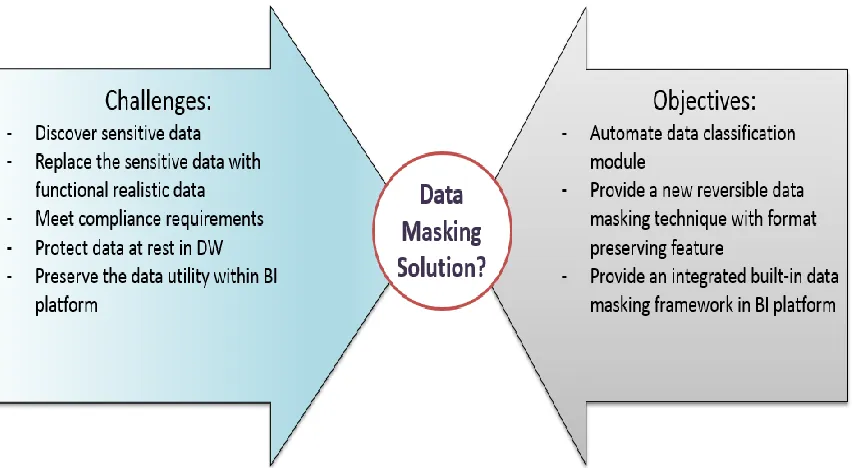
We can summarize the research challenges and the objectives to propose the best data
Figure 1.5: Finding a Data Masking Solution based on challenges and objectives.
1.3
Research Methodology
This section describes the methodologies that are applied in this research to design and
develop the built-in data masking framework and technique to secure the privacy of
sensitive data at rest in data warehouse against internal and external attacks. The
proposed BI-based data masking framework and technique can not only protect data at
rest, but it can also recover the original data for utility purposes. In addition, the designed
and developed framework satisfies the following requirements:
- Read the heterogeneous data from different data sources.
- Ability to identify the sensitive data based on pre-defined business rules.
- Mask the sensitive data in a reversible way that can be recovered for research and
analysis purposes.
- Validation of the security of the masking technique through different attacking
approaches.
- Use formal validation to measure re-identification accuracy.
- Validate the performance of the new masking algorithm versus standards
Notes:A) All diagrams notation follow the UML standards to be a common language
for the reader and practitioners. B) The used technical platforms to accomplish all the
practical results were MS-SQL Server, MS-Excel, and ASP.Net with C#.Net
1.3.1
Data Classifier Module Design
It is a process of identifying the sensitive data from data source and classify the privacy
levels of provided data that would make it easier for user to determine how best to keep
data safe in the DW in which contain direct identifiers, quasi-identifiers, and other
sensitive attributes. Our approach is based on analysis of the entire attributes of the
sample data through exploring the enterprise reporting and data definition documents, as
well as expert determination method that relies on extensive questionnaire (cover these
topics: data appearance and usability, static vs dynamic masking, reversible vs
irreversible, uniqueness-consistency, security strength, and privacy policies). This study
led to describe their occurrences in health reporting systems in terms of frequency and
sensitivity categories (PII/PHI/None). The classifier module is totally relies on the
business rules in which define all the data attributes that needs to be masked or
de-identify in order to comply with the privacy regulations.
After a clear analysis of masking methods for sensitive data and the privacy requirement,
a set of business rules established based on intensive investigation of different BI tools in
healthcare to map the recognized sensitive data to the appropriate masking method in
which fit the usage nature of the data attribute. The data being initially masked is profiled
to detect invalid data and an extra information attribute will be added
The classification module of the masking framework focuses on the first two
components, which are “Identify” and “Map.” The detailed processes of these two
components have been set up and organized in Chapter 3.
1.3.2
COBAD Module Design (Apply, Sign, and Keep)
It is the second module (Apply, Sign, and Keep) stands for (COntent BAsed Data
masking - COBAD) of the BI-based data masking framework is proposed to protect the
information at rest. In addition, it securely de-identifies the sensitive data using a
well-defined light mathematical formula relied on the statistical content of the extracted data.
The new COBAD data-masking algorithm (reversible de-identification) is based on the
derived statistical variables of the extracted data content and how to code the shuffle of
the sequence of these variables, then followed by pack the sequence codes in a binary
format to generate the Shuffle Key KSH with application of AES256 encryption before
saving it in a protected table. Furthermore, the values of the statistical variables have
been packed in a binary Masked Signature Key KM. The KM is publicized, kept with each
row and saved into the destination data table.
COBAD emphasizes the trade-off between data privacy and its utility by preserving the
data format and type to keep it looking realistic for developer, tester, and data scientist
within the non-production environment (e.g., DW) by using a new reversible data
masking technique in the context of maintaining the utility of data analytics
1.3.3
Re-identification Module
The re-identification process is the last component in our iMaskU framework, which is
called “Utilize”. The utilize component is a reverse engineering process that adds a built
in functionality in which acts as a de-masking tool to enable the authorized end-user to
retrieve data and apply the required analysis process to get the right results to be utilized
by analytical tools
The algorithm of the de-masking process relies on reading the public masking signature
key (KM) for each record and then interprets its contains by using the associated shuffle
key (KSH) to get the right order and size of the statistical variable that had created from
the extracted data content. In addition, from the size of KM, the re-identification function
determines the complexity of the masking formula in which used to de-identify the
sensitive data attributes.
1.3.4
Utility Validation: Accuracy Measure
The accuracy is the degree to which the result of an analysis conforms to the correct
calculate the ratio of an error of de-masked value versus the original one. We compare
the re-identified value with the original to determine the accuracy ratio using below
formula:
%Accuracy = de-mask / original × 100%
The accuracy results show, by applying our COBAD’s simple masking formula (Min,
Max, KS1, KS2) on LOS will get 100% accuracy result. On the other hand, if we apply
Min-Max normalization formula (Min, Max, newMin, newMax) to the Age attribute, the
re-identification accuracy reaches to ~98%, which is acceptable range from statistical
analysis perspective [76].
1.3.5
Security Validation: Re-identification Risk Measure
To validate the security requirements of COBAD data masking technique, it is important
to analyze the strength of the proposed algorithm against the most common attack
methods. Therefore, the proposed COBAD masking algorithm is formally analyzed via
these attacking methods to validate its security strength (Section 5.3).
The following attacking methods are considered, a) using a brute force attack, needs, on
average, 55 years to crack the key of each record; b) the dictionary-based attack, needs
6.6 minutes to crack the key for a single record, and 231 days for the entire extracted
dataset (contains 50,000 records), c) a data linkage attack, the re-identification risk is
very low when the common linked attributes are used (e.g., postal code, age group, and
sex). Only two records have been identified out of 51,000 (0.004%).
1.3.6
Performance Validation
We explain and analyze the performance comparison between COBAD (simple, medium,
complex) technique and AES128 3DES encryption algorithms using the well known
TPC-H benchmark. TPC-H is a decision support benchmark in which consist of datasets
and ad-hoc queries that examine large volume of data [72].
1.4
Main Thesis Contributions
This thesis focuses on designing and developing a novel data masking technique to
maintain the utility of data for the analytics within BI platform. Research contribution can
be mainly summarized as follows:
- A taxonomy of existing data masking techniques within the database management
system (DBMS) or as a third part solution.
- An investigation and design of a data masking framework iMaskU starting with a
classifier module in order to automate the process of identification the sensitive
data and then mapping them with the proper masking technique.
- An investigation and design of a COBAD module to apply the proper proposed
algorithm based on the type of the sensitive data and then construct the shuffle
key and masking signature keys
- Design of the required re-identification functionality and embed it into the
analysis services of the BI platform
- A security validation of the proposed COBAD technique against internal and
external attacks.
The research contributions of this thesis have been published in conference proceedings
and a journal paper in the areas of information systems and security. Therefore, these
contributions have been peer-reviewed by external researchers who are experts in the
field.
1.5
Thesis Structure
The thesis structure is outlined as follows:
• Chapter 2 provides an overview of the BI platform in general and the related data protection processes static or dynamic. It presents an in-depth available data
masking technique that protects the sensitive data in the test environment and
DBMS. Also, it presents a literature review of the existing data masking research
from industry or and academic perspectives.
• Chapter 3 presents and discusses the data classification module for a built-in data
and the first and second components (Identify + Map) of the proposed BI- based
secure data masking framework to protect the sensitive data are introduced.
• Chapter 4 presents and discusses the second module (COBAD technique, Apply
and Sign) of the BI-based data-masking framework to protect the privacy of data
and prevent internal and external attackers from disclosing the original
information at rest. In addition, it securely de-identifies the sensitive data using a
well-defined mathematical formula.
• Chapter 5 describes the re-identification formulas and the final results have been compared with the outcomes of the analysis of the original data to measure the
accuracy rate. Furthermore, the achievement of the security requirements of the
COBAD masking algorithm by using simple formula is verified. In addition, the
performance of the algorithm is assessed.
Chapter 2
2
Background and Literature Review
This chapter overviews the BI platform in general and the related data protection
processes whether in static or dynamic fashion. It presents an in-depth available data
masking technique that protects the sensitive data in the test environment and DBMS.
Finally, it presents a literature review of the existing data masking research from industry
and academic perspectives.
2.1
Business Intelligence (BI) Platform
BI is one of the hottest buzzwords in the last several years in the business administration
and information management fields. There are many definitions of BI:
“BI is a strategic initiative by which organizations measure and drive the effectiveness of
their competitive strategy” [1]. To achieve this grand goal, analysis, software, resources,
technical leadership, process specialists, executive leaders, and much more are needed.
“BI is a broad category of applications and technologies for gathering, storing, analyzing,
sharing, and providing access to data to help enterprise users make better business
decisions”, [2]. Gartner also defines a BI platform as a software platform that delivers the
14 capabilities listed below within three main categories of functionality:
1. Integration: BI infrastructure, Development tools, Metadata management,
Collaboration.
2. Information Delivery: Reporting, Ad-hoc query, Dashboards, Data integration,
Search-based BI, Mobile BI.
3. Analysis: Online analytical processing (OLAP), Interactive visualization, Data
mining and Predictive modelling, Scorecards (Key Performance Indicators -KPIs,
Performance Management Methodology) [2].
BI goals are often to:
2. Enhance competitive advantage.
3. Achieve secure and reliable access to data by developers and decision makers to
do their jobs effectively, (this is the most critical point of this work).
4. Use flexible tools to browse the information.
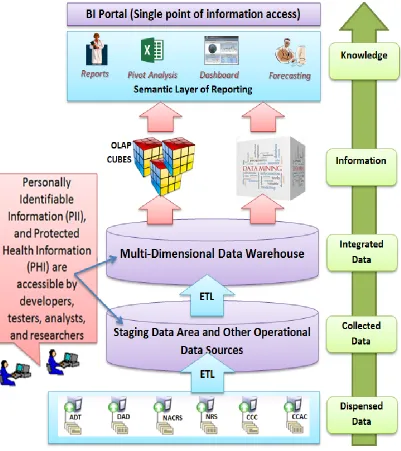
Figure 2.1 represents the essence of BI architecture with the proper workflow of the
interdependent components [7]:
Figure 2.1: The main components of BI architecture and the location of PII & PHI
- A Data Warehouse (DW) is the core of any solid BI solution. A Data Warehouse
can be defined as a “repository for keeping data in a subject oriented, integrated,
time-variant and non-volatile manner that facilitates decision support” [3][4].
Basically, it is a big database containing all the data needed for performance
management, decision making, and prediction. Multi-dimensional modeling
techniques use facts and dimensions within relational or multi-dimensional
databases and are typically used for the design of corporate data warehouses and
departmental data marts. Such a model can adopt a star schema, snowflake
schema, or fact constellation schema [6][52].
- External source systems are not really considered as a part of the BI
environment, but they feed the BI solution, so they are at the base of the whole
architecture and should be totally understood by developers. One of the important
things in the set-up of a BI environment is to consider all the types of data that
may need to be included in the analysis process.
- ETL: Extract, Transform and Load (Integration Services): After building up
a multi-dimensional data warehouse, data from all different sources need to be
extracted and brought to the BI environment; sensitive data disclosure is a
possibility here. After the extraction task, the data need to be transformed. The
transformation process can mean a lot of things, including all activities to make
the data fit the multi-dimensional model of the data warehouse. The proposed data
masking framework will be applied in this stage.
The transformation process may become quite complex, especially when it
includes extra work to clean up, harmonize, and secure the data coming from
different systems, which is why most BI professionals describe ETL work as 70%
of the IT side of a BI project.
While working on the development of the ETL component, a separate database in
the data warehouse is reserved as a storage space for intermediate results of the
required transformations. This area is called a staging area or work area. Once the
multi-dimensional model; this step is not as complex as the transformation, but attention
needs to be given.
- Online Analytical Processing (OLAP) cube refers to analysis techniques
(Analytical Services stage) including a variety of functionalities such as
aggregation, summarization, and consolidation as well as the ability to view
information from different angles [7]. OLAP offers high performance in analysis
and loading of the data. OLAP cubes have had very high success rates for
business environments where the BI solution is used for what-if analysis, financial
simulations, budgeting and target setting, etc.
- BI portal: When the number of different reports begins to grow, the best solution
is to create a single point of access to information within the organization.
Usually, the effort of creating a single point of access results in building an
intuitive portal solution that contains different reports with clear descriptions of
the scope of each report, as well as an indication of who is the business owner of
the report.
As shown in Figure 2.1, the staging storage area and multi-dimensional data warehouse
(DW) are considered the core components of the BI platform and are an integrated
repository derived from multiple data sources (operational and legacy) in the production
environment. Saving sensitive data into a central repository is a serious privacy
disclosure threat when many internal users of different security levels have access to the
BI services. Thus, data privacy and the reliability/utility are considered important issues
that can be compromised in the BI platform while using data masking techniques [7].
2.2
Cryptography, Reversible and Irreversible Data
Masking
Cryptography is the science and art of secret writing or “Secret codes”, it does so using
cryptosystems, or simply Ciphers. Cipher is used to encrypt or “encode” a message or
information called “plaintext”, the result of this encryption is called ciphertext. The aim
of the encryption is to protect a message so that only authorized parties, who possess a
of cryptosystems; a symmetric key cryptosystem uses the same key to encrypt as to
decrypt messages, and a public key cryptosystem uses a public key to encrypt a message
and a private key to decrypt (sign) later. The most common and secure symmetric key
algorithms, e.g., AES and 3DES, depend on a mix between linear and nonlinear
substitution, permutation and shifting operations to be executed on many number of
rounds depends of the key size. Public key algorithms are usually based on number
theory rather than substitution or permutation operations, e.g., RSA, where a trap door,
one-way function is used so that the it is easy to compute in one direction and it is very
hard to compute in other direction. These types of function usually have a “Trap door” to
create keys to be used for encryption and decryption. The more “computationally”
complex of these functions, the more cryptography secure, and the longer key size used,
the more complex these algorithms will be. In general, cryptography needs computational
capabilities in addition to extra storage to achieve reasonable level of security.
Data masking is the process of replacing a sensitive data values such as credit card
numbers with a fake yet realistic looking credit card number. Typically, the main
objective of data masking is like cryptography in the sense that it makes sensitive
information not available to unauthorized users, but without the need for heavy
computations and/or many number repeated operations, see Figure 2.2. Substitutions and
replacement are the most common operations that are used in data masking techniques,
the detail description of these techniques is given in the next Section. There are two types
of data masking; traditional data masking also called irreversible data masking, and
key-based reversible data masking. The most common data masking techniques are not
reversible, where the masking process is done in such a way that there should not be any
way to retrieve original data from masked data. However, in key-based reversible data
masking the original data or near original data can be retrieved if a proper secret key can
be generated during the masking process. The generation of such keys does not require
Figure 2.2: Encryption vs Data Masking
2.3
Data Masking Techniques
Traditionally, data masking has been viewed as a technique for solving data privacy
problems in non-production environments such as cloning databases for testers and
developers to add new features to the application. However, the Gartner Magic Quadrant
Report in December 2013 extends the scope of data masking technology to more broadly
include data de-identification in production, non-production, and analytic use cases. [5]
Masking and de-identification deal with different attributes in a data set, so some
attributes will be masked (irreversible) and some fields will be de-identified (reversible)
to retrieve the original value later. Masking involves protecting direct identifiers such as
patient name, SIN number, telephone number, email, and health card number (HN). The
de-identification process involves protecting attributes by covering things like
demographic and socio-economic information such as age (date of birth), postal codes,
diagnosis code, income, number of children, and race, or other PHI, which are called
Data Masking is important for all enterprises for the following reasons:
• Protecting sensitive data in a non-production environment (i.e., Integrated Data
Warehouse)
• Helps meet compliance requirements. The field-level de-identification methods can help to comply with data privacy regulations while leaving your non-sensitive
data for further processing.
Note: HIPAA (Health Insurance Portability and Accountability Act) compliance
focuses on protecting patient health information to standardize communication
between health care providers and health insurers and to protect the privacy and
security of protected health information (PHI).
• Minimizing information risk when outsourcing or off-shoring
Masking and de-identification deal with different fields in a data set so that some fields
will be masked (non-reversible), and some fields will be de-identified (reversible).
Masking involves protecting things like names, SIN numbers, and health card numbers
HN, which are called direct identifiers. De-identification involves protecting fields by
covering things like demographic and individuals’ socio-economic information like age,
postal codes, income, number of children, and race, or even protected health information,
which are called indirect identifiers.
2.3.1
Traditional Data Masking Algorithms (Non-Reversible):
Several common traditional data masking algorithms can be used such as [9] [10] (See
Table 2.1)
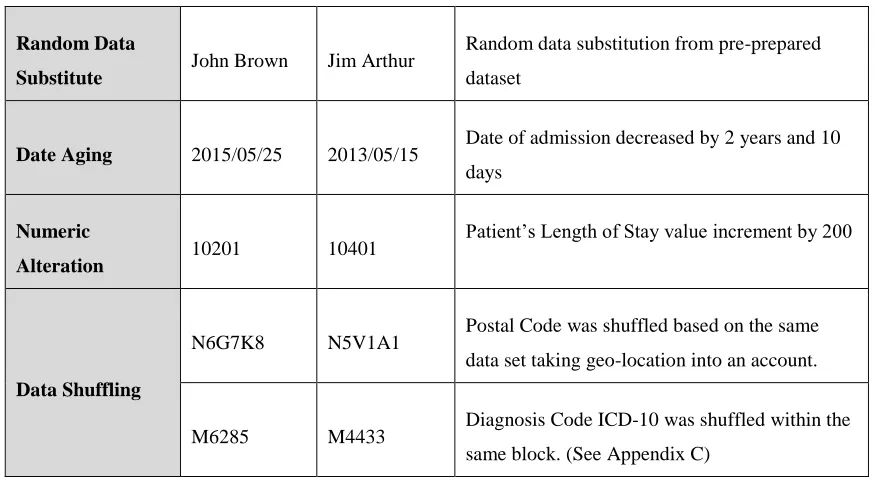
1. Random Substitute (Fictitious data): This technique substitutes data with
similar random values from a pre-prepared dataset, making the data look real
when it is in fact bogus. This technique does not typically affect the application or
testing requirements because it retains all of the data properties. For example, the
patient name "John Brown" could be substituted with the name "Jim Carlos"
2. Date aging: In this technique, and based on pre-defined policies and business
rules, the date attribute is either increased or decreased. However, date ranges
must be defined within acceptable boundaries so that the data utility is least
affected. One example is moving the registration date back by 20 days within the
same month minus 1 year, which would change the date "25-Jan-2015" to
"05-Jan-2014."
3. Numeric alternation: In this approach, based on an acceptable percentage or
range, the numeric attribute will be increased or decreased accordingly. For
example, a wait time value could be increased by 10% of its original value. This
approach disguises the real value of the data, but if someone knows even one real
value, they could decode the entire pattern. This is an easy technique to mask, and
it can also be easily de-masked.
4. Shuffling data: In this technique, a data attribute will be used as its own
substitution dataset; it moves the values among rows in such a way that the no
values remain in their original rows with a broken sequence. The drawback is
with respect to the huge data and the pattern of shuffling: there would be a
repetition of the shuffling patterns. For example, a patient name is moved to
another random row.
5. Masking out or Nulling out: The Masking Out technique sanitizes the data by
replacing certain specified characters with masked characters (i.e., a health card
number might be hashed out as 552 88# ####). This effectively disguises the data
content while preserving what was omitted on front-end screens and reports [11].
The Nulling Out technique simply removes the specified sensitive data by
replacing it with NULL values; it is a simple way of ensuring that it is invisible.
Table 2.1: Common traditional techniques of data masking
Algorithm Original
data Masked Data Explanation
Random Data
Substitute John Brown Jim Arthur
Random data substitution from pre-prepared
dataset
Date Aging 2015/05/25 2013/05/15 Date of admission decreased by 2 years and 10 days
Numeric
Alteration 10201 10401
Patient’s Length of Stay value increment by 200
Data Shuffling
N6G7K8 N5V1A1 Postal Code was shuffled based on the same data set taking geo-location into an account.
M6285 M4433 Diagnosis Code ICD-10 was shuffled within the same block. (See Appendix C)
2.3.2
Reversible Data Masking Algorithm:
The de-identified attributes can look more realistic and still be recovered by using the
following techniques:
1. Pseudonymization (Random Shuffling and Set-Lookup Methods): A method
of shuffling data attributes to preserve data confidentiality that comprises masking
particular attributes of a dataset which are to be preserved in confidentiality,
followed by a shuffling step, which comprises sorting the transformed dataset and
a transformed confidential attribute in accordance with the same rank order
criteria. Figure 2.3 shows the general idea behind this method [12][53].
2. Format-preserving Encryption (FPE): This technique differs in its purpose
from the most common encryption techniques (i.e., DES, AES) which use an
enhanced algorithm similar to AES Encryption (with truncation of the output) to
retain the original formatting of the plaintext data, so that it appears real,
preserves the utility of data by applying simple re-identification calculation, and
compromises the risk factor [14,15].
For example, a diagnosis code “M6285” can be transformed to “Z2138”
maintaining the same alpha-numeric sequence and format.
Figure 2.4: Format Preserving Encryption (FPE)
3. Modulus-based Masking algorithm: This technique applies a mathematical
modulus operator on numerical attributes. It is called MOBAT (MOdulus-BAsed
Technique) and is based on a formula that depends on three masking keys: two of
them are encrypted private (K1 and K2, are not available to any users, including
DBAs), and the third key is public (K3). [18]
Suppose a table T with a set of N numerical columns, Ci = {C1, C2,C3, …, CN} to
be masked and a total set of M rows
Rj = {R1, R2,R3, …, RM}. Each value to be masked in the table will be identified
as a pair (Rj, Ci), where Rj and Ci respectively represent the row and column to
which the value refers.
Each new masked value (Rj, Ci)’ is obtained by applying the following formula
for row j and column i of the table T
(Rj, Ci)’ = (Rj, Ci) – ((K3,j mod K1) mod K2,i) + K2, i
The formula to retrieve the original data is:
2.4
Static versus Dynamic Data Masking
In a previous chapter, we mentioned that most organizations create copies of production
databases for non-production use for many reasons, such as, application development and
testing, personal training, building a prototype for research and analytics model. Data
masking comes in two main fashions as follows [57][59]:
A. Static Data Masking: it is masking the original data at rest permanently in the
physical storage layer. Almost all database vendors (e.g., Oracle, IBM) adopted this
approach, see Section 2.5.1. This starts with reading data from production datasets
and then applies a series of data transformational rules (reversible or non-reversible
techniques) to produce realistic de-identified data and then save them into the
destination data tables, as shown in Figure 2.5 below.
Figure 2.5: High-Level Architecture of the Static Data Masking
Pros:
- Sensitive data is permanently obfuscated due to application of the data
masking techniques during the extract, transform, and load process.
- No need to any process when data is retrieved during the usage phase (if the
accuracy of the result is not matter).
Cons:
- The masking process during ETL process may take minutes to complete
depending on the size of extracted dataset.
- It cannot be easily used to back-up the production datasets as it needs to apply
de-masking algorithm to the entire masked dataset and this may take time.
B. Dynamic Data Masking: it is anonymizing sensitive data on the fly at presentation
layer during user request, leaving the original data at rest with no change. The
primary use of dynamic data masking is to apply role-based security functionality to
each end-user in a read-only context for reporting purposes. Most database vendors
(e.g., Microsoft SQL Server) adopted this approach (see Section 2.4.1.) and used
proxy layer to modify the SQL query and return a modified query result through
applying different type of traditional masking techniques, as shown in Figure 2.6
below [59]:
Figure 2.6: High-Level Architecture of the Dynamic Data Masking
Pros:
- Adds an additional privacy layer to protect the sensitive data.
- Controls the data protection at presentation layer in read-only approach.
Cons:
- Not proper to be sued in BI integrated DW environment to prevent the internal
data breach.
- Performance overhead associated with inspecting all inquiry traffic.
- Needs detailed mapping of users, datasets, data fields, and masking rules as well
as to maintain this matrix configuration.
- The database proxy is a single point of failure and might be bypassed by the
end-user.
2.5
Literature Review
Research on data masking, in general, can be classified into two categories: static and
dynamic models.
The Static model(data-at-rest) is built based on applying de-identification out of historical
data and does masking based on most sensitive data fields identified by the user for
non-production databases, so it applies physical data transformation without taking into
consideration the outcome quality of data analysis; it's just for system testing purposes.
Meanwhile, the Dynamic model (data-in-motion) applies the transformation techniques
on a query layer to hide the identified sensitive data, while keeping the data as its own
and applying masking techniques based on users' security roles [58].
Also, we noticed that the quality factor/metric for data masking framework within BI
platforms have not been covered in a systematic and experimental way.
2.5.1
Traditional Data Masking Researches and some Industrial
Applications
• Ravikumar et al. (2011) conducted an analysis of traditional data masking
techniques for testing purposes to design a uniform application architecture to
automate processes that reduce the exposure of sensitive data without considering
![Figure 2.7: A sampling of the IBM Optim data masking algorithms [68]](https://thumb-us.123doks.com/thumbv2/123dok_us/1913268.1250870/47.612.144.538.72.356/figure-sampling-the-ibm-optim-data-masking-algorithms.webp)