O R I G I N A L P A P E R
Open Access
Sintering driving force of Al
2
O
3
powders at
the initial stage of pulse electric current
sintering under thermoelastic diffusion
Zhang Long
*and Zheng Heng-wei
Abstract
Background:The theoretical investigation of the rapid sintering mechanism under pulse electric current sintering has no unified understanding. Especially for non-conductive powder, since there is no current flowing directly through the powder materials, the driving force in the neck growth mechanism becomes a key problem and needs to make progress.
Methods:The sintering driving force of nonconductive Al2O3powders at the initial stage of pulse electric current sintering is investigated under the thermoelastic diffusion coupling transmission with the consideration of non-Fourier and non-Fick effect.
Results:The concentration diffusion flux, which is caused by the local concentration gradient, and the thermal diffusion flux act as additional driving forces for the surface curvature driving.
Conclusions:Equal-sized particles model reveals that these fluxes exert the dominant influence on sintering driving force for volume and simultaneous surface and volume diffusion mechanisms. In particular, the sintering driving force is remarkably increased at the postperiod of the initial stage of sintering.
Keywords:Pulse electric current sintering, Sintering driving force, Generalized thermoelastic diffusion, Thermal diffusion flux
Background
Pulse electric current sintering (PECS) achieves rapid sin-tering and densification by enabling a high-intensity pulse current to flow directly through indenters and graphite die. It is achieved by using the Joule heat generated by the large current to rapidly heat up the powder under the coupling of multiphysical fields (thermoelastic diffusion) (Antou et al.2015; Semenov et al.2017). But the research of sintering driving force is relatively lacking because of the complex effects of thermal, electrical, and mechanical processes on mass transport (Antou et al.2015).
Considering the coupling effect of the temperature field, mass diffusion, and deformation field, Nowacki established the thermoelastic diffusion theory, which im-plied that the propagation speed of temperature and mass diffusion is infinite (Nowacki 1974a; Nowacki
1974b; Nowacki 1974c). Based on the mass diffusion non-Fick’s law and the non-Fourier heat conduction law, Sherief (Sherief et al.2004) posited the generalized thermo-elastic diffusion theory, which described the temperature and mass diffusion propagation in limited speed, as well as the coupling effect of temperature, deformation, and mass diffusion in elastic solids. And at present, few literatures have used generalized thermoelastic diffusion theory to analyze the rapid sintering mechanism of PECS.
According to the classical mass diffusion of Fick’s law, the concentration gradient is the direct driving force of mass diffusion. Based on the generalized thermoelastic diffusion theory, at the early stage of PECS, the distribu-tions of the temperature and stress fields and of the mass concentration exert an interaction coupling effect at the neck area of particles under transient thermal shock. The influence of temperature gradient and strain are considered in the main concentration diffusion equa-tion. Therefore, the driving forces of mass migration
* Correspondence:[email protected]
Department of Theoretical and Applied Mechanics, Chongqing University of Science and Technology, Chongqing, People’s Republic of China
during neck sintering consists of three parts: (1) the neck vacancy concentration gradient affected by intrinsic Laplace stress, additional pressure, and thermal stress (Zhang et al. 2016); (2) the temperature gradient caused by the non-uniform temperature distribution at the neck (Olevsky and Froyen 2009); and (3) the concentration gradient resulting from the influence of the temperature and stress fields.
A 3D double equal-sized spherical model based on thermoelastic diffusion interaction is established for nonconductive alumina powder to explore the influence of temperature and concentration field distribution on the sintering driving force at the initial stage of PECS.
Methods
Non-Fick’s law and generalized thermoelastic diffusion
theory
Classical Fick law describes the mass diffusion phenomenon under an assumption that mass disturbances propagate at infinite speeds; such an assumption is reasonable for static or quasistatic mass transfer processes. By conducting theor-etical analysis and experimental research, Huai (Huai et al. 2000) and Jiang (Jiang et al.1996) proved that transient mass transfer follows a wave propagation mechanism that is simi-lar to a heat wave. They defined the process as a diffusion wave, and the corresponding diffusion wave velocity was de-fined as the mass propagation velocity. Analogous to the transient heat transfer non-Fourier’s law, the classical Fick’s first law can be revised as the non-Fick’s law as follows:
Jþτ∂∂tJ ¼−D∇C ð1Þ
whereJ,D,∇C, andτdenote the diffusion flux, the dif-fusion coefficient, the concentration gradient, and the diffusion relaxation time, respectively. When the diffu-sion relaxation time tends to zero, the mass propagation velocity approaches infinity; Eq. (1) is degraded into the classical Fick’s first law.
Considering the interaction among elastic effect, heat effect, and mass transfer in the classic thermoelastic the-ory, Nowacki (Nowacki1974a; Nowacki1974b; Nowacki 1974c) proposed the classic thermoelastic diffusion the-ory. For the extreme heat and mass transfer process, Sherief (Sherief et al.2004) deduced the basic equations of generalized thermoelastic diffusion (GTD) theory, which considers the non-Fourier effect of heat conduc-tion and the non-Fick effect of mass diffusion.
Equation of motion:
μui;jjþðλþμÞuj;ij−β1T;i−β2C;i¼ρ0u€i ð2Þ
Equation of heat conduction:
ρ0C
ε T_ þτ0T€
þβ1T0ðe_þτ0€eÞ
þa0T
0 C_ þτ0C€
¼k0T
;ii ð3Þ
Equation of mass diffusion:
Dβ2e;iiþDa0T;iiþC_ þτC€−Db0C;ii¼0 ð4Þ
whereD,C,ui, andT denote the diffusion coefficient,
the concentration, the displacement vector, and the temperature increment related to the reference temperatureT0, respectively.k′,ρ′, andCεrepresents the thermal conductivity, the density, and the specific heat at constant strain.e is the components of the strain ten-sor. The constantsa′andb′are measures of the thermo-diffusion and diffusive effects, respectively. τ is the diffusion relaxation time, and τ0 is the thermal relax-ation time. αc is the linear diffusion expansion
coeffi-cient, αt is the linear thermal expansion coefficient, λ
andμare the Lamé elastic constants andβ1= (3λ+ 2μ)αt, β2= (3λ+ 2μ)αc. Here,λandμcan be expressed in terms of the elastic modulusEand Poisson ratioν, written as:
λ¼ Ev
1þv
ð Þð1−2vÞ;μ¼ E
2 1ð þvÞ ð5Þ
The above field variables may be regarded as the func-tions of the position vector x and time variable t, and the partial derivative forms can be expressed as:
ui;jj ¼∂
2u
i ∂x2
j ;uj;ij¼ ∂2u
j ∂xi∂xj;€ui¼
∂2u
i ∂t2
where the components of the position vectorx arex1,
x2,x3.
Equations (2), (3), and (4) are the governing equations of generalized thermoelastic diffusion theory. The equa-tions considered not only the influence of concentration, temperature, and stress-strain relation but also the limi-tations of temperature and mass propagation velocity. The equations are the coupled equations of temperature, stress, strain, and their concentration combined with the corresponding displacement, temperature, and concen-tration boundary conditions and initial conditions. These equations can obtain the specific solution of the transi-ent heat and mass transfer problem. The corresponding thermal stress in the PECS process is calculated by:
σT¼2μeþδijðλe−β1T−β2CÞ ð6Þ
which considers the influence of temperature, strain, and concentration. Here,δijis Kronecker symbol.
generalized thermoelastic theory (GT) as follows (Zhang et al. 2016):
ρ€ui¼ðλþμÞuj;ijþμui;jj−β1T;i ð7Þ
k0T
;ii¼ρ0Cε T_ þτ0T€
þβ1T0ðε_þτ0€εÞ ð8Þ
The corresponding thermal stress is:
σT¼2μeþδijðλe−β1TÞ ð9Þ
Calculation model and parameters
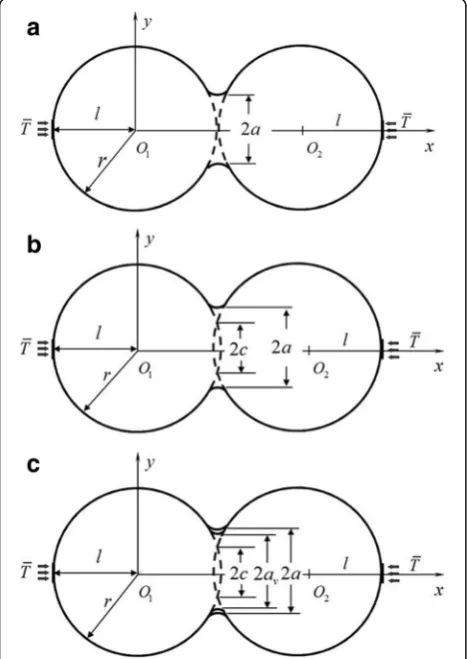
Three kinds of diffusion mechanisms (surface, volume, and simultaneous surface and volume diffusions) are considered. At the initial stage of PECS, surface diffusion causes neck growth but not shrinkage. Thus, the center-to-center distance does not change, as shown in Fig.1a.Under volume diffusion, the neck grows and the center-to-center distance decreases, resulting in shrink-age and densification. This finding is observed in Fig.1b, where a is the neck radius andcis half of the length of the cord; c= 0.74a (Wang 1990). In Fig. 1c, c= 0.74av,
and avis the neck radius produced by the volume
diffu-sion only. The neck curvature radii are approximately ρ =a2/2r(surface and simultaneous diffusions) andρ=a2/ 4r(volume diffusion), whereris the radii of the particle. The neck growth rate is defined asX=a/r. This paper considers only the initial stage of PECS, that is,X≤0.3.
The 3D finite element model is established to solve the distributions of the temperature and concentration fields. Step temperature and additional pressure are applied on both ends of the particles,x= −r , , 3r: T ¼T1ðtÞ, T ¼1273 K andP= 35MPa. The rest of the area of the particles is adiabatic and stress-free. The thermoelastic diffusion parameters (Wang et al. 2010; Young and McPherson 1989; Kumar et al. 2014; Rao and Cutler1972) are shown in Table 1. Relevant partial differential equations (PDEs) are solved using Comsol Multiphysics 3.5.
Results and discussion
Temperature and concentration field distributions
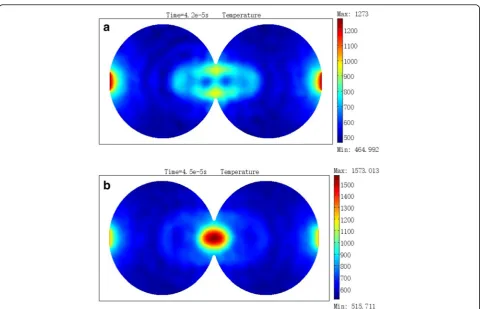
For the volume diffusion mechanism in the generalized thermoelastic diffusion theory that considers the heat conduction non-Fourier effect, the temperature is in the form of wave propagation in the particle system. Firstly, superposition is generated at the edge of the sintering neck, resulting in local high temperature at the edge of the neck as shown in Fig. 2a, and then the heat wave continues to propagate to the center of the sintering neck forming a local high temperature in the center of the neck, and the maximum temperature can be reached to 1573 K, as shown in Fig.2b.
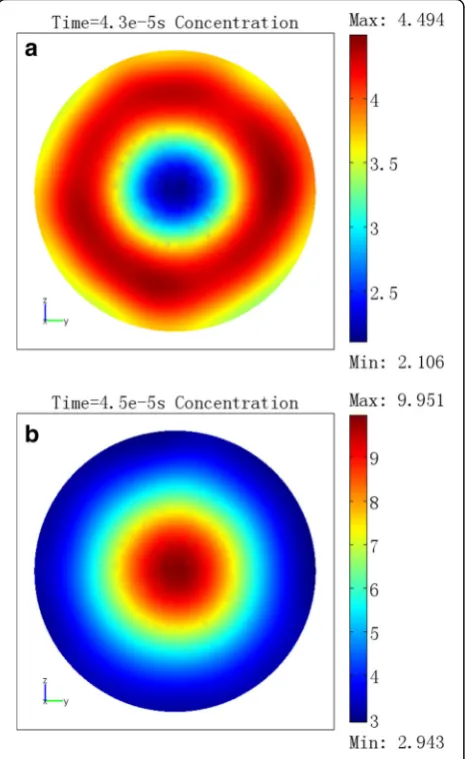
At the same time, the changes in temperature and stress cause a change in concentration in the neck area. The thermal wave at the neck forms the local high temperature and produces a greater larger thermal stress, thereby causing significant changes to the mass concentration of neck sintering, driving neck material migration, and ultimately providing an additional driving force for neck growth. Affected by temperature and stress, the concentration of the edge of the neck initially increases at the neck edge (Fig. 3a) and then forms the high local concentration and the concentration gradient at the center of the neck (Fig.3b). The high concentra-tion gradient drives the neck material migraconcentra-tion to the edge of the neck.
Diffusion flux under volume diffusion
For the condition of a high heat rate under pressure, the vacancy concentration differenceΔCof PECS in consid-eration of the intrinsic Laplace stress, the thermal stress, and the additional applied pressure is proposed as fol-lows (Zhang et al.2016):
Volume diffusion:
Fig. 1Double equal-sized spherical models (Wang1990).aSurface
Table 1The thermoelastic diffusion parameters of Al2O3
Name Symbol Value Unit
Reference temperature T0 293 K
Density ρ′ 3900 kg⋅m‐3
Specific heat Cε 900 J⋅kg−1⋅K−1 Thermal conductivity k′ 27 W⋅m−1⋅K−1 Thermal expansion coefficient αt 8.0 × 10⁻⁶ K−1
Elastic modulus E 380 GPa
Poisson ratio ν 0.22
Thermal relaxation time τ0 0.2 s
Diffusion expansion coefficient αc 2.34 × 10⁻⁴ m3⋅kg
Diffusion coefficient D 0.63 × 10⁻⁸ kg⋅s⋅m−3 Measures of the thermodiffusion effects a′ 2.32 × 10⁴ m2⋅s−2⋅K−1 Measures of the diffusive effects b′ 3.061 × 10⁶ m5⋅kg−1⋅s−2 Diffusion relaxation time τ 0.02 s
Volume of vacancy Ω 2.7 × 10⁻²⁹ m3 Boltzman constant k 1.3806505 × 10⁻²³
Enthalpy of vacancy motion Hm 3.8 eV
ΔC¼ C0Ω=a2kT
4rγþ4pr2=πþa2ΔσT ð10Þ
Simultaneous diffusion:
ΔC¼ C0Ω=a2kT
2rγþ4pr2=πþa2ΔσT ð11Þ
whereγand Pdenote the surface energy and the add-itional applied pressure, respectively;Ω is the volume of vacancy, C0 presents equilibrium concentration of the vacancy of stress-free zone, andkis Boltzman constant.
σTis the thermal stress caused described in Eq. (6). The
corresponding vacancy diffusion flux is
Jcurv−t¼−DΔρC ð12Þ
In hot-pressure (HP) sintering, that is, σT= 0, the
cor-responding vacancy diffusion flux is described asJcurv.
The thermal diffusion flux driven by the temperature gradient is expressed as (Olevsky and Froyen2009):
Jther¼−DCH m
kT
∇T
T ð13Þ
HereHmis the enthalpy of vacancy motion, and∇Tis the temperature gradient.
Affected by temperature and stress, the concentration diffusion flux expression is
Jconc¼−D∇C ð14Þ
Figure 4 compares the vacancy diffusion flux of the HP, the generalized thermoelastic (GT), and the GTD theory under volume diffusion mechanism. Considering the effect of thermal stress, the vacancy diffusion flux calculated by GT and GTD theories greatly increased, and the values of GTD is little higher because GT theory only considers the influences of strain and temperature.
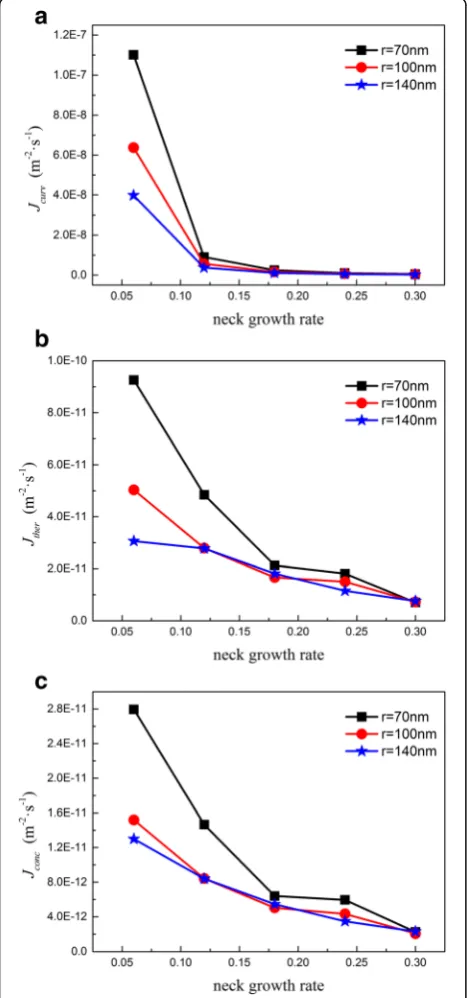
Particle size has a significant effect on the diffusion flux. As the particle size increases, the vacancy of the diffusion flux, the thermal diffusion, and the concentra-tion of the diffusion fluxes were significantly reduced, especially at the initial stage, as shown in Fig.5. Numer-ical results show that large particles have small sintering driving forces; thus, the fine powder accelerates the sin-tering process in a short time. This finding is consistent with actual sintering practices (Hungria et al. 2009; Lu et al.2012).
By introducing the particle radius, r, the ratio of the thermal diffusion flux to the conventional HP curvature-driven flux is given by (Johnson1990).
Jther
r2J curv¼
∇T
T Hm
2Ω
ρ r2=
γ ρ−
γ a
þ4πPra22
ð15Þ
The ratio of the concentration diffusion flux to the conventional HP curvature-driven flux can be written as
Fig. 3Concentration distribution.at= 4.3e−5 s, section xoy
concentration distribution.bt= 4.5e−5 s, section xoy concentration distribution
Jconc
r2J curv¼
∇Cρ
r2ΔC ð16Þ
According to Eqs. (10) and (11), the ratio of PECS vacancy diffusion flux to the conventional HP curvature-driven flux is.
Volume diffusion:
Jcurv−t
Jcurv
¼4rγþ4pr2=πþa2ΔσT
4rγþ4pr2=π ð17Þ
Simultaneous diffusion:
Jcurv−t
Jcurv ¼
2rγþ4pr2=πþa2Δσ
T
2rγþ4pr2=π ð18Þ
The ratios of the PECS vacancy diffusion flux, the thermal diffusion flux, the concentration diffusion flux, and the total of three diffusion fluxes to the conven-tional HP curvature-driven flux are shown in Fig. 6. At the initial stage of PECS, along with the sintering process, the ratio of thermal diffusion flux to the con-ventional curvature-driven flux has an obvious increas-ing trend because the contact area between particles is smaller, the intrinsic Laplace stress is infinite, and the free-surface curvature-driven diffusion is dominant. Then, the contact area increases with the neck growth and the intrinsic Laplace stress decreases, causing the ratio of the diffusion flux to increase. The neck material migration is mainly driven by thermal diffusion. The concentration diffusion flux caused by the change of temperature and stress, retain a relatively higher value, that is, about three to five times that of the HP pro-cesses. Relative to the PECS vacancy and the concentra-tion diffusion fluxes, the influence of thermal diffusion flux formed from the neck non-uniform temperature distribution on the sintering driving force is dominated especially in the late initial stage of PECS that remark-ably increases the sintering driving force. Therefore, for the double equal-sized spherical model under volume diffusion mechanism, the neck growth-driven force is mainly provided by the temperature gradient.
Fig. 5Diffusion flux of different particle sizes under volume
diffusion.aVacancy diffusion flux.bThermal diffusion flux.c
Concentration diffusion flux
Fig. 6Comparison of the ratio of diffusion flux under
Diffusion flux under simultaneous diffusion
Similar to the volume diffusion mechanism, thermal wave produces superposition at the neck under a simul-taneous diffusion mechanism forms the local high temperature. The neck mass concentration change, caused by temperature changes, forms high concentra-tion gradient, promoting the mass migraconcentra-tion of the neck center to the neck surface.
Three kinds of the ratio calculated by Eqs. (15), (16), and (18) under simultaneous diffusion are shown in Fig. 7. The thermal diffusion flux accounted for nearly half of the total diffusion flux, meaning that thermal dif-fusion is the main driving force of the neck mass migra-tion and that the concentramigra-tion diffusion flux cannot be ignored. Thermal stress, thermal diffusion, and concen-tration gradient greatly improved the driving force of the neck mass migration, which explains the reason why PECS possesses higher efficiency than the traditional hot-press sintering.
The ratio of total diffusion flux under volume (v‐Jtotal) and simultaneous diffusions (sv‐Jtotal) is shown in Fig.8. With the increase of neck growth, the ratio of total flux increases significantly; in the late initial stage of PECS, the values of simultaneous diffusion is higher than vol-ume diffusion. In fact, the diffusion mechanism of the PECS process is a series of transient process under the action of varieties of diffusion mechanism. The change tendency of simultaneous diffusion explains that the PECS is finished in a short time.
Conclusions
The sintering driving force at the initial stage of PECS is investigated by introducing the generalized thermoelastic diffusion theory and considering the coupling effect of strain, temperature, and concentration. The following conclusions are drawn:
1. The thermal wave in the neck produces a superposition, thus forming the local high
temperature. Temperature change causes the neck mass concentration to change, thereby forming the local concentration gradient and providing
additional driving force for neck growth. The thermal stress, which includes the influence of strain, temperature, and concentration, improves the vacancy diffusion flux in the neck.
2. For double equal-sized spherical model under vol-ume diffusion and simultaneous diffusion, the ther-mal diffusion flux driven by the high-temperature gradient formed from the neck non-uniform temperature distribution is the dominant sintering driving force, especially at the late initial stage of PECS. This flux remarkably increases the driving force, promoting neck mass migration. At the same time, the total ratio of the diffusion flux of simul-taneous diffusion is greater than the volume.
Abbreviations
GT:Thermoelastic theory; GTD: Generalized thermoelastic diffusion; HP: Hot pressure; PDEs: Partial differential equations; PECS: Pulse electric current sintering
Acknowledgements
This work was supported by the National Natural Science Foundation of China (No.11602042), Chongqing Research Program of Basic Research and Frontier Technology (No. cstc2016jcyjA0259, cstc2015jcyjA50010), and Scientific and Technological Research Program of Chongqing Municipal Education Commission (Grant No. KJ1601304).
Funding
The study was funded by the National Natural Science Foundation of China (No.11602042), Chongqing Research Program of Basic Research and Frontier Technology (No. cstc2016jcyjA0259, cstc2015jcyjA50010), and Scientific and Technological Research Program of Chongqing Municipal Education Commission (Grant No. KJ1601304).
Fig. 7Comparison of the ratio of diffusion flux under
simultaneous diffusion
Fig. 8Comparison of total diffusion flux under volume and
Authors’contributions
ZL and ZH conceived and designed the study. ZL wrote the paper. ZH reviewed and edited the manuscript. Both authors read and approved the final manuscript.
Competing interests
Both authors declare that they have no competing interests.
Publisher’s Note
Springer Nature remains neutral with regard to jurisdictional claims in published maps and institutional affiliations.
Received: 18 June 2018 Accepted: 15 August 2018
References
Antou, G., Guyot, P., Pradeilles, N., et al. (2015). Identification of densification mechanisms of pressure-assisted sintering: application to hot pressing and spark plasma sintering of alumina.Journal of Materials Science, 50, 2327–2336. Huai, X. L., Jiang, R. Q., & Liu, D. Y. (2000). Experimental and theoretical
investigation on the non-Fick effects during the rapid transit mass diffusion.J Eng Thermophysics (in Chinese), 21, 595–599.
Hungria, T., Galy, J., & Castro, A. (2009). Spark plasma sintering as a useful technique to the nanostructuration of piezo-ferroelectric materials.Advanced Engineering Materials, 11, 615–631.
Jiang, R. Q., Kong, X. Q., & Dong, H. X. (1996). Non-Fick’s effects study of mass transfer law for transient mass transfer process.J Eng Thermophysics (in Chinese), 17, 139–142.
Johnson, D. L. (1990). Temperature-gradient-driven diffusion in rapid-rate sintering-comment.Journal of the American Ceramic Society, 73, 2576–2578. Kumar, R., Ahuja, S., & Garg, S. K. (2014). Numerical analysis of the propagation
characteristics of Stoneley waves at an interface between microstretch thermoelastic diffusion solid half spaces.Latin Am J Solid Struct, 11, 2408–2425. Lu, D., Yang, Y., Qin, Y., et al. (2012). Effects of particle size and sintering
temperature on densification during coupled multifield-activated microforming.Journal of Materials Research, 27, 2579–2586.
Nowacki, W. (1974a). Dynamical problems of thermodiffusion in solids I.B Pol Acad Sci-Tech, 22, 55–64.
Nowacki, W. (1974b). Dynamical problems of thermodiffusion in solids II.B Pol Acad Sci-Tech, 22, 129–135.
Nowacki, W. (1974c). Dynamical problems of thermodiffusion in solids III.B Pol Acad Sci-Tech, 22, 257–266.
Olevsky, E. A., & Froyen, L. (2009). Impact of thermal diffusion on densification during SPS.Journal of the American Ceramic Society, 92(S1), S122–S132. Rao, W. R., & Cutler, I. B. (1972). Initial sintering and surface diffusion in Al2O3.
Journal of the American Ceramic Society, 55, 170–171.
Semenov, A. S., Trapp, J., Nöthe, M., et al. (2017). Experimental and numerical analysis of the initial stage of field-assisted sintering of metals.Journal of Materials Science, 52, 1486–1500.
Sherief, H. H., Hamza, F. A., & Saleh, H. A. (2004). The theory of generalized thermoelastic diffusion.International Journal of Engineering Science, 42, 591–608. Wang, C., Cheng, L. F., & Zhao, Z. (2010). FEM analysis of the temperature and
stress distribution in spark plasma sintering: modelling and experimental validation.Computational Materials Science, 49, 351–362.
Wang, J. C. (1990). Analysis of early-stage sintering with simultaneous surface and volume diffusions.Metallurgical Transactions A, 21, 305–311.
Young, R. M., & McPherson, R. (1989). Temperature-gradient-driven diffusion in rapid-rate sintering.Journal of the American Ceramic Society, 72, 1080–1084. Zhang, L., Zhang, X. M., Chu, Z. X., et al. (2016). Effect of heat wave at the initial