doi:10.4236/jwarp.2011.31009 Published Online January 2011 (http://www.scirp.org/journal/jwarp)
Analytical Solution to the One-Dimensional
Advection-Diffusion Equation with Temporally
Dependent Coefficients
Dilip Kumar Jaiswal, Atul Kumar, Raja Ram Yadav
Department of Mathematics and Astronomy, Lucknow University, Lucknow, India E-mail: dilip3[email protected], [email protected], yadav_rr2@yahoo.co.in Received October 8, 2010; revised November 20, 2010; accepted December 23, 2010
Abstract
In a one-dimensional advection-diffusion equation with temporally dependent coefficients three cases may arise: solute dispersion parameter is time dependent while the flow domain transporting the solutes is uni-form, the former is uniform and the latter is time dependent and lastly the both parameters are time depend-ent. In the present work analytical solutions are obtained for the last case, studying the dispersion of con-tinuous input point sources of uniform and increasing nature in an initially solute free semi-infinite domain. The solutions for the first two cases and for uniform dispersion along uniform flow are derived as particular cases. The dispersion parameter is not proportional to the velocity of the flow. The Laplace transformation technique is used. New space and time variables are introduced to get the solutions. The solutions in all pos-sible combinations of increasing/decreasing temporal dependence are compared with each other with the help of graphs. It has been observed that the concentration attenuation with position and time is the fastest in case of decreasing dispersion in accelerating flow field.
Keywords: Advection, Diffusion, Dispersion, Continuous Input, Flux Type Condition
1. Introduction
Immiscible solute or tracer particles of pollutants are major cause of degradation of the hydro-environment in the surface water bodies and aquifers. The sources of such pollutants originate from human activities on the earth. Solute particles reach a surface water body with waste water drainage and reach an aquifer due to infiltra-tions from wastes disposal sites, underground septic tanks, mines and polluted water bodies that recharge the aquifers. Solutes are transported down the stream along the flow and disperse due to combined effects of diffu-sion and advection. Concentration attenuation with posi-tion and time is described by an advecposi-tion-diffusion equ-ation which is a partial differential equequ-ation of parabolic type. Due to growing concern about the safe hydro-envir- onment for the existence of life on the earth the advec-tion-diffusion equation has drawn significant attention of environmentalists, hydrologists, civil engineers and ma-thematical modelers. Its analytical and numerical solu-tions for the set of initial condition and boundary condi-tions typical for real situacondi-tions are useful to assess the
time and position at which the concentration level of the pollutants will start affecting the health of the habitats in the polluted water eco-system. Also such solutions help estimate and examine the rehabilitation process and management of a polluted water body after elimination of the pollution.
In the earlier analytical solutions the solute dispersion parameter and velocity have been considered constant in a homogeneous medium. The basic approach was to re-duce the advection-diffusion equation
2
2
C C
D u
t x x
C
(1)
into a diffusion equation by eliminating the advection term. It was done either by introducing moving coordi-nates
x x ut, t t (2)
or by introducing another dependent variable
,
, exp 22 4
ux u t C x t K x t
D D
D. K. JAISWAL ET AL. 77
For example the analytical solution of the advection-diffusion equation with constant coefficients in an ini-tially solute free semi-infinite domain for a continuous uniform input point source 0 at the origin has been
reported by Ogata and Banks [1], Harleman and Rumer [2], Guvanasen and Volker [3], Marshall et al. [4], by using the transformations in Equation (2), as
C
, 0erfc2 2
C x ut
C x t
Dt
(4)
or by using the transformation in Equation (3), as
0, erfc exp erfc
2 2 2
C x ut ux x ut
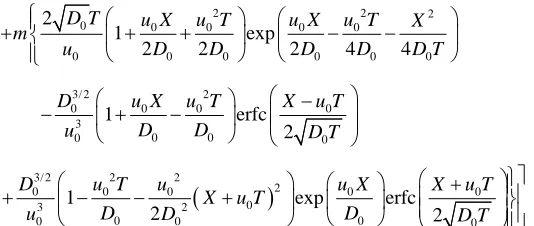
C x t
Dt D Dt
(5)
by Banks and Ali [5], Ogata [6], Lai and Jurinak [7], Marino [8] and Al-Niami and Rushton [9]. Both the so-lutions have been obtained by using Laplace transforma-tion technique. The former solutransforma-tion satisfies the advec-tion-diffusion equation but does not satisfy the input condition. The omission of factor
1 2 in Equation (4) makes the difference between the value of
C C0
atobtained from this solution and that given by the input source condition, just half. Also this difference decreases for a smaller value of the velocity. The latter solution satisfies the input source condition and does not satisfy the differential equation but the error of approxi-mation is of negligible order. So the latter type of ana-lytical solutions have been obtained for different disper-sion problems incorporating the other factors such as zero order production, first order decay, adsorption. Such solutions are compiled by van Genuchten and Alves [10] and Lindstrom and Boersma [11]. Such solutions are very useful in validating the numerical solutions.
0 x
Previous investigations have established that the lon-gitudinal dispersion coefficient was directly proportional to Darcy velocity for a broad range of Reynold’s number. Taking advantage of this relationship, analytical solu-tions were obtained for a class of unsteady flow prob-lems (Jaiswal et al., [12], Kumar et al., [13]). Further Yates [14] considered an exponentially decreasing dis-persion along a uniform flow through porous medium to solve the advection-diffusion equation without adsorp-tion. Logan and Zlotnik [15] and Logan [16] extended the works of Yates by including the adsorption and decay effects and studying their interactions with the heteroge-neity caused by scale-dependent dispersion of periodic input source along uniform flow. Aral and Liao [17] ob-tained analytical solutions to two dimensional advec-tion-dispersion equation with time dependent dispersion coefficients by eliminating convective terms by intro-ducing moving coordinate systems and using superposi-tion method (Haberman, [18]). Such assumpsuperposi-tions were based on the observations of Matheron and De Marsily
[19], Sposito et al. [20], Gehler et al. [21] who showed that large subsurface formations exhibit variable disper-sivity properties, either as a function of distance or as a function of time along uniform flow. But such depend-ency may be more prevalent in surface water bodies due to local effects like curved boundaries, bridges etc., and chemically reactive type of pollutants whose dispersion may marginally increase or decrease with time. To un-derstand the hydro-environment degradation problem in wider perspective, while investigating unsteady disper-sion problems, all the three cases 1) unsteady disperdisper-sion along uniform flow, 2) uniform dispersion along un-steady flow and 3) unun-steady dispersion along unun-steady velocity but both being not proportional to each other, should be investigated. In a recent paper Jaiswal et al. [12] studied the first case and obtained the analytical solutions for pulse type uniform and varying inputs.
The present paper considers the general case 3) and analytical solutions similar to those in Equation (5) are derived by reducing the time dependent coefficients of the advection-diffusion equation into constant coeffi-cients with the help of a set of new independent variables of space and time different from those in the earlier work and then using Laplace transformation technique. Con-tinuous input point sources of uniform and increasing nature are considered. The analytical solutions for the first two cases and that of uniform dispersion along uni-form flow may be obtained from this solution as particu-lar cases. The solutions in different cases are illustrated and compared with each other.
2. Temporally Dependent Dispersion along
Unsteady Flow
The general linear form of one-dimensional advection- diffusion equation in Cartesian system is
,
,C C
D x t u x t C
t x x
(6)
The symbol, C is the solute concentration at position
x of the domain at time . If the two coefficients and are constants then they are referred to as solute dispersion coefficient and uniform velocity, respectively, and the above equation reduces to Equation (1). Let us write the solute dispersion parameter and the velocity of the flow in the above advection-diffusion equation as
t D
u
, 0 1
,D x t D f x t and u x t
, u f0 2
x t, (7)In the present study it is assumed that the solute dis-persion and the velocity of the flow, both are temporally dependent hence we consider
1 , 1
where is a resistive of dimension being inverse of time variable. Thus
m
1
f mt and f2
mt are non-di-The conditions in Equations (10) - (12) may be written in terms of new independent variables as
mensional expressions. It is chosen such that f mt1
1and when either (represents the case of uniform dispersion along uniform flow) or
2 1
f mt m0
0 t
(the initial stage). The advection-diffusion equation in Equation (6) assumes the form
,
0C X T ; X 0, T 0 (17)
,
0C X T C ; X 0, T 0 (18)
2
0 1 2 0 2
C C
D f mt u f mt
t x C x (9) 0 C X
; X , T0 (19)
Now advection-diffusion equation in
X T,
domain given by Equation (16) is reduced into a diffusion equation in terms of a new independent variable, K defined by We study the dispersion of a continuous input pointsource introduced at the origin of an initially solute free one-dimensional semi-infinite medium. Analytical solu-tions are obtained for uniform input point source and that of increasing nature.
0 020 0
, , exp
2 4
u X u T C X T K X T
D D
(20)
which is
2.1. Uniform Input Point Source
2 0 2 K K D T X
(21)
In case of uniform continuous input point source the ini-tial and boundary conditions for the above advection-
diffusion equation are The conditions in Equations (17) - (19) reduce to
, 0C x t ; t0, x0, (10) K X T
,
0; X 0, T 0 (22)
, 0C x t C ; x0, t0, (11)
20
, exp
K X T C T ; , ,
where
0
X T 0
2 2
0 4 0
u D
(23)
0
C x
; x , t0 (12)
0 0 0 2 u K K X D
; , (24)
Let us introduce a new space variable X, using a
transformation which is X T 0
2 2
1 1
f mt f mt
X dx x
f mt f mt
(13) respectively. Applying Laplace transformation above initial and boundary value problem reduces to an ordi-nary second order boundary value problem, which com-prises of following three equationsin terms of which the advection-diffusion equation in Equation (9) reduces to
2
2 0
0
d K p
K D
dX ; 0
, pT
K K X T e dT
(25)
2 1 0 0 2 2 2f mt C C
D u
t X
f mt X
C (14)
02
, C
K X p
p
;
Further a new variable, T is introduced by the
transformation X 0 (26)
2 2 1 0t f mt
T d
f mt
00 0 2 u dK K
dX D ; (27)
t (15) X
It is evident that the dimension of it will be that of time variable hence it is referred to as a new time variable. While choosing expressions for
t
1
f mt and
2
f mt it is also ascertained that T 0 at t0. So the nature of the initial condition does not change in the new time domain. The advection-diffusion equation in Equation (14) reduces to one with constant coefficients which is
The particular solution of this boundary value problem may be obtained as
0
0 2
, C exp /
K X p p D X
p
(28)
Applying inverse Laplace transformation on it, using the appropriate tables (van Genuchten and Alves, [10]) and using the necessary transformations defined earlier in the text, backwards, we may get the desired analytical solution as
2
0 2 0
C C
D u
T X X
D. K. JAISWAL ET AL. 79
2 2 0 01 2 1
0 0
0 1
0 0
, erfc exp erfc
2 2 2
f mt f mt
x u T x u T
f mt f mt f mt
C u
C x t x
D f mt
D T D T
(29)
where is defined in Equation (15). Also an analyti-cal solution of the same initial and boundary value problem similar to that in Equation (4) may be obtained as either
T
2
1 00
0
/
, erfc
2
xf mt f mt u T C x t C
D T ;
2 2 1 0t f mt
T d
f mt
t (30)or
0 0 2
0, erfc
2
x u f mt dt
C x t C
D T
;
1 0 tT
f mt dt (31)where (1/2) is omitted because of the reason stated below the solution in Equation (4).
2.2. Input Point Source of Increasing Nature
Due to increasing human activities the input point source may not remain constant instead it will increase with time. This premise is expressed by a mixed type non- homogeneous condition as
,
, 0 0C
D x t u x t C u C x
; x0, t0 (32)
Using the expressions in Equation (6) it may be writ-ten in terms of and new independent variables defined in Equations (13) and (15), respectively, as
0 0 0 0 2 u C CD u C
X f mt
;
To proceed with it expressions f mt1
exp
mtand f2
mt exp
mt
are considered. For theseex-pressions the new space variable and new time variable will be given by
exp 2
X x mt (34)
1
1 exp 3 3
T m
m
t (35)
Solving old time variable in terms of new time va-riable from the expression in Equation (35), and us-ing that relationship, the condition in Equation (33) may be written as
t T
1/3
0 0 0 0 1 3 0 0 1
C
D u C u C mT u C m
X
T
;0
X , T0 (36)
where the series
2o m is neglected from the binomial expansion as is chosen much smaller than one. Us-ing the transformation in Equation (20), above condition may be written as
m
20
0 0 0 1 exp
2 u K
D K u C mT
X
T ;
0
X , T0 (37)
Applying Laplace transformation on it we may get
0
0 0 0 2 2 2
1 2
u
dK m
D K u C
dX p p
; 0
X (38)
The particular solution of the boundary value problem comprising of Equations (25), (38) and (27) may be ob-tained as
0
X , t0 (33)
0 0
2
2
2
0
0
1
, u C m exp /
K X p p D X
p
D p p
(39)
Applying inverse Laplace transformation on it, using the appropriate tables (van Genuchten and Alves, [10]) and
using the necessary transformations defined in the text, backwards, we may get the desired analytical solution as
0 0 02 20
0 0 0 0 0
, 2 exp erfc
2 2 4 4 2
C T u X u T X
C X T u
D D D D T D T
0
X u T
2
0 0 0 0
0 0 0 0
1 exp erfc
2
u X u T u X X u T
D D D D T
2 2 2
0 0 0 0 0
0 0 0 0 0
2
1 exp
2 2 2 4 4
D T u X u T u X u T X
m
u D D D D D
0T
3/ 2 2
0 0 0 0
3
0 0
0 0
1 erfc
2
D u X u T X u T
D D
u D T
3/ 2 2 2
2
0 0 0 0 0
0
3 2
0 0
0 0 0
1 exp erfc
2 2
D u T u u X X u T
X u T
D D
u D D T
(40)
where X and T are given by Equations (34) and (35), respectively.
2.3. Particular Cases
2.3.1. Uniform Dispersion along Unsteady Flow
An analytical solutio of the dispersion problem in
which solutes of a uniform input point source disperse uniformly along a flow domain of temporally dependent velocity under the same conditions may be obtained by substituting
n
1 ,
f x t 1 and f2
x t, f mt
(41)the solution in Equation (29) as
0
0 0
00
0 0
, erfc exp erfc
2 2 2
xf mt u T xf mt u T
C u x
C x t f mt
D
D T D T
t
(42)
The new time variable in this solution has the expression
2
0 t
T
f mt d (43)Similarly the analytical solution of this particular problem in case of increasing input point source will be defined by the solution (40) but the expressions for the new space and time variables will be
expX x mt and 1
1 exp
2
2T m
mt (44)
2.3.2. Temporally Dependent Dispersion along Uniform Flow
The analytical solutions of this particular dispersion pro- blem in case of uniform and increasing input point sour- ces may be obtained by substituting
1 ,
f x t f mt and f2
x t, 1 (45)in the solutions in Equation (29) and Equation (40) which have been obtained independently in a recent work (Jaiswal et al., [12]).
2.3.3. Uniform Dispersion along Uniform Flow
The analytical solutions in this particular dispersion problem may be obtained by substituting
1 ,
f x t 1 and f2
x t, 1 (46)in the solutions in Equation (29) and Equation (40), which are reported as problems (A1) and (A2), respec-tively, in time domain , by van Genuchten and Alves [10].
0
0 t t
3. Result and Discussions
The solution in Equation (29) describes the solute dis-persion of uniform input point source concentration through a medium in all the four cases of temporal de-pendence of the two coefficients of the advection-diffu- sion equation: 1) temporally dependent solute dispersion along temporally dependent flow, 2) temporally depend-ent dispersion along uniform flow, 3) uniform dispersion along temporally dependent flow and 4) uniform disper-sion along uniform flow. The analytical solutions for last three cases may be obtained from (29) for
1
f mt f mt , f2
mt 1 ; f mt1
1 ,
2
f mt f mt and f mt1
1, ,respec-tively. The concentration values
t 12
f m
0
m
0 are evaluated
from the solution in Equation (29) in all the above four cases and are illustrated in Figures (1)-(4). Temporal dependences of increasing and decreasing nature are con-sidered. The different combinations for which the curves in these figures are drawn are given in Table 1. The last combination may be obtained by putting
C C
in any of the first six combinations. Concentration values are evaluated in a long domain 0x(km)10 at
(years) 1.3,1.9,
t 2.5. The values assigned to different parameters to draw these four figures are: u01.14
km year
, D01.25
year
2km and m0.1 . The input concentration
-1year
C C0atx0
in all these figures is 1.0 as considered in the first boundary condition in Equation (11), stating the input point source of uniform nature. [image:5.595.198.465.80.193.2]D. K. JAISWAL ET AL. 81
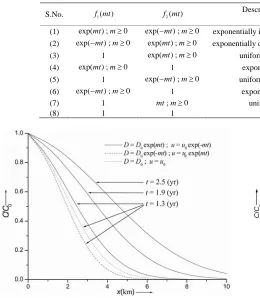
Table 1. Different combinations of temporally dependent/uniform solute dispersion and velocity of the flow.
S.No. f mt1( ) f mt2( )
Description of dispersion, DD f mt0 1( )
( )
uu f mt
in a flow of velocity, 0 2
(1) exp(mt);m0 exp(mt);m0 exponentially increasing dispersion in exponentially decelerating flow (2) exp(mt);m0 exp(mt);m0 exponentially decreasing dispersion in exponentially accelerating flow (3) 1 exp(mt);m0 uniform dispersion in exponentially accelerating flow (4) exp(mt);m0 1 exponentially increasing dispersion in uniform flow (5) 1 exp(mt);m0 uniform dispersion in exponentially decelerating flow (6) exp(mt);m0 1 exponentially decreasing dispersion in uniform flow (7) 1 mt;m0 uniform dispersion in linearly accelerating flow
[image:6.595.299.538.102.397.2](8) 1 1 uniform dispersion in uniform flow
Figure 1. Continuous curves refer to temporally increasing dispersion in decelerating flow, dashed curve refers to temporally decreasing dispersion in accelerating flow and dotted curve refers to uniform dispersion in uniform flow. Concentration values are evaluated from solution in Equa-tion (29) for uniform input point source.
0 2 4 6 8
0.0 0.2 0.4 0.6 0.8 1.0
10
t = 2.5 (yr)
t = 1.9 (yr)
t = 1.3 (yr) ---D = D0exp(mt) ; u = u0
D = D0 ; u = u0exp(mt)
C
/
C0
x(km)
Figure 2. Continuous curves refer to uniform dispersion in accelerating flow and dashed curve refers to temporally increasing dispersion in uniform flow. Concentration values are evaluated from solution in Equation (29) for uniform input point source.
0 2 4 6 8
0.0 0.2 0.4 0.6 0.8 1.0
10
---D = D0exp(-mt) ; u = u0 D = D
0 ; u = u0exp(-mt)
t = 2.5 (yr) t = 1.9 (yr) t = 1.3 (yr)
C
/
C0
x(km)
Figure 3. Continuous curves refer to uniform dispersion in decelerating flow and dashed curve refers to temporally decreasing dispersion in uniform flow. Concentration val-ues are evaluated from solution in Equation (29) for uni-form input point source.
0 2 4 6 8
0.0 0.2 0.4 0.6 0.8 1.0
10
t = 2.5 (yr)
t = 1.9 (yr)
t = 1.3 (yr)
D = D
0 ; u = u0mt
C
/
C0
[image:6.595.311.539.470.642.2]x(km)
Figure 4. Concentration values evaluated from solution in Equation (29). Curves refer to uniform dispersion in line-arly accelerated flow.
[image:6.595.62.283.475.656.2]pattern is on the expected lines, i.e., in the presence of uniform point source of pollution the concentration level decreases with position at a time and increases with time at a particular position. This solution is compared with two other solutions obtained for the combinations (2) and (8), respectively at (years). Thus the concentra-tion distribuconcentra-tion behaviors in cases of increasing disper-sion in decelerating flow; decreasing disperdisper-sion in accel-erating flow; and uniform dispersion in uniform flow, are compared with each other. It may be observed that the concentration values in the combination (8) occur in be-tween the concentration values in other two combina-tions, those for the combination (2) being the least. It means in case of decreasing dispersion in an accelerated flow field the concentration will reach the danger level in a region away from the source of the pollution, in the longest time. The solid curves in Figure 2 represent the solution (29) of the dispersion problem described by the combinations (3) at the three times mentioned at the out-set of this section. One curve of this combination is compared with the curve drawn for the combination (4), at (years). It may be observed that the concen-tration level in case of uniform dispersion in accelerating flow domain is lower than that in case of increasing dis-persion in uniform flow. Figure 3 depicts the solution (29) representing the combination (5) by the three solid curves and the combination (6) by the single dotted curve. It shows that the concentration level at a particular time (years) in case of uniform dispersion in a decel-erating flow is higher than that in case of decreasing dis-persion in an uniform flow. This trend will be same at all times but the difference between concentration values of the two combinations decreases with time more evidently in the middle region of the considered domain. Figure 4
depicts the concentration values obtained from the solu-tion in Equasolu-tion (29) for uniform dispersion along a time dependent flow domain in which velocity increases line-arly defined by the combination (7). It may be noted that the expression
1.3
t
1.3
t
1.3
t
f mt mt cannot be used for m0. The solute distribution pattern in this case being much slower as compared to those obtained for the other com-binations considered above. As evident from Equation (15) the solution in Equation (29) cannot be traced for
1
f mt mt , 2 but the solutions in
Equa-tions (30-31) can be used to trace this case (the figure is not drawn). From Figures (1-3) it may be observed that at a particular position rs)
1f mt
[image:7.595.310.537.79.250.2]at t1.3(yea the concentra-tion values for the combinaconcentra-tions (1), (4), (5), (8), (3), (6), and (2) are in decreasing order.
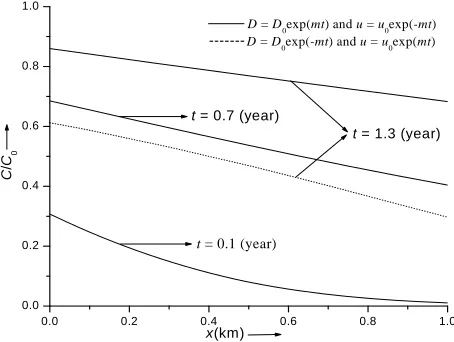
Figure 5 depicts the concentration distribution behav-ior of increasing input point source described by the so-lution in Equation (40) for the combination (1) by the solid curves for the same input values but in a shorter
0.0 0.2 0.4 0.6 0.8 1.0
0.0 0.2 0.4 0.6 0.8 1.0
---t = 0.1 (year)
t = 0.7 (year)
t = 1.3 (year)
C
/
C0
x(km)
D = D0exp(mt) and u = u0exp(-mt)
D = D0exp(-mt) and u = u0exp(mt)
Figure 5. Continuous curves refer to temporally increasing dispersion in decelerating flow and dotted curve refers to temporally decreasing dispersion in accelerating flow. Concentration values are evaluated from solution in Equa-tion (40) for input point source of increasing nature.
domain 0x
km 1 at lesser times t
years
. The solution for this input for the combina-tion (2) is also depicted in the same figure at0.1, 0.7,1.3
ears
0
x
1.3 y
t by the only dotted curve. It may be ob-served that concentration values for the latter combina-tion at are less than those for the former combi-nation. It may be noted that the input concentration
C C0atx0
increases with time as demanded by the condition in Equation (32). The solute transport pattern is same as in case of the uniform input. The solution for the latter combination may be obtained by replacing m by
m in the solution in Equation (40) but in that solu-tion the expressions for the new independent variables will be
exp 2X x mt , and 1
exp 3
1
3T mt
m
.
4. Conclusions
disper-D. K. JAISWAL ET AL. 83
sion along uniform flow; uniform dispersion along un-steady flow and uniform dispersion along uniform flow, are obtained as particular cases. The analytical solutions in each of the four cases are compared with each other. A clear distinction between them may be observed from the figures. Two functions one exponentially increasing with time and other exponentially decreasing with time are considered for the purpose. The present study establishes that among all the possibilities considered the degrada-tion of a water domain in slowest in case of the decreas-ing solute dispersion in an accelerated flow domain. It is slightly better than that in case of decreasing dispersion in uniform flow. It has also been established that the concentration attenuation in a semi-infinite medium is faster than that in a finite medium (Kumar et al., [22]). So a position farther away from the source in a semi-infinite medium is safe for longer period of time. Relying upon such studies the reason of low concentra-tion levels may be thought of, enforcing which techno-logically or by other means degradation of hydro-envi- ronment may be controlled. The similar dispersion prob-lems may be solved analytically in cases of pulse type input condition and initial spatial distribution described by Fischer et al. [23].
5. Acknowledgements
This work is part of the Post Doctoral Fellowship pro-gram of first two authors. Financial assistance provided by the funding agency to first author in the form of Dr. D. S. Khothari Post Doctoral Fellowship, University Grant Commission and second author in the form of NBHM Post Doctoral Fellowship, Department of Atomic Energy, Government of India, are gratefully acknowledged.
6. References
[1] A. Ogata and R. B. Banks, “A Solution of the Differential Equation of Longitudinal Dispersion in Porous Media,” US Geological Survey Professional Papers, No. 34, 1961, p. 411-A.
[2] D. R. F. Harleman and R. R. Rumer, “Longitudinal and Lateral Dispersion in an Isotropic Porous Medium,” Journal of Fluid Mechanics, Vol. 16, No. 3, 1963, pp. 385- 394.doi:10.1017/S0022112063000847
[3] V. Guvanasen and R. E. Volker, “Experimental Investi-gations of Unconfined Aquifer Pollution from Recharge Basins,” Water Resources Research, Vol.19, No. 3, 1983, pp. 707-717.doi:10.1029/WR019i003p00707
[4] T. J. Marshal, J. W. Holmes and C. W. Rose, “Soil Phys-ics,” 3rd Edition, Cambridge University Press, Cam-bridge, 1996.
[5] R. B. Banks and J. Ali, “Dispersion and Adsorption in Porous Media Flow,” Journal of Hydraulic Division, Vol. 90, No. 5, 1964, pp. 13-31.
[6] A. Ogata, “Theory of Dispersion in Granular Media,” US Geological Survey Professional Papers, No. 411-1, p. 34, 1970.
[7] S. H. Lai and J. J. Jurinak, “Numerical Approximation of Cation Exchange in Miscible Displacement Through Soil Columns,” Soil Science Society American Proceeding, Vol. 35, No. 6, 1971, pp. 894-899.
doi:10.2136/sssaj1971.03615995003500060017x [8] M. A. Marino, “Distribution of Contaminants in Porous
Media Flow,” Water Resources Research, Vol. 10, No. 5, 1974, pp. 1013-1018.doi:10.1029/WR010i005p01013
[9] A. N. S. Al-Niami and K. R. Rushton, “Analysis of Flow against Dispersion in Porous Media,” Journal of Hydrol-ogy, Vol. 33, No. 1-2, 1977, pp. 87-97.
doi:10.1016/0022-1694(77)90100-7
[10] M. Th. van Genuchten and W. J. Alves, “Analytical Solu-tions of the One Dimensional Convective-Dispersive So-lute Transport Equation,” US Department of Agriculture, Technical Bulletin, No. 1661, 1982.
[11] F. T. Lindstrom and L. Boersma, “Analytical Solutions for Convective Dispersive Transport in Confined Aqui-fers with Different Initial and Boundary Conditions,” Water Resources Research, Vol. 25, No. 2, 1989, pp. 241-256.doi:10.1029/WR025i002p00241
[12] D. K. Jaiswal, A. Kumar, N. Kumar and R. R. Yadav, “Analytical Solutions for Temporally and Spatially De-Pendent Solute Dispersion of Pulse Type Input Concen-Tration in One-Dimensional Semi-Infinite Media,” Jour-nal of Hydro-Environment Research, Vol. 2, 2009, pp. 254-263.doi:10.1016/j.jher.2009.01.003
[13] A. Kumar, D. K. Jaiswal and N. Kumar, “Analytical So-lutions to One-Dimensional Advection-Diffusion Equa-tion with Variable Coefficients in Semi-Infinite Media,” Journal of Hydrology, Vol. 380, No. 3-4, 2010, pp. 330-337.doi:10.1016/j.jhydrol.2009.11.008
[14] S. R. Yates, “An Analytical Solution for One Dimen-sional Transport in Porous Media with an Experimental Dispersion Function,” Water Resources Research, Vol. 28, No. 8, 1992, pp. 2149-2154.doi:10.1029/92WR01006
[15] J. D. Logan and V. Zlotnik, “The convection-Diffusion Equation with Periodic Boundary Conditions,” Applied Mathematics Letter, Vol. 8, No. 3, 1995, pp. 55-61.
doi:10.1016/0893-9659(95)00030-T
[16] J. D. Logan, “Solute Transport in Porous Media with Scale-Dependent Dispersion and Periodic Boundary Con-ditions,” Journal of Hydrology, Vol. 184, No. 3, 1996, pp. 261-276.doi:10.1016/0022-1694(95)02976-1
[17] M. M. Aral and B. Liao, “Analytical Solutions for Two- Dimensional Transport Equation with Time-Dependent Dispersion Coefficients,” Journal of Hydrologic Engi-neering, Vol. 1, No. 1, 1996, pp. 20-32.
doi:10.1061/(ASCE)1084-0699(1996)1:1(20)
[18] R. Haberman, “Elementary Applied Partial Differential Equations,” Prentice-Hall, Englewood Cliffs, 1987. [19] G. Matheron and G. De Marsily, “Is Transport in Porous
Media Always Diffusive, a Counterexample,” Water Re-sources Research, Vol. 16, No. 5, 1980, pp. 901-917.
[20] G. Sposito, W. A. Jury and V. K. Gupta, “Fundamental Problems in the Stochastic Convection-Dispersion Model for Solute Transport in Aquifers and Field Soils,” Water Resources Research, Vol. 22, No. 1, 1986, pp. 77-88.
doi:10.1029/WR022i001p00077
[21] L. W. Gelhar, C. Welty and K. R. Rehfeldt, “A Critical Review of Data on Field-Scale Dispersion in Aquifers,” Water Resources Research, Vol. 28, No. 7, 1992, pp. 1955-1974.doi:10.1029/92WR00607
[22] A. Kumar, D. K. Jaiswal and N. Kumar, “Analytical So-lutions of One-Dimensional Advection-Diffusion Equa-tion with Variable Coefficients in a Finite Domain,” Journal of Earth System Science, Vol. 118, No. 5, 2009, pp. 539-549.doi:10.1007/s12040-009-0049-y