EVALUATION OF EFFECT OF CENTELLA ASIATICA ON CCL4
INDUCED RAT LIVER DAMAGE
Shirish S. Pingale
Gramonnati Mandal’s, Arts, Commerce and Science College, Narayangaon, Pune, Pin - 410 504, Maharashtra, India. (Affiliated to University of Pune)
Email: [email protected]
Summary
Liver disorders are common but in medicinal practices reliable liver protective drugs are not available. Some herbs play important role in management of liver disorders. Centella asiatica were collected, cleaned, dried and grinded to fine powder by electric mixer and sieved by BSS. The present work was carried out to investigate the hepatoprotective action of Centella asiatica plant material on CCl4 (Carbon tetra Chloride) induced
liver damaged in rats. Blood and tissue biochemical assays like ALT, AST, bilirubin, Total Protein, glucose etc have been studied for evaluation of hepatoprotection. From the results of these parameters it is clear that Centella asiatica gave best recovery for hepatoprotection and may be used as a potent liver tonic.
Keywords: Centella asiatica, Carbon tetra Chloride, ALT, AST, Liver Tonic.
Introduction
Materials and Methods
Centella asiatica plants were collected from various places in Pune and Ahmednagar district; washed thoroughly and dried at room temp in shade. They were powdered, sieved through sieve of mesh to 85 (BSS) and stored in airtight containers (26, 28).
Dose
The dose selected for this plant powder aqueous slurry is 0.7g/Kg body weight against CCl4
damaged liver in rats, preciously for selection of amount of dose acute toxicity study has been also done in mice. All observations are found to be normal (24, 27).
Animals
The animals used for study were Wister Albino rats (130-150 gm) obtained from Raj Biotech (INDIA) Pvt. Ltd, Pune 411 038. They were acclimatized for 15 days before study. They were housed in polymethane cages. Each cage housed six animals and was maintained at 28 ± 2 0C.
The animals were subjected to 12 hrs cycles of light and darkness (24, 27). They were fed with commercially available feed pellets (12mm) containing crude protein (min 20-21 %), crude fiber (max 4 %), calcium (1-2 %) and phosphorus (0.6 %). Animals were supplied tap water from bottles during the experiment per day and the amount food and water intake is noted.
Parameters Observed
Blood of animals was collected by cardiac puncture under light ether anesthesia during sacrifice. Blood Biochemical assays were determined using a CHEMITO SPECTRASCAN UV 2700 spectrophotometrically. The blood parameters observed were GPT(ALT), GOT(AST), Cholesterol, Bilirubin, Triglecerides and √GT were as tissue parameters like Gycogen, T. Protein, Cholesterol, DNA, and RNA. This was done by using Standard kits supplied by Span Diagnostics Ltd., Surat, INDIA.
Animal Grouping
Animals were grouped into five groups. Each group with 12 animals 6 males and 6 females. Reversible liver damage was induced by 0.7 ml/Kg of CCl4 in 0.5 ml. Liquid
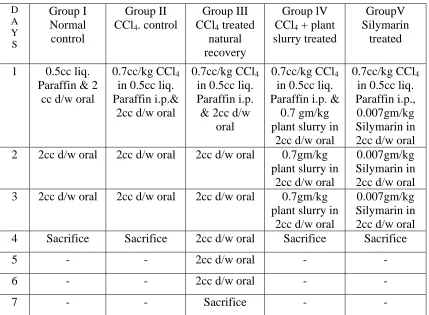
Paraffin per animal i.p. The dose of plant powder in the form of aqueous slurry was given orally via gavages as per dose chart in table ES1(24, 27).
Gr. I served as Normal Control; Gr. II served as CCl4 Control, Gr. III served as CCl4
Recovery, Gr. IV served as CCl4 + Centella asiatica Plant Slurry and Gr. V served as CCl4+
silymarin (a known hepatoprotectant).
Table ES 1: Daily Doses Regime D A Y S Group I Normal control Group II CCl4. control
Group III CCl4 treated
natural recovery
Group lV CCl4 + plant
slurry treated
GroupV Silymarin
treated
1 0.5cc liq. Paraffin & 2
cc d/w oral
0.7cc/kg CCl4
in 0.5cc liq. Paraffin i.p.&
2cc d/w oral
0.7cc/kg CCl4
in 0.5cc liq. Paraffin i.p. & 2cc d/w
oral
0.7cc/kg CCl4
in 0.5cc liq. Paraffin i.p. &
0.7 gm/kg plant slurry in
2cc d/w oral
0.7cc/kg CCl4
in 0.5cc liq. Paraffin i.p., 0.007gm/kg Silymarin in 2cc d/w oral 2 2cc d/w oral 2cc d/w oral 2cc d/w oral 0.7gm/kg
plant slurry in 2cc d/w oral
0.007gm/kg Silymarin in 2cc d/w oral 3 2cc d/w oral 2cc d/w oral 2cc d/w oral 0.7gm/kg
plant slurry in 2cc d/w oral
0.007gm/kg Silymarin in 2cc d/w oral 4 Sacrifice Sacrifice 2cc d/w oral Sacrifice Sacrifice
5 - - 2cc d/w oral - -
6 - - 2cc d/w oral - -
7 - - Sacrifice - -
All dosages are for each individual animal in the group. The number of animals in each group 12 (6 males + 6 females). i.p.: intraperitoneal. d/w: Distilled Water.
Results and discussion
Liver damage due to CCl4
Literature survey reveals that CTC causes hepatic injury and is a well-known liver toxin. CCl4 has direct destructive effect on membranes of the hepatocyte and on consequent
interface with cellular metabolism and transport. It damages the membranes of the hepatocyte causing leakage of the enzymes present in the cell. This results in elevation of the levels of plasma tramaminases.
It leads to fat decomposition in the liver due to blockage of secretion of hepatic triglycerides into plasma. The toxicity of CCl4 depends upon the cleavage of C-Cl bond to
generate a trichloro methyl-a free radical (CCl3O2). This cleavage occurs in the endoplasmic
reticulum and is mediated by the cytochrome P-450 mixed function oxidase system. The product of the clevage binds irreversibly to hepatic proteins and lipids. The metabolism of CCl4 releases CCl3 a free radical, which initiates per oxidation and clevage of fatty acids in
the membranes. The CCl4 derived free radicals initiates the process of peroxidations by
of activity of P450 xenobiotics metabolizing system, loss of glucose-b- phosphatase activity, loss of protein synthesis, loss of capacity of liver to form and excrete VLDL (Very Low Density Lipoproteins). Alterations in these parameters are used to monitor the course and extent of CCl4 induced liver damage (8).
A single dose of CCl4 leads to centrilobular necrosis and fatty liver. Within a few
minutes, there is injury to the endoplasmic reticulum lending to functional defects of the Hepatocyte and multiple biochemical manifestations of hepatic injury. Irrespective of the route of administrations it leads to centrilobular necrosis and steatosis. Biochemical changes in the blood reflect injury. Serum enzyme levels increase with cytoplasmic enzyme reaching their peak within 12 hrs. Mitochondria enzymes reach their park within 36 hrs. Enzymes common to both mitochondria and cytoplasm reach their peak around 24 hrs.
CTC causes accumulations of fat in the liver especially by interfering with the transfer of triglycerides from the liver into the plasma. Many clinical conditions that cause an increase in cholesterol levels also cause increase in triglycerides enzymes sensitive to cytotomic injury are serum glytamic pyruvic transaminase (SGPT) now called Alanine amino transferase (ACT) and serum glytamic oxaloacetic transferase (SGOT) now known as Asparatate amino transferase (AST). Asparatate and Alanine amino transferases are present in high concentration in liver.
Due to hepatocyte necrosis or abdominal membrane permeability, these enzymes are released from the cells and their levels in the blood increase. ALT is a sensitive indicator to acute liver damage and elevation of this enzyme in no hepatic disease is unusual. Alkaline phophatase, although is not a liver specific enzyme, the liver is major source of this enzyme. Also the levels of this enzyme increase in cholestasis, elevated serum gamma-glutamyl transpeptidase levels appear to be indicative of diseases of the liver, biliary tract and pancreases. Bilirubin levels in blood also increase in liver diseases. (Cirrhosis and hepatitis). Mean Tissue Biochemical Parameters for all Groups are given in table ES2
Table ES 2: Mean Tissue Biochemical Parameters for all Groups
Parameter Gr.I Gr.II Gr.III Gr.IV Gr.V
Gycogen 20.55 20.40 22.30 12.20 19.50
T. Protein 4.4 20.20 10.5 8.3 7.1
Cholesterol 1.6 2.30 1.90 2.10 1.8
DNA 0.5 0.45 0.90 1.30 0.6
RNA 2.4 4.90 3.75 7.00 6.90
Table ES 3: Mean Blood Biochemical Parameters for all Groups
Parameter Gr.I Gr.II Gr.III Gr.IV Gr.V
GPT(ALT) 55.60 50.08 41.20 59.70 66.50
GOT(AST) 44.00 46.20 48.30 47.80 56.84
Cholesterol 75.60 82.40 75.40 73.80 69.50
Bilirubin 0.58 0.68 0.64 0.76 0.65
Triglecerides 124.50 130.00 94.80 106.00 124.50
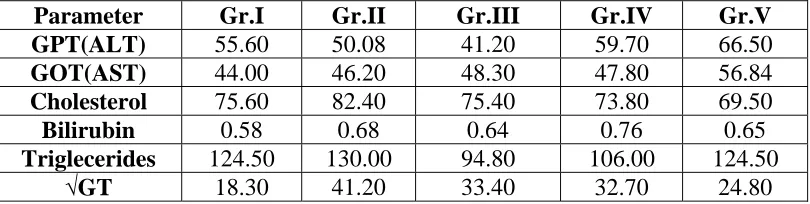
The results obtained from blood biochemical parameters are given in table ES3. In clinical chemistry AST, ALT, values showed significant changes. All the values were higher than those of the control animals. Similar observations were noted in bilirubin and cholesterol.
Dosage
1. A reversible damage was induced in rat liver by administering low concentration of CCl4. The liver damage was induced by an intraperitonially (i.p.) injection of CCl4
(0.7 cm3/kg body wt) liquid Paraffin to each animal of group II to V
2. An i.p injection of 0.5 cm3 of liquid Paraffin was given to each animal from Gr. I as sham treatment.
3. A dose of 0.7g/kg body wt of sieved whole plant powder suspended in 2cc/dist water was administered orally to each rat of Gr. IV
4. A dose of 0.007g/kg-body wt of silymarin (Silybon tablets manufactured by Ranbaxy lab. Ltd. India) suspended in 2CC of distilled water was administered orally to each rat of group V this dose is equivalent to the prescribed human dose of Silybon tablets. 5. The normal control group I, CCl4 cont. Gr. II CCl4 natural recovery group III animals
were administered 2 cc D/W as show treatment except the plant powder.
6. The oral dosing was done using the gavage. The animals were first given CCl4
injection Intraperitonially the oral dose of the drug.
7. The animals from Gr. I, II, IV and V were sacrificed at 72 hrs after CCl4 liver
administration (period of maximum liver damage)(10,13,14) and the animals from Gr. III were sacrificed on seventh day of the study.(10)
General Observations
Animals from all groups showed no abnormal behaviour in food and water consumptions The food consumptions of animals from CCl4 control, CCl4+ Centella asiatica plant treated and
CCl4+ silymarin group decreased significantly. The CCl4 recovery group animals showed
significant decrease up to the fourth day of the treatment, and then they showed an increase. This indicates that the animals are recovering from the toxicity induced by the CCl4 similar
observations were noted with the trends in water consumption by treated animals.
Biochemical parameters
CCl4 treatment caused significant increase in plasma ALT, AST levels. There levels
were not significantly recovering after natural recovery phase. The observations were competent in both the male and female animals. The plant treatment caused significant reduction in ALT and AST levels in both in male and female rats. CCl4 treatment caused
accumulation of cholesterol and the plasma levels of cholesterol were high in treated animals both in CCl4 and CCl4 recovery groups. Centella asiatica plant powder treatment
significantly reduced cholesterol in all rats. Plasma levels of bilirubin significantly increased after treatment, in CCl4 control group and CCl4 recovery groups the levels were marginally
reduced for group IV and V.
Plasma levels of triglycerides increased significantly after CCl4 treatment. These
levels remain high even after natural recovery or CCl4 treatment but Centella asiatica plant
Plant slurry treatment caused significant reduction in cholesterol. The tissue cholesterol levels reduced after natural and Silymarin treatment CCl4 treatment causes
classical fatty liver as indicated by significant increase in tissue cholesterol CCl4 treatment
significantly increased plasma gama GT levels in all treated animals. The levels decreased after plant slurry and silymarin treatment.
Total tissue protein significantly increased after CCl4 treatment. There levels
significantly decreased after natural recovery and silymarin treatment. Plant slurry treatment caused marginal reduction in total tissue proteins in rats (24, 27).
Conclusions
The present work was carried out to investigate the hepatoprotective action of
Centella asiatica plant material on CCl4 (Carbon tetra Chloride) induced liver damage in
rats. Blood biochemical assays like GPT(ALT), GOT(AST), Cholesterol, Bilirubin, Triglecerides and √GT and tissue biochemical assays like Gycogen, T. Protein, Cholesterol, DNA, and RNA have been studied for evaluation of hepatoprotection. From the results of these parameters it is clear that Centella asiatica gave best recovery for hepatoprotection. The observations of “Group I” were matching with “Group IV” than all other groups. The combined synergistic effect of its constituents and micronutrients rather than to any single factor through free radicals scavenging activity play important role in regeneration of liver cells.
References
1. Indira Balachandran and V.V. Sivarajan in : Ayurvedic Drugs and their Plant Sources, 1st Edition, Oxford and IBH Publishing Company Pvt. Ltd., New Delhi, (1994 ).
2. Cruz, A. B., E. Moretto, et. al., Antibacterial activity of Phyllanthus urinaria. Fitoterapia (1994); 65(5): 461-462.
3. Wang M; Cheng H; Li Y; Meng L; Zhao G; Mai K., Herbs of the genus Phyllanthus in the treatment of chronic hepatitis B: observations with three preparations from different geographic sites. J Lab Clin Med, (1995); 126(4):350-2.
4. Higaashino H., Suzuki A., Tanaka Y., Pootakham K., Hypoglycemic effects of Saimese Momordica and Phyllanthus urinaria extracts in streptozotocin-induced diabetic rats (the 1st report). Noppon Yakurigaku Zasshi (Japan) (1992); 100(5): 415-420.
5. Zhou S, Xu C, Zhou N, Huang Y, Huang L, Chen X, Hu Y, Liao Y., Mechanism of protective action of Phyllanthus urinaria L. against injuries of liver cells. [Article in Chinese] Zhongguo Zhong Yao Za Zhi (1997); 22(2):109-11
6. Ji X. H., Qin Y. Z., Wang W.Y., Zhu J.Y., Liu X.T., Effect of extracts from Phyllanthus urinaria L. on HbsAg production in PLC/PRF/5 cell line. Chung Kuo Chung Yao Tsa Chih (CHINA) 1993; 18(8): 496-498, 511.
7. Yao Q. Q. and C. X. Zao, Chemical studies on the constituents of Phyllanthus urinaria L. Acta Pharmaceutica Sinica (Chinese) (1993); 28(11):829-834.
8. Satyan, K. S., Anand Prakash, R. P. Singh and R. S. Srivastsva.,Phthalic acid bis-ester and other phytoconstituents of Phyllanthus urinaria. Planta Medica 1995;61(3):293-294.
10. Meghana C.Shah, Prateek H.Patel, Madura M.Phadke, Sasikumar N.Menon, Ramesh T.Sane, Hepatoprotective Action of Extracts of Phyllanthus debilis in Various Solvents, Bioresearch Journal (1999); 2(1):11-26.
11. Silymarin Clinical Update, Profile on Liver Herb, Scientific Communications International Limited, Hong Kong, (1995).
12. Pandey V.N. and Chaturvedi G.N., Effect of Different Extracts of Kutaki (Picrorhiza kurroa) on Experimentally Induced Abnormalities in the Liver. Ind. Jour. Med. Res. (1969); 57:503-512.
13. Munro H.N. & Fleck A. : in - Methods of Biochemical Analysis. Vol. 14 (Ed. Glick D.) Interscience, New York. (1967) : 113,.
14. Burton K. - Biochem. J. (1956); 62:315.
15. Ceriotti G. - J. Biol. Chem. (1955); 214 : 60.
16. Poole A., Leslie G.B. : in - A Practical Approach to Toxicological Investigations; Canbridge University Press. (1989) : 65 - 66.
17. Ed. A. Wallace Hayes. : in - Principles and Methods of Toxicology. (Second Edition), Raven Press, New York. (1989):599-628.
18. Zimmerman H.J. : in –Hepatotoxicity. Appleton Century Crafts. (1978):167-259.
19. Rouiller, C.H.: in –Experimental Toxic Injury of the Liver. In the Liver Vol. II (C.H. Rouiller, ed.) Academic Press, New York (1964):335-476.
20. Ed. Timbell J.A. : in - Principles of Biochemical Toxicology. Jaylor and Francis Ltd., London. (1982): 130,131, 184-188.
21. Bloom and Fawcett. : in – A Text Book of Histology. Twelfth edition, Chapman and Hall, New York – London (1994):652-688.
22. Schever P.J.; Liver Biopsy Interpretation; Fourth edition, Beillieve Tindell, London (1988).
23. S.S. Pingale, R.D. Pokharkar et. al. Phytochemical Analysis of Root Bark of Argemone Mexicana L., Proceedings of 2nd International Congress of Chemistry And Environment at The Emerald Heights, Indore, India organized by International Journal of Chemistry And Environment Indore, (2005), 134.
24. S.S. Pingale, R.D. Pokharkar, M.S. Pingale and A.M. Kanade, Study of Adsorption on
Activated Charcoal Obtained From Argemone Mexicana L, Proceedings of International Conference On Biosciences, Biotechnology and Biodiversity Analysis organized by Modern College Pune (2005), 65.
25. S.S. Pingale, R.D. Pokharkar and M.S. Pingale, HPTLC Finger Printing for Argemone Mexicana L., Presented at National level Symposium on Recent Trends on Life Sciences with Special Reference to Hydrology and Conservation organised by H.R.Mahavidyalaya Rajgurunagar, Pune in association with Association of Zoologists, (2006) , 4th section,
26. S. S. Pingale and others Pingale et. al., Acute toxicity study for Cissus quadrangularis
whole plant powder, Pharmacologyonline, 2: 256-262 (2008)
27. S. S. Pingale, Pingale et.al., Standardisation of herbal drug as a potent liver tonic,
Pharmacologyonline, 1: 13-19(2008)
28. S. S. Pingale, Pingale et. al., Stability study of a herbal drug, Pharmacologyonline, 1: 20-23 (2008)
29. S. S. Pingale, Pingale et. al., Acute toxicity Study for Argemone mexicana L. Root
Bark Powder, Pharmacologyonline, 1: 24-31 (2008)
30. Pingale Shirish S., Catalytic Study of Activated Charcoal obtained from Argemone