Tevatron Higgs results
Boris Tuchming1,afor the CDF and D0 Collaborations.
1CEA Saclay - Irfu/SPP - France.
Abstract.
We present the combination of searches for the Standard Model Higgs boson, using up to 10 fb−1of p ¯p
colli-sions at √s=1.96 TeV collected with the CDF and D0 detectors at the Fermilab Tevatron collider. The major contributing channels are optimized for the main production modes, the associated production with a vector boson (V H, with V=W,Z), the vector boson fusion, and the gluon-gluon fusion, and the different decay modes
H → b¯b, H → τ+τ−, H → W+W−, and H → γγ. A significant excess of events is observed in the mass range 115<MH <140 GeV. The local significance corresponds to 3.0 standard deviations at mH =125 GeV, consistent with the mass of the new particle observed at the LHC. The observed signal strengths in all channels are consistent with the presence of a standard model Higgs boson of mass 125 GeV. We also present prospects for spin/parity tests to be performed in the V H→Vb¯b channels.
1 Introduction
Finding the standard model (SM) Higgs boson has been of the most topical goals of particle physics in the last decades.
Until 2000, direct searches were conducted at the CERN e+e−collider (LEP) that finally yielded the lower limit of MH > 114.4 GeV [1]. This exclusion limit and those reported hereafter are all defined at the 95% C.L. After the end of searches at LEP, precision electroweak tests, including the W-boson mass mesurement from LEP, and the W-boson mass and top-quark mass measurements from the Tevatron Run I, contributed to constrain further the Higgs boson mass. In Summer 2002, the constraint from the electroweak fit read MH < 193 GeV [2]. This was greatly improved thanks to the top mass and W mass measurements using the first data of Tevatron Run II, so that in Winter 2007, the indirect constraint was MH < 144 GeV [3] which narrowed down substantially the ex-pected mass range for the Higgs boson.
With the beginning of Run II of the Tevatron p ¯p col-lider at √s = 1.96 TeV, a new cycle of searches started in 2002, that ended with the final Tevatron shutdown in September 2011. In 2008, the Tevatron Collaborations, CDF and D0, presented the first post-LEP-era direct con-straint on the Higgs, excluding the mass MH=170 GeV [4]. This constraint was extended over the years [5], and for ex-ample at Summer 2011 conferences the mass range from 156 GeV to 177 GeV was excluded [6].
With the Large Hadron Collider (LHC) a new era started. The 7 and 8 TeV pp collision data from 2011-2012 allowed to explore a wide range of Higgs boson mass, and establish more stringent limits. Upper (lower)
a. e-mail: [email protected]
limits of 131 (122) GeV [7] and 128 (121.5) GeV [8] were obtained by the ATLAS and CMS Collaborations, respectively. But the perspective changed dramatically in 2012 with several announcements. On July 4th 2012, the ATLAS and CMS Collaborations reported excesses above background expectations at the five standard de-viation (s.d.) level, consistent with the observation of a Higgs boson of MH≈125 GeV [7, 8]. In the same week, the CDF and D0 Collaborations reported excesses above background expectations in the H → b¯b search chan-nels [9, 10]. Combining CDF and D0 yields an excess at the three s.d. level, consistent with the production of a Higgs boson of mass MH ≈125 GeV [11]. With the dis-covery of the new particle, a measurement time started.
This proceedings discusses the final combined search results from the Tevatron collaborations, which represents the culmination of more than ten years of data analysis. For most of the channels, the full Run II dataset is used which corresponds to∼10 fb−1of p ¯p collisions per exper-iment after data quality requirements. The results are also interpreted to measure properties of the newly discovered particles: production rate in different modes and measure-ment of couplings to fermions and bosons. Most of these results have been recently submitted and accepted for pub-lication (see Refs. [13–15] and references therein). The D0 internal combined results are discussed elesewhere in this proceedings [12].
2 Higgs boson production and decay
channels
In the SM, the production cross-sections and the branching fractions as a function of the Higgs mass are well known. Over the mass range 90< MH <200 GeV, © Owned by the authors, published by EDP Sciences, 2013
the dominant production process is the gluon-gluon fusion
gg→ H (950 fb at 125 GeV), followed by the associated production with a weak vector boson p ¯p → W H, p ¯p → ZH (130 and 79 fb at 125 GeV) and the weak vector bo-son fusion p ¯p → qq′H (67 fb at 125 GeV). The main decay modes for MH=125 GeV are H →b¯b (58%) and H→W+W−(22%). The most sensitive signatures are:
• one lepton+E/T +two b-jets (W H→ℓνb¯b) • no lepton+E/T +two b-jets (ZH→νν¯b¯b) • two leptons+two b-jets (ZH→ℓ+ℓ−b¯b) • two leptons+E/T (H→W+W−→ℓ+νℓ−ν¯)
Thus, the search for the SM Higgs at Tevatron mainly re-lies on b-tagging efficiency, good dijet mass resolution, high-pT lepton acceptance, good modeling of the E/T, and good modeling of the V+jet background. The Tevatron sensitivity to V H → Vb¯b is complementary to the LHC main discovery channels (H → γγ,H → ZZ), which should help unravel the nature of the new particle.
The main sensitivity is given by the four channels pre-sented above, but many other signatures are also consid-ered to bring additional sensitivity and test the agreement with the SM expectations. For examples, Tevatron exper-iments have also looked for diphoton events (H → γγ), associated production with top-quark pairs (t¯tH), lepton+
E/T+dijet signature (from H→WW), trilepton signatures (e.g. from W H → WWW), same charge dilepton signa-tures (e.g. from W H → WWW), quadrilepton signatures (e.g. from ZH→ℓ+ℓ−WW→ℓ+ℓ−ℓ+ℓ−νν¯), and tau-based signatures (e.g. from W H→ℓντ+τ−or W H→q ¯qτ+τ−).
3 Analysis strategy
Over the course of Run II, both collaborations have followed the same strategy to optimize the analyses and improve their sensitivity faster than expected from just ac-cumulating more and more data.
• Acceptance is maximized by lowering kinematic re-quirements on leptons, by including different lepton re-construction categories, by accepting events from all possible triggers, and by optimizing b-jet tagging with more and more sophisticated multivariate techniques (MVA).
• MVA techniques are widely used in all channels as they provide typically 25% more sensitivity than just using single kinematic discriminant such as the dijet mass for the V H →Vb¯b channels. The improved sensitivity ob-tained thanks to MVA can be assessed by eye in Fig. 1, which compares the most discriminant variables (dijet mass) and the MVA in the D0 E/T +b¯b search chan-nel [16].
Each MVA combines into a single discriminant many variables, which include for example variables describ-ing the event topology, the lepton and jet kinematics, the quality of leptons, and the relation between leptons/jets and E/T. All channels at Tevatron employ at least one MVA, optimized for each different Higgs boson mass hypothesis. For most of the analyses several MVAs
Events / 10 GeV
100 200 300 400 500
600 MJ DT > −0.3
Data (a)
Top V+h.f.+VV V+l.f. Multijet
100 × VH(125)
Dijet Invariant Mass (GeV)
0 50 100 150 200 250 300
analysis sample (medium b-tag) b
b ν ν
→ ZH
-1 D , 9.5 fb
Final Discriminant -1 -0.8 -0.6 -0.4 -0.2 0 0.2 0.4 0.6 0.8 1
Events / 0.125
0 100 200 300 400 500 600 700 800 900
(a)
analysis sample (medium b-tag) b
b ν ν
→ ZH
Data Top V+h.f.+VV V+l.f. Multijet
100 × VH(125)
MJ DT > −0.3 D , 9.5 fb-1
Figure 1. Top, distribution of the dijet invariant mass of
candi-date events in the D0 E/T+b¯b search channel. Bottom, distribu-tions of the final MVA at the same selection stages.
trained specifically against different backgrounds bring additional sensitivity.
The MVA techniques are also employed for object iden-tification (b-jets, leptons, photons) and for energy cor-rection to b-jets. For example the usage of the CDF HOBIT [18] b-tagging algorithm in the final published V H → Vb¯b analyses provides an enhancement of∼ 20% in b-tagging efficiency per jet.
• Another way of achieving better sensitivity to signal, consists in splitting the search channels into subchannels according to jet multiplicity, b-tagging content, lepton flavor or lepton quality. Dedicated MVA are also trained to split analyses into subchannels enhanced or enriched in specific backgrounds. Using subchannels with diff er-ent signal-over-background ratio (s/b) maximizes dis-criminating power, allows sensitivity to different signal production modes, and give more handles and lever-arm to control backgrounds and systematic uncertainties. As an example, Fig. 2 shows the final MVA output for the three b-tagging categories of the CDF E/T +b¯b analy-sis [17].
Fi-)
2
= 125 GeV/c
H
(m
SIG
NN
0 0.1 0.2 0.3 0.4 0.5 0.6 0.7 0.8 0.9 1
1T events / 0.04
0 200 400 600 800 1000 1200
Data QCD Multijet Top V + HF EWK Mistags VV
10)
×
VH (
0.8 0.85 0.9 0.95 1 1
10
2
10
)
2
= 125 GeV/c
H
(m
SIG
NN
0 0.1 0.2 0.3 0.4 0.5 0.6 0.7 0.8 0.9 1
T
L
e
v
e
n
ts
/
0
.0
4
0 20 40 60 80 100 120 140
0.8 0.85 0.9 0.95 1 1
10
)
2
= 125 GeV/c
H
(m
SIG
NN
0 0.1 0.2 0.3 0.4 0.5 0.6 0.7 0.8 0.9 1
TT events / 0.04
0 10 20 30 40 50 60 70
0.8 0.85 0.9 0.95 1 1
10
Figure 2. Final MVA discriminant in CDF E/T+b¯b analysis for the three subchannels defined according to the b-tagging of jets: top, only one jet is tightly tagged (1T); middle, one jet is tightly tagged, and the other loosely tagged (TL); and bottom, both jets are tightly tagged (TT).
nally, the same analysis techniques, namely the same kind of MVA, the same subchannels and the same treat-ment of systematic uncertainties are employed to mea-sure production rates of known standard model candles such p ¯p → W+W− → ℓ+νℓ−ν¯, or VZ → Vb¯b. At D0, the measured cross sectionσ(W+W−)=11.6±0.7 pb−1 is in agreement with the NNLO prediction of 11.3± 0.7 pb−1. The combined CDF+D0 measured cross
sec-tionσ(WW+WZ)=3.0±0.6 stat±0.7 syst pb−1is in
agreement with SM prediction of 4.4±0.3 pb−1.
Fig-ure 3 shows the background subtracted dijet mass distri-bution in highest b-tagging categories used in this later measurement.
) 2 Dijet Mass (GeV/c 50 100
0 150 200 250 300 350 400
)
2
Events / (20 GeV/c
0 200 400 600 800
Data — Bkgd WZ ZZ Higgs Signal
2
=125 GeV/c
H
m
-1 10 fb ≤
int Tevatron Run II, L
1+2 b-Tagged Jets
Figure 3. Background subtracted dijet invariant mass
distribu-tion of the VZ analyses in the high b-tag purity categories.
4 Result of the search
The combination of all search channels for MH = 125 GeV can be visualized in Fig. 4, where the back-ground subtracted distribution of the final discriminant for all channels are sorted as a function of s/b and then added. An excess of events in the highest s/b bins is observed. Figure 5 shows the log-likelihood ratio (LLR) testing the signal-plus-background over the background-only hypoth-esis and computed for different test masses.
-250 -200 -150 -100 -50 0 50 100 150 200 250
-3 -2.5 -2 -1.5 -1 -0.5 0 log10(s/b)
Events/0.25
Data — Bkgd
SM Higgs Signal ± 1 s.d. on Bkgd
Tevatron Run II, Lint≤ 10 fb-1 SM Higgs combination
mH=125 GeV/c2 log
10(s/b)
Events/0.25
-10 -5 0 5 10
-1 -0.75 -0.5 -0.25 0
Figure 4. Background subtracted distribution of events using
the final discriminant of all channels sorted in bins of s/b, for MH =125 GeV.
A significant signal-like excess in the mass range be-tween 115 and 140 GeV is observed. The background p-value of that excess corresponds to 3.0 s.d. for MH = 125 GeV, as shown in Fig. 6. That excess arises from both CDF (2.0 s.d.) and D0 (1.7 s.d) data, as expected from the presence of a standard model Higgs boson of mass 125 GeV.
ex-) 2 (GeV/c H m
100 120 140 160 180 200
Log-Likelihood Ratio
-10 0 10 20 30
1 s.d.
±
b LLR
2 s.d.
±
b LLR
b LLR
s+b
LLR Obs
LLR
2 =125 GeV/c H m LLR
-1 10 fb ≤
int Tevatron Run II, L
SM Higgs Combination
Figure 5. LLR computed as a function of Higgs boson mass
hypothesis.
) 2 (GeV/c H m
100 120 140 160 180 200
Background p-value
-5 10
-4 10
-3 10
-2 10
-1 10
1 10 2 10
3 10
σ
1
σ
2
σ
3
σ
4 -1
10 fb ≤
int Tevatron Run II, L
SM Higgs Combination
Observed Expected w/ Higgs
1 s.d. ± Expected
2 s.d. ± Expected )
2
=125 GeV/c
H
1.0 (m ×
H
σ
)
2
=125 GeV/c
H
1.5 (m ×
H
σ
Figure 6. Background p-value as a function of the Higgs boson
mass hypothesis.
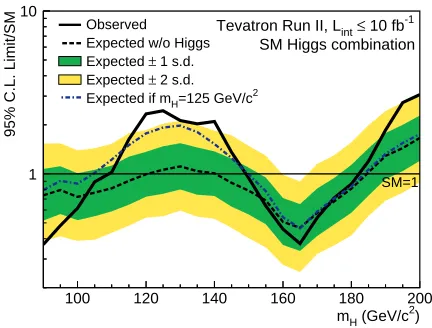
pected excluded regions at 95% C.L. are [90,120] GeV and [140,184] GeV. Because of the excess observed in the low mass region, the actual observed exclusion ranges are smaller: [90,109] GeV and [149,182] GeV. For Mh=125 GeV, the observed (expected) production limits are 2.44×SM (1.06×SM).
1 10
100 120 140 160 180 200
mH (GeV/c 2
)
95% C.L. Limit/SM
Tevatron Run II, Lint≤ 10 fb-1 SM Higgs combination Observed
Expected w/o Higgs Expected ± 1 s.d. Expected ± 2 s.d. Expected if mH=125 GeV/c
2
SM=1
Figure 7. Limits on the SM Higgs boson production as a function
of the mass hypothesis.
5 Searches beyond the standard model
The different SM channels can be used to search for physics beyond the SM.
The Tevatron Collaborations interpret their results in fermiophobic framework in which the Higgs couplings to fermions are heavily suppressed, thus suppressing the gluon-gluon fusion process. In this search the main modes are the H → γγ and H → WW search channels, as both branching ratios are enhanced. The combined ob-served (expected) exclusion resulting from these channels is MH<116 GeV (MH<135 GeV).
Another interpretation is performed within the context of a fourth generation of fermions. In this framework the existence of heavy colored quarks enhances the gluon-gluon fusion by approximately a factor of nine, thus the search is performed in thegg→H→WW channels only. The absence of significant excess of data events allows to exclude the mass range of 121 < MH <225 GeV, while the expected exclusion range is 118<MH<270 GeV, as shown in Fig. 8.
10-1 1 10
100 120 140 160 180 200 220 240 260 280 300 mH (GeV/c2)
95% C.L. Limit/SM4(low mass) Pred.
SM4(low mass)=1
Expected w/o Higgs Observed Expected ± 1 s.d. Expected ± 2 s.d. SM4 (high mass) Tevatron Run II,
int≤ 10 fb
L -1
SM4 Higgs combination
Figure 8. Limits on the Higgs boson production in the context of
a fourth generation of fermions as a function of the Higgs boson mass.
6 Higgs boson studies
6.1 Measurement of production rates
The SM search channels can be separately combined to measure the yield in the different modes: H → b¯b, H →
τ+τ−, H → W+W−, and H → γγ. The best fits to the data are summarized in Table 1 and displayed in Fig. 9. The overall production rate of 1.44+−00..5956×SM is obtained, compatible with the SM Higgs boson of mass 125 GeV. The modes with sizable signal-like excesses relative to the background-only hypothesis are V H → Vb¯b and H → W+W−, as expected from the SM Higgs boson.
6.2 Measurement of couplings to fermions and bosons
are scaled by three numbers,κf,κW, andκZ. For example
the W H → Wb¯b yield is then scaled by κ
2
fκW2 κ2
H
, where the terms in the numerator correspond the scaling of the in-coming and outgoing partial width, while the denominator is a global scaling factors for the total Higgs boson width.
A fit to the data is performed by separating and scal-ing properly the contributions from the different produc-tion and decay modes. Note that in this procedure, only a few modes exhibit some dependence on the relative sign between the coupling scale factors, due to interferences between diagrams. The most important effect arises from the interference between W loops and top-quark loops for the H → γγ partial width: Γ(H → γγ) = Γ(H →
γγ)S M×(1.28κW−0.28κf)2.
The results of the fit are shown in Fig. 10: whenκf is let floating (with flat prior) the best fit region is around (κW, κZ) = (1.25,±0.90); assuming custodial symmetry
CDF [13] D0 [14] CDF+D0 [15]
Rfit(SM) 1.54−+00..7773 1.40−+00..9288 1.44+−00..5956
Rfit(H→W+W−) 0.00+−10..7800 1.90+−11..6352 0.94+−00..8583
Rfit(V H →Vb¯b) 1.72+−00..8792 1.23−+11..2417 1.59+−00..6972
Rfit(H→γγ) 7.81−+44..6142 4.20+−44..6020 5.97+−33..3912
Rfit(H→τ+τ−) 0.00+−80..4400 3.96
+4.11
−3.38 1.68
+2.28 −1.68
Rfit(t¯tH→t¯tb¯b) 9.49−+66..6028 – –
Table 1. Best fit to the data of the Higgs boson production (in
unit of the SM Higgs boson production), assuming
MH=125 GeV, for the different channels and their combination.
Br)/SM × σ Best Fit (
0 1 2 3 4 5 6 7 8 9 10 b
Vb → VH
-τ + τ → H
-W + W → H
γ γ → H
Combined (68% C.L.)
Single channel -1 10 fb ≤
int Tevatron Run II, L
mH=125 GeV/c 2
Figure 9. Best fit to the data of the Higgs boson production in
different channels, assuming MH=125 GeV.
(κW = κZ = κV), the two preferred regions are around (κV, κf)=(1.05,−2.40) and (κV, κf)=(1.05,2.30).
W
κ
0 0.5 1 1.5 2 2.5
Z
κ
-2 -1 0 1 2 3
Local maxima SM
68% C.L. 95% C.L.
floating f
κ
-1 10 fb ≤ int Tevatron Run II, L
V
κ
0 0.5 1 1.5 2
f
κ
-4 -2 0 2 4 6
=1 WZ λ Local maxima SM
68% C.L. 95% C.L. -1 10 fb ≤ int Tevatron Run II, L
Figure 10. Posterior density probability for the coupling scale
factors,κf,κW, andκZ, obtained under different assumptions.
These 2-dimensions results can be turned into one di-mension constraints: assumingκW = κf = 1, the best-fit value isκZ=±1.05−+00..4555; assumingκZ=κf =1, the best-fit 68% confidence intervals are defined byκW = −1.27+−00..4629 and 1.04< κW <1.51; assumingκW =κZ =1, the best-fit value isκf =−2.64−+11..5930; and by letting kf floating with a flat prior, the custodial symmetry is tested and the best fit value for the ratioλWZ = κκWZ readsλWZ =1.24+−20..3442. All
6.3 Spin and parity tests
In general spin/parity of a particle affects angular dis-tributions of its decay products, but also cross-section be-havior near production threshold. This later property can be exploited at Tevatron in the V H→Vb¯b search modes. The spectra of the effective center-of mass energy, √ˆs, of V H → Vb¯b events are expected to be quite different un-der different spin and parity hypothesis (0−, 0+, or 2+) for H [19]. This can be exploited by using as main discrim-inant observable the overall mass (or transverse mass for final state with neutrinos) of the candidate events. The D0 analysis is discussed elsewhere in this proceedings [20]. No measurement has been performed yet, but each Teva-tron Collaboration is expected to release results for the forthcoming conferences.
7 Conclusion
After ten years of excellent performance for the tron collider and the CDF and D0 experiments, both Teva-tron collaborations combine their final results on the SM Higgs boson searches. They almost achieve exclusion sen-sitivity over the full range [90−185] GeV, and exclude at 95% C.L. the range of mass 90 < MH < 109 GeV and 149 < MH <182 GeV. Interpretation of results beyond standard model yields the limits MH < 116 GeV for a fermiophobic Higgs, and 121 < MH < 225 GeV in the context of a fourth generation of fermions.
In the search for the SM Higgs boson, both CDF and D0 observe an excess of signal-like events in the low mass range 115<MH<140 GeV, compatible with the experi-mental resolution. Its combined significance is 3.0 s.d. for MH=125 GeV and it arises mainly from the H→b¯b and H → W+W− channels, as expected from the SM Higgs boson. The measured production rate of 1.44+0.59
−0.56×SM and the measured couplings are compatible with a Higgs boson of 125 GeV. The experiments have also good prospects to probe the spin/parity of the Higgs-like particle of 125 GeV in the V H→Vb¯b modes.
8 Acknowledgments
We thank the Fermilab staff and technical staffs of the participating institutions for their vital contribu-tions. We acknowledge support from the DOE and NSF (USA), ARC (Australia), CNPq, FAPERJ, FAPESP and FUNDUNESP (Brazil), NSERC (Canada), NSC, CAS and CNSF (China), Colciencias (Colombia), MSMT and GACR (Czech Republic), the Academy of Finland, CEA and CNRS/IN2P3 (France), BMBF and DFG (Germany), DAE and DST (India), SFI (Ireland), INFN (Italy), MEXT (Japan), the Korean World Class University Program and NRF (Korea), CONACyT (Mexico), FOM (Netherlands), MON, NRC KI and RFBR (Russia), the Slovak R&D Agency, the Ministerio de Ciencia e Innovación, and Pro-grama Consolider-Ingenio 2010 (Spain), The Swedish Re-search Council (Sweden), SNSF (Switzerland), STFC and
the Royal Society (United Kingdom), the A.P. Sloan Foun-dation (USA), and the EU community Marie Curie Fellow-ship contract 302103.
References
[1] R. Barateet al., Phys. Lett. B 565, 61 (2003).
[2] [Electroweak Working Group and SLD Heavy Flavor Group Collaborations], (2002) hep-ex/0212036. [3] E. Barberis,“Top mass measurement at the Tevatron,”
O. Stelzer-Chilton, “First Run II Measurement of the W Boson Mass with CDF,” in Proceedings of the 42nd Rencontres De Moriond On Electroweak Inter-actions And Unified Theories, edited by J. M. Frere, L. Iconomidou-Fayard, F. Montanet, J. Tran Thanh Van. Hanoi, Gioi Publ., (2007).
[4] The CDF and D0 Collaborations and the Teva-tron New Physics and Higgs Working Group, (2008) arXiv:0808.0534.
[5] T. Aaltonen et al. [CDF and D0 Collaborations], Phys. Rev. Lett. 104, 061802 (2010).
[6] The CDF and D0 Collaborations and the Teva-tron New Physics and Higgs Working Group, arXiv:1107.5518 (2012).
[7] G. Aad et al. [ATLAS Collaboration], Phys. Lett. B 716, 1 (2012).
[8] S. Chatrchyan et al. [CMS Collaboration], Phys. Lett. B 716, 30 (2012).
[9] T. Aaltonen et al. [CDF Collaboration], Phys. Rev. Lett. 109, 111802 (2012).
[10] V. M. Abazov et al. [D0 Collaboration], Phys. Rev. Lett. 109, 121802 (2012).
[11] T. Aaltonen et al. [CDF and D0 Collaborations], Phys. Rev. Lett. 109, 071804 (2012).
[12] E. Chapon, “Combined search for the SM Higgs Bo-son at D0”, this proceedings
[13] T. Aaltonen et al. [CDF Collaboration], arXiv:1301.6668 (2013), accepted by Phys. Rev. D.
[14] V. M. Abazov et al. [D0 Collaboration], arXiv:1303.0823 (2013), accepted by Phys. Rev. D.
[15] T. Aaltonen et al. [CDF and D0 Collaborations], arXiv:1303.6346, accepted by Phys. Rev. D.
[16] V. M. Abazovet al.(D0 Collaboration), Phys. Lett. B 716, 285 (2012).
[17] T. Aaltonen et al. (CDF Collaboration), arXiv:1301.4440 (2013), accepted by Phys. Rev. D.
[18] J. Freeman et al., Nucl. Instrum. Meth. A 697, 64 (2013)
[19] J. Ellis, D. S. Hwang, V. Sanz and T. You, JHEP 1211, 134 (2012)