Reduced Energy Consumption In Wireless Sensor
Network Using Particle Swarm Optimisation And
Bellman-Ford Algorithm
Vikram Rajpoot, Sadhna K. Mishra, Priya
Abstract: Energy efficiency protocols are used in the wireless sensor network (WSN) to maximize device energy conservation and increase the time period. Transmission is complete by node deployment rather than any physical means for WSN communication. The nodes that have been deployed transmit information to the sink or the node of the destination. For better communication, the nodes are collected and clustering is named. Adjacent nodes are located into compatible clusters & transmit information to cluster head (CH) which collections data by different nodes & sends it towards sink further. Different clustering algorithms and techniques for improving WSN have been implemented. In the conventional method, as well as this node restricted to network (n/w) transmission, central node in n/w favored as CH. Before additional nodes lead to dead nodes, this single node consumes more energy. Instead, the straight-line route follows, thus overloading the route which consumes more energy by -n/w's lifetime. We designed an energy-efficient Particle Swarm Optimization (PSO) algorithm based on a grid-based routing algorithm concept that improves total WSN efficiency. The proposed method has good energy efficiency, n/w lifetime as well as better CH selection compared to the genetic algorithm (GA). MATLAB conducts simulation tests of the suggested solution.
Keywords: wireless sensor network, VGDRA, DE, Bellman-Ford
————————————————————
I. INTRODUCTION
WSNs may be definite as self-configured and infrastructure-less wireinfrastructure-less n/w towards observe physical & environmental circumstances, like vibration, temperature, pollutants, motion pressure, or sound as well as to supportively pass their information by NW to key location or sink where information may be observed & analyzed. The base station (BS) performs as an interface among n/w & user. One may save essential data by n/w with injecting queries & collecting results by sink. Usually, WSN includes hundreds, thousands of sensor nodes (SNs) [1]. SNs may communicate between themselves by radio signals. The sensing & processing devices, power components & radio transceivers were equipped with wireless SN. Inherently, individual nodes in WSN [2] are resource constraints; they have restricted power, storage, processing speed & bandwidth of communication. They are often liable to self-organizing proper n/w infrastructure to multi-hop communication by them afterward SNs are deployed. The on-board sensor then starts gathering interesting data Wireless sensor devices often respond to requests delivered by 'control site' for particular instructions or sensing examples. SN's working mode can either be continuous or event-driven. GPS [Global positioning system] & LPAs [local positioning algorithms] could utilized for location as well as positioning data. Wireless sensor devices may be prepared by actuators to' act' under some conditions. Such n/w are sometimes denoted to as n/w of wireless sensors and actuators.[1].
In the wireless environment, WSNs may sense, process, store & send data. Technology innovation has completed WSN self-organized affordable, small size also may communicate short distances, could be organized into big numbers. These have completed WSN consider applications into medical surveillance, systemic control, military surveillance, disaster management, road traffic management, agricultural precision, livestock monitoring, intrusion detection & forest fire detection [3]. The maximum application involves SN auto-localization. SN location relates to location information awareness. Using optimization algorithms, the location of the SN is determined. Traditional algorithms utilize analytical methods, the complexity of which increases by expansion of SNs. Resource constraints, decreased cost requirements to energy constraint of SNs need an algo with minimal computational complexity, needs less memory, less run time, flexible and easy deployment then does not compromise performance, has good location estimation accuracy with better convergence [4].
II.
LITERATURE SURVEY
Khelladi et al.[2019] In this paper, another methodology of sensor–radio wire is proposed. To accomplish this objective, a very narrowband receiving wire of 0.47% fragmentary transmission capacity is structured. At that point, a double band sensor–radio wire is acquainted with amount up to 2 physical parameters all while. Together recreated too estimated outcomes are exhibited, as well as sensible understanding in sensor–radio wire conduct could be watched. In this way, the proposed idea is approved which can be a decent choice to decrease drastically the complexity [2]. Peng Li[2019] Wireless transmission method in wireless sensor networks has put forward higher requirements for private protection technology. According to the packet loss problem of a private protection algorithm based on slice technology, this paper proposes the data private protection algorithm with a redundancy mechanism, which ensures privacy by privacy homomorphism mechanism and guarantees redundancy by carrying hidden data. Moreover, it selects the routing tree generated by CTP (Collection Tree
______________________________
Associate professor Department of CSELNCT BHOPAL [email protected]
Professor & HeadDepartment of CSELNCT BHOPAL [email protected]
Protocol) as a routing path for data transmission. By dividing at the source node, it adds the hidden information and also the privacy homomorphism. At the same time, the information feedback tree is established among the destination node & source node. As a result, it improves the reliability and privacy of data transmission and ensures the data redundancy. [8]. Abderrahim et al.[2019] proposed an energy productive multihop transmission system aimed at Wireless Sensor Networks (WSN) in light of Dijkstra calculation. We deliberate WSN made out of N sensor node. Right off the bat, we bunch the sensor nodes into groups as per their arrangement in the observing region, at that point we compose the nodes inside each bunch by choosing the fitting nodes as bunch head and ordering the rest of the nodes into dynamic nodes and dozing nodes. Our proposed hand-off determination calculation depends on the Dijkstra calculation. The fundamental commitment of the paper is to characterize another transmission methodology that recovers the consequences of our past work by improved limiting force utilization. [9]. Ravi Babu Gudivada [2018] Suggest an energy-efficient, secure communication scheme among SNs’ combinations using symmetric key cryptography to ensure authenticity as well as message integrity. We would use public-key cryptography based on ECC only to uniquely identify every node as well as to set up initial symmetric keys among SNs' combinations. They use a key generation technique in the proposed scheme to minimize the rate of key renewals as well as the Diffie-Hellman key renewal system based on symmetric key to less energy consumption through key renewals. [7]. Qasem Abu Al-Haija[2017] This paper is a continuous demand for WSNs to operate vital & sensitive environmental, health & industrial information that has raised essential to effective security devices. Inherent energy controls in SN, however, present various challenges in the security of WSNs. Several researchers studied how much energy usage required by these SN by using various security systems. We evaluate communication energy usage to homogeneous wireless sensor security by public-key agreement DH-EKE scheme in terms of variable key sizes as well as adjacent nodes. The results of the analysis showed that DH-EKE ranges’ energy utilization by 4.8 μj to 8-bit key size and one adjacent node to 1538 μj (1.6 mj) to 256-bit key size & 10 adjacent nodes. Proposed work would allow designers of low-power cryptographic systems to be showing to variable techniques for larger alterable systems. [5] Ankit Taparia et al. [2017] Diffie-Hellman String’ version Comparison Key Exchange Protocol addressing security susceptibilities found in trivial Diffie-Hellman Protocol has been introduced. This uses a combination of communication as well as encryption strings towards endure man-in-the-middle attacks also may be utilized in together wired and wireless n/w. [6].
III.
RESEARCH METHODOLOGY
A. Problem Statement
Transmission in WSN requires more power than storage. Because the nodes have limited energy capacity, managing and promoting energy across the network is critical. We need a precise route with nodes with sufficient energy to carry out data transmission. For previous research, an absolute optimized route by source to destination is red color for fig. 1. For the selection of CH, the participation of each node by each block is necessary. For that cell, the
participating node from any block acts as CH, performing data transmission and data aggregation tasks to deliver data packets to the destination. Data transmission is performed by way of optimization procedure collected. CH collected data by neighboring nodes of each block & data transmits in additional block to adjacent CH.
Figure 1. Previous research work
The problem with this work was that in the grids 2, 4, 6, 8 the sink was not able to transfer information to CHs of all grids because of the location of the sink it was not able to cover all the grids. This creates the loss of data and break in communication. To overcome these issues we opted for the following methodology.
B. Proposed Methodology
In the WSN, energy usage is a crucial issue, it too affects SN lifetime, as whenever sensors consume lots of energy, nodes are similarly died early until the node's lifetime. We implemented PSO algorithms to solve these problems. In the proposed methodology, we have used PSO and Bellman ford the minimum spanning tree. PSO is used for cluster head selection and the bellman ford algorithm helps to make the shortest tree.
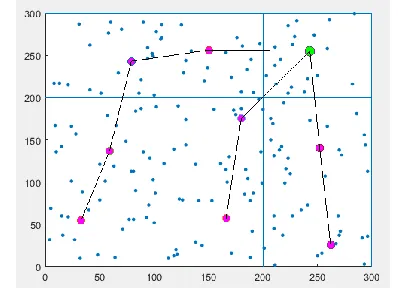
Figure 2 Data transfer using PSO and Bellman-Ford
The benefits of PSO related to GA are that PSO is simple to apply & few parameters need to be modified. In several ways, PSO has been successfully implemented: feature optimization, ANN (artificial neural network) learning, fuzzy system control as well as different areas where GA could be implemented According to G (V, E) graph (directed or undirected) & source vertex, Bellman-Ford algorithm visits G & searches for shortest path from either source to any v vertex. original sequential algorithm's pseudo code is as occurs:
1. For all vertices x ࣅ Yƒ (J) do 2. distances (u) = 1
3. distances (s) = 0
4. to every edges (u, v) • E(G) do 5. RELAX (u, v,w)
Where relax procedure (u, v) by w weight validates if estimated (temporary) distance to v (d[v]) initiate in some prior algo iteration may be improved starting from u. You may summarize relax protocol as occurs:
6. RELAX(u, v, w)
7. whether distances(u) + w < distances(v) then 8. distances(v) = distances(u) + w
Complexity of asymptotic time of that is O(|V||E|), updates distance value of every vertex continuously up to final distances’ convergence.
Fig 3. Flow diagram of Grid-based clustering
IV.
RESULTS
AND
DISCUSSIONS
In this research with the consideration of 2cases, we test outcomes for optimal results. The sensing field was known as an area of 300 * 300 m2 in case one. By definition of grid-based clustering, the area is more divided into 9 blocks. That same no. of nodes in every block. Energy for transmitter (ETX) as well as receiver (ERX) consumption is recommended at 50nJ / bit. The free space and multipath energy consumption ratio are set at 10 pJ / bit / m2 and 0.0013 pJ / bit / m4. The energy is set to5nJ /bit/signal for aggregating data. The data packet’s width is set to 5000 bytes with 3500 rounds. The analysis of simulation will be taken in MATLAB. We discuss case two with 300 * 300 m2 area and total node numbers 180.
Fig 4. Total count of dead nodes using VGDRA
The average no. of rounds is 2000 then equal to 700 iterations, the total number of dead nodes being equal to 0 & instead rapidly increasing. The value of nodes is much above zero around 1800 iterations. This reveals that the first dead node (FDN) continued at 654 rounds and last dead node (LDN) at 1801 round shown into fig 4 in the previous work method.
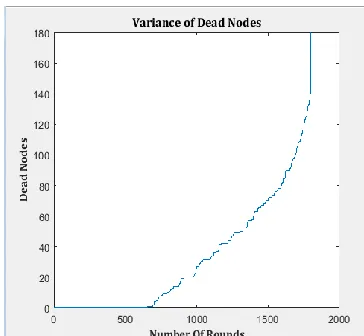
Fig 5 Total count of dead nodes in propose work
Figure 5 shows the first and last node dead time. FDN continued at 707 & LDN in 1941.
Network static declaration (nodes, area, source location, sink location)
Start
CH selection by Optimization algorithm DE
Apply DE operations (mutation, crossover and selection)
Select maximum optimal solution for node to be CH
Start communication as per CH selection
Route selection using Bellman ford tree
Parameter calculation
Fig6 Survival nodes in the network using VGDRA
In the case of previous work, 4 joules energy achieved through n/w & survival nodes’ total count in n/w is defined in figure 6 & 7 correspondingly. (Gradient descent EBST \\\\ ADAM …. Stochastic gradient descent technology)
Fig 7Survival nodes in the n/k using PSO and Bellman-Ford
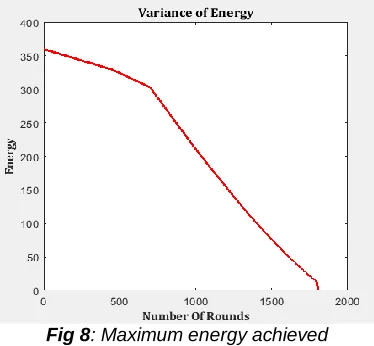
Fig 8: Maximum energy achieved
Figure 8 and 9 represents the energy achieved by n/w & total count of survival nodes in n/w of proposed research.
s
Fig 9 Maximum energy achieved by PSO-Bellmanford
Algorithm Dead nodes round Alive nodes First node
dead
Last nodes
dead
FNA LNA
VGDRA 570 1601 570 160
0
PSO-BF 600 1800 600 179
9
V.
CONCLUSION
Similar to VGDRA, the proposed solution is energy efficient because it is a dynamic method of load balancing. More consistent with the optimization algorithms to find better outcomes in fewer loops that are not probable in other approaches. The network's lifetime depends partly on the node's energy efficiency. The DE with the Bellman-Ford algorithm is introduced to extend the lifetime of n/w with reduced energy usage. We evaluated the proposed technique consisting of a number of nodes and areas and various other parameters. In every case, we accomplished efficient energy by prolong lifetime.
REFERENCES
[1] Misra, P.(1999) Routing protocol for ad hoc mobile,wirelessnetworks.[online].Available,at:http||www.c se.wustl.edu\jain|cis,788,99|ftp|adhoc_routing| index.html [2] Kurose, j.Ross, K.(2012).computer networking: A top
down approach.(6th ed.)Addison-wesley, Boston(MA).
0 500 1000 1500 2000
VGDRA PSO-BF
Energy
[3] Guoqiang Mao, BarÕs Fidan, Brian D.O. Anderson, ―Wireless sensor network localization techniques‖, ScienceDirect, Computer Networks 51 2529–2553,2007. [4] Raghavendra V. Kulkarni, and Ganesh Kumar
Venayagamoorthy, ―Particle Swarm Optimization in Wireless Sensor Networks: A Brief Survey‖, IEEE Transactions on Systems, Man, and Cybernetics, Part C: Applications and Reviews, Volume: 41, Issue: 2, pp 262 - 267, 2011.
[5] R. Khelladi, F. Ghanem, M. Djeddou and M. Nedil, "Dual-band sensor–antenna design for low energy consumption/cost wireless sensor nodes," in IET Microwaves, Antennas & Propagation, vol. 13, no. 1, pp. 48-54, 9 1 2019
[6] Peng Li, Chao Xu, He Xu, Lu Dong, Ruchuan Wang (2019)research on data privacy protection algorithm with homomorphism mechanism based on redundant slice technology in wireless sensor networks,2016 Volume: 16, Issue: 5, May 2019.
[7] M. Abderrahim, H. Hakim, H. Boujemaa And F. Touati, "Energy-Efficient Transmission Technique Based On Dijkstra Algorithm For Decreasing Energy Consumption In WSNs," 2019 19th International Conference On Sciences And Techniques Of Automatic Control And Computer Engineering (Sta), Sousse, Tunisia, 2019, Pp. 599-604.
[8] Ravi Babu Gudivada & R. C. Hansdah (2018). Energy-Efficient Secure Communication in Wireless Sensor Networks 2018 IEEE 32nd International Conference on Advanced Information Networking and Applications. [9] Qasem Abu Al-Haija, Hesham Enshasy, Abdullah Smadi.
(2017). Estimating Energy Consumption of Diffie Hellman Encrypted Key Exchange (DH-EKE) for Wireless Sensor Network. ,2017 ieee international conference on intelligent techniques in control, optimization, and signal processing, 978-1-5090-4778-9/17/$31.00 ©2017 ieee. [10] Ankit Taparia,1 Saroj Kumar Panigrahy2 and Sanjay
Kumar Jena (2017). Secure Key Exchange Using Enhanced Diffie-Hellman Protocol Based on String Comparison,978-1-5090-4442-9/17/$31.00 c 2017 IEEE.